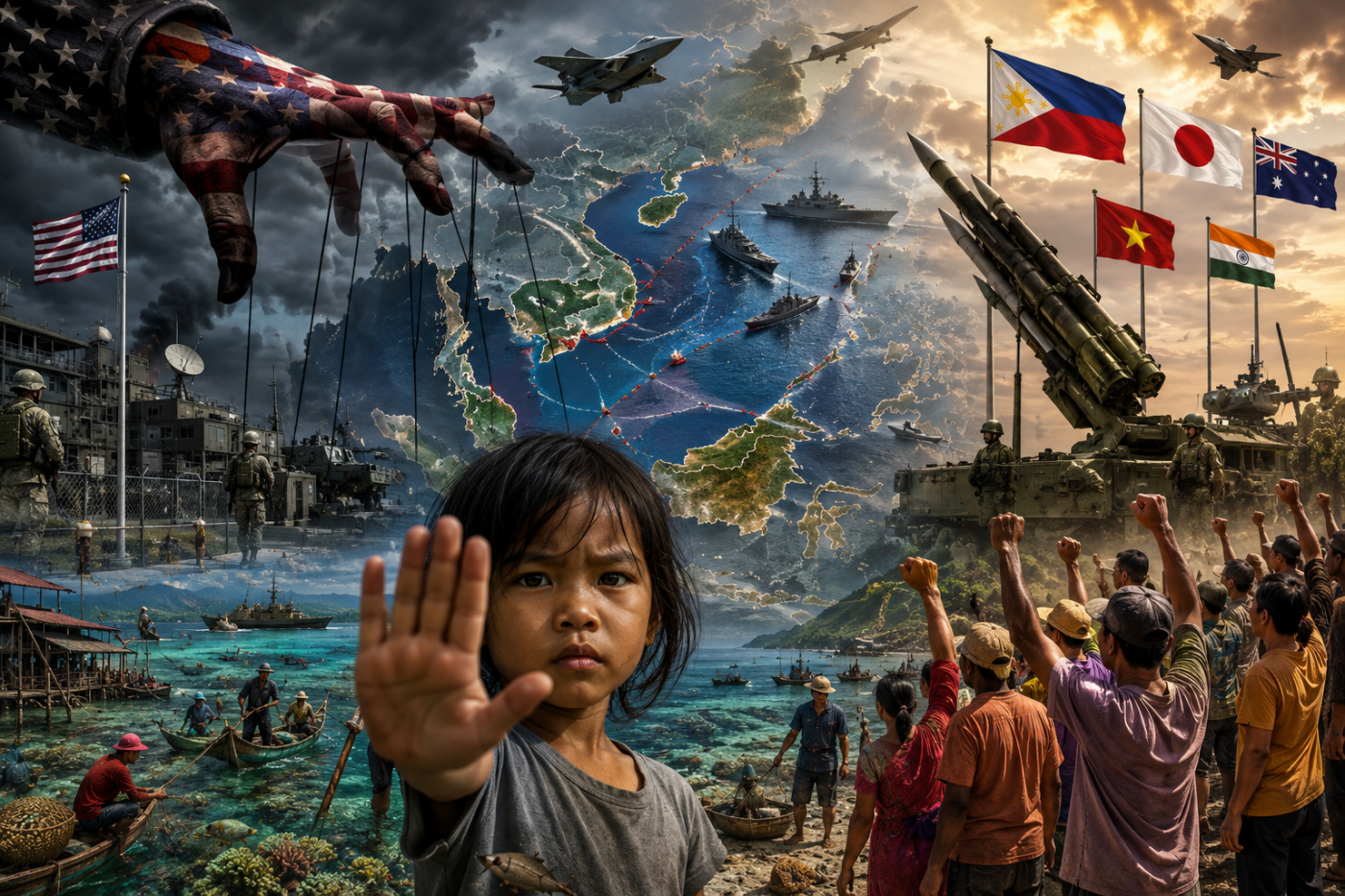
Deutsche Welle dresses militarization in the soft language of autonomy, access, and rules while burying the machinery of containment beneath diplomatic polish. The omitted facts reveal a region tied to China through trade, food security, diplomacy, and history even as U.S.-aligned military infrastructure tightens around it. The real story is not “middle power cooperation,” but imperialist recalibration through regional hands, turning genuine maritime disputes into the architecture of Cold War 2.0. The answer is organized refusal: no bases, no missile corridors, no anti-China war drive, and no surrender of Asian sovereignty to a dying empire’s front line.
By Prince Kapone | Weaponized Information | June 25, 2026
The Velvet Glove Around the War Map
Deutsche Welle’s “Southeast Asia boost defense ties but avoids firm alliances”, written by David Hutt and published on June 24, 2026, arrives with the calm voice of respectable policy journalism. It tells us that the Philippines, Vietnam, India, Japan, Australia, and Indonesia are drawing closer through missile sales, reciprocal access agreements, coast guard exercises, defense consultations, intelligence-sharing talks, and maritime cooperation. The article’s central comfort is that this does not yet amount to a formal anti-China alliance. It is only, we are told, a looser web of “middle power” arrangements designed to make pressure in the South China Sea harder and more expensive. Very reasonable. Very mature. Very clean. And that is precisely why it must be excavated. The most dangerous propaganda does not always kick down the door in boots. Sometimes it enters politely, wipes its feet, and explains that the artillery is merely a neighborhood watch program.
Deutsche Welle is Germany’s international public broadcaster, not a workers’ newspaper passed hand to hand in a port city at dawn. It speaks from inside the media-diplomatic world of a NATO and European Union state, where imperial policy often appears not as domination but as management, not as militarization but as “security cooperation,” not as containment but as “rules.” That does not mean every fact in the article is false. The better propaganda rarely lies that lazily. It works by arranging real facts inside a narrow corridor and telling the reader which direction to walk. David Hutt writes from the world of foreign-policy professionals, where diplomats, think-tank specialists, security analysts, and state officials appear as the natural priests of reality. Missing from the altar are the fisherfolk who will work under the shadow of warships, the port workers whose labor keeps the sea lanes alive, the peasants whose public resources are swallowed by military budgets, and the anti-base organizers who know empire not as a theory but as a fence, a checkpoint, a runway, a soldier, and a boot.
The first trick is doublespeak. The article gives us “strategic autonomy,” “access deals,” “consultations,” “information sharing,” “deterrence,” and “rule of law at sea.” These phrases have the smooth texture of conference-room carpet. They are made for policy memos, embassy receptions, and panels where men in suits explain war in the language of dental hygiene. But beneath the polish sits the harder machinery: missile systems, classified military coordination, reciprocal troop access, coast guard interoperability, logistical planning, and a tightening security architecture around China. “Access” sounds like borrowing a key from a neighbor. In the world of empire, it can mean troops, equipment, storage, runways, communications, and operational planning moving through another country’s territory. “Information sharing” sounds like cooperation between librarians. In military reality, it can mean intelligence channels that prepare the battlefield before the first missile flies. The language does not merely describe the policy. It disinfects it for public consumption.
The second trick is fear. China appears as the pressure behind everything, the dark shape on the horizon that makes every new military arrangement look like common sense. This is how consent is manufactured. First, install the threat. Then, hurry the reader past the questions that matter: defensive for whom, against what, under whose command, paid for by whose labor, and in whose class interest? Once China is cast as the permanent menace, missile purchases become prudence, base access becomes caution, intelligence-sharing becomes stability, and military blocs that dare not call themselves blocs become acts of regional self-respect. Empire has always loved this little magic show. Put a monster on the horizon and suddenly every cannon facing east is called a village fence.
The third trick is assertion. The article tells us that these states share concerns about China and want a region free from coercion, but it does not ask how those concerns differ across governments, military establishments, business sectors, working classes, peasantries, fishing communities, migrant workers, or popular movements. A state is treated as if it has one throat and one mind. Government policy is dressed up as national will. But the people of Southeast Asia are not a policy abstraction. They are workers in export zones, fishers in contested waters, farmers guarding harvests against debt and climate, port workers moving the goods that keep the region alive, soldiers recruited from poor families, mothers counting prices in the market, and youth asked to inherit a future planned by generals. To say “the Philippines wants,” “Vietnam wants,” or “Indonesia wants” without asking which forces inside those societies benefit from militarized alignment is to smuggle ruling-class policy into the room wearing the mask of the people.
The fourth trick is policy laundering. This is where the article is most elegant and therefore most dangerous. It takes the machinery of war and washes it in the tub of bureaucracy. Defense cooperation becomes “dialogue.” Military access becomes “reciprocal arrangements.” Intelligence coordination becomes “classified information sharing.” Missile sales become “coastal defense.” Logistics become “resilience.” The gun is not a gun anymore; it is a framework. The base is not a base; it is a site for cooperation. The war plan is not a war plan; it is interoperability. One must admire the modesty of modern militarism. It can build the road to war and still insist it is only paving a sidewalk.
The people are not asked whether they want their waters, ports, coastlines, taxes, sons, daughters, and futures turned into pieces on a grand chessboard. They are told that officials have upgraded partnerships, launched consultations, signed frameworks, and strengthened regional stability. This is the old colonial habit in modern clothes. The colonizer once arrived with a treaty in one hand and a rifle in the other. Today the rifle is still there, but the treaty has been renamed a security dialogue, the occupation has been softened into access, and the pressure system is advertised as autonomy. The words change because the old ones have too much blood on them.
The fifth trick is controlling the message. The article establishes the frame early: this is not a NATO-style alliance, but a decentralized and flexible network of middle powers. That distinction is not meaningless, but it is also not innocent. By telling us what the arrangement is not, the article narrows the space for asking what it is becoming. It does not need to be NATO to perform a NATO-like function. It does not need one command structure to increase interoperability. It does not need one treaty to militarize China’s maritime environment. It does not need a single flag to create a pressure system. The denial becomes part of the argument. Since it is “not NATO,” we are supposed to relax while the access agreements multiply, the missiles arrive, the intelligence channels open, and the drills become normal.
The sixth trick is divide and conquer. The article separates Southeast Asia from China by presenting the region as a collection of “middle powers” learning to stand up against coercion. But Southeast Asia is not some loose plank floating outside China’s economic and diplomatic world. The region is tied to China through trade, supply chains, infrastructure, production, food, transport, and diplomacy. This does not erase real maritime disputes. It does not pretend that every contradiction is invented in Washington. But it does mean those contradictions can be amplified, disciplined, and weaponized by outside powers that have every interest in turning regional tensions into a containment belt. The trick is simple enough to fit in an old imperial handbook: take complicated neighbors with overlapping interests and unresolved disputes, then train them to see each other through the sights of somebody else’s rifle.
This is why the DW article matters. It does not scream for war. It performs the quieter work of making militarization appear natural, responsible, and inevitable. It teaches the reader to see missile sales as balance, military access as sovereignty, and imperial recalibration as regional initiative. Its genius is not invention but arrangement. It places China at one end of the corridor as threat and places a respectable network of states at the other end as reasonable defenders of order. Missing from that corridor are the old empires, the bases, the arms industries, the class interests, the workers, the peasants, the fishers, and the long history of Asia being turned into a theater for other people’s power. Our task is not to deny the facts the article reports. Our task is to pull away the velvet curtain and show the machinery humming behind it.
The Facts Left Outside the Frame
The military architecture described by Deutsche Welle is real. The Philippines and Vietnam upgraded their relationship to an enhanced strategic partnership on June 1, 2026, and signed a defense cooperation memorandum between Vietnam’s Ministry of National Defence and the Philippine Department of National Defense. Manila and Hanoi had already been moving through the maritime lane: their coast guards strengthened cooperation through joint drills covering search and rescue, firefighting, emergency response, and communications procedures. These are not decorative gestures. They create institutional muscle memory between armed maritime forces. They build the habit of joint action before crisis arrives.
The weapons track is equally concrete. India has signed a deal to supply Vietnam with BrahMos supersonic cruise missiles, after the Philippines moved first with its own BrahMos contract in 2022. Two Southeast Asian states with South China Sea concerns now sit inside the same missile-export pathway. Japan’s security role has also moved from diplomatic politeness into operational law. The Japan-Philippines Reciprocal Access Agreement entered into force on September 11, 2025, creating the legal framework for reciprocal military access and cooperation between Japan’s Self-Defense Forces and the Armed Forces of the Philippines. Australia and Indonesia added another layer through the Australia-Indonesia Treaty on Common Security, signed in February 2026, centered on consultation, defense cooperation, national resilience, and self-reliance. The region is not forming NATO by proclamation. It is assembling habits, channels, weapons, access, logistics, and legal instruments by accumulation.
But the first major fact left outside the frame is diplomacy. On May 21, 2026, ASEAN and China met in Kuala Lumpur to review implementation of the Declaration on the Conduct of Parties in the South China Sea and advance negotiations toward a Code of Conduct. The South China Sea is not only being processed through missiles, ships, drills, and access agreements. It is also being processed through ASEAN mechanisms, China-ASEAN dialogue, and formal commitments to manage disputes without open war. That diplomatic lane matters because it breaks the illusion that militarization is the only available language of regional order.
The Philippines-Vietnam relationship itself is broader than the military frame. Their June 2026 joint statement named the Joint Commission on Bilateral Cooperation, the Joint Trade Committee, defense and security dialogues, maritime and ocean affairs consultations, and other state mechanisms. This is not a single-purpose anti-China instrument. It is a multi-channel relationship spanning trade, diplomacy, maritime management, security dialogue, and regional coordination. The defense layer is important, but the wider state relationship shows a more complicated picture than the neat map of threat and response.
The U.S. basing architecture is the great shadow behind the Philippine security turn. In 2023, Washington and Manila added four EDCA sites, while the United States had already allocated more than $82 million for infrastructure investments at existing EDCA sites. EDCA is not just a diplomatic acronym. It is concrete: sites, roads, runways, storage, logistics, troop movement, rotational presence, and operational reach. Any account of Manila’s military posture that leaves EDCA in the background is describing the smoke while hiding the fire.
Japan’s role also deserves sharper attention. In May 2026, Tokyo and Manila welcomed the RAA’s entry into force, the signing of an Acquisition and Cross-Servicing Agreement, and the start of talks on a General Security of Military Information Agreement. Access, logistics, and classified information are not symbolic ornaments. They are the ribs of military interoperability. The RAA allows movement. The ACSA supports supply and servicing. A classified information agreement secures the channels through which sensitive military planning can travel. Taken together, these arrangements turn warm diplomatic language into a colder operational chain.
The economic body beneath this military skin is enormous. ASEAN-China merchandise trade reached $772.4 billion in 2024, accounting for 20.1 percent of ASEAN’s total merchandise trade, with China standing as ASEAN’s largest trading partner since 2009. This is not a footnote. It is the material life of ports, factories, shipping lanes, electronics, machinery, consumer goods, agricultural inputs, industrial parts, and workers’ livelihoods. The region can be pulled into a security web against China, but it cannot simply be cut out of its economic relationship with China without tearing into its own productive tissue.
The Vietnam-Philippines relationship also runs through the stomach. Manila and Hanoi signed a rice arrangement under which Vietnam’s private sector would supply white rice to Philippine buyers for five years. This is food security, not abstract diplomacy. The Philippines needs reliable rice access; Vietnam has export capacity. The same two states that cooperate at sea also cooperate over the grain that feeds households. That material relationship complicates any flat picture of the region as merely a theater of military anxiety.
Vietnam’s security posture carries the memory and material burden of U.S. war. Vietnamese officials continue to raise war legacy issues including unexploded ordnance and chemical weapons. These are not metaphors. They are buried explosives, poisoned land, damaged bodies, disrupted villages, and public resources diverted into cleanup and recovery. Vietnam does not think about security as an innocent spectator in a policy seminar. It thinks as a country that survived invasion, devastation, reconstruction, and decades of pressure. That history sits beneath every cautious step Hanoi takes.
The Philippines carries its own long wound of unequal military dependence. Philippine legal records describe the old U.S. bases arrangement as an “unacceptable asymmetry,” because the Philippines ratified the bases agreement while the United States refused to submit it to the U.S. Senate. That sentence contains a whole colonial education. One side was bound; the other side kept its hands free. One side hosted the bases; the other side commanded the reach. The current politics of access and cooperation are not born from nowhere. They stand on a long road of unequal alliance, foreign military privilege, and sovereignty managed through legal language.
The broader South China Sea context still includes a formal diplomatic framework. ASEAN’s 2002 Declaration commits the parties to exercise self-restraint, resolve disputes by peaceful means, and work toward a Code of Conduct. That framework does not abolish conflict. It does not erase the disputes between states. But it gives the region another route besides military escalation. When the defense story is told without this diplomatic structure, the reader is left with the false impression that only arms, access, and deterrence can organize the sea.
The Japan-Philippines RAA fits into this larger operational buildup. Tokyo states that the agreement facilitates cooperative activities between Japan’s Self-Defense Forces and the Armed Forces of the Philippines. That polite phrase means movement, exercises, access, coordination, and normalized joint activity. Military relationships become real through repetition. They become normal through paperwork. They become available for crisis through years of quiet preparation.
The Australia-Indonesia Jakarta Treaty also extends an older security relationship rather than inventing a new one from thin air. Australian and Indonesian leaders described it as building on three decades of defense cooperation between the two countries. Its form is consultation, not automatic war. But consultation can still discipline expectations, regularize coordination, and prepare states to move together under pressure. The absence of a mutual-defense clause does not mean the absence of strategic consequence.
India’s BrahMos sale to Vietnam belongs to a longer defense relationship as well. Indian officials have described Vietnam as one of India’s most important defense partners. The missile deal gives that relationship harder edges. For Vietnam, BrahMos strengthens coastal defense capacity. For India, it projects defense industry, strategic signaling, and its eastward policy into the South China Sea environment. This is not simply commerce. It is arms trade as geopolitical language.
The Philippines’ EDCA sites clarify the operational map. The U.S. Department of Defense describes the additional sites as supporting combined training, exercises, and interoperability between U.S. and Philippine forces. Interoperability is one of those mild words that hides a severe reality. It means forces are trained, equipped, and organized to operate together. It means command habits, logistics habits, and battlefield assumptions are developed before the battle. It means Philippine territory becomes legible to U.S. military planning.
The region’s economic map continues to contradict the emerging war map. ASEAN-China integration includes ACFTA 3.0, RCEP participation, annual expos, transport cooperation, supply-chain connectivity, and other mechanisms of regional economic integration. The same region being pulled into a thicker security web around China is tied to China through production, infrastructure, trade routes, investment platforms, and regional institutions. The military planners may prefer clean lines on a map. Real economies make messier lines.
Vietnam’s present balancing rests on ground still marked by a previous imperial war. Current U.S.-Vietnam cooperation includes dioxin cleanup, unexploded ordnance removal, and missing-person recovery. That means the same power now courting Vietnam for strategic purposes is still working through the damage left by its earlier assault on Vietnamese life. This is the kind of historical fact polite security writing prefers to step around, because it interrupts the fantasy that today’s military partnerships begin in a clean moral present.
The Philippines’ base-access politics also stands on old U.S. military ground. Clark’s post-base transformation followed the Philippine Senate’s rejection of extended U.S. bases in 1991, and the former U.S. Clark Air Base was converted into a special economic zone and aviation complex after the U.S. military withdrawal. The land remembers. The legal forms change, the acronyms change, the ceremonies change, but the strategic question returns: who gets to use Philippine territory, for whose purposes, and at what cost to sovereignty?
Put together, the omitted facts reveal the terrain beneath the headline. There is indeed a growing web of defense arrangements across Southeast Asia and its surrounding powers. But that web is developing alongside ASEAN-China diplomacy, massive ASEAN-China trade, Vietnam-Philippines food-security cooperation, U.S. base access, Japanese military logistics, Indian arms exports, Australian-Indonesian security consultation, and long histories of war, occupation, foreign bases, and unequal alliance. Once these facts are restored, the story no longer looks like a simple rise of prudent middle-power coordination. It looks like a region trying to manage real maritime disputes while imperial pressure, economic interdependence, historical memory, and new military infrastructure all collide in the same sea.
The Sea They Want to Turn into a Front Line
The story Deutsche Welle buries is not that Southeast Asia is calmly and independently discovering a new security maturity. The story is that the South China Sea is being reorganized under the pressure of a decaying imperial order that cannot tolerate China’s rise, cannot command the world as easily as it once did, and therefore must distribute the work of containment across a wider cast of states. The old empire does not always arrive today with a single flag and a single colonial governor. It arrives as a network: access agreements, missile sales, logistics channels, classified information talks, coast guard drills, consultation treaties, and polite communiques about “rules.” It no longer needs to announce a new NATO in Asia if it can assemble the practical machinery of one piece by piece.
This is the real meaning of the defense web now forming around China. It is not a formal alliance in the old sense, and that is precisely the trick. The absence of a single treaty becomes the alibi for the presence of a larger architecture. Each arrangement appears limited when viewed alone. A missile sale here. A reciprocal3 access agreement there. A coast guard drill in one place. A logistics pact in another. A consultation treaty next door. A classified information channel waiting in the wings. But imperial strategy rarely asks the people to look at the whole map. It hands them one tile at a time and insists there is no mosaic.
The Philippines sits at the sharpest edge of this map. Its territory is being made more available to U.S. military planning through EDCA sites, infrastructure investments, joint training, and interoperability. The language is always respectful. It speaks of partnership, modernization, resilience, and defense. But the material question remains rude enough to interrupt the banquet: who benefits when Philippine soil becomes a staging ground for another power’s confrontation with China? The Philippine people know this question because they have lived it before. They know the long shadow of foreign bases. They know what it means for sovereignty to be praised in speeches and leased out in practice. The new acronyms do not erase the old relationship; they update it.
Vietnam moves differently, because Vietnam’s history is different. It is not a soft colony waiting to be instructed. It is a nation forged through anti-colonial war, socialist revolution, U.S. invasion, reconstruction, and the long discipline of survival. Its leadership seeks room to maneuver, not simple obedience to Washington. It guards its coast, diversifies its relations, and refuses to be trapped in open dependence. But this is exactly why imperialism approaches carefully. It does not need Vietnam to become a puppet overnight. It only needs each legitimate sovereignty concern, each coastal defense need, and each maritime dispute to be pulled gradually into the gravitational field of the anti-China front. Even a proud state can be pressured by the structure around it.
The same contradiction runs across the region. Indonesia does not rush to the front of confrontation, yet consultation treaties create habits of coordination. Japan returns to Southeast Asian military space under the language of cooperation, even though the memory of Japanese imperial violence has not disappeared from Asia’s soil. India presents its missile exports as sovereign policy, yet those exports harden the military environment around China and extend New Delhi’s own rivalry into Southeast Asian waters. Australia speaks the soft language of common security while helping thicken the regional web of coordination. None of this requires a single unified command. It requires only convergence: different states, different motives, different histories, moving through arrangements that point in the same strategic direction.
That direction is containment. Not always containment by proclamation, but containment by infrastructure. Not always containment by ideology, but containment by access, logistics, weapons, information, and routine. This is imperialist recalibration under conditions of decline. The United States cannot simply order Asia into line the way it once tried to. Its wars have exhausted legitimacy. Its economy no longer towers above the world as before. Its allies are nervous, its partners hedge, and its rivals multiply. So the imperial system adapts. It decentralizes the burden. It asks regional states to host more, spend more, patrol more, train more, buy more, and risk more. The empire’s genius in decline is to make others carry the sandbags for its collapsing wall.
But the buried contradiction is that the region’s military direction cuts against its economic life. Southeast Asia is not outside China looking in. It is tied to China through trade, production, infrastructure, transport, supply chains, industrial inputs, consumer markets, food flows, and regional institutions. Ports do not obey think-tank fantasies. Factories do not shut off geography because a security analyst in a NATO capital prefers a cleaner map. Rice, electronics, machinery, shipping, investment, and labor all tell a more stubborn story than the language of deterrence. The same sea that war planners want to militarize is also a working sea, a trading sea, a fishing sea, a sea of routes and livelihoods. To turn it into a front line is to place the daily life of millions under the shadow of escalation.
This is why the phrase “strategic autonomy” must be interrogated. Autonomy cannot mean deeper military availability to imperial planning. Sovereignty cannot mean opening more doors to foreign troop movement while calling it partnership. Security cannot mean training the people to accept missiles as common sense and bases as maturity. Real sovereignty is measured by whether the people control their land, sea, labor, food systems, ports, and development path. If the generals gain hardware while the masses gain risk, that is not autonomy. That is dependence wearing national colors.
The propaganda article hides the class question because the class question ruins the charm. The ruling layers can profit from militarization. Military officials gain equipment and prestige. Contractors gain contracts. Politicians gain patriotic theater. Think tanks gain conferences. Foreign ministries gain importance. But workers, peasants, fishers, migrants, and the urban poor inherit the danger. They pay through public budgets shifted toward arms. They pay when coastlines become staging grounds. They pay when shipping lanes become crisis zones. They pay when food security is disturbed by military escalation. They are told the sea must be defended, but they are rarely asked who is turning the sea into a battlefield.
The maritime disputes are real. No serious revolutionary analysis needs to pretend otherwise. States have claims. Coast guards clash. Fishing grounds matter. Energy routes matter. Law matters. But real disputes can be captured by larger systems of power. A spark can be real and still be carried into a powder room by an arsonist. The task is not to deny regional contradictions, nor to flatten every Southeast Asian state into a puppet. The task is to see how imperialism organizes those contradictions into a front against China, then calls the result balance.
China, too, must be understood materially rather than mythologically. In the imperial narrative, China appears only as threat, coercion, expansion, menace. Missing is the fact that China is also the region’s largest economic partner, a central force in the emerging multipolar order, and the main target of the New Cold War. The propaganda frame requires China to be separated from Asia, as if China were an outside intruder rather than a civilizational, economic, and productive reality woven into the region itself. This does not settle every maritime claim in China’s favor. It does something more basic: it restores the actual contradiction. The imperial problem with China is not simply a reef, a shoal, or a patrol boat. The problem is that China’s rise threatens the old hierarchy of the world system.
That is why this loose security web matters. It is not only about the South China Sea. It is about the world order being born through struggle. The United States and its partners are trying to preserve a unipolar privilege that no longer fits reality. China, ASEAN, India, Japan, Australia, and the Philippines are all moving inside a world where the old center is weaker, the productive map has shifted, and the Global South has more room to maneuver than before. But room to maneuver is not liberation by itself. It can become the space for independent development, or it can become the space where empire reorganizes domination through local elites, regional anxieties, and militarized partnerships.
This is the story DW cannot tell because the story would expose the machinery behind its own language. The issue is not simply whether a formal anti-China bloc exists. The issue is whether the practical conditions for such a bloc are being assembled without the name. The issue is not whether every regional government has identical motives. The issue is whether their separate moves are being organized into a common strategic pattern. The issue is not whether China has contradictions with its neighbors. The issue is whether those contradictions are being transformed into a forward containment architecture that places the people of the region in the path of imperial confrontation.
The real story, then, is a region caught between two futures. One future is negotiated sovereignty, economic development, regional diplomacy, and the management of disputes without foreign military supervision. The other future is militarized alignment, base access, missile corridors, intelligence channels, and a sea turned into the tripwire of Cold War 2.0. The first future belongs to the workers, peasants, fishers, and peoples who need peace in order to live. The second belongs to empire, arms dealers, comprador elites, and the security class that always discovers freedom at the end of a gun barrel.
The South China Sea does not have to become the graveyard of Asia’s development. But it will move in that direction if the people are trained to mistake military architecture for sovereignty. The task of revolutionary analysis is to strip away the velvet words and name the structure plainly. This is not merely “defense cooperation.” It is the slow construction of a pressure system around China. It is not merely “middle power coordination.” It is imperialist recalibration through regional hands. It is not merely “strategic autonomy.” It is a struggle over whether sovereignty will belong to the people or be managed by generals, contractors, and foreign strategists. Once the propaganda is removed, the buried story stands in the open: Asia is being asked to host the next front of imperial decline, and the peoples of Asia have every reason to refuse.
Refuse the Front Line They Are Building
The task now is not simply to understand the machinery. The task is to organize against it. If the South China Sea is being transformed into a pressure system around China through bases, access agreements, missile corridors, coast guard drills, intelligence channels, and polite diplomatic language, then the people must answer with their own machinery: political education, anti-base campaigns, labor pressure, community organizing, and internationalist solidarity. The first duty is clarity. We must refuse the lie that U.S. militarization in Asia is a gift to the peoples of Asia. Empire never crosses an ocean because it has suddenly discovered tenderness. It crosses oceans because there are routes to control, markets to discipline, rivals to contain, weapons to sell, and local elites willing to exchange sovereignty for protection.
For those in the United States, especially in Filipino, Asian, Black, Indigenous, and antiwar communities, one immediate place to build is BAYAN USA’s “US Out of the Philippines” campaign, which directly targets EDCA, U.S. military bases, Balikatan exercises, and Washington’s use of the Philippines as a launchpad for regional confrontation. This is not abstract solidarity. The Philippines is one of the sharpest edges of the current war map. When U.S. planners expand access to Philippine sites, when infrastructure is built for rotational presence, when interoperability is normalized, the Filipino people are being asked to host the risks of empire’s next confrontation. BAYAN USA gives people in the belly of the beast a concrete campaign through which to say: not in our name, not on our land, not with our people turned into sandbags for the Pentagon.
This struggle must also be tied to the broader anti-imperialist fight against the U.S. military footprint across the planet. The Black Alliance for Peace has consistently organized against war, militarism, AFRICOM, NATO, sanctions, and the global architecture of U.S. domination, while its fiscal sponsorship through Community Movement Builders roots its work in an independent Black-led organizing infrastructure rather than imperial-state policy networks. BAP is essential here because the South China Sea cannot be treated as an “Asian issue” sealed off from the rest of the empire. The same power that surrounds China with bases and access agreements also arms police, funds occupation, trains client armies, sanctions sovereign countries, and turns Black and poor communities inside the United States into internal colonies. The war abroad and the war at home are not twins by coincidence; they are children of the same system.
Veterans, military families, and workers inside communities saturated with patriotic propaganda have a special role to play. Veterans For Peace’s China Working Group provides a direct antiwar vehicle against the “China threat” narrative, and the organization makes its financial reports publicly available. This matters because former soldiers can puncture the fantasy that militarization is a clean exercise in national honor. They know what bases mean. They know what “interoperability” becomes when politicians are done smiling. They know how working-class youth are recruited, disciplined, shipped, and used. Their task is to speak where the empire expects silence: in union halls, campuses, churches, veterans’ spaces, community meetings, and anywhere the next war is being sold as a defensive necessity.
The antiwar message must also reach those who are being trained to see China as the permanent enemy. CODEPINK’s “China Is Not Our Enemy” campaign offers public education, webinars, petitions, and organizing tools against the New Cold War narrative, while CODEPINK operates through a public nonprofit structure with available Form 990 filings. The point is not to romanticize every Chinese policy or erase regional disputes. The point is to break the war story before it hardens into common sense. Once a population has been trained to believe that China is an existential monster, every missile becomes prudent, every base becomes defensive, every provocation becomes deterrence, and every demand for peace becomes suspect. That spell must be broken again and again.
Mass protest infrastructure also matters. The ANSWER Coalition has organized against racism and war with China, and donations to ANSWER are processed through the Progress Unity Fund, a 501(c)(3) fiscal sponsor. Where BAYAN USA gives the struggle a sharp Philippine sovereignty anchor, BAP gives it an anti-imperialist Black radical anchor, Veterans For Peace gives it antiwar veteran credibility, and CODEPINK gives it broad public education tools, ANSWER can help put bodies in the street. No single formation is sufficient. The movement must be a united front against militarized imperialism, built from the organizations already in motion and sharpened by a clear political line.
The tactical program should be concrete. Organize teach-ins on EDCA, the Japan-Philippines Reciprocal Access Agreement, the BrahMos missile exports, the ASEAN-China diplomatic track, and the economic interdependence that the war planners prefer to bury. Push unions, student groups, churches, cultural organizations, neighborhood associations, and community media to adopt resolutions against U.S. base expansion and anti-China militarization. Pressure city councils, state legislators, members of Congress, and labor councils to oppose military appropriations, weapons transfers, and base-access agreements that turn the region into a battlefield-in-waiting. Challenge local universities when they host Pentagon-funded China-threat programming. Confront the think-tank language wherever it appears. Translate “interoperability” into war preparation, “access” into military positioning, and “deterrence” into escalation dressed as caution.
The organizing must also be internationalist without being careless. We defend the right of the peoples of the Philippines, Vietnam, Indonesia, China, Japan, Australia, and the wider region to settle maritime disputes without U.S. imperial supervision. We do not ask workers and peasants to subordinate their sovereignty concerns to another state’s flag. We ask them to see that the empire is trying to turn real contradictions into a war architecture. A revolutionary peace line must therefore be both anti-imperialist and popular: no U.S. bases, no anti-China war drive, no Japanese remilitarization under U.S. command, no missile corridors, no sacrifice of regional workers and fisherfolk to the ambitions of generals and contractors, and no surrender of genuine disputes to the Pentagon’s mapmakers.
Every article like the one in Deutsche Welle should become an organizing opportunity. Clip it. Study it. Break down its language. Show people how the war story is manufactured before the war is declared. Build reading groups in union halls, barbershops, campuses, churches, community centers, and online spaces. Circulate campaign materials from the organizations already doing the work. Invite speakers from Filipino sovereignty formations, Black antiwar groups, veterans’ organizations, and anti-New Cold War campaigns. Make the invisible architecture visible. The empire counts on the people seeing only separate facts. Our job is to show the system.
The South China Sea does not belong to NATO capitals, arms dealers, Pentagon planners, or think-tank cartographers. It belongs first to the peoples who live by it, sail through it, work across it, eat from it, and depend on peace for their children’s future. The answer to imperialist recalibration is organized refusal. Refuse the bases. Refuse the missiles. Refuse the propaganda. Refuse the transformation of Asia into the next front line of a dying empire. Build the committees, join the campaigns, educate the people, pressure the institutions, and make the cost of collaboration higher than the reward. The war map is being drawn now. So must the people’s map of resistance.


Leave a comment