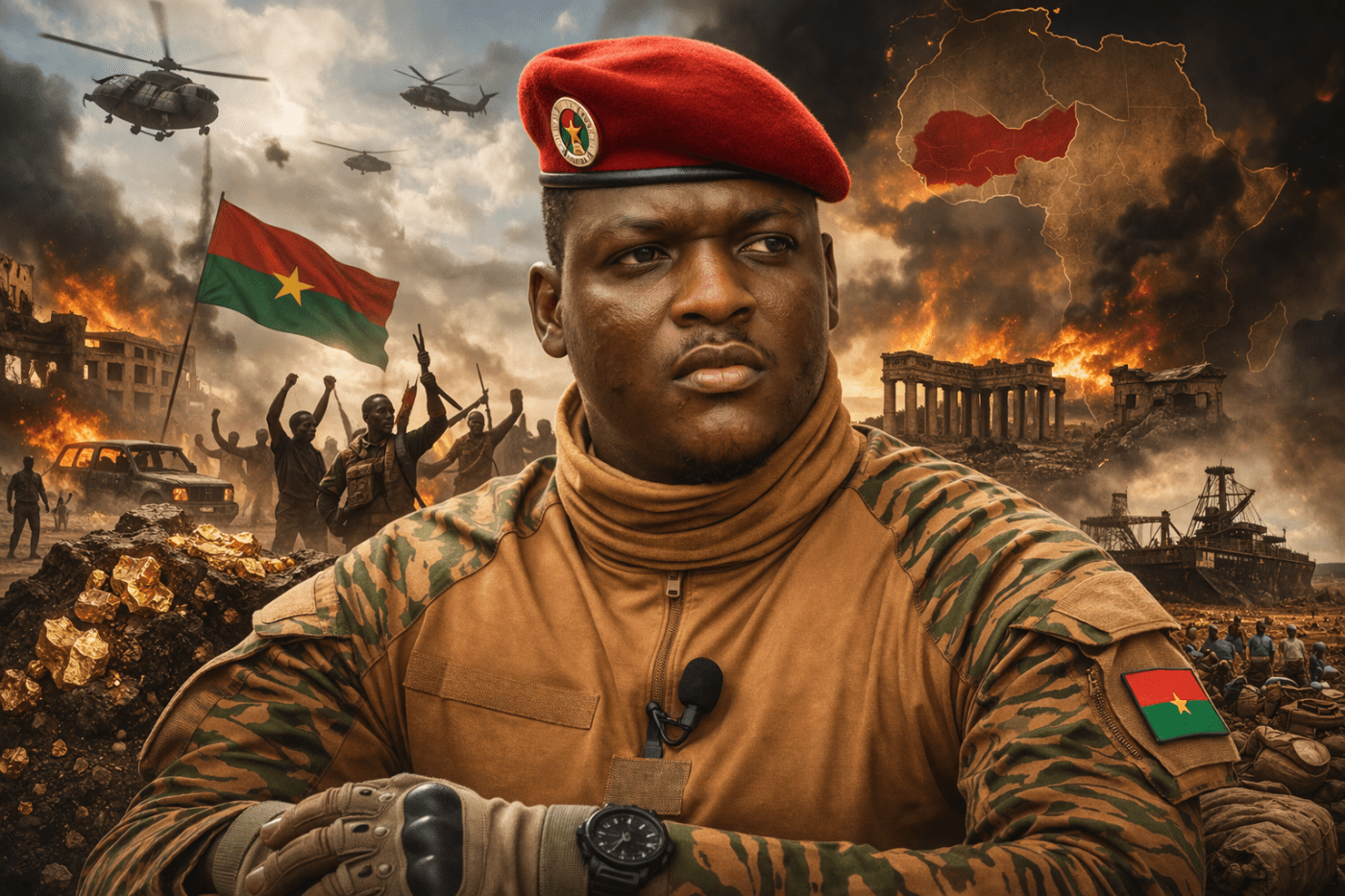
The BBC frames Burkina Faso as a story of a rogue soldier rejecting democracy, but its narrative quietly assumes the innocence of the very system now being challenged. Beneath the surface lies a region shaped by war, extraction, and foreign control, where democracy functioned less as popular rule than as managed dependency. What appears as an authoritarian turn is in fact a contradictory rupture inside imperial decay, where sovereignty is demanded but not yet secured. The real struggle now is whether this opening leads to genuine popular power or is captured by a new form of state domination.
By Prince Kapone | Weaponized Information | April 6, 2026
The Imperial Sermon and the African Defendant
In “Burkina Faso must ‘forget’ about democracy, military leader says”, published by BBC News Africa on April 3, 2026, Wedaeli Chibelushi gives us a compact little morality play: Captain Ibrahim Traoré appears as the soldier who has turned his back on democracy, while the reader is quietly invited to stand with the violated ideal before the evidence is even weighed. The article is not a fabricated text. It reports real remarks, real policies, and real accusations. But propaganda is rarely a matter of simple lying. More often it is a matter of arrangement, of emphasis, of who gets to define the terms before the trial begins. The piece opens with Traoré’s declaration that democracy “kills” and that Burkinabè people must “forget” it, moves through his condemnation of political parties as divisive and dangerous, nods to Libya as his chosen warning sign, and then closes the circle by reminding the reader that his rule has been marked by repression allegations, extended military rule, and continued violence. By the end, the verdict has been prepared with the smooth confidence of a judge who pretends merely to be summarizing testimony.
The institutional location of the BBC matters here, not because every sentence must therefore be false, but because no outlet descends from heaven wrapped in neutral light. The BBC is a British public-service broadcaster constituted through Royal Charter, charged in part with providing impartial news and also with reflecting the United Kingdom, its culture, and its values to the world. It is sustained primarily through a public funding model centered on the licence fee, with the British state setting the charter framework within which that mission is defined. That is not an incidental detail tucked away in the basement. It is part of the building itself. When such an institution reports on an African state rejecting the liberal catechism, it does so from inside a political tradition that treats parliamentary democracy not as one historically contingent form among others, but as civilization’s proper grammar. So the article does not have to wave a Union Jack in the reader’s face. The flag is already stitched into the furniture.
Chibelushi, as publicly profiled, is a BBC News Africa digital journalist. That professional location is important not for any cheap ad hominem performance, but because journalism under large institutional media tends to reproduce a familiar discipline of thought: official statements are treated as the skeleton of the story, liberal norms as the bloodstream, and everything else as decoration or disturbance. In this case, the author’s craft is visible in the article’s very compression. A vast field of history and struggle is squeezed into a tight frame: the issue becomes whether Traoré has insulted democracy, not what “democracy” has meant under neocolonial dependency, military penetration, foreign tutelage, and regional breakdown. That is the first propaganda device here: narrative framing. The second is omission. Libya appears only as Traoré’s example, which allows the article to register his rhetoric without reconstructing why that example carries force in the Sahel. The third is source hierarchy. The thinking subjects of Burkina Faso’s masses are absent, replaced by the familiar exchange among ruler, journalist, and rights-monitor, as though politics were something performed overhead while the people wait below like scenery.
The article also leans on the ideological efficiency of concision. Concision is praised in newsrooms as professionalism, but in imperial reporting it often works like a razor: it shaves away causation until only moral posture remains. A country confronting insurgency, state restructuring, post-coup legitimacy struggles, regional realignment, and the wreckage of externally shaped security orders is reduced to a more marketable script — one ambitious officer has said rude things about democracy. That is easier to circulate, easier to digest, and easier to fit into the old sermon whereby Africa appears as a continent forever standing before the blackboard of Europe, waiting to be graded on proper political conduct. Then there is appeal to authority, though in a polished modern form. The article does not need to thunder that democracy is good. It simply arranges the story so that democracy stands as the unquestioned standard of legitimacy, and every deviation from it arrives already bearing the burden of proof. It performs balance, yes, but it is a balance like that of a scale with a hidden thumb pressed on one side.
What finally makes the piece propaganda excavation material is not that it denounces Traoré too harshly, but that it treats the word “democracy” as though it were self-explanatory, innocent, and detached from empire’s own history of blood-soaked instruction. The article does not ask what social order this word has actually named in much of postcolonial Africa, who managed it, who funded it, who violated it, who emptied it of sovereignty, or why denunciations of it can resonate among populations that are not stupid, not hypnotized, and not waiting for the BBC to teach them the meaning of freedom. Instead, the piece gives us the old imperial catechism in updated digital prose: when a Western-aligned order fails, the failure is local; when that order is challenged, the challenge itself becomes the scandal. That is the trick. Design is presented as accident, history as background noise, and ideology as common sense. The defendant sits in Ouagadougou, but the sermon is still being delivered from London.
What the Democracy Lecture Leaves Out of the Frame
Ibrahim Traoré did in fact say that Burkinabè people should “forget” democracy, and he did invoke Libya as proof that externally imposed democracy arrives with bloodshed. The remarks were made during a roundtable with journalists aired on state television, and they were not stray comments pulled from the air but part of a broader defense of prolonged military-led rule in a country where insurgencies linked to al-Qaeda and Islamic State have shaped the political timetable for years. The junta had once pledged a return to civilian rule by July 2024, but that promise was pushed aside; by 2024 the transition charter had been revised to allow Captain Traoré to remain in office for another five years, extending the transition to July 2029. The authorities then moved from postponement to institutional demolition: in January 2026, the government dissolved political parties and formations, while that same political season also saw the state dissolve the independent electoral commission. Meanwhile, the human cost has kept mounting. Human Rights Watch reported on April 2, 2026 that all sides in the conflict had committed grave abuses and that more than 1,800 civilians had been killed since 2023, while the humanitarian crisis has deepened to the point that 4.5 million people are estimated to require humanitarian assistance in 2026.
But the BBC frame leaves the reader standing in the middle of the room while hiding the walls. Burkina Faso’s political rupture is not unfolding in isolation; it sits inside the wider break between the junta-led Sahel states and the old ECOWAS order. Burkina Faso, Mali, and Niger formally exited ECOWAS on January 29, 2025, making clear that the conflict is not simply over one officer’s rhetoric but over the regional architecture through which West Africa has been governed, disciplined, and aligned. Nor is Burkina Faso merely an orphaned barracks-state floating alone in a sea of chaos. The Liptako-Gourma Charter of September 2023 established the Alliance of Sahel States as a collective defense framework, and the Sahel governments later deepened this process into a confederal structure meant to coordinate security and broader policy. This matters because what is being contested is not only regime form but geopolitical alignment: whether the Sahel remains tied to the old Paris-ECOWAS security belt or attempts to build a different regional pole under fire.
That same buried context includes the break with France. In January 2023, Burkina Faso ended its military accord with France, and the French special forces presence that had symbolized the old security arrangement was wound down soon after. This was not a decorative diplomatic spat. It marked a tangible severing from the former colonial metropole’s military role in the country, and it helps explain why Traoré’s language of sovereignty echoes far beyond Ouagadougou. At the same time, that nationalist posture has not delivered peace. The insurgency has continued to spread and mutate across the Sahel, and Tricontinental’s analysis of the region notes that the military governments arose in a context where French-backed security policy had failed to stop the violence and had instead deepened popular disillusionment with the old order. So the buried fact here is double-edged: the old imperial security arrangement lost legitimacy, but the new military-centered order has not yet resolved the crisis that fed its rise.
The article also floats above the political economy as though Burkina Faso were debating abstractions. It is not. The country remains heavily dependent on extractive export flows, above all gold. The World Bank identifies gold as Burkina Faso’s dominant export and a central pillar of macroeconomic performance, which means that any struggle over sovereignty is also a struggle over who commands the rents, corridors, contracts, and state revenues attached to that extractive base. Burkinabè and regional reporting have also described record gold output of 94 tonnes in 2025, underscoring that the country’s crisis is unfolding atop a major mineral economy rather than some empty desert of pure political symbolism. Yet even as the state speaks the language of self-determination, it remains financially constrained. The IMF states that its Executive Board completed the fourth review of Burkina Faso’s Extended Credit Facility arrangement in February 2026 and approved a new arrangement under the Resilience and Sustainability Facility. In plain language, the country may denounce Western political models, but it still moves inside a global credit structure where external financial institutions continue to shape the state’s room for maneuver.
Then there is Libya, the one word in Traoré’s remarks that the liberal script would prefer to leave as a gesture rather than a history. But post-2011 Libya is not a metaphor in the Sahel. It is part of the material backdrop. The United Nations Panel of Experts on Libya documented the continued trafficking and spread of weapons from Libya across the region, and this diffusion of arms has long been identified as one factor aggravating instability in the wider Sahel belt after NATO’s destruction of the Libyan state. That does not explain everything; history is not a vending machine where one coin buys one outcome. But it does explain why “democracy” preached from NATO capitals sounds like a cruel joke to many people in the region. The BBC article reports Traoré’s invocation of Libya as though it were mainly rhetorical theater. It omits that Libya’s destruction helped alter the security environment of North and West Africa in lasting ways.
The larger field is therefore harder, denser, and more contradictory than the neat democracy sermon allows. Burkina Faso today sits at the intersection of Sahel regional restructuring, ECOWAS rupture, French military withdrawal, ongoing IMF discipline, gold-centered export dependence, and a continuing insurgent war that still devours civilian life. It is also moving through a changing geopolitical field in which Moscow is trying to deepen its place: Russian Foreign Minister Sergei Lavrov said in February 2026 that military cooperation between Russia and Burkina Faso could serve as an example and emphasized the broadening of bilateral ties. None of this proves that the junta has found the road to popular emancipation. It proves something more basic and more important for Section II: the struggle over “democracy” in Burkina Faso is inseparable from questions of war, extraction, external finance, regional realignment, and the afterlife of imperial intervention. That is the terrain the BBC piece trims away so that the reader can be left alone with the simpler fairy tale of soldiers, ballots, and moral disappointment.
When “Democracy” Becomes a Battlefield Word
What the BBC cannot say — not because its journalists are incapable, but because its position does not permit it — is that the word “democracy” in the Sahel has long been hollowed out, stretched thin like cheap cloth over a structure built elsewhere and for other purposes. What is presented to the reader as a simple moral rupture — a soldier rejecting democracy — is in fact the visible surface of a deeper contradiction: a society attempting to break from a political form that never delivered sovereignty, while still trapped inside the material relations that made that form possible in the first place. This is not a story about whether democracy is good or bad. It is a story about what has actually been practiced under that name, who controlled it, and what happens when a people begins to suspect that the word and the reality no longer match.
In Burkina Faso, as in much of the neocolonial world, what passed for democracy was not the unfettered rule of the people, but a carefully managed electoral shell — a system in which ballots were permitted but sovereignty was not. Governments could change faces, but they could not fundamentally alter the terms of their existence. The security architecture remained tied to foreign command structures, the economy remained tethered to extractive circuits feeding global markets, and the financial system remained bound to external institutions that defined the limits of policy before a single vote was cast. This is what the imperial narrative refuses to confront: that “democracy” was often administered as a form of containment, a way to stabilize a dependent order rather than transform it. And when that system begins to collapse under the weight of insurgency, disillusionment, and external pressure, the language of democracy does not disappear because the people have become irrational — it disappears because it has been exhausted as a vehicle for meaningful change.
This is where Traoré’s intervention must be understood, not as a philosophical argument in the abstract, but as a political expression emerging from the crisis of imperialism itself. His rejection of multiparty politics, his invocation of Libya, and his emphasis on sovereignty all draw their energy from a real historical experience: the experience of a region where external military interventions have shattered states, where foreign-backed security arrangements failed to contain violence, and where the promises of liberal governance did not translate into safety, dignity, or development for the masses. But this is only one side of the contradiction. The other side is that the rejection of a hollow democracy does not automatically produce a deeper one. The collapse of the old political form has opened a space, but what fills that space remains contested.
We are therefore witnessing a moment of imperialist decay, where the old mechanisms of control no longer function as they once did, and where new configurations are emerging unevenly, under pressure, and often under fire. The rupture with ECOWAS, the expulsion of French forces, and the formation of new regional alignments signal a process of multipolar recalibration — an attempt by Sahelian states to renegotiate their place in a world no longer dominated by a single uncontested imperial center. But this recalibration is incomplete. The deeper structures of dependency — the extractive economy, the financial constraints, the logistical networks that tie the region to global capital — remain largely intact. The result is a situation of political rupture without full economic delinking, where the shell of the old order has cracked but its foundations still exert their pull.
It is in this gap that the figure of the military ruler emerges, not as an accident, but as a product of the conditions themselves. When civilian institutions are discredited, when security collapses, and when external pressure intensifies, the barracks becomes a site of political consolidation. But the barracks is not the people. It can speak in the name of sovereignty, and at times it may even act against imperial domination, but it can also narrow political life, suppress dissent, and substitute command for participation. This is the unresolved contradiction at the heart of Burkina Faso’s present: the legitimate desire to break free from a neocolonial order is being mediated through a form of rule that risks closing the very space that a genuine popular sovereignty would require.
The BBC’s framing cannot grasp this because it is bound to the logic of the imperialist media apparatus, which treats Western parliamentary form as the universal measure of legitimacy. Within that logic, the question is always whether a country is moving toward or away from democracy, never whether the version of democracy on offer was structurally incapable of delivering sovereignty in the first place. Libya appears only as a warning misused by a military leader, not as a concrete example of militarized imperialism that shattered a state and destabilized an entire region. The Sahel crisis appears as a failure of governance, not as a convergence of war, extraction, and geopolitical restructuring. In this way, the narrative performs a quiet ideological function: it defends the form of democracy even when its content has been emptied out.
But the people of Burkina Faso are not debating abstractions. They are living through the consequences of a system that has failed them, and they are searching — unevenly, contradictorily, and under immense pressure — for a way out. The hatred of neocolonial democracy is real. It has been earned. The danger is that this hatred can be captured by a closed military nationalism that replaces one form of exclusion with another. The possibility, however, is that it could be transformed into a deeper struggle for anti-imperialist sovereignty — one that does not merely reject the old order, but reconstructs political life on a new foundation rooted in the masses themselves.
That is the contradiction the BBC cannot tell you about. Not because it is hidden, but because it cannot be spoken from within the frame. The story is not that democracy is dying in Burkina Faso. The story is that a particular form of democracy — one tied to imperial management, external constraint, and hollow sovereignty — has lost its legitimacy, and that something new is struggling to be born in its place. Whether that new thing will be emancipatory or merely another configuration of power remains an open question. But it is a question that cannot be answered by lectures from London. It will be answered, as it always is, on the ground — in the struggle itself.
From Exposure to Alignment: Standing with the People, Not the Script
If the task of excavation is to strip away illusion, then the task of mobilization is to decide where one stands once the illusion is gone. And here the line must be drawn with precision, not sentiment. We do not stand with the imperial narrative that lectures Burkina Faso on democracy while ignoring the wreckage that made such lectures ring hollow. But neither do we surrender our political clarity to the state simply because it speaks the language of sovereignty. We stand with the Burkinabè people — workers, peasants, displaced communities, and the urban poor — who are living inside this contradiction, bearing its costs, and searching for a way through it. The struggle is not between “democracy” and “military rule” as abstractions. It is between continued subordination to imperial structures and the unfinished project of building genuine popular power under conditions of extreme pressure.
That means grounding solidarity in real anti-imperialist organization, not rhetorical posturing. The Black Alliance for Peace provides one such concrete vehicle. It is a people-centered anti-war and anti-imperialist formation working to dismantle U.S. military domination globally, including AFRICOM’s role across Africa. In practical terms, this means supporting campaigns that expose and oppose AFRICOM operations, foreign military basing, and the broader security architecture that has helped produce the crisis now being moralized from afar.
At the same time, targeted anti-war agitation inside the imperial core remains essential. Organizations like CODEPINK have consistently mobilized against U.S. militarism and interventionist policy, including NATO operations and sanctions regimes that destabilize regions like the Sahel. The role here is not to romanticize any single organization, but to recognize that struggle requires infrastructure — networks capable of translating analysis into pressure, disruption, and sustained political education.
From that foundation, concrete work follows. First, we must expose the ideological weaponization of “democracy promotion” itself. That means building sharp, accessible political education — articles, teach-ins, media interventions — that trace the line from NATO’s destruction of Libya to the destabilization of the Sahel, showing how the same powers now invoking democracy helped produce the very crisis they condemn. This is not abstract critique; it is a necessary intervention into the battlefield of ideas, where narratives shape consent and consent shapes policy. Second, we must illuminate the material core of the struggle: the gold, the extraction, the financial constraints, the corridors of capital that continue to bind Burkina Faso even as it seeks to break free. When people understand that this is not merely a political crisis but a struggle over resources and sovereignty, the terrain shifts.
Third, we must articulate a line of solidarity that refuses both imperial hypocrisy and uncritical state loyalty. “No to recolonization, no to civilian massacres, yes to Burkinabè sovereignty and popular power” is not a slogan for aesthetic effect — it is a political position rooted in the contradiction itself. It affirms the right of Burkina Faso to break from French domination, ECOWAS pressure, and external control, while also insisting that sovereignty without the people is not liberation but substitution. Fourth, we must connect this struggle to the broader pattern: from the Sahel to the Red Sea, from Venezuela to Iran, the same imperial apparatus attempts to manage decline through coercion, narrative control, and selective moral outrage. Each site is distinct, but the system is shared.
Finally, and most importantly, this moment demands that we deepen our own capacity as guerrilla intellectuals — not spectators, not commentators, but organizers of clarity in a world saturated with distortion. The BBC article is not an isolated failure. It is one node in a vast ideological network that shapes how millions understand power, legitimacy, and resistance. To confront it requires more than rebuttal. It requires building a counter-infrastructure of analysis, agitation, and organization that speaks from the standpoint of the oppressed and acts in their interest. That is the real work. And like all real work, it does not begin in the newsroom or the think tank. It begins where people struggle — and it must return there, sharpened, disciplined, and ready to serve.
 Weaponized Information
Leave a comment