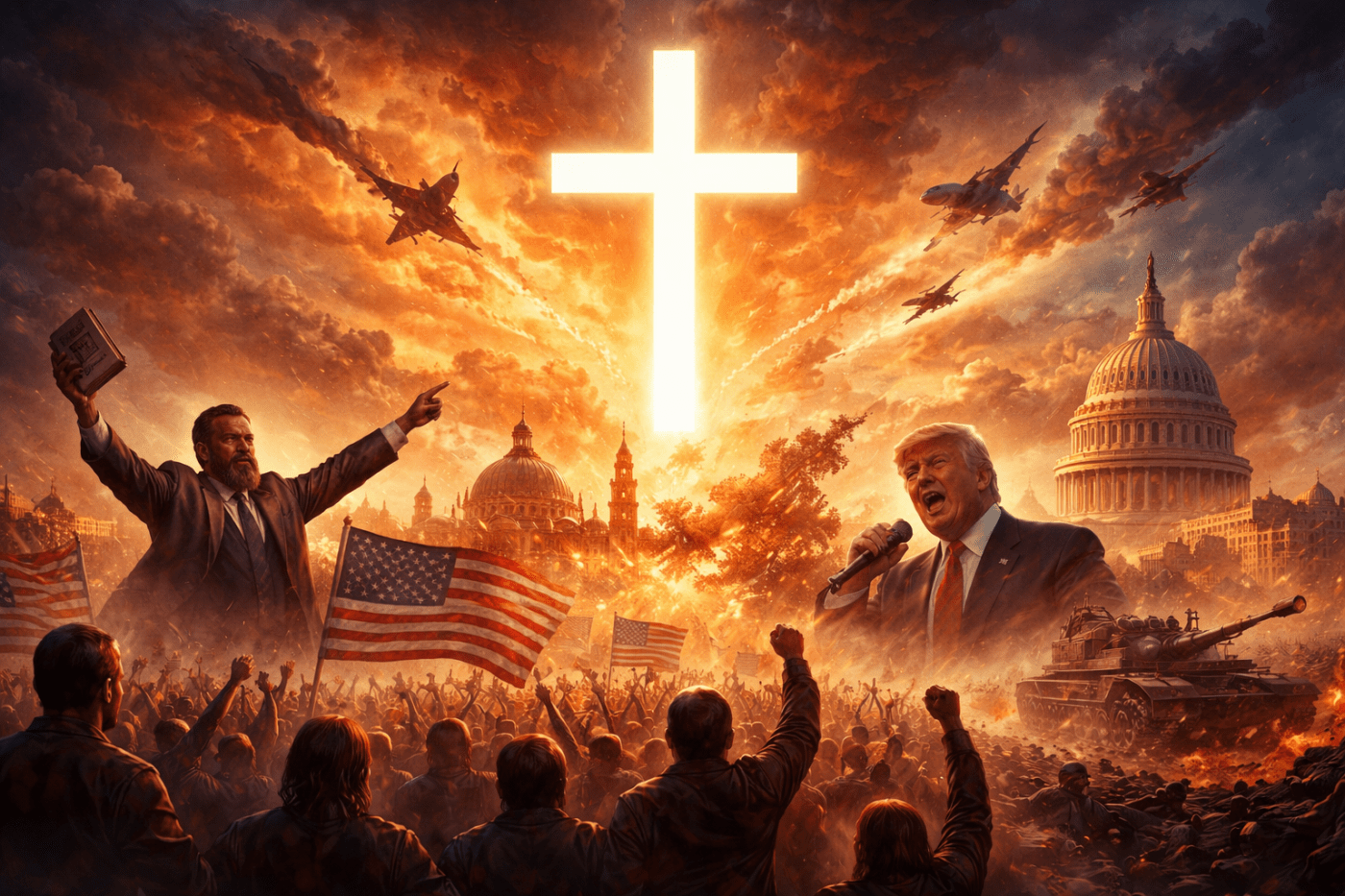
A war sold through fear is now preached as destiny, as the language of intelligence gives way to the language of God. Behind the spectacle of evangelical zeal lies a harder truth: Iran sits at the crossroads of global energy and imperial control.
At home, the same forces sanctifying war are reshaping society through family doctrine, border enforcement, and political exclusion. What appears as religious extremism is in fact a system in crisis, forging a new ideological weapon to preserve its rule.
By Prince Kapone | Weaponized Information | April 4, 2026
When Empire Learns to Pray Out Loud
“Trump’s Holy War Abroad and at Home”, published by The Intercept on April 3, 2026, gathers around an interview with journalist Sarah Posner to argue that the Christian right is not some decorative fringe hanging off the sleeve of Trumpism, but one of its living nerves. The piece moves from Pete Hegseth’s blood-soaked Pentagon piety to John Hagee’s end-times Zionism, then into Heritage Foundation family doctrine, reactionary politics, immigration repression, and the broader machinery of white Christian nationalism. Its core intervention is to insist that the mainstream press has for too long treated Trump’s alliance with the Christian right as either harmless pageantry or a cynical transaction, when in fact it is an ideological fusion with serious consequences for war abroad and discipline at home. That is an important correction, and the article earns its urgency by refusing the old liberal bedtime story that religion is merely background music to power. Still, the piece remains trapped inside a familiar limit of left-liberal journalism: it identifies the fever but does not quite trace the factory that keeps manufacturing the heat.
That limit begins with how the article positions authority. The Intercept presents itself as an adversarial publication outside the corporate press herd, sustained by member support and animated by a self-conscious opposition to authoritarian drift. That posture gives the article some needed sharpness. It is less timid than the average respectable newsroom sermon about “polarization,” and more willing to say plainly that war propaganda, Christian nationalism, and totalitarian governance are linked. But even dissident liberal outlets often carry their own habits of containment. They know how to expose hypocrisy, profile villains, and sound the alarm, yet still leave untouched the deeper machinery of class power and imperial strategy that gives those villains their historical function. The result is that power appears as the triumph of bad ideas, bad men, and bad theology, rather than as the political expression of a system in decay looking for stronger ideological weapons.
This is where the article’s main propaganda problem appears, not because it repeats state propaganda, but because it is still organized by a liberal grammar that personalizes structure. Pete Hegseth is made to stand in for the danger, and indeed he deserves no mercy from criticism. A man praying for “overwhelming violence of action” while dressed in the costume of public duty is not subtle. He is a crusader with a government expense account. But the article lets him carry too much explanatory weight. His religious extremism is real, yet the piece frames him primarily as a particularly zealous actor rather than as one expression of a larger imperial need now seeking theological armor. In the same way, John Hagee appears as the apocalyptic impresario of Christian Zionism, Heritage as the architect of family reaction, Candace Owens as the antisemitic opportunist, and together they form a gallery of grotesques. The gallery is accurate, but a gallery is still a gallery. The reader is ushered past the monsters one by one while the building that houses them stays mostly in the dark.
The article also relies heavily on source hierarchy in a way that narrows its own horizon. Posner is clearly knowledgeable, and the interview gives the piece coherence, but that coherence comes at a price. Her interpretive voice governs the narrative so thoroughly that the article becomes less an excavation of material relations than a guided tour through ideological tendencies. Everything is filtered through what these religious actors believe, preach, and signal. That method helps expose worldview, but it also shifts the center of gravity away from what those worldviews are doing for state power. Religion becomes the explanation rather than one of the instruments. The war on Iran is therefore presented largely through the language of end-times belief, dominionist zeal, and Christian-nationalist aggression, while the harder material ground beneath the spectacle remains mostly offstage.
Then there is the article’s most important omission, which sits like a missing wall in the room. It says the war is illegal and unprovoked, and that is true. But it does not reconstruct the strategic terrain that makes Iran such a prized target of empire in the first place. It tells us a great deal about the men who wish to sanctify war, and far less about the imperial order that needs war sanctified. In that way, the piece practices a familiar form of liberal containment: it widens the frame just enough to show that religion matters, but not enough to show how theology, militarism, oil routes, sanctions, Zionist power, and domestic social discipline are being fused into a single governing project. It sees the Christian right as a dangerous influence upon the state, when the sharper formulation is that the state in crisis has found in the Christian right a language fit for its own purposes. Empire, having committed so many crimes in the language of freedom, now finds it useful to commit them in the language of God.
What the Pulpit Leaves Out, the Chokepoint Explains
The immediate factual terrain begins with the article’s own baseline. Trump publicly justified the war by repeating claims about an Iranian nuclear threat, even as the U.S. intelligence community’s 2025 Annual Threat Assessment stated that Iran was not building a nuclear weapon. In the podcast discussion itself, the war is presented as having been sold through a language of national emergency, military necessity, and looming danger, while Pete Hegseth’s public posture gave that message an openly sectarian edge. The article quotes Hegseth’s Pentagon prayer asking for “overwhelming violence of action against those who deserve no mercy”, placing on the record that one of the principal officials overseeing U.S. war policy has wrapped state violence in a theological vocabulary of righteousness and punishment. Sarah Posner further identifies Hegseth as belonging to the Communion of Reformed Evangelical Churches and situates that current within a reconstructionist understanding in which biblical law is treated as higher than secular restraint. The article also identifies Christian Zionism as a mass political force, centering John Hagee and Christians United for Israel, which publicly backed the joint U.S.-Israeli operation and describes itself as a movement of more than 10 million members across all 50 states. On the domestic side, the article ties the war mentality to a broader program of Christian-nationalist social discipline, pointing to the Heritage Foundation’s 2026 report Saving America by Saving the Family, which explicitly elevates the “natural family,” married biological parents, and marriage between man and woman as the preferred social norm and frames departures from that model as civilizational danger. It links that same agenda to the SAVE Act’s documentary proof-of-citizenship requirements for federal voter registration, a regime that would impose additional burdens on registration and create obvious hurdles for people whose names do not match their underlying citizenship documents. The article’s final factual baseline is that Christian nationalism is not some decorative tendency inside the Trump coalition but a real social bloc tied to immigration repression, a point reinforced by PRRI’s March 2026 findings that Christian nationalism adherents are markedly more supportive of coercive ICE practices than rejecters.
But the article leaves out the hard material ground beneath this spectacle. It does not reconstruct the strategic significance of the place around which this war is unfolding. The U.S. Energy Information Administration reports that in 2024 and early 2025 the Strait of Hormuz carried more than one-quarter of global seaborne oil trade, about one-fifth of world oil and petroleum consumption, and about one-fifth of global LNG trade. That is not some theological abstraction. That is the monetary plumbing of the world economy. Nor is this merely latent strategic significance sitting quietly in the background. Reuters reported on April 3 that Iran’s position over the Strait was already producing oil shocks and giving Tehran leverage over Washington and the global economy. In other words, the war is unfolding not only against a state demonized in U.S. political theology, but against a state positioned at one of the planet’s most sensitive capitalist chokepoints.
The article also treats the nuclear theme primarily as propaganda rhetoric of the moment without reconstructing the policy sequence that helped produce the crisis now being sold as emergency. Trump formally withdrew the United States from the JCPOA in May 2018 and ordered the re-imposition of sanctions, moving the Iran file away from negotiated containment and back toward open coercion. That sequence matters because it shows that today’s war atmosphere did not fall from heaven like a revelation. It was built through state policy. The omission runs deeper still, because the hostility between Washington and an independent Iran is not a recent quarrel generated by evangelical prophecy or Trumpian whim. Declassified State Department material and National Security Archive documentation on the 1953 coup against Mohammad Mosaddegh show direct U.S. planning and implementation around Operation TPAJAX. That longer assaut on sovereignty is not background decoration. It is part of the factual foundation needed to explain why Iran became, and remains, a central object of imperial discipline.
The domestic side of the article also becomes clearer once its omitted institutional scale is recovered. The piece is right to name Christian Zionism, Heritage, and the Alliance Defending Freedom, but it does not fully materialize the size and durability of that machine. CUFI’s own public statement describes the organization as operating across all 50 states with more than 10 million members, which makes it less a fringe theological hobbyhorse than a mass lobbying and mobilization apparatus. ADF openly claims its role in the Dobbs decision and continues to litigate and campaign against protections for oppressed groups, showing that the Christian-right legal infrastructure is not speculative or aspirational but already deeply embedded in reactionary governance. Meanwhile, Heritage’s 2026 family report does not simply praise heterosexual marriage in the abstract; it frames the restoration of the “natural family” as necessary to national survival and treats abortion, gender ideology, and alternative household forms as threats to social order. The point here is factual before it is anything else: the apparatus described in the article is not a loose network of preachers and commentators, but a multilayered bloc of lobbying organizations, legal shops, donor-backed policy mills, media circuits, and voter-mobilization institutions.
The immigration dimension also needs to be stated with more precision than the article gives it. It is not only that white evangelicals support Trump in general. PRRI’s March 2026 reporting found that Christian nationalism adherents were substantially more likely to support harsh immigration enforcement practices, including the relocation of undocumented immigrants without allowing them to challenge detention. That matters because it gives empirical substance to the article’s claim that the “Christian nation” narrative is tied to border repression. Likewise, the voting-rights dimension is not merely symbolic. The House text of the SAVE legislation requires applicants using the federal mail voter registration form to provide documentary proof of U.S. citizenship and sharply narrows what counts as acceptable documentation, while also embedding in-person burdens that can easily catch people whose present legal names do not match birth records or other citizenship documents. These are not stray culture-war gestures floating in the atmosphere. They are concrete policy mechanisms aimed at regulating who belongs, who votes, what a family should look like, and which social forms are to be marginalized.
Taken together, the larger factual context is broader than the article’s ideological frame. Iran is not simply a scriptural antagonist in the imagination of Christian Zionists or dominionists. It is a state located at a decisive energy chokepoint whose disruption can reverberate through oil, gas, shipping, inflation, and global trade. The public case for war sits in tension with official U.S. intelligence language maintaining that Iran was not building a bomb. At home, the “natural family” project is not a nostalgic sermon but an actionable policy blueprint for disciplining gender, reproduction, and household life, while the voting and immigration measures associated with this bloc are not rhetorical flourishes but concrete administrative burdens and enforcement preferences. The empirical record shows that the war on Iran and the domestic Christian-right offensive are unfolding on the same historical ground: a state apparatus under strain, a ruling bloc hardening its ideological spine, and a coercive architecture reaching outward through war and inward through social discipline.
Empire in Its Final Language Learns to Speak in God’s Name
What the article gestures toward, but cannot fully say within its own limits, is that we are not witnessing the intrusion of religion into politics so much as the maturation of a political order that now requires religion as one of its organizing languages. The facts laid out in the previous section do not describe a random convergence. They describe a system under pressure, searching for new forms of legitimacy, and finding in Christian nationalism a vocabulary capable of sanctifying what can no longer be justified in the tired idioms of liberal democracy. When a state wages war in the face of its own intelligence assessments, when it escalates conflict around a chokepoint that carries a fifth of the world’s energy flows, when it intensifies sanctions and coercion against a country shaped by decades of intervention and sovereignty struggle, it requires more than policy papers and press briefings. It requires belief. Not belief in the sense of personal faith, but belief as a social force, a mobilizing energy that can turn contradiction into duty and violence into obligation.
This is where the Iran war must be understood not as an ideological aberration, but as a moment of convergence. On one side stands the material logic of empire: the need to discipline states that resist integration into its economic and geopolitical order, the need to maintain control over strategic corridors of energy and trade, the need to demonstrate that sovereignty outside its orbit comes at a cost. On the other side stands the ideological apparatus required to make that logic palatable, even righteous, to a domestic population increasingly disillusioned with the promises of the system. Christian nationalism enters precisely at this junction. It does not create the war. It translates it. It renders imperial necessity into moral destiny. It tells a population that what is being done for power is in fact being done for God.
Seen from this angle, the spectacle of Pentagon prayer, evangelical prophecy, and Zionist fervor is not a sideshow to the real machinery of power. It is part of that machinery. The same state that withdrew from negotiated agreements and escalated sanctions is the state that now wraps its actions in theological language. The same system that confronts a multipolar world in which its dominance is no longer uncontested is the system that reaches for older, deeper narratives of chosenness, mission, and civilizational struggle. Religion here functions as adhesive. It binds together otherwise unstable elements: militarism, settler identity, racial hierarchy, patriarchal order, and geopolitical ambition. It gives them a common emotional and symbolic ground. It turns policy into prophecy and strategy into scripture.
The domestic front mirrors this logic with chilling clarity. The so-called “natural family” is not simply a cultural preference or a nostalgic longing for a simpler time. It is a disciplinary formation suited to a system that requires order, hierarchy, and predictability under conditions of crisis. When the state moves to regulate reproduction, restrict voting access, intensify immigration enforcement, and marginalize those who fall outside rigid gender norms, it is not acting out a series of disconnected prejudices. It is consolidating a social base. It is constructing a population that is easier to govern, easier to mobilize, and less capable of resisting. The family, in this context, becomes a unit of control. It organizes labor, reproduction, and identity in ways that align with the needs of a tightening system.
What appears as a culture war is therefore inseparable from what is being waged abroad. The same ideological current that demands obedience at the border demands obedience in the home. The same logic that defines Iran as an enemy of righteousness defines migrants, gay people, and dissidents as threats to the nation’s moral fabric. These are not parallel developments. They are expressions of a single process. A ruling bloc that can no longer rely on consent alone begins to lean more heavily on coercion, and coercion requires justification. That justification increasingly takes on sacred form. The enemy is no longer merely strategic. The enemy is evil. The mission is no longer merely political. The mission is divine.
This is why the liberal framing of the problem as a failure to “take the Christian right seriously enough” falls short. The issue is not that the media underestimated a religious movement. The issue is that the media continues to treat that movement as an external influence on an otherwise normal system. But the system itself is changing. Under conditions of imperial strain, the boundary between state power and ideological extremism begins to dissolve. What was once fringe becomes functional. What was once embarrassing becomes useful. The language of apocalypse, dominion, and divine mandate is not tolerated despite its extremism. It is embraced because it performs work that no longer-neutral language can perform.
In this sense, we are witnessing a transformation in how power presents itself. The older language of democracy, human rights, and rules-based order is still invoked, but it no longer carries the same persuasive force. It rings hollow against the backdrop of endless war, economic instability, and visible contradiction. The system does not abandon that language entirely, but it supplements it with something more visceral. It reaches into deeper reservoirs of identity and belief. It tells its population not only that it must act, but that it is chosen to act. That its violence is not only justified, but ordained.
The article sees the outlines of this shift but stops at the threshold. The fuller picture, drawn from the facts already established, is that we are not dealing with a temporary distortion of politics by religious zeal. We are dealing with a stage in which an imperial order, facing limits it cannot easily overcome, begins to reforge its ideological armor. Christian nationalism is one of the metals being used in that forge. It hardens the system’s exterior, sharpens its internal discipline, and gives it a language through which to confront both external rivals and internal dissent. The war on Iran and the war on the so-called “degenerate” elements of society are not separate campaigns. They are chapters in the same unfolding narrative, written in the ink of power and now increasingly read aloud in the voice of God.
Breaking the Empire’s Pulpit: Organizing Where Faith Refuses War
If the previous sections have clarified anything, it is that the struggle is not simply against policy, nor even against a particular administration, but against a system that is learning to fuse power with belief. That means resistance cannot afford to abandon the terrain of belief to the forces of domination. The same religious language now being used to sanctify war and discipline society is also contested ground. It contains within it another tradition—one rooted not in empire, but in the struggles of the oppressed. The task, then, is not only to oppose the machinery of war and repression, but to align with and strengthen those currents that refuse to let faith be weaponized in the service of empire.
On the question of war itself, there already exists a network of Christian organizations that have taken clear positions against militarism, sanctions, and imperial aggression. Formations such as American Friends Service Committee, Friends Committee on National Legislation, and Pax Christi USA have long organized against U.S. wars, including recent mobilizations opposing escalation with Iran. These are not symbolic statements of concern. They are organized efforts that lobby, educate, mobilize, and build coalitions capable of exerting pressure on the political process. Engaging with these formations—whether through local chapters, campaigns, or national actions—places anti-war commitment within an existing structure of sustained resistance rather than isolated outrage.
At the same time, liberation-oriented Christian movements provide a crucial bridge between anti-war struggle and broader questions of justice. The Catholic Worker Movement, with its decentralized communities across the country, continues to practice a form of direct action rooted in solidarity with the poor, opposition to war, and refusal of state violence. Similarly, Sojourners and the Quixote Center connect faith to struggles around poverty, migration, and global inequality, making clear that militarism abroad and exploitation at home are inseparable. Internationally rooted formations like Sabeel and its U.S.-based “Friends of Sabeel” chapters extend this perspective into anti-colonial solidarity, particularly in relation to Palestine, challenging the theological justifications used to support settler colonial projects.
This terrain becomes even more important when confronting the domestic side of the emerging order. The same ideological current that legitimizes war also seeks to define who belongs within the nation and under what conditions. Organizations such as Mijente and United We Dream are already resisting the enforcement regimes that target migrants, while faith-linked coalitions like Churches for Middle East Peace and the National Council of Churches explicitly connect foreign policy with domestic justice concerns. Supporting and collaborating with these efforts helps break down the artificial separation between “foreign” and “domestic” issues, reinforcing the reality that both are expressions of a single system of control.
There is also a necessary ideological struggle within Christianity itself. The rise of Christian nationalism depends on the illusion that it speaks for the faith as a whole. That illusion can and must be challenged. Initiatives like Christians Against Christian Nationalism work to expose how religious language is being manipulated to justify exclusion, repression, and violence. Engaging with such efforts is not about theological debate for its own sake. It is about disrupting the ideological monopoly that allows reactionary forces to present their project as divinely sanctioned and uncontested.
The strategic task is therefore twofold. First, to join and strengthen existing formations that are actively resisting war, repression, and exploitation. Second, to help forge deeper unity across these struggles, linking anti-war movements, migrant justice organizing, racial justice struggles, and liberation-oriented faith communities into a more coherent front. This requires more than occasional participation. It requires sustained commitment: attending meetings, contributing resources, building local networks, and developing the political clarity necessary to navigate a complex and shifting terrain.
Empire is attempting to consolidate itself not only through force, but through meaning. It is trying to define what is righteous, what is natural, and what is inevitable. To confront that project effectively, resistance must operate on the same scale—not only opposing specific policies, but contesting the narratives that sustain them. The existence of anti-war and liberation-oriented Christian movements shows that this is already underway. The question is whether that current remains fragmented and marginal, or whether it becomes part of a broader, organized force capable of challenging the system that now seeks to speak in the name of God.
 Weaponized Information
Leave a comment