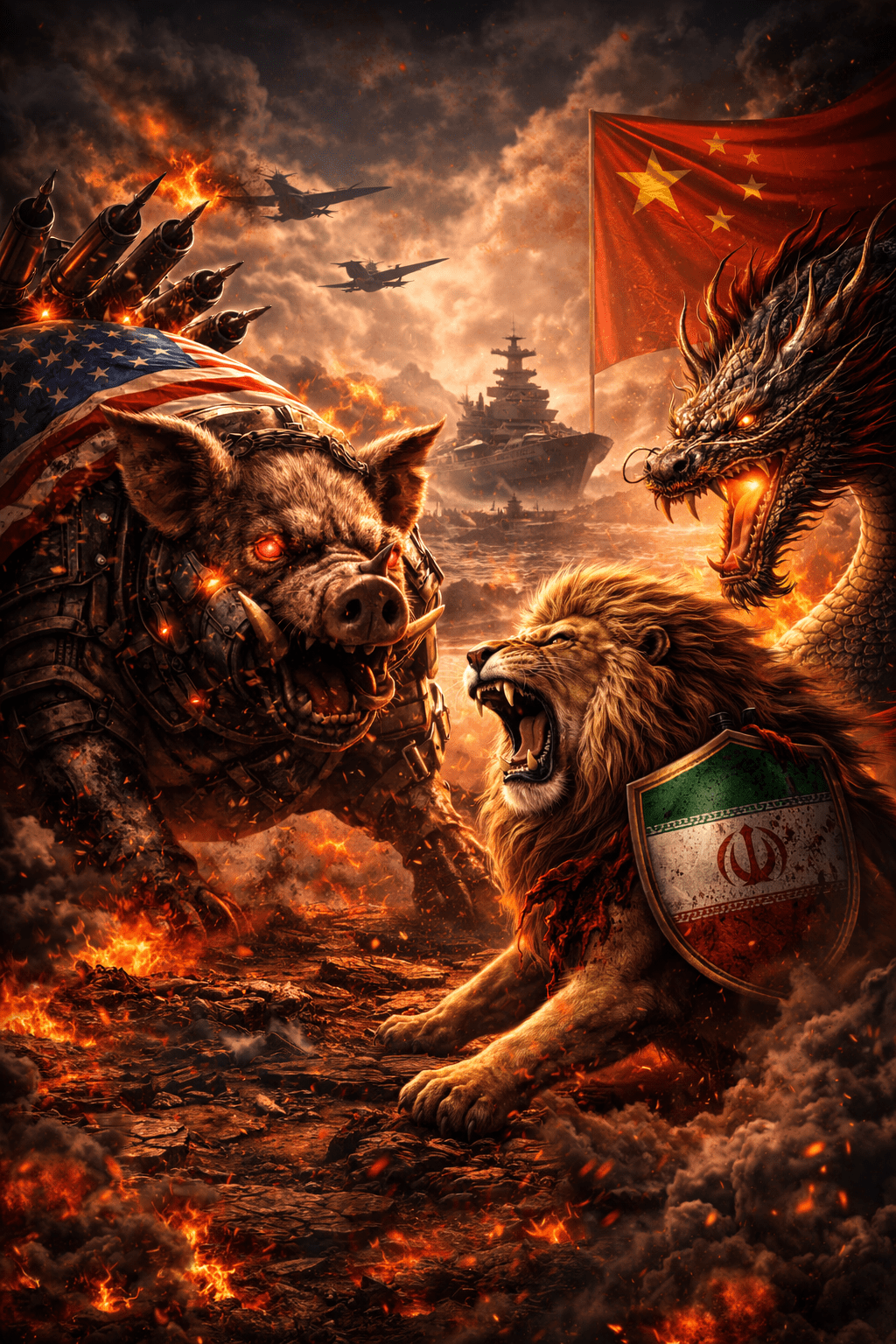
The bombs falling on Iran did not begin this war—they reveal it. For decades, U.S. strategy has worked to break states, choke economies, and fracture regions in order to control the flow of energy and discipline any path of independent development. What looks like a regional conflict is the tightening of a global vise, aimed not only at Iran but at the rising power of China and the defiance of the Global South. Empire is escalating because it must—and in that escalation, it exposes both its violence and its limits.
By Prince Kapone | Weaponized Information | April 2, 2026
The War That Was Written Before It Was Fought
Empire’s oldest trick is to present design as accident. The bombs fall, the anchors lower their voices, the policy men stroke their chins, and suddenly the public is told that events have “spiraled,” that tensions have “boiled over,” that nobody could have foreseen how things got so bad. As if war were weather. As if the most heavily funded machinery of organized violence on earth just stumbled into catastrophe like a drunk tumbling down basement stairs. But empires do not blunder into war. They outline it, test it, cost it, circulate it, rehearse it, and normalize it long before the first missile lights up the sky. They do not discover catastrophe. They prepare it administratively.
That is why the most revealing place to begin is not with the explosions of 2026, but with the policy literature that anticipated them. Long before the current war was packaged as emergency, Washington’s strategy class had already reduced Iran to a problem set. Among the clearest examples sits Which Path to Persia?, produced by the Brookings Institution. What makes the document so useful is not that it says something unusual, but that it says something typical with unusual bluntness. It does not tremble before the possibility of war. It inventories methods. It does not ask whether the United States has the right to subvert another sovereign state. It asks which instruments—sanctions, covert action, proxies, destabilization, direct force—might best produce the desired outcome. That is not neutral scholarship. That is empire doing paperwork on future violence.
The significance of the document lies precisely in how calm it is. The prose is managerial, not fevered. That is how you know you are reading the inner language of power. Madness on television is often theater; calm in strategic memoranda is where the real danger lives. Here, regime change is not treated as some wild fantasy of cranks. It is approached as a technical problem requiring sequencing, leverage, and public pretext. Direct invasion is weighed against indirect methods. Internal fractures are considered usable. Economic pressure is treated as a strategic instrument. Provocation is contemplated not as an unfortunate side effect, but as a possible political resource. Create the pressure, narrow the choices, bait the response, then reappear in public as the injured party. First build the trap, then act offended when the victim thrashes inside it.
That matters because it destroys the childish fairy tale that war begins when officials announce it. No. War begins much earlier, in the institutional labor of making aggression sound prudent. Papers like Which Path to Persia? do not merely comment on possible futures. They help furnish the grammar in which those futures become actionable. They establish the vocabulary through which strangulation can be called pressure, subversion can be called democracy promotion, and military escalation can be called deterrence. They are part of the transition point where domination passes from desire into doctrine.
This is why the liberal habit of treating war as a communication breakdown is worse than useless. It turns structure into mood. It asks us to stare at personalities, tempers, election cycles, or diplomatic atmospherics while ignoring the continuity of institutions whose business is to plan coercion across administrations. Presidents change their slogans. Cabinets change their faces. One faction speaks with cowboy swagger, another with humanitarian perfume. But beneath the cosmetic differences, the strategic assumptions endure. The script can survive a cast change because the deeper issue is not who is speaking. It is what role the imperial state has assigned itself in the world.
And Iran has long occupied a special place within that script. It was never merely a state with which Washington had a disagreement. It was a persistent breach in regional management: a state that slipped the leash of U.S. supervision, survived repeated pressure, and continued to demonstrate that political endurance outside the American orbit was possible. That is the kind of example empire cannot easily forgive. It can absorb corruption, brutality, dictatorship, and dependency all day long. What it cannot comfortably tolerate is durable defiance, because durable defiance makes imitation imaginable.
So the war that became visible in 2026 was not born in 2026. It was sedimented over decades in strategy papers, sanctions architecture, proxy design, military planning, and the patient institutional cultivation of crisis conditions. The question is not why war arrived all at once. The question is how long it had been assembled behind the scenes while the public was trained to see only isolated episodes. If we want to understand this conflict in its real dimensions, we cannot begin with the blast. We have to begin with the blueprint.
Before the First Shot: How the Battlefield Was Built
The first bomb is never first. By the time the missile leaves the rail, by the time the map on CNN turns red, by the time some dead-eyed official starts talking about “limited operations,” the real work has already been done. War begins earlier—down in the cellar, behind the curtain, in the long dirty labor of rearranging reality so that violence arrives looking natural. You do not just attack a country like Iran and hope for the best. You weaken its lungs before you punch its chest. You isolate it, thin out its alliances, crowd its borders, starve its economy, degrade the forces that could complicate your plans, and then—only then—do you step forward with your sanctimonious little speech about security and peace. The war on Iran did not erupt. It was built brick by brick, sanction by sanction, proxy by proxy, corpse by corpse.
Its modern roots begin with a wound empire never managed to cauterize. In 1979, the Iranian people overthrew a regime that had functioned as a loyal pillar of U.S. power in the region. That was not merely a transfer of office. It was a strategic amputation. A client regime fell, and with it fell a crucial fixture in the architecture of U.S. dominance in West Asia. Washington lost not only a ruler, but a position. And empire, like any old plantation boss, never really gets over the day the overseer is run off and the fields refuse to answer to the whip anymore. The objective of regime change persisted across decades, pursued through sanctions, proxy conflict, and diplomatic isolation. Administrations switched mascots. Republicans barked it, Democrats varnished it. One side wrapped the knife in anti-terror language, the other in diplomacy talk. But the blade stayed the same.
Still, large states are not broken in a single blow, especially when they have depth, memory, institutions, and regional relationships. So the strategic method was not immediate frontal assault. It was encirclement through sequence. The invasion of Iraq in 2003 did not merely topple a government; it detonated an entire regional order and replaced it with fragmentation, occupation, sectarian engineering, and permanent instability. Iraq was not just invaded. It was smashed open and turned into a workshop for imperial reconfiguration. Libya followed in 2011, its state apparatus reduced to fragmentation under NATO intervention. Another state torn apart in the name of saving it. Another country shoved from sovereignty into ruin and then blamed for its own dismemberment. Each war came packaged as its own urgent exception. But stacked together, they tell a more honest story: the region was being softened up, broken into manageable pieces, disciplined into vulnerability.
Syria was the hinge. Not because it was the only battlefield that mattered, but because it sat where several strategic lines met. After years of war and externally driven regime change culminating in the fall of the Syrian government in late 2024, and with that collapse, the land corridor linking Iran through Iraq and Syria into Lebanon—used to move weapons and sustain allied forces—was severed. This was not a mere change in Damascus. It was the cutting of connective tissue. What had once been continuity became fracture. The map did not change only visually; it changed materially. Routes, logistics, deterrence, coordination, strategic depth—all were narrowed. Iran remained standing, yes, but the room around it had been emptied, the furniture kicked aside, the exits reduced.
Then came the tightening of the ring. In Lebanon, sustained Israeli bombardment, targeted assassinations, and the U.S.-brokered ceasefire framework were directed toward weakening Hezbollah’s deterrent capacity and constraining its political-military room to operate. The point was never necessarily to annihilate every fighter or erase every bunker. Empires are often more realistic than their own propaganda. The point was to reduce cost-imposition capacity, to weaken a force that could exact a price high enough to complicate later escalation. In Gaza, devastation reduced Hamas from a strategic pressure point to a humanitarian catastrophe through the systematic destruction of social life, infrastructure, and the material conditions of survival. Gaza was not only being punished. It was being strategically bludgeoned into reduced significance as an active front of resistance. In Yemen, Ansar Allah’s sustained attacks on commercial vessels in the Red Sea and Bab al-Mandeb—through which roughly 15 percent of global seaborne trade passes—disrupted shipping flows and triggered U.S. and U.K. airstrikes explicitly aimed at restoring maritime circulation. That is how the language reads. Secure maritime routes. Very neat. Very respectable. As if what was at stake were simply shipping insurance premiums and not the political-military neutralization of forces capable of disrupting the arteries of global trade.
At the same time, the knife was being worked inward through the economy. Sanctions functioned not as temporary punishments, but as instruments of coercion designed to pressure states into altering their political behavior. They restricted access to the dollar-based financial system, drove foreign firms out of the market, sharply reduced oil exports, and disrupted trade and investment flows. That is the administrative wording. In human language, it means pressure was applied not only to state institutions, but to the entire metabolism of social life. Inflation, import bottlenecks, currency instability, uncertainty—all of it works like a slow vise. Sanctions have been associated with currency collapse, surging inflation, recession, and the loss of tens of billions in oil revenue. Sanctions are siege warfare with spreadsheets. They are the accountant’s version of artillery. They don’t just “punish the regime.” They grind at the society, betting that enough pain, enough strain, enough exhaustion will turn internal contradiction into externally usable instability.
Geography, too, was conscripted into the campaign. The Persian Gulf has been saturated with sustained U.S. military buildup and counter-mobilization, with Iranian forces explicitly framing control of these waters as a contest over strategic advantage and regional power. The Strait of Hormuz, through which roughly one-fifth of the world’s oil flows, has become a central pressure point where geography, military capability, and global energy circulation converge. The Red Sea and Bab al-Mandeb corridor, a critical maritime gateway linking the Suez Canal to global shipping routes, carries around 10–12 percent of global trade and has become a focal point where disruptions ripple across supply chains, freight costs, and energy markets. This is the sort of thing imperial strategists understand very well and liberal moralists barely understand at all: control over space is control over time. Whoever controls the chokepoints controls the tempo of circulation—of energy, of commodities, of crisis, of leverage. You do not have to own every barrel if you can hover over the bottleneck through which the barrels must pass.
So when we place all these developments side by side, the pattern hardens. A revolutionary state long targeted for discipline. Neighboring states shattered. A key regional connector severed. Deterrent allies degraded. Economic pressure intensified. Maritime and energy routes militarily managed. There is nothing random here. Iran was not suddenly discovered as a threat in 2026. It was methodically repositioned into vulnerability. It was not first struck. It was first surrounded.
That is what so much mainstream analysis cannot or will not say plainly. It keeps waiting for war to begin with the visible explosion because that allows it to ignore the less photogenic labor that makes the explosion meaningful. But the battlefield had already been laid out. The balances had already been altered. The sequence had already done its work. By the time the first overt shot arrived, the war was already far along. The missile did not inaugurate the conflict. It merely announced that the preparation phase had ended.
The System Behind the Strike
Once we grasp how the battlefield was built, the next question is unavoidable: built for what? Not merely for revenge. Not merely for one ally’s preferences. Not merely because Washington is run by madmen, though there is never a shortage of those. The deeper issue is structural. This war emerges from a world order trying to preserve coercive command in a period when that command is being contested more openly, more unevenly, and across more fronts than before. To understand that, we have to stop treating the war as a regional tantrum and start reading it as an expression of imperial political economy.
That is also why the “it’s all Israel” explanation has to be confronted directly. It captures one real element, then turns that element into an all-purpose substitute for analysis. Israel matters. It is armed, funded, shielded, integrated, and repeatedly used as a forward operating extension of U.S. regional power. But reducing the war to Israeli manipulation turns empire into a puppet and history into gossip. The United States has waged wars and military interventions across continents and decades as a structural feature of its global power—from Korea and Vietnam to Latin America and Africa—amounting to hundreds of military interventions in dozens of countries over the past two centuries, and causing up to 4.5 million casualties in the last 25 years alone, without any need for Israeli mediation. Israel is merely hammer in the tool-bag of Empire. A hammer might be useful in the hand of a thief, but it doesn’t mean that it planned the robbery.
The real motor is the political economy of U.S. power. The United States sits atop a capitalist world order whose ruling blocs do not simply seek profit in the narrow accounting sense. They seek to maintain the conditions under which profit, leverage, and geopolitical command can be reproduced across time: secure routes where useful, coerced closures where necessary, access to resources, disciplined labor, subordinated states, and the obstruction of development paths that escape imperial management. Imperialism is a system through which a dominant power controls the trade, investment, labor, and natural resources of other peoples. Sanctions, seizure of national reserves and assets, and other forms of non-military coercion operate alongside military power as part of a single integrated imperial structure. Sanctions are not morally distinct from war so much as a weapon of economic warfare that disciplines states and societies, often softening the ground for wider forms of intervention. The drone strike and the asset seizure belong to the same family. One shatters more visibly; the other strangles more politely.
Within that family of coercion, energy occupies a strategic place that bourgeois commentary continually cheapens. The childish version of the story says America wants oil because America needs to fill its own tank. But that is not how imperial energy strategy actually works. The United States produces vast quantities of oil, has become a net exporter of petroleum, and is not structurally dependent on West Asian supplies for its own survival. That fact should bury the campfire myth that the central issue is domestic shortage. The decisive issue is leverage over flow. U.S. strategy is not organized around immediate consumption need, but around command over circulation. That is why its own doctrine stresses preventing “adversarial power from dominating oil and gas supplies and chokepoints,” making clear that energy is treated not as fuel in the abstract, but as geopolitical leverage over the wider metabolism of the world economy.
And that is the point at which the analysis must tighten. Because energy control, sanctions regimes, military positioning, and financial dominance are not separate tools scattered across policy space—they converge around a single strategic problem: the rise of China. China has significantly expanded its economic and strategic presence across the Middle East, emerging as a major external actor in the region’s energy and infrastructure landscape. As the world’s largest importer of energy, China depends heavily on the Persian Gulf. More than half of China’s oil imports originate from Persian Gulf countries, making the region central to its energy security, while any disruption to these Gulf shipping routes is considered a serious risk to the functioning of China’s economy.
This is the hinge. Not one factor among many, but the axis around which the others rotate. Control over oil flows becomes leverage over China’s industrial metabolism. Control over chokepoints becomes leverage over China’s temporal rhythm of growth. Sanctions regimes become laboratories for financial containment. Military escalation becomes a way of shaping the environment before direct confrontation. What appears, on the surface, as a war with Iran reveals itself, at the structural level, as an effort to discipline the conditions under which China rises. The war is local in form but systemic in function. It is not simply about breaking a state. It is about regulating the future of global power.
The U.S. state has already told us, in its own language, how central that rivalry has become. The Pentagon explicitly designating it as the “pacing threat” means China is not one concern among many, but the rival against which long-term force posture, procurement, doctrine, and strategic planning are increasingly organized. Official defense strategy likewise defines China as the “most consequential strategic competitor,” not as a passing irritation but as the central reference point for imperial military planning. Read from that angle, the war on Iran becomes intelligible as positional warfare inside the New Cold War against China.
Finance deepens the contradiction. Global oil sales are overwhelmingly priced and settled in U.S. dollars, embedding the currency at the center of energy trade. This arrangement reinforces U.S. financial dominance, as the recycling of petrodollars into U.S. financial assets sustains demand for the dollar, helps finance persistent deficits, and stabilizes American economic power. But recent shifts toward dedollarization and multipolarity are placing pressure on this system, while Iran’s attempts to bypass the dollar contribute to a broader erosion of monetary monopoly. The more the system is challenged, the more coercion is required to defend it.
Yet this strategy is saturated with contradiction. Expansion across multiple fronts strains resources and exposes economic fragility. Every sanction encourages evasion. Every war produces instability. Every assertion of dominance reveals how much dominance now has to be forced into existence. This is the paradox of a declining hegemon: it becomes more aggressive not because it is secure, but because it is not.
And that is the bridge forward. Because once we understand that this war is not an isolated event but a structural maneuver within a global system under strain, we can begin to see how that system operates across regions—not in fragments, but as a unified pattern of domination adapting itself to different terrains.
One System, Multiple Theaters
Once the China axis and the political economy of imperial power are brought into view, the war stops appearing as a discrete regional episode and starts to reveal itself as one theater inside a wider system of coercive management. West Asia is not isolated from Latin America. The Persian Gulf is not isolated from the Caribbean. Sanctions on Iran are not some exotic foreign-policy specialty divorced from blockade, asset seizure, coup pressure, and political strangulation elsewhere. The system is more unified than that. It adapts its instruments to terrain, but the governing logic remains recognizably the same: punish sovereign defiance, control strategic circulation, make examples of the disobedient, and warn the rest of the world what autonomy will cost.
This is where the regional map has to be read as part of a planetary one. In West Asia, that logic appears through military buildup, proxy warfare, corridor disruption, and the management of energy chokepoints. In Latin America, it appears through sanctions, financial siege, diplomatic isolation, asset theft, selective military force, presidential kidnappings, and the continued resurrection of Monroe Doctrine arrogance under updated conditions. Weaponized Information has identified this as the Fortress America/American Pole strategy. The costumes vary. One front may get the language of maritime security, another the language of democratic restoration, another the language of humanitarian concern. But the script is familiar. Wherever a state or movement resists incorporation into the imperial chain of command, pressure follows. Sometimes it arrives as a bomb. Sometimes as a bank notice. Sometimes as a blockade. Sometimes as a color-coded NGO sermon. The empire is multilingual in its lies, but materially consistent in its purpose.
That is also why West Asia must be understood not as a collection of separate crises but as an integrated strategic theater. Iraq, Syria, Lebanon, Gaza, Yemen, the Gulf, and Iran are not just neighboring headlines. They form an interlinked field in which logistics, deterrence, maritime circulation, air power, political legitimacy, and alliance structures all condition one another. To degrade Hezbollah is to affect Iran’s deterrent environment. To destroy Gaza is to reduce one node of regional pressure. To sever Syria’s corridor is to narrow the movement of matériel and strategic depth. To strike Yemen is to discipline a force capable of interrupting maritime circulation. To crowd Hormuz and Bab al-Mandeb is to place a hand nearer the valves of energy and commerce. Different fronts, one operational picture.
The same is true at the level of global class geography. This is not simply a clash among states in the abstract. It is bound up with resource control, trade routes, currency hierarchy, sanctions regimes, debt structures, and the long imperial effort to prevent the Global South from consolidating more autonomous forms of development, exchange, and strategic cooperation. Regional alignments, South-South relationships, multipolar experiments, and alternative financial arrangements all become threatening in proportion to how much they reduce Washington’s ability to set the terms. That is why so many apparently separate imperial operations begin to resemble one another once you strip away the local costume. What is being defended is not merely one alliance or one policy preference, but an entire architecture of hierarchy.
And that is the synthesis we have to land on with force: one system, multiple theaters. Not because every event is centrally micromanaged from a single desk, but because the same imperial state and ruling blocs confront the same world-historical problem across regions. The problem is simple enough to state and difficult enough to govern: more of the world is trying, in uneven and contradictory ways, to live beyond unquestioned U.S. supervision. Some do so through open resistance, some through hedging, some through trade diversification, some through strategic ambiguity, some through national-popular endurance under siege. Empire answers each with a different pressure package. But the answer remains recognizably imperial. That is why the war on Iran has to be read alongside the siege of Palestine, the punishment of Yemen, the pressure on Venezuela, the blockade of Cuba, and the broader disciplining of the Global South. Different terrains. Same system. Same hand.
Turn the Exposure into a Weapon
And now we come to the living question. Not whether the analysis is sharp enough to impress the seminar room. Not whether we can pile up enough clever phrases to sound more radical than the next man. But what follows politically from seeing the war clearly. Because the point of exposing this architecture is not to become better informed spectators of empire’s crimes. It is to locate the contradictions, measure the limits, understand the consequences, and turn that understanding toward organization. Otherwise truth becomes decoration. And decoration has never stopped a bomb.
The first contradiction is the one the ruling class works hardest to conceal: this war is not the expression of effortless imperial confidence, but of stressed supremacy. The United States can still wound, still terrorize, still set regions on fire, still weaponize finance, still mobilize narratives, still make whole populations pay. Nobody should underestimate that. But it is doing these things under conditions of mounting strain. It has to sanction harder, bomb louder, surveil deeper, and posture more aggressively because the world is less governable on the old terms. The old ease is gone. The old obedience is thinner. What presents itself as dominance is increasingly saturated with anxiety. That does not make empire harmless. It makes it more dangerous.
The second contradiction is that the costs of preserving imperial command do not stay abroad. They come home in class form. The bombs dropped overseas return domestically as inflation, austerity, cuts, layoffs, militarized policing, colonial anti-migrant operations, crumbling public goods, and endless lectures about sacrifice for everyone except the people who profit from war. The same state that always seems broke when people need housing, schools, clinics, or relief becomes lavish the moment a carrier group needs moving or a proxy needs funding. So when we connect war abroad to misery at home, we are not making a poetic comparison. We are describing the circulation of imperial priorities through everyday life. The war budget and the rent bill are not strangers. They are relatives.
The third contradiction is political. Crisis creates openings, but openings are not victories. Imperial instability does not automatically produce anti-imperialist consciousness. It can just as easily produce chauvinism, nihilism, fascist reaction, and redirected rage. The same stress that reveals the brittleness of the system also tempts the ruling order to intensify repression, racial scapegoating, anti-migrant hysteria, anti-Muslim panic, anti-Black reaction, and all the old colonial reflexes dressed up for a new season. That means no one gets to sit back and imagine that contradiction does the organizing by itself. It does not. Contradiction creates terrain. Human beings still have to build on it.
That is why the anti-war movement cannot remain episodic, aesthetic, or merely moral. It cannot be a temporary emergency room that opens only when the casualty count rises high enough to puncture the news cycle. Protest matters. Marches matter. Refusal matters. But protest without organization is thunder without rain. The task is to root anti-imperialist struggle in durable formations tied to labor fights, tenant fights, migrant defense, anti-police struggles, anti-austerity battles, campus organizing, and neighborhood work. Empire depends on fragmentation. It needs people to think foreign policy is over there while eviction is over here, that Palestine is one issue and the grocery bill another, that Iran is one crisis and layoffs another, that surveillance is one thing and militarism another. Our task is to reconnect what the enemy works overtime to divide.
And solidarity has to harden accordingly. Not charity solidarity. Not symbolic solidarity. Not the kind of moral theater that lets people feel clean without changing material relations. Hard solidarity. Strategic solidarity. Anti-imperialist solidarity that understands Iran, Palestine, Cuba, Venezuela, Yemen, and every other targeted front not as separate heartbreaks for separate hashtags, but as linked terrains in one struggle against one system. The weapons vary by location because the terrain varies. Here sanctions. There bombings. Here blockade. There destabilization. Here a naval chokehold. There a financial noose. But the hand arranging the pressure belongs to the same order, and our politics have to become coherent enough to say so plainly.
So what does that require? It requires organizations built to outlast the news cycle. It requires political education that teaches not only that the empire lies, but how it functions. It requires labor formations willing to expose the class character of militarism. It requires community organizations capable of linking local dispossession to global imperial priorities. It requires anti-war coalitions that refuse the comfort of liberal respectability and are willing to name the system rather than merely complain about its excesses. It requires turning every imperial crisis into a recruitment ground for deeper clarity, stronger institutions, and broader struggle. It requires building institutions of dual and contending power as part of a protracted revolutionary process.
That is the final dividing line. Not between the informed and the uninformed. Not between those with better rhetoric and those with worse. But between those who stop at explanation and those who move toward organization. Between those who use truth as ornament and those who use it as a weapon. The empire has shown its hand. Beneath the flags, the steel, the money, the mythology, and the media choreography, it is no longer ruling from effortless command. It is forcing the issue because history is getting less obedient. That is where the opening lives.
So let the conclusion be neither despair nor admiration of imperial cunning. Let it be a line of march. Organize where you are. Connect the struggles they divide. Study harder. Build deeper. Fight longer. Make anti-imperialism concrete. Make solidarity material. Make the exposure of empire costly. Because the system is not going to fall from embarrassment. It has to be pushed. And history only belongs to the people when the people decide to seize it.
 Weaponized Information
Leave a comment