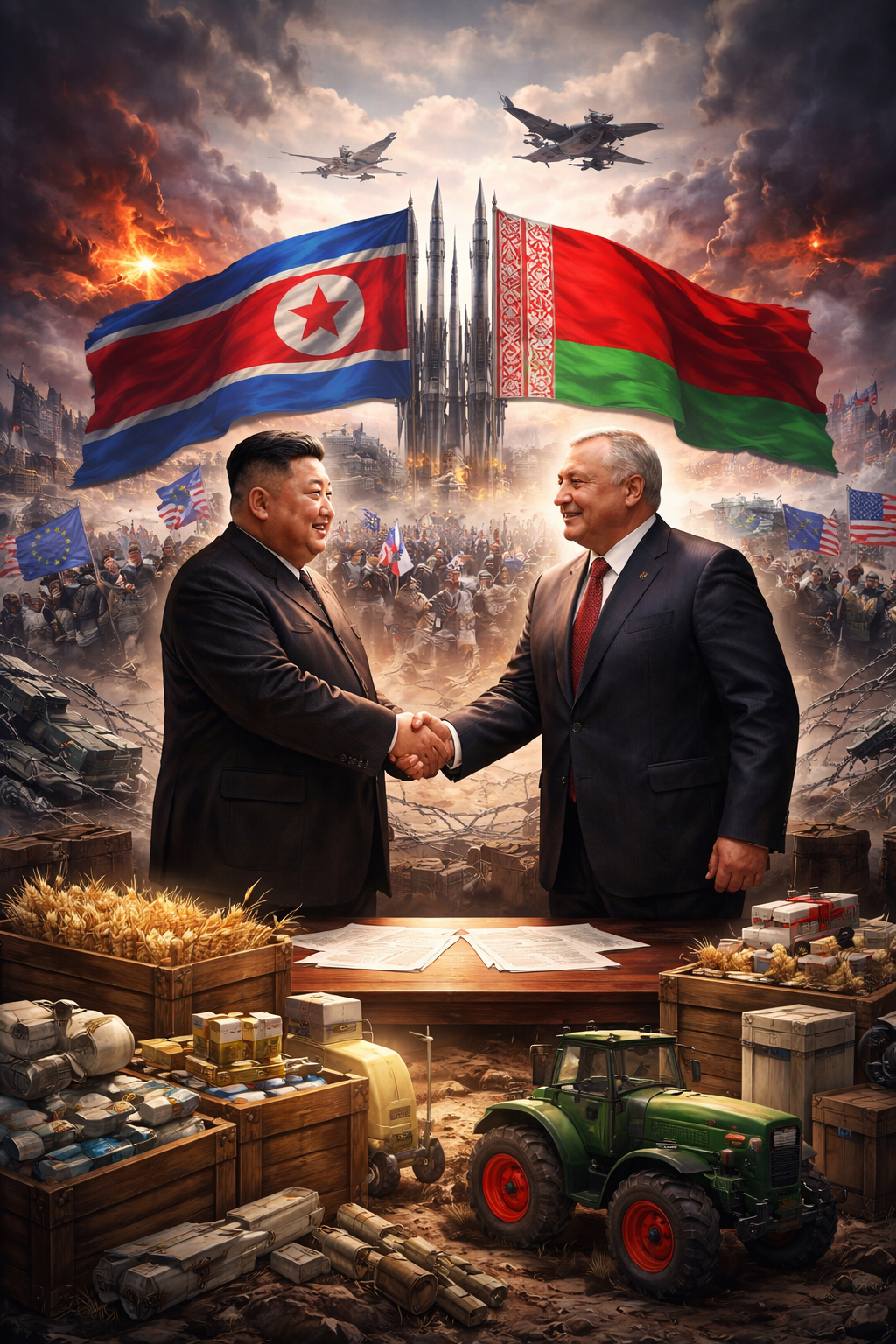
The Independent recasts the DPRK–Belarus treaty as suspicious alignment while obscuring sanctions, war, and coercion shaping both states. The actual record shows concrete agreements across food, healthcare, industry, and education built through ongoing diplomatic coordination. These developments emerge from Korea’s imposed partition, Belarus’s post-Soviet Western pressure, and their shared positioning alongside Russia in the Ukraine war. What the outlet frames as dangerous alignment is in fact the rational adaptation of states operating under sustained imperial constraint.
By Prince Kapone | Weaponized Information | March 26, 2026
The Spectacle and the Silences
“North Korea and Belarus sign ‘fundamental’ treaty as Lukashenko visits Kim in Pyongyang”, published by The Independent on 26 March 2026 and written by Namita Singh, presents itself as straightforward international reporting, but it performs a more familiar labor for liberal imperial media: it takes a diplomatic event, strips it of its material depth, dresses it in suspicion, and then hands it back to the reader as proof that the enemies of the West are forever scheming in the shadows. The article tells us that Belarusian president Alexander Lukashenko’s visit to Pyongyang marks a “new stage” in relations with the DPRK, but it refuses to let that fact stand on its own feet. Almost immediately, the treaty is dragged into the gravitational field of Russia and the Ukraine war, where the reader is instructed to understand it not as a bilateral development with its own institutional logic, but as one more dark ripple in the great pool of geopolitical menace. The message is subtle only in the way a brick through a window is subtle: do not ask what these states are building, only ask what danger they pose to the order that claims the right to police the world.
This is how the piece does its ideological work. It begins with the formal event itself, the signing of a cooperation treaty in Pyongyang, but then pivots quickly to the now obligatory catechism of Western narrative discipline: North Korea is aiding Russia, Belarus is aligned with Moscow, sanctions hover in the background like a halo of moral righteousness, and therefore the real meaning of the treaty lies somewhere outside the treaty. That is the first trick. The actual subject is displaced by a larger frame already loaded with approved anxieties. The Belarus–DPRK relationship is not permitted to appear as a relation with history, agency, and concrete motives. It must instead appear as a symptom of a pathology already diagnosed by the imperial newsroom. The article does not investigate the internal content of the agreement with any seriousness. It does not ask what ministries are involved, what sectors are being developed, what institutional channels are being revived, or why both sides describe the agreement as foundational. It gives us the diplomatic shell and withholds the political economy.
The second trick lies in the hierarchy of voices. When Belarusian and DPRK officials speak, they are permitted mostly ceremonial language: friendship, cooperation, a new stage, a legal foundation. Their speech is treated as ritual, almost decorative, the sort of grandiloquent theater one expects from states that Western media has already filed away under the category of the suspect and the unserious. But when interpretation is needed, when the article wants us to know what the visit really means, authority migrates elsewhere—to South Korea’s unification ministry, to unnamed analysts, to the silent background assumptions of Atlantic common sense. This is not an accident. It is the article’s epistemological caste system. The states actually making the agreement may speak, but only as actors in costume. Their rivals, adversaries, and the broader Western interpretive machine reserve for themselves the right to explain reality. One can almost hear the old colonial whisper beneath the modern prose: the natives may perform, but the empire will interpret.
Then comes the selective concreteness, that old journalist’s hustle where some things are painted in thick, vivid strokes while others are left conveniently blurry. The article is perfectly capable of specificity when speaking of the allegations that North Korea has sent troops, shells, missiles, and rocket systems to support Russia, or that Belarus hosts Russian forces and weapons. But when it comes to the treaty itself, the language suddenly turns foggy. It is “fundamental.” It marks a “new stage.” It is a “foundation for future ties.” Fine phrases, but what do they amount to? The article has no urgency about finding out. It does not seem especially curious about the content of what was signed, only about the opportunity to place the event inside a ready-made script of authoritarian convergence. Suspicion is rendered in hard outline, while cooperation is dissolved into vapor. That imbalance is not a flaw in the article’s construction. It is the construction.
The ceremonial details are handled with equal ideological care. We are treated to the 21-gun salute, the military honors, the goose-stepping parade, the mausoleum visit, the floral tributes, the solemnity of state ritual. The cumulative effect is not informative so much as theatrical. The diplomacy is aestheticized into spectacle, and the spectacle is made to carry the burden of interpretation. There is a long and disreputable tradition in Western writing about non-Western or official enemies: turn every ceremony into evidence of unreality, every formal protocol into a kind of exotic pantomime, every state visit into an operatic performance of strange men in stranger systems. The reader is nudged to smirk before they are asked to think. The article does not say outright that these states are absurd, archaic, or theatrical by nature. It does something more efficient. It arranges details so that the reader arrives at that conclusion on their own, imagining themselves clever while merely being led by the nose.
Its treatment of sanctions is another small masterpiece of liberal sleight of hand. We are told that both Belarus and the DPRK are under extensive Western sanctions, but this fact is presented as though it were self-explanatory, almost meteorological, like cloud cover or humidity. Sanctions appear not as instruments of coercion imposed by definite powers with definite goals, but as a kind of natural moral atmosphere surrounding disobedient states. No effort is made to explain what these sanctions actually do: how they constrict trade, banking, transport, procurement, development, medicine, food systems, or diplomatic maneuver. In the article’s moral universe, sanctions do not need explanation because they are assumed to be expressions of justified displeasure. Their function is not analytical but liturgical. They certify virtue on one side and vice on the other. The material world disappears, and in its place we get a morality play for adults who still need fairy tales.
What finally gives the game away is omission. The article itself notes that Belarus and the DPRK established relations in 1992 and that a trade and economic cooperation committee was reactivated last year. That is not a small detail. It is a door into the actual story. Yet the article refuses to walk through it. What had the committee been doing? Which sectors were under discussion? What changed in 2025 and 2026? What are the concrete motivations driving the relationship? Why were ministers from health, education, foreign affairs, and industry part of the delegation? These are the questions that would allow the reader to see the event historically and materially. But those are precisely the questions the article cannot afford to center, because once the event is grounded in institutions, sectors, and state priorities, the fog begins to lift. And when the fog lifts, the liberal narrative loses one of its favorite toys: the power to portray every move by sanctioned or targeted states as irrational theater, shadowy conspiracy, or the inevitable behavior of official villains.
Namita Singh writes from the professional location of a liberal correspondent trained to move through the grammar of strategic affairs, human-rights-coded state narration, and conflict reporting. The Independent, for its part, speaks from the social world of commercial liberal media, where moral seriousness is brand identity and neutrality is sold like bottled water—clean, portable, and rarely examined at the source. Together, writer and outlet do not simply report an event. They stage-manage its meaning. The result is a piece that appears calm, informed, and responsible, while quietly narrowing the reader’s imagination. The treaty is announced, but its substance is evacuated. The actors are quoted, but their agency is reduced. The scene is rendered in vivid ceremonial detail, while the actual machinery of cooperation is pushed offstage. By the end, the reader has been shown a great deal and told almost nothing. That is often how propaganda works in liberal dress: not by screaming lies, but by choreographing attention so carefully that truth never gets a chance to enter the room.
The Material Ground Beneath the Ceremony
Once the pageantry is pushed aside and the record is rebuilt from the documents and official statements themselves, the visit to Pyongyang stops looking like a vague diplomatic spectacle and starts looking like what it plainly was: the formal deepening of an already developing state relationship. KCNA’s account of the summit states that Kim Jong Un and Alexander Lukashenko signed a Treaty on Friendship and Cooperation, while Belarusian official reporting after the summit described the visit as the opening of a “fundamentally new stage” in bilateral relations and linked it to the expansion of a legal framework for future cooperation. This was not some improvised handshake between men in uniforms under giant portraits. It was an institutional act, signed at the head-of-state level and backed by a cluster of agreements designed to make the relationship operational.
Belarusian officials had said so in advance. Before the visit began, Belarusian foreign minister Maxim Ryzhenkov told the press that Minsk expected the trip to yield one foundational treaty and roughly nine additional agreements linking ministries and institutions in agriculture, education, healthcare, chambers of commerce, agricultural science, and information. KCNA’s summit report then confirmed that additional agreements were signed in diplomacy, information, agriculture, education, and public health. That matters because it tells us the visit was not being treated by the participants as symbolic theater but as a juridical and administrative consolidation of ties.
Nor did this begin in March 2026. In 2025 the DPRK and Belarus held the third session of their intergovernmental joint committee for trade and economic cooperation in Pyongyang, where the agenda included agriculture, machine-building, public health, trade, and education. During the October 2025 meeting between the Belarusian and DPRK foreign ministers in Minsk, both sides publicly committed themselves to expanding cooperation in political, trade-economic, humanitarian, and other fields, while also pledging mutual support in international forums. The March 2026 treaty therefore did not create a relationship out of nothing. It formalized a relationship that had already been revived through ministerial meetings, committee sessions, and administrative preparation.
What the article leaves blurry, these sources make concrete. Belarusian reporting on the visit made clear that the relationship is being built not only through summit rhetoric but through ministries, sector agreements, and targeted economic coordination. That same reporting stated that Belarus wants to expand supplies of food and pharmaceuticals to the DPRK, while also considering imports of DPRK consumer goods such as cosmetics as part of a broader effort to diversify trade and widen non-Western exchange channels. Belarusian ministers then filled in the rest of the picture on the ground in Pyongyang: the healthcare side emphasized pharmaceuticals, treatment, and sanitary-epidemiological cooperation; the education side pointed to engineering, agribusiness, and natural-science training; the industrial side raised agricultural machinery, tractor production, mechanical engineering, and tram modernization. These are not decorative categories. They are sectors tied directly to food production, public health, transport, technical labor formation, and industrial maintenance—the ordinary means by which a state reproduces everyday life under pressure.
This material content matters even more once the sanctions environment is stated plainly instead of being waved around like a moral badge. The UN’s own summary of the DPRK sanctions regime shows that the restrictions reach crude oil supplies, while Security Council Resolution 2397 tightened the cap on refined petroleum products to 500,000 barrels per year. On the Belarus side, the Council of the European Union states that economic sanctions target Belarus’ financial, trade, energy, transport, technology, and defence sectors, and its 2024 sanctions renewal notice specifies that Belarus remained under restrictions covering finance, trade, dual-use goods, technology, telecommunication, energy, and transport, alongside asset freezes and travel bans applied to hundreds of individuals and dozens of entities. Once those restrictions are named concretely, the sectoral choices in the treaty stop looking mysterious. Food, medicine, machinery, technical education, and transport systems are precisely the kinds of things states under pressure seek to secure through alternative channels.
The Korean side of the story also becomes much sharper once the historical baseline is stated honestly. The U.S. State Department’s own historical summary of the Korean War acknowledges that during World War II the United States and the Soviet Union agreed to divide Korea at the 38th parallel in order to oversee the removal of Japanese forces. That outside-imposed partition did not disappear; the same official history notes that the 1953 truce “crystallized the division between North and South that exists today.” The armistice agreement itself ended large-scale hostilities but did not create a final peace settlement, which means the DPRK continues to operate under the legacy of imposed partition preserved by an unresolved armistice structure. That is not interpretation piled on later; it is the legal and historical terrain under which the state still functions. In April 2025, the commander of U.S. Forces Korea told Congress that the NDAA maintained a manpower floor of 28,500 U.S. servicemembers in the Republic of Korea. So when the DPRK seeks new external partnerships, it does so under the continuing reality of outside-imposed division, armistice without peace, and permanent U.S. military presence on the peninsula.
Belarus needs the same historical seriousness, because the pressure on Minsk did not begin in 2020 like rain beginning on the hour for the convenience of a weather app. NATO’s own chronology states that relations with Belarus began in 1992, that Belarus joined the Partnership for Peace in 1995, and that its diplomatic mission to NATO opened in 1998. On the EU side, the European External Action Service identifies Belarus as one of the original Eastern Partnership countries, while the EU’s Belarus page records negotiations on Partnership Priorities, visa facilitation, and readmission agreements during the 2010s. In plain terms, Belarus has lived through sustained Western political pressure and disciplinary interference since the Soviet collapse: first through partnership frameworks, engagement, and conditionality meant to pull it into a Euro-Atlantic orbit, and later through downgrade, sanctions, and political punishment when that integration did not proceed on acceptable terms. The relationship was never only one of sanctions, nor only one of partnership. It was a long sovereignty struggle conducted through alternating incorporation attempts and disciplinary measures.
The EU’s own account of relations with Belarus says that the period of improved ties “came to a halt” around the 2020 election crisis, that the EU then scaled down relations with the Belarusian authorities, redirected assistance toward Belarusian civil society and opposition-oriented sectors, and in 2021 Belarus suspended its participation in the Eastern Partnership. Belarusian official discourse in 2026 continued to characterize sanctions as “illegal interference in internal affairs,” while Lukashenko’s 2021 address to the Belarusian People’s Congress framed the crisis as a failed “blitzkrieg coup.” Whether one accepts Minsk’s language or not, it remains a politically relevant fact that the Belarusian state reads the post-Soviet period not as a neutral disagreement with the West but as a prolonged sovereignty struggle involving institutional pressure, political conditionality, sanctions, and destabilization attempts. That baseline gives the Pyongyang trip more weight than the article allows.
The military and strategic alignment also needs to be stated without fog. NATO says Belarus enabled Russia’s full-scale invasion of Ukraine and continues to enable the war by making its territory and infrastructure available to Russian forces. The EU’s June 2024 sanctions package against Belarus was adopted explicitly “in view of the regime’s involvement in Russia’s war of aggression against Ukraine,” and the EU sanctions timeline repeatedly describes new measures as responses to Belarus’ complicity in that war. On the DPRK side, Reuters reported on 26 March 2026 that Kim and Lukashenko were already known as supporters of Putin’s war effort, with the DPRK linked to troops and munitions and Belarus linked to territorial access, logistical depth, and the hosting of Russian capabilities. So the point should be made cleanly: Belarus and the DPRK were already aligned with Russia inside the same Ukraine-war strategic camp before this treaty was signed, and the treaty formalizes and deepens a relationship inside that preexisting alignment rather than creating it from scratch.
Placed back in its proper context, the treaty stops looking like exotic theater and starts looking like a rational development between two states operating under sanctions, military pressure, and strategic encirclement. The sectors named in the agreements matter because they answer problems of state reproduction under siege. The Korean security logic matters because it is rooted in outside-imposed partition and armistice without peace. The Belarusian turn eastward matters because it comes after decades of post-Soviet Western engagement, pressure, suspension, and sanction discipline. And the Russia factor matters because the two states were already situated on the same side of a wider strategic confrontation before the pen touched the paper in Pyongyang.
When Sanctions Build Bridges
What we are looking at here is not an aberration, not a strange diplomatic detour taken by two so-called “isolated regimes,” but a predictable development in a world system that punishes disobedience and then expresses shock when the punished begin to cooperate with one another. The liberal narrative would have us believe that Belarus and the DPRK have discovered each other in some shadowy corner of geopolitical intrigue, drawn together by a shared taste for authoritarian theatrics. But the material record tells a far more grounded story. These are states operating under sustained external pressure—economic, military, and diplomatic—and their cooperation emerges not from irrational impulse but from necessity. When a system is designed to exclude you, you either submit to it or you find ways to live outside it. This treaty is one such way.
The first thing that must be understood is that coercion is not a passive condition. It is an active force that reorganizes behavior. Sanctions do not simply punish; they compel adaptation. They redraw trade routes, reconfigure alliances, and force states to reconsider where they source food, medicine, machinery, and knowledge. In this sense, the treaty between Belarus and the DPRK is not merely a political gesture. It is an infrastructural response to exclusion. It is the attempt to build alternative circuits of exchange in a world where the dominant circuits are increasingly weaponized. The irony, of course, is that the very system that seeks to isolate these states ends up pushing them into each other’s arms. Empire closes doors and then feigns surprise when new doors are constructed elsewhere.
What liberal commentary refuses to grasp—or refuses to admit—is that sovereignty under pressure produces alignment. Not ideological purity, not romantic unity, but practical alignment. Belarus and the DPRK are not identical societies. They do not share the same history, political system, or developmental trajectory. But they do share a condition: both exist within a structure of external constraint that limits their access to global markets, finance, technology, and diplomatic space. That shared condition becomes the basis for cooperation. It is not about friendship in the sentimental sense; it is about survival in the material sense. When your access to medicine is restricted, you look for partners who can supply it. When your machinery imports are constrained, you look for partners who can produce or exchange it. When your engineers need training, you look for institutions willing to teach them. This is not ideology. This is reproduction—of life, of labor, of the state itself.
The deeper contradiction exposed here is one that runs through the entire imperial system. The same powers that insist on the free movement of capital, goods, and services erect barriers when those movements threaten their dominance. They celebrate globalization when it benefits them and weaponize isolation when it does not. In doing so, they create a fractured global economy in which access is conditional, contingent, and politically policed. States that fall outside the approved order are expected to endure this condition quietly, to accept stagnation or collapse as the price of defiance. But history has rarely worked that way. Pressure generates counter-pressure. Exclusion generates alternative inclusion. The treaty we are examining is one small expression of that larger dynamic.
This is why the fixation on “authoritarian alignment” is so misleading. It substitutes moral labeling for structural analysis. It tells us who to fear without explaining why things happen. It reduces complex material processes to simple ideological categories, as though states were drawn together by personality traits rather than by shared constraints and interests. But the facts tell a different story. These states are building channels in sectors that sustain everyday life—healthcare, agriculture, industry, education. They are not exchanging abstract slogans; they are exchanging the means to function. To dismiss this as mere geopolitical posturing is to misunderstand the basic logic of how societies endure under pressure.
There is also a temporal dimension that must not be ignored. The present alignment is not a sudden deviation but the continuation of long-standing trajectories shaped by war, division, and post-Soviet restructuring. In the case of the Korean peninsula, the absence of a formal peace settlement has left a permanent architecture of tension in place, one that conditions every external relationship the DPRK enters into. In the case of Belarus, the post-Soviet period has been marked by a continuous negotiation over alignment—whether to integrate into Western-led structures or to pursue a more independent path. The intensification of sanctions and political pressure in recent years has narrowed that space for maneuver, making alternative partnerships not just desirable but necessary. What we are seeing, then, is not improvisation but historical continuity expressed under new conditions.
The war in Ukraine adds another layer, but not in the way it is commonly portrayed. Rather than being the cause of this alignment, it is better understood as an accelerant. It has sharpened existing divisions, hardened existing blocs, and intensified the need for states to clarify where they stand and how they will sustain themselves. Belarus’s role as a logistical rear space and the DPRK’s reported support through materiel and manpower situate both within a broader strategic configuration centered on Russia. The treaty does not create this configuration; it reflects and reinforces it. It is an institutional expression of a geopolitical reality already in motion.
What emerges from all of this is a simple but often obscured truth: when the dominant order becomes a mechanism of exclusion, alternatives begin to take shape at its margins. These alternatives are not always coherent, not always stable, and certainly not free of contradiction. But they are real. They are built out of necessity, out of the need to maintain production, to feed populations, to educate workers, to treat the sick, and to preserve a degree of autonomy in the face of external pressure. The Belarus–DPRK treaty is one such construction. It is not a grand ideological project. It is a practical response to a world that has made normal participation contingent on submission.
The liberal narrative would have us see danger where there is, in fact, adaptation. It would have us interpret cooperation among sanctioned states as evidence of instability rather than as evidence of resilience. But once the material conditions are brought back into view, the picture changes. What appears as alignment of the condemned begins to look like the self-organization of the excluded. And that, more than any ceremonial display or rhetorical flourish, is the real story taking shape beneath the surface.
From Understanding to Organization
If analysis does not move, it hardens into decoration. And there is no shortage of decoration in the imperial core—opinions stacked on opinions, outrage piled onto outrage, while the machinery of war and sanctions continues to grind forward without interruption. The task before us is different. It is to translate clarity into alignment, and alignment into organized force. The treaty between Belarus and the DPRK is not something to be passively observed from a distance like a spectator sport. It is a signal of how the world is reorganizing under pressure, and therefore a signal of where struggle must sharpen.
The first terrain is the Korean peninsula, where the unresolved war structure continues to justify permanent militarization. Organizations like US Out of Korea—a campaign associated with Nodutdol—are already doing the work of confronting that structure directly. They organize protests against joint U.S.–ROK war exercises, build political education around the unfinished nature of the Korean War, and insist on a peace settlement where the dominant powers insist on perpetual tension. Their organizing matters because it connects the abstract language of “security” to its material consequences: troop deployments, weapons systems, and the constant threat of escalation. To engage here is not symbolic. It is to intervene in one of the central pressure points of the global military order.
The second terrain runs through the bodies and experiences of those who have been used to sustain that order. Veterans For Peace provides a structure through which former soldiers—those who have seen the machinery from the inside—can turn against it. Their financial disclosures and public reporting make clear that they operate outside the orbit of the usual imperial foundations, and their campaigns continue to expose the human cost of endless war. When veterans speak against militarization, they puncture the mythology that sustains it. They remind the public that war is not an abstraction but a system that consumes lives, resources, and futures. Organizing alongside them means amplifying a contradiction the state struggles to contain: those trained to fight refusing to legitimize the fight.
The third terrain lies in the possibility of refusal itself. About Face: Veterans Against the War builds networks among post-9/11 veterans to challenge militarism at its roots, creating spaces where service members and former service members can question, resist, and ultimately reject participation in imperial warfare. Their work extends beyond protest into the cultivation of dissent within the very institutions tasked with enforcing state violence. This is not a small thing. Empires rely not only on weapons but on obedience. When that obedience fractures, even slightly, the system begins to strain. Supporting such organizing means helping to widen those fractures.
But organization is not only about joining existing groups. It is about linking struggles across terrains. The sanctions imposed on states like Belarus and the DPRK are not isolated policies; they are part of a broader strategy that disciplines entire populations by restricting access to food, medicine, and development. To oppose sanctions is therefore not to defend any particular government uncritically, but to reject a form of collective punishment that falls most heavily on workers, peasants, and the poor. This requires building campaigns that connect local conditions—rising costs of living, austerity, the diversion of public funds into military budgets—to the global structures that produce them. When a community organizes against cuts to healthcare while billions are allocated to military expansion, the link must be made explicit: this is the same system at work, the same priorities enforced.
The practical steps are neither mysterious nor glamorous. They involve forming study groups that move beyond surface narratives, organizing public forums that bring together veterans, workers, and diasporic communities, and pushing for resolutions in unions, student organizations, and local councils that oppose war drills, troop expansions, and sanctions regimes. They involve building independent media and communication channels that can counter the constant flow of imperial framing. And above all, they involve discipline—the slow, often uncelebrated work of building relationships, sustaining organizations, and developing political clarity over time.
To declare solidarity is easy. To practice it is harder. It means recognizing that the struggles of people in Korea, Belarus, and elsewhere are not distant curiosities but connected fronts in a larger conflict over how the world is organized—who controls resources, who decides the terms of exchange, who lives under threat and who profits from it. It means rejecting the comfort of passive critique and stepping into the discomfort of collective action. The treaty we have examined is one small piece of a shifting global landscape. The question is whether we remain observers of that shift or become participants in shaping what comes next.
 Weaponized Information
Leave a comment