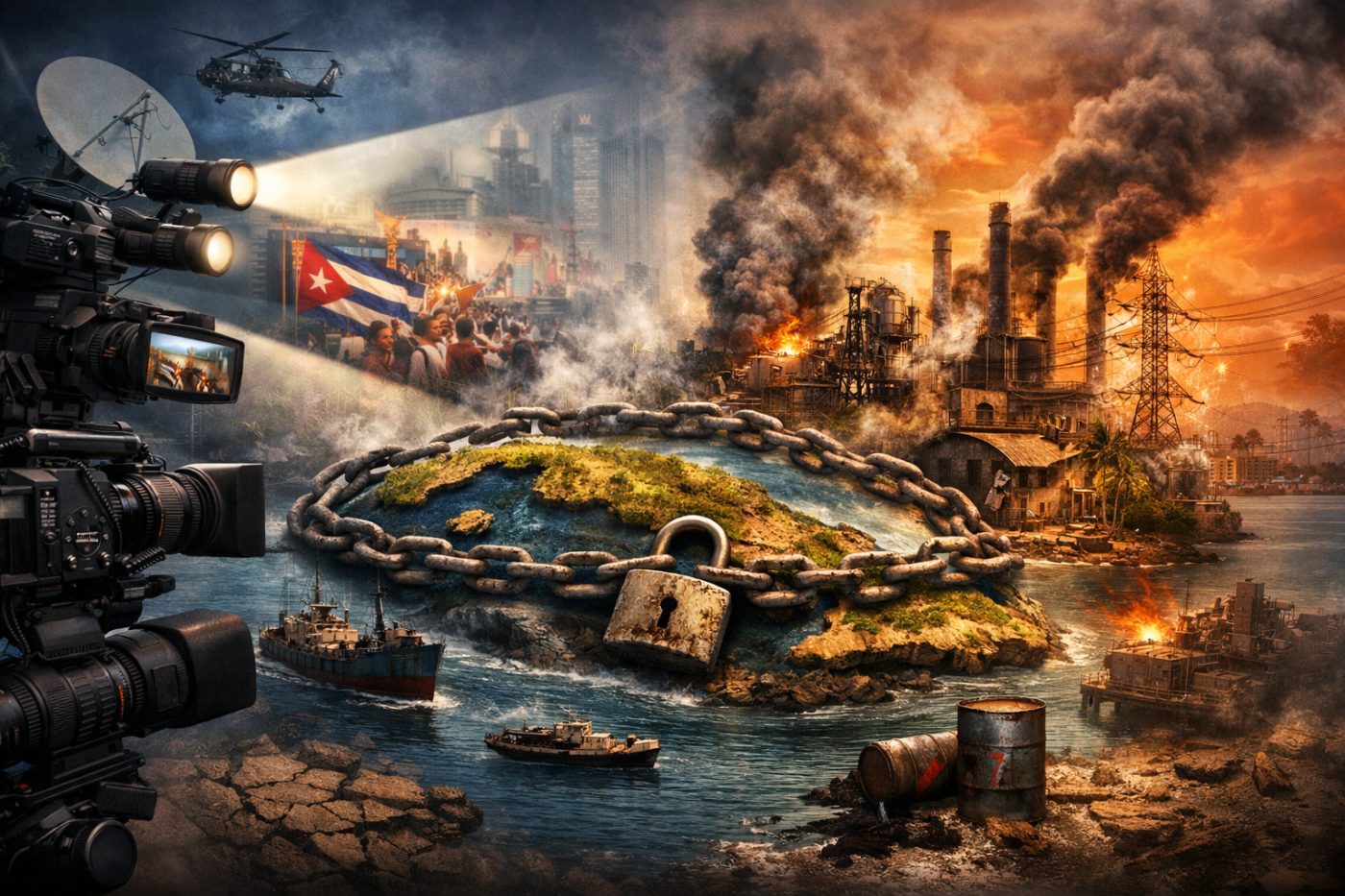
NBC’s coverage frames Cuba’s economic adjustment as a dramatic crisis, but a close reading of the article reveals the narrative techniques and framing devices used to construct that impression. Beneath the headline lies a far denser economic terrain shaped by sanctions, energy shortages, inflation, and the long search for productive stability under siege. When these omitted facts are placed back into their historical and geopolitical context, the story shifts from a morality tale about governance to a case study in how imperial pressure structures development in the Global South. The task that follows from this excavation is not simply interpretation but solidarity: connecting workers, movements, and international campaigns already organizing to end the blockade and defend national sovereignty.By Prince Kapone | Weaponized Information | March 16, 2026
When a Reform Is Written Like a Distress Signal
NBC’s “exclusive” on Cuba’s decision to allow nationals living abroad to invest in and own businesses on the island arrives dressed up as economic reporting, but it moves like something else. It does not begin from curiosity about what Cuba is actually doing, why it is doing it, or how the policy is being articulated by Cuban officials in their own national context. It begins from the assumption that Cuba stands before the reader as a problem already solved in advance: a besieged and failing state, staggering under hardship, now forced at last to loosen its grip and make terms with reality. The policy itself is therefore not introduced as a strategic choice made by a government navigating difficult conditions. It is introduced as if it were the gasp of a wounded body. That is the first ideological move the piece makes, and like most ideological moves in corporate journalism, it makes it with the smile of neutrality.
Look closely at the rhythm of the article and the trick becomes clear. The reform is announced, but almost immediately the reader is ushered away from the policy as policy and into an atmosphere of strain. The economy is “ailing.” The official in charge is trying to “breathe life” into it. There is an energy crisis. There are protests. There is pressure. There is Trump hovering in the background like a landlord tapping the bat against his palm while the tenant fumbles for the rent. By the time the reader has finished the piece, the reform no longer appears as a decision that may have emerged from a longer internal process of debate, adjustment, planning, or tactical experimentation. It appears as an emergency concession extracted by chaos. That is not a matter of facts alone. It is a matter of sequencing, tone, and narrative architecture. In other words, it is a matter of propaganda craft.
The article’s real labor is not to explain Cuba’s policy. Its labor is to domesticate the meaning of that policy for a U.S. audience trained to read socialist and postcolonial states through the vocabulary of exhaustion, breakdown, and inevitable surrender. So the story gives us a reform, yes, but never lets that reform stand upright on its own legs. It must be tethered to blackouts, unrest, and American threats, so that the reader encounters not an act of governance but a scene of weakening. Corporate journalism has a thousand ways of saying the same old thing: that any state which resists full subordination to the imperial order is either irrational, collapsing, or secretly begging to be normal. Sometimes the line is barked like a Pentagon spokesman. Sometimes it is poured gently into the ear like warm soup. NBC, here, chooses soup.
Another thing worth noticing is how the article carefully centers the United States even while pretending to report on Cuba. The Cuban announcement is supposedly the subject. Yet the gravity of the piece keeps bending northward. Trump’s remarks are given dramatic force. Washington’s pressure becomes part of the emotional background music. The narrative field is arranged so that Cuba appears not as a country acting in history, but as a country reacting under the shadow of the United States. This is one of the oldest habits in imperial reporting: the inability to imagine smaller nations as subjects of their own political motion. They are permitted to appear, but mainly as objects of pressure, cautionary tales, or pieces on a board moved by hands elsewhere. Even when the article quotes Cuban officials, the larger frame into which those quotations are inserted remains unmistakably imperial. Cuba speaks, but NBC decides what kind of speech the reader is hearing.
Then there is the matter of juxtaposition, that sly little art by which one political story is made to borrow emotional residue from another. The piece swerves into Venezuela, Maduro, raids, weapons charges, narcotics charges, and oil disruption. We are told this in an article about Cuba’s investment policy. Not because the article is trying to patiently map a full and coherent regional history, but because association itself is doing the work. Cuba need not be directly accused of everything that attaches to Washington’s enemy list. It need only be placed in the same corridor of images and names. This is how corporate narrative launders insinuation. It does not always say, “these are the same.” It simply teaches the reader to feel them as neighbors in the same house of disorder. By now the trick is ancient, but imperial editors still use it because it still pays rent.
The visual rhetoric of unrest deepens the point. Protest images are not incidental decorations hanging around an otherwise analytical report. They are part of the report’s argument. Stones, fire, confrontation, disturbance: these appear not as carefully investigated political expressions with their own content and social composition, but as visual proof that the national situation is combustible. This is the magic of bourgeois news imagery. It transforms the photograph into a little deputy sheriff. No theory is needed, no historical memory, no social explanation. The image whispers: look, things are breaking down. Once that whisper enters the bloodstream, the article no longer needs to openly argue that the reform is a forced retreat. The whole presentation has already done that work through mood.
What makes this kind of writing so effective is that it does not feel hysterical. It feels measured. It sounds reasonable. It adopts the polished diction of professional concern. That is precisely why it matters to study it closely. The loud propagandist is easy to spot; he comes into the room waving the flag and sweating on the furniture. The more dangerous propagandist adjusts his tie, lowers his voice, and tells you he is merely reporting developments as they unfold. He does not rant about empire. He simply narrates the world from inside its assumptions. In this case, the assumption is that Cuba’s every motion must be interpreted through stress, fragility, and proximity to U.S. power. The article never has to declare this openly because it has already arranged the furniture of the narrative so that no other reading feels natural.
And that, finally, is the genius of the piece in the worst sense of the word. It takes a policy announcement that could have opened serious questions about governance, development, diaspora relations, and national strategy, and it presses all of that into a narrower emotional mold. The reader is encouraged to see a government on the defensive, a society under strain, and an island whose significance still lies largely in how it appears to Washington. The result is not a lie in the crude sense. Corporate propaganda usually aims higher than that. It aims to narrow the imaginable. It gives you selected fragments, ordered in just the right way, until the conclusion arrives in your mind wearing your own clothes. That is why this article must be excavated. Because beneath the language of reform and reportage, it is really doing the old imperial job: teaching the audience how to read a besieged nation without ever asking who laid siege to it in the first place.
The Economic Terrain Beneath the Headline
To understand what NBC presents as a fresh and dramatic turn, we have to step away from the theater lighting and look at the ground itself. Cuba’s decision to open greater space for nationals living abroad to invest in and own businesses on the island did not appear out of thin air, nor did it fall from the sky in response to a single bad week of blackouts or a single burst of public anger. It emerged inside a longer process of economic adjustment that Cuban authorities had already been discussing in public terms. In early March 2026, the Cuban leadership was calling for urgent transformations in the economic and social model, with priorities including macroeconomic stabilization, increased foreign-currency earnings, and the development of national production, especially food. That matters because it places the NBC story inside a policy continuum rather than a sudden moment of panic.
The institutional framework for foreign capital had also been in place well before this week’s headlines. Cuba’s foreign investment regime continues to rest on Law No. 118/2014, and by February 2026 the country’s official investment portfolio had grown to 426 projects worth more than $30 billion, distributed across 13 sectors and all provinces of the country. A November 2025 report described new measures to flexibilize and dynamize foreign investment, including financial, banking, and territorial initiatives meant to operate with greater autonomy and speed. In other words, the relevant fact is not simply that Cuba is now “allowing” something. The more important fact is that the state has already been searching for ways to widen productive and financial space while preserving an organized national framework for development.
The macroeconomic background is harsh and cannot be brushed aside. Cuba’s official GDP publication for January–December 2024 provides the national statistical baseline from which the current strain must be understood, while ECLAC’s late-2025 regional projections estimated that Cuba would register -1.5% real GDP growth in 2025 and only 0.1% in 2026. Inflation has also remained elevated. According to ONEI’s August 2025 CPI bulletin, cumulative inflation for the year through August stood at 10.05%, with a 15.21% year-over-year increase. Those are not small figures. They help explain why questions of prices, purchasing power, access to imports, and productive bottlenecks weigh so heavily on ordinary life. They also show why any serious account of Cuban policy has to begin with material conditions rather than with the moral melodrama so beloved by imperial newsrooms.
Tourism, one of the sectors most often asked to carry the burden of foreign-exchange recovery, remains under pressure as well. ONEI’s tourism statistical publications and its January 2026 visitors release show that the state continues to monitor a sector that remains vital for revenues but unstable in performance. That instability matters because Cuba’s search for investment, foreign exchange, and productive partnerships is not happening in a vacuum. It is happening in an economy where major revenue streams remain uneven, where imports are expensive, and where every shortfall in hard currency ripples outward into fuel, food, maintenance, transport, and the daily arithmetic of survival.
No honest account of this terrain can ignore the blockade. The United Nations General Assembly once again adopted a resolution on the necessity of ending the economic, commercial, and financial embargo imposed by the United States against Cuba, reaffirming the overwhelming international consensus against Washington’s policy. The Cuban government’s annual report on the embargo period from March 1, 2024 through February 28, 2025 states that the blockade caused $7.5561 billion in material damages during that span alone. The point here is not rhetorical inflation. It is that the sanctions regime is not some ceremonial relic trotted out for speeches. It is an active structure of restriction affecting finance, trade, shipping, technology, and the cost of every workaround forced upon the island. Corporate outlets often mention this in passing, the way a landlord mentions a flood after discussing the tenant’s “poor housekeeping.” But the blockade is not background scenery. It is one of the central facts of the case.
The sanctions story is not merely Cuban state rhetoric either. In February 2025, UN human rights experts criticized the United States for reinstating Cuba on the State Sponsor of Terrorism list and called for the lifting of unilateral coercive measures. Then, after a November 2025 visit, the UN Special Rapporteur on unilateral coercive measures issued preliminary findings stating that the measures against Cuba have serious extraterritorial effects and contribute to worsening migration, shrinking birth rates, and vacancy levels that reach up to 50% in parts of the public sector, including health care and education. That is crucial omitted context. It tells us that what is under discussion is not only a stressed economy, but a society dealing with compound pressure that reaches well beyond market transactions and into labor reproduction, demographic stability, and the endurance of public institutions.
The energy crisis sits at the center of this compound pressure. In March 2026, a widespread blackout was linked to a fragile grid and a severe fuel squeeze, while the Associated Press reported that major outages in western Cuba were striking an island already struggling with dwindling oil supplies and a crumbling electrical system. A separate AP report stated that Cuba had gone more than three months without petroleum shipments and was relying on a reduced mix of natural gas, solar power, and thermoelectric generation. People’s Dispatch reported that Washington had warned countries sending oil to Cuba that they could face an additional 10% tariff on goods entering the United States. So when NBC wraps blackouts into its atmosphere of crisis, the missing fact is not small: the energy emergency is bound up with a deliberate external squeeze on fuel access.
Social strain, then, cannot be reduced to a morality play about one-party governance. Protests in places like Morón, disruptions in universities, and the mounting frustration around food and electricity are real enough, and recent AP reporting has described demonstrations, arrests, and student sit-ins connected to the deterioration of daily conditions. But those conditions themselves are shaped by a larger structure of scarcity, sanctions, fuel disruption, inflation, and stalled growth. When the symptoms are reported without the full anatomy of the illness, the reader is left with a familiar imperial fable: troubled island, troubled government, troubled people. What disappears is the full chain of causation.
There is also a demographic dimension that sharpens the seriousness of the moment. ONEI’s Demographic Yearbook 2024 and its 2025 demographic indicators bulletin indicate a declining and aging population trajectory, while the UN Special Rapporteur linked the country’s deteriorating economic environment to growing outward migration and labor shortages in essential sectors. At the same time, UNDP documentation on productive development in Cuba notes that U.S. sanctions exclude the country from much of the international financial system and constrain firms through financial restrictions that directly affect productive capacity and export strengthening. Put plainly, Cuba is trying to reorganize development under conditions where it is simultaneously short on foreign exchange, short on fuel, short on labor, and obstructed in its access to normal financing channels. Under such conditions, policy shifts toward diaspora capital, foreign investment, and new productive arrangements cease to look like ideological betrayals or sudden confessions of failure. They begin to look like attempts to keep a besieged economy moving.
That is the factual terrain beneath the headline. Cuba is not standing still, and it is not simply improvising in blind panic. It is moving through a prolonged crisis shaped by domestic constraints, external coercion, energy disruption, inflation, weak growth, and the strategic search for new sources of revenue and investment. The NBC story catches one visible moment in that process, but only as a headline event. The larger reality is slower, denser, and far more material. Before anyone starts sermonizing about what Cuba “must” do, it is worth first confronting what has been done to Cuba, what pressures are now bearing down on it, and why this latest opening appears not as an isolated event, but as one more adaptation inside a long struggle to reproduce national life under siege.
Reading the Crisis Through the Structure That Produced It
Once the empirical terrain is laid out plainly, the narrative that frames Cuba’s economic adjustments as a sudden confession of failure begins to dissolve. What appears in the corporate press as a desperate pivot begins to look instead like something far more familiar in the long history of nations confronting concentrated external pressure: adaptation. The reforms discussed in the NBC article—opening space for investment by Cubans living abroad, widening the field of economic activity, and searching for new sources of foreign exchange—belong to a broader pattern in which a small nation attempts to reorganize its productive life under the combined weight of domestic constraints and international coercion. If the story were told from the standpoint of the global working class rather than from the editorial desk of a corporate newsroom, the central question would not be why Cuba is adjusting its economic policies. The central question would be how a country attempts to sustain social life under conditions deliberately designed to constrict its economic breathing space.
The first element in that structure is the blockade. For more than six decades the United States has maintained an economic embargo whose effects reach far beyond bilateral trade. When the United Nations General Assembly overwhelmingly reaffirmed the necessity of ending the embargo, it did so because the measures extend into banking systems, shipping networks, insurance markets, technology transfers, and international finance. The result is not simply that Cuba faces difficulty trading with the United States. The result is that companies across the world must calculate the risk of financial penalties if they trade with Cuba at all. The practical consequence of such a regime is that a transaction that might cost one price for a normal country costs another price for Cuba, because every step requires detours through intermediaries, additional transport routes, and layers of financial caution. In economic terms, the blockade functions less like a wall than like a tightening vise.
The energy crisis that now dominates headlines illustrates how this pressure radiates through daily life. When fuel shipments decline or disappear, the effects ripple outward across the entire productive system. Electricity generation falters, transportation slows, food distribution becomes more difficult, and industrial maintenance is delayed. Recent reporting on widespread blackouts and a prolonged interruption in petroleum shipments demonstrates how quickly such shocks cascade across a national economy already operating with thin margins of imported energy. Under those conditions the search for new investment channels is not ideological improvisation; it is an attempt to stabilize the circulation of resources that keep hospitals operating, factories running, and households supplied with basic necessities. What corporate narratives portray as a crisis of governance is often better understood as a crisis produced by the collision between economic sovereignty and external restriction.
At the same time, Cuba’s internal economic debates cannot be separated from the country’s long effort to maintain social guarantees in areas that many developing nations have been forced to abandon. The pressures described by international observers—migration, labor shortages in public services, and strain on national infrastructure—are not simply signs of institutional decay. They are signs of the enormous cost of sustaining a system that has historically prioritized universal education, public health care, and social protection in an environment where access to credit, technology, and energy supplies is structurally constrained. When the UN Special Rapporteur reported that sanctions were contributing to labor shortages in key sectors such as health care and education, the statement revealed something important about the nature of the conflict. The policies aimed at isolating the Cuban economy do not only affect markets. They affect the reproduction of the social institutions that hold a society together.
In that light, the Cuban government’s attempt to mobilize investment from its diaspora becomes easier to understand. Millions of Cubans now live abroad, particularly in the United States and Europe. Their remittances already form a crucial component of household income across the island. Opening structured avenues for investment by these communities can be read not simply as a concession to global capitalism, but as a strategic attempt to reconnect national development with a dispersed population whose economic capacity has grown abroad. Many countries—Mexico, China, India, and the Philippines among them—have long used diaspora investment as a component of development strategy. What makes the Cuban case distinct is that these efforts must operate inside an international environment where financial transactions themselves are subject to political scrutiny and restriction.
The broader historical perspective makes the contradiction even clearer. Throughout the twentieth century and into the present, Cuba has existed at the intersection of two competing visions of development. One vision insists that small nations integrate fully into global markets dominated by powerful financial and industrial centers. The other insists that such nations retain a degree of autonomy over their economic trajectory, even if that autonomy requires constant adjustment and experimentation. The tension between those two visions has defined Cuba’s modern history, from the revolutionary reorganization of land and industry in the 1960s to the difficult economic recalibrations that followed the collapse of the Soviet Union in the 1990s. The current reforms therefore belong to a lineage of adaptation rather than to a moment of capitulation.
The language used in corporate reporting rarely captures this dynamic because it treats the socialist project as a static model rather than as a living process. But historical experience suggests that societies confronting long-term economic pressure often develop hybrid strategies that combine planning, public ownership, and selective market mechanisms. The expansion of small and medium enterprises in Cuba, the search for foreign investment, and the potential participation of diaspora capital all form part of that evolving landscape. None of these measures erase the country’s commitment to national sovereignty, nor do they eliminate the structural constraints imposed by sanctions and financial isolation. Instead they reflect the ongoing effort to preserve social stability while navigating a hostile international environment.
From the vantage point of the global working class, the lesson of the Cuban case is not that one economic system has triumphed over another. The lesson is that development itself becomes a battlefield when powerful states attempt to dictate the political and economic orientation of smaller ones. When sanctions disrupt energy supplies, restrict access to finance, and raise the cost of every import, they are not merely tools of diplomacy. They are instruments that shape the living conditions of ordinary people. The debates unfolding inside Cuba today—about investment, production, migration, and the future of the national economy—are therefore inseparable from the wider struggle over who has the authority to determine a country’s path of development.
Seen through this lens, the NBC article captures only the surface of the story. Beneath that surface lies a much deeper process: a society attempting to reorganize its economic life while preserving independence in a world where economic power is concentrated in a few dominant states. The contradictions visible in Cuba today are not unique to the island. They are part of a broader global pattern in which nations seeking to chart their own course must constantly adjust to external pressures. The Cuban case simply makes those pressures visible with unusual clarity.
From Understanding to Solidarity: The Struggle Beyond the Headline
Once the layers of the story are stripped away, the question that remains is not merely analytical. It is political. If the conditions shaping Cuba’s present moment are tied to external economic pressure, financial exclusion, and the deliberate constriction of trade and energy flows, then the responsibility for responding to that reality cannot fall on Cuba alone. The struggle surrounding the island’s economic future is also a struggle unfolding in the political spaces of the countries that enforce or sustain those pressures. In other words, the contradictions revealed by this excavation point outward, toward the global system that structures them. Understanding the problem is only the first step. The next step is deciding what to do with that understanding.
Across the United States and Europe, networks of solidarity have already begun organizing around this very question. The National Network on Cuba, a long-standing coalition of organizations and activists, has worked for decades to expose the human consequences of the blockade and to mobilize public pressure for its removal. Through educational campaigns, national conferences, and coordinated weeks of action, the network has helped bring together trade unionists, students, religious organizations, and community activists who view the sanctions regime not as an abstract policy dispute but as a material obstacle to the wellbeing of ordinary Cubans.
Other formations have taken a similar path from analysis to action. Organizations such as CODEPINK have organized delegations and humanitarian initiatives aimed at breaking the political isolation that sanctions seek to impose. The grassroots movement Puentes de Amor has carried out public campaigns and caravans across cities in the United States calling for the lifting of restrictions on travel, remittances, and economic exchange. Medical solidarity organizations like MEDICC have built partnerships between Cuban health institutions and international public health advocates, demonstrating in concrete terms that cooperation between peoples can flourish even when governments remain locked in confrontation.
These initiatives do not operate in a vacuum. They are part of a broader tradition of internationalist organizing in which working people recognize that economic sanctions and coercive policies imposed abroad often mirror the same structures of power that shape inequalities at home. The logic that restricts Cuba’s access to credit and fuel is connected to the same global economic order that concentrates wealth in a handful of financial centers while leaving much of the world dependent on volatile markets and external capital. When solidarity movements challenge sanctions, they are therefore doing more than defending one country. They are contesting a system that normalizes economic coercion as a tool of international governance.
For workers, students, and community organizations in the Global North, the practical implications of this struggle are clear. It means building political pressure on governments to end sanctions that isolate entire societies. It means strengthening ties between labor movements and international solidarity campaigns so that economic justice is understood as a global question rather than a national one. It means supporting independent media and research initiatives that challenge the narratives of crisis and failure used to justify coercive policies. And it means expanding educational work—through unions, universities, and community groups—so that the historical and economic realities behind sanctions regimes become part of public consciousness rather than remaining buried beneath headlines.
None of these efforts alone will resolve the contradictions facing Cuba today. But they represent the beginnings of a different approach to international relations—one grounded not in punishment and isolation, but in cooperation and mutual development. The more people understand how sanctions function, the harder it becomes for policymakers to maintain them behind the curtain of bureaucratic language and diplomatic routine. Public knowledge has always been one of the most powerful forms of pressure available to social movements, particularly when that knowledge connects the fate of distant communities with the moral and political choices made at home.
In the end, the story excavated here is not only about Cuba. It is about the broader question of whether nations will be allowed to pursue their own paths of development without being forced into submission by economic force. The answer to that question will not emerge from newsrooms or diplomatic briefings. It will emerge from the actions of people who recognize that the struggle for sovereignty and the struggle for social justice are inseparable. When workers, activists, and communities across borders begin to act on that recognition, the pressures shaping Cuba’s present moment become part of a much larger movement to transform the rules of the global system itself.
 Weaponized Information
Leave a comment