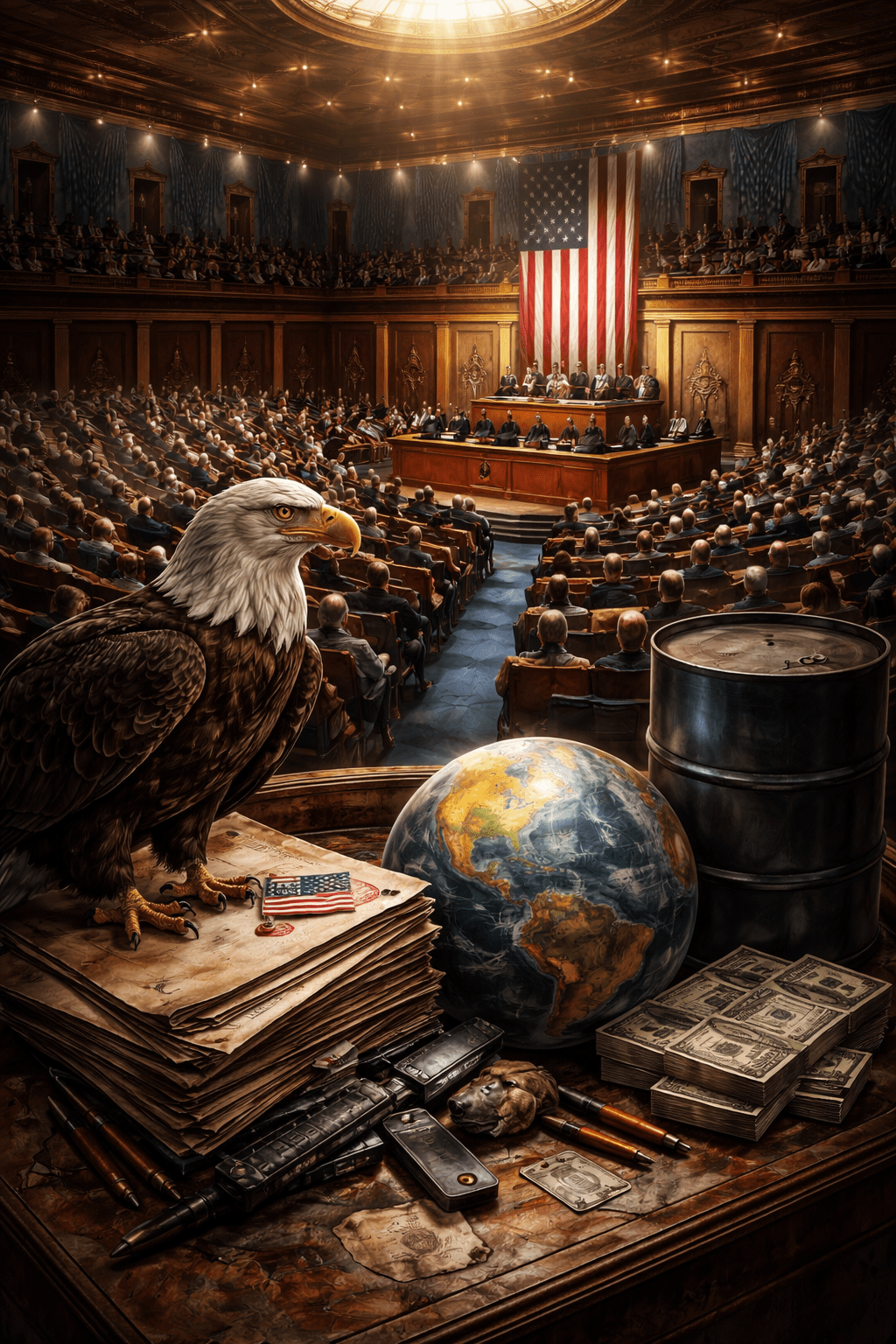
This hearing revealed empire speaking in its managerial voice, not its moral one. Venezuela was treated not as a nation, but as a logistical and political control problem. Bipartisan oversight functioned as maintenance of imperial authority, not restraint upon it. For revolutionaries North and South, the American Pole names the structure we must learn to dismantle.
By Prince Kapone | Weaponized Information | January 29, 2026
Introduction: A Hearing Where Empire Speaks Aloud
On January 28, 2026, the United States Senate Committee on Foreign Relations convened a hearing titled “U.S. Policy Toward Venezuela.” The event — livestreamed and archived by the committee — brought into a Capitol Hill hearing room a constellation of power that is rarely subjected to rigorous public interrogation: the executive branch’s conduct of foreign intervention and the legislature’s response to it. The sole witness was Secretary of State Marco Rubio, appearing before his former Senate colleagues to defend and explain the administration’s extraordinary actions in Venezuela.
At the head of the committee was Chairman Senator Jim Risch of Idaho, who opened the hearing with unambiguous praise for the military operation that abducted Venezuelan President Nicolás Maduro earlier in the month, calling the planning and execution “incredible” and thanking “the brave men and women who participated.” Throughout the session, Risch and other senators from both parties — including Senator Jeanne Shaheen of New Hampshire and Senator Chris Murphy of Connecticut — participated in what was billed as oversight of U.S. policy in Venezuela but functioned as a broader affirmation and management review of an unprecedented use of force.
The hearing took place in the aftermath of the January 3 military operation that kidnapped Maduro and brought him to the United States to face federal drug trafficking charges. Rubio, who also serves as National Security Adviser, defended the action as “a law enforcement operation” rather than an act of war and outlined the administration’s strategic framework for Venezuela in stages — “stabilization,” “recovery,” and “transition” — with eventual “free and fair elections” described as the end goal. Senators pressed him on legality, transparency, economic strategy, and potential future uses of force, but none challenged the basic premise that the United States had the authority to orchestrate such an intervention.
This essay undertakes a Weaponized Information excavation of that hearing — not through abstraction, but by grounding analysis in the record itself: the words spoken, the presumptions embedded in them, and the political logic they reveal. We begin with how the session opens, move through the ideological work performed by key phrases like “law enforcement” and “stability,” and trace how bipartisan consensus around imperial prerogatives was quietly enacted as routine policy discussion. What follows is a close, quote-anchored analysis of power talking to itself, convinced that its own prerogatives are common sense — and in doing so, revealing the architecture of late U.S. imperialism in distress.
“I’d Like to Start by Recognizing the Operation”
The hearing doesn’t open like a courtroom. It opens like a victory parade. The chair doesn’t begin with constitutional questions, legal limits, or even the basic courtesy of acknowledging that another country’s sovereignty has just been smashed. Instead, he offers thanks to the “brave men and women” who carried out the operation and praises the “incredible” planning and execution. We are told, with unmistakable pride, that “only the U.S. could have pulled off this mission.” Before anyone asks whether the United States had the right to do this, we are invited to admire how well it was done. That is not oversight — that is applause.
That opening sets the emotional tone of the entire hearing. The removal of another country’s head of state is treated as a demonstration of American excellence, not as a dangerous precedent in international politics. It is presented as proof of competence and resolve, something to be proud of. Once that mood is in place, serious legal or moral questions start to feel almost impolite, like spoiling the celebration. Empire knows this trick well: cheer first, think later — if at all.
Secretary Rubio then performs the main ideological maneuver of the day. Over and over, he calls Maduro an “indicted narco trafficker,” reminds the committee that there was a bounty on his head, and describes the mission in the language of law enforcement. The president of a sovereign state disappears behind the image of a criminal suspect. The raid becomes the capture of a fugitive, not the forced removal of a head of government. Politics is downgraded; policing is upgraded.
This is not accidental word choice. Once you call it law enforcement, it stops sounding like aggression. Sovereignty starts to look like a technicality, an inconvenience in the way of justice. Rubio reinforces this by emphasizing that the mission was “limited in scope” and “short in duration,” as if the problem with violating another country’s borders is not the violation itself, but whether it was done efficiently. The focus shifts from whether the United States should have done this to how professionally it was carried out.
Even the critics stay inside this cage. Senator Shaheen questions whether the operation was “worth the cost” and whether the follow-up plan will work. But she begins by expressing “admiration for the military operation” and agreeing that Maduro was “bad for Venezuela” and “bad for the United States.” The argument is about management, not legitimacy. The right of Washington to act is assumed; the only debate is over whether the project is being run wisely. That is not anti-imperial opposition — that is performance review.
Then comes the discussion of oil, and the mask slips even further. Rubio calmly explains that Venezuelan oil, once sanctioned, will now be allowed onto the market under U.S. licensing, and that the money from those sales will flow through controlled accounts whose use will be overseen through mechanisms acceptable to Washington. This is described as a way to make sure the funds “benefit the Venezuelan people.” But strip away the polite language and you are left with a simple fact: the United States is positioning itself to supervise how another nation’s main resource is sold and how the proceeds are spent. Colonial trusteeship, updated with spreadsheets.
Put all of this together and the architecture becomes clear. Military force is renamed law enforcement. Regime change is renamed criminal accountability. Resource control is renamed humanitarian stabilization. Praise replaces doubt, and management replaces legality. Sovereignty — the idea that a people get to decide their own political and economic future — is quietly pushed to the side, treated like an outdated formality in the face of U.S. “security” and “stability.” No one stands up to argue that Washington has this authority. They speak as if it is simply how the world works. That is imperial ideology at its most honest: power talking to itself, convinced it is common sense.
“This Was a Law Enforcement Operation”
Once the applause dies down, the real laundering begins. Secretary Rubio insists, with the calm tone of a man describing a tax audit, that this was “a law enforcement operation.” Not an act of war. Not a military intervention. Not regime change. Law enforcement. The phrase is repeated like a spell meant to transform reality itself. If you say it enough times, maybe the helicopters become police cars and the raid becomes an arrest warrant served across a quiet suburban lawn.
But law enforcement presumes jurisdiction. Police operate within a shared legal framework. Courts, treaties, extradition agreements — these are the normal instruments. None of that is present here. The United States did not request custody through international legal channels and receive it through recognized procedures. It sent force into another country and removed its head of state. That is not policing. That is power projection. Calling it law enforcement does not change its nature; it only changes how it sounds on television.
Rubio’s argument rests heavily on the word “indicted.” Maduro is described first and foremost as “an indicted narco trafficker,” as if a U.S. courtroom automatically grants Washington authority anywhere on earth. The logic is breathtaking in its simplicity: once the United States labels someone a criminal, geography becomes optional. Sovereignty dissolves. Borders turn into inconveniences. By this standard, any country could claim the right to snatch foreign leaders so long as it has filed charges at home. Imagine how Washington would respond if another state tried that logic on one of its own officials.
The hearing quietly erases that mirror. Instead, the operation is framed as the natural extension of a bounty that “multiple administrations” had maintained. The continuity is meant to reassure: this isn’t reckless, it’s bipartisan. But bipartisan agreement does not magically turn an international use of force into a police procedure. It only shows that imperial assumptions run deep enough to survive changes of party.
Notice also how the language of restraint is deployed. Rubio emphasizes that the mission was “limited in scope” and “short in duration.” As if the issue with violating another country’s sovereignty is not the act itself, but whether it was done efficiently and wrapped up on time. It is the logic of a well-run break-in: no one got hurt on our side, the job was quick, the team was professional. The question of whether the house was yours to enter in the first place is treated as beside the point.
This rhetorical shift is crucial. Once the operation is accepted as policing, opposition starts to sound like sympathy for criminals. Anyone raising concerns about sovereignty or precedent can be painted as soft on drug trafficking or indifferent to “American lives.” Crime talk does that work. It stirs fear and moral outrage, and in that emotional climate, extraordinary measures feel not only acceptable but necessary. Empire does not always need to shout about glory; sometimes it whispers about safety.
What disappears in this frame is the political nature of what happened. A government was forcibly altered by an external power. That is a geopolitical act with consequences far beyond any courtroom. Yet the hearing keeps dragging the conversation back to indictments, bounties, and fugitives, as if history can be reduced to a police blotter. This is how modern imperialism speaks: not in the language of conquest, but in the language of crime control. The uniform has changed, but the authority claimed is the same.
“We Will Have Oversight Over the Account”
When the discussion turns to oil, the language shifts from handcuffs to spreadsheets. Secretary Rubio explains that sanctioned Venezuelan oil will now be allowed onto the market under U.S. licensing and that the proceeds will be placed into accounts that Washington will help supervise. He states plainly that the funds will be deposited into an account “that we will have oversight over” and that spending will be limited to purposes defined in advance as acceptable. This is presented as a technical stabilization measure, almost like a development program with extra paperwork.
But oil is not a side detail in Venezuela. It is the backbone of the country’s economy, the main source of national revenue, the material basis of social policy and political power. To control how that oil is sold, where the money goes, and how it can be spent is to sit at the nerve center of the state. Rubio describes the arrangement as a way to ensure the funds benefit “the Venezuelan people” rather than corrupt networks. Yet the structure he outlines places decisive financial leverage in U.S. hands. The message, stripped of its polite tone, is simple: access to your own resources now runs through our approval.
This is not described as occupation, trusteeship, or external administration. Instead, it is folded into the language of “stability” and “transition.” Rubio notes that Venezuelan authorities will submit budgets, that categories of spending will be defined in advance, and that mechanisms will be created to monitor how the money is used. The arrangement is portrayed as temporary and pragmatic, a bridge to normalcy. But bridges are built by those who decide where the road goes. The side that designs the rules of spending holds the real power in the room.
What makes this moment so revealing is how unremarkable it is treated. There is no dramatic pause, no acknowledgement that a foreign power is stepping into the financial bloodstream of another nation. Senators ask about auditing mechanisms, account locations, and payment flows the way they might discuss a domestic appropriations bill. The extraordinary becomes administrative. Control is disguised as management.
This is the modern face of imperial economic power. There are no governors in colonial uniforms, no flags being raised over ministries. Instead, there are sanctions regimes, licensing systems, and supervised accounts. The language is softer, but the hierarchy is clear. One state claims the authority to decide when another state can sell its main resource and under what conditions the revenue can circulate. And it is all justified in the name of helping that country recover and eventually become “democratic.”
The colonial story was always that the empire was not taking resources, only safeguarding them from misuse. That logic is alive and well here. Washington presents itself not as an external actor with its own strategic and economic interests, but as a responsible custodian protecting infantile Venezuelans from corruption and chaos. The thief, as the old saying goes, has appointed himself trustee. The hearing does not argue this point; it assumes it. That assumption is the quiet center of the entire project.
“Free and Fair Elections” — After We Set the Table
By the time the hearing arrives at the word “democracy,” the political ground has already been rearranged. Secretary Rubio speaks of the end goal as a “free, fair, prosperous, and friendly Venezuela,” and senators nod along as if this were a neutral aspiration rather than a conditional formula. The sequence matters. First comes “stability.” Then “recovery.” Then a transition shaped through economic restructuring and security cooperation. Only after these phases are underway do “free and fair elections” enter the picture as the desired destination. Democracy is not the starting point; it is the prize at the end of a managed process.
Listen to how the term is used. Elections are described as something Venezuela will be able to hold once the right conditions are in place, conditions defined solely through alignment with U.S. objectives. The oil industry must be normalized. Foreign influence from rivals must be rolled back. Political space must be opened in ways consistent with a controlled transition. Democracy, in this framework, is less a right exercised by a sovereign people and more a certification that the political environment now meets acceptable standards. It is the stamp at the end of the form, not the pen in the citizen’s hand.
This is a subtle but decisive shift. In the classical idea of self-determination, the people choose their government first, and that government then sets the direction of economic and foreign policy. Here, the order is reversed. Economic policy and geopolitical alignment are shaped through negotiations backed by sanctions and leverage, and only then are elections envisioned as the mechanism to legitimize the new arrangement. Sovereignty is not the source of policy; it is the seal applied after policy has been steered into a preferred channel.
Even the discussion of political prisoners fits neatly into this sequence. Their release is treated as a sign of progress in the transition, evidence that the interim authorities are moving in the right direction. Freedom becomes a metric in a broader reform package, not an absolute principle. It is counted, paced, and folded into negotiations. The language of human rights is absorbed into the language of phased compliance.
What makes this powerful is that it sounds reasonable. Who could object to “free and fair elections”? But in the hearing, those elections are never imagined as a process that might produce outcomes Washington dislikes. The assumption is that a properly stabilized and recovered Venezuela will naturally choose leaders compatible with U.S. interests. Democracy is welcome so long as it behaves. The leash is long enough to look like freedom, but the boundaries are already drawn.
So democracy, like law enforcement and stabilization before it, becomes another word doing ideological labor. It provides moral cover for a transition whose key parameters are set outside the country in question. The hearing does not present this as control. It presents it as guidance, partnership, and support. But when one side designs the sequence, defines the benchmarks, and holds the economic levers, the partnership is not between equals. It is supervised autonomy, marketed as liberation.
“We Agree Maduro Had to Go”
One of the most revealing features of the hearing is not what divides the senators, but what unites them. Again and again, members who differ sharply on tone, cost, and diplomatic fallout begin from the same premise: Maduro’s removal was justified. Senator Shaheen says she “shares the chairman’s admiration for the military operation” even as she questions its price and long-term effectiveness. Her critique is not that the United States crossed a sovereign border to remove a head of state, but whether the follow-through plan will succeed and whether American taxpayers will see results. The foundation — the right to act — remains untouched.
This pattern repeats throughout the questioning. Some senators worry that the interim authorities may not distance themselves fast enough from Russia, China, or Iran. Others are concerned about corruption, about whether oil revenues will be properly monitored, or whether the timeline toward elections is realistic. But these disagreements are managerial. They revolve around efficiency, sequencing, and risk. No one mounts a sustained challenge to the idea that Washington can decide when another country’s leadership has become intolerable and act accordingly. Empire is not on trial; only its project management is.
Even the debate over costs stays inside this narrow frame. When senators question whether the operation was “worth it,” they are weighing expenditures against strategic return, not legality against principle. The calculus is imperial bookkeeping: how much influence did we gain, how much did we spend, how stable is the situation now? Missing from the discussion is the possibility that some actions are destabilizing not because they are expensive, but because they assert a right to intervene that others may one day claim for themselves.
This is how bipartisan consensus around imperial power works. One side emphasizes strength and decisive action. The other emphasizes alliances, optics, and sustainability. But both sides accept the underlying architecture: the Western Hemisphere as a zone of U.S. responsibility, rival influence as a problem to be managed, and sovereignty as conditional when it conflicts with Washington’s definition of security. The argument is over how to run the empire, not whether to run it.
What passes for dissent, then, becomes a form of quality control. Senators press for clearer plans, better oversight mechanisms, more coordination with allies. These are real concerns, but they operate at the level of administration, not at the level of structure. The hearing never seriously entertains the possibility that the problem might be the assumption of authority itself. Instead, it assumes that the authority is there and asks only how to exercise it more effectively.
In this sense, the hearing offers a rare, unguarded glimpse into the political culture of U.S. imperialism in decline. The loud disagreements that dominate headlines fade in this setting, replaced by a quieter unity around global management. The parties argue about methods, but they share the map. And on that map, Venezuela is not simply another country. It is a file on a desk, a situation to be handled, a space where U.S. power is expected to operate — with applause at the beginning and oversight questions about the paperwork at the end.
“In Our Hemisphere” Means Under Our Watch
As the hearing unfolds, a phrase keeps returning like a quiet drumbeat: “in our hemisphere.” It sounds geographical, almost innocent, but it carries a heavy political load. When senators and the secretary speak of Venezuela as a problem “in our hemisphere,” they are not just locating it on a map. They are invoking an old doctrine with a fresh coat of paint — the idea that this part of the world falls under a special U.S. security mandate. Rival powers operating there are described not simply as foreign states pursuing their interests, but as intrusions into a space where Washington claims supervisory rights.
Rubio repeatedly frames Venezuela under Maduro as a platform for Iran, Russia, and China, a “base of operation” for adversaries close to U.S. shores. This security narrative does important work. It shifts the focus away from Venezuelan internal politics and toward so-called “great-power competition.” The country becomes a square on a global chessboard. Once that framing is accepted, intervention begins to look less like interference and more like perimeter defense. The Monroe Doctrine reappears, not in nineteenth-century language about European empires, but in twenty-first-century talk of strategic denial and hostile influence.
The logic is straightforward: because the United States has global responsibilities, it must ensure that no rival foothold emerges too close to home. But this logic quietly erases the agency of the countries in question. Venezuela’s relations with other powers are treated not as sovereign policy choices, however contested internally, but as security liabilities to be corrected. The hemisphere becomes a managed space, and the line between partnership and oversight blurs.
What is striking is how rarely this assumption is challenged. Senators may differ on tactics, but few question the premise that Washington has a special right — even an obligation — to shape political outcomes in the region. The language of “our hemisphere” naturalizes this authority. It makes intervention sound like neighborhood maintenance rather than geopolitical assertion. If a problem arises down the street, the responsible neighbor steps in. The metaphor hides the reality that the “neighbor” is a superpower and the “street” contains sovereign nations.
In earlier eras, this doctrine announced itself with gunboats and marines. Today it operates through sanctions, financial controls, and selective partnerships. The tools are more bureaucratic, the language more polished, but the hierarchy remains. The United States positions itself as the ultimate guarantor of order in the hemisphere, the power that decides when a government has strayed too far and when a correction is required. The hearing does not justify this role; it presumes it.
Thus the intervention in Venezuela is woven into a larger strategic story: keeping adversaries out, keeping the region aligned, maintaining a sphere of influence in a world of shifting power. The vocabulary is modern, full of talk of “stability” and “security,” but the structure is familiar. The hemisphere is not just a collection of countries; it is treated as a zone of responsibility. And responsibility, in imperial practice, is often another word for control.
Oversight, But Only of the Paperwork
By the time the hearing moves into its rhythm of questions and answers, something else becomes clear: “oversight” is taking place, but not of the thing that matters most. Senators press for details about timelines, audit mechanisms, diplomatic staffing, and coordination with allies. They ask how funds will be monitored, how fast political prisoners might be released, how the transition will be sequenced. These are not trivial questions. But they orbit around implementation. The core decision — to use force across borders and reshape the political landscape of another country — is treated as settled business.
This is how empire fits inside democratic institutions without appearing to break them. Congress performs its constitutional role, but within boundaries already drawn. The debate is about management, not mandate. Senators speak like board members reviewing a major overseas project: is the plan realistic, are the partners reliable, are the financial controls tight enough? Not once do they step back to ask whether the project itself rests on an assumption of authority that has never been openly granted by the people most affected.
When concerns about consultation or war powers arise, they surface as procedural tensions rather than structural alarms. There is talk of briefings, of what was shared and when, of the balance between secrecy and accountability. These are important institutional questions, but here they obviously function as safety valves. They allow the system to register discomfort without challenging the underlying logic that the United States can and should act as it did. The problem becomes how Congress was informed, not whether the action should have been taken at all.
Rubio, for his part, responds in the language of administration. He speaks of phases, processes, mechanisms, and contingencies. He acknowledges complexity, promises updates, and frames the entire situation as a difficult but manageable transition. This tone reinforces the idea that what is happening is a policy problem to be solved, not a precedent to be scrutinized. The extraordinary is domesticated through bureaucratic vocabulary.
The result is a hearing that looks like democratic accountability in motion while leaving the deepest assumptions of power undisturbed. The legislature questions the executive, the executive explains itself, and both operate inside a shared understanding of the United States as a global manager with special rights in its hemisphere. Oversight becomes a conversation about how to run the machinery of intervention more smoothly, not whether that machinery should be running in the first place.
In this way, the hearing performs a quiet ideological service. It shows that imperial action does not have to bypass democratic forms; it can pass through them, clothed in procedure and policy language. The spectacle of questioning becomes proof that the system is working, even as the most consequential decisions are treated as background facts. Democracy, here, is not absent. It is absorbed into the administration of empire.
When Empire Speaks in Its Own Voice
Taken together, the hearing offers something rare: not a leak, not a scandal, not a secret memo — but empire explaining itself out loud. No one pounds the table and declares a new doctrine. No one uses the word “empire.” Instead, the assumptions surface in the calm, procedural flow of the discussion. The United States is treated as a power with the authority to remove a foreign leader, supervise the sale of that country’s main resource, shape its political transition, and decide when its democracy is ready to return. These are not presented as radical claims. They are presented as the normal responsibilities of U.S. statecraft.
What makes this moment so revealing is the lack of dramatic moral theater. There is no urgent humanitarian catastrophe dominating the language, no last-minute appeal to the United Nations, no elaborate effort to portray the action as reluctant. Instead, we hear the language of management: stability, transition, oversight, licensing, sequencing. This is imperial power in its administrative phase — less about spectacle, more about systems. The violence that made the new situation possible recedes into the background, while the spreadsheets and timelines step forward.
Throughout the hearing, democracy, law enforcement, and humanitarian concern are not absent. They are everywhere. But they function as justifications layered on top of strategic and economic priorities that are treated as self-evident. Maduro is a criminal, so removing him is law enforcement. Oil revenues must be protected, so U.S. supervision is benevolence. Elections are the goal, so a managed transition is democracy in progress. Each concept is stretched just enough to cover the exercise of power, like a blanket pulled over machinery that continues to hum underneath.
This is what late-stage imperial ideology sounds like when it is comfortable. It does not shout about destiny or civilizing missions. It speaks in the tone of a project manager giving an update to a board of directors. The senators ask how the plan is going, whether the partners are cooperating, whether the numbers add up. Very few ask whether the United States should be in the position of designing the plan at all. The frame is already set: Washington acts, others react, and Congress reviews the progress.
For those watching closely, the lesson is clear. Power does not always hide behind secrecy; sometimes it hides behind normalcy. The most consequential assertions of authority can appear as routine policy discussions. In this hearing, empire does not arrive with banners. It arrives in committee rooms, in careful sentences, in bipartisan agreement about what is simply “how the world works.” That quiet confidence — the sense that no further justification is needed — is the clearest sign of all.
Lessons From the American Pole for Those Who Intend to Break It
For revolutionaries, the significance of this moment is not moral outrage — it is strategic clarity. The American Pole names the structure we are up against in its current phase: a hemispheric consolidation project designed to lock resources, labor, logistics, and political space into a U.S.-managed enclosure as global dominance erodes elsewhere. What we saw in that hearing is how calmly this enclosure is discussed at the top of the system. Intervention is policy maintenance. Sovereignty is a variable. Law is a tool of internal coordination. This tells us that appeals to conscience inside imperial institutions are structurally misdirected. The system is not malfunctioning. It is operating as designed.
For revolutionaries in the Global South, the lesson is that sovereignty struggles cannot be fought only at the level of formal politics. The American Pole does not need to abolish your flag to control your future. It works through chokepoints: finance, shipping, energy circulation, sanctions architecture, legal warfare, and the weaponization of “compliance.” National liberation in this era therefore requires not just control of the state, but strategies to de-link, diversify, and harden economic and logistical lifelines against imperial leverage. Multipolar alignment is not symbolic — it is material oxygen. The empire’s hostility to it is proof of its necessity.
For revolutionaries in the Global North, especially inside the United States, the lesson is different but inseparable. The American Pole is not only a cage for the hemisphere; it is a restructuring of life inside the core. Fortress America means militarized borders, permanent emergency powers, surveillance expansion, austerity justified by “security,” and a political culture trained to accept external domination as normal. The same machinery used to discipline Caracas is used to discipline workers at home — through scarcity, fear, and the redirection of social anger toward external enemies. Anti-imperialism is therefore not charity toward distant nations; it is self-defense against the domestic consolidation of imperial rule.
Both fronts are linked by logistics. The empire’s power now rests less on mass occupation and more on control of flows — oil, minerals, data, money, migrants, and manufactured goods. Interrupting, rerouting, and politically contesting those flows becomes a central terrain of struggle. Labor movements, port workers, tech workers, energy workers, and logistics workers occupy strategic positions whether they recognize it or not. The American Pole is a system of circulation control; solidarity that crosses borders at those same points of circulation is one of the few forces capable of jamming its gears.
Another lesson is ideological. The hearing shows how empire speaks when it no longer believes it must persuade. That bluntness creates an opening. As the humanitarian mask drops, contradictions sharpen. The gap between democratic language and imperial practice becomes harder to hide. Revolutionaries must be prepared to translate that clarity into mass political education — not abstract slogans, but concrete explanations of how sanctions raise food prices, how blockades disrupt medicine, how militarization at the border is tied to militarization abroad. The American Pole depends on confusion. It weakens when connections are made visible.
Finally, the American Pole reminds us that we are living through contraction, not expansion. This is an empire trying to hold ground, not one confidently remaking the world. That makes it more dangerous, but also more brittle. Overreach, legitimacy crises, fiscal strain, and resistance at multiple nodes can compound. The task for revolutionaries is not to confront the system on terrain of its choosing, but to widen its contradictions — linking antiwar struggle with labor struggle, anti-racist struggle with anti-sanctions struggle, ecological struggle with anti-extraction struggle — until the costs of maintaining the enclosure exceed what the system can bear.
The Pole is being built in plain sight. That visibility is not a sign of strength; it is a sign that concealment is no longer possible. For those fighting in the South, the mandate is to defend sovereignty while building material alternatives. For those fighting in the North, the mandate is to disrupt the machinery that makes the enclosure possible. Different fronts, same structure. The American Pole is the terrain of struggle in this phase of imperial decline — and understanding its architecture is the first step toward dismantling it.
 Weaponized Information
Leave a comment