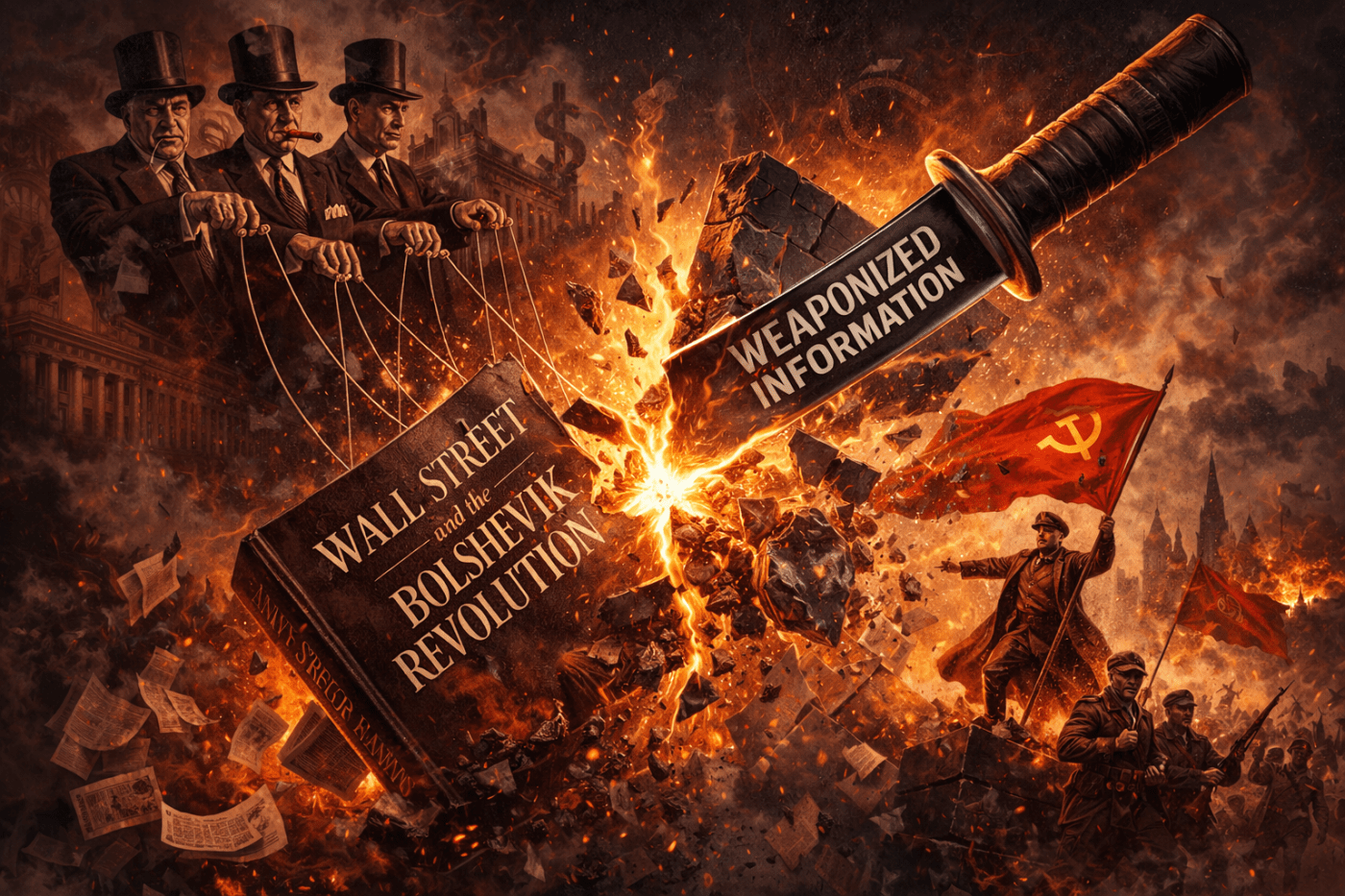
Sutton replaces workers, soldiers, and soviets with bankers and boardrooms, turning revolution into elite theater. Trotsky’s travel becomes “proof” of sponsorship, as bureaucracy and wartime chaos are rebranded as capitalist command. Forged documents linger as atmosphere while the real record—bank nationalization, debt repudiation, and trade monopoly—buries the thesis. The book ends where history begins: capital funds counterrevolution, the West wages siege, and Sutton mistakes vultures for architects.
By: Prince Kapone | Weaponized Information | Weaponized Intellects Book Review | January 27, 2026
Why Sutton Exists: Conspiracy as Anti-Communist Counter-History
Antony C. Sutton’s Wall Street and the Bolshevik Revolution does not present itself as polemic. It presents itself as exposure. Published in 1974, when the Cold War’s more primitive propaganda no longer convinced, the book offers a subtler ideological service: the replacement of mass revolutionary struggle with elite puppetry. Sutton promises to “follow the money.” What he actually follows is a long anti-communist tradition that treats popular power as illusion and finance capital as the only historical actor that ever matters.
This move depends on erasing the material conditions that produced the Russian Revolution. By 1917, the Russian Empire was collapsing under the weight of World War I. Nearly fifteen million Russians had been mobilized, and by the eve of revolution approximately 1.7 million soldiers were dead, with millions more wounded, captured, or missing—losses that shattered the army and destabilized the state.
At the same time, Russia’s wartime economy imploded. Inflation surged to roughly four times prewar levels by 1917, wages lagged far behind prices, and food distribution collapsed under the strain of war mobilization and transport breakdown. Petrograd entered the winter of 1916–1917 facing acute shortages that directly triggered mass strikes and bread riots, the spark of the February Revolution.
These conditions are not background noise. They are the engine of the revolution Sutton tries to reframe. Soldiers mutinied because the army was disintegrating. Workers struck because factories could not feed them. Soviets emerged because the imperial state could no longer govern. Sutton’s conspiracy narrative requires that all of this be treated as incidental, while bankers appear as the only actors capable of intention.
The immediate response of the capitalist world exposes the political function of this erasure. Far from nurturing Bolshevism, the Allied powers moved swiftly to destroy it. Between 1918 and 1920, foreign armies—including British, French, American, and Japanese forces—intervened directly in the Russian Civil War, supplying and supporting counterrevolutionary White armies in an attempt to reverse October. The United States alone provided more than $50 million in military support to White armies, a material commitment that makes the notion of Wall Street “authorship” of Bolshevism untenable.
This review proceeds from a different discipline. We do not infer power from proximity or intention from rumor. Sutton’s claims will be tested against law, institutions, and class policy—against what the Bolshevik state actually did when it took power, how capitalist states actually responded, and which class forces wielded coercion. Chronology will matter. Decrees will matter. Archives will matter. Capitalist maneuvering after a revolution will not be confused with capitalist authorship of a revolution.
Sutton’s skepticism is selective. He doubts the capacity of workers and soldiers to make history, but never doubts the omnipotence of bankers. He treats mass death, economic collapse, and imperial breakdown as scenery, while elevating speculation into explanation. The result is not a revelation about 1917, but a counter-history designed to neutralize its most dangerous lesson: that when empires break and people organize, revolutions do not ask permission from finance capital.
The Bankers Take the Stage—But the Workers Built the Theater
Sutton opens his book by parading an elite cast list. Bankers, financiers, corporate directors, trust executives—names stitched together through interlocking boards and shared institutional space. This, he suggests, is where real power resides. Wall Street appears as a disciplined command structure capable of shaping world events from afar. Once this architecture is established, Sutton invites the reader to make an unspoken leap: if finance capital is organized, and if a revolution occurred, then finance capital must have played a decisive role in making it happen.
What Sutton never demonstrates is causality. He shows that monopoly capital existed and coordinated—which no serious historian disputes—but he never explains how these financial networks translated into control over revolutionary mass politics. There is no mechanism in his account by which bankers commanded factory committees, disciplined mutinous soldiers, or overrode Bolshevik party organization inside the soviets. Capacity is substituted for causation, and implication is allowed to do the work of evidence.
The material reality Sutton suppresses is extensive and well documented. By mid-1917, workers’ and soldiers’ committees proliferated across factories and military units. In Petrograd and Moscow, factory committees existed in nearly every plant by the end of March 1917, becoming the basis of workers’ control in the upheaval. In the army, the revolution was institutionalized through soldiers’ committees: Order No. 1 of the Petrograd Soviet established that soldiers would execute officers’ orders only insofar as they did not contradict Soviet directives, while weapons were placed under committee control—a decisive break with imperial command. In practice, soldiers’ committees frequently vetoed officers’ orders, as discipline collapsed in the ranks. By October, desertion had reached mass scale—over two million soldiers had deserted by the eve of the Bolshevik seizure of power. These were not abstractions. They were organized, armed, and decisive social forces produced by imperial breakdown, not by banker design.
The Bolshevik Party itself reflected this material base. At the beginning of 1917, Bolshevik membership was on the order of 23,600. Its operating funds came from dues, sympathizers, and underground methods developed under repression—rather than any demonstrated pipeline of Wall Street bank transfers. When the record is forced to speak in documents rather than insinuations, Sutton’s case has nothing to stand on.
The decisive refutation of Sutton’s thesis arrives not in memoirs or speculation, but in law. On December 14, 1917, the new Soviet government issued the Decree on the Nationalization of Banks, declaring banking a state monopoly, abolishing private credit, and merging all commercial banks into the State Bank without compensation. This was not symbolic legislation. It eliminated the institutional foundations of finance capital inside the revolutionary state within weeks of October.
This was not an isolated act. As contemporaneous institutional histories make clear, the decree initiated the rapid absorption and liquidation of private banking as a class force, subordinating credit to state authority and extinguishing the independent power of commercial bank. No theory of capitalist authorship survives contact with a revolution that abolishes banking on its first calendar page.
Sutton never confronts this contradiction because he cannot. A revolution authored by Wall Street does not begin by expropriating Wall Street’s functional equivalents. A regime dependent on finance capital does not abolish private credit, seize assets without compensation, and criminalize independent banking activity. These are acts of open class war, not camouflage.
By opening his analysis with bankers alone, Sutton commits the founding error of conspiracy history: he removes the masses from history and then marvels that elites appear omnipotent. Workers fade into the background. Soldiers dissolve into noise. Soviets become scenery. What remains is a mystified portrait of power floating above society, detached from institutions, law, and coercion.
The correct synthesis is far simpler and far more dangerous to Sutton’s politics. Wall Street did not build the Russian Revolution. Workers, soldiers, and peasants did—under conditions of imperial collapse that finance capital neither controlled nor anticipated. Wall Street’s role began not as architect, but as adversary. And the first act of the revolutionary state made that antagonism unmistakably clear.
Passports, Police Files, and the Poverty of Conspiracy
Unable to demonstrate that Wall Street commanded soviets, Sutton shifts terrain. If bankers cannot be shown directing the revolution from above, perhaps they can be shown opening doors along the way. Leon Trotsky’s departure from New York in early 1917—his passport, his detention in Canada, his eventual release—becomes the insinuated hinge of the argument. The claim is never stated outright, but the implication is clear enough: revolutions do not travel unless someone powerful smooths the path.
This move relies on converting bureaucratic chaos into intentional sponsorship. The world Sutton abstracts away is a world at war. In 1917, borders across the Atlantic system were unstable, inconsistently enforced, and overwhelmed by military traffic, refugees, political émigrés, and returning nationals. Millions were on the move as empires disintegrated, administrations improvised controls, and no coherent regime of transit yet existed. This was not an orderly world of elite clearance; it was a collapsing one as the war losses and dislocation record makes plain.
Trotsky did not depart the United States on a Wall Street passport. He traveled as a Russian émigré headed into a revolutionary situation that had already erupted. His brief detention by British authorities in Halifax in April 1917 reflected wartime suspicion of political radicals and foreign nationals, not banker protection. Trotsky himself records that the British embassy in Petrograd issued an official claim that the detainees were traveling “under a subsidy from the German embassy,” and he also notes that the detentions were handled in relation to the Provisional Government’s “wishes” being ascertained, with pressure from the Soviet forcing a reversal. Sutton offers no financial record, no correspondence, no institutional directive tying Trotsky’s movement to capitalist sponsorship.
The absence of evidence here is not accidental; it is structural. Trotsky’s material circumstances in New York are not mysterious. In his own account, his “only profession” there was that of a revolutionary socialist: he wrote articles, edited a newspaper, and addressed labor meetings, and he joined the editorial board of the Novy Mir. There are no ledgers in Sutton’s presentation showing Wall Street transfers underwriting Bolshevik organization—only insinuation where proof would need to exist.
What Sutton substitutes for documentation is atmosphere. Police files are treated as proof of control. Detention becomes sponsorship. Release becomes endorsement. But even Trotsky’s own recollection underlines the opposite lesson: in wartime, authorities lied promiscuously, improvised repression, and then retreated under political pressure when that repression threatened to inflame the revolutionary situation in Petrograd itself.
The deeper ideological function of this chapter is to make revolution administratively impossible. If Trotsky’s return can be reduced to paperwork and police discretion, then mass politics vanish from the story. Power flows downward from offices rather than upward from struggle. The millions of workers and soldiers already in motion by the spring of 1917 are rendered irrelevant, while a passport does the explanatory work Sutton refuses to assign to class forces.
This inversion collapses on contact with chronology. Trotsky did not arrive in Russia to initiate revolution at banker behest. He arrived in the midst of an already-accelerating crisis produced by war, state breakdown, and mass mobilization. His subsequent political influence derived not from foreign backing, but from his capacity to articulate, organize, and discipline forces that already existed—an arc Trotsky himself frames as a political convergence with the revolutionary tide, not a patron’s appointment in his account of the February upheaval reaching New York.
Sutton’s treatment of Trotsky reveals the poverty of conspiracy as historical method. Where archives are silent, he speculates. Where chaos reigns, he imputes design. Where mass agency threatens his thesis, he reduces history to travel documents. What disappears is the most dangerous possibility of all: that revolutions move because people move, and that no banker stamps the papers when empires begin to fall.
Forged Papers, Lingering Myths, and the Refusal to Let Go
By the time Sutton turns to Lenin, Germany, and the so-called Sisson Documents, his argument has already lost structural coherence. What remains is salvage work. The documents at the center of this chapter—once touted as proof that Bolshevism was financed and directed by the German state—had been exposed as forgeries long before Sutton wrote his book, yet he treats them as if their mere existence were evidence.
The Sisson Documents were a collection of secret-style papers acquired in 1918 by U.S. Committee on Public Information operative Edgar Sisson in Petrograd, then published in the United States with the claim that they proved German financial backing of Lenin, Trotsky, and other Bolshevik leaders. A U.S. government historical record states that the “absurd Sisson documents” charging the Bolsheviks with being German agents were so crudely forged that mere examination was sufficient to disclose fraud.
Scholars have long demonstrated that the Sisson Documents contained obvious inconsistencies and anomalies incompatible with authentic German-Bolshevik correspondence. A leading mid-20th-century critique by historian George F. Kennan argued that the papers were not genuine, pointing to technical flaws and historical implausibilities that indicated forgery rather than truth.
The broader context of their production matters. The CPI’s pamphlet, The German-Bolshevik Conspiracy, was circulated as propaganda during and after World War I, with the aim of discrediting the Bolshevik leadership and bolstering Allied wartime narratives. Contemporary left-wing analysts such as John Reed recorded how the documents were used to justify intervention and to portray Bolsheviks as German stooges—a portrayal that modern analysis must regard as part of an intentional disinformation campaign.
Sutton’s maneuver reveals his method in its purest form: evidence may be shown to be false, but the insinuation is preserved. The documents may be forged, he suggests implicitly, but perhaps they point to something “true” behind the surface. This is not historical skepticism. It is faith repackaged as doubt.
What Sutton refuses to place alongside this episode is decisive institutional reality. Within months of seizing power, the Soviet government repudiated the sovereign debts inherited from Tsarist and Provisional governments. In early February 1918 the Council of People’s Commissars issued a decree canceling all previously issued foreign loans and declaring them null and void, a move that immediately severed Russia’s legal ties to global finance capital. The Decree on the Annulment of State Loans declared that all foreign loans without exception were unconditionally annulled.
This was not symbolic defiance but a sweeping structural break with the old financial order that eliminated the legal claims of international investors—particularly French and British creditors—overnight. Research on sovereign defaults confirms that the Bolshevik repudiation of Tsarist debt in 1918 was among the largest wholesale defaults of the era, and it constrained Soviet access to international capital for decades.
To maintain his thesis, Sutton must ask the reader to believe that a revolutionary state simultaneously served foreign capital and annihilated its claims; that it accepted covert sponsorship while publicly declaring class war on creditors. Rather than confront this contradiction head-on, he retreats into atmosphere, allowing discredited documents to cast a shadow they no longer merit.
This refusal to let go is not accidental. The Sisson Documents persist in Sutton’s narrative because they serve the ideological function of suggesting Bolshevism was not a genuine mass uprising but a foreign-engineered spectacle. Even after decades of scholarly rejection, the myth endures in his presentation because it flatters a particular worldview.
When stripped of insinuation, this chapter leaves Sutton with nothing. Forged papers cannot substitute for institutions, law, or policy. The real record—of Soviet debt repudiation and legal rupture with international finance capital—stands in clear contradiction to the fantasy Sutton preserves. The alleged “German money trail” dissolves. What remains is a revolution that global finance immediately recognized as an existential threat and moved to strangle.
Hedging the Storm Is Not Making the Weather
Having failed to show that Wall Street engineered October, Sutton retreats to a softer, more elastic claim. Finance capital, he argues, is clever. It hedges. It probes. It plays all sides. From this uncontroversial observation, Sutton draws an illicit conclusion: that capitalist maneuvering in the aftermath of revolution amounts to evidence of capitalist authorship of the revolution itself.
This move depends entirely on collapsing chronology. The contacts Sutton catalogs—bankers exploring trade, intermediaries floating proposals, firms seeking concessions—occur after the Bolsheviks have already seized power and consolidated it against rivals. Post-hoc adaptation is retroactively transformed into prior causation. Capitalist response becomes capitalist design.
The legal framework Sutton refuses to treat seriously makes this sleight of hand impossible. On April 22, 1918, the Soviet government issued the Decree on the Nationalization of Foreign Trade, declaring that all imports and exports were to be conducted exclusively by state organs and that “apart from these bodies all export and import agreements are forbidden.” Legal scholarship and archival legal analyses treat this as the foundational act establishing the state monopoly of foreign trade in practice.
This decree did not coexist with capitalist control; it annihilated it. Foreign capital could not enter Soviet Russia freely, could not dictate terms, and could not operate independently. Any engagement occurred within a tightly policed legal architecture designed to preserve state monopoly over exchange. Legal-historical treatments of Soviet contract and trade law underline that this monopoly framework was not decorative—it was the governing principle of external economic relations. A regime under Wall Street’s direction does not outlaw private trade at the level of law.
Sutton’s preferred evidence—foreign concessions—collapses under quantitative inspection. Between 1921 and 1929, the Soviet state approved a limited number of foreign concession agreements, all of them state-designed, contractually bounded, and revocable. Contemporary NEP syntheses note that the concessions system remained marginal to Soviet production, while Soviet economic-historical statistical compendia quantify concessions’ scale as roughly ~1% of industrial output in the mid-NEP years. Soviet/Russian economic history research emphasizes how quickly concession arrangements ran into contradictions and closures—including conflicts with trade unions and intentionally limited access to finance—and how many concessions proved short-lived in practice. Detailed sectoral studies of concessions in Soviet industry likewise stress their limited durability as Soviet capacity and political consolidation advanced.
Even contemporary capitalist observers understood their insignificance. A 1930 Foreign Affairs analysis by N. Liubimov described foreign concession activity as small in fiscal terms, noting concession-related figures as an “insignificant” sum relative to the overall Soviet budget. These were tactical arrangements under siege, not levers of control.
What Sutton consistently confuses is class interest with class power. Of course capital sought access. Of course it explored openings created by upheaval. Capital does this everywhere, at all times. But desire is not command, and probing is not authorship. Sutton catalogs attempts and treats their existence as proof of success, ignoring how often those attempts failed or were unilaterally terminated by the Soviet state. The Russian economic history literature on concessions is explicit that closure and conflict were not anomalies but recurrent outcomes.
What he also refuses to integrate is the broader international alignment of the capitalist world. The same powers whose financiers he portrays as quietly nurturing Bolshevism were simultaneously enforcing embargoes, denying recognition, and backing armed counterrevolution. Capital did not hedge because it felt secure. It hedged because it faced a revolutionary rupture it could not control. Official U.S. diplomatic history records that American non-recognition persisted until 1933, underscoring the long arc of state hostility shaping the environment in which any “contacts” occurred.
This is the inversion Sutton cannot escape. The Bolshevik Revolution did not unfold inside a capitalist safety net. It unfolded inside a hostile world system that sought to isolate and strangle it. Limited post-revolutionary contact does not imply pre-revolutionary authorship. Hedging against a storm is not the same thing as making the weather.
By presenting capitalist adaptation as capitalist orchestration, Sutton once again evacuates mass politics from history. Workers disappear. Soldiers vanish. The revolution shrinks into a chessboard where elites move pieces at will. The real record shows the opposite: capital scrambling to respond to a rupture it neither planned nor permitted—and never succeeded in undoing.
Humanitarian Cover and the Limits of Influence
In Sutton’s telling, the American Red Cross Mission to Russia is where insinuation finally acquires a human face. Bankers recede slightly, replaced by respectable intermediaries—industrialists and reformers operating under the language of relief. William B. Thompson and Raymond Robins are cast as pivotal figures who allegedly blur the line between charity and command. The suggestion is never proven, but it is repeated until it feels intuitive: behind humanitarian language, Sutton implies, lay a quiet pipeline of capitalist power sustaining Bolshevism.
This is where Sutton’s evidentiary footing collapses entirely. The claims surrounding Red Cross “financing” rest on press reports, recollections, and repetition—not on bank records, ledgers, or institutional confirmations. Allegations of million-dollar transfers circulate without documentation that would be unavoidable if such sums had actually moved through the financial system Sutton invokes. In place of receipts, Sutton offers atmosphere.
The structural context Sutton avoids makes these claims implausible on their face. The early Soviet state treated bourgeois influence not as a partner to be accommodated, but as a class enemy to be neutralized. On December 20, 1917, the Soviet government created the Extraordinary Commission for Combating Counter-Revolution and Sabotage, better known as the Cheka. Its mandate was explicit: suppress counterrevolutionary activity, sabotage, and class enemies threatening the new order.
The creation of the Cheka was not rhetorical. Between 1918 and 1920, arrests and coercive operations expanded dramatically under Cheka authority amid civil war conditions, as the state confronted armed revolt, foreign intervention, and internal sabotage. Finance capital and its representatives were not operating in a permissive environment. They were operating under surveillance, coercion, and the constant threat of expulsion or arrest. A revolutionary state that builds a coercive apparatus to crush bourgeois resistance is not outsourcing policy to visiting philanthropists.
Raymond Robins, whom Sutton repeatedly frames as an influential intermediary, exemplifies this contradiction. Robins’ own recommendations to U.S. officials did not describe a Bolshevik regime awaiting guidance or financing. They stressed Bolshevik durability and urged policy choices shaped by that reality, not by fantasies of control. Later scholarship on the U.S. recognition debate likewise treats Robins’ advocacy as an argument about managing instability and U.S. policy options—not evidence of command over Bolshevik decision-making. Proximity did not translate into authority.
Nor did humanitarian presence confer leverage. Relief missions function within political limits set by states, not the other way around. Aid does not override law, reorganize class relations, or dictate policy to governments engaged in civil war. Sutton’s argument requires believing that symbolic benevolence could neutralize a regime that had abolished private banking, repudiated foreign debt, and criminalized independent trade. The contradiction is never addressed because it cannot be resolved.
What Sutton actually documents here is capitalist anxiety, not capitalist mastery. These figures were not architects steering events from behind the scenes. They were observers and intermediaries attempting—often unsuccessfully—to interpret and influence a process already beyond their control. Their presence reflects uncertainty and improvisation, not command.
By treating limited humanitarian contact as proof of hidden sponsorship, Sutton once again mistakes access for power. He converts the absence of evidence into evidence itself and presents the limits of influence as proof of success. In doing so, he erases the reality that defined the period: a revolutionary state consolidating power through force, law, and mass organization while the capitalist world searched in vain for leverage.
The Red Cross did not prop up Bolshevism. It revealed how little leverage capital retained once its institutions had been dismantled. Sutton’s failure to grasp this is not accidental. It is necessary for a narrative that cannot tolerate the possibility that revolutions survive not through elite blessing, but through organized mass power capable of resisting both charity and coercion.
When the World Tried to Choke the Revolution
At this stage of his argument, Sutton’s narrative performs a quiet reversal. After hundreds of pages implying tacit tolerance or covert sponsorship, he confronts a historical record defined by open hostility. Rather than acknowledge the contradiction, Sutton reframes it. What was, in fact, an international campaign to suffocate the Soviet state is recoded as confusion, disagreement, or overreaction within an otherwise ambiguous relationship.
The material record allows no such ambiguity. Following the Bolshevik seizure of power, the capitalist powers intervened directly in the Russian Civil War. British, French, American, and Japanese forces deployed troops, supplied arms, and backed White armies whose explicit objective was the destruction of Bolshevik rule. This was not hedging. It was counterrevolution by force.
Military failure did not end the campaign. It shifted it. Diplomatic recognition was denied. Trade relations were severed. Financial warfare became policy. The United States Treasury instructed mints and assay offices to reject gold bearing evidence of Soviet origin, effectively blocking one of the few instruments the new state possessed for international exchange. This was not symbolic hostility. It was an attempt to strangle the Soviet economy at the level of circulation itself.
These measures forced the Soviet state to seek indirect and punitive routes for survival—selling gold through intermediaries, often at steep discounts, under constant surveillance and obstruction. Sutton treats these maneuvers as evidence of integration or tolerance. In reality, they are receipts of siege. States do not impose embargoes on projects they secretly endorse.
Sutton’s language of “export” further distorts the sequence. The Bolsheviks were accused of exporting revolution not because Wall Street permitted it, but because ruling classes feared contagion. Worker uprisings across Europe, mutinies in defeated armies, and mass strikes at home convinced capitalist elites that the Russian example posed a systemic threat. Anti-communism was not paranoia; it was a rational response to the possibility that October would not remain confined to Russia.
This fear shaped policy. Socialist organizations were surveilled and repressed. Communist parties were banned or driven underground. Trade unions were policed. At the international level, the Soviet state was treated as a pariah. Sutton’s attempt to recast this environment as one of tacit accommodation requires ignoring the scale, coordination, and duration of capitalist countermeasures.
What emerges, once the inversion is corrected, is a coherent picture Sutton cannot accept. Capital did not manage the Bolshevik Revolution. It confronted it—and lost the first round. Armed intervention failed. Economic blockade inflicted suffering but did not break the state. The USSR survived not because it was protected, but because it reorganized society, consolidated power, and mobilized resources under conditions of siege.
By calling this period one of “export,” Sutton once again misnames the process. What was exported was not revolution by permission, but fear by example. The attempt to choke the revolution was not evidence of confusion within capitalism. It was evidence that the class lines had been drawn clearly—and that Wall Street knew exactly which side it was on.
Representation Under Siege Is Not Patronage
Sutton’s treatment of the Soviet Bureau in New York is another sleight of hand. Having failed to prove that Wall Street authored the revolution, he lowers the bar: the mere existence of an unofficial Soviet presence on American soil is treated as evidence of elite backing. Offices, staff, meetings, and correspondence—documented in the records of the Russian Soviet Government Bureau—are recoded in Sutton’s narrative as signs that the Bolsheviks were quietly protected by the very class they had just expropriated.
This reading confuses the minimum conditions of survival with the maximum claims of control. A besieged state seeks channels wherever it can find oxygen. Representation is not a privilege; it is a necessity under isolation. The decisive question is not whether Soviets operated in New York, but whether the American state apparatus that defends capital treated them as partners or targets—a question answered decisively by the historical record.
The answer is not subtle. On >June 12, 1919, the New York State Joint Legislative Committee to Investigate Seditious Activities (the Lusk Committee) raided the Russian Soviet Government Bureau, seizing documents, correspondence, and records as part of a coordinated campaign against radical organizations during the First Red Scare. A client regime does not get raided by its supposed patrons. A project “backed by Wall Street” does not get handled as an internal security threat by the very state institutions constructed to defend property and capital.
This raid was not an aberration or a misunderstanding. As the New York State Archives’ guide to the Lusk Committee records makes clear, the Bureau was treated as a subversive organization whose activities were to be monitored, disrupted, and neutralized through legislative and police power. The Bureau’s existence did not demonstrate sponsorship. It demonstrated constraint.
Sutton attempts to minimize this hostility by presenting it as bureaucratic confusion—one agency acting at odds with another. But the broader federal posture confirms the pattern. Throughout this period, the United States government explicitly refused diplomatic recognition of the Soviet state, a policy maintained until 1933, as we have already documented. Non-recognition, raids, surveillance, and document seizures are not the behavior of a patron.
This is why Sutton’s method fails again. He catalogs contact and wants proximity to stand in for command. He lists addresses and affiliations and wants geography to substitute for governance. But power is not measured by who shares a city block with bankers. Power is measured by which institutions set the legal terms, and which institutions are authorized to deploy coercion—and in this case, coercion flowed decisively against the Soviet presence.
The Soviet Bureau operated under surveillance, contested legality, and continuous political hostility, as reflected in both its own documentation and the records of the Lusk Committee’s investigations. Its disruption was not accidental. It was part of a broader effort to contain revolutionary influence domestically while isolating Soviet Russia internationally.
The record shows the opposite of what Sutton claims. The Soviet Bureau was not evidence that capital welcomed Bolshevism. It was evidence that the revolution had to claw for any channel of contact in a world that moved rapidly from suspicion to repression. Sutton reverses this reality because his narrative cannot tolerate what the documents plainly show: that even minimal Soviet representation was treated as a threat to be suppressed, not a partner to be protected.
A Building Is Not a Command Center
When argument thins, Sutton turns to symbolism. A single address—120 Broadway—is elevated into a supposed nerve center of revolutionary orchestration. Banks, trusts, insurers, and intermediaries shared space in lower Manhattan, Sutton notes, and from this co-location he invites the reader to infer coordination, direction, and ultimately authorship of the Bolshevik Revolution. Geography is asked to do the work that evidence cannot.
This move is rhetorically clever and analytically empty. Manhattan’s financial district was dense because capital concentrates spatially. Infrastructure, communications, and law firms cluster where money moves. To discover multiple institutions in one building is not to uncover a conspiracy; it is to observe capitalism functioning normally. Elevators do not transmit political authority, and shared square footage does not dissolve class antagonism.
The institutional character of the tenants Sutton invokes undermines his own implication. The major banks and financial firms operating out of lower Manhattan were publicly and materially hostile to Bolshevism, supporting armed intervention against Soviet power after 1917 and backing policies of isolation and restriction that targeted Soviet trade and gold. Sutton names institutions whose recorded actions align with repression and rollback, then asks the reader to imagine them as covert midwives of a workers’ state.
The presence of Soviet representatives or intermediaries in the same urban space does not alter this reality. Revolutionary states do not choose their adversaries’ geography; they operate where access is possible. In New York, that meant proximity to finance not because finance was friendly, but because finance was unavoidable. Sutton reverses necessity into choice and constraint into alliance.
What this chapter reveals most clearly is Sutton’s inability to distinguish between infrastructure and power. Buildings house institutions; they do not align their interests. A shared address does not override laws, policies, or coercive apparatuses. Sutton collapses these distinctions because without them he cannot show how Wall Street supposedly exercised command over Bolshevik policy.
In reality, 120 Broadway—the Equitable Building— illustrates the opposite of Sutton’s thesis. It stands as a physical reminder of how concentrated, visible, and entrenched capitalist power was in the United States—and how hostile that power remained toward the Soviet experiment. The juxtaposition highlights the asymmetry Sutton refuses to confront: a revolutionary state improvising access on the margins of a world system dominated by institutions determined to exclude it.
By the end of this chapter, Sutton’s evidence has been reduced to architecture. Walls replace mechanisms. Addresses replace archives. The revolution is no longer something produced by social rupture; it becomes something that can be mapped by real estate. This is not historical materialism. It is mysticism by floor plan.
Geography is not governance. Elevators do not confer authority. And no amount of shared square footage can turn monopoly finance capital into the author of a revolution that dismantled its power at every institutional level.
Gold Under Siege Is Not Integration
With Guaranty Trust, Sutton believes he has finally landed something solid. Gold appears. Accounts move. Correspondence circulates. The imagery does the rhetorical work for him: Soviet gold touching Western banks, Western finance handling revolutionary wealth. From this contact, Sutton invites the reader to infer accommodation, even alliance. But once chronology and power relations are restored, the argument collapses.
What Sutton describes does not occur at the birth of the revolution. It occurs after the Bolsheviks have seized power, abolished private banking, repudiated foreign debt, and survived the first waves of civil war and intervention. The Soviet state enters international exchange not as a beneficiary of capitalist goodwill, but as a pariah struggling to procure machinery, fuel, and basic industrial inputs in a hostile world economy. Gold here is not evidence of integration; it is one of the few remaining instruments available to a state under siege.
The decisive constraint Sutton minimizes is state policy. During this period, U.S. Treasury policy required that gold not be accepted by U.S. mints or assay offices without sworn proof it was of non-Soviet origin, effectively denying the new state access to normal channels of exchange. A contemporary scholarly account of the same restriction notes that gold could not be accepted by the U.S. Mint or assay offices without an affidavit attesting it to be of non-Soviet origin. Gold could move only indirectly, under surveillance, through intermediaries, and often at punitive discounts. This was not smooth incorporation into global finance. It was contested circulation under embargo.
Guaranty Trust’s involvement illustrates capitalist opportunism, not capitalist control. Banks explored margins created by volatility, as they always do. But exploration is not command. Sutton treats the willingness of a bank to handle transactions as proof of political alignment, ignoring the broader framework in which those transactions occurred—a framework defined by non-recognition, restriction, and active efforts to weaken the Soviet economy.
The asymmetry is stark. While Soviet gold sales were forced into indirect channels—often moving through Sweden and other countries at steep discounts—counterrevolutionary forces received vastly greater material backing. British war policy alone is described in official diplomatic documentation as including £50,000,000 in munitions for Kolchak, a scale of support that makes Sutton’s fixation on constrained gold movements look like misdirection rather than analysis.
None of this altered the internal structure of Soviet power. Banking remained a state monopoly by decree, with all private banks absorbed into the state system under the December 14, 1917 bank nationalization law, while foreign exchange was structurally fenced off by the state monopoly on foreign trade. Sutton offers movement without mechanism, transaction without transformation. The revolution’s core institutions remain untouched by the evidence he presents.
Here Sutton’s confusion between survival and submission becomes most pronounced. A revolutionary state forced to transact under embargo does not thereby concede ideological or political ground. It adapts. It improvises. It uses what it has to acquire what it needs. Gold shipments under these conditions are not signs of reconciliation; they are symptoms of pressure.
By mistaking constrained exchange for alliance, Sutton once again inverts agency. He presents banks as the active subjects and the Soviet state as a passive recipient. The record shows the opposite: Soviet leaders made calculated decisions about when, how, and whether to engage with hostile financial institutions, fully aware that those institutions operated within a state system committed to strangulation.
Gold under siege is not integration. It is evidence of economic warfare conducted in slow motion. The gold moved, but the class lines did not.
When Sutton Accidentally Tells the Truth
Near the end of his book, Sutton commits a fatal error—not factual, but analytical. After hundreds of pages implying that Wall Street midwifed Bolshevism, he acknowledges that the most powerful institutions of monopoly finance did something else entirely. J.P. Morgan and its allies did not hedge sympathetically between revolution and counterrevolution. They materially supported the forces trying to destroy the Bolshevik state.
This is not a minor complication. It is a structural confession. In the U.S. government’s own diplomatic record, you can trace concrete efforts to sustain anti-Bolshevik state structures in Siberia and the Far East—through financing, procurement, and logistics channels that were inseparable from the broader Allied project of keeping an anti-Soviet authority alive long enough to defeat the revolution militarily.
These were not symbolic gestures. They were material commitments—credit mechanisms, supplies, transport, and diplomatic backing—channeled toward armed forces whose explicit aim was the overthrow of Soviet power. This is what class alignment looks like in practice: when confronted with a workers’ state that had abolished private banking, repudiated foreign debt, and nationalized foreign trade, monopoly finance did not nurture it. It tried to kill it.
Sutton treats this as something like an awkward footnote, something to be placed beside his insinuations without forcing a conclusion. But history does not allow that compartmentalization. One cannot coherently argue that Wall Street authored the Bolshevik Revolution while simultaneously acknowledging, in the same evidentiary universe, that major U.S. financial power and state power were organizing support for counterrevolutionary authority in the context of Allied intervention. Either the revolution escaped capitalist control, or it was never under that control to begin with.
The record points decisively in one direction. Finance capital did not sit on the fence managing both outcomes. It aligned with counterrevolutionary armies, pressed states to intervene, and supported policies of blockade and isolation—an alignment visible not in rumor, but in the paperwork and policy trail left behind in the U.S. diplomatic archive and in the operational history of the Siberian intervention preserved in military-historical work grounded in archival collections. One such study situates U.S. activity in Siberia within the broader counterrevolutionary effort that Sutton’s “Wall Street sponsors Bolshevism” framework cannot metabolize.
What Sutton lacks is a theory of class power capable of interpreting his own evidence. Capital is not omnipotent; it cannot always shape outcomes to its liking. Revolutions occur precisely when ruling classes lose control of processes they once managed. Sutton’s inadvertent acknowledgment that the money-power centers of his story appear on the side of counterrevolution restores—despite himself—the central motor of the period: class struggle.
Read honestly, this is not a “complication.” It is the negation of Sutton’s thesis. The bankers he wants to cast as authors of October appear here doing what bankers and capitalist states reliably do when confronted with mass emancipation: mobilizing wealth, coercion, and international leverage in defense of a threatened order. Sutton’s book collapses not because he lacks documents, but because when the documents become unmistakably concrete, they point to a class war—against Bolshevism—not a class partnership with it.
The “Unholy Alliance” That Never Was
Sutton closes his book by attempting to gather the fragments of his argument into a single ominous phrase: an “unholy alliance” between bankers and revolution. It is meant to sound decisive, as if repetition can substitute for proof. But when the narrative is forced to stand on its own legs—tested against law, institutions, chronology, and class policy—it collapses under its own weight.
What Sutton has assembled is not evidence of alliance, but a catalog of reactions. Bankers probed. Governments maneuvered. Intermediaries speculated. States miscalculated, intervened, embargoed, and regrouped. None of this explains how a revolutionary party rooted in workers’ councils, factory committees, and mutinous garrisons seized power, dismantled private finance, repudiated debt, and survived a civil war fueled by foreign capital. Sutton mistakes the noise generated by capital confronting crisis for proof that capital designed the crisis itself.
The institutional record is decisive and admits no ambiguity. Within weeks of October, private banking was abolished and folded into a state monopoly. Credit ceased to function as a private weapon. Foreign debt was annulled outright, wiping out the legal claims of international creditors. Foreign trade was nationalized and private exchange criminalized. These were not gestures. They were structural transformations that determined who ruled and who did not.
The international response confirms the line of struggle Sutton works so hard to blur. The capitalist world did not treat Soviet power as a partner or proxy. It treated it as a contagion. Armed intervention, economic blockade, diplomatic isolation, gold rejection, domestic repression, and the financing of counterrevolution were not episodic disagreements. They were coordinated strategies aimed at reversing a defeat. This is not how ruling classes behave toward projects they secretly control.
Sutton’s error is not simply factual; it is theoretical. He treats capital as omnipotent and the masses as inert. History becomes a sequence of elite maneuvers, while popular struggle is reduced to surface effect. Such a framework cannot explain rupture, contingency, or failure. It cannot explain why capital so often loses control of processes it sets in motion. And it cannot explain why revolutions occur at all.
But Sutton’s function is bigger than Sutton. This genre does political work. It takes the most dangerous lesson of 1917—mass organization can shatter an empire—and neutralizes it by turning it into a boardroom magic trick. If bankers make revolutions, then workers never have to. If finance capital secretly authors its enemies, then capitalism is never truly threatened. The reader is left with cynicism instead of strategy, suspicion instead of organization, and a paranoid worldview that always points upward but never moves outward into collective power.
That is why Sutton remains useful to the present. His story feeds a modern anti-communism dressed up as “anti-elite” posture: a politics that can name banks all day but cannot name class struggle, cannot name imperialism as a system, and cannot imagine disciplined mass power as a real historical force. It is tailor-made for an era where reactionary influencers recycle Cold War myths as contrarian “truth,” laundering old counterrevolutionary narratives through new media ecosystems. It sounds radical because it says “Wall Street,” but it functions like a sedative: it replaces material analysis with melodrama and leaves the working class disarmed.
The Bolshevik Revolution did not succeed because bankers allowed it. It succeeded because an empire collapsed under the weight of war, exploitation, and hunger, and because an organized political force transformed that collapse into a new form of power. Capital responded as it always does: first with confusion, then with violence, then with siege. That response—documented across Sutton’s own pages—is the real through-line of the period.
By naming this history an “alliance,” Sutton performs his final ideological inversion. He turns capitalist hostility into benevolence, defeat into manipulation, and mass agency into illusion. In doing so, he offers comfort to the powerful and disarmament to the reader. The point is not to understand 1917. The point is to make 1917 impossible.
History offers no such reassurance. Bankers fund coups and counterrevolutions. They impose embargoes and starve nations. What they cannot do is create soviets. The Bolshevik Revolution remains dangerous to Sutton’s worldview for the simplest of reasons: it demonstrates that when ruling orders break and people organize, history moves without permission—and sometimes it moves against capital itself.
 Weaponized Information
Leave a comment