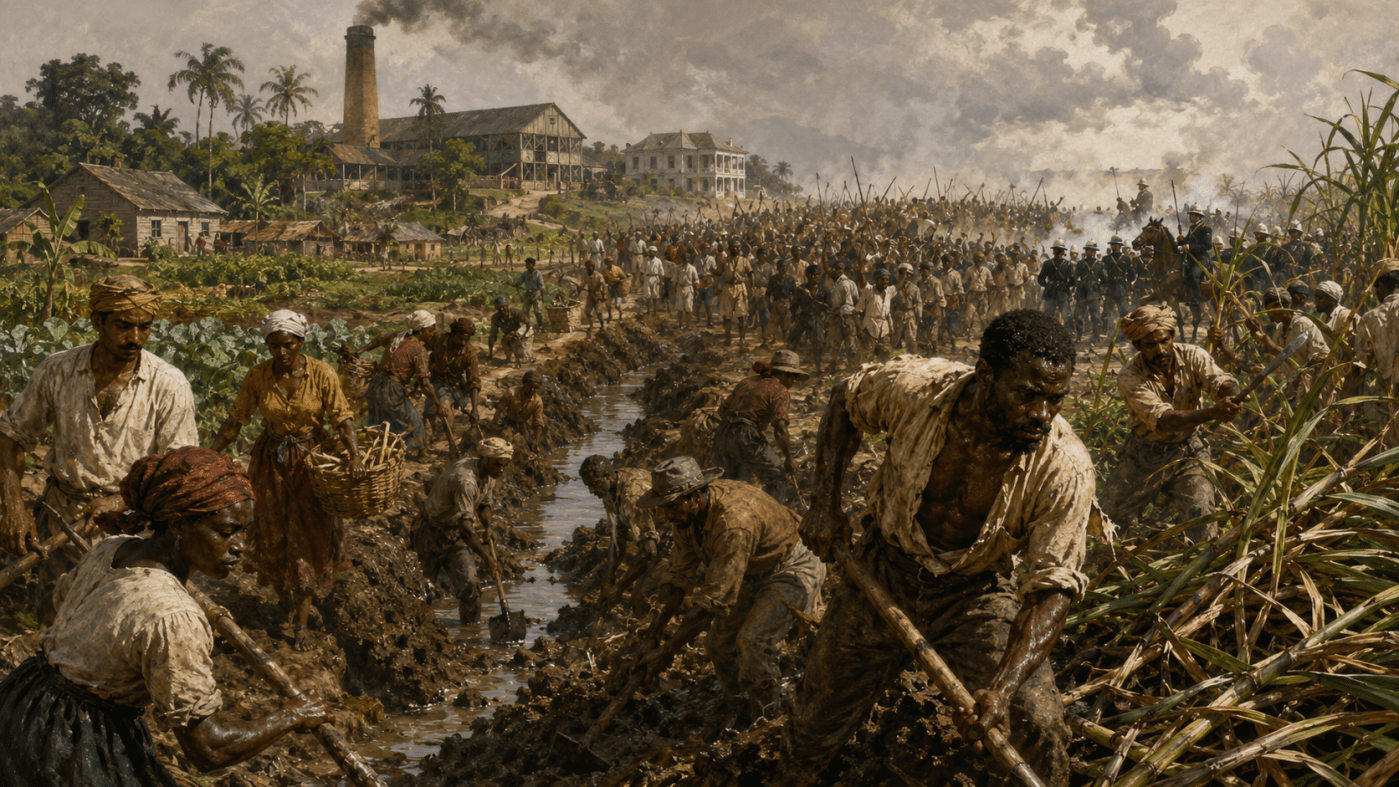
Walter Rodney begins with a colonial society physically reproduced by working people yet organized to deny those same people control over the labor, land, and material conditions that kept it alive. Emancipation shattered slavery’s legal form without resolving capital’s labor problem, forcing the struggle onto new terrain as workers used land, villages, mobility, and subsistence to widen the material space from which they could resist plantation command. Those partial escapes produced no simple march toward unity: economic diversification generated new classes and strata, political reform opened real capacities while exposing the limits of cross-class alliance, and racialized competition developed through material differences that could neither be dismissed as illusion nor accepted as destiny. By 1905, the Guyanese working people had constituted themselves through struggle strongly enough to appear as a collective historical force, but Rodney’s harder lesson remained unresolved—the distance between a people capable of rebellion and a class organized strongly enough to sustain its own power.
A Colony Built by the Labor It Had to Control
Walter Rodney begins where colonial history usually prefers not to look: at the ground beneath everybody’s feet. Before constitutions, elections, strikes, race riots, reform clubs, or declarations of political principle, somebody had to make coastal British Guiana physically inhabitable. The coast did not simply present itself to planter capital as a ready-made stage for sugar production. Rodney writes that working people made a “tremendous contribution to the humanization of the Guyanese coastal environment.” That phrase does more work than it first appears to. The environment enters his history not as scenery but as accumulated labor. Canals had to be dug. Dams had to be maintained. Water had to be controlled. Land had to be made usable. The colony rested materially upon a landscape that working people continuously produced and reproduced.
Rodney sharpens the point when he writes that “the hands that dug the canals and the feet that trod the dams” were participating in the class struggle that would eventually shape the Guyanese people. He does not begin with workers holding red flags or calling themselves a class. He begins with hands and feet. That is the first discipline the book imposes on the reader. Class cannot be summoned into existence by announcing the correct category. It has to be reconstructed from the material activity through which people reproduce society and confront those who command that reproduction. The workers may not yet possess stable organizations or a fully developed collective political identity, but their labor has already placed them inside a definite social relation. They build the physical conditions of production while another class controls the production their labor makes possible.
This is the first contradiction Rodney establishes, and it is almost embarrassingly simple once he drags it into daylight. The people whose labor keeps the colony above water do not control the colony. Their indispensability does not translate automatically into power. That is the little joke capitalism plays everywhere: society cannot survive without the laboring majority, but the laboring majority is told that those who own the land, the factory, the estate, or the ledger are the indispensable ones. British Guiana gave the joke a particularly wet and muddy form. The planter could own the estate, but ownership did not drain a canal. Capital could command production, but capital did not tread the dam. The contradiction begins with this dependence of the ruling order upon people it must nevertheless keep subordinate.
Rodney therefore does not treat the Guyanese working people as victims standing outside history waiting for exploitation to happen to them. Their labor is already constitutive. They are making the colony even before they fully acquire the collective capacities necessary to remake it. But that does not mean Rodney romanticizes productive necessity into political power. The planters remain entrenched. Property remains concentrated. Colonial institutions remain organized around a social order in which those who perform the necessary labor possess little command over the conditions of that labor. The important thing is the relation: planter society cannot reproduce itself without the workers, yet it must organize the workers in such a way that their indispensability does not become autonomy.
That problem cannot be understood within the borders of British Guiana alone. Rodney places the colony inside what he calls its “dependent integration into the world capitalist system.” The wording matters. British Guiana is not simply oppressed by some foreign force hovering over it from London. Nor is dependency merely a question of exporting sugar and importing manufactured goods. Rodney insists that dependency was “reflected in and supported by the internal socioeconomic structures.” The external relation and the internal order reproduce one another. The colony is tied to world capitalism through trade, markets, prices, and metropolitan power, but those pressures acquire force because production, property, and political authority inside the colony have already been organized to transmit them downward.
This is where Rodney’s account becomes more precise than the lazy language of “foreign domination.” A world market cannot fire a worker by itself. A price collapse does not walk into a village and confiscate somebody’s dinner. International capitalism becomes material through mediations. Rodney writes that capitalist slumps and market crises struck at the fundamentals of working-class existence: the ability to work and to earn a living wage. The movement therefore runs from the world market through the colonial economy into employment and wages, and from there into the reproduction of working people themselves. A crisis that begins far away becomes a question of whether a family eats because the colony has been structured so that distant market movements determine the local conditions of life.
Dependency, then, is not merely a flag planted over a subordinate territory. It is a social relation reproduced inside the colony. External capitalist crisis passes through the plantation economy; planter power passes through property and political institutions; the consequences arrive as unemployment, wage pressure, insecurity, and the narrowing of workers’ choices. This is why Rodney’s analysis cannot be reduced to geopolitics. Britain matters, but “Britain” is not an explanation. The world capitalist system matters, but “imperialism” is not a magic word that saves us the trouble of showing how imperial power works. Rodney makes the machinery visible. External dependence becomes effective through an internal class structure capable of transferring the costs of capitalist instability onto those least able to refuse them.
The planter class sits at the decisive junction of that machinery. Rodney does not need to portray planters as uniquely wicked men rubbing their hands together over the misery of laborers. Their structural position explains more than moral accusation ever could. They control the productive apparatus of the colony and operate within a political order that secures that control. They require workers to reproduce the estates and the coastal infrastructure upon which plantation production depends. At the same time, they confront a permanent danger buried inside that dependence: the workers who make the system function may develop ways of making themselves less available to it. The history Rodney is about to tell turns on how that contradiction is managed, resisted, displaced, and transformed.
That is why the opening chapter should not be read as background before the “real” political history begins. The drainage trenches are political history. The export market is political history. The wage is political history. The sea wall is political history. Rodney is constructing the field on which later disputes over emancipation, land, indenture, race, representation, and rebellion will become intelligible. Without that field, the rest of the story easily collapses into a parade of grievances and heroic responses. With it, each later struggle can be located inside a changing relation between capital’s need for disciplined labor and working people’s efforts to widen the material space from which they can resist.
Just as important, Rodney refuses to cheat by beginning with the ending. In the conclusion he warns against giving social classes greater precision than they had actually achieved within the “evolving social formation.” That warning reaches backward across the entire book. The people digging canals and maintaining dams are already situated within antagonistic relations of production, but Rodney will not pretend that this automatically makes them a politically consolidated working class. The class has to become. Its members have to encounter one another through production, land, migration, village life, elections, racial competition, strikes, repression, and collective action. A historian who labels the destination too early destroys the very process that needs explaining.
This refusal is especially important in colonial history because the laboring population is anything but socially uniform. Rodney knows from the beginning that British Guiana contains different legal statuses, occupations, origins, locations, and relations to land. The mistake would be to treat this heterogeneity as evidence that class analysis cannot apply, or to perform the opposite trick and dissolve every difference into an abstract worker identity. Rodney does neither. He begins from the material relation that gives the history its pressure—the organization and control of labor—and then follows what happens as real human beings struggle inside it under unequal and changing conditions.
The opening movement of the book therefore establishes something more severe than the familiar proposition that workers created wealth they did not own. Working people created part of the very physical possibility of the colony while colonial capitalism organized the economic and political conditions under which that creative labor remained subordinate. World-market dependence reinforced the arrangement, but it did so through internal structures. The workers were indispensable without yet being sovereign over their indispensability. They had power in potential because the colony could not function without them; they lived weakness in practice because the material means of production and the political machinery governing those means remained elsewhere.
Rodney has not yet given us a unified working class. He has given us the historical problem from which one may emerge. Capital needs labor, but it needs something more specific than human beings capable of working. It needs labor available on terms compatible with accumulation. The workers, meanwhile, need wages, food, shelter, land, and some capacity to reproduce life without surrendering every condition of existence to the estate. The moment those needs begin pulling in opposite directions, the labor problem becomes political. And once slavery is abolished, the problem becomes sharper still. The workers are now legally free. The plantation still needs them. The next question is no longer whether freedom has been declared. It is who will decide what that freedom is materially worth.
Freedom Changes the Law, Not the Labor Problem
Rodney opens the post-emancipation history with a sentence that cuts through a century of liberal mythology: “The extent to which an alteration of legal status was transformed into substantial social change was determined by the class struggle in the post-Emancipation era.” He does not deny emancipation. He does not reduce it to a fraud. The legal rupture matters precisely because it changes the terrain on which the struggle must now be fought. What disappears is the slaveholder’s juridical ownership of the worker. What does not disappear is the planter’s ownership of the estate, the worker’s need to live, or the conflict over who will control the conditions under which labor enters production. Freedom has been declared. Its material content remains unsettled.
Rodney captures that unsettled terrain by describing former slaves as continuing their struggle “under radically transformed legal conditions but under the same material circumstances.” The formulation has to be held together. Tear away the first half and emancipation becomes cosmetic, as though slavery simply changed its paperwork. Tear away the second and the law acquires magical powers, capable of dissolving property relations merely by announcing a new legal status. Rodney permits neither fantasy. The people have become legally free while the estates, land, productive infrastructure, and economic command remain concentrated elsewhere. The contradiction is therefore no longer master against legally owned slave. It has become a struggle over what freedom can mean when the newly free still confront a material order organized around somebody else’s control of the means of life.
That is why Rodney’s discussion of “free labor” is so important. He writes that the planters were “bitterly opposed to the untrammeled operation of free wage labor,” while the former slaves were “equally resistant to that aspect of the free labor system that demanded total alienation of workers from land ownership.” Neither side behaves the way the clean textbooks tell us capitalism is supposed to work. The planters, those alleged apostles of private property and market freedom, suddenly discover that freedom becomes terribly inconvenient when workers possess enough of it to leave. Former slaves, meanwhile, do not interpret liberation as the sacred right to become completely dependent upon an employer. They understand that a worker who must sell labor every day or starve possesses a kind of freedom considerably more attractive in a political speech than at the end of a bad harvest.
The conflict over land therefore enters directly into the conflict over labor. Workers seek access to land because land can provide food, production, and some room to refuse plantation employment on unacceptable terms. Planters oppose that autonomy because the estate requires labor to remain sufficiently available. Rodney’s point is more concrete than the abstraction that capital wants profit and workers want higher wages. The deeper struggle concerns the conditions under which the worker can say no. A laborer with no independent means of subsistence approaches the employer from one position; a laborer with access to land approaches from another. The wage relation may be formally voluntary in both cases, but the material power contained inside that voluntariness is not remotely the same.
Rodney then shows why the post-emancipation labor market cannot be understood as a neutral arena in which free individuals simply meet and bargain. “The political hegemony of the planter class,” he writes, guaranteed that struggle at the point of production would be conditioned “primarily by legal sanctions rather than by the operation of market forces as such.” The sentence ruins the comforting bourgeois story that politics interferes with an otherwise natural market. Here politics helps make the market. The law determines the boundaries within which labor may move, bargain, leave, contract, and resist. Planter power does not stand outside economic relations waiting to intervene when something goes wrong. It enters the constitution of those relations themselves.
This is where the colonial state becomes materially visible. Rodney does not need to announce a general theory of the state or decorate the page with quotations about executive committees. He gives us the mechanism. A class possessing economic power also enjoys sufficient political hegemony to turn its labor requirements into legal constraints. The worker confronts the employer at the estate, but the relation stretches beyond the estate through magistrates, ordinances, contracts, sanctions, and the wider coercive capacity of colonial government. Wage bargaining therefore occurs inside a political order already structured unevenly between those seeking dependable labor and those seeking enough freedom to withhold it.
Indenture enters this history through that unresolved labor problem. Rodney’s language here demands precision because the temptation to collapse different systems of exploitation into one dramatic analogy is strong. He writes that “more than anything else, it was the regimented social and industrial control which caused indenture to approximate so closely to slavery.” The operative word is not identity but approximation, and Rodney tells us exactly where the resemblance lies: control. Slavery and indenture are not the same juridical relation. One treats human beings as legally owned property; the other operates through contract, migration, penal sanctions, and regimented labor discipline. But the planter’s material problem persists across the transformation: how to secure a labor force whose ability to withdraw from the plantation is sufficiently constrained.
The continuity therefore lies in the requirement for labor command; the mechanisms change. That distinction matters politically because historical materialism becomes useless the moment every form of exploitation is flattened into the same thing. Capital does not survive by repeating one institution forever. It survives precisely because relations of domination can be reorganized when old forms become untenable. Emancipation destroys one legal structure. Plantation production responds within the new terrain through immigration, indenture, sanctions, and the political regulation of labor. The point is not that nothing changed. The point is that what changed has to be measured against the material struggle it reorganized.
The former slaves develop their own answer. Rodney writes that land acquisition during the 1840s represented “the search for some degree of ownership and control of the means of production.” The phrase strips village formation of its sentimental covering. This is not simply a story about families wanting little farms because rural life suited them. Control over land means some control over food, some control over production, and therefore some control over the conditions under which labor must be sold. A village plot cannot abolish colonial capitalism, but it can alter the immediate balance between a planter demanding labor and a worker deciding whether the offered wage is worth accepting.
Rodney makes the political lesson explicit: “Confrontations with the planters suggested to the Creoles that their freedom could not be guaranteed by wage labor alone.” Freedom becomes something workers learn materially. They do not arrive at the conclusion through a seminar on political economy. They discover it in conflict. If survival depends completely upon access to wages controlled by employers, then legal liberty remains vulnerable to economic compulsion. Land becomes important because it places some portion of social reproduction outside the employer’s immediate command. That does not make the worker independent of capitalism. It gives the worker another position from which to confront it.
This is also where Rodney states what he calls the “fundamental contradiction.” Rejecting an explanation that would elevate conflict between plantation and peasant production into a separate governing struggle, he writes that “a more comprehensive explanation requires that one pinpoint the fundamental contradiction as that between capital and labor on the estates.” Read carelessly, the sentence could make Rodney appear to shove everything back behind the plantation fence. But his own explanation does the opposite. Village production matters precisely because it changes the terms on which plantation labor confronts capital. Subsistence outside the estate can make labor less dependent upon the estate; planter hostility toward that subsistence follows from the effect it has upon bargaining power. The village relation is therefore connected back to the estate contradiction through the worker’s capacity to survive without immediately submitting to the wage.
This is a crucial distinction. Rodney is not saying nothing outside the plantation matters. He is asking how those apparently separate forms of life feed back into the central struggle over labor command. The worker who farms part of the week and works for wages another part cannot be divided neatly into “peasant” on Monday and “proletarian” on Tuesday. The same person carries one relation into the other. Access to land changes the price at which labor can be compelled, the urgency with which employment must be sought, and the confidence with which a worker can resist planter demands. The class relation extends beyond the immediate moment when wages exchange for labor power because the capacity to enter or refuse that exchange is produced elsewhere.
But Rodney refuses to turn the villages into liberated territory. He writes that they “never constituted an independent economic system or even a coherent economic subsystem.” That sentence blocks another easy romance. Land created autonomy, but not escape. Villagers still moved through colonial markets, still depended in varying degrees upon plantation employment, still confronted the vulnerabilities of an economy organized beyond their control. The village could weaken total dependence upon the estate without abolishing dependence upon the wider colonial economy. Autonomy existed, but inside a structure that continued to place severe limits around it.
That contradiction is what gives the village its real importance. If it were merely dependent, it would change nothing. If it were fully independent, the plantation relation would cease to govern it. It is precisely because the village occupies the space between these poles that it becomes historically explosive. A worker able to produce part of what a family needs is still inside colonial capitalism, but not in exactly the same position as a worker whose next meal depends entirely upon tomorrow’s wage. The planter understands that difference quite well. So does the worker.
Rodney’s post-emancipation history therefore destroys two opposite myths at once. The liberal myth says the legal abolition of slavery creates free labor and the market handles the rest. The romantic counter-myth says nothing fundamental changes because exploitation survives. Rodney forces us to do the harder work. Emancipation creates a genuine juridical rupture. That rupture opens new possibilities for mobility, bargaining, landholding, and refusal. Planter capital then struggles to contain those possibilities through historically different forms of labor discipline. Workers respond by building material bases of autonomy. Neither side simply imposes its will. The social meaning of freedom emerges through the struggle between them.
By the time Rodney reaches the village economy, the labor problem has therefore become more complicated than it was at emancipation. The planter still needs workers, but those workers are no longer positioned in one uniform relation to the estate. Some can combine wage labor with cultivation. Some can seek other livelihoods. Indentured workers enter the colony under different legal conditions. The forms through which people reproduce themselves begin to multiply. What capital confronts is no longer merely a legally liberated labor force; it is a laboring population developing uneven degrees of distance from direct plantation command.
That development does not yet make a unified class. It does something more historically important: it changes the material terrain on which class formation must occur. Legal freedom has opened possibilities. Land has widened some of them. Indenture and legal regulation have narrowed others. Village autonomy has weakened total plantation dependence without creating an independent economy. The contradiction Rodney identified on the estates now reaches outward through subsistence, property, migration, and differentiated labor status. Working people are becoming harder to hold in one place at precisely the moment the colonial economy requires their labor.
The next movement follows from that instability. Once people begin finding partial ways outside the plantation, the result is not a clean march toward independence. New sectors develop. New occupations appear. New commercial layers emerge. The hinterland expands the geography of accumulation. The working population becomes more differentiated, not less. The road away from total plantation dependence does not lead outside capital. It leads into a more complicated colonial society, where the question of who belongs to the working people—and how those increasingly different people might ever act together—becomes harder to answer.
The Ways Out of the Plantation Do Not Lead Outside Capital
By the time Rodney turns toward the hinterland, the social map has begun to move. Sugar remains powerful, but it no longer explains the whole economy by itself. Rodney notes that its declining share of exports came primarily from “the broadening of the economy to exploit the productive capacity of areas in the hinterland.” That phrase marks a genuine transformation. Gold, diamonds, timber, commerce, transport, and other activities begin pulling people into different occupations and different relations to production. The colony becomes less economically uniform. But Rodney refuses the easy conclusion that diversification means liberation from the structure that produced the plantation in the first place. The economy can spread outward without changing who controls its direction.
This is where a weaker history would start congratulating British Guiana for “developing.” More sectors appear, new markets open, new fortunes become possible, and the old sugar monopoly loses some of its relative weight. On paper, the colony looks more complex and therefore more modern. Rodney looks beneath the arithmetic. He calls British Guiana “a classic example of a colonial economy” because it failed to use resources already present within the country while depending upon imported goods that those same resources could potentially have supplied. The contradiction is not that nothing develops. Plenty develops. The question is development for what, organized by whom, and connected to which needs.
Rodney’s distinction matters because colonial economies are perfectly capable of expansion. A subordinate economy does not have to remain frozen in order to remain subordinate. New industries can grow. Exports can increase. Towns can expand. Commercial layers can enrich themselves. None of that proves that the society has gained control over the reproduction of its own economy. The decisive question is whether diversification reorganizes the relation between the colony and the forces determining accumulation. Rodney answers with brutal clarity when he writes that “total dependence on a foreign market once more meant that the growth and performance of the industry could not be locally planned.” There is the problem stripped of ceremony. Production may occur in Guiana; the governing conditions of that production are still being set somewhere else.
This does not mean some invisible hand in London personally decides where every miner goes or how every shopkeeper earns a living. Rodney’s argument is more material than that. External markets determine whether a commodity can be profitably sold. Those markets shape investment, employment, infrastructure, and the allocation of resources. A sector may therefore expand inside the colony while the basic logic of its expansion remains externally oriented. The economy becomes broader without becoming more sovereign over its own development. Colonial dependency survives not by preventing all change but by organizing change around needs and pressures the colony itself does not control.
That distinction is one of the strongest things in Rodney’s political economy. It cuts through the childish opposition between stagnation and progress. Colonial capitalism can produce both movement and dependence at the same time. In fact, that is precisely what makes it durable. A system that could survive only by keeping everything exactly as it was would not last very long. Capital is perfectly capable of abandoning one line of accumulation, entering another, opening new territories, and reorganizing labor when conditions change. The political question is whether the people living through that transformation gain control over its direction or merely acquire new places inside an economy still governed by external accumulation.
The hinterland therefore expands more than the geography of production. It expands the social geography of the colony. People who had once been understood primarily through their relation to the plantation increasingly appear as miners, woodcutters, traders, shopkeepers, small proprietors, transport workers, contractors, and intermediaries. Some accumulate resources. Some remain wage earners. Some move between different forms of work. Others find openings in commerce that were never available on the estates. Rodney’s history becomes harder at exactly this point because the working population becomes harder to classify.
That complication is not a problem for Rodney’s method. It is the method. He does not begin with fixed boxes labeled worker, peasant, middle class, African, Indian, Portuguese, Chinese, and then sort people into them like a colonial clerk doing inventory. He watches positions change. The social formation differentiates itself through the movement of accumulation. People who share a racial or immigrant background begin occupying increasingly unequal relations to property and commerce. Economic development produces not merely “communities” but strata inside communities.
Rodney’s discussion of the emerging Indian middle class makes the point with unusual sharpness. Its rise, he writes, was a process in which “the few differentiated themselves from the many.” The sentence is short, but it destroys a whole category of lazy politics. “Indian” cannot function as a complete social explanation if some Indians are becoming proprietors, merchants, and members of an intermediate class while many others remain laborers. The same racial designation now contains increasingly different relationships to property, labor, and accumulation. Cultural belonging persists. Historical experience persists. But neither cancels class differentiation.
This is where the book quietly prepares its later confrontation with race. Rodney does not wait until racial conflict appears and then announce that class lies underneath it like a secret answer hidden at the back of the book. He shows the material differentiation occurring first. People enter different occupations, acquire unequal access to property, move through different labor regimes, and encounter different economic opportunities. By the time racial politics becomes an explicit problem, those populations have already been internally transformed by the economy. Race will have political force, but it will not act upon socially identical groups.
The same development complicates the category of “working people.” A society dominated by one plantation complex can create the illusion that everyone beneath the planter class occupies essentially the same position. Diversification tears that illusion apart. Some laborers acquire land. Some move toward commercial activity. Some enter hinterland industries. Some rise into middle strata. Some remain tied closely to estate labor. Some move between these worlds. The colony is producing greater differentiation precisely while the old planter order is losing some of its monopoly over economic life.
But differentiation should not be confused with emancipation either. The appearance of new classes and sectors does not automatically displace the structure that organizes the economy as a whole. Rodney’s insistence on foreign-market dependence matters here because it tells us that new economic positions can develop within an old relation of dependency. A merchant can rise. A miner can leave the estate. A commercial farmer can accumulate. A new middle layer can form. Yet the wider economy may still lack the power to determine what gets developed, for whom, and toward what social purpose. Personal mobility and national economic autonomy are not the same thing.
This is one of the places where Rodney’s analysis remains far more useful than the usual story of colonial “modernization.” That story counts railways, exports, shops, new industries, and a growing professional class and then declares history to be advancing. Rodney asks what relation all this movement reproduces. If timber is extracted, gold mined, commodities exported, and domestic needs still subordinated to foreign markets, the economy has certainly changed. What has not necessarily changed is the governing direction of accumulation. Colonial development can therefore be very busy while remaining fundamentally dependent.
The social effects are equally contradictory. The plantation order becomes less capable of containing the whole population within one immediate labor relation. That gives working people more possible routes through the economy. But those routes do not produce a single collective destination. They produce unequal possibilities. Some people gain property. Some gain commercial leverage. Some become wage workers in new sectors. Some remain vulnerable to the estate. The expansion of economic space therefore increases both room for maneuver and distance between different segments of the population.
That is the historical significance of Chapter 4. Rodney is not simply giving us an economic intermission between plantation labor and formal politics. He is showing how the material composition of the people changes before their political relationships change openly. Political alliances do not arise among abstract “classes” waiting fully formed backstage. They arise among people whose positions have already been differentiated by land, employment, commerce, migration, and access to accumulation. When these people later enter reform movements, elections, village politics, and racial conflict, they do so carrying those uneven material histories with them.
This also explains why the road out of direct plantation dependence cannot be romanticized as a road toward automatic working-class unity. The weakening of one form of domination can generate new divisions. Greater occupational mobility can produce new intermediate strata. Access to commerce can detach some families materially from those still working for wages. New sectors can reduce sugar’s relative dominance while leaving the wider colonial economy externally dependent. History does not move by replacing one clean social arrangement with another. One contradiction loosens, and the loosened social structure generates another set of tensions.
Rodney’s method is strongest precisely because he does not panic when history becomes messy. He does not repair the disorder by forcing everyone back into neat categories. He follows the movement. Plantation capital remains important. Colonial dependency remains decisive. But neither relation freezes the society in place. People respond, relocate, accumulate, differentiate, and acquire new social positions. The economy changes beneath the political vocabulary available to describe it.
By the end of this movement, British Guiana is no longer merely a plantation society populated by planters on one side and an undifferentiated laboring mass on the other. The plantation remains central, but the society around it has thickened. Villages, commerce, hinterland extraction, wage labor, petty production, and emerging middle strata have produced a far more uneven social formation. The colonial economy has diversified without obtaining control over its own development, while the population has diversified without arriving at a common political identity.
That is the terrain on which the next struggle has to occur. The people confronting planter power now occupy different economic positions, possess different degrees of property, and carry different relationships to labor and race. Yet the same colonial order continues to place limits around their political and economic lives. The question moving forward is no longer simply how workers can reduce their dependence upon the estate. It is whether people being pulled into increasingly different social positions can act together against a common structure of power—and what happens when the classes attempting to lead that alliance do not have the same interests as the people expected to carry its weight.
A Working Class Divided Before It Is United
When Rodney turns from economic differentiation to politics, he does not suddenly leave material history behind and enter the cleaner world of constitutions, elections, and ideas. He insists that political life can only be understood through “a clear appreciation of the political power of the planters vis-à-vis the metropolitan authorities and in relation to other classes and strata inside the colony.” The sentence establishes the terrain immediately. Politics in British Guiana is not a duel between “the colony” and Britain, because the colony itself is divided. Nor is planter power absolute in every direction. It operates upward toward metropolitan authority and downward across classes whose interests increasingly diverge. Political struggle therefore develops through a field already fractured by property, occupation, race, and emerging middle-class formation.
That is what makes Rodney’s treatment of reform so much more useful than the usual radical reflex of dismissing every constitutional opening as fraud. He writes that “to live in a village was to open up the possibility of participating in a political process which was by no means totally under planter control.” The qualification matters: by no means totally. Rodney does not claim that village politics abolished colonial domination. He shows something subtler. Institutions can remain subordinate to an unequal order while still creating real capacities within the people forced to operate through them. Villagers vote, deliberate, administer, argue, choose representatives, and acquire experience in collective decision-making. A restricted political space can still produce practices the ruling class does not completely command.
This is already enough to wreck the lazy formula that reform simply contains struggle. Sometimes it does. Sometimes it opens terrain that later becomes difficult to close. Rodney describes the post-1891 constitutional changes as, “at best,” a “political embryo” that would eventually grow into a movement for self-determination. The caution in his wording is as important as the claim. He does not mistake an embryo for a finished organism. The reforms remain narrow, class-bound, and colonial. But if the form creates expectations, habits, organizations, and political experience among people previously excluded from such activity, then its historical effects cannot be measured only by the intentions of those who designed it.
Rodney drives the point further when he describes the reform movement as displaying the characteristics of an incipient “mass” organization with discernible class objectives. Constitutional politics is no longer confined to respectable men discussing respectable reforms while workers stand outside the room. The struggle begins pulling broader social forces into political activity. More importantly, Rodney says the movement became a “popular front,” drawing together different strands through opposition to the landlord class that embodied large-scale capital. That is not a fantasy alliance imposed retrospectively upon the record. It is the concrete political form through which distinct classes temporarily discover enough common antagonism to act together.
But common antagonism is not identical interest. This distinction is where Rodney’s history becomes politically sharp. The working people and the middle strata can confront planter capital together without ceasing to occupy different places in the social order. Their alliance is real precisely because the conflict that produces it is real. Its limitations are equally real because the participating classes do not enter the struggle with the same material needs, the same exposure to retaliation, or the same desired endpoint. A popular front is not exposed as false merely because contradictions later appear inside it. Those contradictions are what one should expect from an alliance across class lines.
Rodney gives the asymmetry a human cost. The small section of the working class enfranchised after 1891, he writes, was “called upon to take the greatest risks on behalf of the de facto popular alliance across class lines.” Workers could face intimidation, loss of employment, victimization, and planter retaliation while voting against the political interests of the class that still possessed enormous economic power over their lives. The ballot here is not a harmless ritual. It becomes a test of whether a worker is willing to exercise a limited political right against people capable of punishing that exercise materially.
That changes how we have to understand both reform and class leadership. If workers accept real risk in order to advance a cross-class movement, then they are not simply being pacified by parliamentary theater. They are acquiring political experience through struggle. Yet because the alliance is cross-class, the people carrying the heaviest risks need not control its strategy. That contradiction becomes visible when Rodney concludes that, “on balance, the accommodative middle-class tendency betrayed hopes which were aroused by the reform campaign.” The force of the sentence does not lie in the word betrayed alone. Rodney has already shown the material basis of the divergence. Middle-class opposition to planter domination can be genuine while remaining bounded by interests that stop short of what working people require.
This is stronger than the morality play in which noble workers are fooled by crooked reformists. The alliance works for a time because there is something real holding it together. It breaks because something equally real separates its component classes. Middle-class leaders can oppose planter monopoly, demand constitutional change, and mobilize popular grievances without wanting a political order dominated by laboring people. When the struggle raises costs or threatens to move beyond the limits within which intermediate classes can safely operate, accommodation becomes materially intelligible. One need not admire the retreat to explain it. Explanation is more dangerous than denunciation because it tells us what conditions will reproduce the same contradiction again.
Rodney applies the same refusal of moral simplification to the working people themselves. “Each day in the life of a member of the working population,” he writes, “was a day on which there was both struggle and accommodation.” This may be one of the most important sentences in the book because it destroys the cheap revolutionary habit of dividing oppressed people into the pure and the corrupted. Workers have to live tomorrow. They have children to feed, rents to meet, employers to face, and institutions they cannot overthrow every morning before breakfast. They bargain, retreat, endure, evade, compromise, resist, and sometimes explode. None of those acts by itself tells us the whole political character of a class.
Rodney does not flatten the contradiction into an eternal balance either. He says that “ultimately, resistance rather than accommodation asserted itself as the principal aspect of this contradiction.” The phrase matters because it gives the history motion. Workers do not cease accommodating. Material necessity does not vanish. But through repeated confrontation, resistance increasingly shapes the direction of the period. The point is not that everybody becomes more militant in a straight ascending line. The point is that struggle accumulates experience and begins shifting the level at which conflict occurs.
By the turn of the century, Rodney writes, “the only possible way of raising the challenge to a higher level was by a more radical attack on colonial government per se,” and he argues that working people laid the basis for such a challenge between 1900 and 1905. Colonial authority becomes politically visible through accumulated experience. Workers do not awaken one morning and discover “the state” as an abstract Marxist category. They encounter it through the material obstructions placed in their path: restrictions, political exclusion, labor discipline, official intervention, and the limits of local reform. Conflict that begins around ordinary conditions of life begins revealing the political structure that protects those conditions.
Yet even as this wider political consciousness develops, Rodney refuses to manufacture unity where none exists. Chapter 7 carries a title that should discipline every class analysis of the book: Race as a Contradiction among the Working People. Not race as a distraction from the working people. Not race as an illusion imposed upon a naturally unified proletariat. A contradiction among them. Rodney writes that Africans and Indians “had developed competing interests. More important still was their own conviction that their interest conflicts.” That second sentence makes the first politically consequential. People act not only within objectively differentiated positions but through what they understand those positions to mean.
The conflict was not conjured from thin air by clever colonial propaganda. Rodney shows material relations giving racial antagonism traction. State-aided Indian immigration could affect employment and wages. Creole workers could experience the fiscal arrangements supporting immigration as a direct injury; Rodney captures the bitterness in the formulation that “Creole taxpayers were subsidizing their own retrenchment.” Whatever else racial ideology may later do, a worker who believes his taxes are financing a labor system that weakens his position is not hallucinating the existence of a material problem. Revolutionary analysis gains nothing by calling such grievances false consciousness and walking away.
At the same time, Rodney finds within those same conflicts the possibility of a wider class recognition. He notes that many working people understood that the institution of “bound” labor “had a great deal to do with controlling the laborer.” That perception does not erase racial competition, but it exposes a deeper relation capable of being recognized through it. The immediate grievance may be African opposition to indentured immigration. Yet the institution under dispute also reveals something about how planter power seeks to govern labor as such. The historical possibility of solidarity lies not in pretending competing interests never existed but in developing the political capacity to understand the system producing them.
This is where Rodney’s treatment of race becomes especially difficult to vulgarize without ruining it. He does not tell us that race is simply class wearing a disguise. Nor does he detach racial conflict from political economy and allow identity to explain itself. By the end of the chapter he traces the contradiction through state-aided immigration, residential separation, cultural differences, the slow diversification of the economy, and “the conscious manipulation of the society by those who had state power.” Manipulation is present, but it is one determination among several. The rulers can exploit divisions because historical processes have already given those divisions material substance. The existence of manipulation does not mean the contradiction itself was invented by decree.
Rodney also warns against treating the later history of racial conflict as destiny. He attacks an approach that goes searching backward for “precursors of conflict and nothing but precursors of conflict.” That is a methodological warning with political teeth. Once we know that racial antagonism became powerful later, it is tempting to reinterpret every earlier disagreement as proof that the outcome was inevitable. Rodney refuses the trick. History contains tendencies and countertendencies, moments of competition and cooperation, real grievances and possibilities of broader identification. To write the ending into the beginning is not analysis. It is fatalism wearing the costume of hindsight.
The same discipline applies to political reform. Rodney’s remark in the Conclusion that “the representative principle has a dynamic of its own” prevents us from reducing political institutions to the intentions of the class that initially tolerates them. Limited representation can reproduce hierarchy and still generate political consequences. Voting can expose the power employers hold over workers. Village institutions can cultivate capacities outside direct planter administration. Reform campaigns can produce popular alliances whose mass participation exceeds elite plans. Once people have entered politics, they do not always remain politely inside the boundaries drawn for them.
That does not make constitutional reform revolutionary. It makes it contradictory. The institutions open space while preserving unequal power. The middle class mobilizes workers against planter capital while retaining interests distinct from theirs. Workers participate in alliances that strengthen political consciousness while bearing disproportionate risks. Accommodation remains necessary even as resistance grows. African and Indian workers remain differently positioned even as each can confront mechanisms of labor control. None of these contradictions can be solved by declaring one side unreal.
This is the point at which Rodney’s working class begins to look least like the tidy proletariat of political catechism and most like an actual historical class. It is divided by race, occupation, status, property, and political experience. It contains people who accommodate today and resist tomorrow. It enters alliances led by other classes. It uses institutions it did not design. It acts through grievances that can pull workers apart as well as together. And yet, through precisely these struggles, relationships are being tested and political capacities are being accumulated.
By the opening years of the twentieth century, the laboring population has therefore moved well beyond the position from which Rodney began. Political exclusion has been contested. Village institutions have become schools of participation. Reform has gathered mass force and exposed its own class limits. Workers have discovered that middle-class allies can move with them only so far. Resistance has increasingly pushed against colonial authority itself. Racial competition has become a genuine contradiction inside the people rather than something that can be wished away by invoking common exploitation.
The result is not unity. It is a more advanced form of contradiction. Enough common experience has accumulated for working people to confront the colonial order on a broader field, but the people entering that confrontation remain heterogeneous, unequally organized, and divided by interests that colonial capitalism has not magically erased. That is what makes 1905 significant before a single stone is thrown or a single Riot Act is read. The coming eruption will not reveal a perfectly unified class that had been hiding beneath the surface. It will reveal how far a divided working population has actually come in acquiring the capacity to act together—and how far it still has to go.
1905: The Class Appears Before the Organization Does
Rodney reaches 1905 without pretending that history has been marching toward it with a drumbeat in the background. The accumulated conflicts of the previous decades now burst into the streets, but he refuses to let the word riot settle the meaning of what happened. “The police response, when it came,” he writes, “was not to criminal acts but to what they interpreted as social rebellion.” That distinction is devastating because it comes from the authorities themselves. Colonial power may describe disorder publicly in the language of lawlessness, but when it organizes its response it recognizes something more dangerous: workers and other popular layers acting together around grievances that have escaped the boundaries of an isolated workplace dispute.
The difference between riot and rebellion is not a matter of finding a more flattering word for violence from below. Rodney reconstructs the social relation underneath the label. Wage demands had produced strikes and demonstrations. Crowds tried to stop work. Conflict spread beyond the immediate employer. The question confronting colonial authority was no longer simply whether this or that manager could settle a dispute. Rodney writes that “the colonial state had but one answer to this escalation of industrial action: to declare parts of the city ‘proclaimed areas’ and read the Riot Act.” Industrial conflict had become a political problem because the capacity of workers to disrupt production was beginning to escape ordinary mechanisms of discipline.
The state’s response makes the mediation visible. Rodney later records that after Ruimveldt official policy “deliberately excluded the possibility of any wage negotiations,” while Governor Hodgson answered labor claims with the “maximum show of force.” This is not the theatrical moment when some liberal mask suddenly falls from an otherwise neutral state. Rodney gives us something harder and more useful. Bargaining remains one possible way of regulating conflict until colonial authority decides that bargaining itself threatens the wider labor order. At that point the political apparatus narrows the economic field. The workers are still demanding wages, but the state determines that those demands will no longer be treated primarily as matters for negotiation.
Rodney makes the point sharper by refusing to collapse every capitalist and every state official into one identical will. “Some managers were prepared to make concessions,” he notes, but Hodgson forced them to withdraw those promises. That small detail matters enormously. If individual employers are willing to settle and the governor blocks settlement, then colonial state action cannot be explained as the simple sum of whatever each capitalist wants at a particular moment. The state is defending something larger than one manager’s short-term calculation: the political conditions under which labor as a whole is expected to remain governable. The distinction does not make the colonial state independent of class power. It tells us at what level that power is being reproduced.
This is why Rodney’s 1905 cannot be reduced to a story of brave workers confronting wicked officials. What has become visible is the social machinery built throughout the book. Labor claims reach employers. Employers may bargain. Wider worker mobilization changes the stakes. Colonial authority intervenes to prevent concession from becoming precedent or collective confidence from becoming power. Police violence then appears not as an inexplicable outbreak of cruelty but as one means by which a political order restores the boundaries of what labor is permitted to demand.
Yet Rodney is equally careful about the people on the other side of the barricade. He does not purify the rebellion into a photograph of one homogeneous proletariat. “Men and women of the working class voiced wage demands which gave rise to strikes and popular demonstrations,” he writes; “members of the middle class expressed sympathy,” while much of the physical confrontation involved “social elements on the fringe of the working class.” This is the class struggle in its actual clothes—mixed, uneven, socially porous. The people moving together in 1905 do not suddenly lose the differences Rodney has spent hundreds of pages reconstructing.
That matters because there is always a temptation, once the crowd becomes militant enough, to rewrite everyone inside it as the political subject we wish had already existed. Rodney refuses the courtesy. The wage demands have a working-class core. Middle-class sympathy is real but not identical to worker interest. Marginal social layers participate intensely in street confrontation. The movement is therefore neither a random mob nor a finished proletarian organization. It is a moment of convergence produced by accumulated antagonisms among people whose social positions remain distinct.
Only after showing us that messy convergence does Rodney return in the Conclusion to the question of class itself. He warns against giving classes more precision than they had achieved historically, then identifies the capitalists as the most sharply defined class because they “owned most of the means of production, controlled the institutions of the colonial state, and secured most of the surplus alienated through wage labor or market mechanisms.” The capitalist class appears more coherent because the material relations binding it together are already relatively consolidated: property, surplus, and political command. The laboring population does not enjoy that same structural unity simply because it confronts the same ruling order.
Rodney’s central conclusion therefore lands with much greater force than it would if quoted at the beginning and treated as a slogan: “This study has sought to show some of the ways in which the Guyanese working class constituted itself through its own activities.” By 1905, we know what those activities have involved. They have not been confined to formal organizations or spectacular confrontations. They include struggles over wages, land, mobility, village life, political participation, alliances, racialized competition, accommodation, strikes, and open rebellion. The class does not emerge by somebody correctly naming it. It acquires historical substance as people repeatedly act within and against the relations shaping their lives.
That is Rodney’s real break with both mechanical Marxism and liberal social history. Capitalism creates antagonistic positions, but antagonism does not hand workers a ready-made collective identity. Shared exploitation does not erase differentiated interests. A labor force can be central to production and still be racially divided, geographically dispersed, politically inexperienced, partly tied to land, and dependent upon allies from other classes. Class formation therefore requires activity through which those relations are encountered, tested, and sometimes transformed. The economic relation creates the terrain; history is made in the struggle over it.
And then Rodney refuses the triumphant ending. “In 1905,” he writes, “spontaneity was much more evident than organization.” There is no contempt in the sentence. Spontaneity has already accomplished something formidable. Working people can recognize grievances, withdraw labor, gather crowds, spread action, defy authority, and force the colonial state to respond politically. Those are not small achievements. But none of them automatically creates an organization capable of preserving those capacities after the confrontation ends.
This is the strategic boundary Rodney leaves us with. A crowd can erupt faster than an institution can be built. Anger can generalize before strategy does. People who have learned through experience that the same order stands behind several grievances can still lack durable machinery for coordinating action across workplaces, communities, racial divisions, and political cycles. Repression makes the problem harder because organization must survive precisely what spontaneous action can momentarily outrun. Hunger makes it harder still. Workers who can shut down production today must still eat tomorrow. No slogan abolishes that material fact.
The point is not to sneer at spontaneity from the comfortable altitude of hindsight. Without spontaneous action, many historical possibilities never announce themselves at all. The point is to understand what spontaneity cannot guarantee. It cannot by itself preserve memory, coordinate long-term strategy, settle contradictions among different sectors of the people, or secure political independence from classes whose interests temporarily overlap with those of workers. Those tasks require forms capable of carrying collective knowledge from one confrontation into the next.
Rodney does not fail because his book stops at this threshold. His historical period stops there. To demand that A History of the Guyanese Working People, 1881–1905 provide the completed organizational answer would be to punish the book for refusing teleology. Its achievement is to show how the problem itself was historically produced. By 1905 the working people are no longer merely an administratively managed labor supply scattered across estates, villages, towns, and racial categories. They have acquired enough political experience to appear collectively as a force. They have not yet developed sufficient organization to make that appearance durable.
That distinction is where the book becomes most useful beyond its own period. Rodney gives revolutionaries no license to assume that objective exploitation will eventually solve the political problem of unity for us. Capital can place millions under common domination while dividing their immediate interests. Workers can resist power and still accommodate it. They can enter useful alliances with other classes and still discover that those allies have a stopping point. They can fight across racial lines in one conjuncture and compete bitterly in another. None of this proves that class politics has failed. It tells us what class politics actually has to overcome.
The legitimate extension from Rodney therefore begins where his chronology ends. If working people constitute themselves through activity, then revolutionary organization has to become a form capable of preserving and deepening what that activity teaches. It must carry knowledge across defeats, prevent every new struggle from beginning at zero, confront racialized interests materially rather than preaching unity abstractly, and maintain political independence when temporary alliances become necessary. Rodney does not supply that organizational theory here. He supplies the historical evidence that makes the organizational question unavoidable.
His final scale is larger still. “Imperialism extinguished the rights of subjugated peoples to make their own autonomous history,” Rodney writes, which is why the “self-expression” of oppressed working people under such conditions represented “a definite historical achievement.” The phrase autonomous history brings the whole book together without turning the workers into saints. Colonial rule does not literally make historical action impossible; if it did, Rodney would have had no book to write. It organizes power so that the direction of social development is subordinated to forces the people themselves do not command. Every strike, village institution, political association, refusal, and rebellion therefore acquires significance as part of the struggle to become something more than labor administered for somebody else’s accumulation.
That is what Rodney ultimately gives us. Not a legend about an already unified people marching toward destiny, but a history of ordinary people becoming more capable of making history under conditions designed to keep that capacity fragmented. They acquire land without escaping the colonial economy. They enter politics without controlling the state. They form alliances without abolishing class differences. They confront racial divisions whose material foundations cannot be wished away. They rebel without yet possessing organization equal to their militancy. The contradictions remain because the people are real.
The revolutionary value of A History of the Guyanese Working People lies precisely there. Rodney does not hand us a purified working class. He shows us one being made. And because he refuses to fake the finished product, he leaves the reader with a harder question than admiration: how does a divided population that has learned to fight become an organized force capable not merely of interrupting the history written for it, but of sustaining the power to write history for itself?


Leave a Reply