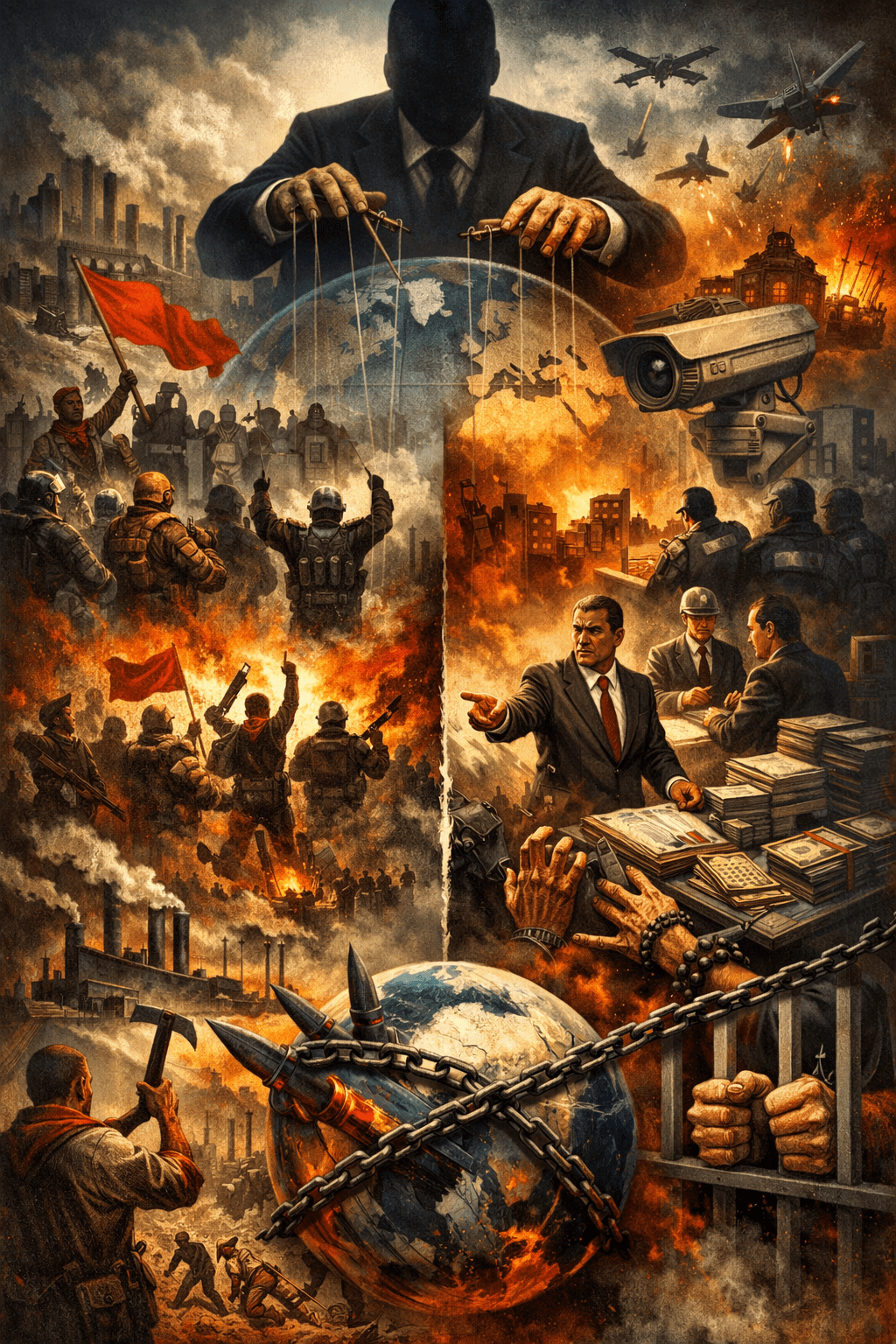
This essay is part of Weaponized Information’s larger project to forge a new discipline of political science—one that treats politics as the scientific study of power: how it is accumulated, organized, enforced, and resisted. In “Towards a New Political Science: Politics as the Science of Power”, we broke with procedural political science and its canon of respectable illusions. Here we apply that method to one of the discipline’s most powerful policing concepts: “authoritarian.” The goal is not semantic debate. It is forensic reconstruction. We treat “authoritarianism” as a political technology—an ideological weapon that disguises how all states organize coercion, while reserving moral stigma for those projects (especially socialist and anti-imperialist ones) that threaten the authorship of capital and empire. If political science lost power as its object, “authoritarian” is one of the words that helped it disappear.
The Word That Pretends to Explain
There are words that help you see the machinery, and there are words that are part of the machinery. Words that claim to illuminate politics while quietly doing politics—doing it for the ruling class, doing it against anyone who tries to move outside the permitted lanes. “Authoritarian” is one of those words. It enters a sentence like a verdict. Not as an invitation to analyze, but as a signal to stop analyzing. Once it is spoken, the room often relaxes. The moral sorting has been completed. The file has been stamped. The question has been sealed.
Notice how rarely it is treated as something that needs definition. Most people use it the way a cop uses a flashlight—only to shine it where they want your attention, never to reveal what they are doing with their other hand. What exactly makes a system “authoritarian”? Compared to what baseline? By what measurable mechanism? Those questions are considered impolite. The word is expected to do its work without being examined. It is not designed to produce clarity. It is designed to produce consensus.
And the consensus is always the same: illegitimacy. Once “authoritarian” lands, the target is no longer approached as a political formation with a history, a class structure, a siege environment, and an internal struggle over power. It becomes a moral object—unfit, dangerous, beyond the pale. The country, the movement, the government is treated as something that must be corrected, contained, or removed. Analysis gives way to a posture. “We don’t negotiate with that.” “We don’t learn from that.” “We don’t even have to listen.”
This is why the term’s vagueness is not a problem to be solved but a feature to be preserved. A concept that is sharp has to be defended. A concept that is precise can be tested against evidence. A concept that is elastic can travel. “Authoritarian” is elastic on purpose. It stretches across wildly different histories and political forms, and yet it always lands in the same political location: the place where sovereign projects that threaten capital and empire are placed for moral quarantine. It marks the kinds of power the empire wants to punish.
From there, the rest follows with the calm efficiency of a system that has done this many times. The label opens the gate for measures that would otherwise be recognized for what they are: coercion, sabotage, collective punishment. Sanctions. Blockades. Asset freezes. Media warfare. Funding opposition networks. Coups—soft when possible, hard when necessary. The official story says these are responses to repression. But the pattern tells a different story: “authoritarian” often arrives before the violence, not after it. The word is not merely describing a threat. It is manufacturing permission.
Which is why, for us, the goal is not to have an endless seminar about definitions. We are not here to debate adjectives while people are strangled by policy. We are here to do forensic reconstruction. When a word is everywhere, defined nowhere, and appears reliably at the moments when coercion needs a moral alibi, the task is not to repeat it more carefully. The task is to pry it open and inspect what it is hiding. What does this word actually explain? What does it conceal? Who benefits when it circulates as common sense, and who pays when it sticks?
In the method we laid out in Towards a New Political Science, politics is the scientific study of power: how it is accumulated, organized, enforced, and resisted. That method requires treating language as part of the field of power itself, not as neutral decoration. Political vocabularies are not innocent. They are training regimes. They teach people what to fear, what to accept, what to call normal, and what to call criminal. “Authoritarian” is one of the discipline’s most successful training words. It teaches the public to recoil from certain forms of visible authority while remaining obedient to the authority that hides behind markets, procedures, and the polite grammar of liberal rule.
So we begin with a basic act of refusal: we refuse to let the word do our thinking for us. We refuse to let it close the file. If political science lost power as its object, “authoritarian” is one of the words that helped power disappear—by turning domination into a moral drama and making imperial punishment feel like public service. Our job is to disarm that word, not as an academic exercise, but as a necessary step in making power legible again.
Who Gets to Write the World
If “authoritarian” is going to be anything more than a television insult, we have to slow the whole thing down and walk backward to the root. Strip away the tone, the pundit cadence, the policy vocabulary, and you hit something plain: “authoritarian” comes from authority. And authority is not a mood, not a personality type, not a leader’s arrogance. Authority is authorship. The power to write the script of social life and make it stick. The power to say, this is law, this is property, this is legitimate, this is crime—and then to enforce those definitions through institutions, through punishment, through the organized capacity to compel.
That chain matters—author, authority, authorship—because it exposes what liberal political language spends its life trying to keep hidden. The real problem is not that some societies have authority and others don’t. Every society has authority. Every society has binding decisions, enforced rules, sanctioned truths, and consequences for defiance. The political question has never been whether authority exists. The political question is always: whose authority? Who gets to author social reality? Who gets recognized as the legitimate writer of the world?
Who gets to write law and call it justice. Who gets to draw borders and call them natural. Who gets to define property and call it sacred. Who gets to name violence as order and resistance as disorder. Who gets to decide which lives count as fully human and which are disposable. That is authority—not as a speech about “values,” but as a social relation backed by force. Authority is the power to make your version of reality official, and to have the police, the courts, the prisons, the markets, and the schools treat that version as the only one that matters.
Once you understand authority this way, the childish moralism around “authoritarianism” starts to look like what it is: misdirection. Liberal ideology wants authority to appear as a gentle byproduct of consent—like it floats up naturally from procedures, norms, and elections. But consent without enforcement is a suggestion, not a political order. Norms without coercive capacity are etiquette, not rule. The moment a rule matters—when somebody’s wealth, land, labor, or freedom is on the line—it is backed by force, whether visible or hidden. Authority only feels “normal” when it is working smoothly in the interests of those already positioned to benefit from it.
This is why liberal language prefers to treat authority as something that becomes suspicious only when it is loud. When authority is centralized, named, and clearly owned, liberalism panics. But when authority is dispersed across contracts, institutions, and market “necessities,” liberalism calls it freedom. It trains people to focus on the style of power rather than the ownership of power. It asks whether the ruler is rude instead of asking who rules. It invites outrage at visible coercion while teaching obedience to coercion that arrives in a suit, in a spreadsheet, in a credit score, in a bureaucratic letter that says “unfortunately” while it takes your home.
And here is where the word “authoritarian” does its most effective work: it makes authorship itself disappear. It tries to convince ordinary people that the best political order is one where no one appears to be writing anything at all—where power is supposedly “limited,” “checked,” “balanced,” and therefore harmless. But a world with no authors is a fairy tale. If no one is authoring, it simply means the author is hidden. It means the authorship has been relocated—into capital, into inherited property, into institutions that claim neutrality while enforcing class rule.
Once authority is grasped as authorship, the battlefield changes. The struggle is no longer between “authoritarian” systems and “democratic” ones in the abstract. The struggle is over who gets to write the conditions of life: whether the world remains authored by capital, empire, and inherited power, or whether the masses—workers, peasants, and the colonized—claim the right to author their own futures. That question cannot be resolved by polite vocabulary. It is resolved by organization, by institutions, by force in the real sense: the collective capacity to make decisions binding and defend them against those who would reverse them.
So when we hear “authoritarian,” we do not treat it as an explanation. We treat it as a reflex—often a trained reflex—triggered the moment authorship threatens to move. Because what the empire fears most is not authority. The empire is authority on a planetary scale. What it fears is the wrong author. The wrong pen in the wrong hands. The people writing their own world without asking permission.
When Authority Grows Teeth
Once authority is understood as authorship, it becomes impossible to keep pretending that politics is a seminar moderated by norms. Authorship does not float in the air. It hardens. It settles into institutions. And sooner or later, it grows teeth. This is the point where the state enters the analysis—not as a neutral referee hovering above society, but as authority organized, centralized, and armed for enforcement.
Historical materialism strips away the origin myths quickly. States do not arise because people politely agree to be governed. They arise because societies divide into classes with irreconcilable interests, and those interests collide. When conflict becomes structural rather than episodic, authority must be enforced, not imagined. The state is that enforcement apparatus. Courts, police, prisons, armies, tax systems, borders—these are not secondary features of politics. They are its skeletal structure. Without them, authority collapses into aspiration.
Law, viewed from this angle, stops looking sacred. It starts looking accurate. Law is force made regular. Violence slowed down, written down, standardized, and administered. You do not obey the law because you woke up one morning and consented to it. You obey because you know—often without having to think about it—what follows disobedience. The threat is rarely shouted, but it is always present. Authority without the capacity to compel is advice. Authority with teeth is rule.
This is precisely the point liberal political science works hardest to blur. It treats coercion as an exception, something that appears when politics “breaks down.” But history tells the opposite story. Politics is the process by which coercion is organized, justified, and directed. The breakdown is not when force appears, but when the stories that normally justify it stop convincing people to comply. What liberalism calls crisis is often just clarity.
Once you see this, the comforting contrast between “free” societies and “authoritarian” ones begins to rot from the inside. Every state enforces property relations. Every state disciplines labor. Every state defends borders and suppresses threats to the existing order. The difference is not the presence of force but its distribution and camouflage. Some states display coercion openly. Others bury it in paperwork, debt schedules, zoning laws, credit systems, and the quiet violence of economic necessity. The effect is the same. Only the aesthetics differ.
This is why it is a mistake to imagine repression as something that only appears in riot police and prisons. Those are just the sharpest edges. Schools, welfare offices, licensing boards, immigration agencies, and regulatory bodies all sit on the same foundation. They operate differently, but they answer to the same authority. When persuasion fails, enforcement does not need to be invented. It is already waiting in the structure.
Understanding the state this way does not lead to nihilism. It leads to precision. It forces us to stop asking whether power is being used and start asking how it is being used, by whom, and for what ends. Once authority grows teeth, the real political conflict comes into focus—not between order and chaos, but between competing projects of rule. And it is exactly at this moment, when coercion becomes visible as a permanent feature of governance rather than an unfortunate deviation, that liberal ideology reaches for its favorite insult.
“Authoritarian” enters here as a way to recoil from the truth without confronting it. It names the teeth without naming the jaw. It condemns visible enforcement while protecting the structures that make enforcement inevitable. And in doing so, it keeps people arguing about morality while the machinery of domination continues to grind, largely undisturbed.
Authority Without a Face
Once the state is understood as authority organized into coercive power, the next move of liberal ideology comes into focus. Liberalism does not abolish force. It learns how to hide it. Its real achievement is not freedom from coercion, but the production of authority that rarely has to announce itself. Power does not disappear under liberal rule; it changes costume and learns to speak softly.
In liberal capitalist societies, authority rarely arrives as a command. It arrives as a condition. The boss does not threaten the worker with a baton; the rent does. The bank does not need a jail cell; it has interest rates. The court does not need to shout; it sends a letter. The state does not have to constantly demonstrate violence because the consequences of disobedience are already woven into everyday life. Obedience is organized in advance, through systems that feel impersonal, technical, and inevitable.
This is why liberal authority feels invisible to those who benefit from it. When power is aligned with your interests, it looks like common sense. Prices feel natural. Debt feels like a personal failing. Unemployment feels like bad luck. Borders feel eternal. But remove the abstractions and the same structure is there: laws enforced by police, property defended by courts, markets stabilized by the state, and violence waiting patiently in reserve. Nothing about this arrangement is neutral. It only feels that way because it works smoothly for some and relentlessly against others.
Liberal ideology depends on this disappearance act. It teaches people to associate authority with uniforms, decrees, and centralized commands, while encouraging trust in authority that is dispersed across institutions and markets. Power exercised through parliament is legitimate. Power exercised through planning is suspect. Power exercised through the market is freedom. Power exercised through collective decision-making is coercion. The distinction has nothing to do with force. It has everything to do with authorship.
When no one appears to be deciding, responsibility evaporates. Who decided wages should stagnate while profits soar? The market. Who chose to gut public services? Fiscal necessity. Who imposed austerity? Investor confidence. Authority speaks in the passive voice, and domination hides behind grammar. Decisions are made, lives are shaped, suffering is produced—and yet no author can be found.
This is precisely the terrain on which the accusation of “authoritarianism” does its quiet work. It redirects anger away from these faceless systems and toward moments when authority becomes visible again—when decisions are named, centralized, and owned. The problem, we are told, is not domination without consent, but domination that admits it exists. Not power itself, but power that refuses to hide.
Liberalism trains people to revolt only against authority that has a face, while accepting authority that has been broken into pieces and scattered across institutions. In doing so, it preserves the most durable form of rule: power that governs without appearing to govern at all. And it is this hidden authority—quiet, normalized, and deeply embedded—that will be defended most violently when it is finally brought into the open.
When Power Stops Apologizing
Once authority is exposed as something liberalism conceals rather than abolishes, the meaning of “authoritarian” sharpens. The word does not attach itself to power in general. It attaches itself to power that stops pretending it isn’t there. This is why socialism, more than any other political project, is permanently branded authoritarian—not because it invents coercion, but because it refuses to let coercion hide behind the market’s passive voice.
Socialist politics does not deny authority. It names it. When production is planned, when land is redistributed, when finance is disciplined, when capital is subordinated to social need, authority can no longer masquerade as inevitability. Decisions have authors. Institutions have purposes. Power is exercised consciously rather than mystified. And for liberal ideology, this visibility is intolerable.
The central lie is that liberal societies rule through consent while socialist societies rule through force. In reality, all class societies rule through force; the difference lies in how that force is organized and justified. Liberalism governs through force that denies itself. Socialism governs through force that acknowledges its class character and directs it toward transforming the relations of production. One hides domination. The other confronts it.
This is why Marxism insists on clarity where liberalism demands comfort. Every state is a dictatorship of a class. The only questions that matter are which class rules, over whom, and in whose interests. Democracy for one class always implies coercion against another. Exploitation does not negotiate its own abolition, and no ruling class has ever surrendered power because it was politely asked to.
When working people seize political power, they inherit a state apparatus built to serve their enemies. That apparatus does not dissolve under good intentions. Courts resist. Capital flees. Media lies. Foreign powers intervene. Counterrevolution organizes. In this context, the demand that socialist authority remain “non-authoritarian” is not naïve—it is a demand for surrender. It asks emancipatory projects to disarm themselves while their adversaries retain every weapon.
This is the trap embedded in the accusation. “Authoritarianism” becomes a one-sided moral test applied only to those attempting to break the rule of capital. The defense of collective gains is labeled tyranny. The defense of private accumulation is labeled order. Authority used to expand social power is condemned; authority used to concentrate wealth is normalized. The standard is not freedom. It is obedience to an existing hierarchy.
What liberalism cannot forgive is not repression, but reorientation. Authority redirected away from capital and toward workers, peasants, and the colonized threatens the entire architecture of hidden rule. Once power stops apologizing for itself—once it openly declares whose interests it serves—the word “authoritarian” is unsheathed. Not to understand what is happening, but to stop it.
How Power Was Rewritten as Procedure
If socialism is condemned for making authority visible, political science supplies the language that explains why this visibility is treated as a crime. This is where the discipline enters the story—not as a neutral observer, but as an active participant in reorganizing how power itself is understood. Faced with the undeniable fact that all states rule through coercion, political science does not confront force directly. It performs a sleight of hand. Power is not denied; it is translated into procedure.
In this translation, politics ceases to be about who rules, whose interests are enforced, and how domination is maintained. Instead, it becomes a study of forms. Elections. Constitutions. Courts. Checks and balances. Norms. These are treated as the substance of politics rather than as the surface through which power moves. The coercive capacities that make these forms binding—police, prisons, armies, sanctions, borders—fade into the background, treated as unfortunate necessities rather than constitutive features.
This allows political science to speak endlessly about legitimacy without ever naming domination. Elections are analyzed without asking what they cannot change. Constitutions are revered without examining the property relations they were written to protect. “Rule of law” is celebrated without tracing the violence that enforces it. Power is emptied of content and refilled with process. Authority becomes something that emerges from correct sequencing rather than something imposed and defended.
Procedure performs a crucial ideological function here. It converts obedience into virtue. A policy that immiserates millions is rendered legitimate if it passes through the proper channels; resistance to that policy is rendered illegitimate if it disrupts them. Political conflict is narrowed to arguments over form, while challenges to substance are treated as threats to order itself. In this way, procedure does not restrain power. It disciplines those who would confront it.
The accusation of “authoritarianism” fits perfectly into this procedural worldview. It becomes the name for any exercise of authority that refuses disguise. A state that plans openly, mobilizes directly, or suppresses counterrevolution without apology violates the aesthetic rules of liberal governance. It is not condemned for coercion—since coercion is everywhere—but for bypassing the rituals that normally sanctify it.
This is why political science can describe the routine violence of liberal capitalism—evictions, mass incarceration, imperial war, economic strangulation, police murders—as regrettable but normal, while treating popular attempts to reorganize power as pathological. Procedure becomes the moral filter through which authority is judged. If power wears the correct institutional costume, it is legitimate. If it does not, it is “authoritarian.”
By rewriting power as procedure, the discipline shields the existing order from scrutiny. It trains analysts to see institutions instead of domination, norms instead of force, and legitimacy instead of coercion. Once this training is complete, the word “authoritarian” can circulate effortlessly—appearing not as ideology, but as common sense. And with that, political science completes its quiet task: not explaining power, but managing how it is perceived.
Labels That Replace Explanation
Once power has been drained of substance and recast as procedure, political science still faces a problem: not every state conforms to the approved rituals. Some do not govern primarily through market mediation. Some centralize decisions openly. Some restrict opposition in ways that cannot be smoothed over with institutional language. When these cases appear, the discipline does not return to material analysis. It reaches for labels.
This is where typology steps in to do the work that explanation refuses to do. “Authoritarian.” “Competitive authoritarian.” “Hybrid regime.” “Illiberal democracy.” These terms present themselves as analytical tools, but they function more like filing systems. They organize political systems by outward appearance—electoral rules, elite circulation, media openness—while severing those features from the historical, economic, and geopolitical conditions that produced them.
By design, these categories are thin. They bracket out class relations. They ignore ownership of land, control of finance, and organization of labor. They say nothing about siege conditions, sanctions, covert war, or permanent threat of overthrow. Authority is reduced to institutional choreography, and politics is flattened into style. The question is no longer what a state is defending, but whether it behaves correctly while doing so.
This reduction is not accidental. Once stripped of material content, the label itself begins to carry moral weight. “Authoritarian” stops functioning as shorthand and becomes judgment. It signals that a state is suspect, deviant, and eligible for correction. The typology does not merely describe the world; it prepares it for discipline. Classification quietly becomes prelude.
The asymmetry is impossible to miss. States aligned with imperial power are described as flawed or imperfect democracies, regardless of mass incarceration, police violence, emergency rule, or external aggression. Their coercion is contextualized and forgiven. States that challenge imperial arrangements are branded authoritarian regardless of popular support, redistributive outcomes, or participatory structures. The label follows geopolitical alignment, not analytical consistency.
In this way, typology replaces causality. Instead of explaining why authority has taken a particular form—why centralization increases under siege, why opposition is constrained during counterrevolution, why planning replaces markets under developmental pressure—the discipline simply names the outcome and moves on. History disappears. Class struggle disappears. Imperial pressure disappears. The label itself becomes the explanation.
This is the final transformation of “authoritarian” within academic discourse. What began as a moral insult is now a professional classification, backed by journals, indices, and policy briefs. It wears the language of science, but it performs the work of power. By the time the label is applied, inquiry has already ended—and the consequences are about to begin.
When Judgment Becomes a Number
Once labels have replaced explanation, the next step is efficiency. A word can still be argued with. A number feels settled. Final. This is how “authoritarian” completes its transformation—from accusation, to category, to score. Political judgment no longer needs to persuade. It only needs to calculate.
Democracy indices and freedom rankings present themselves as neutral instruments, as if they were thermometers simply recording political temperature. But thermometers do not decide what counts as illness. These metrics encode a specific political model and then measure the world against it. Private property becomes freedom by definition. Market openness becomes autonomy. Executive constraint becomes virtue—unless the executive serves capital, in which case flexibility suddenly looks pragmatic.
What disappears entirely is power as lived reality. The indices do not ask who owns production, who controls investment, who disciplines labor, or who absorbs crisis. They do not measure hunger prevented, literacy expanded, housing guaranteed, or sovereignty defended. They measure compliance with liberal form. Outcomes are irrelevant if procedures are violated. Obedience is rewarded even when misery deepens.
The genius of this system is that it hides ideology behind methodology. What once required argument now arrives as data. What once demanded justification now appears as expertise. A country is scored “authoritarian,” and the conversation shifts immediately—from understanding to management. Capital hesitates. Aid is conditioned. Sanctions become reasonable. Intervention becomes responsible. The spreadsheet has spoken.
These numbers do not merely describe political systems; they govern them. States learn to anticipate their ratings. Laws are drafted with index approval in mind. Reforms are shaped to satisfy external benchmarks rather than internal needs. Sovereignty quietly migrates upward—from popular institutions to rating agencies, NGOs, and policy networks embedded in the imperial core. Authority is outsourced, but never relinquished.
And once again, the pattern holds. States aligned with empire are granted interpretive flexibility. Their repression is contextualized. Their emergency measures are rationalized. States that resist are frozen by their score. No amount of participation, redistribution, or national development can offset the offense of refusing liberal form. The metric does not measure legitimacy. It measures obedience.
When judgment becomes a number, dissent is rendered irrational by definition. You cannot argue with a ranking. You can only submit to it or be disciplined by it. This is not the triumph of objectivity. It is the quiet conversion of ideology into infrastructure—and the clearest proof yet that “authoritarian” was never designed to explain power, only to manage it.
The Permission Slip for Punishment
Once judgment has been reduced to a number, what remains is enforcement. This is where the word “authoritarian” reveals its final and most consequential function—not as analysis, not even as ideology, but as authorization. It becomes the permission slip that allows coercion to pass as responsibility and violence to present itself as care.
In practice, the label does not live in textbooks or debates. It travels with sanctions packages, aid suspensions, trade exclusions, asset freezes, diplomatic isolation, covert operations, and open threats. A country is declared authoritarian and suddenly its population must be “protected” from its own government—by collapsing the economy, strangling public services, sabotaging infrastructure, and funding opposition forces aligned with foreign interests. The suffering is not an accident. It is the mechanism.
The asymmetry is systematic. States aligned with imperial power may jail dissidents, militarize police, suspend civil liberties, rule by emergency decree, and wage endless war without forfeiting their democratic credentials. Their violence is contextualized, regretted, and explained. States that disrupt imperial arrangements receive no such charity. Their every act of enforcement is retroactively declared proof of illegitimacy.
This is why the accusation of authoritarianism clusters so predictably around certain projects. It appears wherever governments attempt to control strategic resources, redirect surplus toward social need, break with dollar discipline, or construct independent political blocs. It appears wherever mass participation exceeds managerial containment. It appears wherever sovereignty threatens the smooth circulation of imperial power. The word does not follow repression. Repression follows the word.
Under this logic, punishment becomes preventative. A state need not commit atrocities to be sanctioned; it need only refuse compliance. Development itself becomes suspicious if it occurs outside approved channels. Popular legitimacy becomes irrelevant if it is not recognized by external arbiters. Authority exercised in defense of collective projects is reframed as tyranny, while authority exercised in defense of private accumulation is recoded as stability.
This is not a malfunction of political science. It is its imperial function fulfilled. By the time coercion arrives, the terrain has already been prepared by language, metrics, and expert consensus. Violence no longer appears as violence. It appears as enforcement of standards. And those standards, conveniently, are authored far from the people who must endure their consequences.
At this stage, arguing over the definition of “authoritarian” misses the point entirely. The word is not there to be clarified. It is there to be obeyed. To understand it fully is to see how knowledge and force converge—how a concept becomes a command, and how a command clears the path for empire to act while pretending it has no choice.
When the Mask Slips
If “authoritarianism” functions as empire’s permission slip for disciplining others, the present moment forces an uncomfortable reversal. What happens when liberal power can no longer keep coercion offshore? What happens when the crises long managed in the periphery—stagnation, illegitimacy, social fracture—begin to press inward on the imperial core itself?
This is where the liberal myth finally breaks down. Faced with declining profitability, eroding consent, and rising resistance, liberal states do not transcend coercion. They return to it openly. Emergency powers expand. Surveillance deepens. Policing hardens. Protest is criminalized. Executive authority swells while legislatures perform ritual debate. What changes is not the substance of rule, but its presentation.
Political science calls this “democratic backsliding,” as if history had taken a wrong turn. But nothing has gone wrong. What we are witnessing is continuity. Liberal governance was never the absence of coercion; it was its strategic management. When consent thins and procedure can no longer absorb conflict, authority sheds its polite cover and asserts itself directly.
The irony is thick. The same states that built their moral identity by denouncing “authoritarianism” now rely on its familiar techniques to govern. Curfews, mass surveillance, militarized borders, preventive detention, censorship justified by security or misinformation—these are no longer foreign pathologies. They are domestic tools. The difference is not in kind, but in audience.
Liberal ideology rushes in with reassurances. These measures are temporary. Necessary. Regrettable. They will be rolled back once stability returns. But stability, under conditions of imperial decline, does not return. It is perpetually deferred. Crisis becomes permanent, and with it the normalization of rule by decree. What was once named “authoritarian” abroad is quietly renamed “governance” at home.
This moment exposes the real content of the accusation. Liberalism never opposed coercive power. It opposed losing control over who wielded it. When authority serves capital and empire, it is framed as order. When authority threatens them, it is framed as tyranny. The moral language shifts, but the class logic remains intact.
As the mask slips, “authoritarianism” can no longer function as a clean boundary between systems. It dissolves into contradiction. The question is no longer why others rule harshly, but why liberal states believed they could rule indefinitely without doing so. The answer lies not in political culture or bad leadership, but in the material limits of an imperial order now turning inward on itself.
Authority, Stripped of Its Alibis
By the time the mask slips, the category of “authoritarianism” has lost whatever analytical value it once pretended to have. It can no longer serve as a boundary between political systems, because the boundary itself has collapsed. What remains is authority in its naked form—no longer softened by procedural language, no longer hidden behind markets or metrics, no longer displaced onto distant enemies. Power stands exposed, and the old vocabulary can no longer contain it.
This exposure forces a reckoning that liberal political theory has spent decades trying to avoid. If liberal states govern through coercion when their interests are threatened, then coercion cannot be the defining feature of “authoritarianism.” If surveillance, repression, and emergency rule expand precisely at moments of crisis, then these practices are not deviations from liberalism. They are its reserve instruments. The problem was never force itself. The problem was who force was allowed to serve.
At this point, the moral contrast collapses completely. The question is no longer whether authority is exercised, but how it is organized and toward what end. Authority deployed to preserve minority rule is normalized. Authority deployed to dismantle inherited domination is treated as illegitimate. The distinction is not ethical or cultural. It is material and class-bound.
Stripped of its alibis, authority appears as a relationship of domination that must be organized one way or another. Either it is organized to reproduce exploitation—protecting property, disciplining labor, enforcing imperial hierarchies—or it is organized to break those relations and construct something new. There is no neutral configuration. There is only alignment.
This is where liberal political language reaches its terminal limit. It has no vocabulary for authority exercised in the interests of the many, because it has never recognized such authority as legitimate. It can only name that possibility as excess, danger, or tyranny. “Authoritarian” becomes the word that appears when explanation fails—when domination can no longer be hidden, but cannot yet be admitted.
A materialist analysis refuses this dead end. It does not ask whether authority looks harsh or gentle, centralized or dispersed. It asks whose power is being enforced, whose interests are being protected, and whose lives are being shaped by decisions they did not make. Authority, once seen clearly, demands classification by class and by project, not by tone.
At this stage, critique alone is insufficient. What is required is reconstruction. If the inherited vocabulary collapses under the weight of reality, then a new one must be forged—capable of naming power without mystification and authority without moral theater. Only then can political science move from policing legitimacy to explaining domination, and from explaining domination to understanding how it might finally be undone.
Concepts Are Battlefields
What this excavation of “authoritarian” ultimately reveals is not a flaw in one concept, but a pattern in the discipline itself. Political science does not merely study power; it helps administer it by deciding which words are allowed to explain the world and which words are used to shut explanation down. Concepts are not neutral tools waiting to be applied. They are forged inside particular power relations and carry those relations forward unless they are consciously broken.
This is why rebuilding political science cannot stop at criticizing institutions or expanding the canon. It has to reach into the language itself. Every major term—democracy, legitimacy, order, stability, freedom—must be treated as a site of struggle. Who authored it? Under what historical conditions? What forms of coercion does it normalize, and which forms does it criminalize? What kinds of political action does it render thinkable, and which does it make unspeakable?
Weaponized Information approaches political theory with this method deliberately. We do not ask whether a concept is elegant or widely accepted. We ask what it does in the world. Does it clarify the mechanisms of domination, or does it help disguise them? Does it orient people toward collective power, or does it train them to fear it? Does it explain why certain forces rule, or does it merely tell us to accept that they do?
In this sense, the critique of “authoritarianism” is not a semantic dispute. It is a demonstration of method. A science of power must be willing to disarm the very vocabulary that has been used to defend power. It must be willing to say that some of the most common words in political discourse function less as explanations than as commands. Obey this order. Respect this boundary. Do not cross this line.
Once this is understood, the stakes of political knowledge sharpen. To analyze power is already to interfere with it. To expose how concepts police legitimacy is to weaken their hold. This is why empire invests so heavily in language, metrics, and expertise, and why challenges to those forms of knowledge are met with such hostility. Clarity is dangerous when domination depends on confusion.
The task ahead is therefore not modest. A new political science must treat concepts as part of the machinery of rule and subject them to the same scrutiny as laws, prisons, markets, and armies. It must produce knowledge that does not manage the world as it is, but helps people understand how it is held together—and how it might be pulled apart.
If politics is the science of power, then political theory is not an academic exercise. It is a form of preparation. The question is not whether this discipline will be accepted by existing institutions. The question is whether it will be useful to those who are forced to live under the power it seeks to explain. On that terrain, “authoritarian” is not the last word. It is one of the first that must be broken.
 Weaponized Information
Leave a comment