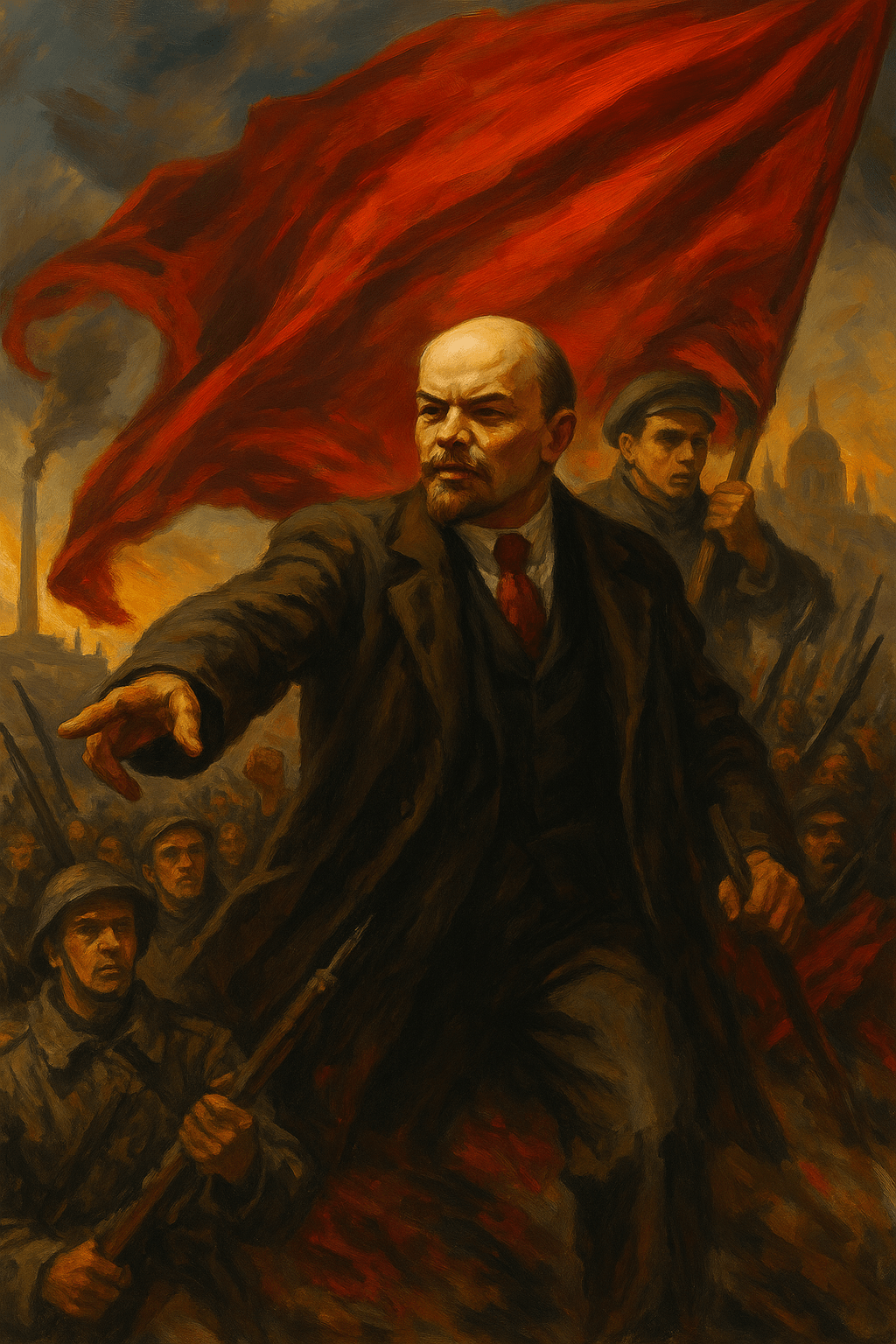
Samir Amin’s October 1917: Revolution, A Century Later is both a commemoration and a battle cry — a lucid Marxist-Leninist reflection on the world-historic rupture of 1917 and the unfinished struggle it ignited. Written in the twilight of the neoliberal era, the book reasserts the global and anti-imperialist meaning of the October Revolution, reminding us that the collapse of the Soviet Union did not end the socialist project — it exposed the fragility of a world still enslaved to capital. A century later, Amin’s analysis reads less like history and more like prophecy: a manual for revolution in the age of imperial decay.
Weaponized Intellects Book Review: October Revolution Series | By Prince Kapone | Weaponized Information | November 2025
The Global Significance of October — A World-System Fracture
Samir Amin opens his analysis with a thunderclap: the October Revolution was not a Russian event but a world-historical rupture. It marked the first decisive break from the capitalist world system—a system that, by 1917, had already fused colonialism, industrial monopoly, and finance into a single global order. Against the grain of Eurocentric Marxism, Amin insists that this rupture could only have occurred on the periphery, where imperial exploitation had stripped away every illusion of reform. Russia, semi-feudal and exhausted by war, became the weak link not because it was underdeveloped, but because it bore the full weight of the imperial chain. Lenin saw that weakness as possibility. The Western Marxists saw it as heresy. History proved Lenin right.
In Amin’s reading, Leninism is the application of Marxism to the age of imperialism—the conversion of theory into planetary strategy. The revolution’s logic was not confined to Petrograd; it was geopolitical. The seizure of power in a “backward” country exposed the global nature of capital accumulation and redefined the geography of revolution itself. The old orthodoxy of the Second International—that socialism must first mature in the advanced capitalist nations—collapsed. October’s success announced a new law of history: revolution begins where the contradictions of capitalism are most explosive, not where its comforts are greatest. It was the oppressed, not the privileged, who would open the road to socialism.
This, Amin argues, is the true meaning of Lenin’s theory of imperialism as the “highest stage” of capitalism. Imperialism is not merely a policy or an era—it is the structural condition of modern capitalism, the mechanism that sustains prosperity at the core through plunder at the periphery. The system’s “progress” depends on global polarization. The colonies are not marginal to capitalism; they are its foundation. Thus, when the Bolsheviks took power, they did not just seize the Russian state—they struck a blow at the very architecture of imperial accumulation. The revolution in one nation was, from the outset, a revolution against the world market.
Amin’s analysis exposes the blindness of Western Marxism to this reality. In the imperial centers, the working class had been bribed into passivity, its revolutionary potential diluted by the superprofits of empire. The Bolsheviks, by contrast, stood with the exploited majority of the planet—the peasants, the colonized, the enslaved. Their victory made socialism a global question for the first time. From Moscow’s signal fire, new revolutions would take their bearings: China, Vietnam, Cuba, and the decolonization waves of Africa and Asia. Amin calls this the “universalization of October.” The revolution’s message was not Russian but human: the end of empire and the beginning of history from below.
In this section, Amin demolishes the liberal and Trotskyist conceit that the Soviet Revolution was a tragic mistake. For him, such narratives serve only to disguise imperial nostalgia. The October Revolution unleashed a century of anti-colonial uprisings, transformed the balance of world forces, and forced capitalism to reform itself to survive. The welfare states of postwar Europe, the victories of labor in the West, even the language of “human rights” emerged under the pressure of Soviet existence. Every concession of capital during the twentieth century was an act of fear—a response to the specter of socialism. When the USSR fell, those concessions were withdrawn, confirming Amin’s point: capitalism without a counterweight reverts to barbarism.
Amin also highlights the ideological violence that followed October’s triumph. The imperialist powers understood that they could not kill the revolution with bullets alone; they had to destroy its meaning. Thus was born a century of anti-communism dressed as moralism, scholarship, and art. The Cold War was not just fought with armies—it was fought in classrooms, publishing houses, and newsrooms. The purpose of this propaganda was to make the revolution appear unnatural, impossible, or evil. Amin’s counterattack is relentless: he reclaims October as the dawn of a new modernity, one grounded not in the exploitation of the many by the few, but in the sovereignty of peoples over production, land, and destiny.
He shows that even the partial survival of October—its echo through decolonization, its influence on social movements, its imprint on human imagination—has permanently altered the global order. The revolution’s defeat in the Soviet Union did not erase its achievement; it scattered its energy across the world, embedding it in every struggle for national independence and social justice. The anti-imperialist movements of the twentieth century, from Bandung to Havana, are all tributaries of October’s river. The West’s anti-communism could never dam that current—it only diverted it, temporarily.
For Amin, the global significance of October lies precisely in its unfinished nature. It did not close a chapter; it opened a process. It transformed Marxism from a European critique into a weapon of the oppressed world. Its core message—that liberation begins where empire ends—remains the guiding principle of the twenty-first century. The revolution was not a tragic misstep in humanity’s march toward liberal democracy; it was the first step toward ending the global dictatorship of capital. To remember that is to refuse the cynicism of the age. To forget it is to accept the world as it is.
From Marx to Lenin — The Renewal of Revolutionary Praxis
Samir Amin’s second major intervention in October 1917: A Century Later dismantles one of the West’s most persistent myths: that Lenin distorted Marx. This accusation, repeated endlessly by liberal scholars and Western Marxists alike, is for Amin the intellectual cornerstone of modern anti-communism. The claim that Lenin “betrayed” Marx by seizing power, by using the state, by rejecting the slow march through parliament—this, Amin shows, is not analysis but ideology. It is the worldview of a Left reconciled to defeat, a Left that cannot forgive Lenin for proving that Marxism works. Against them, Amin reconstructs Lenin as Marx’s most faithful student—the one who turned theory into method, method into strategy, and strategy into victory.
For Amin, the passage from Marx to Lenin is not a rupture but a development dictated by history itself. Marx’s critique of capital emerged in an era of free competition and expanding markets. Lenin’s revolution unfolded in a world already carved into imperial hierarchies. The capitalism of 1917 was no longer progressive—it was monopoly capitalism, an empire of banks and cartels feeding on the colonies. Imperialism, as Lenin described it, was not an accident of capitalism but its highest and most violent stage, where accumulation depends on the super-exploitation of the global periphery. In this context, revolution could not begin at the center, where workers’ wages were subsidized by imperial plunder. It would begin on the margins—where the system’s contradictions were most unbearable and its chains most visible.
This is the insight that shattered the dogmas of the Second International. European social democracy, drenched in chauvinism, had long preached that socialism would come through parliamentary reform within the advanced capitalist nations. But when the First World War erupted, those same parties voted to fund the slaughter, proving that their socialism ended at the borders of empire. Lenin’s break with this tradition was not opportunism—it was scientific realism. He grasped that imperialism had created a global working class divided by privilege, and that revolutionary leadership would have to come from the oppressed nations where capital’s brutality was naked. In turning to the peasantry, the colonized, and the semi-proletarian masses, Lenin was not abandoning Marxism; he was saving it from European degeneration.
Amin’s critique of Western Marxism here is unsparing. He ridicules the tendency he calls “Marxology”—the sterile exegesis of texts divorced from struggle. The professors of the West, he writes, dissect Marx’s words like priests parsing scripture while the poor bleed in silence. Lenin, by contrast, understood Marxism as a living science—a weapon forged in motion. To read Capital while ignoring imperialism was to miss its central lesson: that capital’s logic is global, and so must be the revolution that opposes it. By developing the theory of imperialism, Lenin gave Marxism back its historical agency. He transformed it from a critique of capitalism into a strategy for its destruction.
Amin traces how this renewal of praxis culminated in The State and Revolution—Lenin’s most subversive work, and the one Western Marxists pretend not to understand. Against the revisionists who saw the state as a neutral tool, Lenin reaffirmed Marx’s lesson that the bourgeois state is an instrument of class domination. It cannot be taken over; it must be smashed and replaced by the dictatorship of the proletariat—the organized power of the majority. Amin insists that this principle is what separates revolutionary socialism from social democracy, science from superstition. Every movement that has ignored it—from Eurocommunism to today’s NGO Left—has been absorbed back into the system it claims to oppose.
What emerges in Amin’s reconstruction is not the caricature of Lenin as despot, but as dialectician. Lenin’s strength was his refusal of dogma. He treated Marxism not as a set of commandments but as a compass, adapting its insights to the concrete realities of a world transformed by imperialism. His leadership of the Bolsheviks was not an authoritarian imposition but an act of discipline—the creation of an instrument capable of confronting the most organized ruling class in history. The party, for Lenin, was the condensed expression of class consciousness, the organized intelligence of the working people. It was not bureaucracy but strategy embodied.
Amin’s Marx-to-Lenin continuum also illuminates the philosophical gulf between revolutionary humanism and liberal moralism. The liberals preach freedom in the abstract, but Lenin’s practice demonstrated that freedom without power is illusion. The proletariat cannot negotiate its emancipation; it must seize it. In this sense, Lenin completes Marx’s dictum that “the philosophers have only interpreted the world—the point, however, is to change it.” For Amin, this is not a slogan; it is the dividing line between those who seek transformation and those who perform critique for tenure and applause.
By recovering Lenin’s unity of theory and practice, Amin exposes the hypocrisy of those who mourn 1917 while enjoying the spoils of imperial peace. The Western Left, he writes, fears Lenin because it fears the masses—because his victory proved that the oppressed can govern without professors, without philanthropists, without permission. That is why, for Amin, Lenin remains the most dangerous thinker of the modern world: he showed that history can be planned, that empire can be defeated, and that Marxism without revolution is merely another branch of idealism. The renewal of revolutionary praxis begins where moralism ends—with organization, strategy, and power.
In this section, Amin completes the intellectual bridge that connects Marx’s critique to Lenin’s revolution. What began as an analysis of exploitation becomes, in Lenin’s hands, a plan for liberation. The October Revolution thus stands as the historical proof of Marxism’s truth: that theory, when united with organized struggle, can transform the world. In that transformation, Amin finds not an episode of the past but a blueprint for the future—a reminder that the revolution’s science remains incomplete until it is renewed, again and again, by those willing to fight.
Revolutions and Counter-Revolutions — The Empire Learns to Strike Back
For Samir Amin, the century that followed 1917 is not a history of socialism’s failure—it is the history of imperialism’s revenge. The October Revolution cracked the world system open; the rest of the twentieth century was the ruling class’s desperate attempt to seal it shut again. In October 1917: A Century Later, Amin maps this long arc of counter-revolution with surgical precision. From fascism to neoliberal globalization, every mutation of capitalism has been an effort to restore the power that October shattered. The ruling classes of the West did not simply oppose communism—they restructured the entire world economy to contain it.
Amin situates this struggle within his broader world-systems framework. Imperialism, he insists, is not a foreign policy or a stage we can outgrow—it is the permanent structure of global capitalism, organized around the exploitation of the periphery by the core. The North–South divide is not an aftereffect of the system; it is its engine. Every “crisis” of capitalism is followed by a counter-revolution that reorganizes the mechanisms of control, from colonial occupation to financial domination. The twentieth century’s great lesson, Amin writes, is that capital has learned to govern the world as a single imperial bloc—what he calls the “collective imperialism” of the Triad: the United States, Western Europe, and Japan. Each new phase of globalization is merely a new form of that same dictatorship.
This analysis explodes the moral myth that capitalism triumphed through democracy or innovation. Amin shows that the global “liberal order” arose not from the failure of socialism, but from its achievements. The fascist regimes of the 1930s were capitalism’s first counter-revolutionary answer to 1917—a way to preserve class rule through militarized nationalism when liberal democracy could no longer contain revolt. When fascism fell, U.S.-led imperialism inherited its function, using the Cold War to rebuild the same world hierarchy under new banners: “freedom,” “development,” “modernization.” NATO, the IMF, and the CIA replaced the colonial gunboat. Where Mussolini used bayonets, Washington used debt, propaganda, and sanctions. Amin’s point is devastating in its simplicity: imperialism never disappeared; it merely changed its costume.
Within this framework, Amin rereads the Soviet experience as the century’s central contradiction. The USSR’s survival constrained the imperial system, forcing capital to make concessions it never intended: social welfare in Europe, national independence in the colonies, labor rights in the United States. These were not gifts of enlightened democracy—they were the price of containment. The Cold War, Amin writes, was a global counter-revolution disguised as peace. It disciplined workers in the North through consumerism and crushed insurgency in the South through coups, blockades, and assassinations. Underneath its talk of “liberty,” it was a planetary police operation to restore the supremacy of private capital.
Amin’s polemic cuts through the hypocrisy of the Western Left, which continues to treat the collapse of the USSR as an act of “liberation.” He calls 1989–1991 by its real name: a bourgeois Thermidor, the restoration of capitalism under the banner of reform. The Soviet bureaucratic class, increasingly divorced from the masses, mistook accommodation for modernization. In Gorbachev’s perestroika and Yeltsin’s shock therapy, Amin sees the logical culmination of decades of ideological drift—a ruling stratum that sought to construct capitalism without capitalists, a “transition” that ended in mass privatization, poverty, and imperial recolonization. The triumph of neoliberalism was not a spontaneous people’s uprising; it was the revenge of a comprador class trained and financed by the West.
Here Amin turns his critique outward, to the chorus of Western intellectuals who celebrated the “end of history.” The collapse of the USSR, he argues, marked not the victory of freedom but the disintegration of a counterweight that had kept imperialism in check. Neoliberal globalization—the so-called “Washington Consensus”—was capitalism’s global counter-revolution, the total re-subjugation of the periphery through debt and deregulation. Structural adjustment became the new colonialism; democracy became the language of domination. In this new order, finance capital reigned supreme, unbound by borders and accountable to no people. The free market, Amin writes, is simply the dictatorship of money.
Yet even amid this dark consolidation, Amin sees the dialectic of resistance at work. Every counter-revolution produces its opposite. The defeat of the Soviet Union unleashed imperial arrogance but also reignited the anti-imperialist imagination—from Venezuela to South Africa, from China’s reassertion of sovereignty to the resurgence of socialist thought across the global South. The West’s victory, he argues, is already decomposing under the weight of its contradictions: environmental collapse, mass precarity, and endless war. The same system that once fed on the periphery now devours its own children.
Weaponized through our lens, this section is not just an account of imperial reaction—it is a map of the terrain of modern class war. Amin’s historical sweep transforms scattered episodes into a single narrative of struggle: from the White Armies to Wall Street, from NATO to neoliberalism, from fascism to Facebook. Each phase of counter-revolution carries forward the same project: to bury the memory of October. Our task, Amin insists, is not to mourn the defeats but to learn their anatomy. The revolution’s enemies have studied their failures; so must we. For as long as capital rules, counter-revolution remains its highest form of government.
In this way, Amin’s third movement completes the dialectic begun in 1917: revolution, counter-revolution, renewal. He shows that socialism was never crushed by its internal contradictions alone—it was strangled by a world order that cannot tolerate alternatives. But every system that must fight this hard to survive is already dying. The empire can rewrite history, but it cannot erase the fact that the exploited once seized the world and changed it. The lesson of Amin’s century is clear: revolutions can be defeated, but they cannot be undone.
The Sovereign Popular Project — The Alternative to Liberal Globalization
After dissecting a century of counter-revolution, Samir Amin turns from diagnosis to prescription. If imperial globalization is the dictatorship of capital on a planetary scale, what is the alternative? His answer—clear, radical, and uncompromising—is the sovereign popular project: a strategy for the peoples of the South to delink from imperial control, reclaim their productive capacities, and rebuild socialism through national and regional sovereignty. In Amin’s view, socialism can no longer be imagined as a purely domestic arrangement within one state; it must emerge as a collective front of nations, classes, and peoples united against the global oligarchy. The struggle for sovereignty, he writes, is not nationalism in the bourgeois sense—it is the internationalism of the oppressed.
Amin identifies liberal globalization for what it truly is: the organized counter-revolution of finance capital. Beneath its rhetoric of “free markets” and “open societies,” the neoliberal world order centralizes wealth in the imperial core and imposes underdevelopment on the periphery through debt, trade dependency, and the privatization of public goods. It is not an evolution of capitalism but its decomposition—a system kept alive by plunder. The global South’s integration into this order, Amin argues, has been catastrophic. Its ruling classes—the comprador bourgeoisies—serve as intermediaries between imperial finance and domestic exploitation. These elites manage their countries not as societies, but as subcontracted enterprises in the empire’s supply chain.
Against this structure, Amin calls for delinking—not isolation, but the reorientation of economies toward internal and regional development rather than subordination to global capital. The sovereign popular project begins with three principles: (1) control over natural resources and finance, (2) industrial and agricultural policies directed by social need rather than export quotas, and (3) democratic participation rooted in the organized power of workers and peasants. This is not an economic adjustment plan—it is a revolutionary program. Where neoliberalism promises growth through dependency, delinking promises autonomy through solidarity. Its purpose is to reconstruct socialism on the terrain of sovereignty.
In illustrating this alternative, Amin turns to China, not as a model to copy but as proof that strategic autonomy is possible even under global capitalism. The Chinese revolution, he argues, preserved the core of socialism by retaining public control of land, finance, and key industries while selectively using markets to develop productive forces. This, for Amin, is Leninism adapted to contemporary conditions: markets subordinated to the state, and the state subordinated to the people’s long-term project of development. The Western Left, blinded by Eurocentrism, dismisses China as “capitalist” because it refuses to fit within their theoretical comfort zone. But Amin reads it dialectically—as a contradictory but real continuation of the anti-imperialist trajectory opened by 1917.
The same logic, he notes, can be observed—though under far more difficult conditions—in Cuba, Vietnam, and parts of Latin America. These states, each in their own way, pursue the sovereign popular project: defending their independence through public control, social welfare, and mass participation. Their existence demonstrates that socialism, far from being obsolete, remains the only coherent response to imperial globalization. Even the emergence of regional blocs like ALBA or BRICS signals the beginning of a multipolar world struggling to be born. For Amin, these experiments are not perfect or permanent; they are transitional forms—bridges toward a more organized socialist internationalism.
What the sovereign popular project rejects above all is the NGO-ization of the Left—the liberal fantasy that “civil society” can reform global capitalism from within. Amin calls this the humanitarian illusion: the belief that philanthropy, fair trade, or green capitalism can substitute for revolution. He is merciless toward this tendency, which he sees as the ideological soft power of imperialism. NGOs, he writes, have replaced colonial missionaries, preaching “empowerment” while policing dissent. Against this pseudo-left moralism, Amin’s project grounds liberation in material sovereignty: land reform, nationalization, and class organization, not grants and slogans. His message to the postmodern left is simple—revolution cannot be outsourced.
Weaponized through our lens, this section detonates the myth of globalization as progress. Amin exposes it as the final mask of empire, a system that speaks of freedom while enslaving nations through debt and data. The sovereign popular project, by contrast, returns agency to the global proletariat and peasantry—the very classes erased by neoliberal narratives. It redefines democracy not as electoral ritual but as economic self-determination: a people’s right to plan, produce, and distribute wealth according to their own needs. In this sense, sovereignty and socialism are inseparable. Without sovereignty, socialism becomes impossible; without socialism, sovereignty becomes empty nationalism.
Amin’s vision is not nostalgic—it is anticipatory. He sees in the contradictions of neoliberalism the raw material for a new internationalism. As the imperial core decays under crisis and ecological collapse, the South’s struggle for autonomy becomes humanity’s struggle for survival. The sovereign popular project is not an alternative model for developing nations alone; it is the next stage in the world revolution that began in 1917. It is the answer to the chaos of a dying empire and the moral bankruptcy of a Left that mistakes critique for struggle. In reclaiming sovereignty, Amin insists, the peoples of the South reclaim the future itself.
The chapter closes with a warning and a challenge. Imperialism, Amin writes, will not tolerate sovereignty; it will meet every attempt at delinking with sanctions, sabotage, and war. The task of revolutionaries, therefore, is not to beg for integration but to build the structures of resistance—alliances, cooperatives, movements, and parties—that can sustain autonomy against imperial assault. In this, Amin stands firmly within Lenin’s lineage: revolution is not an event but a system of organization, a counter-power to empire that must be built, defended, and expanded. The sovereign popular project is not the end of history—it is the resumption of it.
The Agrarian Question — Peasants, Land, and the Future of Socialism
Samir Amin closes October 1917: A Century Later with a return to what he calls “the most enduring contradiction of capitalism”—the agrarian question. For Amin, no socialist project can succeed without resolving the land question, because capitalism itself was built upon its violent destruction. The enclosures of Europe, the plantation economies of the Americas, and the imperial domination of the Global South all emerged from one process: the separation of the producer from the means of production. Land was humanity’s first battlefield, and it remains the terrain on which imperialism reproduces itself today. Amin’s analysis cuts to the root: who controls the land controls the future.
He begins by tracing how capitalism has globalized the agrarian question. Industrial agriculture, multinational monopolies, and land privatization have turned food into a commodity governed by finance rather than need. The result is the destruction of peasant economies across Africa, Asia, and Latin America, replaced by export-oriented production that enriches foreign investors and starves local populations. The ideology of “modernization,” Amin writes, has always meant the same thing: turning peasants into cheap labor for the global market. Under neoliberalism, this process accelerates through what he calls the agrarian counter-revolution—a new wave of enclosures in the name of development, driven by agribusiness, the World Bank, and the comprador classes who profit from dispossession.
Against this tide, Amin reaffirms the revolutionary potential of the peasantry. He rejects the Western Marxist assumption that industrial workers alone are the agents of socialism. In the periphery, the peasantry constitutes the majority of the exploited class, and their liberation is inseparable from the struggle against imperialism. Lenin understood this in 1917; Mao, Ho Chi Minh, and Cabral extended it in practice. The revolution in the periphery cannot be a copy of the European model—it must be agrarian, national, and popular. Amin’s position is blunt: without the peasantry, there is no socialism.
Drawing on China and Vietnam, Amin highlights how revolutionary land reform can transform not only property relations but the very structure of social life. In both cases, land redistribution created the material foundation for national sovereignty and economic planning. The collectivization that followed—when guided by mass participation and respect for local conditions—turned scattered peasants into a politically conscious class capable of building socialism. Amin contrasts these experiences with the Soviet Union’s forced collectivization, which he characterizes as a defensive, bureaucratic reaction to isolation and crisis rather than an organic alliance between workers and peasants. The lesson, he argues, is not that collectivization failed, but that socialism must grow from the participation and initiative of the masses, not from decree.
Amin links this agrarian question directly to his larger argument about delinking and the sovereign popular project. The struggle for land is the struggle for sovereignty itself. Imperialism maintains its power through control of raw materials, food systems, and ecological resources. To delink from global capitalism therefore means reclaiming the land from transnational corporations and reorienting agriculture toward domestic needs. In his view, this requires more than reform—it requires a social revolution led by the alliance of peasants, workers, and progressive intelligentsia. Only such an alliance can dismantle the comprador state and create a new state capable of planning for human need instead of profit.
Weaponized through our lens, this chapter reads as a direct indictment of neoliberal globalization’s final frontier: the recolonization of the earth itself. The “green economy,” the “digital farm,” the rhetoric of “food security”—Amin tears these illusions apart as cover for a new imperialism of biopower. The same monopolies that dominate finance now dominate seed patents, water rights, and land ownership. The peasant, long treated as a relic of the past, becomes the last revolutionary subject capable of defending the planet from capital’s ecological suicide. In this sense, the agrarian struggle is not nostalgic—it is prophetic. The future of socialism, Amin argues, will be decided in the fields as much as in the factories.
Amin’s approach restores the peasantry to its rightful place in Marxist theory: not as a class doomed to extinction, but as the living base of popular sovereignty in the Global South. Land reform, agroecology, and cooperative production are not technocratic policies—they are the material form of democracy. In defending collective ownership and sustainable production, peasants defend not only their livelihoods but the very conditions of human survival. Capitalism’s destruction of nature and people are two sides of the same coin; socialism’s restoration of both must begin with the soil.
The chapter closes with Amin’s characteristic realism. He knows the road ahead will be long, contested, and violent. Imperialism will not yield its control of land and food without blood. But he also insists that the forces of renewal are already stirring across the Global South—in movements of landless workers in Brazil, peasant unions in India, and food sovereignty struggles in Africa. These, he writes, are the heirs of October: revolutions not of industry but of earth, revolutions that carry forward the same principle that shook the world in 1917—that those who labor shall govern.
For Amin, the agrarian question is therefore not an appendix to the socialist struggle; it is its ground, literally and figuratively. The return of the land to those who work it is the beginning of humanity’s return to history. The peasant uprising and the planetary struggle for life are now one and the same. Socialism will be green, or it will not be at all.
From the Liberal Counter-Revolution to the Next Revolutionary Wave
Samir Amin concludes October 1917: A Century Later not with melancholy for a lost past, but with a revolutionary warning for the present. The liberal order that triumphed after 1991, he writes, is not the “end of history” but the end of legitimacy. Its globalization project—fueled by debt, war, and ecological ruin—has entered its final phase of decomposition. What the bourgeoisie calls stability is merely the stillness before collapse. Amin refuses the fatalism of the Western Left, which mistakes crisis for permanence. Capitalism, he reminds us, is not eternal; it is a historical system that has reached its senile stage. The choice before humanity, as before, is the same as Rosa Luxemburg declared: socialism or barbarism.
Amin interprets the rise of Trumpism, Brexit, and European fascist populism not as anomalies but as symptoms of decay. These movements express the desperation of a capitalist class that can no longer rule as before and the confusion of masses trapped within imperial ideology. The liberal center collapses under its own contradictions, while the far right offers the only apparent rebellion—a rebellion that defends capital by turning against the oppressed. Fascism, Amin argues, is not the negation of liberalism but its mirror: both are instruments of monopoly capital, differing only in method. Where liberalism governs through consent, fascism governs through fear. In this sense, the present crisis is not a break from the old order but its logical culmination.
Amin’s conclusion is not merely analytical; it is strategic. He calls for the reconstruction of a new internationalism of workers and peoples, grounded in sovereignty, planning, and solidarity. The first wave of socialist revolutions demonstrated that capital could be defeated; the second must demonstrate that it can be replaced. This requires not nostalgia for the USSR but learning from its contradictions—the need for democratization of planning, cultural revolution against bureaucratization, and the unification of struggles across borders. Amin’s call is neither a return to the past nor an imitation of models; it is a call to rediscover the revolutionary creativity of 1917 within the conditions of the twenty-first century.
He insists that the path forward cannot pass through reformism. The era of “regulated capitalism” is gone, its social democracy bankrupted both materially and ideologically. The welfare state, born out of the Cold War’s balance of fear, has been dismantled. To demand its return without confronting the imperial structure that financed it is to chase a ghost. What remains is the hard truth: only a planned, sovereign, socialist order can meet humanity’s collective needs and save the planet from ecological destruction. Amin thus redefines socialism for the new epoch—not as the mere redistribution of wealth, but as the reconstruction of civilization on anti-imperialist foundations.
Amin’s closing chapters merge economic analysis with prophetic clarity. He foresees a multipolar world emerging from the ruins of U.S. hegemony, driven by the resurgence of China, the defiance of Russia, and the persistence of revolutionary movements in Latin America, Africa, and West Asia. This multipolarity, he warns, is not yet liberation—it is a new battlefield. Without the conscious organization of peoples, the emerging powers may reproduce a different form of hierarchy. The task of revolutionaries is to intervene in this transition, to transform geopolitical multipolarity into popular multipolarity: a system of cooperation among sovereign nations and peoples, not among rival capitalist blocs.
Weaponized through our lens, Amin’s conclusion exposes the current liberal world order as a dying empire clinging to supremacy through digital surveillance, sanctions, and perpetual war. What the media calls “democracy” is the global dictatorship of finance capital; what it calls “peace” is the pacification of the South. Against this, Amin positions the sovereign popular project as the embryo of a new international socialism—one that unites the agrarian and industrial struggles, the workers and peasants, the South and the North’s marginalized classes. His demand is not for reconciliation with capital but for rupture, reconstruction, and renewal.
He warns that the road to this renewal will not be peaceful. Imperialism, in its death throes, lashes out like a wounded beast—invading, sanctioning, and destabilizing any state that resists. The next revolutionary wave, Amin insists, must therefore be disciplined and prepared for a protracted struggle. Organization, not spontaneity, is its lifeblood; strategy, not sentiment, is its compass. He calls on the new generations of militants to study Lenin as rigorously as they study neoliberalism—to understand that the same imperial order that surrounded Petrograd now surrounds the planet itself.
In closing, Amin returns to the spirit of October. The Bolsheviks, he reminds us, did not wait for perfect conditions—they created them through struggle. Today, revolutionaries face the same imperative: to act before the future is foreclosed. The decomposition of the neoliberal order is not a tragedy; it is an opening. The world’s working peoples, armed with the lessons of a century of revolution and counter-revolution, must once again seize history. The revolution of the twenty-first century will not repeat 1917—but it will complete it. And when it does, humanity will finally step out of the long night of capital into the dawn first glimpsed in Petrograd.
This is how Amin’s book ends: not with mourning, but with instruction. The October Revolution was not a closed chapter—it was a beginning. Its centenary, Amin insists, must not be a memorial but a mobilization. For as long as imperialism exists, October lives. And in every strike, every peasant uprising, every movement for sovereignty in the Global South, its red star still burns.
 Weaponized Information
The link to Amin’s book only contains the first two chapters.
LikeLike
Thats because of copyrighting. I couldnt find a public link to the full book
LikeLike