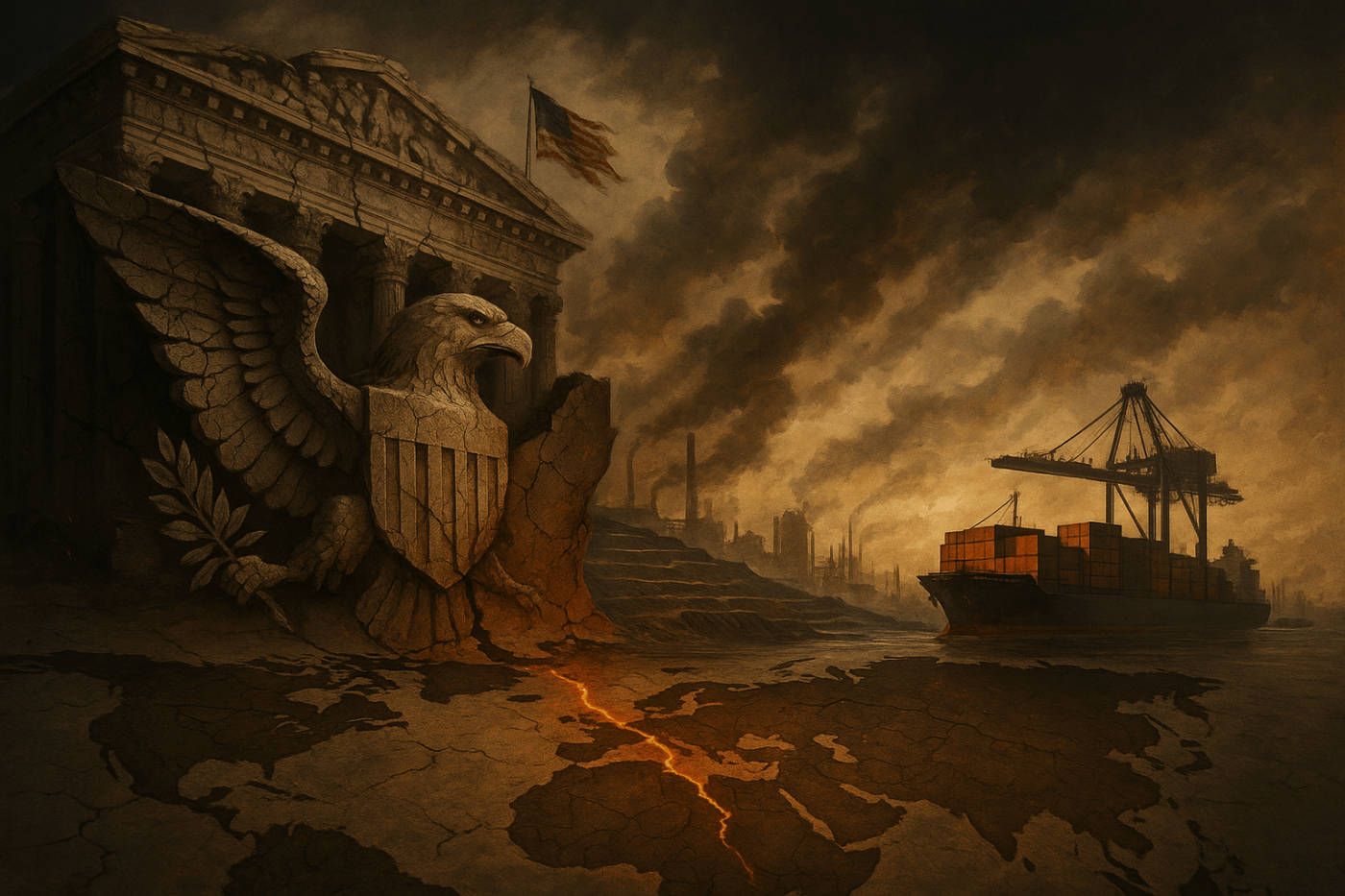
How U.S. Economic Warfare Against China Exposes the Crisis of Hyper-Imperialism
By Prince Kapone | Weaponized Information | October 22, 2025
The Empire’s Invisible Hand on the Newswire
On October 22, 2025, Reuters published a story announcing that the United States is “considering” sweeping new export restrictions on any product “containing or made with U.S. software” as retaliation for China’s rare earth controls. At first glance, it reads like neutral journalism, a simple relay of official statements and anonymous whispers. But beneath the surface, the narrative functions as a textbook exercise in imperial propaganda: state messaging laundered through a wire service to normalize escalation, erase history, and hide the iron fist of U.S. economic coercion behind the velvet glove of technocratic language.
Reuters frames the story as responsible statecraft — a great power simply weighing its options in a moment of tension — and the reader is invited to nod along as though this is all rational, reactive, and inevitable. The tone is clinical, like a weather report predicting sanctions instead of storms. The assumption is baked in from the first sentence: the United States acts, the world adjusts. China is cast as the trigger, the irritant, the one forcing Washington’s hand. There is no history, no diplomacy, no struggle over sovereignty — only a powerful empire keeping the world “stable,” even as it tightens its grip around the global economy’s throat.
The authors, seasoned Reuters correspondents with long careers embedded in the bloodstream of U.S. foreign policy reporting, perform the familiar routine of quoting unnamed officials as if anonymity were proof of authority rather than a shield for unaccountable power. “A U.S. official… three people briefed… sources said.” This is not transparency — it is narrative ventriloquism. The state speaks without owning its words, and the press repeats without challenging its premises. The effect is to turn journalism into a hall of mirrors, where power hides in plain sight and the public is taught to trust a voice it’s not allowed to see.
The outlet itself — a newswire owned by a financial intelligence conglomerate servicing investors, banks, and corporations — is never neutral terrain. Its business model depends on protecting the confidence of markets and the mythology of American managerial competence. So when Reuters covers U.S.–China escalation, the question is never who is right, or who suffers, or who bleeds. The question is how the markets feel. In this article, the only human consequence mentioned is a brief dip in the Nasdaq, before stocks “pared their losses.” The suffering of millions is irrelevant; the nerves of shareholders are sacred.
Meanwhile, the real casualties — workers across the supply chain, the Global South economies caught in the crossfire, and the people whose lives are shaped by decisions made in Washington boardrooms — are erased entirely. Not one sentence considers the miners extracting the rare earths, the factory workers assembling electronics, or the communities whose livelihoods will be thrashed by tariff whiplash and export blackmail. Empire requires this erasure. The oppressed must disappear so that imperial policy can masquerade as managerial housekeeping rather than legalized violence.
The propaganda moves are subtle but relentless. The U.S. is portrayed as measured; China as retaliatory. Escalation is framed as defense. An act of economic warfare is described as a “tool.” Imperial coercion becomes policy, and policy becomes common sense. Trump’s threats are treated not as unhinged brinkmanship but as legitimate negotiation tactics between equals — even though the entire story rests on the U.S. claim to global jurisdiction over software, technology, and trade beyond its borders. The empire speaks as though its law is the world’s law, and Reuters reports it that way.
By the end of the piece, the reader is not informed but conditioned. The story does not explain; it prepares. It builds public tolerance for escalation and markets imperial policy as inevitability. It teaches readers to accept software chokeholds, tariff wars, and global economic coercion as normal instruments of governance. This is not journalism in service of the public. It is narrative infrastructure for empire — the soft power edge of hard power strategy. And like all imperial propaganda, it demands to be unmasked. That is the task of the next section: to rip away the neutral mask and lay out the material facts Reuters carefully avoids.
The Material Architecture of Escalation
To understand the gravity behind Reuters’ messaging, we must strip the propaganda down to its material foundations. The article tells us that Washington is “considering” restricting any product “containing or made with U.S. software” as a retaliatory measure against China’s expansion of rare earth export controls. Buried inside that sterile phrasing is a geopolitical earthquake. The United States, the self-appointed guardian of “free markets,” is asserting the right to decide what the entire world can sell, buy, manufacture, or ship — not only within its borders, but anywhere on Earth where its software is present. And since nearly every advanced commodity — from laptops and smartphones to satellites, automotive systems, and jet engines — involves U.S.-origin code or tools, the scope is planetary.
Reuters briefly references the Biden-era measures against Russia as precedent, but avoids explaining what that precedent actually is. The central instrument is the Foreign Direct Product Rule, a bureaucratic phrase with imperial teeth. Under FDPR, Washington claims extraterritorial authority: if a product anywhere in the world is made with U.S. software or technology, the United States assumes the right to control its destination. This is not defensive policy — it is global economic governance by decree. The article reduces it to a passing comparison, leaving readers unaware that this regulatory weapon reshaped entire industries overnight when deployed against Moscow in 2022.
Likewise, the rare earth question is flattened into a single sentence. The article states that China “expanded its export controls,” but provides no context. In reality, China controls the processing of rare earth elements that form the backbone of modern technology — magnets, semiconductors, electric vehicles, medical devices, renewable energy grids, aerospace equipment, and advanced weapons systems. For decades, U.S. corporations offshored this dirty and dangerous extraction chain to China to cut costs and boost profits. Now, after building dependency, Washington presents itself as the victim of Beijing’s decisions. The Reuters story treats this dependency as an accident of history rather than the logical result of capitalist globalization in service of Wall Street and Silicon Valley.
The article also hides the timing. Trump’s tariff threats, the expansion of China’s controls, and the planned meeting between Trump and Xi are not isolated incidents. They are synchronized moves in a larger struggle over who controls the commanding heights of the global economy. With its industrial base hollowed out and its unipolar moment decaying, the United States is shifting from persuasion and soft power to coercion and hard leverage. Software dominance becomes a substitute for lost manufacturing power. Export controls become an economic bludgeon. Tariffs become a loyalty test. This is not policy drift — it is imperial recalibration.
Meanwhile, Reuters acknowledges potential “blowback” only in terms of Wall Street and multinational corporations, as shown in its focus on corporate losses. The real blowback — the kind that touches working-class lives — is never mentioned. If these measures advance, consumers will face price shocks and shortages; workers in logistics, electronics, and automotive industries will confront layoffs and instability; Global South economies will find themselves choked by a trade war they did not choose. U.S. policy elites can afford a prolonged crisis. Workers, tenants, farmers and debt-strapped nations cannot. The omission is not accidental — it reflects the class lens of the outlet and the audience it serves.
What the Reuters narrative most aggressively suppresses is the fact that this fight is not fundamentally about “national security” or “retaliation.” It is about control — control over chokepoints, over standards, over flows of goods, over the global hierarchy of production, and over the future of technology itself. China’s rare earth leverage threatens a system long dominated by U.S. capital, and Washington’s export controls and software ultimatum function as a counter-lever in this struggle for economic command. The stakes are not an abstract policy dispute; they are material and planetary, as reflected in the global repercussions of rare earth restrictions and trade controls.
The task now is not simply to reveal these omitted facts, but to reinterpret their meaning. What looks like “competition” is in fact escalation. What looks like “policy” is in fact economic warfare. What looks like “trade tension” is in fact a clash over who will shape the next world order: a declining empire desperate to preserve unipolarity, or a rising multipolar system asserting its right to develop outside Washington’s command. By excavating the facts Reuters buried, we can now advance to the next step — reframing the entire narrative from the standpoint of the oppressed, the exploited, and the dispossessed, rather than from the view of markets, officials, and imperial managers.
Hyper-Imperialism in Decline: When a Dying Empire Reaches for the Gun
The Reuters story, once stripped of its neutral mask, becomes a window into a deeper geopolitical crisis: the United States is not escalating because it is confident, but because it is losing control. What we are witnessing is the behavior of a hyper-imperial power in decline, clinging to authority it can no longer maintain through persuasion, production, or legitimacy. The software threats, the tariff blackmail, the invocation of global jurisdiction through tools like the Foreign Direct Product Rule — these are not signs of strength, but symptoms of imperial exhaustion. A stable empire does not need to remind the world of its power. A declining one does.
For decades, Washington enjoyed a unipolar moment in which it could command global obedience through a combination of market coercion, ideological dominance, and military intimidation. But that era is rotting from the inside. The United States offshored its manufacturing base to maximize corporate profit, hollowed out its productive capacity, and became dependent on the very supply chains it now tries to discipline. China’s rare earth leverage is not an accident of fate — it is the material outcome of U.S. capital choosing short-term shareholder gains over long-term strategic autonomy. Now, instead of confronting its own structural decay, the empire lashes outward, demanding through force what it can no longer secure through economic vitality.
That is the true meaning of the Reuters narrative: escalation presented as stability, coercion dressed up as policy, and panic disguised as “retaliation.” When the article frames China’s moves as an instigating threat while portraying Washington as a reluctant responder, it reproduces the mythology that the United States is the guardian of order. In reality, the roles are inverted. China is acting from a position of material leverage built through industrial development. The U.S. is acting from a position of insecurity, trying to weaponize the only commanding heights it has left — software control, financial infrastructure, dollar dominance, and the legal machinery of sanctions.
This is the essence of hyper-imperialism: a world system in which the declining hegemon compensates for its eroding economic base by expanding its coercive reach. A rising multipolar order is eroding the ideological and geopolitical foundation that allowed Washington to rule without rivals. And in response, the empire tightens its grip — not because it is strong, but because it is slipping. The Reuters article helps manage this transition by normalizing the idea that the United States has the right to decide what the world can trade, produce, or access. It invites the public to accept imperial enforcement as ordinary statecraft, never questioning the legitimacy of a system in which one nation claims authority over all others.
But beneath the surface, the contradictions are sharpening. If the U.S. could rely on its productive capacity — the factories it once commanded, the industrial base it once boasted — it would not need to issue global ultimatums through software chokepoints. If it could rely on ideological legitimacy, it would not need to hide behind anonymous officials and manufactured narratives. If it could rely on stable alliances, it would not need to threaten the very supply chains its allies depend on. The empire is behaving like a cornered animal, not a confident architect of world order.
Reuters cannot admit this, because acknowledging decline would shatter the imperial common sense that underwrites its entire worldview. So the story is flattened into a script: China provokes, America deliberates, markets tremble, leaders prepare to “manage” the situation. No mention of multipolarity. No mention of the structural crisis. No mention of the reality that U.S. policy now resembles a gambler doubling down on every losing hand — raising the stakes not from confidence, but from desperation.
When viewed through the eyes of the global working class and the oppressed nations of the world, the meaning becomes unmistakable. The United States is not defending freedom, security, or stability. It is defending supremacy. And supremacy in decline becomes more dangerous than supremacy at its peak. A rising world is demanding the right to develop on its own terms, while a fading empire is insisting that development can occur only under its supervision. This is not a “trade dispute.” It is a historical collision between two epochs: the fading unipolar order and the emerging multipolar future struggling to be born.
Thus, the question before us is not whether the United States will escalate — it already has. The question is whether humanity will allow a declining empire to drag the world into crisis after crisis in order to preserve a hierarchy that no longer has material legitimacy. The Reuters article reveals the mindset of the ruling system: normalize the coercion, conceal the decline, and pretend that empire is stability. Our task — and the work of the next section — is to turn this clarity into strategy, so that the global majority can not only interpret the world, but organize to change it.
From Exposure to Action: Building Power Against the Machinery of Empire
Now that the mask has been torn from the narrative, the final task is to move from clarity to strategy. If the United States is escalating because its imperial order is decaying, then the question facing workers, organizers, and movements in the Global North is simple: what do we do with that knowledge? Understanding the system is not enough. We must learn to fight on terrain that is shaped by sanctions, software chokepoints, trade wars, and economic blackmail. Reuters speaks to investors. Washington speaks to corporations. We must speak to each other, build power from below, and disrupt the system that is driving humanity toward endless crisis for the sake of preserving a dying empire.
The first step is solidarity with those on the frontlines of this global economic warfare — not the politicians or CEOs who manufactured this conflict, but the workers and communities who will absorb the blow. When the next round of tariffs hits, it will not be Trump, Biden, or the think-tank aristocracy that pays the cost. It will be the dockworkers facing reduced hours, the warehouse workers pressured under leaner supply chains, the families confronting higher prices, and the Global South producers squeezed by a war they did not choose. We must reject the propaganda that tells us to pick a side between rival empires or cheer for “our” oligarchs. Our side is the side of humanity — the miners in Congo, the assembly workers in Shenzhen, the port workers in Oakland, the precarious and the dispossessed everywhere.
The second step is to attack the narrative battlefield. Reuters and outlets like it rely on public passivity — on people absorbing imperial logic without questioning how the world is organized or who benefits from these conflicts. Countering this does not require billion-dollar media networks. It requires disciplined, grassroots political education: study circles, community teach-ins, worker-led media projects, and information networks rooted in trust rather than corporate sponsorship. Every time a trade war is announced, someone must explain who profits and who bleeds. Every time sanctions are justified, someone must show the human cost. Every time the empire says “we must,” someone must ask “for whom?”
The third step is organization. Without independent working-class power, knowledge is a weapon without an army to wield it. Movements must pressure unions, community organizations, campus groups, and local institutions to oppose economic warfare and reject the narrative of national unity behind imperial policy. We must refuse to let the ruling class wave a flag and demand our obedience. A declining empire will always try to conscript its workers into its geopolitical ambitions. We answer: we will not pay for your crisis.
Finally, we must internationalize our struggle. If multipolarity is emerging, it cannot be left in the hands of states alone. A new world must be shaped from below, not negotiated by elites at summits. Real internationalism means building relationships between workers, movements, and media across borders — to share strategy, amplify each other’s struggles, and develop a common front against sanctions, blockades, and economic domination in all its forms.
Empire is most dangerous at the moment of its decline, but it is also most vulnerable. The United States escalates because its power is slipping, not because its victory is assured. If we organize with clarity, discipline, and international solidarity, we can turn this moment of imperial crisis into an opening — not for a different empire, but for a different world altogether. The task now is to build it.
 Weaponized Information
Leave a comment