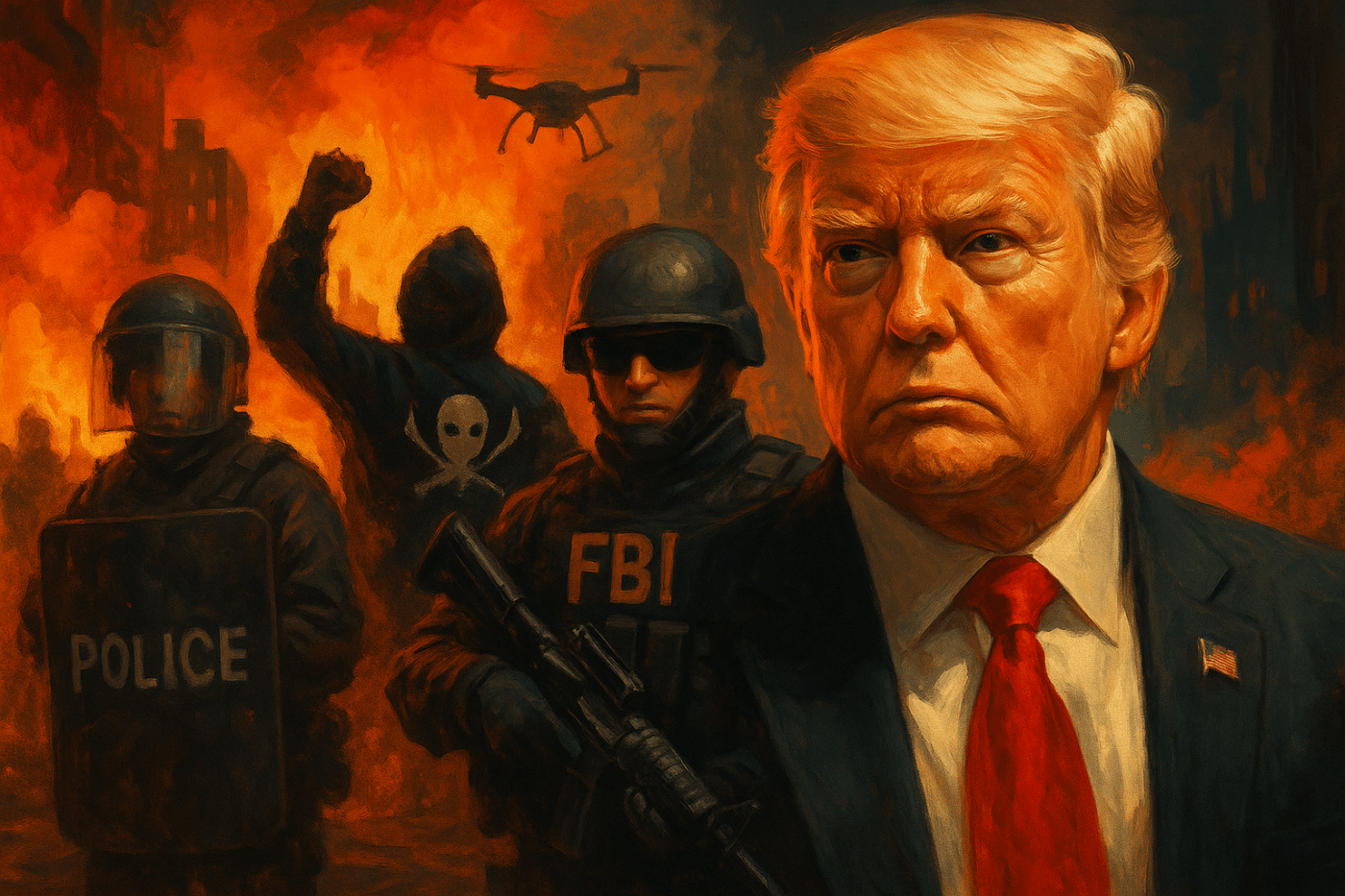
The so-called “antifa terrorism” charges in Texas expose a deeper truth: the empire’s legal and media institutions are being fused into a technofascist apparatus of control. The war on terror has come home.
By Prince Kapone | Weaponized Information | October 17, 2025
The Manufacture of Domestic Terror: Reuters as Lawfare Apparatus
On October 16, 2025, Reuters ran a story by Jack Queen called “U.S. prosecutors bring first antifa terrorism charges in Texas police shooting case.” It claimed the federal government had made history—charging two young men from Texas with “supporting terrorists” after a scuffle at an ICE detention center. Reading it, you’d think the state had just defeated a small army. In reality, it was another press release disguised as journalism: a story that does not inform, but instructs. It teaches the reader to fear dissent and trust the badge.
Jack Queen writes like a man who knows which side of the courtroom he’s on. His beat—federal prosecutions, court cases, and the machinery of “law and order”—has made him fluent in the language of authority. He quotes prosecutors and FBI officials as if they were objective narrators of truth, while defendants’ voices arrive only as a legal formality. His class position is that of the imperial stenographer: the middleman who translates the violence of the state into polite, printable sentences.
And the company that pays him—Reuters—is no stranger to power either. It’s owned by Thomson Reuters Corporation, a global data giant headquartered in Toronto with contracts across Wall Street and Washington. Reuters sells “intelligence” to the same Homeland Security agencies and private prisons that profit from surveillance and detention. It’s not a news agency so much as a laundering service for empire—washing blood and bureaucracy into something you can read with your morning coffee.
The mouthpieces chosen to “break” this story tell you everything you need to know: FBI Director Kash Patel, Trump officials, and a few anonymous “law enforcement sources.” It’s a chorus of badges and briefcases, all harmonizing to the same note—fear. Their message is clear: the greatest threat to America isn’t white supremacists, corporate plunder, or state violence. It’s the people who dare to call those things by name.
The article opens with a trick as old as propaganda itself: start with the verdict, then backfill the evidence. “First-ever terrorism charges” sounds historic, even heroic, so the rest of the story simply has to justify it. The government speaks first, the FBI follows, and by the time the defense attorneys appear, the reader has already been told who the “terrorists” are. Reuters doesn’t have to say the defendants are guilty—the structure of the article does that automatically.
Language is the weapon here. Words like “cell,” “attack,” and “violent extremist” turn two defendants into a phantom army. The reader never meets them as people—only as threats. That’s the beauty of this kind of writing: it doesn’t need to lie, just to describe. Call someone an “anarchist extremist” often enough, and you don’t have to prove a thing.
And then there’s what’s missing. The piece never mentions that “antifa” isn’t an organization at all—it’s a loose network of people who oppose fascism. It doesn’t ask whether Trump even has the legal authority to call it a “terrorist group.” Those absences are deliberate. When you leave out the facts that complicate a narrative, you don’t weaken the lie—you fortify it. What Reuters doesn’t say is more important than what it does.
Even the illusion of fairness—the token quote from a defense lawyer—is part of the performance. It gives readers a small dose of “balance,” just enough to pretend that democracy is still functioning. But the ratios tell the truth: a dozen lines for the state, one for the accused. The empire speaks in paragraphs; the people are allowed a single sentence of protest.
By the end, what looks like news reads like a sermon. Reuters wants us to believe that criminalizing dissent is a reasonable defense of order. That when the state swings its hammer, it’s only fixing the cracks we made by questioning it. But beneath the polite phrasing and careful objectivity lies the same old lesson: if you resist, you are the enemy. The “war on terror” has come home, and its first casualties are the ones who dared to stand against fascism. This isn’t journalism—it’s lawfare with a press badge.
The Legal Weaponization of Fear
When power begins to wobble, law becomes its crutch. Every empire in decline retools its legal code into a weapon, and the Trump regime has mastered this art. What Reuters framed as a simple “terrorism” case in Texas is part of a larger pattern: the reengineering of law to criminalize dissent, militarize domestic life, and turn the language of “security” into a euphemism for social control. The facts that never make it into the headlines tell a far more disturbing story.
Start with the so-called “antifa terrorism” designation. According to the Washington Post, there is no provision in U.S. law that allows the government to label domestic groups as terrorist organizations—Congress has never created a domestic counterpart to the foreign terrorist organization list. As confirmed in the U.S. Code, Section 219 of the Immigration and Nationality Act applies strictly to foreign entities, not to citizens or political movements operating inside the United States. Despite this, the White House announced in September 2025 that President Trump had signed an executive order designating “antifa” as a domestic terrorist organization—effectively treating an ideology as an enemy of the state. Legal scholars quickly condemned the move: experts at the Lawfare Institute warned that the order had no legal foundation, while the Cato Institute called it “executive overreach dressed up as patriotism.” In substance, the order was less about public safety than about policing dissent—a declaration of war not on a network of militants, but on political opposition itself.
Antifa, contrary to the myth, isn’t a club with leaders or funding streams. As PBS explains, it’s a loose constellation of people who reject fascism wherever it appears—an umbrella term rather than a formal group. Analysts at the Center for Strategic and International Studies (CSIS) describe it as a decentralized movement made up of autonomous collectives, community organizers, and individuals acting independently against white supremacy. Some organize in neighborhood defense groups, others through unions, community centers, or online networks that share antifascist materials and tactics. There’s no membership card, no chain of command, and as even Wikipedia’s comprehensive overview notes, no central leadership or official membership structure. Yet the state and its stenographers in the press keep describing it as a “cell,” a “movement,” or a “network”—language meant to make an idea sound like an army. As bureaucracies can’t fight ideas, they settle for arresting bodies. By turning a decentralized resistance into a phantom “organization,” the state transforms repression into what looks, on paper, like law enforcement.
The origins of this narrative trace back to 2020, when protests erupted nationwide after Minneapolis police officer Derek Chauvin murdered George Floyd. Time magazine documented how the demonstrations spread across the country within days, drawing millions into the streets and marking one of the largest protest movements in U.S. history. Led primarily by Black working-class communities, the uprisings brought together migrants, poor whites, students, and the unemployed in a wave of solidarity against police violence. As the protests grew, President Trump and Attorney General William Barr publicly blamed “antifa” for protest violence—an accusation made without evidence, clearly aimed at discrediting the movement. Inside the government, the narrative began to unravel. It was later revealed that internal FBI reports found no coordinated antifa role in organizing or instigating the demonstrations. Nevertheless, the claim served its purpose: it gave the administration and law enforcement a convenient pretext to intensify surveillance, expand repression, and reframe a nationwide demand for justice as a crisis of “domestic extremism.”
The tools of surveillance built during that period never went away. As the Salon reported, federal agencies used aircraft and drones equipped with advanced sensors to monitor anti-colonial protests in real time. It was later confirmed that U.S. air marshals deployed surveillance planes over multiple cities, capturing the movements of thousands of demonstrators. At the ground level, facial-recognition software was used by police departments and federal task forces to identify protesters, archiving their faces in secret databases. At the data-fusion level, the Brennan Center for Justice has documented how Department of Homeland Security fusion centers expanded their surveillance mandates to include the monitoring of anti-colonial activism, sweeping up cell-phone metadata and social-media posts in the process. Further investigations, including a U.S. Senate inquiry led by Senator Ron Wyden, confirmed that DHS intelligence units compiled dossiers on protesters in Portland and distributed the data through fusion-center networks. Even PBS NewsHour has reported that these centers have come under scrutiny for undermining civil rights through their collection of cellphone and social-media data from peaceful demonstrators. In September 2020, the Department of Homeland Security’s Office of Intelligence & Analysis compiled “intelligence reports” on journalists covering protests in Portland, which The Washington Post revealed had described leaked documents and social media activity as part of internal intelligence assessments. These disclosures showed how protest reportage was folded into surveillance architectures, setting a precedent: those technologies and bureaucratic frameworks never disappeared, but lay dormant, waiting to be reactivated as the skeleton of Trump 2.0’s security apparatus.
By the time Trump returned to office, the stage had been primed for escalation. The assassination of reactionary figure Charlie Kirk became a political lightning rod—Trump tied his executive order to the fallout, making the crime a pretext for sweeping repression. Within days he signed the executive order labeling antifa a “domestic terrorist organization” and pledging to dismantle left-wing networks accused of inciting violence. In the White House’s own framing, antifa is cast as a “militarist, anarchist enterprise” bent on overthrowing law and order. His rhetoric wore the cloak of national security: dissent equated to subversion, and subversion became war. This time, the front line was home soil.
Then came the National Guard deployments—framed as a crackdown on crime in U.S. cities. Trump openly invoked a narrative of an “enemy within” to justify sending troops to urban centers, a framing reminiscent of Cold War paranoia Reuters. In Illinois, a federal appeals court struck down his attempt to deploy federalized Guard units within Chicago, rejecting claims of rebellion and limiting the administration’s military reach. State officials protested too—in California, the attorney general threatened legal action if troops were sent into San Francisco without lawful basis. The message was already out: for the state, the distinction between the American ghetto and a battlefield was evaporating. For the poor, the difference between occupation abroad and occupation at home began to vanish.
Meanwhile, Trump’s assault on dissent has crept into the digital and cultural spheres. On Day One, he signed Executive Order 14149, titled “Restoring Freedom of Speech and Ending Federal Censorship,” which accuses internet platforms of muzzling speech and gives federal agencies leverage to punish platforms that host “anti-American” content. The order explicitly targets fact-checking by platforms and broadcasters as a form of censorship. Meanwhile, his administration has moved to defund PBS and NPR—cutting $1.1 billion in public broadcasting funds—while pressing legal action against them on claims of liberal bias. Riding that wave, state legislatures—spurred by White House signals—introduced 41 anti-protest bills across 22 states in 2025 alone, targeting climate, anti-ICE, and other demonstrators with harsher penalties. These documented moves together sketch a pattern: the administration uses law, money, and regulation to bend culture and speech to its will.
This is the full context Reuters refused to touch. What they called a “terrorism case” was in fact one battle in a broader domestic counterinsurgency campaign—a fusion of police, military, and legal power aimed squarely at the working class and its allies. The law has become a weapon, the courtroom a battlefield, and the word “terrorism” the empire’s favorite disguise. Once you see the pattern, you can’t unsee it. The war on terror was never about the Middle East; it was a rehearsal. The real target was always the people at home.
Empire Turns Inward
Every empire, when it begins to fall, turns its arsenal against its own people. The “antifa terrorism” charges in Texas aren’t an isolated case; they’re a signal flare marking the next stage of decay. When the empire can no longer dominate abroad, it wages war at home. The same tools that enforced neoliberal order across the Global South—sanctions, surveillance, propaganda, counterinsurgency—are being repurposed to police the working class within the United States. This is not about crime or security; it’s about legitimacy. A ruling class that has lost the consent of the governed can only rule through fear. What we’re witnessing is the crisis of imperialism coming home to roost.
The crisis didn’t begin with Trump, but under his second regime it has been stripped of all pretense. The wars abroad failed to restore U.S. supremacy. The unipolar order collapsed. BRICS expanded. The dollar’s supremacy faltered. The system is in free fall, and the masters of empire know it. So they’ve decided to recalibrate their war machine—not by dismantling it, but by turning it inward. Every dissenting voice, every protest, every act of resistance now appears as an existential threat to a decaying order. The “terrorist” label once reserved for liberation movements in the Global South has been domesticated, used to criminalize the same spirit of rebellion that empire once exported violence to crush. The crisis of imperialism is no longer a foreign policy problem—it’s a domestic condition.
That’s where lawfare comes in. Repression no longer requires just tanks or firing squads; it can be done with a gavel and a headline. The “antifa terrorism” case is a perfect example: there’s no statute criminalizing antifascism, but the state doesn’t need one. It manufactures its own legality. Like the old anti-communist purges, the state doesn’t target crimes—it targets consciousness. The courts and media perform a ritual of legitimacy, laundering political persecution through the language of law. This is the weaponization of the judiciary as counterinsurgency. Dr. Charisse Burden-Stelly called it the “Black Scare/Red Scare”: the racialized and ideological twin engines of repression that keep the settler state intact. Today, the same mechanism is being rebooted through executive orders and terrorism charges designed to equate dissent with treason. Lawfare turns the very idea of justice into an instrument of domination.
But beneath the robes and rhetoric lies the military logic of counterinsurgency. The empire that once waged colonial wars in Vietnam, Angola, and Iraq now wages them in Chicago, New Orleans, and Portland. The same doctrines—clear, hold, build—have been adapted to the domestic terrain. The National Guard deployments into Black working-class neighborhoods, the surveillance of protest networks, and the labeling of activists as “domestic extremists” are not random policies; they are the strategic application of internal warfare. Counterinsurgency is not just about bullets—it’s about hearts, minds, and data. RAND, the Pentagon, and Silicon Valley have fused their expertise to engineer obedience. Every protestor photographed, every organizer flagged, every algorithm that sorts “risk” profiles is a digital checkpoint in the occupation of everyday life. The colonial logic persists: control the population, neutralize the insurgent, pacify the colony. Only now, the colony is the population of the United States itself.
All of this converges in what we’ve called technofascist consolidation—the marriage of monopoly finance, Big Tech, and the security state under a single command. Trump’s “Free Speech” order wasn’t about restoring democracy; it was about disciplining digital space. The censorship of dissent, the defunding of public media, and the fusion of private platforms with state power mark the end of the liberal mask. Technofascism doesn’t wear jackboots; it wears algorithms. It doesn’t burn books; it buries information beneath an avalanche of disinformation and distraction. Its function is to maintain capitalist control in an era where the old ideological apparatuses no longer work. What began as a corporate-state partnership to manage social media has evolved into a full-blown digital police state—one that surveils, categorizes, and preemptively punishes disobedience.
This is not a sign of strength. It’s a symptom of collapse. The empire that once claimed to export freedom can now only impose order. The real “enemy within” is not the antifascist or the worker in the street—it’s the decaying imperial system itself, desperate to survive the contradictions it created. Every law it passes, every enemy it invents, every protest it suppresses only exposes its fragility. In the end, all that remains is coercion without consent, power without legitimacy, and violence without justification. What Trump calls “national security” is really the ruling class fortifying its castle against the very people who built it. The empire turns inward, because it can no longer look outward without seeing its own reflection: a system in terminal crisis, fighting to keep the future from being born.
The People’s Firewall
Every stage of imperial collapse breeds two forces: repression from above, and resistance from below. Trump’s war on dissent has revealed something the ruling class never wanted us to see—that the machinery of empire depends on our consent to be ruled. The moment that consent evaporates, the empire turns its weapons inward. But it’s also the moment when the people begin to recognize their collective strength. This is the paradox of history: repression clarifies the lines of struggle. When empire calls antifascism “terrorism,” it’s admitting that ordinary people standing together still terrify the powerful.
The first task is to build solidarity across the artificial lines that divide us. The Black working class that led the George Floyd uprisings, the migrant communities under ICE terror, the unions now suing over state surveillance, the students and journalists punished for “unpatriotic speech”—these are not separate fronts. They are one front. The repression of antifascists, the criminalization of protest, the militarization of poor neighborhoods, and the censorship of dissent all arise from the same root: the crisis of imperialism. And because the crisis is global, so too must be the resistance.
That resistance is already forming. The movements that survived the last decade—Black liberation networks, immigrant rights coalitions, environmental defenders, and socialist formations—have been quietly building the infrastructure of counterpower: people’s assemblies, mutual aid networks, alternative media, labor councils, encrypted communication hubs, and worker cooperatives. These are the embryonic institutions of a new social order. When the state tightens its grip, these networks become lifelines of truth and survival. They are the people’s firewall against technofascism.
In the Global North, solidarity means moving from sympathy to strategy. It means joining campaigns that fight surveillance contracts, like the Ban the Scan coalition targeting facial-recognition policing, or backing ACLU and EFF efforts to dismantle fusion centers and digital spying programs. It means divesting from the banks, universities, and corporations that profit from the infrastructure of repression. It means supporting grassroots media that refuse corporate funding and amplify voices from the front lines of struggle. And above all, it means organizing—locally, consistently, and collectively. The revolution will not be livestreamed, but it will be organized.
We must also reclaim the ideological terrain. Trump’s “Free Speech” order tried to redefine patriotism as obedience. Our task is to redefine it as solidarity. True freedom of speech is not the right of billionaires to dominate discourse—it’s the right of the oppressed to tell the truth. Counter to their censorship, we build people’s journalism. Counter to their propaganda, we build people’s education. Counter to their economy of fear, we build an economy of care. Every collective garden, every strike, every occupation, every communal kitchen is an act of defiance against technofascist consolidation.
The empire wants us atomized, afraid, and obedient. But history’s lesson is clear: when the ruling class can no longer govern in the old way, and the people can no longer live in the old way, the conditions for transformation ripen. Our role is to seize that moment—not in despair, but in discipline. To turn outrage into organization, repression into resistance, and isolation into internationalism. The crisis of imperialism is not the end of the world—it’s the end of theirs. What comes next depends on whether we build the power to make it ours.
 Weaponized Information
Leave a comment