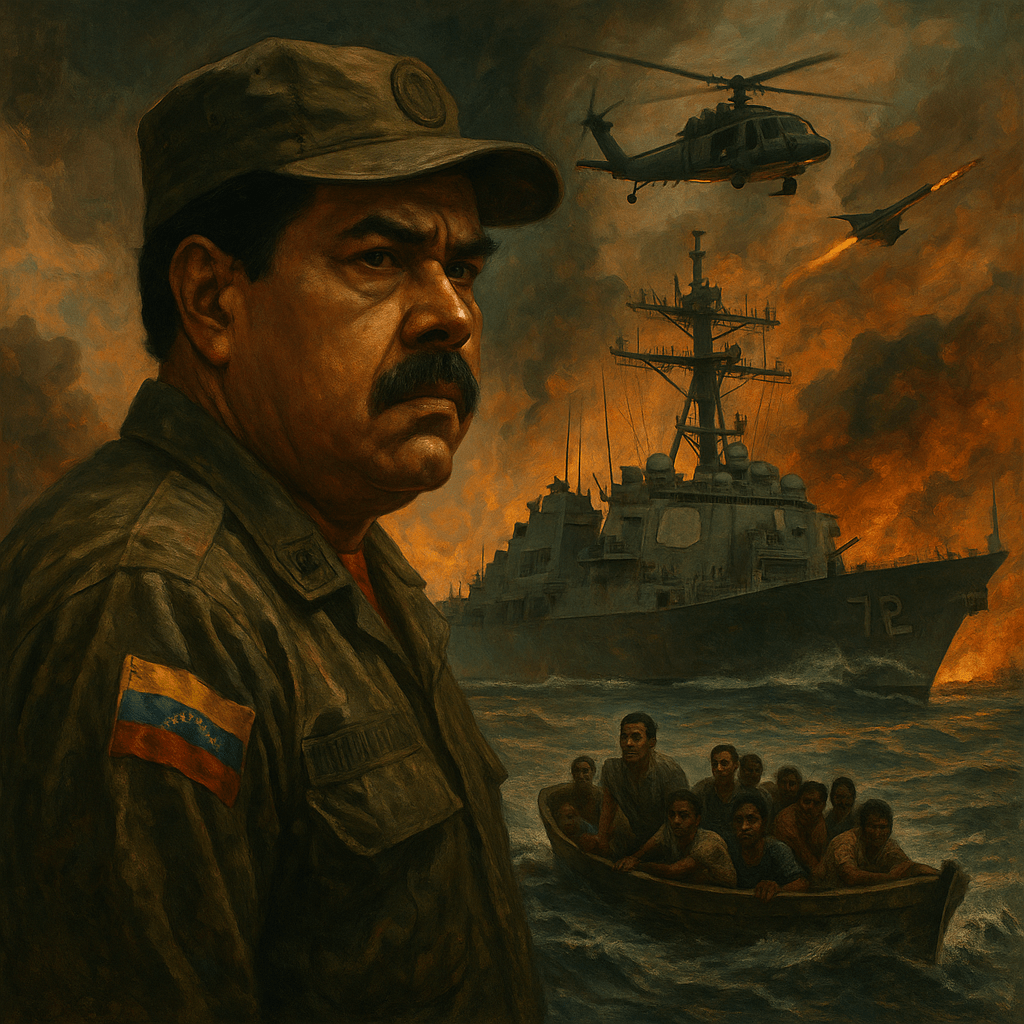
The empire claims it’s fighting drug cartels. In truth, Trump 2.0 has resurrected the Monroe Doctrine—weaponizing the “war on drugs” to recolonize the hemisphere, forge an American Pole of power, and crush the Bolivarian Revolution standing in its way.
By Prince Kapone | Weaponized Information | October 17, 2025
Empire’s Mask: The Stage, the Stakes, and the Lie
The story opens not in Washington or Caracas, but on the docks of Trinidad, where fishermen wait for men who will never return. Their boats—small, wooden, built for the sea’s daily rhythm—were mistaken for “narco-terrorist vessels.” Or rather, they were called that after being blown apart by American destroyers. The White House claims they were chasing cartels; the Caribbean knows they were killing workers. The surviving few are now reportedly detained aboard a U.S. ship—legal ghosts, nameless and stateless in the middle of the ocean. The press calls it “counternarcotics.” History will call it something else.
This is not a war on drugs. It is a regime-change war in drag—a campaign of hybrid aggression disguised as law enforcement, dressed in the costume of moral necessity. Beneath the talk of “narco-terrorism” lies the oldest imperial play in the book: the resurrection of the Monroe Doctrine, updated for a digital empire and weaponized under Trump 2.0. The target is not cocaine. It is sovereignty. And the theater of war is not just the Caribbean—it is the hemisphere itself, where Washington hopes to weld the Americas into a captive “American Pole” as a bulwark against the multipolar world now rising beyond its reach.
Like every U.S. war dressed up as virtue, this one begins with a story about danger and ends with a body count. The script is familiar. The president speaks of “narco-terrorists.” The media repeat the line. Congress pretends to be surprised, and the Pentagon swears it’s protecting freedom. But look closer and you find the real logic: a decaying empire enforcing its dominion through violence, narrative, and spectacle. The destroyers in the Caribbean are not chasing drug lords—they are performing sovereignty, showing the world that the empire still has teeth, even if its stomach is rotten.
The so-called “counternarcotics operations” are merely the next act in a long drama of recolonization. When the United States can no longer dominate globally, it retreats to the hemisphere and fortifies it—what I have called the Fortress Empire—to ensure no rival can breathe free in its so-called “backyard.” The Trump doctrine is not isolationist; it is hemispheric consolidation. Behind every missile fired in the Caribbean lies the blueprint of the American Pole: a hemispheric bloc of comprador elites, militarized states, and subservient economies, bound together under U.S. command. What looks like an attack on Venezuela is in fact the foundation stone of a new colonial order.
This essay aims to strip away the mask. Drawing on reports from AP, Reuters, CNN, and NPR, statements from the United Nations, and the documented actions of both Washington and Caracas, it reconstructs the hidden architecture of this war—the propaganda, the pretexts, the legal acrobatics, and the economic siege that together form the anatomy of imperial coercion. It also builds on the analytical scaffolding of Weaponized Information: the synthesis of technofascism, hyper-imperialism, and the crisis of monopoly finance capital as the inner logic of this moment. Our method is forensic and political, human and theoretical: the facts are our ammunition; the truth, our weapon.
To the untrained eye, it may seem the empire is defending its borders. To those who know its history, it is defending its illusion. For two centuries, the United States has waged war under the banner of peace—from the Philippines to Panama, from Grenada to Iraq, from Libya to the Caribbean today. Every invasion is baptized in the language of law, every atrocity justified as “stability.” Yet what unites them all is not law or order but profit, domination, and fear. In the twilight of unipolarity, Trump’s America clings to its last doctrine: might makes right, and the hemisphere must obey.
But the tide has turned. The same multipolar world that Washington fears now rises to meet its challenge. Venezuela, with its oil, its socialism, and its defiance, stands not as an outlier but as a symbol—a living reminder that sovereignty is still possible in a world built to deny it. The empire may control the narrative, but it cannot control reality forever. Beneath the noise of CNN and the bluster of the White House, the fishermen of Trinidad, the workers of Caracas, and the people of the Americas know the truth: this is not a war on drugs. It is a war on independence. And history, once again, is on the side of the oppressed.
The Manufacture of “Narco-Terror”: How Empire Turns Lies into Law
Every empire needs a story, and Washington’s favorite one is that it’s fighting crime. The label changes with the decade—“bandits,” “communists,” “narco-terrorists”—but the script is always the same. The enemy is dehumanized, the violence is legalized, and the spoils are privatized. In Trump’s second term, the story has been remastered for the Caribbean stage: a war on “narco-terrorism” that conveniently targets Venezuela’s coastlines, shipping routes, and sovereignty. The murdered are called traffickers, the destroyers are called police, and the audience is told to applaud.
The language itself is a weapon. When U.S. officials label a fishing boat a “narco vessel,” they erase the need for proof. When the victims are called “unlawful combatants,” they erase the category of civilian. It’s not a mistake—it’s a legal spell, one designed to transform murder into enforcement. The same formula was used in Iraq when entire cities were declared “terrorist strongholds,” and in Colombia when peasants were branded “guerrilla collaborators.” Once the label is uttered, the trigger follows. The words kill first; the missiles arrive later.
Even the geography gives the lie away. The United Nations’ own drug monitoring data shows that the main cocaine routes to the United States run through the Pacific, not the Caribbean. Yet Washington has chosen the Caribbean as its “battleground,” deploying guided-missile destroyers, submarines, and surveillance aircraft for what it claims are anti-smuggling operations. If this were about stopping drugs, the Navy would be patrolling the Pacific. But this is not about narcotics—it is about narrative control. The Caribbean was chosen not for its strategic utility against traffickers, but for its symbolism: the imperial lake of the Monroe Doctrine, the sea where the U.S. once toppled governments and trained dictators in the name of freedom.
The mismatch between rhetoric and reality is staggering. You do not need billion-dollar warships to chase speedboats, nor nuclear submarines to intercept a few sacks of cocaine. What you need them for is intimidation. Each “interdiction” is a message to Caracas and Havana, to every nation that dares chart an independent course: we can reach you anywhere. Empire has learned that propaganda is most effective when it comes with a soundtrack of engines and explosions. The roar of the Aegis cruiser is not about efficiency—it is about dominance.
Then there’s the theater of law. Trump’s Justice Department placed a $50 million bounty on President Nicolás Maduro’s head, calling him a “narcoterrorist” and declaring his government a “criminal enterprise.” In reality, this was not law enforcement—it was lawfare. By labeling a sovereign head of state as a fugitive, Washington attempted to erase the sovereignty of the Venezuelan state itself. Once a government is deemed illegitimate and its leaders criminalized, its destruction can be framed as justice rather than aggression. The missiles follow the indictments.
All of this unfolds in flagrant violation of international law. The U.N. Charter forbids the use of force except in self-defense or under Security Council authorization. The United States claims the right to strike anywhere in the world against “non-state actors,” invoking a doctrine of “unwilling or unable”—a legal fig leaf concocted to bypass the Charter’s limits. But there is no war here, no armed attack against the U.S., no Security Council mandate. There is only a self-declared empire designating its enemies and executing them at sea. The victims—fishermen, migrants, workers—have no trial, no appeal, no graves.
This is how the drug war has always functioned: as a pretext for counterinsurgency and recolonization. In Colombia, Plan Colombia was sold as anti-narcotics but served to crush peasant movements and secure oil pipelines. In Mexico, the Mérida Initiative turned entire cities into laboratories of militarized policing. Now the same logic sails under a new flag: “Operation Caribbean Shield.” Each bullet, each bomb, each body is justified by a word that’s been emptied of meaning and filled with power—narco-terrorism. It is a concept engineered to end argument, a word that kills debate before it kills people.
To believe this narrative is to accept that empire can police the planet. To reject it is to see what’s really happening: a war for sovereignty disguised as a war for safety. The “drug war” is not about purity, order, or security—it’s about power. The empire’s true addiction is not to cocaine but to control. And like all addicts, it will destroy anyone who threatens its supply.
From Covert to Overt: How Empire Forgot to Hide Its Crimes
Once upon a time, the United States pretended to keep its dirty wars in the shadows. Covert meant secret, plausible deniability meant diplomacy, and even the CIA had the decency to whisper. But under Trump 2.0, the mask has been ripped off and nailed to the wall. “We’re in Venezuela,” he bragged from the Oval Office, “to stop the drugs.” With that, the covert operation became a televised confession. The president of the most powerful country on Earth declared—without irony—that he had unleashed the CIA inside a sovereign nation. No hearings, no authorizations, no shame. It was not a slip of the tongue. It was a performance of power: the normalization of illegality as a governing principle.
This is what happens when technofascism matures. The distinction between secret and public, war and policing, foreign and domestic—those old liberal guardrails—collapse into a single imperial gesture. The executive state acts, and the media manufactures justification after the fact. There are no leaks anymore, only stage-managed disclosures. The CIA doesn’t deny involvement; it advertises it. The Pentagon doesn’t conceal troop movements; it films them for recruitment ads. In the age of algorithmic propaganda, confession becomes camouflage. The crime is so blatant that disbelief becomes the defense.
The U.S. Navy’s so-called “interdiction campaign” has already claimed dozens of lives. Six confirmed strikes on vessels labeled “narco boats” have left at least twenty-seven people dead, some burned beyond recognition, others simply “lost at sea.” Survivors have been detained aboard a U.S. vessel under conditions of total legal limbo—no charges, no names, no access to counsel. They exist in a maritime purgatory, where Washington claims jurisdiction but denies responsibility. The administration calls them “terrorists.” The law calls them civilians. The truth calls them victims of state terror.
Each strike follows the same ritual. A Pentagon press release announces a “precision engagement.” The footage—grainy, edited, and soundless—is broadcast across social media by government accounts. The president tweets a victory emoji. The press corps, hungry for access, parrots the language: “suspected traffickers neutralized.” There are no journalists on the water, no independent witnesses, no forensic verification. The public receives war by livestream and mistake it for law enforcement. In this new information order, the border between journalism and propaganda dissolves. Reuters, BBC, CNN—they don’t investigate; they curate imperial mythology.
Meanwhile, leaks and psyops fill the void of truth. Opposition leaders in exile—some crowned as human rights champions, others rewarded with Nobel Prizes—publicly call for U.S. intervention, declaring Maduro’s government a “narco-regime” beyond redemption. Miami-based media and think tanks amplify every rumor of dissent inside Venezuela’s armed forces. The goal is not persuasion but exhaustion: to flood the public sphere until reality itself becomes unverifiable. This is what counterinsurgency looks like in the digital age—not censorship, but oversaturation.
Even within the U.S. establishment, the machinery creaks under the weight of its own hypocrisy. Senator Tim Kaine and Rand Paul co-sponsored a war powers resolution demanding a vote before any further strikes on Venezuela. It failed 48–51, with Democrats and Republicans alike terrified of being labeled “soft on drugs.” Admiral Alvin Holsey, the Navy commander overseeing the operation, abruptly resigned—officially for “personal reasons.” Unofficially, sources suggest he refused to authorize further attacks without proper identification of targets. His replacement, an untested loyalist, immediately expanded the engagement zone. The message was clear: obedience matters more than legality.
Outside the halls of power, legal scholars and international jurists have begun to sound the alarm. At Just Security, former Pentagon lawyers warn that Trump’s “open acknowledgment of covert action” effectively nullifies oversight. Chatham House and the OHCHR have both questioned the legality of the strikes under the U.N. Charter, pointing to the absence of any Security Council authorization. Yet these critiques exist only as polite footnotes in the imperial record. They do not stop the bombs. They do not reach the dead.
The result is a world turned inside out. Crimes once buried are now bragged about. Illegality has become spectacle. Empire no longer hides its hand; it dares you to look away. This is not a bug in the system—it is the system maturing into its final form: a technofascist order that calls transparency a virtue while using it as anesthesia. The CIA no longer needs to operate in the dark because the public has been trained not to see. The empire, once cautious enough to deny its sins, now commits them live on air—and calls it freedom.
Monroe Doctrine 2.0: Forging the American Pole in a Multipolar World
Every dying empire dreams of resurrection, and Trump’s America has found its scripture in the Monroe Doctrine. Once sold as a policy of “hemispheric defense,” it has always been a license to conquer—the theological claim that everything south of the Rio Grande belongs to Washington by divine right. Under Trump 2.0, this old gospel has been reborn with Silicon Valley polish and Pentagon steel. The United States no longer promises global leadership; it promises hemispheric lockdown. The new doctrine is simple: if it cannot rule the world, it will rule the hemisphere—and call it “the American Pole.”
The “American Pole” is not a metaphor; it is a strategy. In the Pentagon’s 2025 posture statement, it appears as a tidy phrase: “the consolidation of hemispheric stability through security partnerships and shared prosperity.” Translated into plain language, that means recolonization. The empire that can no longer sustain unipolarity abroad seeks to weld together a captive bloc at home—stretching from Alaska to Patagonia—under the banner of law, order, and free enterprise. In the eyes of the U.S. ruling class, this is survival: if multipolarity cannot be stopped, it can at least be fenced off.
Venezuela stands directly in the way. It is not only a socialist state; it is the geopolitical keystone of Latin American sovereignty. Its oil reserves—the largest on Earth—represent the material base for an independent continental project. Its alliances with China, Russia, Iran, and the Global South threaten to delink the hemisphere from Washington’s financial chokehold. To destroy Venezuela, therefore, is to reassert the Monroe Doctrine by force. The “war on narco-terrorism” is merely the moral sugar coating on this imperial pill. Each naval strike, each sanction, each bounty is aimed at one objective: breaking Bolivarian sovereignty so that no nation in the Americas dares to follow its path.
Behind the military theater lies the deeper architecture of empire: logistics, infrastructure, and financial coercion. The United States is rapidly converting the Caribbean into a militarized logistics hub—new bases in Puerto Rico, expanded radar facilities in Aruba and Curaçao, and maritime “cooperation centers” in Trinidad and Barbados. The purpose is not counternarcotics; it is control over chokepoints. Whoever commands the Caribbean commands the trade routes, energy flows, and undersea cables that connect the Americas to the world. By turning the Caribbean into an imperial moat, Washington hopes to isolate Venezuela, contain Brazil, and pressure Mexico—all while rebranding occupation as “regional security.”
The economic dimension is equally ruthless. Trump’s tariff regime and financial sanctions operate as weapons of integration by coercion. A 25 percent tariff on any country that purchases Venezuelan oil forces even neutral states to choose sides—obey the blockade or face economic punishment. The same goes for secondary sanctions on shipping companies, insurers, and banks. These are not random acts of cruelty; they are tools for building the American Pole. By weaponizing trade law, Washington transforms the global market into an imperial enforcement mechanism. In the language of finance, the American Pole is simply a monopoly cartel enforced by the U.S. Navy.
The Monroe Doctrine 2.0 also operates through ideological warfare. Corporate think tanks like the Atlantic Council and CSIS now speak openly of “reintegrating the Western Hemisphere.” Their papers dress recolonization in managerial jargon: “regional interoperability,” “hemispheric resilience,” “cross-domain coordination.” In practice, this means folding Latin American militaries, intelligence networks, and digital infrastructure into U.S. command structures. It is not enough to topple governments; the empire must also program the software of subservience. Through Silicon Valley contracts and Pentagon funding, surveillance technologies developed for domestic repression are exported as “governance solutions” across the hemisphere. Technofascism at home becomes hyper-imperialism abroad.
Yet the contradiction is inescapable. The same arrogance that drives the Monroe Doctrine 2.0 is what undermines it. Every tariff, every drone strike, every act of lawfare pushes the region closer to unity against the aggressor. Venezuela’s defiance has inspired not isolation but solidarity. Cuba, Nicaragua, Bolivia, and Honduras reaffirm their alignment through ALBA; Mexico and Brazil hedge closer to BRICS; Caribbean nations voice dissent at the U.N. while their people march in the streets against foreign intervention. Even in Washington’s backyard, the soil of rebellion remains fertile.
To call this “regional security” is an insult to intelligence. What the U.S. calls security is simply subjugation wrapped in patriotism. The “American Pole” is not a legitimate bloc of sovereign states; it is the imperial core reorganizing itself into a hemispheric prison. Its logic is parasitic: to survive, the empire must consume what remains of independence in the Americas. But the more it feeds, the weaker it becomes. The Monroe Doctrine was born when the U.S. was rising. Its reincarnation under Trump 2.0 comes in decline—a desperate reflex of a ruling class trying to fence off history itself. The fortress may hold for a season, but no doctrine, no destroyer, and no tariff can stop the tide that is turning.
Bolivarian Resolve: Sovereignty in the Crosshairs of Empire
In the eyes of Washington, Venezuela’s greatest crime is not drugs, corruption, or authoritarianism. Its crime is sovereignty. Nicolás Maduro’s government refuses to kneel before the U.S. Treasury, refuses to hand over its oil, refuses to trade independence for “democracy assistance.” That defiance is intolerable to an empire addicted to obedience. For more than two decades—through coups, sanctions, sabotage, and slander—the Bolivarian Revolution has endured, because beneath its flag stands not just a government but a people who have learned the meaning of dignity under siege.
When Trump announced his Caribbean “interdiction” campaign, Caracas did not flinch. Within hours, Maduro went on national television surrounded by workers, soldiers, and Indigenous leaders, declaring: “We will not kneel to the empire. We will defend our waters, our people, and our future.” His words were not bravado—they were continuity. The Bolivarian process was built on resistance: from the Caracazo uprising in 1989 to the oil sabotage of 2002, from the attempted coup of 2019 to the assassination plots and mercenary invasions that followed. Each time, the people have answered with the same message: we will not surrender. And each time, the empire has been forced to escalate.
The legitimacy of Venezuela’s 2024 elections—certified by observers from the African Union, ALBA, CELAC, and independent monitors from the Global South—has been buried under a mountain of Western disinformation. While Reuters and the State Department recycle the mantra of “sham elections,” those who were actually on the ground tell a different story: transparent balloting, organized logistics, and overwhelming turnout in working-class barrios. Even the European Union, though politically opposed, could not present credible evidence of systemic fraud. But empire does not need evidence. To delegitimize is enough. Once a government is branded “illegitimate,” any crime against it becomes permissible.
Maduro’s government responded to the naval attacks with discipline and precision. Venezuela’s ambassador to the United Nations, Samuel Moncada, denounced the strikes as “a series of extrajudicial executions” and called for an independent international investigation. At the U.N. Security Council, he raised photographs of Trinidadian fishermen believed to have been killed by U.S. missiles, declaring, “There is a killer prowling the Caribbean.” This was not hyperbole; it was the language of the colonized confronting their executioner. Yet the Western media framed his speech as “provocation,” proving once again that in the imperial press, the victim is always on trial.
Inside Venezuela, the state has fortified its defenses—not for aggression, but for deterrence. The Bolivarian Militia, numbering over three million civilians, has been mobilized for coastal defense and logistical readiness. Fishermen’s unions now double as surveillance networks; communal councils track supply chains to prevent sabotage; worker brigades in the oil sector guard against cyberattacks. This is not militarism—it is people’s war in embryo, a sovereign society preparing to defend itself on every front: territorial, economic, informational, and digital. The Revolution has learned that survival requires decentralization: power rooted in the communes, not just in ministries.
At the same time, Caracas continues to wage the political struggle for truth. State media and independent journalists have exposed the inconsistencies in U.S. narratives, publishing evidence that the so-called “narco-boats” were unarmed civilian vessels. Venezuelan social networks, often throttled or shadow-banned by Western platforms, have become spaces of counter-information, linking testimonies from survivors’ families in Trinidad, Colombia, and Venezuela itself. Each revelation peels back another layer of imperial deceit. In this information war, truth itself is revolutionary.
But sovereignty is not only defense—it is creation. The Bolivarian process continues to expand social missions: housing, food distribution, community clinics, and free education programs still operate despite sanctions that have choked off imports and frozen billions of dollars abroad. These are not mere welfare schemes; they are political acts, assertions that even under siege, the people can govern themselves. To maintain them is to defy the logic of imperial strangulation. Every bag of rice distributed, every clinic opened, every teacher paid is an act of insurgent governance—a living declaration that socialism, however battered, remains alive.
On the international front, Venezuela’s diplomacy has transformed isolation into alliance. Through ALBA, CELAC, BRICS+, and direct partnerships with China, Russia, and Iran, Caracas has built a web of cooperation that bypasses Western finance. Oil is traded in yuan and rubles, humanitarian goods arrive through multipolar corridors, and regional solidarity has deepened as smaller nations witness what Washington’s “democracy” really means. When Trump’s destroyers prowled the Caribbean, Cuba and Nicaragua reaffirmed their defense treaties; Bolivia pledged solidarity; and movements from Argentina to Mexico organized protests under the banner: “Hands off Venezuela.” The Bolivarian cause has become the hemisphere’s rallying cry for sovereignty.
This is why the empire rages. It cannot forgive a people who refuse despair. It cannot tolerate a revolution that has survived every siege. Venezuela’s endurance is proof that imperial power is not omnipotent—that even a sanctioned, blockaded, maligned nation can build, resist, and inspire. In a hemisphere being carved into an “American Pole,” Caracas stands as the anti-pole: the living contradiction, the unbending example that freedom is not a slogan but a practice. In the battle between narco-terrorism and sovereignty, it is not Venezuela that stands accused—it is the United States. And history, as always, will judge on the side of the oppressed.
Fault Lines of Escalation: How Empire’s Bluff Risks Global Detonation
Every empire reaches a point where its threats outrun its capacity to enforce them. The U.S. is now entering that phase—an empire gambling on fear, hoping that spectacle can substitute for strategy. Trump’s war planners believe that Venezuela will break before the contradictions of imperial decline catch up to them. But as the naval strikes multiply, the line between coercion and catastrophe grows thinner. The so-called “war on narco-terror” is a theater with no script, its actors improvising violence under the illusion of control. Each strike risks triggering a chain reaction that neither side can contain.
A U.S. land invasion of Venezuela—once unthinkable—is no longer outside the realm of discussion in Washington. Leaked Pentagon memos refer to “limited cross-border stabilization operations” along the Colombian frontier, a euphemism familiar to anyone who has studied the history of imperial euphemisms. Drones already patrol Venezuelan airspace under the pretext of “monitoring trafficking routes.” If boots follow bombs, the administration will call it humanitarian intervention. The language is always the same: first they criminalize sovereignty, then they bomb it, then they call the rubble democracy.
Inside Venezuela, the Bolivarian Armed Forces are fully aware of what’s at stake. They know that a single miscalculated response—one downed aircraft, one captured operative—could be used to justify open invasion. For now, Caracas has pursued strategic restraint: strengthening defenses while denying Washington the incident it craves. But restraint has limits. If U.S. forces kill again in Venezuelan waters or strike civilian infrastructure, even cautious allies may abandon neutrality. Every imperial “precision strike” brings the hemisphere closer to a war no one voted for and no Congress authorized.
The collateral damage is already regional. Colombia’s right-wing government, under pressure to prove loyalty, has offered “logistical cooperation” to U.S. forces—an echo of Plan Colombia’s darkest years. The Caribbean, once a sea of trade and migration, is being transformed into a militarized moat, where fishermen vanish under missiles and small nations are forced to choose between silence and starvation. Even Trinidad’s government, initially supportive, faces domestic outrage as its citizens become collateral in Washington’s “narco-terror” crusade. The United States is redrawing maritime borders not with diplomacy, but with explosions.
International law is groaning under the weight of these contradictions. The U.N. Charter forbids the use of force except in self-defense or with Security Council authorization—neither applies here. Human rights experts have labeled the naval killings “extrajudicial executions.” The International Criminal Court’s prosecutor has quietly opened a preliminary file on potential war crimes. European allies issue nervous statements about “proportionality” while continuing to supply targeting data through NATO channels. The hypocrisy is mathematical: every violation erodes the legal order that the West claims to defend, but to stop the violations would mean confronting the empire itself.
Domestically, Trump’s lawfare strategy is producing cracks within the white ruling class. One faction—anchored by Marco Rubio, defense contractors, and the oil lobby—demands escalation to secure the hemisphere’s resources and assert dominance over the Global South. Another, represented by elements of finance capital and segments of the intelligence bureaucracy, fears that open war will destabilize markets and accelerate the multipolar drift they already struggle to contain. The contradiction is sharpening: empire needs war to restore confidence, but every war it starts exposes its weakness. What passes for debate in Washington is really a quarrel among grave-diggers about how best to bury legitimacy.
For Venezuela and the hemisphere, the danger is not abstract. Every drone, every missile, every false headline carries human consequences. The dead fishermen of Trinidad are not statistics; they are warnings written in blood. The Caribbean’s waters are becoming mass graves for a doctrine that refuses to die. And yet the logic of imperial escalation continues—because the system itself demands motion. The American Pole cannot exist without a constant enemy, and if none exists, it must invent one.
But history has a way of turning the empire’s momentum against itself. The more the United States militarizes its backyard, the more clearly the rest of the world sees the rot at its core. The American Pole is a fortress built on fear, but fear cannot hold forever. The people of the Americas have endured dictatorships, invasions, and blockades before. They know that empires burn brightest before they collapse. What is unfolding in the Caribbean is not the dawn of renewed U.S. supremacy—it is the flicker of its twilight, the last convulsion of a power that mistakes violence for vitality.
The Empire’s Last War: Solidarity, Sovereignty, and the Future of the Americas
The United States claims it is fighting narco-terrorism, but every bomb it drops exposes the truth: this is a war against sovereignty itself. The Caribbean has become a theater of imperial desperation, where the empire stages its illusions of strength while the world watches its decline in real time. Trump 2.0’s “war on drugs” is the Monroe Doctrine reborn, an act of hemispheric recolonization under the banner of law and order. Behind the smoke and spectacle lies the true objective—to forge a captive American Pole as a counterweight to the rising multipolar world led by the Global South. In this struggle, Venezuela’s Bolivarian Revolution stands as both the target and the test: if the empire can crush it, it can crush the idea of independence in the Americas. If it fails, it will not recover.
Empire has always worn moral masks. In the 19th century, it spoke of “civilizing” savages. In the 20th, it spoke of “fighting communism.” Now it speaks of “combating narcotics.” The slogans change, but the logic remains: subjugate the periphery, plunder its resources, and destroy any experiment in self-determination. Trump’s “war on narco-terror” continues this tradition with technological refinement and ideological decay. Guided missiles replace missionaries, sanctions replace treaties, and algorithms replace colonial administrators. The empire has gone digital, but its core remains barbaric.
Venezuela’s defiance is more than symbolic. It represents the persistence of a historical current that refuses erasure: Bolívar’s dream of a sovereign and united Latin America. From the barrios of Caracas to the communes of the Andes, the Bolivarian process embodies a truth the empire cannot tolerate—that democracy can exist without imperial permission, and that socialism can be built from the ground up even under blockade. The U.S. may control banks, warships, and headlines, but it cannot control a people who have learned to govern themselves. That is the revolution’s unbreakable secret.
What makes this moment decisive is not only the confrontation between Washington and Caracas, but the choices it imposes on all of us. For the nations of the South, neutrality is no longer possible. The empire demands submission or destruction. For the working class in the North, indifference is complicity. The same system that bombs Venezuela starves their neighborhoods, poisons their water, and strips them of healthcare and dignity. Every dollar spent on a destroyer in the Caribbean is a school, a clinic, or a meal stolen from someone at home. To defend the Bolivarian Revolution is not charity—it is self-defense against a ruling class that treats the entire planet as collateral.
The task before us is to transform awareness into action. Solidarity cannot be sentimental; it must be strategic. It means organizing campaigns to lift sanctions, to expose the war propaganda, to disrupt the corporate supply chains that profit from imperial plunder. It means building alliances across borders—workers with workers, peasants with peasants, students with students—linking the struggles from the barrios of Caracas to the ghettos of Chicago, from the oilfields of the Orinoco to the picket lines of the Rust Belt. It means learning, as the empire once taught us through violence, that our liberation is bound together.
In this new century, the struggle is no longer merely for territory, but for narrative. Washington’s generals understand that whoever controls the story controls the battlefield. That is why propaganda has become their primary weapon—why every act of resistance is branded “terrorism,” every demand for justice is called “threat,” and every voice of truth is algorithmically buried. To counter this, we must weaponize information in defense of the people: telling the stories the empire erases, naming the crimes it hides, and revealing the human faces behind its “collateral damage.” The fight for truth is not auxiliary to revolution—it is the revolution’s first front.
History’s pendulum is swinging back toward the oppressed. The fortress of the American Pole trembles, not from foreign invasion, but from the growing consciousness of the peoples it tried to cage. The Bolivarian Revolution, standing firm under blockade and bombardment, has shown that survival itself can be revolutionary. Each Venezuelan fisherman, teacher, and worker who refuses despair has already done more to defeat empire than a thousand resolutions in marble halls. Their endurance exposes the empire’s fragility; their dignity predicts its fall.
The time has come to make a choice—between sovereignty and servitude, between truth and propaganda, between solidarity and silence. Trump’s America has chosen the path of war; the peoples of the world must choose the path of resistance. Let this moment mark the beginning of a new hemispheric movement—an alliance of the poor, the colonized, and the conscious—standing shoulder to shoulder against technofascism and imperial decay. From Caracas to Havana, from Chiapas to Harlem, the message must resound: the age of empire is ending, and the future belongs to those who fight for the right to be free.
History, as always, will side with the oppressed. The destroyers that prowl the Caribbean today will one day rust beneath its waves, forgotten relics of a dying empire that mistook domination for destiny. But the Bolivarian flame will remain—lit in the hearts of millions who understand that freedom is not granted by decree, but seized through struggle. The task before us is clear: defend Venezuela, defend sovereignty, and build the new world the old one fears. Because the storm that frightens the empire is the dawn that liberates humanity.
 Weaponized Information
Leave a comment