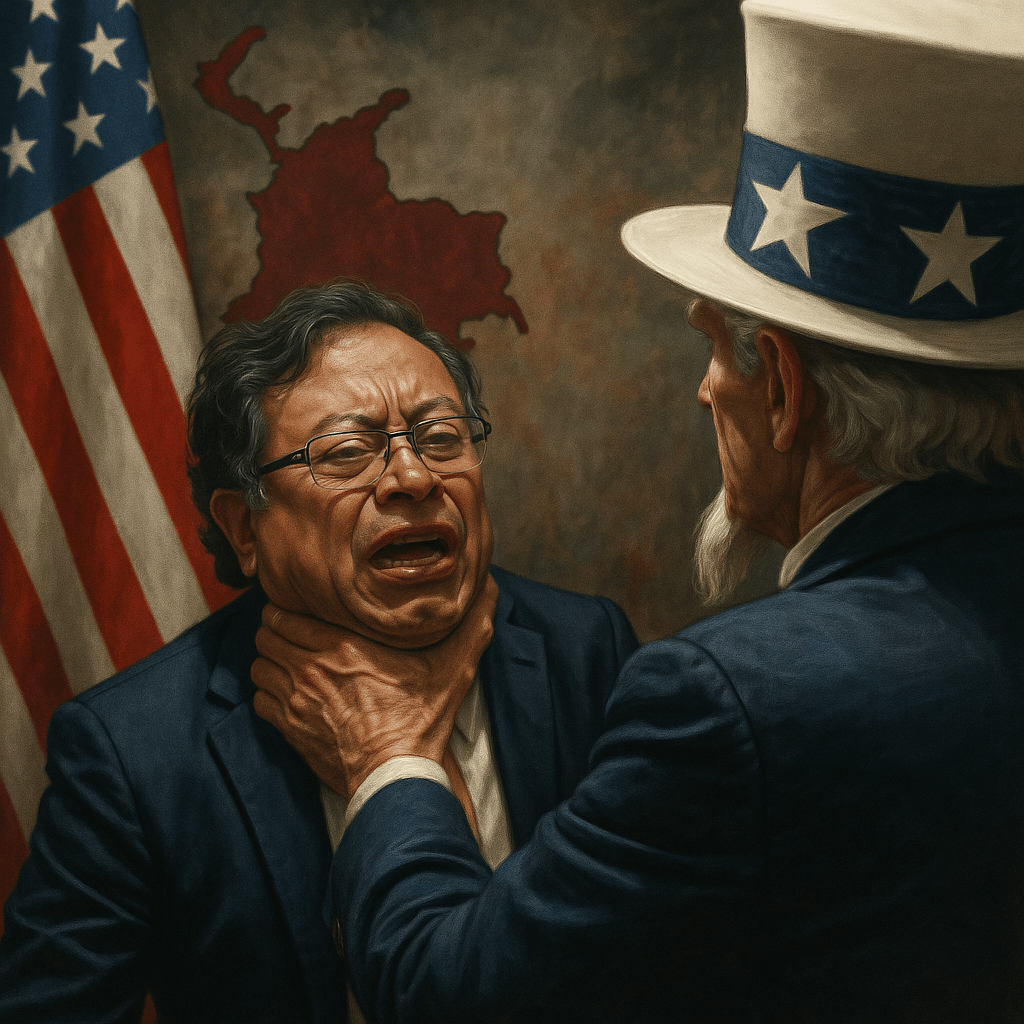
Washington dresses lawfare as “drug control” while tightening the Monroe Doctrine’s noose around the hemisphere. Petro’s defiance—on labor, land, Palestine, and multipolarity—marks him as a target not for coca but for sovereignty. The drug war is the mask; recolonization is the mission.
By Prince Kapone | Weaponized Information | September 16, 2025
How a “Neutral” Wire Story Tightens the Noose
The target is plain enough: an Associated Press report announcing that Washington has “decertified” Colombia for the first time in nearly three decades. The copy reads like a lab result: record coca hectares, slowed eradication, a presidential memo, and a waiver of sanctions wrapped in the phrase “vital U.S. national interests.” The plot is simple—Colombia failed, the United States measured, the system regrets to inform you—and the denouement is managerial: analysts warn of strain, institutions frown, the ledger is updated. On the page, it feels procedural. In the world, it is anything but.
The bylines—Joshua Goodman from Miami and Astrid Suárez in Bogotá—signal the usual division of labor for an imperial wire: one foot in the U.S. security and finance corridor, one foot on the ground where policy lands like shrapnel. The Associated Press, for its part, is the house organ of “objectivity” as business model: a syndication machine whose value is speed, reach, and the unspoken promise that power will never be surprised by its own publicity. It is not that the facts are invented; it is that the frame is permanent.
The chorus enters on cue. Adam Isacson explains decertification as a “huge irritant” to cooperation; the U.N. drug office supplies the growth curves; the U.S. executive branch voices solemn disappointment. Former president Ernesto Samper floats through as a cautionary ghost from the 1990s, his scandal history deployed like a watermark on the page. The roles are all familiar: the expert who smooths, the institution that counts, the official who scolds, the memory that warns.
Read closely and the piece is a master class in narrative policing. First, the bureaucratic mask: a unilateral act by Washington is presented as a technical compliance judgment, a bloodless noun—“decertification”—that drains the politics from punishment. The verbs that carry force—“designates,” “determines,” “lists”—belong to the United States; Colombia “fails,” “slows,” “laments.” Agency and authority are distributed like passports.
Second, the alchemy of numbers. Hectares and tonnage appear as immaculate metrics, sealed off from the conditions that produce them. The graph stands where history should be. When seizures rise, the increase reads as menace rather than proof of interdiction; when eradication falls, the index itself becomes morality. Counting substitutes for thinking. The ledger is transformed into a theology in which the only heresy is context.
Third, the trick of the reluctant disciplinarian. The copy stresses that sanctions are waived—what mercy!—even as it describes a “stinging rebuke.” The pose is paternal: the master withholds the lash to demonstrate magnanimity, then mentions it often enough that everyone still hears the crack. The reader learns, by tone alone, which party is adult and which must be corrected.
Fourth, the sleight of chronology. The text reaches back to the 1990s just far enough to summon narco-specters and a cautionary anecdote about a plane and heroin, then leaps forward to today’s acreage without walking the path between. The intervening decades—what happened, who benefited, how the terrain was made—are compressed into a few words about “cooperation” and “aid,” as if history were a single switch toggled on and off by Washington’s patience.
Fifth, the ventriloquism of neutrality. Anonymous “critics” warn, “analysts say,” “officials determined”—a chorus of passive voices that floats judgment while hiding the judges. Even when a name appears, it arrives as credential rather than position. The institutional voice is treated as a clean glass; the interests inside it are invisible by design.
Sixth, the moral geometry of blame. The memo’s line that the “failure rests solely with political leadership” is relayed without interrogation, and the word “solely” does its job: it disqualifies structures, classes, treaties, and wars from the field of causation. In a country where the poor live the consequences of every policy cooked elsewhere, responsibility is narrowed to a face. That is how systems absolve themselves—by shrinking the stage until only the designated culprit remains in the light.
Finally, the careful excision. The piece is punctilious about what it includes—hectares, waivers, quotes that frown—and serene about what it omits. The reader is told nothing that might invert the arrows of causality, nothing that might identify pressure as policy, nothing that might suggest Colombia could be something other than a delinquent pupil in a transnational classroom. The absence is not an error; it is the argument. What is unsaid disciplines what can be thought.
Put it together and the method is clear. The wire strips power of its fingerprints, launders decision into procedure, and turns an act of coercion into a quarterly result. Like all good ideology, it presents the world as a management problem whose solutions are already known. The story is tidy. The world is not. And that dissonance—between the clean lines of the page and the rough hands that live beneath it—is precisely where we must begin to dig.
The Facts the Empire Tries to Bury
The Associated Press told the story like a courtroom transcript stripped of context. They reported that the Trump administration “decertified” Colombia in the drug war for the first time since 1997, while quietly waiving sanctions to protect what they call “vital U.S. national interests.” They noted that coca cultivation rose to a record 253,000 hectares, that manual eradication slowed under Petro, and that U.S. officials bristled at his refusal to hand over combatants, his criticism of Washington’s immigration dragnet, and his rejection of a U.S. strike on a Venezuelan vessel. The official memo, AP dutifully relayed, blamed Colombia’s “political leadership” alone for the supposed failure. What AP never asks is why this ritual finger-pointing exists in the first place, or what larger game it serves.
What goes missing in this sanitized version is the siege Petro has faced from the oligarchy at home. His bid to pass a labor reform bill was repeatedly blocked in the Senate until mass pressure and a threat of referendum forced its passage in a scaled-down form and his health-care overhaul was killed outright. Now Petro has escalated the confrontation, announcing that the 2026 elections will include a ballot on convening a National Constituent Assembly to rewrite the rules of the Colombian state itself, a move that has unleashed open panic from the Senate and former president Duque. The AP frames a crisis of hectares; in reality it is a crisis manufactured by an oligarchy that fears reforms aimed at workers, farmers, and the poor.
Petro’s foreign policy makes the picture even clearer. In May 2024, he cut ties with Israel over its war on Gaza, moved to support South Africa’s genocide case at the International Court of Justice, and opened a Palestinian embassy. None of this appears in AP’s account. Because if it did, their readers might start connecting the dots between Petro’s break with Zionism and Washington’s sudden outrage about coca plants.
On the drug war itself, Petro has been blunt. At the United Nations he called it irrational and destructive, and together with other regional leaders he denounced it as a failed, colonial policy. His government has refused to extradite demobilized traffickers who surrender, and by 2025 even suspended U.S. extraditions outright to protect peace negotiations. Meanwhile, he extended a ceasefire with the ELN and advanced substitution programs with coca farmers. That is not “failure.” It is a deliberate break with Washington’s obsession with spraying poison from the sky while campesinos bury their dead.
The alignment shift is equally undeniable. Petro’s government signed on to China’s Belt and Road Initiative, deepening ties with Beijing, and in response to decertification he declared that Colombia’s army will end its dependence on U.S. weapons, choosing to buy or build nationally instead. To underline the point, authorities reminded the world that Colombia seized 889 tons of cocaine in 2024—a record haul conveniently ignored in Washington’s paperwork.
Once you widen the lens, the real pattern comes into focus. Cuba has lived under a blockade for over 60 years. Venezuela has been choked by an 11-year sanctions siege. Nicaragua faces its own sanctions regime. Brazil and Mexico are hammered with tariffs and threats when they step out of line. Haiti has been gutted into a non-state through coups, IMF programs, and occupation. Washington has sent a naval fleet (of 8 ships, a nuclear powered submarine, and 4,500 sailors and marines) off the coasts of Venezuela in the Caribbean Sea, launched two seperate naval attacks on Venezuelan vessels in the Caribbean (extrajudicially executing 14 Venezuelans), deployed F-35s to Puerto Rico and two U.S. AV-8B’s to Guyana. Each of these moves tightens the noose around governments in the Americas that dare to chart a path of sovereignty.
This imperial posture is not accidental—it is openly declared. Trump’s regime has revived the Monroe Doctrine as official policy and gone further, proclaiming that it is a direct security threat to U.S. national interests for sovereign nations in the hemisphere to deepen political or economic ties with China. In that light, Colombia’s “decertification” is not a technical evaluation of coca fields but a warning shot. Petro’s real crime is not slowed eradication—it is multipolar defiance: breaking with Zionism, aligning with BRICS, and refusing to accept that Washington alone decides the fate of the hemisphere.
This is why the omissions matter. Because when AP reduces the crisis to hectares and eradication targets, it hides the political reality: Washington uses drugs as a pretext, but the real enemy is sovereignty itself. Petro’s fight is not about coca fields alone. It is about whether Colombia belongs to its oligarchs and their patrons in Washington—or to its workers, campesinos, and poor, who have demanded something different.
Fortress America and the Recolonization of the Hemisphere
The colonial contradiction between U.S. imperialism and the peoples of the Americas has never disappeared. From the Monroe Doctrine to Plan Colombia, Washington has insisted that the hemisphere is its “backyard,” a zone to be patrolled, exploited, and pacified. Today, that contradiction erupts in a new form: a Crisis of Imperialism where the declining empire struggles to hold on to unipolar power while nations like Colombia seek to assert Anti-Imperialist Sovereignty through Multipolar Recalibration. Petro’s government—by joining the Belt and Road Initiative, defending peace accords, and challenging the U.S. drug war—embodies this shift. His agenda is fragile, embattled by oligarchs at home and threatened by Washington abroad, yet it marks an unmistakable break from comprador servility.
The U.S. response is a textbook case of Imperialist Recalibration. Having failed to break Russia and China on the world stage, Washington turns back toward its self-declared “backyard,” seeking to weld the Americas into an American pole of the multipolar order. This is the architecture of Fortress America: sanctions and blockades tightening around Cuba, Venezuela, and Nicaragua; tariffs and pressure campaigns against Brazil and Mexico; Haiti stripped of sovereignty and reduced to rubble. Against Petro, the empire deploys its whole arsenal—extrajudicial Lawfare in the form of “decertification,” threats of renewed sanctions, and the constant shadow of Counterinsurgency. The naval build-up in the Caribbean and armed strikes on Venezuelan vessels are not accidents but demonstrations, warnings that sovereignty will be tolerated only within the boundaries set by Washington.
This is where the drug war becomes central. For decades, it has served as the alibi of empire: a permanent emergency legitimizing militarization at home and intervention abroad. Now it mutates again. In Venezuela, Maduro was branded a “narco-terrorist,” paving the way for indictments, sanctions, and coup plots. The same script can be run against Petro. Colombia remains the epicenter of global cocaine production; all Washington needs is to flip the narrative, to recast Petro’s sympathy with coca farmers, his clashes with the DEA, and his defense of peace accords as complicity with “narco-terrorism.” From partner to pariah, from ally to enemy—this is how the propaganda machine works. Once that frame is locked in, regime change, coups, and even assassination can be presented not as imperialist aggression but as “hemispheric security.”
In this sense, Petro’s decertification is not simply a rebuke. It is the first move in a long game, the laying of legal and ideological groundwork for escalation. It marks Colombia as unreliable, opens space for narrative inversion, and signals to elites in Bogotá that Washington holds the leash. It is Neocolonial Militarism reinforced by cognitive warfare: even the hint of “narco-terrorist” branding can discipline an entire government. The drug war is not failing; it is succeeding perfectly as the infrastructure of control. It is the binding logic of Fortress America, a strategy to recolonize the hemisphere under the guise of law enforcement and stability while waging war on any state that dares to step outside the orbit of empire.
Seen from the standpoint of the international working class, this reframing is decisive. The struggle unfolding in Colombia is not a local quarrel over coca hectares or trade balances. It is part of a continental confrontation between an empire in decline and peoples striving for sovereignty. Petro’s attempt at Multipolar Recalibration places Colombia inside the wider current of global resistance to unipolar domination. The U.S. reaction—decertification, naval posturing, sanctions threats—reveals both the fragility of its rule and the violence it is prepared to unleash. The question is not whether Colombia will be allowed space to breathe, but whether the hemisphere itself will be chained back into Washington’s fortress—or whether, in defiance, it will break free.
Breaking the Walls of Fortress America
The meaning of this struggle is not confined to Colombia. The Crisis of Imperialism and the forging of Fortress America place the peoples of the hemisphere face to face with a familiar enemy: the empire that once carved up their land and labor now seeks to recolonize the continent under the banner of “narco-terrorism” and “security.” What is at stake is nothing less than Anti-Imperialist Sovereignty across the Americas, from the Andes to the Caribbean, from the barrios of Caracas to the favelas of Rio, from Havana to Bogotá. And what is needed is not quiet lament but organized resistance.
This resistance already exists in living form. Movements across the hemisphere are raising the alarm: Cuban workers and youth who have resisted seventy years of blockade, Venezuelan communities defending their communes against sanctions and sabotage, Nicaraguan farmers refusing to be starved into submission, Haitian grassroots organizations demanding an end to foreign occupation, Indigenous peoples of the Amazon defending their land against both local oligarchs and imperial capital. In Colombia itself, trade unions that fought for Petro’s labor reform, campesino organizations advancing coca substitution, and peace communities defending the accords—all are already on the front lines of this confrontation with empire.
The task before us in the Global North is to break the isolation that Washington tries to impose. That means tearing down the lies of the Imperialist Media Apparatus and exposing the “decertification” farce for what it is: lawfare dressed up as policy, a pretext for recolonization. It means linking arms with anti-imperialist organizations already mobilizing—from solidarity campaigns with Cuba, Venezuela, and Palestine, to networks resisting the drug war and calling out U.S. military expansion in the Caribbean. It means uniting workers, students, peasants, migrants, and defectors from empire into a single front that can strike at the foundations of the Monroe Doctrine.
The contradictions we expose here—between sovereignty and subjugation, between multipolarity and recolonization, between the peoples’ needs and imperial command—are not academic. They are invitations to act. To organize study circles and people’s tribunals that investigate the drug war as Counterinsurgency. To mobilize solidarity caravans and campaigns that break the sanctions stranglehold. To defend governments under attack, not uncritically but as part of a united front against imperial domination. To build bridges of struggle between North and South, colonized and settler, so that the fortress walls being erected in Washington’s imagination are torn down in practice by the hands of the people.
History is not waiting. The empire sharpens its knives while the peoples of the Americas sharpen their will. This is the call: to recognize the battlefield for what it is, to take our place in the ranks of international struggle, and to ensure that the fortress being built around us does not become our prison, but the ruins from which a liberated hemisphere can rise.
 Weaponized Information
Leave a comment