Part VII – Food for Profit: The Ruling Class Capture of the Global Food System
By Weaponized Information Editorial Committee
Introduction: Not Broken, But Owned
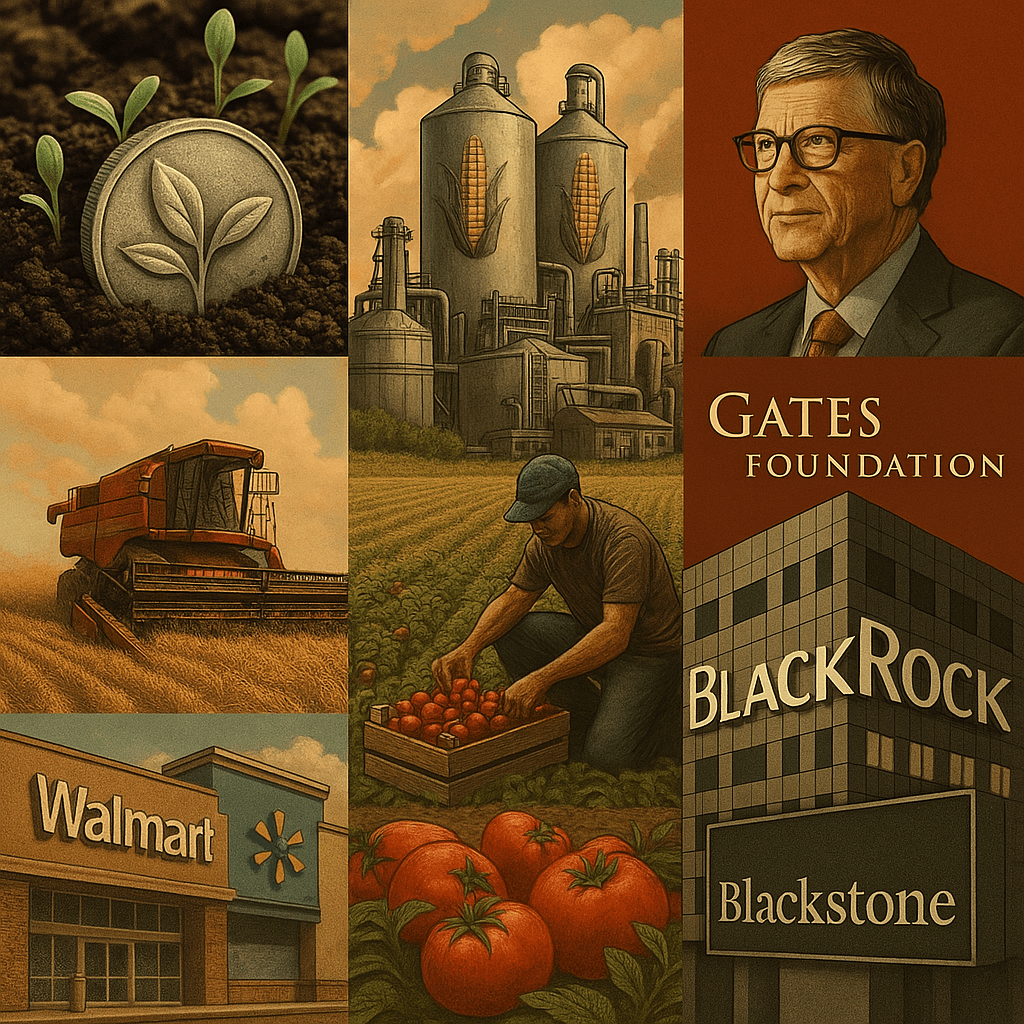
There is a popular belief that the global food system is broken. That hunger persists because of inefficiencies, misaligned incentives, or unfortunate market externalities. But the truth is sharper and more violent: the system is not broken—it is owned. Every stage of the food chain, from soil to shelf, is controlled, commodified, and captured by a tightly linked network of monopoly capital: agribusiness giants, investment firms, tech platforms, philanthropic fronts, and state institutions operating in collusion.
This is the agricultural face of monopoly finance capital in the 21st century. And it is a cornerstone of what we have identified as technofascism: the fusion of corporate monopolies, imperial finance, and state violence to manage planetary collapse on behalf of ruling class survival.
Seeds: Control at the Origin
The control of the food chain begins at its biological source: the seed. Over 60% of global seed markets are controlled by four corporations—Bayer-Monsanto, Corteva, Syngenta (ChemChina), and BASF. These corporations:
- Patent and genetically modify seeds to prevent replanting
- Enforce intellectual property laws to criminalize traditional seed saving
- Merge seed supply with chemical inputs to monopolize the input market
This is not innovation—it is bio-imperialism. The seed, once held in common, is now the proprietary asset of monopoly firms.
Inputs: Extraction as Infrastructure
These same corporations control the chemical inputs—pesticides, herbicides, fertilizers—that farmers are now forced to purchase annually. Firms like Nutrien, Yara, Bayer, Syngenta generate billions in profits from chemical dependency while poisoning soil, air, and water. The IMF, USAID, and Gates-backed AGRA program push these technologies across the Global South, destroying Indigenous agroecologies in the name of “modernization.”
Production: The Land Under Management
Land is increasingly managed not by farmers, but by agribusiness contractors, data platforms, and state-backed agrarian capital. A growing share of farmland is owned by private equity, pension funds, and corporate land banks. In the U.S., BlackRock, Bill Gates, and UBS are now among the largest farmland owners. Globally, millions of hectares have been seized through land grabs driven by speculative investments and food security concerns of rich countries.
Farmers are reduced to tenant-operators on land they do not own, growing crops they do not choose, for contracts they do not control. It is agricultural production by algorithm, debt, and extraction.
Labor: Exploited, Invisible, Disposable
The food chain runs on hyper-exploited labor. In every region:
- Farmworkers are undocumented, underpaid, and unprotected
- Women laborers are denied land rights and excluded from credit or cooperative infrastructure
- Migrant labor is moved like freight—tracked by QR codes, logged by biometric apps, and replaced at will
Tech platforms (UberEats, Instacart) are expanding this model of gigified agricultural labor into food delivery and last-mile distribution. Human labor is treated as a variable input, optimized for profit, and discarded when surplus.
Processing and Distribution: Vertical Integration
Processing is concentrated in the hands of a few meatpackers and grain traders. Cargill, JBS, Tyson, ADM and others manage global flows of food from slaughterhouse to port. At every level:
- Workers are underpaid and disposable
- Inputs are standardized for export, not nutrition
- Environmental costs are externalized onto frontline communities
Retail and distribution are dominated by Walmart, Amazon, Costco, and their equivalents. These corporations dictate prices to suppliers, dominate shelf space, and eliminate local competition through monopsony power. Consumers are left with hyper-processed, chemically laden, commodified food—designed for shelf life, not health.
Finance: Food as an Asset Class
The highest level of food system control is not found in fields or factories—it is in finance. BlackRock, Vanguard, Blackstone, State Street, and other asset managers own major stakes in all of the companies mentioned above. Their investment portfolios span seeds, chemicals, supermarkets, and farmland itself. They are not farmers. They are rentiers—extracting value from every transaction, every calorie, every hectare.
These firms actively promote policies that support vertical integration, deregulation, and land consolidation—while greenwashing their role through ESG funds and “sustainable investing.”
Philanthropy as Cover: The Gates Empire
No single figure embodies technofascist agriculture more than Bill Gates. Through the Gates Foundation, he promotes:
- GMO adoption and seed privatization via AGRA
- Digital agriculture platforms controlled by Microsoft and Bayer
- Lab meat, vertical farming, and techno-fixes designed to maintain corporate control while appearing innovative
His land ownership empire (over 250,000 acres in the U.S. alone) and strategic partnerships with the World Bank, USAID, and African governments give him de facto sovereignty over vast territories and populations. This is not philanthropy. It is corporate colonialism with a liberal face.
Conclusion: Nothing Grows That They Don’t Own
The global food system is now a fully integrated imperial-corporate complex. From genome to grocery store, every link in the chain is controlled by firms who view food not as life, but as a commodity. The ruling class profits from the hunger they create, the diseases they accelerate, and the labor they exploit.
This is not a malfunction. It is the strategy of capitalist crisis management. As climate, soil, and society collapse, the ruling class builds vertical farms, hoards farmland, patents life forms, and digitizes supply chains—not to feed the world, but to continue extracting from it.
Our response must be equally systemic. We must seize the seed, the land, the labor, and the flows—decommodify them, decolonize them, and return them to the service of life.
In Part VIII, we will turn to resistance: tracing the rise of global peasant and Indigenous movements that have begun to dismantle this system from below—and plant the seeds of an entirely different world.
 Weaponized Information
Leave a comment