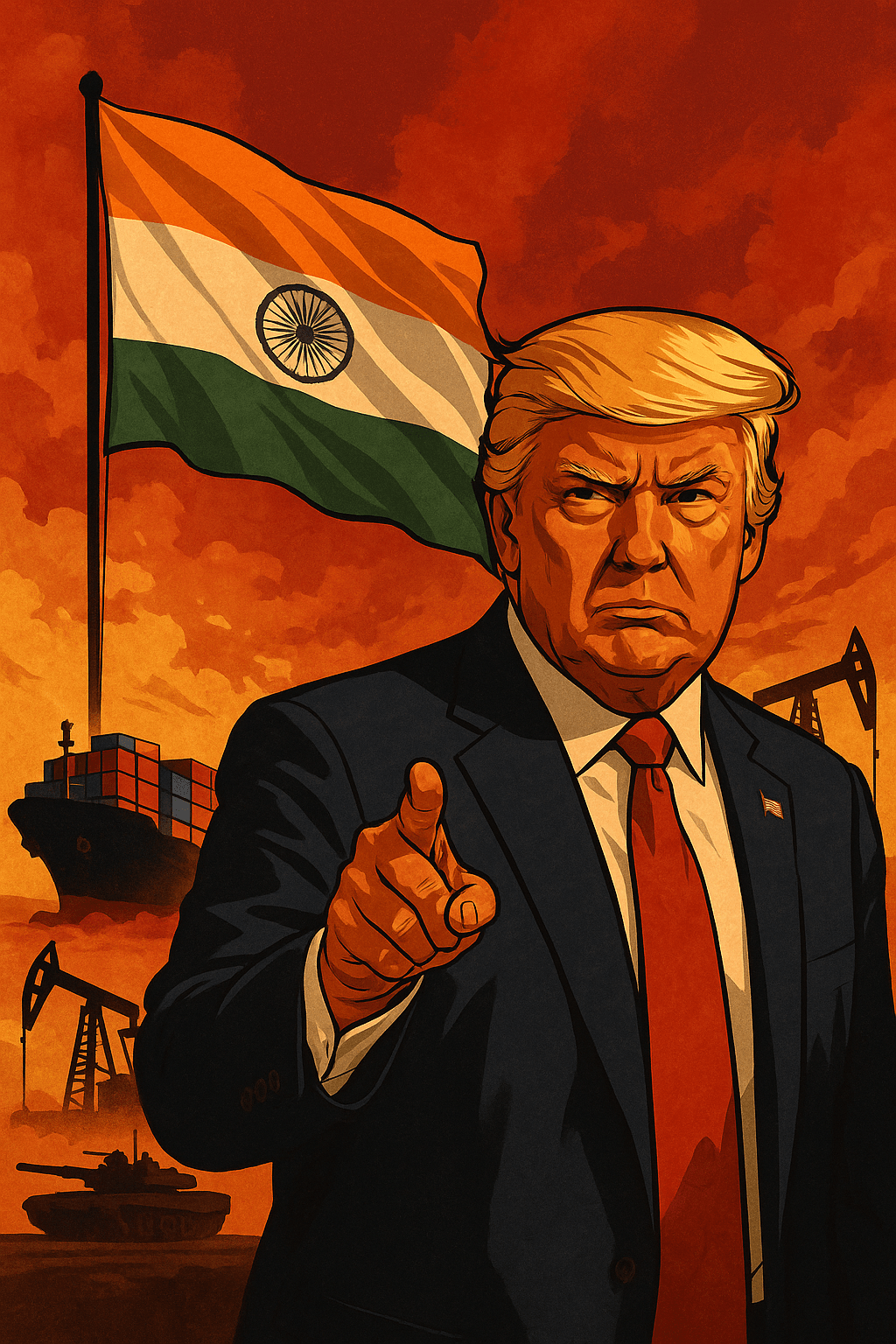
The U.S. isn’t negotiating with India—it’s disciplining it. Trump’s 25% tariff threat isn’t about trade; it’s about obedience. Behind the Apple supply chain shift lies a digital leash. Behind the rhetoric of fairness lies imperial punishment. Washington wants to break BRICS+, shatter India’s autonomy, and reassert control over the semi-periphery. This is empire in decline, lashing out not with confidence—but with coercion, contempt, and a demand to be called “Daddy.”
By Prince Kapone | Weaponized Information
July 30, 2025
Tariffs Don’t Lie: Coercion Disguised as Reciprocity
On July 30, 2025, Donald Trump stood before the cameras and did what he does best: bark threats behind the language of law and order. In announcing a 25% tariff on Indian goods, Trump claimed that India’s own tariffs were “unacceptably high” and that the U.S. would no longer tolerate being treated “unfairly.” What he didn’t say—because he never has to—is that this isn’t about trade deficits or market access. It’s about power. The kind of raw, unilateral, old-fashioned imperial power that demands tribute, submission, and obedience. What the American press coyly frames as a dispute over duties is, in fact, a colonial ultimatum: call us Daddy, or get punished.
Let’s not waste time dressing this up in liberal niceties. This is not a policy disagreement—it’s a racket. A mafia logic dressed in the robes of diplomacy. India is being told to lower its economic defenses, abandon its strategic autonomy, and break its partnerships with Russia or face economic retribution. Just like Vietnam, South Korea, and Mexico before it, India is being issued a choice: become a compliant subcontractor in the U.S.-led global order, or be treated like an enemy. The tariff, then, is not an instrument of negotiation—it is a whip.
The contradiction here is as old as empire: India, a nation still clawing its way out of centuries of colonial underdevelopment, seeks to protect its industries, its farmers, its sovereignty. The United States, a declining hegemon scrambling to reimpose order through coercion, insists that India’s protective policies are “barriers to free trade.” But free trade in this context means unilateral exposure to U.S. monopolies—agricultural, digital, and military. It means dismantling public sector protections, abandoning self-reliance, and surrendering to a rules-based order where only the U.S. makes the rules. And when that doesn’t work, tariffs are slapped on like economic drone strikes: surgical, punitive, and designed to send a message.
This is the context in which we must understand Trump’s latest tariff barrage. It is not about some abstract principle of reciprocity—it is about disciplining a rising power before it gets ideas of independence. It is about kneecapping BRICS+, sabotaging South-South solidarity, and keeping the Global South fragmented and dependent. This is the logic of Daddy Diplomacy: a geopolitical kink where U.S. imperialism demands not partnership but obedience, not cooperation but submission. NATO’s Secretary-General may have said it in jest, but the reality is deadly serious—when they call him Daddy, what they really mean is Master.
Breaking the Bloc: How Washington Uses Tariffs to Undermine BRICS+
When Trump’s tariff threat dropped, the mainstream media treated it like a minor squabble between trading partners—a spat over percentages and duties. What they conveniently omitted is that India’s real crime isn’t tariffs. It’s disobedience. India has refused to bow to U.S. sanctions on Russia. It continues to buy discounted Russian oil. It maintains a decades-long defense relationship with Moscow, even daring to explore new payments systems outside the dollar. That makes India dangerous—not because it’s hostile, but because it’s independent. And independence, in the eyes of empire, is unforgivable.
Behind the scenes, what Washington fears most isn’t a tariff schedule—it’s BRICS+. A multipolar alliance capable of creating an alternative world order, one based not on NATO’s chain-of-command imperialism, but on South-South cooperation, resource sovereignty, and economic self-determination. In that project, India plays a crucial role: a rising power with technological, industrial, and demographic weight; a bridge between West and East; a vital buyer of Russian energy and arms; and a founding BRICS member with global credibility. For U.S. strategy, that’s a problem to be solved—not a partnership to be nurtured.
So the tariff isn’t about steel or cars or almonds—it’s a pressure tactic. A way of leveraging U.S. market access to fracture India’s alignment. The goal is to force India into making a “strategic choice”: either align with the dollar-dominated, U.S.-led digital-military order, or face slow suffocation through trade penalties, currency manipulation, and reputational warfare. It’s classic divide-and-conquer imperialism, rebooted for the 21st century. If BRICS+ represents the embryo of a post-Western world system, then sabotaging it from within—starting with India—is not a tactic, but a strategy.
It’s not hard to read between the lines. Washington is demanding that India distance itself from Russia, dismantle its tariff protections, halt indigenous defense procurement, and sign up for the so-called “rules-based” order—which, translated from imperial bureaucratese, means obey the U.S. and punish whoever it tells you to. What’s being offered in return? The privilege of continued access to the American consumer market. A place in the imperial supply chain. And maybe, if India plays nice, a pat on the head from Daddy Trump. But sovereignty is not on the table. That’s the point.
This is how empire disciplines its semi-peripheries. Not with bombs—at least not yet—but with economic punishment disguised as diplomacy. The U.S. doesn’t just want India’s compliance. It wants its betrayal: of Russia, of BRICS, of the Global South. And if India refuses? Then the tariff becomes not just a tool—but a threat. Because nothing terrifies the empire more than the possibility of nations refusing to kneel.
The Supply Chain Leash: Apple, Foxconn, and the Illusion of Partnership
While Trump wields tariffs like a bludgeon, his corporate lieutenants offer velvet gloves. Apple, that sleek emissary of U.S. capital, has been shifting major parts of its supply chain out of China and into India. Foxconn has poured billions into Tamil Nadu and Karnataka, turning Indian labor into the next frontier of tech extraction. Liberal pundits call it “de-risking.” Economists call it “China+1.” But let’s call it what it is: imperial recalibration. The U.S. isn’t decoupling from exploitation—it’s just rerouting it. And India is being groomed to become the next obedient node in a system built to serve Silicon Valley, Wall Street, and the Pentagon.
This is not a gift. This is leverage. The Apple supply chain shift is the imperial carrot that balances Trump’s tariff stick. You want investment? Then liberalize your data laws. Remove your tariffs. Give us full access to your cloud infrastructure. Break with Russia. Abandon BRICS+. And above all, never forget who runs the system. The new imperialism doesn’t arrive in battleships—it arrives in iPhone contracts, trade treaties, and IMF “technical assistance.” Behind every clean room and tech park lies a demand: open your economy, dismantle your sovereignty, and give our corporations the final word.
India, for its part, is trying to play both sides—accepting U.S. investment while maintaining strategic autonomy. It wants to use the supply chain shift as a developmental engine, an opportunity to boost manufacturing, create jobs, and achieve digital sovereignty. But the U.S. has other ideas. It doesn’t want an independent India—it wants a compliant subcontractor. A country that can assemble gadgets but never control the platforms. A country that can fight wars, but only the ones Washington approves. A country with engineers and soldiers, but no autonomy.
That’s why the tariff comes now—right when Apple is most entrenched. It’s a pressure point. A reminder. The U.S. is not asking India to be a partner; it is telling India to be a client. If India wants the investment to keep flowing, it must behave. Call it “friendshoring,” “nearshoring,” or “strategic alignment”—it all means the same thing. You can have a role in the empire, but only on your knees.
Trump’s tariff is not separate from the Apple shift—it is its shadow. One hand gives, the other strikes. This is Daddy Diplomacy in practice: the cynical choreography of coercion and consent, where supply chains are weaponized, sovereignty is conditional, and the ultimate goal is to install a digital leash on every nation that dares to think for itself.
“Fair Trade” for Whom? Unequal Exchange in Imperial Costume
Trump’s handlers and media mouthpieces love to talk about “fair trade.” They say the U.S. is only defending itself against India’s “excessive tariffs.” But fairness, in the imperial lexicon, is always measured from the standpoint of the strong. What they call fairness is in fact extortion. What they call reciprocity is obedience. When the U.S. demands lower tariffs from India, it’s not so India can export more—it’s so U.S. monopolies can invade, dominate, and extract without resistance. And if India dares to protect itself, it is labeled a violator of the so-called rules-based order—rules, of course, written by the empire and enforced at gunpoint.
Let’s examine the facts. India’s average applied tariff is around 15%—entirely legal under WTO rules, especially for developing nations. The U.S., by contrast, floods the world with heavily subsidized agricultural products, uses non-tariff barriers to restrict imports, and imposes unilateral Section 301 tariffs anytime it feels slighted. On top of that, it weaponizes intellectual property, digital standards, and tech export controls to throttle competitors. This isn’t a free market—it’s a command economy enforced by the dollar, the drone, and the data server. When India tries to support its farmers, it’s accused of distorting trade. When the U.S. hands billions to Big Ag and Big Tech, it’s called competitiveness.
And what of “free trade” itself? In the real world, it means subjecting your economy to the whims of imperial capital. It means dismantling subsidies, lowering protections, and handing over the strategic heights—telecom, banking, e-commerce—to transnational corporations headquartered in Washington, not Delhi. It means becoming a consumer colony, where your population is mined for data and your infrastructure serves Amazon’s logistics and Google’s algorithms. Free trade is a euphemism for recolonization.
The logic is simple: protectionism is a crime when practiced by the colonized. But when practiced by the empire, it’s national defense. This is why the U.S. reserves the right to use tariffs, subsidies, sanctions, and trade wars—yet punishes India for doing the same. Because this isn’t about fairness. It’s about locking the Global South into a permanent state of dependency, where all attempts at autonomous development are branded illegal, inefficient, or corrupt.
Trump’s tariff threat isn’t a defense of fair trade. It’s a declaration of economic warfare. It says to India: your sovereignty ends where our supply chain begins. Your laws are valid only if they serve our monopolies. Your independence is acceptable only if it’s symbolic. This is not a dispute over taxes. It is the tightening of a global hierarchy, with Washington on top and the rest of the world scrambling for access, favors, and mercy. It’s not a negotiation. It’s a shakedown.
Imperial Discipline: The Strategy Behind Economic Blackmail
The tariff is not an outburst. It’s a doctrine. A calibrated act of imperial discipline designed to bring India into alignment with the geopolitical architecture of U.S. supremacy. Trump’s administration may deliver the message with a sneer and a red hat, but the underlying logic transcends partisan lines. Whether it’s Biden’s “friendshoring” or Trump’s America First tariffs, the goal remains the same: subordinate the semi-periphery. Convert independent nations into pliable nodes in a U.S.-commanded global system of extraction, finance, logistics, and war.
This isn’t the first time the U.S. has weaponized trade to force obedience. Mexico was threatened with tariffs to enforce border militarization. South Korea was told to abandon Huawei and accept digital trade rules in exchange for tariff relief. Vietnam was threatened with “currency manipulation” status unless it embraced U.S. tech standards and containment of China. Even the EU was hit with steel tariffs and then offered a deal—if it joined the anti-China digital crusade. Every time, the pattern is clear: economic punishment followed by conditional inclusion. It’s the gangster playbook with a G7 badge.
India is now the next target in this chain of coercive alignment. And make no mistake—what Washington wants is not dialogue, but domination. India must sever its ties to Russia, dilute its role in BRICS+, and surrender its digital sovereignty. It must harmonize its trade policies, military procurement, and financial systems with the dictates of Wall Street and the Pentagon. In exchange, it will be rewarded with conditional access to U.S. markets, hollow recognition as a “partner,” and the toxic privilege of being on Washington’s leash instead of Beijing’s.
But sovereignty cannot be shared with empire. There is no space for a truly autonomous India in Washington’s imperial blueprint. The moment India asserts its interests—whether by purchasing Russian oil, protecting domestic industries, or building its own tech stack—it becomes a threat. And threats must be neutralized. Through tariffs, through propaganda, through sabotage. This is how empire maintains order: not through mutual benefit, but through calibrated coercion. The empire doesn’t punish disobedience out of spite—it does so to set an example.
Trump’s tariff is therefore a signal, not just to India, but to all nations contemplating independence. It says: we see what you’re doing. We control the flows—of capital, data, energy, and narrative. And if you won’t submit willingly, we’ll tighten the screws. With sanctions, with sabotage, with tariffs that hit your industries where it hurts. It is not diplomacy. It is discipline. And its ultimate aim is to replace international cooperation with imperial obedience, under the gleaming logos of American corporations and the shadow of U.S. airpower.
Sovereignty at Gunpoint: India’s Crossroads in a Recolonizing World
India stands now at a brutal crossroads, squeezed between imperial invitation and imperial threat. On one side, the United States dangles access to its markets, technology, and investments—provided India dismantles its protectionist policies, kneels to its digital regime, and aligns itself militarily and economically with the declining empire. On the other, India has the path of multipolarity: deeper cooperation with Russia, China, Iran, and the Global South; development on its own terms; energy independence; and an active role in forging a new international order beyond the dollar, beyond NATO, beyond the delusions of Western exceptionalism.
But that path won’t come easy. Washington doesn’t tolerate fence-sitters. If India chooses sovereignty, it will be punished. Already we see the outlines: tariffs as warning shots, financial weapons waiting in the wings, media narratives painting India as an unreliable partner. Hybrid warfare in the age of technofascism doesn’t always come with bombs. It comes through rating agencies, trade panels, cyberattacks, and color-coded regime-change proxies. The price of defiance is high—but the price of submission is national asphyxiation.
India’s ruling class—divided as it is between comprador technocrats and developmental nationalists—must decide. Will it continue its hedging strategy, trying to please both Washington and Moscow, both Davos and Durban? Or will it finally confront the reality: the empire doesn’t want a partner. It wants a subordinate. You can’t be both sovereign and servile. The attempt to have it both ways is not strategic ambiguity—it is suicidal delusion. The U.S. is not offering India a seat at the table. It is offering it a chain.
The irony is rich. After centuries of British colonization, after the slow, painful construction of an independent industrial and technological base, after forging alliances with other formerly colonized nations to challenge Western supremacy—India is being asked to walk back into the house of empire. Not as a ruler, but as a loyal subcontractor. Assemble the gadgets. Process the data. Enforce the sanctions. Obey the dollar. And in return? A hollow handshake from Uncle Sam and the privilege of calling Donald Trump “Daddy.”
India has every tool it needs to choose another path. It has oil from Russia, tech potential of its own, partnerships across Africa, Asia, and Latin America, and a billion-strong population with revolutionary potential. What it needs is political will. To assert that sovereignty is not negotiable. That dignity cannot be bought with iPhone contracts. That development must serve people, not platforms. And that no self-respecting nation should ever again be told who its friends can be—or how high it must jump to keep them.
Daddy Diplomacy Unmasked: The Psychosexual Pathology of Empire
When NATO’s Secretary-General stood beside Donald Trump and called him “Daddy,” the world winced. Some laughed. Others cringed. Trump, predictably, beamed. But behind the smirk and the soundbite was a telling admission: this is how the U.S. views the world—not as a network of equals, but as a hierarchy of dependents. The United States is the patriarch. The rest are unruly children, wayward teens, or dysfunctional clients who need discipline, correction, and—if they behave—a little praise. This isn’t diplomacy. It’s a psychosexual pathology masquerading as foreign policy. It’s not about respect. It’s about domination.
Trump’s tariff threat against India fits perfectly into this pathology. India, in Washington’s eyes, is a child stepping out of line—buying Russian oil, protecting its markets, flirting with multipolar rebellion. And Daddy doesn’t like that. So Daddy imposes a tariff. Not because it makes economic sense, but because it asserts control. Because it sends a message to India and every other rising power: We made you, and we can break you. The infantilization of allies, the tantrum-style trade policy, the performative bluster—it’s all part of the same imperial psychodrama. And India is just the latest cast member being forced to rehearse its lines.
But the world is changing. The post-WWII imperial choreography is breaking down. The empire is aging, paranoid, and increasingly hysterical. It lashes out not from confidence, but from fear—fear of a world it can no longer command, of technologies it no longer controls, of alliances it can’t fracture, of movements it can’t surveil. Daddy is losing his grip. And in that panic, he gets violent, desperate, and delusional. The tariffs, the sanctions, the blackmail—they’re not expressions of strength. They’re evidence of a fading superpower clinging to relevance by coercing the very nations it once hoped to lead.
India has a choice. It can accept the leash and call it opportunity. Or it can tear the leash off and walk away. Not into isolation, but into solidarity—with the BRICS+, with the Global South, with its own people. Daddy Diplomacy only works if the children keep playing along. But the moment they stop—the moment they refuse to bow, refuse to obey, refuse to call him anything but what he is—the spell breaks. And the empire, exposed in all its fragility, becomes just another bully screaming for control in a world that no longer listens.
Let it be known: the age of empire dressed in business casual is ending. The future will not be built by those who beg for favor. It will be built by those who stand upright, break the chains, and say with absolute clarity—we have no Daddy. We have each other.
 Weaponized Information
Leave a comment