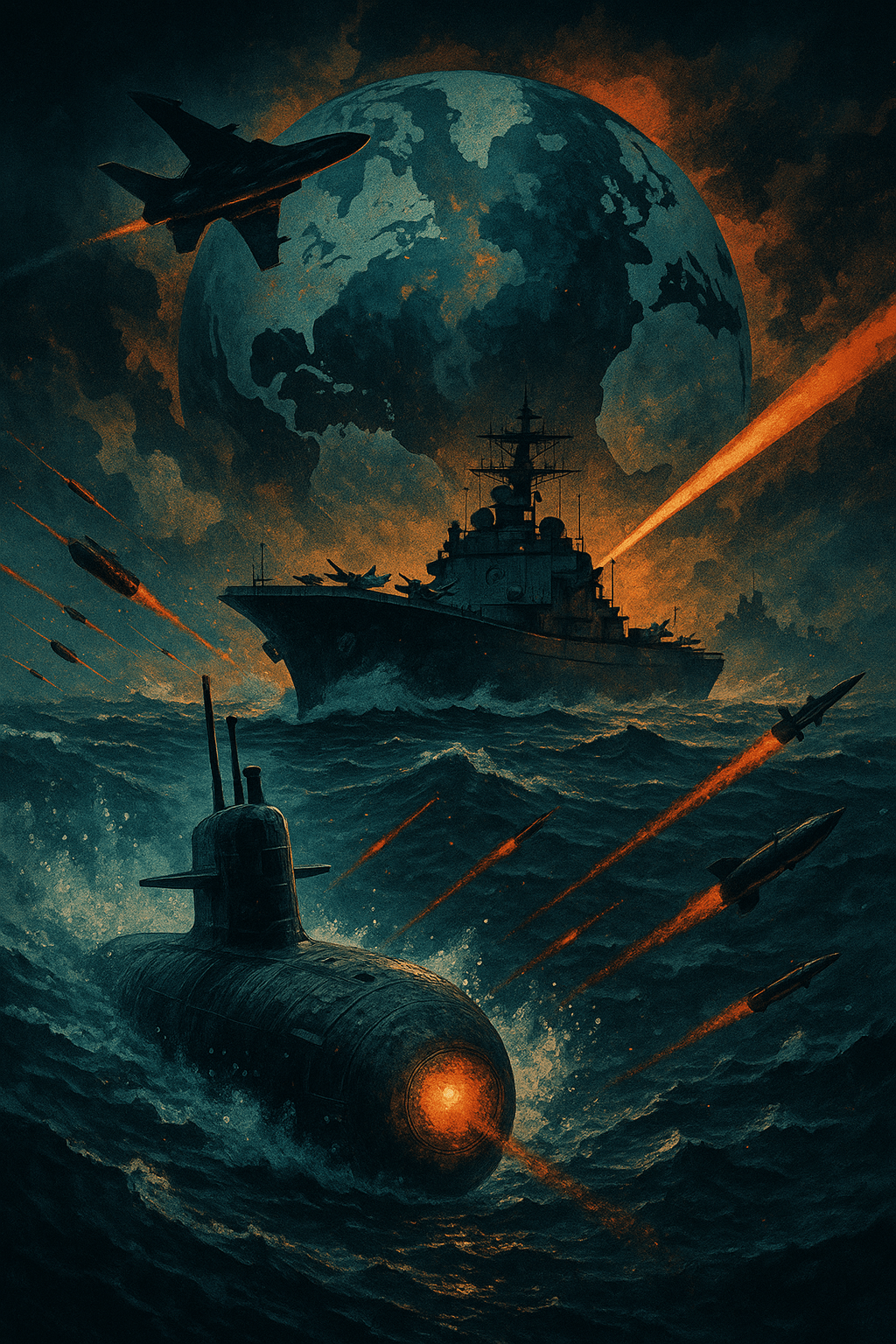
The next world war won’t start on land—it will start underwater. From UNCLOS obstruction to seabed militarization, Washington is weaponizing the sea to block China, sabotage multipolarity, and preserve empire through force and extraction.
By Prince Kapone | Weaponized Information | June 13, 2025
1. “Sovereignty,” Screamed from a Think-Tank Balcony
Flip on 60 Minutes and you’ll hear the liberal lament: Why won’t America ratify the UN Convention on the Law of the Sea (UNCLOS)? The hand-wringers say we’re “ceding the future” to China. What they bury is the dirty author of this holdout: the Heritage Foundation, Wall Street’s ideological pit bull. Heritage has spent two decades drilling the same talking point into Republican skulls: any treaty that limits U.S. corporate reach is a chain on “sovereignty.” Their memo became gospel; thirty-four GOP senators keep the treaty six votes short of ratification, an obstruction celebrated on prime-time TV.
This is Technofascism in action: algorithmic think-tank chatter feeds congressional blockade, which in turn licenses the Pentagon to treat the high seas as a privatized border wall. No multilateral leash, no international royalties, no pesky seabed court—just unfiltered power.
As Weaponized Information exposed in “The Art of Choking”, the refusal to ratify UNCLOS is just one maneuver in a broader strategy: deny multilateral legitimacy, then weaponize logistics. Just as U.S. sanctions cut off medicine and food while blaming the victims for “mismanagement,” maritime power is framed not as coercion but as the natural order—one where only Washington gets to write the rules.
Corporate media paints U.S. obstruction as a humiliating “loss” to Beijing. But look closer: the same outlets cheer every new aircraft-carrier patrol through the South China Sea. That’s the trick of Cognitive Warfare—sell militarized escalation as innocent self-defense, then sob on cue about a self-inflicted treaty handicap.
Even bipartisan reformers echo the script: “Our companies can’t mine the seabed without legal certainty!” True—U.S. firms lack the International Seabed Authority licenses that Chinese and Russian outfits already hold. But that “problem” is the plan. Washington’s ruling bloc would rather police the oceans with destroyers than share them under law. UNCLOS would make pillage a regulated enterprise; hyper-imperial doctrine prefers pillage enforced by gunboat.
As argued in “Recolonizing the Core”, the same ruling-class panic over “falling behind” fuels both military escalation abroad and labor repression at home. The logic of scarcity—engineered by capital—is used to discipline workers into accepting declining wages, anti-union regimes, and deregulated environmental destruction. The maritime scramble is simply the oceanic face of this race-to-the-bottom imperialism.
2. Riches in the Ruins — The Abyssal Rush and Its Necro-Extractivist Logic
Zoom in on the International Seabed Authority’s contract map and you’ll see a checkerboard of corporate flags covering the Clarion-Clipperton Fracture Zone (CCZ), halfway between Hawaiʻi and Mexico. A third of those blocks fly Chinese colors; the rest belong to Russia, Korea, France, and a handful of venture-funded shell firms. Absent are U.S. companies — not because Washington is “falling behind” but because Imperialist Recalibration means refusing any rules it can’t dictate. Instead of paperwork, the Pentagon parks a carrier strike group nearby and calls that “freedom of navigation.”
The stakes dwarf gold-rush lore. Nodules here average 1.3% nickel, 1% copper, 0.2% cobalt, plus rare-earth traces (GeoExpro). Each potato-sized rock could end up in a Tesla drivetrain or a Lockheed missile guidance system. No wonder Wall Street’s latest darling, The Metals Company, brags it will “power a carbon-neutral future” by vacuuming 500 million tonnes of the seabed.
As Weaponized Information revealed in “Rare Earthquake”, the deep-sea rush is not merely speculative—it’s survivalist. With rare-earth inputs dwindling and grid failures mounting, the U.S. corporate-military bloc views the ocean floor not as resource, but as emergency fuel line. This isn’t about abundance. It’s about scarcity, engineered and enforced at scale.
How did U.S. capital lock itself out of the licensing bazaar? Cue the Heritage Foundation’s memo mill. For two decades it has framed UNCLOS royalties as a “global tax” on American enterprise, peddling the fantasy that domestic legislation or executive orders can grant U.S. companies unilateral seabed title. That is Lawfare in its purest form: weaponize legal abstention so the Navy, not a judge in Kingston, becomes the ultimate claims office.
A Carnegie Endowment brief calls this a strategic own-goal; Beijing calls it a gift. We call it the predictable logic of Technofascism: governance by algorithmic lobbyists, enforced by gunboat if the code fails.
Peer-reviewed research shows seabed scars still barren four decades after a single test dredge. Sediment plumes suffocate filter feeders, while nodule removal erases habitat built over tens of millions of years. Climate scientists warn the abyss is a vital carbon sink; scrape it, and planetary heat sinks shrink. This is Necro-Extractivism: profit modeled on pre-priced extinction.
Even the business press flinches. TIME magazine admits deep-sea mining “isn’t a viable climate fix,” yet hedges: maybe if we just “study it more.” That hedging is a textbook move of the Imperialist Media Apparatus—mute the alarm, amplify the venture-capital stopwatch.
The smallest states are sounding the biggest siren. Palau, Fiji, and nine Pacific neighbors formed an alliance in 2022 demanding a global moratorium (Reuters). Palau’s president told Mongabay he will not “swap our children’s ocean for someone else’s battery” interview. That is Anti-Imperialist Sovereignty in action — a digital-age replay of Bandung, now staged on coral atolls.
Their stand terrifies the mining lobby. If islands refuse port access, deny data links, or sue in ITLOS court, corporate extraction timetables crumble. Here the concept of Chokepoints flips: imperial navies once used them to strangle; now island nations threaten to close them in defense of life.
Monthly Review nails the contradiction: capitalism’s “green transition” demands a new continuum of extraction stretching from Andean lithium flats to abyssal plains MR, Apr 2024. Cobalt for electric SUVs, nickel for smart bombs—sold as salvation, purchased with somebody else’s obliterated biome. This is not the circular economy; it is a planetary sacrifice zone stitched together by finance and enforced by fleets. That is Hyper-Imperialism: spasmodic militarism plus financial strangulation when raw force is too messy for CNN.
Meanwhile, the Deep Sea Conservation Coalition rallies unions, scientists, and coastal communities into a counter-network. Their demands undermine corporate timelines, proving Dual & Contending Power does not begin with rifles; it begins with refusal, with moratoriums, with building solidarity cables beneath empire’s data wires.
Heritage thinks the solution is more warships and a domestic “American Seabed Act.” But a carrier can’t police a global boycott, nor silence biodiversity data leaking from every ROV camera. Empire is desperate: its Crisis of Imperialism collides with a climate crisis that refuses to be bribed. The result is a rush toward the ocean floor as if history ends there. It doesn’t. History ends when the exploited say “no,” whether on a picket line in Tacoma or a lagoon in Vanuatu.
3. Chokepoint Cartography — Wall Street, Warships, and the Financial Noose
In 2024, a Wall Street consortium led by BlackRock announced a $22.8 billion deal to acquire Panama’s key port operator, which controls facilities on both ends of the canal. This was not just an investment—it was a hand-over of sovereignty. As Geopolitical Economy Report revealed, the move was coordinated with the U.S. embassy and sweetened by “security assistance” packages masked as port-protection aid.
This is classic Financial Piracy: the seizure of strategic assets under cover of liberal economics. But it’s also part of a broader Technofascist logic. Wall Street isn’t just buying ports; it’s buying the right to decide who can pass and who can’t. To “invest” in a chokepoint is to hold the keys to empire. In a dollar-based world economy, this isn’t just influence—it’s enforcement.
A CSIS brief notes that U.S. security agreements now wrap these ports in a Pentagon-State umbrella. Translation: finance capital captures the infrastructure, and the military guarantees its use as an imperial gate.
As documented in WI’s “Canals, Chokepoints, Chains and Capital”, this is not just a Panama story. It’s a blueprint—from the Panama Canal to the Suez, from the Caribbean to the Congo. The imperial doctrine is simple: privatize the bottlenecks, militarize the logistics, and then deny access at will.
In March 2025, a Pentagon review called AUKUS “a cornerstone of maritime dominance.” Washington Post coverage cheered the shift. But the real story was buried: the U.S. is off-loading its chokepoint burden onto allies—arming Australia with Virginia-class subs and pushing Britain into a forward posture in the South Pacific.
This is Sub-Imperialism at scale: settler allies like Australia and Canada serve as extensions of U.S. power, bearing the burden of encirclement while sharing the spoils. A Carnegie study explains AUKUS as a strategy of “infrastructure denial” to China (Carnegie Endowment). In plain terms: a coordinated bid to control ocean routes, cable networks, and sea-lanes of communication through militarized chokepoints.
The Malacca Dilemma—China’s dependence on this single passage for 80 percent of its oil imports—has become a guiding obsession for U.S. naval planners. The logic is simple: if Beijing’s trade arteries run through American-controlled bottlenecks, war becomes optional. Starvation-by-sanction can do the same work.
And it’s not just the South Pacific. As WI revealed in both “Choking the North” and “Greenland in the Crosshairs”, the U.S. is turning the Arctic into a new maritime kill zone—arming up bases from Alaska to Greenland, targeting Russia’s Northern Sea Route, and planning for blockade-style encirclement as sea ice retreats.
Across the Indo-Pacific, the U.S. maintains a dense lattice of bases: 375,000 personnel, 200+ ships, 500+ combat aircraft (USPACOM). Bases in Guam, Okinawa, Diego Garcia, and the Philippines form a literal noose—a picket line of empire floating on water.
Monthly Review’s Indo-Pacific imperialism report explains this spatial logic: “power projection” now hinges not on conquest, but on the ability to interrupt flow—of oil, minerals, capital, data. The empire’s new map isn’t one of continents. It’s a lattice of pressure points.
Weaponized Information’s “Mapping the World to Control It” shows how this isn’t just about geography anymore. It’s about data fusion. With AI-enhanced logistics, satellite surveillance, and predictive modeling, the U.S. can now weaponize flow itself—anticipating trade routes, simulating disruptions, and digitally throttling entire regions with deniable precision.
When military chokepoints don’t work fast enough, financial ones take over. That’s how Iran was cut off from SWIFT in 2012, how Venezuela lost access to its own central-bank reserves, how Russia was severed from Visa and Mastercard. These aren’t “sanctions” in the traditional sense. They’re weaponized flows—dollar denial as blockade. The technical term is Sanctions Architecture. But really, it’s just colonial seizure dressed in digital robes.
This is the other face of empire. Not the boot, but the bank. Not the Marine, but the clearinghouse. And together, they form the core logic of the U.S. strategy: Imperialist Recalibration. Withdraw from multilateral frameworks. Fortify the infrastructure. Control the gates. Suffocate the alternatives.
This is no longer a battle for territory. It’s a battle for routes—pipelines, shipping lanes, fiber-optic cables, satellite orbits, debt corridors, software standards. The empire doesn’t need to own land. It needs to own the lanes of motion—and deny them to rivals.
This is what Chokepoint Imperialism looks like. It’s not a new map. It’s a new logic of domination. And as we’ll explore in Part IV, the ones who will suffer most are not U.S. citizens or Chinese billionaires—but the dockworkers, seabed miners, trawler crews, and village rebels caught in the crossfire of this infrastructural war.
4. Hegemonic Strategy or Hyper-Imperial Blueprint?
Washington’s refusal to ratify the United Nations Convention on the Law of the Sea (UNCLOS) is framed as conservative isolationism or bureaucratic inertia. But in reality, it’s a deliberate rejection of multilateral constraint. The New York Times reported that Heritage Foundation lobbying has guided Republican opposition for years, arguing that any treaty limiting unilateral U.S. action undermines “sovereign maritime rights.”
That refusal grants U.S. corporations and military forces something no international framework could: plausible deniability. The U.S. can patrol, blockade, and operate anywhere under the banner of “freedom of navigation,” but without being bound by the same rules it enforces. This is Technofascism at Sea—a rejection of legal parity in favor of weaponized exception.
Weaponized Information’s “Strangled in the Cradle” makes clear that this refusal isn’t a glitch—it’s doctrine. U.S. imperial strategy views any global institution that might constrain its dominance as a threat to be neutralized, defunded, or bypassed. UNCLOS, like the ICC or WHO, is treated not as a platform for cooperation but a trapdoor for multipolar governance. Refusal is empire’s firewall.
What empire cannot dominate through law, it now controls through geography. From Panama to Malacca, Greenland to Guam, the U.S. is fortifying a global lattice of chokepoints. In 2024, BlackRock and a Wall Street consortium completed a $22.8 billion takeover of Panama’s main container-terminal operator—an imperial backdoor masked as foreign direct investment. Geopolitical Economy Report later showed the deal was facilitated by U.S. embassy coordination and Pentagon “port-security” guarantees.
Meanwhile, the U.S. Indo-Pacific Maritime Initiative is channeling more than $600 million into port upgrades from the Philippines to Palau. These aren’t just logistics hubs—they are valves in a pressure system. Control of these chokepoints means the ability to suffocate China’s trade, starve dissident regimes, and block multipolar alternatives. Hyper-Imperialism means denying rivals access to life-support infrastructure, not merely bombing them.
As analyzed in WI’s “Mapping the World to Control It”, the empire’s bet isn’t on law—it’s on infrastructure dominance. Through digital logistics corridors, undersea cables, and privatized ports, Washington seeks to command the nervous system of global capitalism, then flip the switch on dissent.
Just as the U.S. outsourced manufacturing to Global-South sweatshops, it is now outsourcing enforcement to junior partners. India, under Narendra Modi, has emerged as Washington’s lead sub-imperial ally. Its integration with U.S. forces deepens through the Quad, while New Delhi woos Western capital with duty-free rare-earth corridors in Odisha and Gujarat (Financial Times).
But India’s role is not passive. As Monthly Review details, New Delhi acts as regional enforcer for the U.S. agenda—promoting digital colonization, quelling peasant uprisings, and stoking border clashes with China to position itself as the “pro-business democracy” of the Global South. This is Sub-Imperialism: client states rewarded for policing empire’s frontiers and disciplining their own working classes.
At the International Seabed Authority (ISA), nations such as Palau, Vanuatu, and Chile pressed for a global moratorium on deep-sea mining until ecological risks are understood (Reuters). But the U.S.—as a non-signatory to UNCLOS—doesn’t even show up. It’s a signal: the commons will be replaced by contracts. The ocean, like everything else, is for sale.
Why share when you can privatize? Why obey rules when you can dictate surrender terms? This is the essence of the hyper-imperial turn: total logistical dominance with zero institutional accountability. The U.S. is not collapsing; it is consolidating—from the abyssal plain to low-Earth orbit, from critical minerals to shipping arteries.
As WI’s “Recolonizing the Core” explains, this logic doesn’t stop at the water’s edge. It now defines the imperial relationship to the domestic working class as well—privatize what’s left, discipline dissent, and consolidate rule through control over essential flows: fuel, food, transit, finance. Deep-sea mining is simply the deepest frontier of a planetary strategy to suffocate sovereignty and extract obedience.
This is not decline. This is design. And in our conclusion, we will expose the full contours of this global recomposition—not as a failure of empire, but as its rebirth through force, finance, and infrastructure seizure.
5. Contested Futures — Who Will Control the Oceans?
The global economy is on the brink of a deep-sea scramble. According to the U.S. Government Accountability Office, the demand for critical minerals like cobalt, manganese, and nickel may double or triple by 2030, largely due to military and “green” tech competition. Meanwhile, Arthur D. Little projects that the economic value of deep-sea resources could reach $20 trillion.
Private capital is racing to secure early extraction rights. Credence Research forecasts the market for deep-sea mining to balloon from $1.1 billion in 2022 to nearly $37 billion by 2028. If current trends continue, international law will be left behind—replaced by corporate contracts and U.S. naval enforcers.
Weaponized Information’s “Rare Earthquake” reminds us this isn’t just about commodities—it’s about continuity. Empire cannot sustain its current military and tech dominance without new inputs. Deep-sea mining is becoming less an option than a last resort—an imperial gasp for resource control in the twilight of global consent.
The International Seabed Authority (ISA) has failed to finalize a regulatory framework after years of pressure and protest. As detailed in a 2024 ScienceDirect analysis, bureaucratic stalling has opened the door for unilateral action and private actors backed by national militaries.
Without clear regulations, companies like The Metals Company—backed by U.S. and Canadian financiers—could begin commercial mining through flag-of-convenience partnerships, such as those with Nauru or Tonga. This risks converting international waters into fragmented zones of extractive sovereignty, enforced not by law but by naval might.
As Weaponized Information warned in “Mapping the World to Control It”, these “private regimes” are not rogue actors—they’re embedded in a coordinated infrastructure of empire. From fiber-optic cables to satellite AI targeting, the entire logistics stack is being hardened for a post-legal future: one in which domination is automated, not debated.
U.S. naval strategy is evolving rapidly. In 2024, DARPA tested a new generation of Manta Ray unmanned underwater vehicles—submersible drones designed to operate autonomously for months on the seafloor. The Pentagon’s Defense Innovation Unit has solicited further tech to support undersea operations.
This is not about protecting trade. It’s about controlling extraction zones, severing rival supply lines, and asserting American dominance through robotic, deniable force. The U.S. doesn’t need more treaties—it’s betting on supremacy by infrastructure, not consensus.
The northern Arctic, once impassable, is fast becoming a new battleground. According to ScienceDirect data and Arctic WWF, traffic through Russia’s Northern Sea Route has grown by over 7% annually. Russia now projects a 50% increase in Arctic shipping by 2030, as confirmed by Reuters.
Control of Arctic sea lanes is more than economic—it’s strategic. Melting ice is opening corridors that bypass traditional chokepoints like the Malacca Strait. This could redraw the imperial map, as NATO and Russia maneuver to militarize the top of the world.
As WI explored in “Choking the North”, this is not merely a northern theater—it’s the keystone in empire’s re-bordering of the planet. The Arctic is becoming a massive logistics choke valve. Whoever commands it, commands the future of global routing itself.
Environmental scientists warn that seabed mining could unleash an ecological disaster. A Planet Tracker report highlights massive risks to global carbon sinks, fisheries, and deep-ocean biodiversity. The Pew Charitable Trusts advocate a moratorium on all commercial activity until sufficient research is done.
Marine biologists and climate coalitions argue that the seabed could become a political frontier for climate reparations and indigenous sovereignty. As noted in ScienceDirect’s 2024 foresight study, calls for a global moratorium may reshape how the ISA allocates future mining zones—or whether it can survive at all.
From French Polynesia to Chile, movements for ocean sovereignty are growing. As Time Magazine reports, territories like French Polynesia have enacted bans on seabed mining, defending not just ecosystems but cultural rights. The Guardian confirms that dozens of states have now joined the opposition to seabed mining licenses at the ISA.
Meanwhile, the new High Seas Treaty adopted by over 60 nations promises to expand Marine Protected Areas (MPAs) and limit commercial exploitation. But U.S. refusal to ratify such treaties leaves open the question: can global sovereignty exist in waters ruled by empire?
As WI asked in “The Art of Choking”, what happens when the gatekeepers of global infrastructure are also its greatest saboteurs? The coming battles over deep-sea mining will not be technocratic—they will be existential. Who gets to decide what life is worth preserving? And who decides which life is worth extracting?
The struggle for oceanic liberation will not be waged in UN conference rooms. It will be waged in island councils, trawler ports, and rebel scientific networks. And if the empire beneath the waves is to be dismantled, it will be by those who refuse to let the oceans be privatized—who see the sea not as territory, but as life.
6. Win the Future, Not the War
The myth of American benevolence is collapsing. After decades of failed occupations, trillions in wasted military spending, and rising domestic poverty, public patience is wearing thin. A 2024 Chicago Council survey found that only 41% of Americans support sending U.S. troops to defend Israel—clear evidence of war fatigue. Responsible Statecraft polling further shows majorities want fewer entanglements in Syria, Ukraine, and Taiwan. The empire’s forever wars have lost their moral shine.
Younger generations are demanding change. A Gallup survey confirms that roughly half of Millennials and Gen Z view socialism favorably. And it’s not just economic: a 2023 Pew Research Center poll found 65% of U.S. adults say Washington is doing “too little” on climate. The same capitalist system that fuels war is torching the planet, and people know it.
Despite nonstop demonization of China and the Global South, Americans are open to cooperation. A Chicago Council brief shows 72% support working with China to limit climate change (Chicago Council). Business leaders see opportunity too: nearly half of U.S. executives surveyed by the Monterey Initiative for Global Studies believe BRICS-oriented trade can bolster resilience (MIIS). Multipolar pragmatism is outrunning Cold-War nostalgia.
As Weaponized Information argued in “The Long Road to Multipolarity”, the future is not a battle between superpowers but between empire and planetary sovereignty. BRICS is not a bloc—it is a symptom of a world reorganizing itself against coercion. The fact that so many in the U.S. support climate cooperation with China signals a quiet revolt against imperial framing.
Contrary to Beltway fears, most Americans still believe in global solidarity. The World Values Survey finds 68% saying wealthy nations have a moral duty to assist poorer ones. And resistance to punitive sanctions is rising: Institute for Policy Studies analysis shows broad majorities preferring diplomacy and humanitarian aid over economic strangulation (IPS). That’s not pacifism. It’s clarity.
Imperial planners are hedging. A 2025 Foreign Affairs essay argues the U.S. must trim its global commitments or face strategic defeat. A Brookings commentary contends that updating multilateral norms would actually serve U.S. interests (Brookings). These aren’t radicals; they’re imperial custodians, signaling that the unipolar model is untenable.
The future is multipolar. Nations from French Polynesia’s vast marine reserve (TIME) to a growing bloc at the International Seabed Authority opposing deep-sea mining (The Guardian) show that sovereignty and eco-defense are rising. The U.S. public must choose: die for a sinking empire, or live for a shared world. That is not rhetoric; it is a revolutionary line—and if we are serious about saving this planet, it must guide our organizing, our agitation, and our action.
As Weaponized Information warned in “Recolonizing the Core”, empire is not just a foreign policy—it is a domestic regime. The same logic that strangles BRICS with sanctions is strangling U.S. workers with debt, surveillance, and collapsing infrastructure. To join the world is not an act of charity—it’s self-preservation.
There is no future in domination. But there is a future in cooperation—and it starts by defecting from empire.
 Weaponized Information
Leave a comment