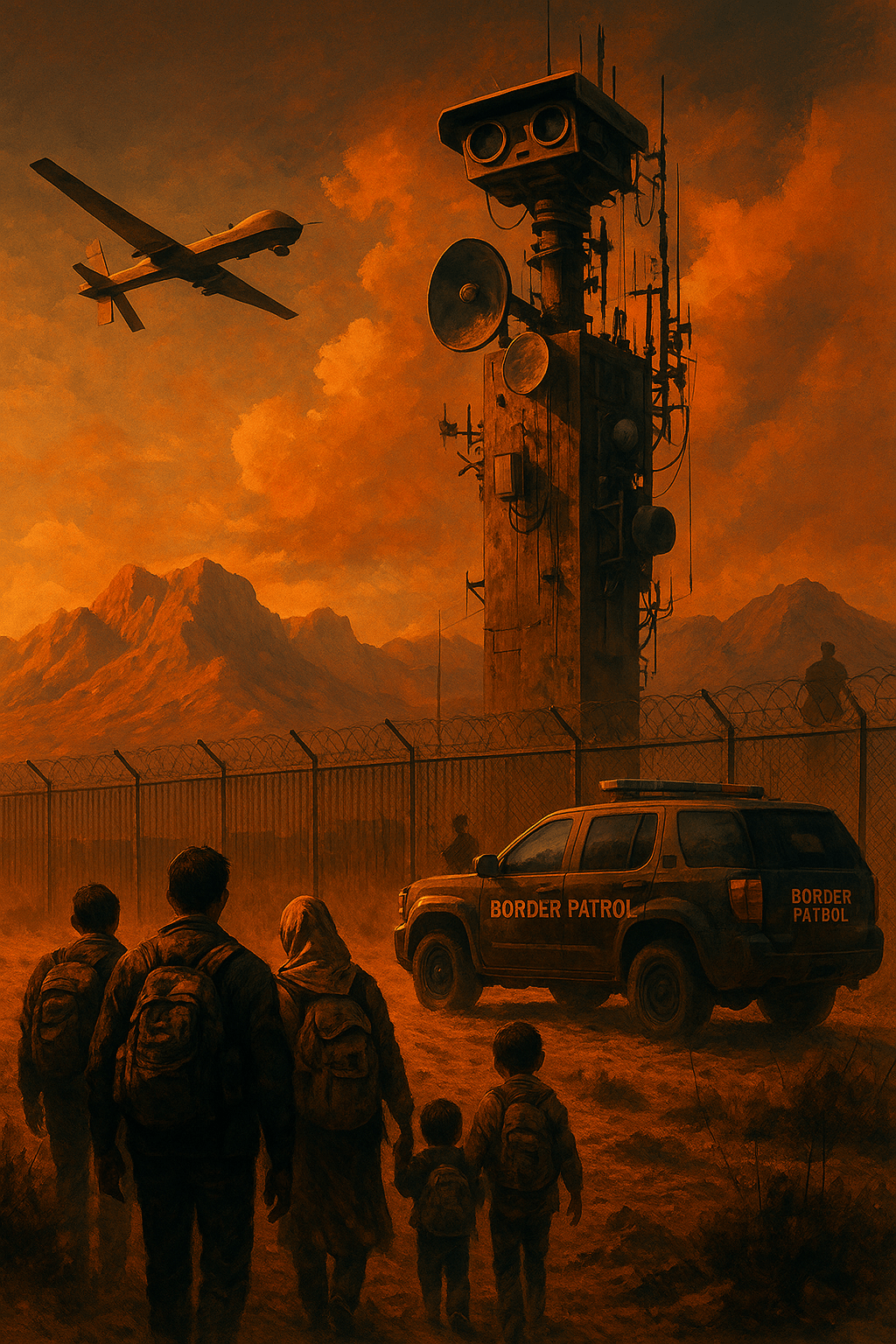
In the deserts of Southern California, a new kind of border war is being waged—not with boots and barbed wire, but with drones, algorithms, and biometric terror. Migrants are the target. Humanitarians are suspects. And the U.S. borderlands have become a proving ground for the empire’s technofascist future.
By Prince Kapone | Weaponized Information | May 13, 2025
Eyes in the Sky, Lies in the Press: Mapping the Author Behind the Surveillance Narrative
Amanda Ulrich, the author of this Guardian piece, is no amateur. A decorated freelancer, she floats comfortably between the media empires of the liberal West—from USA Today to PBS and the Pulitzer Center. Her beats? The forgotten, the remote, the exploited—but always framed through a lens that reinforces the moral legitimacy of the imperial state. She lectures journalism at San Diego State University—one of many institutions that churn out “ethical storytellers” trained to narrate empire with a concerned tone. She’s reported on Indigenous dispossession, Caribbean hurricanes, and environmental collapse—but always at the edge of critique, never cutting to the root. She documents decay while protecting the system that causes it. And that’s the point: Ulrich belongs to a class of educated liberal narrators who sanitize imperial brutality through stories of “human resilience” while making sure no fingers point at capital.
And the outlet? The Guardian—a bastion of progressive imperialism. It plays the role of watchdog while guarding the kennel. Owned by the Scott Trust, shielded from market pressure by charitable endowment, it serves as the ideological wing of British liberalism—reporting critically on war crimes, all while preserving the legitimacy of the imperial order that commits them. The Guardian doesn’t fabricate facts—it fabricates frameworks. Its job isn’t to lie outright, but to curate what is visible and invisible, what is foregrounded and what’s buried under ten paragraphs of anecdote. It mourns the cruelty of the boot while defending the necessity of the boot itself.
And whose interests does this narrative serve? The Biden–Trump technofascist consensus at home, and the borderland surveillance industry abroad. Think of Anduril Industries, Palantir Technologies, and Raytheon—all profiting from the transformation of the U.S.-Mexico border into a digital prison. Think of CBP brass, DHS contractors, and the settler sheriffs deputized as foot soldiers for capital’s last domestic war. These are not metaphors. They are material forces. And every piece of liberal journalism that portrays this repression as a series of tragic misunderstandings—rather than as an organized, intentional class war—helps to grease the gears of that machine.
The Guardian article doesn’t lie. It lets the repression speak in whispers. We hear about “drones,” “surveillance towers,” “algorithmic sensors,” but not once is the phrase technofascism used. We hear about “Border Angels” harassed by patrol agents, but not about how counterinsurgency doctrine treats humanitarian aid as a threat to imperial control. The CBP helicopter overhead? Just coincidence. The sensors triggered in the desert? Just context. The fact that Trump shut down CBP One, leaving asylum seekers with no legal path into the U.S.? A tragedy, yes—but not a strategy. And yet we know, from our own analysis and the long archive of empire, that this is not mismanagement. It’s refinement.
What this piece omits—strategically—is that the U.S. border is now a zone of active counterinsurgency. The agents aren’t just chasing “illegals.” They are waging war against the very idea that poor and colonized people have the right to move, to breathe, to survive. Every biometric checkpoint, every infrared scan, every ICE raid is a node in a vast, expanding infrastructure of imperial labor discipline. This is Technofascist Labor Recalibration: the project of reshaping the U.S. workforce through terror and surveillance, turning the borderlands into a test lab for mass repression that will soon be deployed across the empire.
And Ulrich’s framing? A softer border, a gentler fascism, where the helpers are noble, the agents are misguided, and the migrants are passive victims. No mention of class war. No mention of racial capitalism. No mention that what’s being rehearsed in the Sonoran desert will be rolled out in Chicago and Detroit when the uprisings come. Because the job of imperial journalism is not to tell the whole story. It’s to manage consent. And when the machine gets meaner, the liberals get quieter.
Desert Data, Drone Eyes: Extracting Truth from a Borderland Battlefield
Strip away the anecdotes, and what we’re left with in this article is a horrifying empirical reality—one buried beneath the Guardian’s narrative fog. The facts are there, but scattered like bones in the dirt. So let’s gather them, reconstruct the skeleton, and place them back in motion.
Fact: U.S. Customs and Border Protection is now operating a 24/7 surveillance regime along the U.S.-Mexico border, using biometric sensors, drones, and heat-signature towers to monitor terrain once traversed by migrants, humanitarian groups, and wildlife. Fact: aid workers with organizations like Border Angels are now treated as suspects, followed by helicopters, and confronted by agents who refer to asylum seekers as “customers”—a dehumanizing term from the carceral lexicon. Fact: the legal pathways for asylum are collapsing. CBP One is shuttered. Trump has functionally ended all legal entry. And the courts are too preoccupied with punishing the poor to challenge the legality of the collapse. This isn’t incompetence. It’s engineered illegality—deliberate state sabotage of the last remnants of bourgeois humanitarianism.
But for every fact revealed, ten more are left buried. We’re told about heat. We’re told about handcuffs. But we are not told how many contracts were awarded to Anduril Industries this fiscal year. We are not told how many DHS fusion centers are now operating in California’s interior, syncing municipal police databases with ICE facial recognition software. We are not told that Fort Huachuca—headquarters of Joint Task Force–Southern Border—was once used to train death squads for U.S.-backed dictatorships in Central America. These facts would change the story. So they’re left out.
Let’s recontextualize what we’ve excavated. The closure of CBP One isn’t just a “policy shift.” It is a strategic maneuver within a broader project of imperial labor management. By sealing legal channels, the state manufactures illegality. That illegality becomes the justification for counterinsurgency. And that counterinsurgency becomes a new form of domestic accumulation: a militarized frontier where surveillance firms, defense contractors, and borderland sheriffs all get paid to repress, detain, and dispose.
The article tells us that coyotes and smugglers now fill the gap. But what it doesn’t say is that the U.S. state created that gap. This is not the breakdown of a system—it is the system functioning precisely as designed. A border economy of desperation, funneled through narco-networks, monitored by private intelligence contractors, and used to justify endless DHS budget increases. In other words: the refugee crisis is being produced on purpose, then monetized as logistics, then neutralized as security risk.
This is what we mean when we say the border is an accumulation frontier. It’s where racialized repression and monopoly capital meet. Surveillance becomes currency. Detention becomes investment. Every migrant who collapses in the desert becomes another argument for more towers, more drones, more cops. The logic is necropolitical: life is cheap, but the tech to police death is a booming market. And the Guardian, intentionally or not, ends up laundering this death-economy through a sanitized tale of “policy challenges” and “open hate.”
But we don’t deal in euphemisms. We call this what it is: Technofascist Counterinsurgency. And the facts are clear—if you know where to look, and what to listen for. The desert is speaking. The data is bleeding. And the empire is tightening its grip, one algorithm at a time.
Sabotaging the System: From Humanitarian Aid to Revolutionary Counter-Logistics
The border is not a humanitarian crisis. It’s a counterinsurgency operation. And every bottle of water left in the desert, every life saved by Border Angels, every legal case fought by immigrant defenders is not just charity—it’s a form of resistance. But if we stop there, we fall short. Because the machine is still running. The towers are still scanning. The drones are still flying. The algorithm is still learning. To dismantle this apparatus, we need to escalate beyond aid into sabotage. We need to transform isolated acts of care into coordinated acts of class war.
The technofascist infrastructure strangling the borderlands—from Fort Huachuca’s drone command centers to the Lattice AI towers to the fusion of DHS, ICE, and local police—must be mapped, exposed, and targeted. These are not just tools of surveillance; they are profit engines. Anduril, Palantir, CoreCivic, and GEO Group are not peripheral players—they are the digital colonizers of this new frontier. Every undocumented body they track, cage, or process is another dollar in their pocket. The border is not just militarized—it’s monetized.
We can’t defeat this with court challenges alone. We must move from passive solidarity to active disruption. That means:
- Sabotaging the data streams feeding predictive policing algorithms.
- Organizing supply chain workers to block the transport of surveillance equipment.
- Launching digital campaigns that crash the systems ICE relies on to hunt people.
- Building sanctuary cities that are more than slogans—zones of organized refusal to collaborate with empire.
We also need to fight on the ideological front. To tear off the liberal mask that pretends these policies are about “order” or “sovereignty.” We must teach our people that the deportation regime is a war machine—and that war machine is coming for all of us. The drones won’t stop with the undocumented. The surveillance grid won’t pause at citizenship. The fascist tools being sharpened on the backs of migrants will soon be wielded against striking workers, poor settlers, and the Black, Brown, and Indigenous masses the state has always feared.
This is not paranoia. It’s precedent. Every generation of U.S. repression has expanded from its initial targets to the broader working class. The same troops that crushed slave revolts were used to break strikes. The same jails that held migrant children are now filling with homeless elders. The same biometric databases tracking asylum-seekers are being pitched as “public safety tech” in our cities. The buffer zone is the blueprint. The empire is testing the system before it rolls it out nationwide.
That’s why our struggle must be rooted in revolutionary internationalism and class solidarity. We must connect the fights: from Tijuana to Tucson, from Otay Mountain to Occupied Palestine, from detention centers to strike lines. We must organize beyond the divisions of papers, race, language, and status—and build a unified front against the technofascist state.
Because the future they’re planning is one where the only legal path is submission, the only safe job is silence, and the only permitted life is one of obedience. But we refuse. We choose resistance. We choose solidarity. We choose to smash the machine and build a world where borders don’t kill, and surveillance doesn’t rule. The only buffer zone we recognize is the one between the ruling class and our liberation. And we intend to breach it—together.
From Border to Battlefield: Reframing the U.S.-Mexico Border as a Technofascist Frontline
The liberal press tells us the border is broken. We say: it’s working exactly as intended. This isn’t chaos—it’s choreography. A meticulously engineered counterinsurgency zone, designed not to welcome, but to repel; not to process, but to punish. The U.S.-Mexico border is no longer a line on a map. It is the cutting edge of technofascism: a laboratory for surveillance, a proving ground for repression, and a site of racialized social control that will be exported deeper into the empire’s interior.
Here’s what the Guardian won’t say: the purpose of the border is not to stop migration—it’s to manage labor. It’s to criminalize surplus workers, destabilize communities, and discipline the domestic workforce through terror. It’s to ensure that no one, regardless of status, feels safe enough to organize, strike, or resist. And the tools used to enforce this regime—drones, biometric scans, heat maps, predictive patrols—are not temporary. They are permanent fixtures in a digital counterinsurgency grid that stretches from San Diego to San Juan.
This is not border control. It’s logistical counterinsurgency. It’s the application of military doctrine to human movement. And it’s rooted in the oldest imperial logic there is: control the periphery to protect the core. By turning the borderlands into war zones, the U.S. state sends a message to every worker, every organizer, every potential rebel: this is how we treat the poor, the racialized, the displaced. If you cross the line—geographic, racial, political—you will be surveilled, detained, erased.
The Guardian frames this as a story of “tension” and “open hate.” But the real story is this: the state is preparing for war. Not just at the border, but everywhere. What’s being piloted in Otay Mountain will be deployed in Oakland. What’s normalized in Jacumba will be made standard in Jackson. Every migrant checkpoint is a dry run for a domestic lockdown. Every biometric scan is a prelude to predictive arrest. Every surveillance tower is a rehearsal for total control.
This is why the liberal narrative fails. It isolates the border from the broader structure of empire. It treats the repression as an excess, not an essential function. It paints border agents as rogue actors, not trained counterinsurgents. And it completely ignores the class dimension: the fact that the entire technofascist architecture is built to discipline labor, not protect “sovereignty.” That’s why we reframe this story: not as a crisis of policy, but as a strategy of imperial preservation.
And let’s be clear: this strategy isn’t partisan. The border regime was built by Democrats and Republicans alike. It was armed by Obama, expanded by Biden, and digitized by Trump. It is bipartisan technofascism—refined, recalibrated, and ready to crush resistance wherever it emerges. To fight it, we need more than moral outrage. We need revolutionary clarity. Because what happens at the border today will happen in your neighborhood tomorrow. The question is: will you be ready to resist?
Sabotaging the System: From Humanitarian Aid to Revolutionary Counter-Logistics
The border is not a humanitarian crisis. It’s a counterinsurgency operation. And every bottle of water left in the desert, every life saved by Border Angels, every legal case fought by immigrant defenders is not just charity—it’s a form of resistance. But if we stop there, we fall short. Because the machine is still running. The towers are still scanning. The drones are still flying. The algorithm is still learning. To dismantle this apparatus, we need to escalate beyond aid into sabotage. We need to transform isolated acts of care into coordinated acts of class war.
The technofascist infrastructure strangling the borderlands—from Fort Huachuca’s drone command centers to the Lattice AI towers to the fusion of DHS, ICE, and local police—must be mapped, exposed, and targeted. These are not just tools of surveillance; they are profit engines. Anduril, Palantir, CoreCivic, and GEO Group are not peripheral players—they are the digital colonizers of this new frontier. Every undocumented body they track, cage, or process is another dollar in their pocket. The border is not just militarized—it’s monetized.
We can’t defeat this with court challenges alone. We must move from passive solidarity to active disruption. That means:
- Sabotaging the data streams feeding predictive policing algorithms.
- Organizing supply chain workers to block the transport of surveillance equipment.
- Launching digital campaigns that crash the systems ICE relies on to hunt people.
- Building sanctuary cities that are more than slogans—zones of organized refusal to collaborate with empire.
We also need to fight on the ideological front. To tear off the liberal mask that pretends these policies are about “order” or “sovereignty.” We must teach our people that the deportation regime is a war machine—and that war machine is coming for all of us. The drones won’t stop with the undocumented. The surveillance grid won’t pause at citizenship. The fascist tools being sharpened on the backs of migrants will soon be wielded against striking workers, poor settlers, and the Black, Brown, and Indigenous masses the state has always feared.
This is not paranoia. It’s precedent. Every generation of U.S. repression has expanded from its initial targets to the broader working class. The same troops that crushed slave revolts were used to break strikes. The same jails that held migrant children are now filling with homeless elders. The same biometric databases tracking asylum-seekers are being pitched as “public safety tech” in our cities. The buffer zone is the blueprint. The empire is testing the system before it rolls it out nationwide.
That’s why our struggle must be rooted in revolutionary internationalism and class solidarity. We must connect the fights: from Tijuana to Tucson, from Otay Mountain to Occupied Palestine, from detention centers to strike lines. We must organize beyond the divisions of papers, race, language, and status—and build a unified front against the technofascist state.
Because the future they’re planning is one where the only legal path is submission, the only safe job is silence, and the only permitted life is one of obedience. But we refuse. We choose resistance. We choose solidarity. We choose to smash the machine and build a world where borders don’t kill, and surveillance doesn’t rule. The only buffer zone we recognize is the one between the ruling class and our liberation. And we intend to breach it—together.
 Weaponized Information
Leave a comment