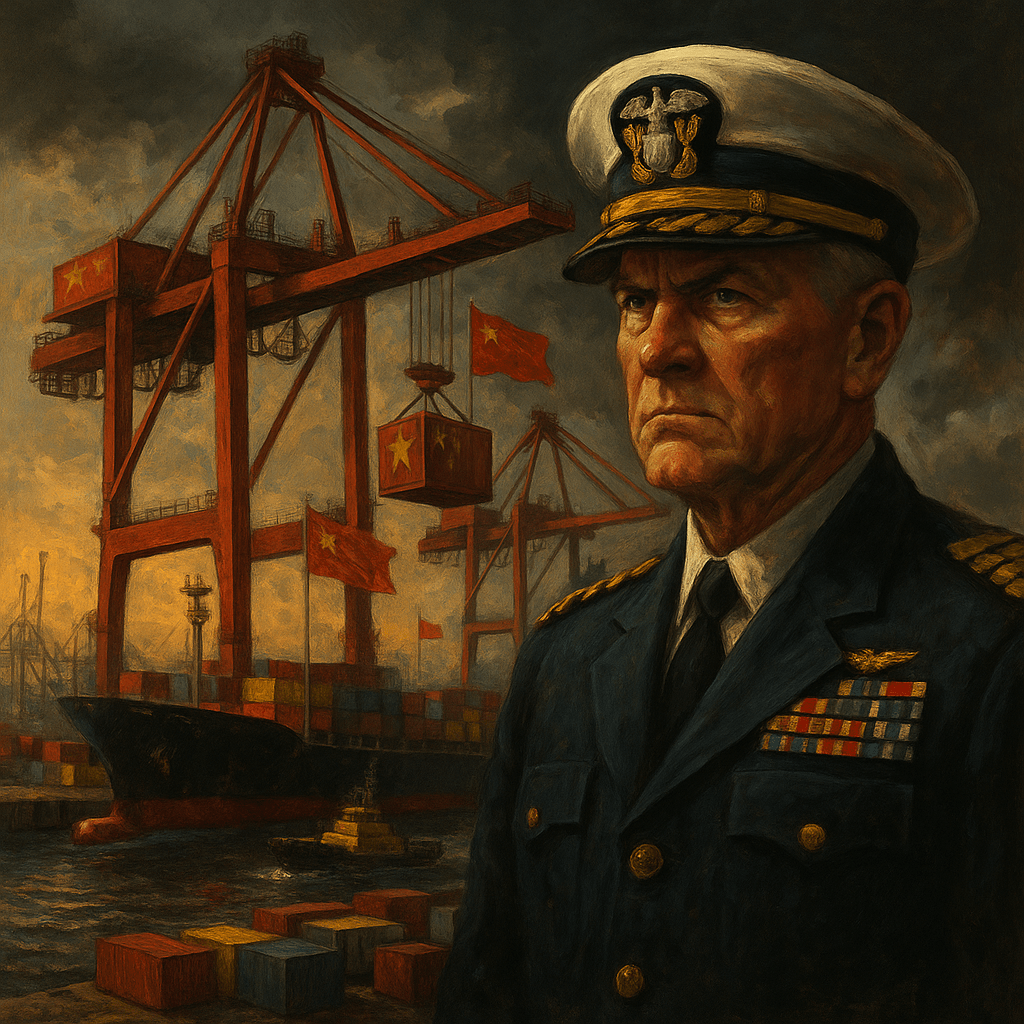
The Wall Street Journal sounds the alarm over China’s port infrastructure in Latin America—but behind the panic lies an empire afraid of losing control. This isn’t journalism. It’s psychological warfare dressed up as reporting.
By Prince Kapone
Weaponized Information | May 13, 2025
I. Behind the Curtain: Who Writes for Empire, and Why It Always Sounds the Same
The Wall Street Journal’s piece on Chinese port expansion in South America is penned by Samantha Pearson, the Journal’s Brazil-based correspondent. Pearson has built a career reporting from São Paulo for a paper that doesn’t just reflect Wall Street’s worldview—it serves it. Her work, almost without exception, frames Latin American political and economic dynamics through the lens of investor anxiety and U.S. “interests.” Whether it’s inflation in Argentina, agribusiness in Brazil, or Chinese investments in the region, Pearson’s coverage adheres strictly to the narrative expectations of the imperialist media apparatus: local sovereignty is dangerous, Chinese development is suspicious, and Washington’s dominance is natural. She is not an independent journalist. She is a stenographer of capital, embedded deep inside a publication that sees the Global South not as a collection of nations, but as an asset class.
The Wall Street Journal itself is a pillar of the imperialist media apparatus. Owned by Rupert Murdoch’s News Corp, the WSJ operates not as a newspaper but as a transmission belt for Wall Street’s class interests. It speaks on behalf of the Yankee financial oligarchy—those who don’t just own stocks, but write the global rules of finance, war, and trade. When Chinese companies break ground on infrastructure in Brazil or Peru, the WSJ doesn’t see ports—it sees broken chains in a logistical system it thought it owned. This isn’t reporting. It’s counterinsurgency with a press pass.
The article quotes U.S. Southern Command officials, unnamed White House sources, and logistics “experts” like David Sacks of the Council on Foreign Relations and Rebecca Bill Chavez of the Inter-American Dialogue—each a loyal node in the imperialist brain trust. These aren’t neutral observers. They are operatives and enablers of empire, paid to dress military strategy up as policy advice and market domination as “concern for sovereignty.”
Now let’s peel back the rhetorical camouflage. The headline warns of China building “megaports” to “feed its need”—as if the second-largest economy on Earth were some monstrous creature creeping over the Andes in search of soybeans. This is not language chosen at random. It’s imperial projection—China as bottomless hunger, Latin America as passive terrain. The article repeatedly implies that commercial infrastructure is secretly military. Terms like “dual-use facilities” and “strategic leverage” are slipped in without evidence, but with heavy insinuation. The goal is clear: cast doubt, sow fear, and legitimize U.S. interference.
The WSJ also wields the standard Cold War kit: mentions of Beijing’s “clout,” fears of “security gaps,” and speculation that “future military activity” might follow. There’s no proof, of course—just vibes and imperial muscle memory. Meanwhile, the fact that Washington has more than 70 military installations across Latin America goes unmentioned. So does the U.S. role in destabilizing regional governments who dare to chart a course outside the IMF death trap. Sovereign development is framed as suspicious. But centuries of U.S.-backed coups, invasions, and occupations? Those don’t make the copy.
When China invests in ports, it’s a Trojan horse. When BlackRock buys the ports outright, it’s just good business. That’s the cognitive warfare at play here—what we at Weaponized Information have named the ideological sleight-of-hand that masks imperial sabotage as national defense. The WSJ article performs this magic trick with discipline. It never names U.S. financial control. It never mentions the Monroe Doctrine. It just naturalizes empire, like a weatherman describing the rain—except the storm is made of gunboats, hedge funds, and lies.
II. The Facts They Bury, the History They Erase
Strip away the imperial theatrics and the Wall Street Journal article reveals a handful of simple facts: Chinese firms have invested in or are developing major ports in Brazil, Argentina, Peru, and Mexico. Most of these facilities are designed for agricultural trade—soybeans, corn, grains—vital exports for Latin American economies, and essential imports for China’s population of 1.4 billion. The ports are civilian infrastructure. They are being financed through legal contracts, often with favorable terms, and involve regional actors who are choosing Beijing over Washington for one reason: China offers roads and railways, not coup threats and IMF chains.
But what the article does not say is even more important than what it does. There is no mention that BlackRock and other Wall Street firms have taken direct control of key Latin American ports, including those flanking the Panama Canal. There is no mention that U.S. Southern Command routinely classifies regional infrastructure as “strategic assets” and considers any deviation from Washington’s grip as a “security risk.” There is no mention that the U.S. has more than 800 military bases worldwide—including dozens across Latin America—and has used them to back every major right-wing coup in the region for the last century.
Nor does the WSJ acknowledge the context of rising regional resistance to U.S. domination. CELAC, ALBA, and other integrationist bodies are pushing for anti-imperialist sovereignty—a form of development rooted in regional cooperation and mutual respect, not IMF debt servitude. China’s port investments are not acts of conquest; they are alternative lifelines emerging in the ruins of unipolarity. In this light, it is not Beijing that threatens the region’s autonomy—it is the empire desperate to maintain the chokepoints that once guaranteed its dominance.
Historically, the U.S. has treated Latin America as a warehouse, a plantation, and a battlefield. The Monroe Doctrine of 1823 declared the hemisphere a U.S. sphere of influence, and from that moment forward, every attempt by Latin American nations to pursue independent development was met with sabotage. The U.S. invaded Cuba, Haiti, the Dominican Republic, Nicaragua, Grenada, and Panama. It orchestrated coups in Chile, Brazil, Argentina, Honduras, Guatemala, Bolivia, Venezuela, and more. This is the historical context that the WSJ erases.
More recently, as the crisis of imperialism deepens, Washington has shifted from outright invasion to imperialist recalibration: sanctions, lawfare, algorithmic propaganda, and control over supply chains. The port narrative fits neatly into this recalibration. By painting Chinese investments as a threat, the U.S. justifies new rounds of coercion—whether economic, military, or psychological—aimed at locking the region back into its prescribed role within the imperialist value chain.
The WSJ also fails to mention that BRICS+ is rising as an alternative to Western finance. Countries like Brazil and Argentina are exploring regional currencies, energy alliances, and infrastructure coordination with China and Russia. These developments threaten the dollar’s supremacy and the U.S.’s ability to weaponize finance as a tool of global control. Ports are not just ports. They are material battlegrounds in a global economic war. They either enable sovereign trade—or enforce dependency.
To sum it up: China is building infrastructure. The U.S. is building narratives. The former pours concrete. The latter pours poison. But even poison wears off—especially when the working class and peasantry begin to connect the dots between trade, sovereignty, and survival.
III. Ports of the People: Infrastructure as Insurgent Geography
Let’s reframe the story, not through the eyes of Wall Street, but through the calloused hands of Latin American dockworkers, farmers, and migrants who’ve spent generations watching their homelands turned into export platforms and sweatshops. The ports China is helping build aren’t imperial outposts—they are contested sites in a struggle to break free from the long shadow of U.S. domination. This isn’t about “Chinese control.” It’s about whether countries like Brazil, Argentina, and Peru can carve out space to breathe in a world hardwired for dependency.
Infrastructure is not neutral. It reflects power. For over two centuries, infrastructure in Latin America served one master: empire. Railways were laid to move silver out of Bolivia, not food into working-class neighborhoods. Roads connected plantations to ports, not villages to hospitals. Ports themselves were bottlenecks of extraction, wired into the logistical chains of hyper-imperialism, not lifelines for sovereign development. So when the U.S. howls about “dual-use facilities,” it’s not because it fears warships. It fears a world where infrastructure might finally serve the people who live on the land, not the banks that loot it.
Chinese-funded ports don’t guarantee liberation. But they open cracks. They offer options. And that’s what empire can’t allow. Because options threaten monopoly. Multipolarity doesn’t bring justice on its own—it brings possibility. And possibility is the seed of anti-imperialist sovereignty. That’s why these ports matter. They aren’t just trade hubs. They are geographic expressions of geopolitical insubordination. They are arteries through which a different future might begin to flow.
We don’t romanticize China. We recognize contradictions. Elites can still profit. Corruption can still seep in. Ecological damage can still occur. But none of that changes the underlying shift. When Latin American nations choose China over Washington, they aren’t trading one master for another—they are buying time, leverage, and space. That space can be used to build housing, launch cooperatives, restore food sovereignty, or deepen integration through bodies like CELAC. Or it can be wasted. The outcome depends on whether popular movements seize the opening.
Here’s the bottom line: what the WSJ calls a “strategic risk” is in fact a material opportunity for the revolutionary rupture of the imperial supply chain. These ports are tools. They can be wielded by capital or by the people. That’s the terrain of struggle now. The empire wants ports as chokepoints. We want them as pathways. It’s time we reclaimed the map.
IV. From Chokepoints to Frontlines: Fighting for Infrastructure, Fighting for Liberation
What we’re witnessing across Latin America is not a threat to stability—it’s a threat to imperialism. And that’s a good thing. The ports under construction, the trade routes being reoriented, the diplomatic realignments underway—all of it is opening cracks in the old system of extraction and control. But cracks don’t guarantee collapse. They must be widened by popular struggle. By revolutionary organization. By class war waged from below.
Let us be clear: the imperialist media apparatus is already mobilizing. Think tanks are writing policy briefs. U.S. military commands are updating battle plans. Financial oligarchs are buying up regional ports through proxies like BlackRock. What looks like economic analysis in the Wall Street Journal is actually the soft launch of an imperial counterattack. This is cognitive warfare, designed to isolate China, criminalize sovereignty, and discipline Latin American nations daring to pursue infrastructure on their own terms.
We, too, must mobilize. And we must do it on every front:
- Expose the propaganda: Launch coordinated Weaponized Propaganda Excavations targeting anti-China media narratives. Use memes, infographics, and counter-narratives to saturate social media, classrooms, union halls, and barrios with the truth.
- Organize with the logistics proletariat: Build solidarity campaigns with dockworkers, port unions, and transport workers from Chile to Veracruz. These workers are the literal operators of the global supply chain—and the only ones with the power to shut it down.
- Map imperial control: Form research brigades to track foreign ownership of ports, railways, canals, and logistics hubs across the region. Expose U.S. financial piracy disguised as infrastructure investment.
- Support regional integration from below: Engage with people’s movements advancing CELAC, ALBA, and BRICS+ integration—not through elite diplomacy, but through grassroots internationalism and mutual aid infrastructure across borders.
We must also build ideological unity with comrades across the Global South fighting similar battles. From Gulf of Guinea dockworkers resisting EU naval occupation, to Philippine farmers blocking U.S. military bases on their land, to Houthi attacks on Western shipping in defense of Gaza—this is all one war, waged on the terrain of infrastructure and sovereignty.
And for those of us living inside the belly of the beast—inside the U.S. empire itself—this struggle is our responsibility too. We must target the real chokepoints: banks like JPMorgan, monopolies like BlackRock, and media syndicates like News Corp. We must sabotage the narrative pipelines that normalize imperial sabotage. We must bring the war home—not with slogans, but with strategy.
This isn’t about cheering for China. It’s about fighting for the right of nations to build, to trade, to connect, and to dream outside the cage of hyper-imperialism. The ports are being built. The question is: who will control them—and to what end? The answer will not be found in boardrooms or press briefings. It will be forged in the streets, the docks, and the class struggle that lies ahead.
Revolutionaries, take your post. The sea lanes are shifting. The empire’s map is tearing at the edges. Let’s draw a new one—one port at a time.
 Weaponized Information
Leave a comment