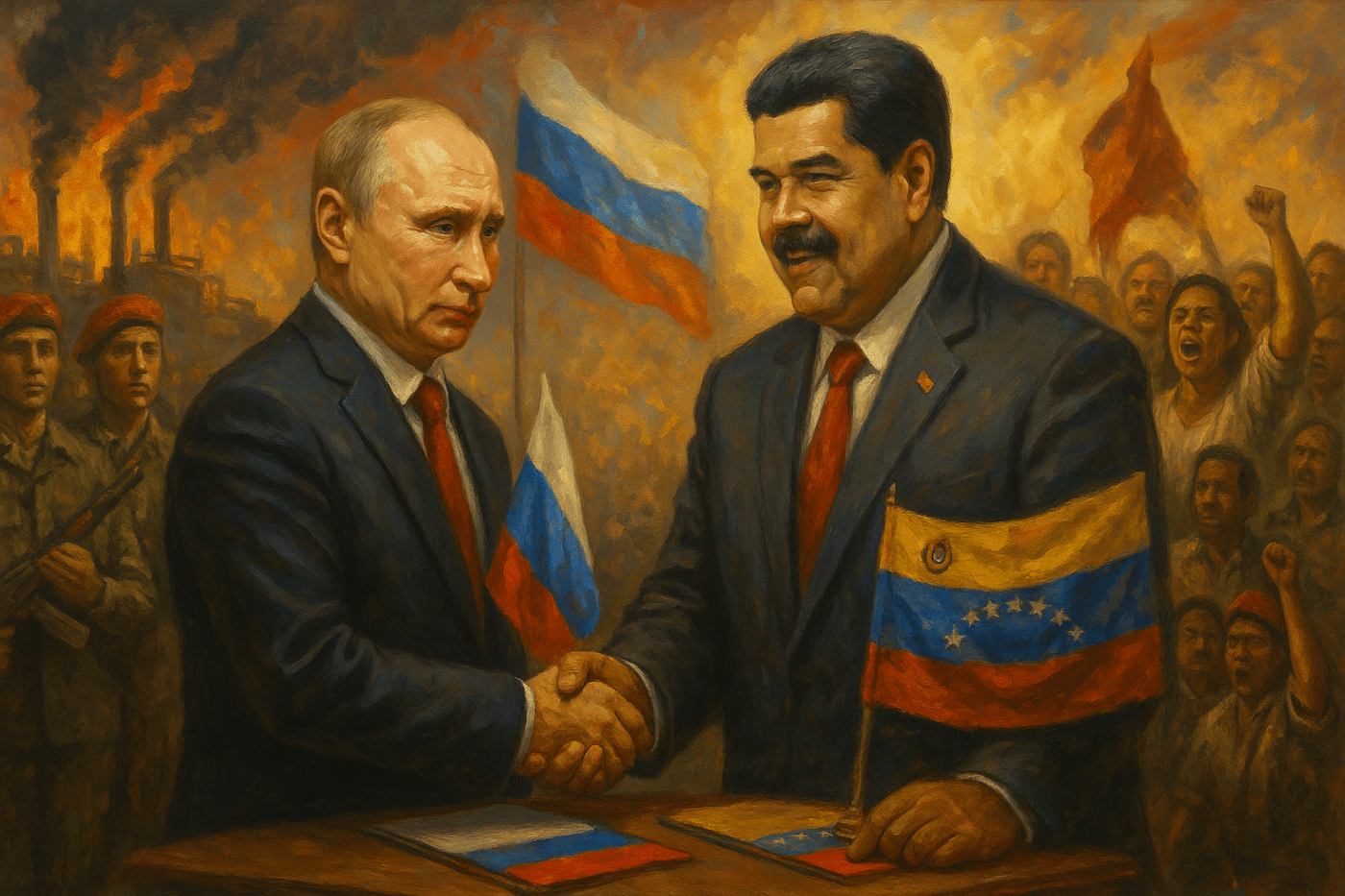
Two besieged nations—survivors of sanctions, sabotage, and siege—sign a strategic alliance that challenges the foundations of empire and lays bricks for a multipolar world.
By Prince Kapone | Weaponized Information
May 8, 2025
Part I: Reuters Mumbles While History Marches
It’s always the same tone—dead-eyed, polite, and hollow. Reuters tells you that Putin and Maduro signed a “strategic partnership agreement,” but it’s written like they were trading postcards, not striking a blow against empire. The story ran on Investing.com, a site built for the suits—currency traders, hedge fund analysts, and imperial bureaucrats who need just enough information to bet on the market, but not enough to understand the world.
No byline is attached, but the fingerprints are obvious. Reuters, owned by the Thomson Corporation—a Canadian media behemoth with deep links to the Western financial elite—functions as an information clearinghouse for the transatlantic ruling class. It doesn’t just report. It frames, filters, and flattens. Its job isn’t to tell the truth. It’s to keep empire comfortable.
And how does it do that here? With soft distortions and surgical omissions. Russia’s involvement in Ukraine is reduced to a “three-year-old war,” as if NATO’s provocations and U.S.-backed coups never happened. Venezuela’s decade of resistance is summed up as a “fraught history,” with no mention of assassination attempts, economic strangulation, or U.S.-sponsored clowns like Guaidó. Maduro is presented as a pariah on tour, not a statesman representing a defiant people.
The voices in the article? Carefully selected. We hear from a Kremlin spokesman and a passing mention of Interfax, framed to make Russian media sound like it’s broadcasting from another planet. Venezuelan voices are nowhere to be found—because to let a Bolivarian speak would be to admit they are still standing, still thinking, still fighting.
The framing is simple: keep it sterile. Use terms like “cooperation,” “fraught,” “collective West.” Never mention sanctions. Never say blockade. Never admit the U.S. has tried to starve Venezuela and encircle Russia into submission. Instead, paint the alliance as two bad actors finding comfort in each other’s misery—rather than two sovereign nations building a new kind of future, forged in the fires of imperial sabotage.
But we know better. This wasn’t a handshake for the cameras. It was a signal to the world: the sanctioned will not submit. The besieged will not beg. They will build. They will collaborate across continents, across histories, and across languages to break the spine of unipolar dominance. And that, comrades, is what Reuters dare not say. So they bury it in boilerplate, hoping no one notices the tectonic plates beneath the polite prose.
Part II: From Caracas to Moscow—Building Power Under Siege
The deal between Russia and Venezuela was more than just a ceremonial photo op at the Kremlin. It was a political declaration: the sanctioned are building their own world. On the surface, the agreement signed by Presidents Putin and Maduro outlines expanded oil and gas cooperation, joint initiatives within OPEC+ and the Gas Exporting Countries Forum (GECF), and coordination at the United Nations. But beneath the diplomatic phrasing is a clear message—resistance is being systematized. Multipolarity is being built, not just in words, but in pipelines, shipping routes, policy coordination, and joint defense against economic warfare.
Let’s start with the basics that Reuters actually told us: Russia and Venezuela are expanding oil trade and exploration. They’re pledging to coordinate energy policy through OPEC+ and GECF. They’re pushing for what they call a “balanced and stable long-term development of global energy markets without the use of unfair competition instruments.” That’s a coded—but unmistakable—reference to unilateral sanctions, price caps, and financial piracy from the U.S. and EU. These aren’t two rogue states playing dress-up. They’re crafting legal, political, and material infrastructure to survive empire’s chokehold.
Now here’s what the article didn’t tell you. Venezuela, the most heavily sanctioned country in the Western hemisphere*, has survived a decade of sabotage: banks frozen, oil tankers seized, elections delegitimized, media flooded with lies. And yet, it still sits on the largest proven oil reserves in the world. Russia, cut off from SWIFT, barred from Western capital markets, and targeted by 17,000 sanctions, has retooled its economy, shifted trade to Asia and the Global South, and maintained military, energy, and industrial self-sufficiency. Both countries were supposed to collapse. Neither did.
The partnership agreement includes coordination in arms control, opposition to unilateral sanctions at the United Nations, and a framework for deeper defense collaboration. This is not just a fossil fuel deal. It’s a sovereignty pact—political, economic, and military. It represents the concrete formation of an anti-sanctions front: an alliance between countries who’ve been attacked for asserting control over their own resources, borders, and development paths.
And it’s not happening in isolation. Since 2022, Russia has signed strategic agreements with China, North Korea, and Iran. Venezuela, meanwhile, has deepened ties with BRICS+, welcomed investment from Turkey, and rekindled its revolutionary diplomacy in Africa and the Caribbean. The world is moving—toward what we call multipolarity. Not as a slogan, but as a material reorganization of international relations: trade, energy, finance, diplomacy, even security cooperation—without the West calling the shots.
What this agreement shows is that those labeled “pariahs” by the empire are no longer playing defense. They’re forming alliances, coordinating policy, building joint ventures, and forging solidarity through shared struggle. These are not marginal acts. They are building blocks of a world where Washington and Brussels no longer dictate the terms of existence. Where sovereignty is not punished, but protected.
Part III: What Empire Calls Isolation, the World Calls Alliance
To hear it from Reuters, Russia and Venezuela are just two autocrats clinking glasses in a bunker—lonely, desperate, and cut off from the civilized world. But to those of us living under the boot of empire, it looks more like two nations refusing to crawl. It looks like strategy. Like survival. Like a plan.
This is what imperial propaganda always tries to erase: the fact that empire doesn’t fear isolation. It fears connection. It fears those it has sanctioned, blockaded, and demonized finding each other, building with each other, rising together. And that’s exactly what this agreement is—an expression of unity born not from weakness, but from shared resistance.
Let’s break it down. The energy clause isn’t just about oil profits. It’s about taking control of global price-setting away from Washington. It’s about resisting the weaponization of the dollar. The arms control section isn’t about selling weapons—it’s about blocking NATO expansion and securing military sovereignty. And their joint work at the UN? That’s a direct challenge to the use of international institutions as tools of the West’s lawfare and economic warfare.
Together, they are laying the groundwork for a world no longer dictated by a single currency, a single court, a single media narrative. This is the real meaning of multipolarity—not just diplomacy among elites, but power redistributed among the formerly dispossessed. A world where Venezuela’s oil doesn’t get stolen through sanctions. Where Russia’s grain doesn’t get blockaded in the Black Sea. Where sovereignty means something real.
This agreement is a rejection of hyper-imperialism—that desperate, dangerous stage of Western decline where anything not controlled must be destroyed. It’s a rejection of financial piracy, of dollar supremacy, of IMF noose-loans. It’s a refusal to play the empire’s game, where your sovereignty is the prize and their “democracy” is the mask.
And for the working class in the imperial core—especially those of us suffocating under militarized austerity, gig economy precarity, and rising fascism—this matters. Because every act of resistance abroad opens space to resist here at home. Every alliance forged outside of empire is a crack in the walls that confine us. This isn’t a backroom deal between thugs. It’s a page in the playbook of global liberation.
What Reuters calls “fraught,” we call brave. What the West calls rogue, we call revolutionary. What they call a pariah alliance, we call a rehearsal for the future.
Part IV: From Embassy Defenders to Empire Disruptors—Solidarity Is a Weapon
This is not the first time the empire has tried to isolate Venezuela and Russia. And it’s not the first time people stood up to say: Not in our name. Not on our watch.
In 2019, when the U.S. tried to hand over Venezuela’s embassy in Washington, D.C. to a puppet regime no one elected, it wasn’t just government buildings being defended—it was sovereignty itself. Organizations like CODEPINK, Popular Resistance, and ANSWER Coalition formed the Embassy Protection Collective. They occupied the building for weeks, withstood police raids, faced federal charges, and held the line under siege. Their message was simple and clear: the empire has no right to decide who governs Venezuela.
This wasn’t a symbolic protest. It was an act of material solidarity. It put bodies on the front line of U.S. regime change. It forced the media to cover what they wanted to ignore. And it showed that even within the imperial core, there are people ready to break with empire and stand with the oppressed.
That spirit didn’t begin in 2019, and it didn’t end there. It lives in the work of Black and Brown organizers in the U.S. who’ve long seen the connections between the war on their communities and the wars abroad. It lives in the protests against the Monroe Doctrine, in the street actions against sanctions, in the international brigades that have traveled to Caracas, Havana, Donetsk, and beyond to witness, support, and defend.
And now, with this strategic agreement between Russia and Venezuela, it’s time to escalate our own commitments. Because while empire plots in boardrooms and backrooms, we build power on the ground.
Here’s what that looks like now:
- Defend the Narrative: Flood social media and left media with the truth. Expose the economic war, debunk the talking points, and elevate the words of Venezuelans and Russians building a new world from below.
- Disrupt the Sanctions Architecture: Pressure local governments, unions, and institutions to divest from companies enforcing U.S. sanctions or profiting from war and blockade. Target the banks that freeze sovereign assets.
- Build Anti-Imperialist Alliances: Connect struggles—link tenants’ unions, climate justice movements, and anti-racist organizations to the global fight against militarism and economic strangulation. Multipolarity starts with us refusing to be foot soldiers of empire.
- Support the Builders: Fundraise for solidarity delegations. Translate and distribute speeches and media from Venezuelan and Russian working-class organizations. Uplift people’s diplomacy in our own communities.
- Reclaim Space: Occupy and defend again, if necessary. From embassies to corporate offices, let no attack on sovereignty go unanswered.
Empire hopes we’ll forget these alliances. That we’ll see Russia and Venezuela only through their narrative lens—villains, rogues, enemies. But our job is to rip off that lens, to remember, and to act. The future is being negotiated in the streets, in the oilfields, and in the trenches of people’s diplomacy. Let’s make sure we’re on the right side of that line.
When the sanctioned reach for each other, we must reach with them. Not with charity, but with comradeship. Not as saviors, but as fellow resisters. Solidarity is not a feeling—it is a front. And now, more than ever, it must be advanced.
*While Venezuela has faced the most extensive and multilayered U.S. sanctions regime in recent years, Cuba remains the most heavily and longest-sanctioned country in the Western hemisphere, enduring a full blockade since 1960.
 Weaponized Information
Leave a comment