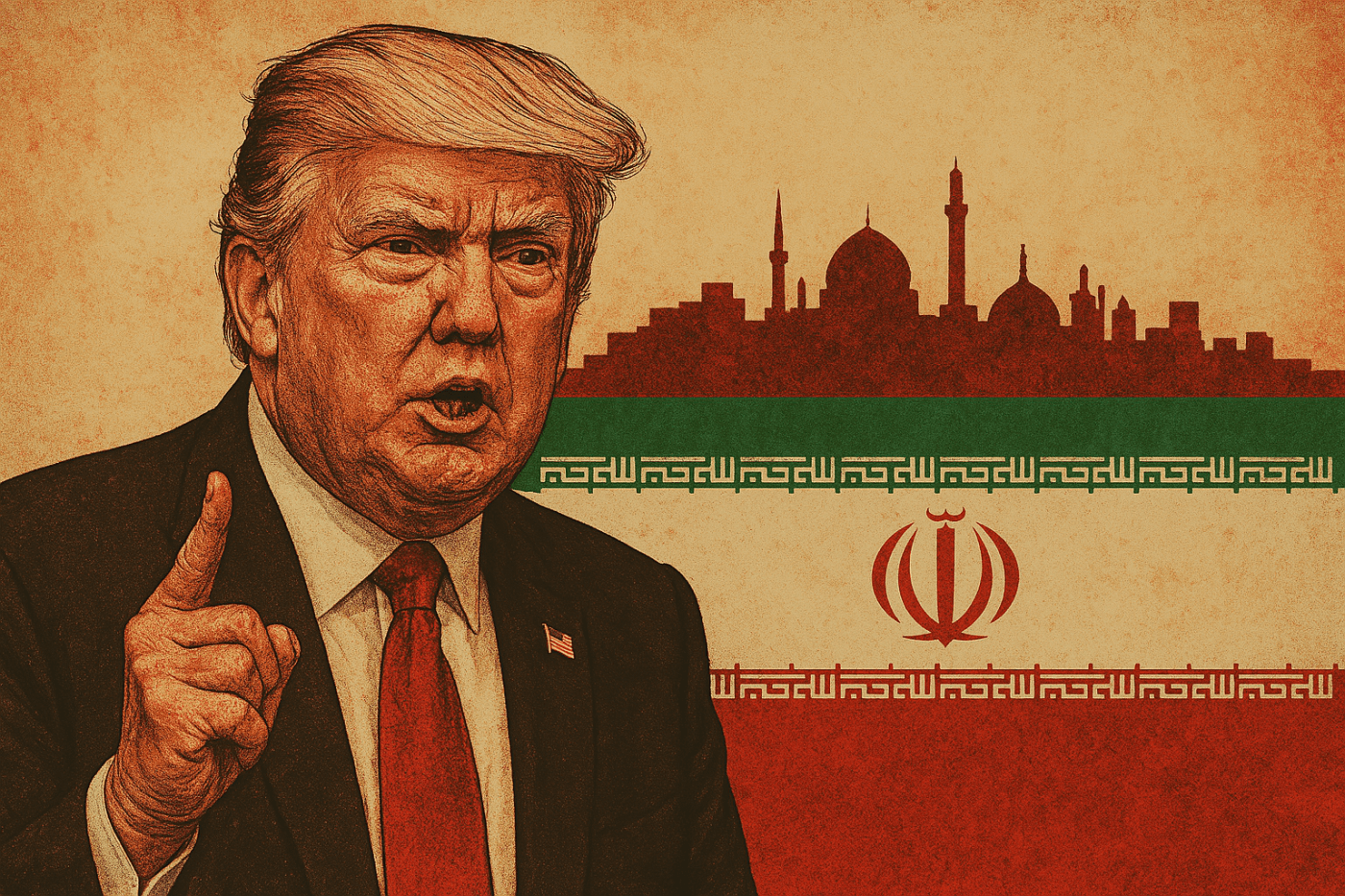
Trump’s threats against Iran aren’t new—they’re the latest phase in a decades-long imperial war to crush sovereignty, recalibrate hegemony, and discipline the Global South through hybrid warfare and high-tech siege.
History, when it repeats itself under empire, does so not as farce, but as algorithm. Here we are again in 2025, watching Washington script another act in the long war against Iran. The scriptwriters haven’t changed much: lobbyists in Tel Aviv, generals in the Pentagon, technocrats at Treasury. The lines are familiar: Iran is a threat, a destabilizer, a rogue actor. The solution? More sanctions, more threats, more war games, more “options on the table.”
Trump, returned to the White House like a bad software update, is once again pounding the war drums. But this is not a neocon sequel. This is technofascism rebooted: a spectacle of strength for domestic consumption, a recalibration of imperial strategy for an unstable world system, and a data-driven blueprint for managing West Asia through attrition, not invasion.
Iran has long been a glitch in the matrix of U.S. global dominance. It refused to be bought, overthrown, or permanently contained. Since 1979, the Islamic Republic has been a symbol—flawed, complicated, but undeniably sovereign. And for empire, sovereignty is the ultimate heresy.
Washington cannot tolerate a regional power that trades oil outside the dollar system, refuses military basing agreements, or supports resistance movements from Lebanon to Yemen. It certainly can’t allow Iran to deepen ties with China, Russia, and the multipolar world order taking shape across the Global South.
So what does empire do when full-scale war is too costly, and diplomacy threatens to acknowledge Iran’s legitimacy? It wages hybrid war. This is not peace; this is counterinsurgency by another name. Sanctions, cyberattacks, sabotage, assassinations, psychological warfare, media psyops, ethnic destabilization campaigns—this is technofascism’s foreign policy arm: decentralized, deniable, and devastating.
Trump’s current threats must be read as part of this continuum. They serve two audiences. One is domestic: to stir nationalism, to racialize the enemy, to manufacture the illusion of strength amid deepening imperial decline. The other is global: to signal that the empire may be fractured, but it is not finished. Not yet.
Iran is responding not with retreat but recalibration. It courts Beijing and Moscow, deepens ties with the resistance axis, and builds strategic depth through alliances forged in fire. But the U.S. playbook remains brutal. As we wrote in our 2018 warning, the attack on Iran would not begin with bombs but with attrition. The goal is not regime change through invasion, but collapse by exhaustion.
And yet, for all the rhetoric, empire is nervous. The world has shifted. BRICS has grown teeth. The dollar is fraying at the edges. Gaza has lit the region afire. Even the Saudis are hedging. What’s left is spectacle. Trump postures as a madman, not out of strategy but necessity. It is all theater—except the killing is real.
This isn’t about Iran alone. It’s about the future of West Asia, and whether it will be ruled by settlers, client kings, and aircraft carriers—or by the people. Washington fears a world it can’t dominate. Tel Aviv fears a border it can’t breach. And Wall Street fears a commodity it can’t control.
Trump is not steering the ship. He is its hood ornament. The war machine moves on autopilot now, fueled by algorithms, lobbyists, and inertia. If we are to stop it, we need more than protests—we need rupture. We need global anti-imperialist solidarity, a strategy to link Tehran and Ramallah to Oakland and Johannesburg.
Because the next attack on Iran is not about security. It is about sovereignty. And the empire’s war against sovereignty will not end in Tehran. It will spread until resistance spreads faster.
We warned in 2018. We warn again. This is not the beginning of war. It is its continuation by high-tech means. And the time to fight back is always now.
 Weaponized Information
Leave a comment