The Oil Is Venezuela’s: The Reconstruction May Not Be
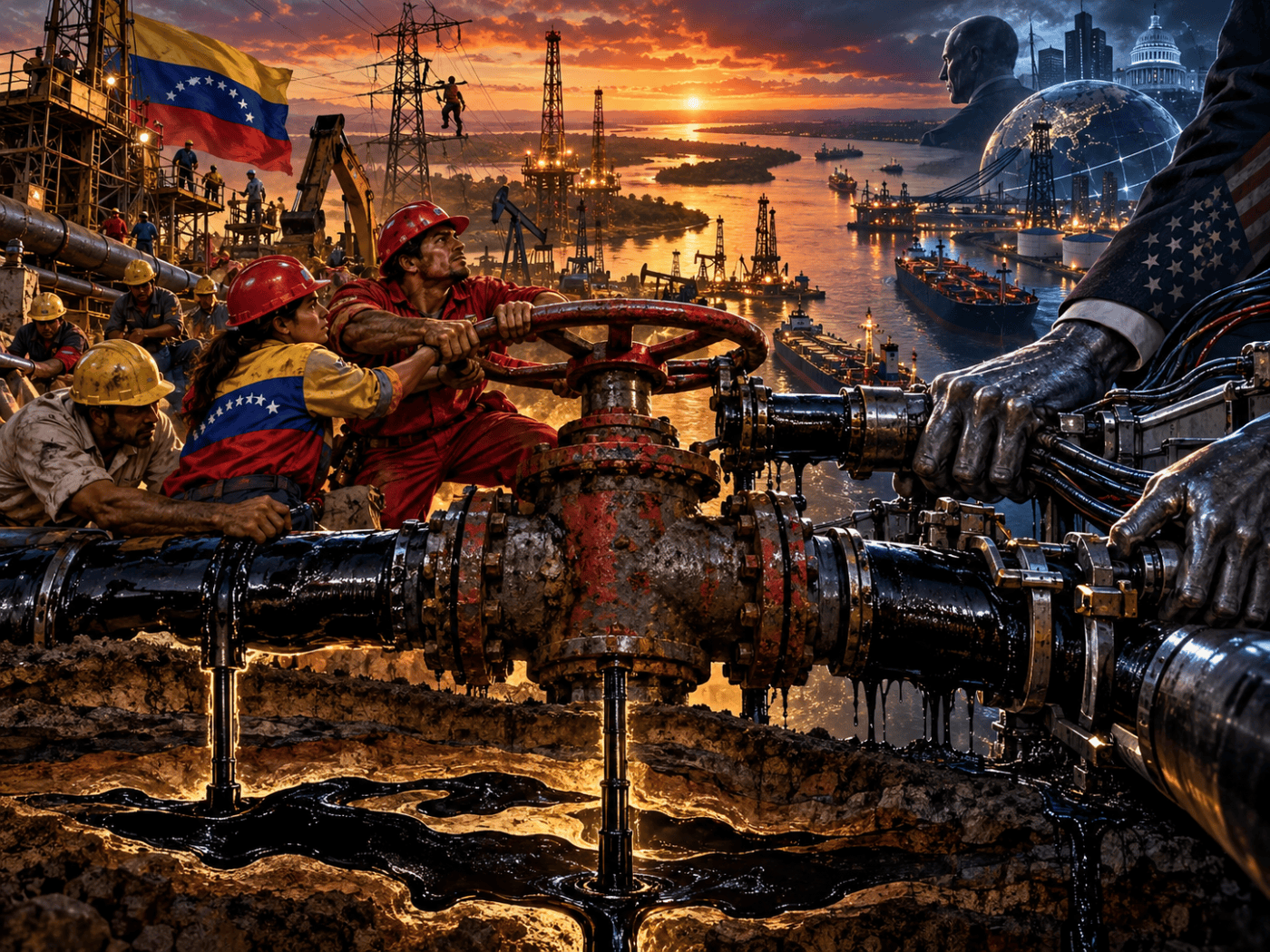
Oilprice turns Venezuela’s petroleum future into a century-long Western wager, as though the great danger were that Venezuelans might someday refuse to honor a bet somebody else placed on their oil. Beneath that investor’s-eye view lies an older struggle over who controls the machinery that turns crude under Venezuelan soil into revenue, technology, political power and social development. Venezuela genuinely needs capital and productive reconstruction, but Washington spent years narrowing the roads through which that recovery could travel and now holds influence over several of the roads reopening before it. The future won’t be decided by the name written on the deed alone, but by who works the fields, moves the money, captures the surplus and decides what recovery is supposed to build.
Prince Kapone | Weaponized Information | October 6, 2026
A Century Is a Long Time to Call Something a Bet
Simon Watkins opens his October 6, 2026 Oilprice article with El Dorado. European adventurers once hacked through the Orinoco hunting a city made of gold; now, Watkins tells us, another crew of adventurers has arrived looking for Venezuela’s “black gold.” The image is almost too perfect. Halliburton, TotalEnergies, Chevron, BP, Eni and Repsol enter through the old romance of discovery, as though hundreds of billions of barrels had spent centuries hiding in the jungle waiting for the proper gentlemen with drilling contracts to find them. A struggle over a nation’s strategic wealth becomes a frontier story, and the oil beneath Venezuelan feet starts looking like buried treasure waiting for outsiders bold enough to claim it.
Then the metaphor changes, but the point of view stays put. The gold rush becomes a bet. Watkins asks whether the West’s “100-Year Venezuela Oil Bet” is about to backfire, turning an arrangement over Venezuelan petroleum into something like a wager placed across a casino table. That little choice of language does a lot of heavy lifting. Western corporations risk money. Washington risks strategy. Venezuela supplies the chips.
That framing allows Watkins to print some remarkably naked imperial language without the article ever losing its respectable business-news posture. Washington speaks openly about the Monroe Doctrine, restoring American “pre-eminence,” driving foreign rivals out of “our hemisphere,” securing strategically vital assets and making sure U.S. dominance is “never again questioned.” There’s no need to hide any of it because “energy security” gives the whole performance a clean shirt and tie. Empire walks through the front door wearing a name tag, and the great suspense becomes whether the paperwork will hold.
The moral vocabulary follows the same road. Russian and Chinese actors appear through Washington’s language as “malign” forces that “looted Venezuela’s resources.” The U.S.-aligned order coming in behind them arrives wrapped in “recovery,” “development,” “security” and stronger supply chains. Watkins reproduces that contrast with barely a raised eyebrow. Foreign control is apparently an outrage when the foreigners are the ones Washington dislikes; when Washington announces that it intends to purge them and secure its own dominance, everybody gets back to talking about investment.
The TotalEnergies story sharpens the pattern. One of Watkins’s major claims about the French company’s return rests on an unnamed senior source tied to Europe’s energy-security apparatus. The uncertainty hardly slows the narrative. The claim gets folded into a wider sense that Western re-entry is already marching forward, one more company joining the rush. A shaky corporate detail becomes part of the atmosphere of inevitability.
Then Venezuela finally becomes dangerous. Watkins warns that constitutional requirements, courts or a future government could challenge long-term concessions. Here Venezuelan sovereignty enters the frame with real force, but mostly because it might interfere with somebody else’s investment. The ability of a country to contest control over its own strategic resources becomes “legal risk.” That is the deepest inversion in the piece. The West announces a wager stretching across generations of Venezuelan life, and the possibility that Venezuelans might someday refuse to keep paying out is what gets presented as the problem.
Before the Barrel Reaches the Market
Venezuela’s oil didn’t become strategically important when Halliburton signed a memorandum or when Washington started talking about a deal measured in generations. A 1953 State Department paper already treated Venezuelan petroleum as a strategic hemispheric resource, tied secure access to U.S. private investment and warned against nationalization. That doesn’t make 2026 a dusty replay of the 1950s. It does tell us that Washington’s habit of looking south and seeing Venezuela’s oil as part of its own strategic landscape is much older than the current fight with Russia and China.
The Bolivarian era changed the legal and political weight attached to that resource. Venezuela’s constitution still defines its hydrocarbon deposits as inalienable public property of the Republic. The 2026 hydrocarbons reform leaves that ownership intact while opening more room above ground for private capital. Under the reformed law, private Venezuelan-domiciled companies can participate in primary petroleum activity through contracts with state companies, while minority private partners in mixed enterprises can take on technical management, commercialize authorized production and manage certain accounts abroad. The crude under the soil remains public property. More of the machinery that brings it out of the soil can now be operated through private hands.
The reopening still runs through Washington’s sanctions machinery. Treasury’s Venezuela licensing framework permits new petroleum investment while continuing to restrict dealings involving Russian, Iranian, Cuban, North Korean and specified Chinese-linked interests. And Washington’s reach doesn’t stop once the well starts producing. Certain royalties, levies and federal taxes owed to Venezuela or PDVSA under covered transactions have to move through Treasury-directed accounts, while some authorized contracts with Venezuelan state entities must send disputes to legal venues in the United States, Britain, France or Singapore. The license reaches backward toward the investor and forward toward the money.
The North American Blue Energy Partners (NABEP) arrangement sits in the middle of this opening, although some of its loudest advertised features remain contested. The White House description says the project covers 17 fields containing roughly 65 billion barrels and gives the United States unusual rights over governance and future production. Venezuelan officials have publicly described a 25-year agreement, not the century-long arrangement Washington advertises. U.S. statements have also spoken of rights connected to a 35 percent American interest, while the Pentagon itself disputed whether the office named in the arrangement can legally hold ordinary private-company equity. The project is enormous. The exact legal architecture behind some of its most spectacular claims remains murkier than the press release.
Washington has also sold the new order as the clearing out of Russian and Chinese control. The record is narrower than the sales pitch. Reuters identified specific transferred projects previously operated by Chinese firms and one connected to Russian interests, rather than the wholesale replacement of every Russian and Chinese position inside Venezuela. Russia once pursued large projects such as Junín-6, but its present producing footprint is much smaller than those ambitions once suggested. China still matters through trade, credit and investment, yet Venezuelan crude has supplied only a limited share of total Chinese oil imports. What is being fought over is future position and control over commercial relationships as much as the barrels moving today.
And none of these contracts can bully oil out of the ground. Venezuela’s petroleum system has absorbed years of sanctions, underinvestment, equipment shortages, decaying infrastructure and internal failures. Getting anywhere near historic production will require tens of billions in investment over years, while the electrical system alone needs billions in rehabilitation. Three hundred billion barrels underground can look magnificent on a reserve table. They don’t power a pump, repair a grid or turn themselves into export revenue.
That hard material need is why the Venezuelan argument runs deeper than a tidy division between people for foreign investment and people against it. Writers at Misión Verdad argue that the government is bargaining from a damaged position and using outside investment to restart production while preserving national ownership. Blas Regnault’s critical analysis puts the weight elsewhere, on commercialization, rent capture and payment channels, asking how much practical authority remains public when those powers begin moving outward. Both arguments start from the same ugly reality: Venezuela needs recovery. The dispute is over the terms under which recovery is being purchased.
The people who actually pull the oil into the world have entered that fight with demands of their own. Petroleum-worker organizations including CAIT, Movimiento 21 de Enero and Sinutapetrol have tied the new energy agreements to wages, healthcare and rehiring, while worker assemblies have pressed for collective bargaining after contracts expired without settlement. At the same time, the Communard Union continues bringing together communes engaged in collective production, local decision-making and social provision.
So before a Venezuelan barrel ever reaches a refinery, an entire social struggle has already wrapped itself around it. Fields have to be worked, machinery powered, crude marketed, payments cleared, rent collected and claims on that wealth fought out. Those powers sit in different places and different hands. That is the ground beneath the talk of a Western oil “bet.”
The Deed Is Not the Command
A deed tells you who owns the oil beneath the ground. It doesn’t tell you who governs the road from buried crude to social wealth. Venezuela still owns the petroleum, but ownership becomes real power only through the whole living chain that carries oil into production, money and social life. The struggle now runs through that chain.
Venezuela also has to rebuild it. Years of economic warfare landed on top of internal deterioration and the old vulnerability of an economy that never escaped its dependence on oil and the world market. Reconstruction isn’t some seminar-room preference. Wells have to produce. Electricity has to flow. Equipment has to work. Skilled workers have to live well enough to keep the entire damn machine running. A revolution can’t distribute wealth that remains buried beneath the earth.
The trouble is that Venezuela is rebuilding inside conditions partly shaped by the same imperial power that helped squeeze its room to maneuver in the first place. Foreign capital returns because productive capacity needs rebuilding, while access to markets and financial circulation still passes through channels Washington can influence. Investment can repair the machine and, at the same time, redistribute who gets to touch the controls.
That is the principal contradiction: sovereign reconstruction against coercively conditioned reconstruction. Venezuela needs capital and technology to recover productive strength. Washington can use the reopening of economic space as leverage over the terms of that recovery. Those positions aren’t historical mirror images. Venezuela is trying to rebuild under conditions of pressure; Washington possesses far greater power over several of the channels through which rebuilding becomes possible.
Imperialism doesn’t always arrive with a marine carrying a flag. Sometimes it arrives as permission. First markets close, access freezes and the vise tightens. Later the door cracks open again, except now somebody else is standing beside it deciding who passes and on what terms. The pressure that once attacked an economy from the outside begins leaving fingerprints inside the structure of its recovery.
This deepens what WI has called coercive reconstruction. Sanctions change more than trade figures and government accounts. Prolonged pressure narrows the choices available to a state trying to survive. Emergency accommodations become contracts; contracts become investment patterns; investment patterns develop interests that expect to keep eating. External coercion can harden into internal structure. That is sanctions-to-structure conversion: the siege begins reproducing itself through the institutions formed in response to it.
Venezuela still acts inside this process. Caracas bargains. The state retains ownership. Workers produce. Popular forces fight over the wealth. Foreign capital has to move through Venezuelan law, labor and political struggle. Sovereignty hasn’t simply disappeared; it has become uneven along the road the oil travels.
This is command-chain sovereignty. A nation may own the reservoir while holding different degrees of control over extraction, technology, sale, payment, rent and the final use of the surplus. Some links can remain firmly national while others drift outward. That is why the constitutional deed matters so much and still can’t answer the whole question. A resource formally owned by a nation can remain dependent on outside power to become usable wealth.
The socialist question is therefore brutally simple: who disciplines whom? Does public power bend capital toward national reconstruction, technological development, the reproduction of workers and a wider social project? Or does the country’s hunger for capital gradually bend development toward the needs of accumulation? The difference between using capital and being used by it shows up in who controls production, who captures the surplus and which social forces grow stronger when recovery comes.
Here the WI concept of the American Pole gets flesh on its bones. Hemispheric domination doesn’t need formal annexation when energy, finance, contracts, markets and infrastructure can be bent into circuits Washington can influence. U.S. power seeks a regional order in which strategic resources flow through channels it can police while competing relationships get squeezed toward the margins. The flag can remain Venezuelan while more of the machinery around it leans north.
Russia and China can widen Venezuela’s room to maneuver, and that matters because monopoly command becomes harder when alternatives exist. But multipolarity doesn’t settle the class question. A Russian contract doesn’t become socialist because it carries a Russian signature. A Chinese investment doesn’t become popular power because it bypasses Washington. Multipolarity creates space. Workers, states and organized communities still have to fight over what fills it.
That fight runs through Venezuela itself. The state and the revolution aren’t one seamless body. A government under siege can make concessions to keep production moving and institutions alive, while workers fight over wages and bargaining power inside the same process. Popular institutions can demand that national wealth reproduce collective life instead of simply replenishing state accounts and private profits. Where the revolution survives, it survives as organized social power beneath and around the state as much as inside the government.
Production growth by itself therefore proves very little about the social meaning of recovery. Venezuela could restore output, refill state coffers and still rebuild the dependency that made imperial coercion bite so deeply in the first place. Pumps could run, crude could move and money could circulate while the decisive bridge between production and social power stretches farther beyond popular control.
Another road remains possible. Restored petroleum capacity can provide resources for diversification, public investment, technological development and stronger popular institutions. Nothing in the market guarantees that outcome, and Washington certainly isn’t coming south to build socialism. It depends on whether Venezuelan society can turn recovered production into greater control over the conditions of its own life.
Oilprice worries that the West’s wager may unravel. Venezuela faces the harder problem: whether rebuilding the oil industry will rebuild sovereign capacity along with it, or whether the country will recover the machinery of extraction while outside power keeps gaining ground over the machinery of command.
Who Rebuilds Venezuela Decides What Recovery Means
If the pressure on Venezuela is organized outside its borders, solidarity has to reach the machinery applying that pressure. In North America, that means fighting the sanctions and intervention apparatus where it is politically reproduced. The Venezuela Solidarity Network has built its work around ending U.S. and Canadian attacks on Venezuela without pretending to dictate Venezuela’s internal political disputes. Its public education, coordinated days of action, webinars and solidarity campaigns help build organized opposition inside the countries imposing the pressure. CODEPINK solidarity actions have joined that anti-sanctions work. The task isn’t to clap for every decision made in Caracas. It is to weaken the imperial machinery that narrows the choices Venezuelans themselves can make.
Inside the petroleum industry, the lever sits somewhere else. Production can rise while the workers producing the oil remain squeezed, and Venezuelan petroleum workers have already put that contradiction on the table. CAIT, Movimiento 21 de Enero, Sinutapetrol and allied formations have linked the new energy agreements to wages, healthcare and rehiring, while worker assemblies have demanded renewed collective bargaining after agreements expired without settlement. Their assemblies, inter-union coordination and bargaining demands strike directly at the labor process. Rigs, terminals and pipelines don’t work themselves. A recovery measured in barrels while the people producing those barrels grow poorer is a recovery with the working class rubbed out of the ledger.
The struggle continues after the rent is collected. Venezuela’s communes already organize collective production, assemblies, social provision and local self-government, and the Communard Union links those experiences on a national scale. Its communal program centers social property, cooperation and the effort to move beyond the extractive-rentier economy. That existing practice doesn’t amount to a specific campaign over these new petroleum agreements, and it shouldn’t be presented as one. It does establish an organized popular force already fighting over a larger question that petroleum recovery will sharpen: whether new national wealth enlarges collective productive power or simply keeps the old machinery of rent and accumulation turning.
These fronts touch different pieces of the same material struggle. Solidarity movements abroad confront coercion where imperial policy is made. Petroleum workers organize where the wealth is physically produced. Communes build power where national wealth is turned back into social life. None can substitute for the others, and none becomes stronger because somebody writes a fiercer slogan on their behalf.
A contract can say one hundred years if the lawyers have enough ink. History has never been that obedient. Contracts endure because institutions enforce them, workers labor under them and organized social forces permit the order behind them to reproduce itself. The orientation is concrete: weaken the coercive pressure from outside, strengthen labor’s claim inside the petroleum economy, and enlarge the organized popular power capable of deciding what reconstruction is actually for. The future of Venezuelan oil won’t be decided by how many years somebody managed to type onto a document. It will be decided by who has enough organized power to determine what gets rebuilt, who benefits from it and who gets to hold the controls.


Leave a comment