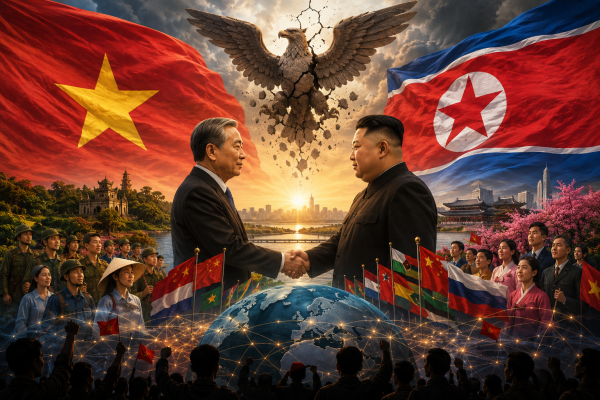
In May 2026, Vietnam's Foreign Minister met with North Korean officials, a significant yet underreported event that challenges the Western narrative of the DPRK as isolated and irrational. This meeting signifies the resurgence of socialist internationalism and the resilience of anti-imperialist relations against a U.S.-dominated order. Vietnam asserts its independence by maintaining ties with a historically aligned state despite pressures to conform to U.S. interests, illustrating a defiance of binary political expectations dictated by Western powers. As these two nations deepen cooperation, they expose cracks in imperial control, revealing that sovereignty endures in the face of sanctions and coercion.
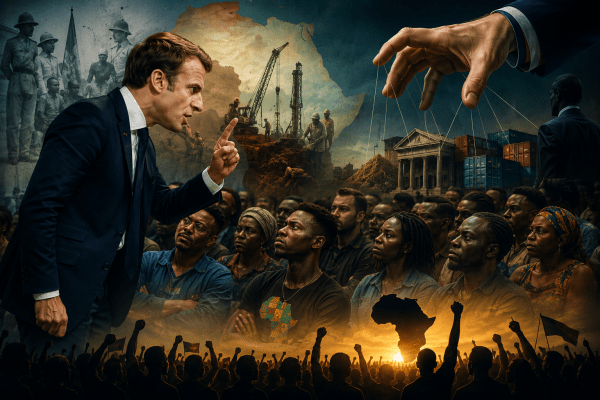
Françafrique 2.0: Macron, Multipolarity, and the Quiet Reassembly of Empire
French President Emmanuel Macron's interruption at a Nairobi summit starkly reveals the hypocrisy behind France's so-called partnership with Africa. Masked in the rhetoric of mutual respect and development lies an insidious struggle for neocolonial influence amid a backdrop of declining French authority. As African nations increasingly assert sovereignty, aiming to break free from debt and military dependency, Macron's actions embody centuries of colonial entitlement. While Paris attempts to rebrand its influence through climate and technological initiatives, a new wave of Pan-African movements challenges these narratives, demanding genuine autonomy over the façade of partnership. The true legacy of imperialism endures, evolving but never vanishing.
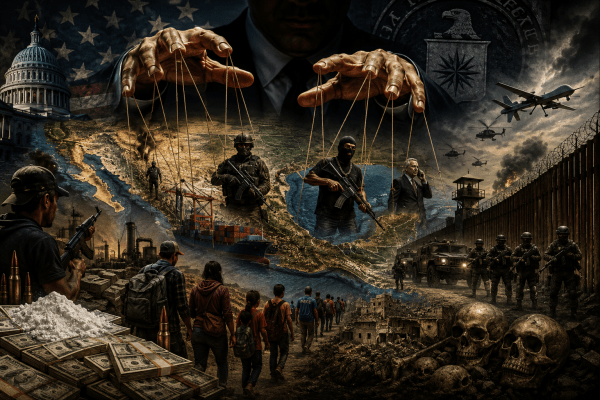
Grand Theft América: Cartels, Capital, and the CIA’s Hemispheric War
CNN's report on secret CIA operations in Mexico reveals a troubling narrative that frames U.S. intervention as a necessary counter-terror effort against cartels, while obscuring deeper issues of imperial influence. The article reflects how imperial media sanitizes violent operations, portraying them as essential for security. These actions are linked to a broader strategy of militarization and economic dependency, threatening Mexican sovereignty and democracy. The framing of cartels as terrorist organizations facilitates increased U.S. oversight and intervention. The need for organized anti-imperialist resistance is urgent, as declining U.S. hegemony conditions responses to crises under the guise of safety and necessity.
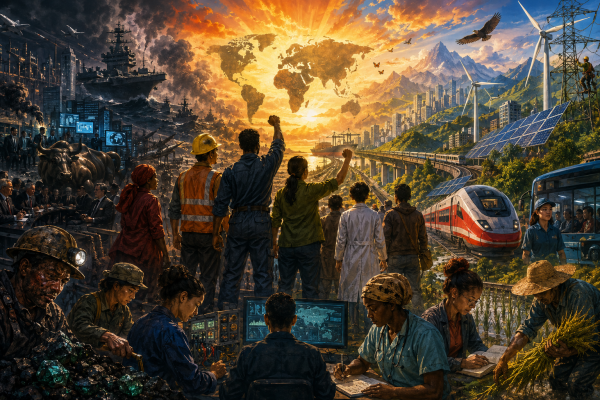
Workers of the New World: BRICS+, Platform Capital, and the Class Struggle Inside Multipolarity
The Atlantic neoliberal order is disintegrating, revealing the ravages inflicted on workers and the environment by a relentless pursuit of profit. As BRICS+ nations seek to reclaim industrial sovereignty and labor rights, they face a chaotic multipolar reality where exploitation continues under different guises. Amid profound instability, the laboring class must transition from mere instruments of production to conscious political actors capable of reshaping development. This moment offers a critical opportunity: to reclaim the narrative and construct a world centered on human dignity and ecological balance. The question now is whether history will be rewritten by workers or remain dominated by elites.
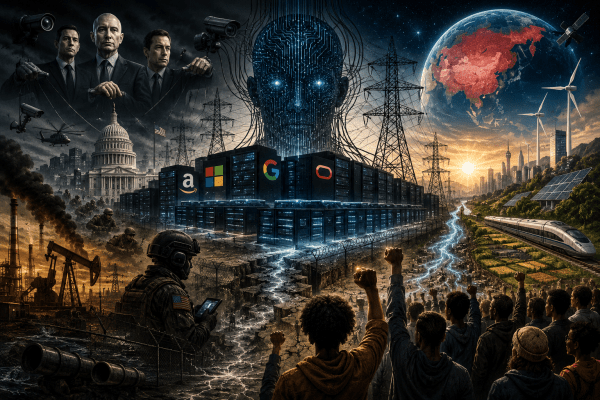
Empire on Extension Cord: Big Tech, Cold War 2.0, and the AI Grid Crisis of American Capitalism
The Harvard policy brief on AI and the electric grid inadvertently exposes the contradictions of a decaying American empire desperate to maintain technological supremacy through monopolistic control. Beneath the façade of innovation lies a stark energy crisis, with the rising demand from AI data centers straining an already fragile grid. As the U.S. grapples with fragmented privatization while competing against China’s centralized planning, the notion of the “clean cloud” is shattered by its heavy reliance on fossil fuels and depleted resources. This crisis symbolizes an empire’s struggle, revealing a society entangled in a web of profiteering that prioritizes corporate gain over public need, leaving ordinary citizens to pay the price for elite ambition.
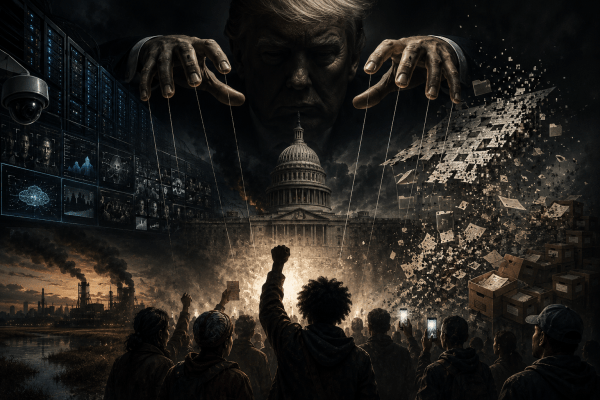
Census of Collapse: Trump, Technofascism, and the War Against Reality
The Trump regime's assault on federal datasets is a calculated effort to erase reality, obscuring critical information on hunger, pollution, maternal health, and climate disasters. By dismantling public data, the ruling class suppresses the very tools citizens need to challenge systemic failures. Expert narratives dominate discourse, overshadowing the voices of the oppressed who suffer and resist. This isn't just bureaucratic negligence; it's a deliberate strategy to manage perception amidst a crumbling empire. As the regime erases statistics, communities are disarmed and rendered invisible, making the struggle for public knowledge essential to resistance against state control. The battle for data is a battle for truth.
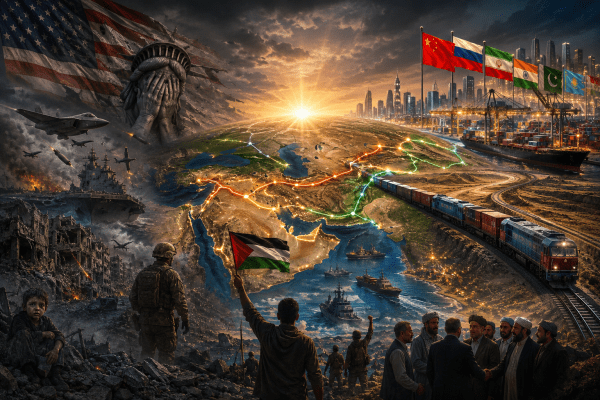
The Corridors of Defiance: How the War on Iran Accelerated the Multipolar Reorganization of Western Asia
The 2026 U.S.-Israeli assault on Iran was a strategic miscalculation, intended to reassert imperial dominance in Western Asia but instead revealing the fragility of Atlantic hegemony. As the old security architecture eroded, alternative infrastructures and regional alliances emerged, facilitating trade and cooperation beyond Western control. The ongoing crises connected Gaza, Yemen, and the vital sea lanes, illustrating that military aggression has backfired, prompting regional states to recalibrate and seek resilience against imperialism. This war exposed a transformative geopolitical landscape, where logistics and diplomatic maneuvers are increasingly driven by necessity, carving out a multipolar future and undermining the sheer authority once held by the empire.
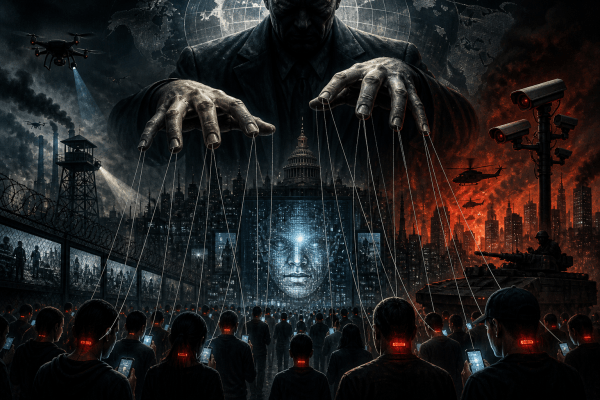
Technofascism: The Digital Leviathan and the War on Humanity
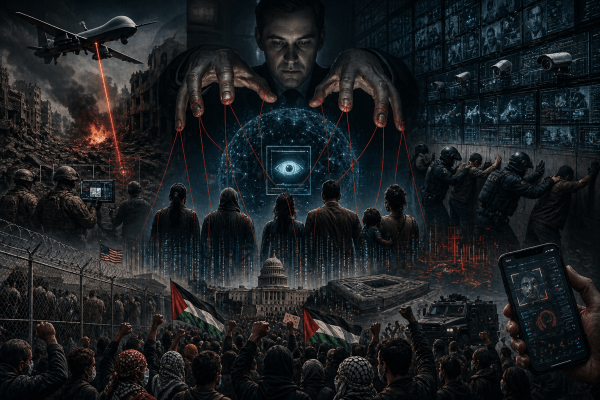
The United States isn’t gracefully unraveling; it’s morphing into a technofascist apparatus of control that leverages financial dominance, digital surveillance, and labor discipline. While the elite tout "innovation," they're repackaging colonial exploitation under the guise of progress, tightening their hold domestically and globally. Liberal analyses miss the subtleties of this shift, mistaking procedural forms for genuine democracy, while real power redistributes into unaccountable systems. As public trust wanes and crises mount, this infrastructure of power rapidly transforms governance into an invisible web of control, inching toward collective consciousness and organized resistance that could eventually dismantle the machinery of oppression.
Palantir and the Digital Leviathan: Silicon Power, State Violence, and the Technofascist War on Humanity
Palantir's recent manifesto is more than corporate bravado; it reveals an unsettling convergence of warfare, surveillance, and governance. The media's alarmism obscures a deeper truth: Palantir stands as a linchpin in an expansive control apparatus, integrating deportation, military actions, and state surveillance into a seamless framework of power. Critics timidly label this brewing authoritarianism but fail to pinpoint the machinery at work. As anti-immigrant systems and military strategies fuse, resistance is evolving. It’s time to unite disparate struggles against this creeping technofascism, transforming scattered dissent into a powerful, coordinated force ready to dismantle the system that seeks to dominate us all.
Petrodollars and Missiles: U.S.–Israel War, Iran’s Retaliation, and the Gulf’s $6 Trillion Imperial Contradiction
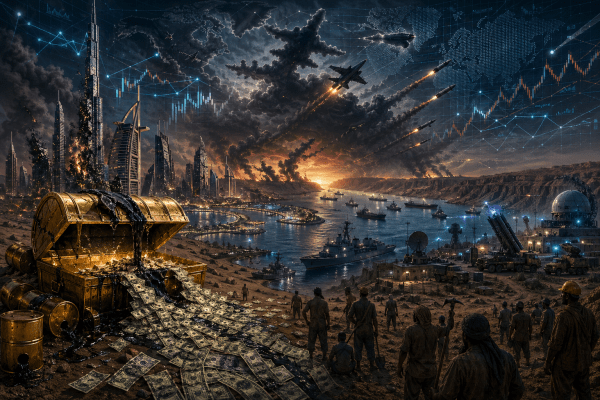
The Economist laments over the Gulf's $6 trillion sovereign wealth as war disrupts its financial stability, but this narrative is a smokescreen. The real story lies in the imperial dynamics that intertwine U.S.-Israeli aggression with Gulf fortunes. Rather than a neutral financial assessment, it presents war as a minor nuisance to elites banking on oil rents. The article flattens the human cost, sidelining migrant laborers and ignoring the root causes of conflict shaped by imperial agendas. Ultimately, this crisis reveals the Gulf's wealth is a tool of empire, not liberation—a stark reminder that war and capital are inexorably linked.