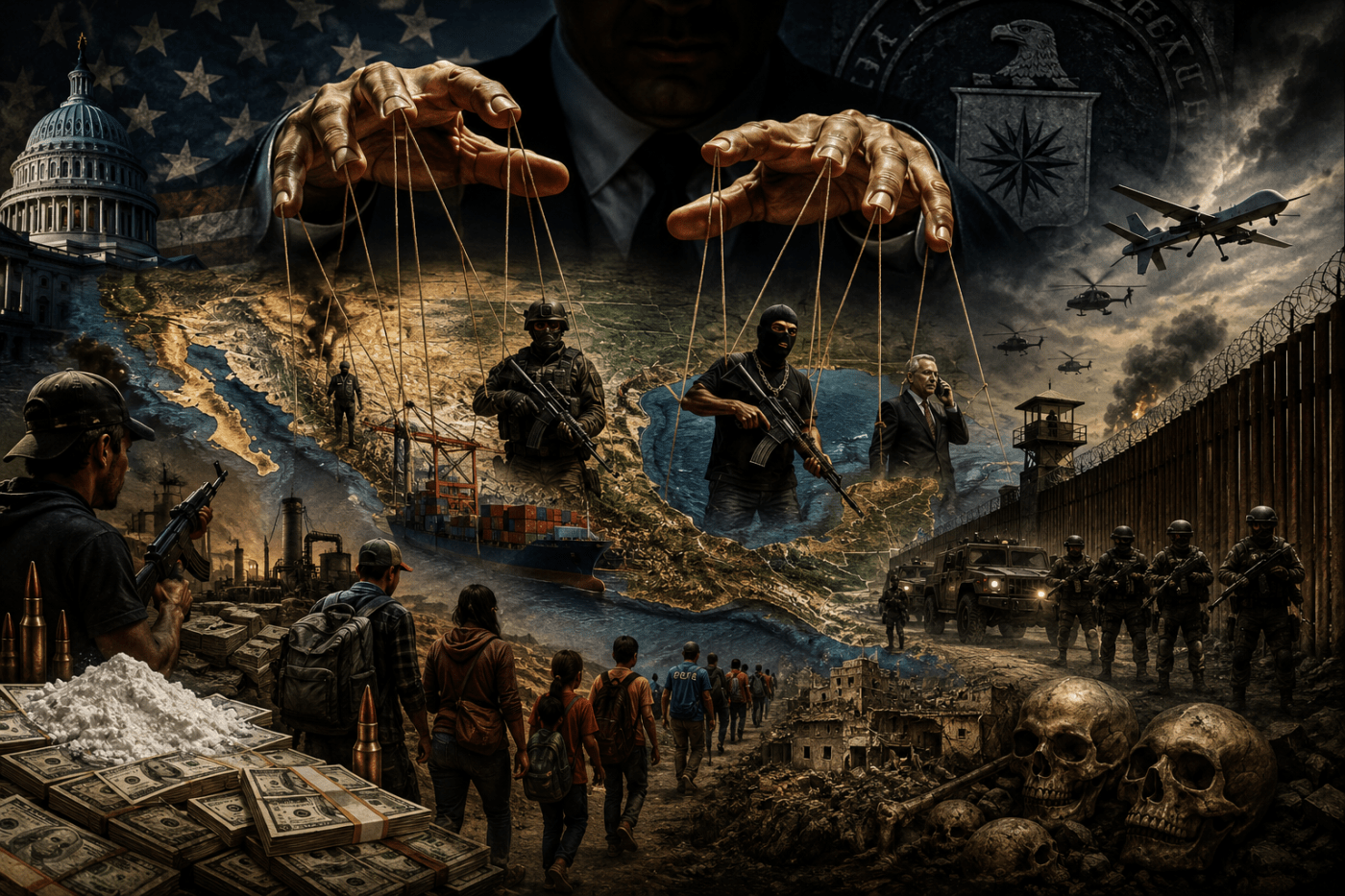
CNN’s “exclusive” report on covert CIA operations inside Mexico exposes how imperial media launders clandestine violence into the language of security, professionalism, and necessity. Behind the spectacle of cartel warfare lies a deeper system of arms trafficking, labor exploitation, financial laundering, border militarization, and hemispheric dependency binding Mexico to the political economy of U.S. empire. The expansion of the narco-war marks a new phase in the consolidation of hemispheric counterinsurgency, where counterterror doctrine, covert operations, and permanent emergency become instruments for tightening imperial control across the Americas. In response, the peoples of the hemisphere face the urgent task of building organized anti-imperialist resistance capable of confronting the fusion of covert war, capitalist crisis, and recolonization.
By Prince Kapone | Weaponized Information | May 12, 2026
The Assassin’s Press Release Disguised as Journalism
CNN’s article, “Exclusive: CIA escalates secret war on cartels with deadly operations inside Mexico”, by Natasha Bertrand, Zachary Cohen, Evan Perez, and Mauricio Torres, arrives dressed in the respectable clothing of national-security reporting. It tells us that the CIA’s Ground Branch has allegedly participated in lethal operations inside Mexico, including the killing of Francisco “El Payin” Beltran, described as a mid-level figure in the Sinaloa Cartel. On the surface, it reads like a dramatic scoop: explosions, secret operatives, dangerous cartels, anonymous officials, and the familiar theater of empire whispering through the curtains. But beneath the smoke and professional polish, the article performs a different function. It does not merely report the expansion of U.S. covert war into Mexico. It prepares the reader to accept it.
CNN is not some barefoot village newsletter scribbled together by the people after a day in the fields. It is a corporate media institution owned by Warner Bros. Discovery, embedded in the political economy of advertising, subscriptions, platform distribution, and ruling-class legitimacy. Its newsroom sits inside the imperial communications system, where “exclusive” national-security leaks often function less like journalism and more like a controlled drip from the basement of the security state. The empire speaks anonymously, the journalist types carefully, and the public is invited to confuse stenography with revelation. A marvelous arrangement: the assassin gets a press office, and the press office gets a Pulitzer tone.
The authors occupy the familiar Washington national-security press layer, that professional caste whose access depends on the same agencies it claims to scrutinize. The article relies heavily on unnamed current and former U.S. officials, intelligence sources, and former paramilitary officers. These sources are granted the power to define the event, describe the danger, explain the logic, and frame the stakes. Mexican sovereignty appears, but mostly as an obstacle, a complication, a legal fog around the main imperial drama. The Mexican people do not anchor the story. The CIA does. The anonymous U.S. security official becomes the narrator of Mexican reality.
The first device at work is the appeal to authority. The article leans on the prestige of the intelligence world—the CIA, Ground Branch, former paramilitary officers, national-security officials—to make the escalation appear serious, informed, and technically necessary. The reader is not asked to examine power from below, but to trust the men who operate in the shadows because, after all, they know things. This is one of the oldest tricks of empire: secrecy creates ignorance, then ignorance is used to justify obedience to those who keep the secrets.
The second device is narrative framing. These are not presented primarily as foreign lethal operations inside a sovereign country. They are presented as counter-cartel and counterterror actions. That framing does enormous ideological labor. Once the cartel is placed inside the mental category of “terrorism,” the whole machinery of the war on terror walks across the border wearing new boots. Assassination becomes “targeting.” Intervention becomes “cooperation.” Sovereignty becomes “coordination.” The vocabulary is cleaned of blood before being served to the reader.
The third device is card stacking. The article foregrounds cartel violence, operational risk, and the supposed sophistication of CIA involvement. What recedes into the background are the U.S. demand for drugs, the U.S. weapons that arm cartel war, the financial institutions that wash dirty money until it smells like respectable capital, and the long history of U.S. interference in Mexico. The cartel is made to appear as a monster born from Mexican soil alone, as if it sprang from the desert fully armed, fully financed, and fully supplied, like some narco Minotaur conveniently waiting for Langley’s heroic blade.
The fourth device is fear. The specter of cartel retaliation, violence spilling into the United States, and traffickers moving freely across the border produces the emotional atmosphere necessary for escalation. Fear narrows the political imagination. It tells the reader that there is no time for history, no room for sovereignty, no patience for law, and certainly no need to ask who built the conditions that made the cartel economy possible. Fear is the border wall inside the mind.
The fifth device is policy laundering. The article treats the designation of cartels as foreign terrorist organizations as a legal turning point, a bureaucratic fact that opens new possibilities for intelligence action. But this is precisely how imperial policy launders itself. First, the state creates a designation. Then the designation creates an authority. Then the authority creates an operation. Then the operation creates a precedent. By the end, what began as a political decision appears as a technical necessity. The law is not broken; it is conveniently redesigned to escort violence into the room.
Finally, the article rests on omission. It does not structurally center the U.S. role in producing the cartel economy. It does not begin with the circuits of drugs, guns, banks, labor, migration, and capital that bind the United States and Mexico together in a violent political economy. It does not ask why the same empire that floods the region with weapons and consumes the narcotics now claims the right to enter with bombs, drones, operatives, and death lists. It does not ask why Mexico’s sovereignty becomes negotiable whenever Washington discovers a crisis useful enough to weaponize.
That is the real work of the article. Not simply to reveal a secret war, but to domesticate it. Not to oppose the expansion of covert power, but to narrate it as the rough medicine of serious men facing ugly realities. The reader is meant to leave disturbed, yes, but also prepared. Prepared to believe that the CIA may already be inside Mexico, that it may already be killing people there, that this may be dangerous and legally murky, but perhaps unavoidable. And that is how empire likes its propaganda best: not shouted through a loudspeaker, but whispered through an “exclusive.”
The Border Is Not the Beginning of the Story
The CNN article presents the expansion of CIA operations inside Mexico as if history began with exploding cars, cartel violence, and the arrival of highly trained American operatives carrying the burden of civilization on their backs like exhausted Roman centurions. But the actual terrain beneath this story is older, wider, and far more material than the article allows the reader to see. The violence now being narrated as a “counterterror” emergency did not emerge from nowhere. It was built through decades of economic integration, militarization, arms trafficking, labor displacement, drug demand, financial laundering, and imperial management stretching across the hemisphere.
The Bicentennial Framework, which formally governs current U.S.–Mexico security cooperation, was publicly presented by both governments as a structure based on “shared responsibility” for public health, community safety, reducing homicides, addressing addiction, and confronting arms trafficking. Its language was intentionally crafted to distance itself from the openly militarized image of the old Mérida Initiative. The framework emphasized coordination, information sharing, border management, and institutional cooperation. Nowhere in its public presentation was Mexico granting the United States a blank check for unilateral covert assassinations carried out by foreign intelligence officers operating inside Mexican territory.
This matters because the present controversy is not occurring in a legal vacuum. Mexico’s 2020 National Security Law imposed restrictions on foreign agents operating in the country after years of tensions surrounding DEA, FBI, and intelligence activities. The law requires foreign agents to share information with Mexican authorities and explicitly limits their operational authority inside Mexico. In plain language: foreign security personnel are not supposed to conduct independent law-enforcement or military-style operations on Mexican soil. That is precisely why the Chihuahua incident triggered such public friction. It was not merely a bureaucratic misunderstanding. It touched the nerve of sovereignty itself.
President Claudia Sheinbaum publicly stated that foreign agents cannot operate in Mexican territory without federal authorization and insisted that Mexican sovereignty “is not negotiable.” Those statements were not rhetorical decoration for domestic consumption. They reflected a growing contradiction inside the bilateral relationship itself. Washington increasingly speaks the language of counterterror warfare, while Mexico officially insists on coordination without subordination. The contradiction is becoming harder to hide because the operational logic of the United States increasingly pushes beyond intelligence sharing toward direct intervention.
The ideological bridge enabling this shift was built through the designation of major cartels as foreign terrorist organizations. Trump’s January 2025 executive order initiated the process for classifying major Mexican cartels as FTOs and SDGTs. What sounds like technical legal language is actually a strategic transformation of the battlefield itself. The “drug war” becomes a “counterterror war.” Criminal enforcement becomes national-security doctrine. Police functions bleed into military functions. Intelligence agencies acquire expanded legal and political justification for covert operations. The empire changes uniforms without changing objectives.
Yet the article omits the material relationship tying the United States itself to the political economy of cartel power. Banxico reported nearly $62 billion in remittance inflows flowing from workers laboring inside the United States back into Mexico over a twelve-month period. These flows are not secondary details. They reveal the deep economic integration binding the two countries together through labor migration, industrial production, family survival, and dependency. The same border that is militarized in the name of security remains structurally open for capital extraction and labor exploitation. The worker may cross the desert illegally, but his labor crosses legally the moment it enters the supply chain of North American capital.
The article also avoids centering the weapons pipeline that materially sustains cartel militarization. Mexico’s Foreign Ministry has maintained extensive legal filings accusing U.S. gun manufacturers and distributors of facilitating the southbound flow of firearms into cartel networks. The Mexican government’s lawsuits argue that U.S.-based companies knowingly tolerate trafficking systems that arm organized crime groups throughout the country. In other words, the same imperial center now presenting itself as the regional firefighter also exports the gasoline.
The larger geopolitical terrain surrounding this escalation becomes clearer when viewed through the evolution of hemispheric strategy itself. Weaponized Information’s analysis of “Southern Spear” identified the emerging narco-war doctrine as part of a broader project of hemispheric consolidation. Under conditions of imperial decline, Washington increasingly treats Latin America not as a collection of sovereign states, but as a strategic rear command zone whose labor, minerals, logistics, migration routes, ports, energy systems, and security architecture must remain subordinate to U.S. geopolitical command.
This is why the “narco-terror” framework matters so much. Weaponized Information’s study of the “American Pole” argued that narco-terrorism increasingly functions as the ideological justification for expanding U.S. military, intelligence, and surveillance penetration throughout the hemisphere. The war on drugs and the war on terror have effectively merged into a single doctrine of managed instability. Wherever the United States identifies migration pressure, organized crime, resource competition, Chinese investment, political independence, or social instability, it now possesses a ready-made language of “security threats” through which intervention can be normalized.
Mexico occupies a uniquely sensitive position inside this structure. It is simultaneously a labor reservoir, industrial platform, migration corridor, energy partner, buffer zone, and security frontier for the United States. Weaponized Information previously argued that the narco-war increasingly functions as a license to penetrate sovereignty itself. Once organized crime is fused conceptually with terrorism, sovereignty becomes conditional. Any refusal of U.S. operational access can be framed as weakness, corruption, incompetence, or complicity.
The historical roots of this contradiction stretch back far beyond the present cartel war. The Treaty of Guadalupe Hidalgo, signed after the U.S. invasion of Mexico in 1848, formalized one of the largest territorial seizures in modern history. The border itself emerged through conquest, annexation, and dispossession. That history matters because the contemporary security relationship still carries the same asymmetry of power. The empire repeatedly claims the right to police instability inside Mexico while rarely acknowledging how deeply its own political economy helps produce the conditions it later declares emergencies.
Even the language of “shared security” reveals this contradiction. The United States demands operational flexibility inside Mexico while simultaneously maintaining a domestic economy structurally dependent on narcotics demand, prison labor, financial laundering systems, migrant labor, and weapons production. It is a remarkable arrangement: Wall Street launders money, gun companies export death, corporations absorb cheap labor, consumers consume narcotics, and then the CIA arrives to eliminate the symptoms of the disease with explosives and covert action. Capitalism first manufactures the wound, then invoices the world for the bandages.
Fortress America and the New Cartography of Empire
The CNN article wants the reader to believe that the United States has reluctantly stumbled into a dirty but necessary war against criminal chaos. That is the official mythology. The empire is always reluctant in its own storytelling. It never invades; it responds. It never dominates; it stabilizes. It never expands power; it protects civilization from disorder. The knife is always presented as medicine.
But the real story unfolding beneath the language of “counter-cartel operations” is the transformation of the entire Western Hemisphere into an increasingly militarized security zone under the management of a declining imperial power struggling to preserve its dominance in an age of multipolar fracture. What is being constructed is not simply a border policy or an anti-drug campaign. It is the architecture of Fortress America.
For decades, the United States ruled the global capitalist order through overwhelming industrial, financial, military, and ideological supremacy. It could project power outward with the confidence of an empire that believed history itself wore the stars and stripes. But empires age the way old factories decay: slowly at first, then all at once. Industrial capacity migrates. Infrastructure collapses. Political legitimacy erodes. Rivals emerge. Social contradictions sharpen. The old imperial center begins to discover that it can no longer manage the entire world with the same ease it once managed banana republics and oil fields.
Under these conditions, imperial strategy shifts from uncontested global command toward hemispheric consolidation. The empire begins tightening its grip closest to home. This is the logic of Fortress America: the attempt to weld the Western Hemisphere into a disciplined sphere of labor extraction, logistical control, migration management, military penetration, and economic dependency under U.S. command. The border becomes not merely a line separating nations, but a giant political membrane regulating labor, commodities, surveillance, coercion, and crisis itself.
Mexico occupies a central place in this emerging order because Mexico is not merely adjacent to the United States. Mexico is structurally fused to it. The factories of northern Mexico feed U.S. supply chains. Mexican labor subsidizes American agriculture, logistics, construction, hospitality, and manufacturing. Migrant labor disciplines wages across the continent while border militarization disciplines migrant labor in return. Energy infrastructure, trade corridors, ports, rail systems, remittance flows, and intelligence operations all converge in the same territorial space. Mexico is simultaneously labor reservoir, industrial platform, migration corridor, security frontier, and geopolitical hinge.
That is why the “cartel war” increasingly exceeds the limits of ordinary criminal enforcement. Organized crime becomes the ideological mechanism through which the empire justifies deeper forms of penetration into Mexican sovereignty. The cartel is transformed into a permanent emergency. And permanent emergencies are useful things for declining empires. They suspend political restraint. They normalize exceptional powers. They convert intelligence agencies into battlefield actors. They turn neighboring countries into operational theaters.
The designation of cartels as foreign terrorist organizations is therefore not a technical legal adjustment. It is a profound act of political transformation. Terrorism is the magic word of the post-9/11 imperial order. Once an enemy enters that category, entire systems of extraordinary violence become available: covert operations, expanded surveillance, sanctions, military deployments, extraterritorial targeting, intelligence penetration, indefinite emergency logic. The state does not merely change the label. It changes the terrain upon which power operates.
And notice how carefully the CNN article prepares the public imagination for this transition. The CIA is presented not as a foreign intelligence service violating sovereignty, but as a grim professional force dealing with dangerous realities. The anonymous officials speak the language of necessity, expertise, and technical competence. This is how imperial media manufactures consent among exhausted populations. The empire no longer promises democracy, prosperity, or freedom. It promises management. The technocrats of violence arrive carrying PowerPoint presentations and drone footage instead of flags and manifest destiny sermons.
The cartel itself is treated as if it emerged independently from Mexican pathology rather than from the integrated political economy of North American capitalism. The article disconnects cartel violence from the material structures that sustain it: U.S. narcotics demand, U.S. gun manufacturing, financial laundering systems, labor displacement under neoliberalism, rural devastation, border militarization, and the enormous profits generated by prohibition itself. The effect is ideological sterilization. The political economy disappears, and only the monster remains. Once the monster is isolated, intervention appears humane.
Yet the contradiction at the center of this system cannot be hidden forever. The United States simultaneously depends on and criminalizes the very circuits it claims to fight. It depends on migrant labor while militarizing the border. It exports firearms while condemning cartel violence. It launders narcotics wealth through banks while declaring a war on traffickers. It restructures economies through neoliberal trade systems, destroys local agricultural stability, uproots populations, and then treats the resulting instability as evidence that more intervention is needed. Capital first creates the fire, then privatizes the fire department.
What emerges from this contradiction is a new form of hemispheric counterinsurgency. The narco-war becomes the language through which broader forms of social control are legitimized. Surveillance expands. Intelligence networks deepen. Security cooperation bypasses democratic accountability. Border militarization intensifies. Migrant populations become securitized populations. Local sovereignty becomes conditional upon compliance with imperial security priorities.
This is why the conflict unfolding in Mexico cannot be understood narrowly as a bilateral anti-crime operation. It belongs to a wider process of Imperialist Recalibration under conditions of declining U.S. hegemony and accelerating multipolarity. As China deepens economic relationships throughout Latin America and as alternative geopolitical alignments emerge across the Global South, Washington increasingly treats instability in the hemisphere as a strategic threat to imperial control itself. Migration, organized crime, trade corridors, ports, telecommunications, energy systems, and political alliances become fused into one security framework.
The result is a dangerous transformation of sovereignty. Sovereignty no longer means the formal right of nations to govern their own territory. Under Fortress America, sovereignty becomes conditional upon alignment with U.S. strategic priorities. Cooperation is rewarded. Independence becomes suspicious. Resistance is reframed as incompetence, corruption, or complicity with criminality. The empire reserves for itself the right to determine when another country’s internal problems become justification for external intervention.
And so the article ultimately performs a deeper ideological function than merely reporting covert operations. It acclimates the public to a future in which the CIA, special operations forces, surveillance platforms, and counterterror doctrines move more openly across the hemisphere in the name of security management. It teaches readers to see the border not as a boundary between sovereign nations, but as the outer wall of an imperial fortress whose stability must be defended by permanent covert war.
From the standpoint of the working class and oppressed peoples of the Americas, the central danger is not simply the cartel. It is the consolidation of a hemispheric security architecture in which every crisis becomes an excuse for deeper imperial penetration. The narco-war is not failing because it cannot solve the problem. It is succeeding because the problem itself has become useful. The emergency must survive because the emergency authorizes the empire.
From Exposure to Organization
The purpose of revolutionary analysis is not simply to describe the machinery of empire with greater sophistication than the liberals or greater fury than the nationalists. The point is to help ordinary people locate themselves inside the struggle and move from political recognition toward organized action. If the narco-war is becoming a new language of hemispheric intervention, then the task before the peoples of the Americas is not abstract outrage but concrete organization against the expanding architecture of militarized imperial control.
The first principle must be clear: solidarity with Mexican sovereignty is not charity. It is self-defense for the working class across the hemisphere. The same security logic now being tested against Mexico will inevitably be turned against migrants, Black communities, labor organizers, Indigenous struggles, environmental defenders, antiwar activists, and every population treated as politically disposable under Fortress America. Empires do not construct surveillance systems, counterterror laws, militarized borders, and covert operational networks for single-use purposes. Once built, these systems expand. Repression abroad and repression at home are twins sharing the same bloodstream.
That is why organizations already struggling against imperial militarization across the Americas become strategically important. Unión del Barrio, a Chicano and Mexicano liberation organization rooted in community organizing and political education, openly identifies itself as financially independent through dues, local fundraising, and community support. Its work linking migration, imperialism, labor exploitation, and self-determination provides an important organizational model precisely because it understands that the border question cannot be separated from class power, colonial history, and state violence.
Likewise, Black Alliance for Peace’s “Zone of Peace” campaign directly confronts the expanding militarization of the Americas and challenges the role of U.S. Southern Command throughout the hemisphere. The campaign situates military expansion, sanctions, covert destabilization, and intelligence penetration within one continuous imperial system. This is critical because the danger facing Mexico is not isolated from Cuba, Haiti, Venezuela, Colombia, Honduras, or the wider Caribbean Basin. The same security doctrine travels under different names while carrying the same imperial logic.
Antiwar formations inside the United States also remain necessary terrain of struggle. CODEPINK, which has publicly opposed threats of U.S. military escalation against Mexico and maintains publicly accessible nonprofit filings, has helped expose how quickly cartel rhetoric is being converted into open calls for intervention. Their work demonstrates an important political truth: antiwar organizing inside the imperial core remains indispensable because the machinery of intervention is ultimately financed, legitimized, and operationalized from within the United States itself.
But organization must move beyond symbolic opposition and moral protest. The narco-war has to be confronted politically at the level of material systems. The guns flowing south must be exposed as products of U.S. capital accumulation. The banks laundering narcotics money must be identified as pillars of respectable finance capital rather than unfortunate bystanders. The border must be understood not simply as a site of migration control, but as a labor-disciplining mechanism essential to North American capitalism. The intelligence agencies must be treated not as neutral protectors of public safety, but as instruments of hemispheric class management.
This means political education must become a central battlefield. Teach-ins, reading groups, multilingual political media, workplace discussions, migrant solidarity networks, antiwar coalitions, and community defense formations all become necessary instruments for breaking the ideological isolation imposed by imperial media. Every article like the CNN piece should be transformed into an organizing opportunity. Every “exclusive” leak should become a doorway into exposing the larger machinery of empire hidden beneath the spectacle.
There is also an urgent need to reconnect antiwar struggle with labor struggle. The same corporations profiting from weapons contracts, border surveillance systems, prison expansion, logistics militarization, and intelligence outsourcing also profit from low-wage labor regimes across the hemisphere. Fortress America is not simply a military project. It is a political-economic order. It extracts labor from the South while criminalizing the workers forced north by the very system that displaced them. The worker crossing the desert and the worker unloading weapons at the port are trapped inside the same imperial circuit whether they recognize it or not.
The task ahead is therefore not nostalgia for an earlier liberal order that was supposedly less violent. The old order produced the conditions of the present crisis. The task is to build independent working-class and anti-imperialist organization capable of resisting the consolidation of hemispheric counterinsurgency under the language of security management. The narco-war must be exposed not as a campaign to protect ordinary people, but as part of a wider struggle over sovereignty, labor, territory, migration, and imperial decline itself.
The empire hopes the people of the Americas will see only isolated crises: gangs here, migrants there, drugs somewhere else, instability everywhere. But the worker, the migrant, the peasant, the colonized, and the dispossessed must learn to see the structure connecting them all. Because once the structure becomes visible, the question changes. The issue is no longer whether the CIA should be allowed to conduct covert operations inside Mexico. The issue becomes whether an entire hemisphere will continue living under the permanent emergency rule of a declining empire desperately fortifying its last great continental stronghold.


Leave a comment