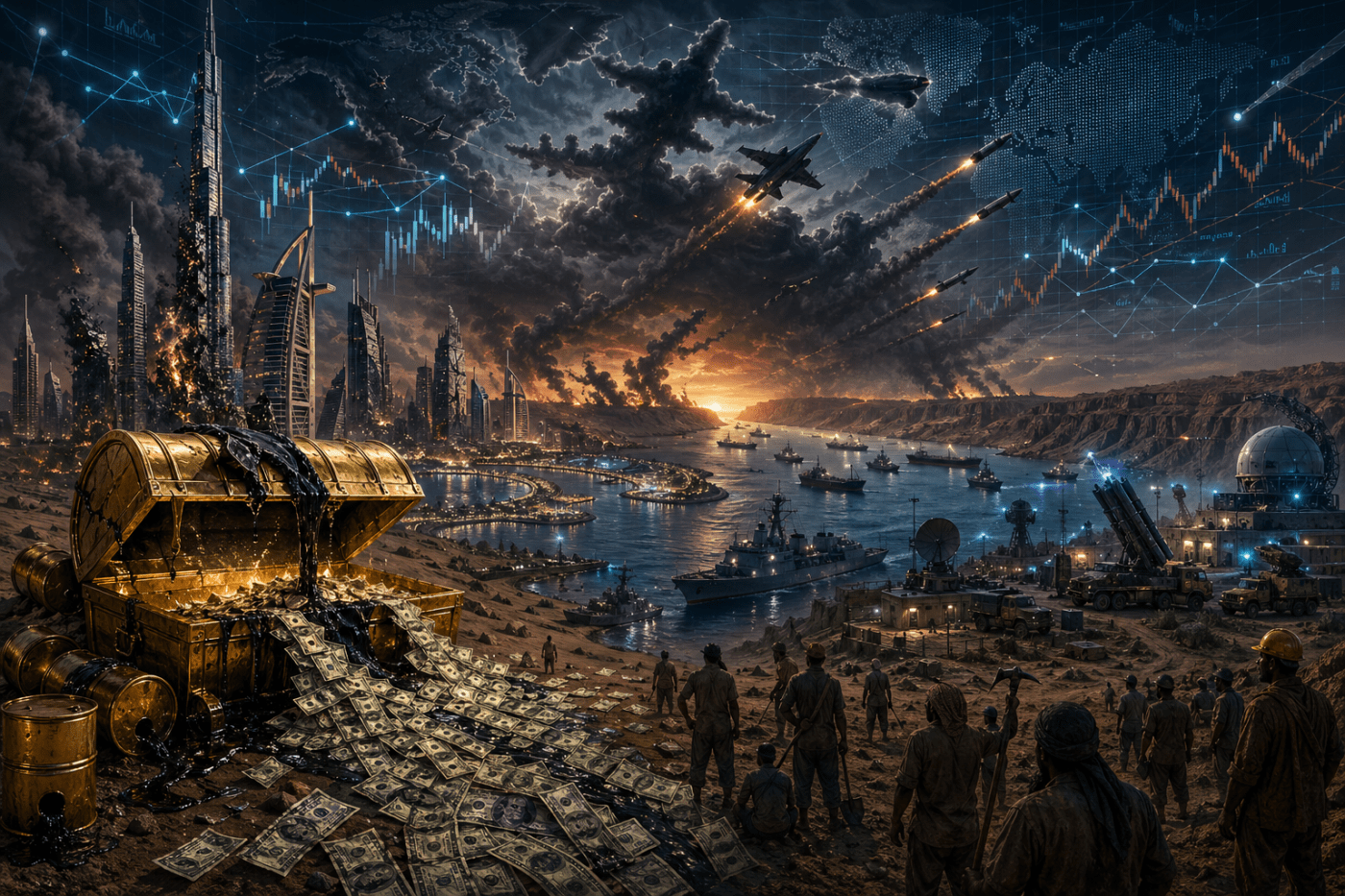
The Economist mourns threatened sovereign wealth while quietly framing a war produced by U.S.–Israeli escalation and imperial security architecture. The empirical record reveals a system of bases, chokepoints, sanctions, and financial control binding Gulf capital to global monopoly power. Beneath the narrative, sovereign wealth funds emerge as shock absorbers of crisis, redirecting oil rents into war, reconstruction, and imperial stability. From antiwar mobilizations to sanctions resistance and labor solidarity, the terrain of struggle is already forming across the same global circuits the system depends on.
By Prince Kapone | Weaponized Information | April 27, 2026
When the Treasure Chest Starts Bleeding
The Economist’s “War will drain the Gulf’s $6trn treasure chest”, published on April 15, 2026, arrives from Dubai with the cool voice of the counting house. The article tells us that war in the Gulf is putting pressure on the sovereign wealth funds of Bahrain, Kuwait, Oman, Qatar, Saudi Arabia, and the United Arab Emirates. These funds, fattened for decades on hydrocarbon wealth, have become enormous global investors, pouring money into artificial intelligence, private credit, real estate, football clubs, airlines, ports, data centers, and the glamorous wreckage of late capitalism’s favorite toys. Now, The Economist warns, the conflict with Iran has complicated the lives of the men who manage these fortunes. Oil and gas infrastructure has been damaged. Defense bills are rising. Airlines, hotels, airports, ports, and property firms are taking hits. Megaprojects are wobbling. The Gulf’s sovereign funds may have to sell assets, redirect capital, and spend more money at home instead of buying the world abroad.
On the surface, this looks like a sober financial report. The tone is crisp, the sentences are polished, and the numbers march across the page with the confidence of accountants who have never had to ask who dug the oil, who built the towers, who cleaned the hotels, or who died under the missiles. But beneath the calm prose is the familiar political economy of imperial journalism. The Economist speaks not from the refinery floor, the airport tarmac, the migrant labor camp, the dock, the pipeline repair crew, or the working-class neighborhood where war becomes rent, wages, food prices, and fear. It speaks from the boardroom. Its world is populated by fund managers, bankers, consultants, investment advisers, and sovereign wealth executives. In this world, war is not first a human catastrophe or a symptom of imperial disorder. War is a disruption to asset allocation.
That class position matters. The Economist is not some neutral village noticeboard where facts stroll in barefoot and innocent. It is one of the great house organs of liberal finance capital, a magazine that has long translated the interests of empire, markets, and managerial elites into the language of common sense. It does not usually need to shout. Its power is quieter than that. It teaches the reader how to see: which losses are tragic, which victims count, which experts matter, which structures remain invisible, and which questions are too rude to ask in polite company. The article is unsigned, which only strengthens this effect. No individual writer steps forward. Instead, the institution itself speaks, wearing the mask of objective reason while giving us the anxieties of global capital in the accent of civilization.
The first propaganda device at work is narrative framing. The war is framed as a financial-management problem for Gulf sovereign wealth funds. The question becomes: how will these funds preserve liquidity, rebalance portfolios, manage illiquid assets, and keep investors calm? That framing is not false in a narrow technical sense, but it is politically loaded. It narrows the reader’s field of vision until the Gulf appears not as a militarized zone of empire, not as an oil-and-dollar fortress, not as a region shaped by U.S. bases, sanctions, arms deals, and strategic chokepoints, but as a set of investment vehicles unfortunately inconvenienced by Iranian retaliation. The reader is invited to worry about the treasure chest before asking who filled it, who guards it, who spends it, and whose blood lubricates its hinges.
The second device is source hierarchy. The authoritative voices in the piece come from consultants, research firms, investment advisers, bankers, and sovereign wealth specialists. These are the priests of the portfolio temple. They may know where the money moves, but their class function is to treat money movement as the center of reality. Their expertise is not neutral; it is expertise from within the machinery. Workers appear nowhere as knowing subjects. Migrant laborers, who built much of the Gulf’s glittering skyline and keep its airports, hotels, logistics hubs, and construction sites alive, are absent. So are the people of Iran, whose country is treated mostly as a source of missiles and risk. The oppressed enter the article only as background noise behind the financial concerns of the powerful.
The third device is omission, the old emperor of bourgeois propaganda. The article gives us Iranian projectiles, damaged infrastructure, nervous investors, and interrupted megaprojects, but it does not seriously ask how the war began, what imperial military architecture made the Gulf so exposed, or how U.S. and Israeli actions shaped the crisis. Iran appears as the force that has “proven its grip” over the Strait of Hormuz, while the deeper structure of containment, sanctions, basing, and militarized energy control remains offstage. This is a neat little trick. If history begins with Iranian retaliation, then Iran becomes the author of instability. If history begins earlier—with imperial pressure, military escalation, sanctions, and the Gulf’s integration into U.S. security strategy—then the whole moral geography changes.
The fourth device is fear. The article does not scream like a tabloid; it whispers like a banker with bad news. “Iranian projectiles” dent the allure of wealthy Gulf states. Foreign contractors retreat. Western investors get cold feet. Airline traffic falls. Luxury hotels suffer. Residential sales plummet. The fear here is not the fear of ordinary people facing war. It is the fear of capital losing confidence. This is fear refined for elite consumption, decanted into respectable prose and served at room temperature. The political purpose is clear: make the reader feel that Iranian power is the destabilizing force, while the enormous U.S.-aligned military and financial order surrounding Iran is treated as the natural background of life.
The fifth device is card stacking. The article piles up evidence of Gulf vulnerability: damaged smelters, weak tourism, airline disruption, canceled contracts, risky private investments, and sovereign funds forced to support domestic economies. But it gives little comparable weight to who profits from the crisis. War does not only destroy value; it reallocates it. Arms manufacturers, oil traders, reconstruction firms, insurers, contractors, and financial intermediaries all gather around the fire with their forks ready. Yet The Economist’s sympathy sits mainly with the custodians of oil fortunes whose portfolios may become less elegant. One is almost moved to tears: the poor sovereign wealth fund, forced by war to choose between AI startups, luxury districts, and missile-defense bills.
The sixth device is doublespeak. The article describes Gulf sovereign wealth strategy as “farsighted” planning for life after fossil fuels. But what does this “post-oil” future look like in the article’s own telling? It looks like oil money flowing into airports, airlines, luxury hotels, real estate, ports, artificial intelligence, private credit, global property, and megaprojects built on imported labor and imperial security guarantees. This is not liberation from oil. It is oil rent dressed in a new suit and sent abroad to mingle with monopoly finance. The old economy is not overcome; it is converted into portfolios. The treasure chest does not stop being a treasure chest because someone puts a data center on top of it.
So the article performs a subtle ideological operation. It asks the reader to see the Gulf monarchies as prudent investors whose modernization projects are being disrupted by war, while hiding the fact that the Gulf’s wealth, vulnerability, and military exposure are all part of the same historical arrangement. The sovereign funds are presented as instruments of national foresight, but never as nodes in a global system of oil rents, dollar finance, arms dependency, Western markets, and imperial protection. The war is presented as an interruption, not as a revelation. But the smoke rising over the Gulf is not merely damaging the treasure chest. It is showing us what the chest was made of all along.
What the Balance Sheet Hides: War, Oil, and the Architecture Beneath the Numbers
The Economist gives us numbers, and the numbers are not false. But numbers alone are like bones scattered across a desert—they tell us something died, but not how, not why, and not who pulled the trigger. When we gather the facts and force them into relation with one another, the clean financial story begins to crack, and the real terrain comes into view.
Start with what even the official narrative admits. The Gulf sovereign wealth system is immense: roughly five trillion dollars in assets, built on decades of hydrocarbon extraction and global investment flows, now under pressure as war disrupts revenue streams and domestic economies. Governments are already reacting. Gulf states are reviewing sovereign investments to offset the economic shock, preparing to redirect capital inward just as Dubai rolls out a 1 billion dirham stimulus package to stabilize businesses rattled by conflict. Airlines, one of the crown jewels of Gulf diversification, have been shaken hard: flight operations collapsed and only partially recovered weeks into the war. Industrial infrastructure has not been spared either. Emirates Global Aluminium reported significant damage to its facilities, disrupting a sector that supplies nearly a tenth of global aluminum output.
Even the future—the glittering skyline of Gulf ambition—is trembling. The desert dreams of post-oil grandeur are encountering the hard reality of war. Saudi Arabia’s NEOM project has canceled major contracts, signaling that even trillion-dollar visions cannot float above geopolitical gravity. Tourism, another pillar of diversification, is collapsing under the weight of instability. The war threatens tens of billions in tourism revenue, while hotel occupancy in Dubai has sharply declined. These are not isolated disruptions. They are fractures running through the entire model.
But the article stops where the real story begins. Because this war did not fall from the sky like bad weather. It has a history, an origin, and a structure. On February 28, 2026, the U.S. and Israel launched coordinated strikes on Iranian targets and assassinated Iran’s Supreme leader, Ayatollah Khamenei. Iran’s retaliation was immediate and expansive, targeting not only military installations but the broader economic infrastructure of Gulf states aligned with the U.S. order. The missiles did not invent the system they struck. They exposed it.
That system is not hidden. It is built in steel, concrete, and command structures across the region. The United States maintains a dense network of military bases across the Gulf, including major installations in Bahrain, Qatar, Kuwait, Saudi Arabia, and the UAE. These bases are not decorative. They are the physical backbone of a regional security architecture designed to control energy routes, deter adversaries, and enforce geopolitical alignment. When war comes, these bases do not simply protect. They also attract fire. Protection and exposure arrive in the same package.
That architecture is not informal or incidental—it is structured through ongoing coordination and formalized defense integration. U.S. and Gulf states operate through joint security frameworks that explicitly link air and missile defense, maritime surveillance, and regional force projection into a unified system. As reflected in U.S.–GCC defense working group coordination on integrated air and missile defense, the region’s security is organized as a shared operational environment under U.S. leadership. This means the Gulf is not simply protected by American power—it is embedded within it. When conflict erupts, the distinction between ally, host, and battlefield begins to dissolve. The infrastructure of protection becomes the infrastructure of exposure.
The same logic applies to the region’s defensive systems. Gulf states rely heavily on American-made missile defense technologies. As the conflict escalated, the United States approved over $16 billion in new arms sales, including interceptors, radars, and drones. War, in this sense, is not only destruction. It is also procurement. Every missile that lands generates demand for another missile to stop the next one.
And beneath all of this lies the geography that gives the Gulf its global significance. The region is not just wealthy—it is structurally indispensable. The Strait of Hormuz carries roughly one-fifth of global oil and gas flows, making it one of the most critical chokepoints in the world economy. When conflict disrupts that passage, the effects ripple across continents. Traffic through the strait has already been severely reduced, exposing how fragile the system really is. Pipeline bypasses exist, but they carry only a fraction of the volume. The rest must pass through a narrow corridor where sovereignty, war, and global capitalism collide.
The Red Sea tells a similar story. Houthi actions around Bab al-Mandab have already demonstrated the vulnerability of shipping routes, reminding the world that control of trade is never purely economic. It is enforced, contested, and fought over.
To understand Iran’s position in this system, one must also account for the long shadow of sanctions. The United States has imposed extensive sanctions networks targeting Iran’s oil exports, banking system, and trade relationships. These measures have restricted revenue, distorted economic planning, and forced Iran into alternative channels of trade. They are not background policy—they are material pressure shaping how a state survives, plans, and responds. A country constrained in its economy often compensates in its strategy. Power shifts from balance sheets to missiles, from markets to deterrence.
Meanwhile, the Gulf’s wealth—so carefully managed in global portfolios—remains deeply tied to the very system that produces this instability. The petrodollar system has long linked Gulf oil revenues to U.S. financial markets, recycling surplus into dollar-denominated assets and reinforcing Western capital structures. Today’s sovereign wealth funds are not external to that system. They are one of its primary engines. In 2025 alone, Gulf funds accounted for a dominant share of global sovereign investment flows, pouring money into technology, infrastructure, and financial assets—much of it within the United States itself.
This arrangement did not emerge spontaneously—it was forged through decades of geopolitical consolidation, particularly in the aftermath of the 1991 Gulf War, when U.S. military presence became permanently embedded across the region and oil-for-security relations were institutionalized at scale. Gulf oil revenues were systematically recycled into dollar-denominated assets, especially U.S. Treasury securities, anchoring both American fiscal power and Gulf financial strategy in a shared structure. As contemporary analysis notes, the petrodollar system ties energy flows directly to U.S. financial dominance, meaning disruptions in Gulf oil production or dollar recycling reverberate through the core of the global economy. In moments of war, this relationship tightens rather than loosens. As supply disruptions shift market dynamics, the United States is able to expand its role in global energy markets, reinforcing its leverage even as Gulf infrastructure absorbs the damage. The system, in other words, is designed so that crisis redistributes power upward, even when destruction is concentrated locally.
But the dependence runs deeper than investment flows alone. It extends into the very liquidity of the system itself. In moments of crisis, access to dollars becomes as decisive as access to oil. Recent reporting shows U.S. officials discussing dollar swap line arrangements with Gulf partners, mechanisms designed to stabilize financial systems by providing emergency dollar liquidity. These are not neutral technical tools. They are instruments of monetary discipline. To receive liquidity is to remain within the system’s terms; to risk exclusion is to face currency instability, capital flight, and financial isolation. In this way, the dollar system does not merely facilitate Gulf investment—it governs the conditions under which that investment can exist. The treasure chest, even at its most global, remains locked inside a monetary architecture it does not control.
This is why the disruption feels so deep. The system is not being attacked from outside; it is being strained from within. Oil flows are interrupted, but oil prices have simultaneously surged above $100 per barrel, generating windfalls even as infrastructure burns. Service firms lose contracts, but stand ready to profit from reconstruction. Arms manufacturers secure new deals. Financial institutions reposition capital. War does not simply destroy value—it redistributes it across the architecture of global capitalism.
And yet, beneath the spreadsheets and sovereign funds, there is a social reality that the article barely acknowledges. The Gulf economies rest heavily on migrant labor. In sectors like construction, foreign workers make up the overwhelming majority of the workforce, often living precariously and sending remittances back home. When projects stall, when tourism declines, when construction slows, it is not only capital that feels the pressure. It is workers—both in the Gulf and across the Global South—whose livelihoods are tied to these economic circuits.
Step back far enough, and the pattern becomes clear. The Gulf is not simply a collection of wealthy states managing investment portfolios. It is a central node in the global energy system, a pillar of dollar finance, a heavily militarized zone of U.S. strategic control, and a key site of emerging multipolar tension. Saudi Arabia’s move toward BRICS and the Gulf’s growing economic ties with China signal that the region is not standing still. It is probing, hedging, recalibrating—trying to navigate between old dependencies and new possibilities.
What The Economist presents as a financial dilemma is, in fact, the visible edge of a much larger contradiction. The Gulf’s wealth, its security, its vulnerability, and its global role are all products of the same historical arrangement. War has not interrupted that arrangement. It has illuminated it.
The Treasure Chest Was Always a War Chest
The Economist tells the story as though war has arrived from outside the Gulf’s financial system and begun draining its treasure chest. But the deeper truth is more ruthless than that. The war is not an external accident interrupting an otherwise peaceful project of sovereign investment. It is the return of the system to itself. The same imperial order that made the Gulf monarchies rich, armed, exposed, and globally significant is now demanding that their accumulated wealth be spent to repair, defend, and stabilize that order. The treasure chest was never outside the war machine. It was one of its vaults.
This is the contradiction at the center of the whole affair. The Gulf monarchies accumulated enormous pools of capital by sitting atop the energy arteries of the capitalist world-system. Oil and gas rents flowed upward into royal states, then outward into dollar markets, Western corporations, private equity, real estate, artificial intelligence, airlines, ports, and megaprojects. This outward flow was never neutral. It was not simply “integration” into global finance. It was insertion into a system where capital flows function as signals of obedience and instruments of discipline. Money does not just move; it instructs. Liquidity is extended to those who align, withdrawn from those who hesitate, and redirected to reshape political behavior. In this sense, Gulf sovereign wealth is not merely invested—it is positioned inside a financial architecture that rewards compliance and punishes deviation. Finance here operates as a weapon: subtle, silent, and devastating in its reach.
But the role of Gulf capital does not end at obedience. It also functions as an intermediary layer of empire—a relay station through which imperial power travels under a different flag. When Gulf sovereign wealth flows into Africa, Asia, or Latin America, it often arrives dressed in the language of South–South cooperation, partnership, and development. Yet beneath that language, it frequently reproduces the same extractive logic long associated with Western capital. The funds move through Dubai, Doha, and Riyadh, but they remain tethered to Wall Street, London, and the circuits of global monopoly finance. In this way, Gulf sovereign wealth operates as a Trojan horse—carrying imperial capital into new terrain under the cover of non-Western identity. What appears as diversification becomes continuation. What appears as autonomy becomes mediation. The empire does not always arrive directly; sometimes it comes through its most well-dressed intermediaries.
This intermediary role is increasingly bound up with a new layer of accumulation: technofascist infrastructure. The Gulf’s investments in artificial intelligence, data centers, logistics corridors, ports, telecommunications networks, and digital platforms are not simply bets on future growth. They are investments in systems of control. Artificial intelligence is not just a tool for efficiency; it is a tool for governance—monitoring populations, predicting behavior, managing flows of labor, capital, and information. Ports and logistics networks do not merely move goods; they structure global supply chains and determine who eats, who waits, and who pays. Telecommunications systems do not merely connect; they surveil. What sovereign wealth funds are building, therefore, is not just accumulation—it is the infrastructure of control. The Gulf is becoming not only a hub of finance and energy, but a testing ground for the digital architecture of empire.
And now war forces all of these layers to reveal their unity. The illusion of endless outward expansion collapses under the pressure of conflict. Capital that once flowed outward into speculative ventures, luxury developments, and global acquisitions is pulled back inward to repair pipelines, rebuild industrial facilities, stabilize airlines, support domestic economies, and replenish missile defenses. This is not merely crisis—it is recalibration. The imperial system is not collapsing in a single dramatic moment. It is adjusting under pressure, reallocating resources to maintain itself in a changing world. War becomes the mechanism through which this reallocation occurs. Capital is redirected, priorities are reshuffled, and the system reorganizes itself in response to the shocks it generates.
In this process, sovereign wealth funds become shock absorbers of imperial crisis. They are called upon to stabilize what the system destabilizes. When infrastructure is damaged, they pay. When economies slow, they intervene. When defense systems need replenishing, they finance. When investor confidence wavers, they reassure. The funds are not autonomous actors navigating risk; they are instruments deployed to manage the contradictions of the system itself. Their global portfolios shrink not because of miscalculation, but because the system demands that they return home to repair its foundations.
The Gulf’s so-called diversification now appears in a different light. Tourism collapses under the weight of war. Airlines struggle to maintain routes. Megaprojects stall or are scaled back. Illiquid investments—once symbols of long-term vision—become liabilities when rapid capital mobilization is required. The promise of a post-oil future reveals itself as dependent on the very conditions it sought to transcend: stable energy flows, secure trade routes, and a functioning imperial security umbrella. When those conditions fracture, the future folds back into the present.
Iran’s role in this system must also be understood within this broader structure of coercion and resistance. A state subjected to prolonged sanctions, economic strangulation, and military assault does not operate within the same horizon as those who impose such conditions. Its strategic posture is shaped by necessity, not preference. The ability to disrupt chokepoints, to project force across the region, and to impose costs on adversaries becomes a form of counter-pressure within a system designed to limit its options. The narrative that isolates Iranian actions from this context is not analysis—it is ideological concealment.
Meanwhile, the Gulf monarchies attempt to navigate a shifting global landscape. They hedge toward China, engage with BRICS, and explore alternative financial arrangements, while remaining deeply embedded in U.S. military and financial systems. This dual alignment reflects not strategic clarity, but structural constraint. They seek room to maneuver within a system that limits their autonomy. Multipolarity opens space, but it does not dissolve dependency. Without a transformation in the underlying class structure and ownership of wealth, these maneuvers remain negotiations within the system rather than ruptures from it.
At the base of all this lies the global proletariat, whose labor sustains the entire edifice. The Gulf’s cities are built and maintained by migrant workers drawn from South Asia, Africa, and beyond. The resources that feed global industry are extracted from lands across the Global South. The profits generated from these processes are funneled into financial centers in the West. This is not a collection of separate processes—it is a unified circuit. Gulf labor, African extraction, Asian manufacturing, and Western financial accumulation form one interconnected system of exploitation. When war disrupts one node, the effects travel across the entire circuit. Workers lose jobs, remittances decline, prices rise, and insecurity spreads. The burden is distributed downward, even as profits are captured upward.
From this vantage point, the Gulf crisis is not a story about sovereign wealth under pressure. It is a story about a system revealing its inner logic. Wealth accumulation, military protection, financial integration, technological control, and class exploitation are not separate phenomena—they are components of a single structure. War does not break this structure; it forces it to reorganize. The treasure chest bleeds because it is connected to every artery of the system. And as that system recalibrates under pressure, it demands more from the very wealth it produced.
The conclusion is unavoidable. There is no path to sovereignty through deeper integration into this order. There is no liberation in becoming a more efficient node within imperial circuits of finance, technology, and security. The Gulf’s experience demonstrates that wealth without control over its conditions of existence remains vulnerable to the very forces that generated it. Only by transforming the ownership and direction of that wealth—placing it in the hands of the people who produce it—can the cycle of accumulation, dependency, and crisis be broken.
The treasure chest was never separate from the war. It was forged within it, expanded through it, and now, under the pressure of imperial recalibration, it is being called upon to sustain it once again. The system has come full circle, and in that circle lies both the trap and the possibility of rupture.
Where the War Meets Resistance: Organizing Along the Fault Lines
The contradictions exposed in the Gulf are not unfolding in silence. They are already being contested—on the streets, in campaigns, and through organizations that understand that war, finance, and empire are not separate arenas, but one continuous system. What matters now is not inventing resistance from scratch, but identifying where struggle already exists and sharpening its direction.
Across the United States, coordinated antiwar mobilizations have already emerged in response to the escalation. Recent actions organized by CODEPINK’s “No More Money for War, Genocide, Empire, and ICE” campaign have brought together formations including the ANSWER Coalition’s emergency protests against the war on Iran, alongside grassroots organizers mobilizing in major cities. These are not isolated demonstrations—they are part of a broader attempt to reconstitute an anti-imperialist front capable of confronting war as a system, not a single event.
Among these formations, Black Alliance for Peace represents one of the clearest organizational expressions of a people-centered anti-imperialist line. Its campaigns linking militarism abroad to repression at home, including calls to shut down foreign bases and dismantle U.S. military command structures, place it directly in confrontation with the same architecture identified in this analysis. In parallel, United National Antiwar Coalition (UNAC) and its Sanctions Kill campaign are actively organizing against economic warfare, exposing sanctions as instruments of collective punishment that shape the very conditions of conflict.
Additional pressure is emerging from within and around the military system itself. Veterans For Peace continues to mobilize former service members against U.S. war policy, bringing direct experience of imperial warfare into public opposition. At the same time, War Resisters League and broader war tax resistance networks are linking opposition to the Iran war with campaigns to refuse financial participation in militarism, targeting the fiscal lifeblood of empire.
The terrain of struggle is therefore already mapped. The task is to align these efforts with the material structure revealed in this analysis. First, campaigns must escalate around the infrastructure of militarism itself. This means opposing arms sales such as the multi-billion-dollar U.S. weapons transfers to Gulf states, exposing the role of regional bases, and targeting the corporations and logistics networks that sustain war. Every contract, every shipment, every deployment is a point of intervention.
Second, movements must confront the financial dimension of empire. The same system that recycles Gulf sovereign wealth into global markets can be pressured through campaigns opposing war funding and demanding divestment from militarized capital. Recent efforts, including a coordinated letter from hundreds of organizations opposing additional Iran war funding, demonstrate that financial pressure is already a site of struggle. This must be expanded into sustained campaigns targeting banks, asset managers, and public budgets that enable war.
Third, solidarity must be built along the global circuits of labor that sustain the system. Migrant workers in the Gulf, whose labor underpins construction, logistics, and service industries, are directly impacted when war disrupts economic activity. Organizing must connect their conditions with broader struggles across the Global South and within the imperial core, recognizing that labor exploitation, resource extraction, and financial accumulation are part of a single system. Support for worker organizing, amplification of labor struggles, and cross-border coordination are essential to breaking the fragmentation that sustains imperial power.
Finally, these struggles must converge around concrete demands that weaken the system’s ability to reproduce itself: closure of foreign military bases, an end to sanctions regimes that function as economic warfare, and the redirection of public resources away from militarism and toward social needs. These are not symbolic demands—they strike directly at the mechanisms sustaining the system identified throughout this analysis.
The Gulf is not just a site of war. It is a site where the global system reveals its structure. And wherever that structure becomes visible, it also becomes vulnerable. The task is not simply to oppose the war, but to organize against the system that makes it inevitable—and to do so in coordination with the forces already in motion.


Leave a Reply