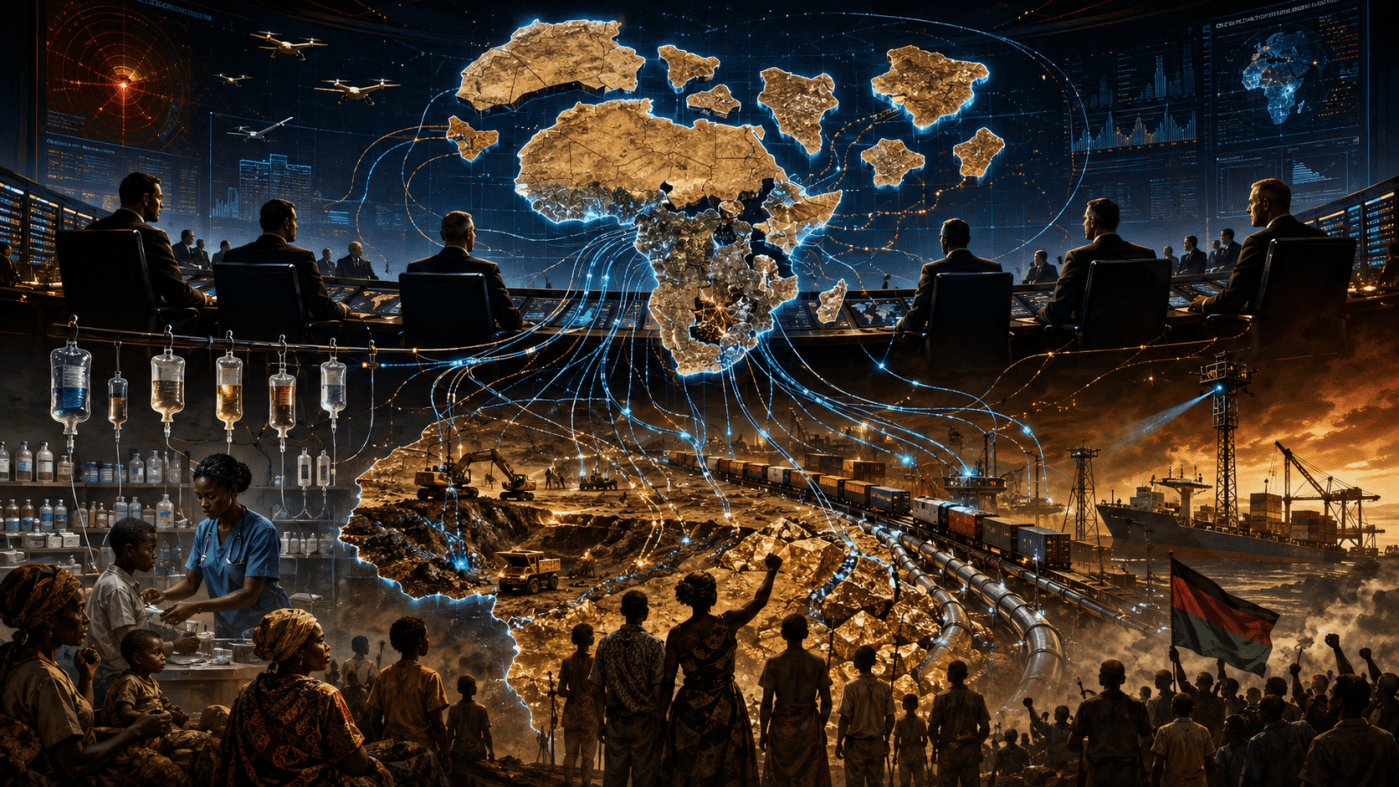
A viral State Department map turned the humiliation of mislabeling an entire continent into a comedy of AI incompetence, allowing the health agreements beneath the spectacle to escape scrutiny. Those agreements reveal a harder structure in which shrinking assistance is bound to co-financing demands, data and specimen access, investment corridors, security cooperation and Washington’s power to withdraw support before African public systems are prepared. The map’s errors were accidental, but the hierarchy was historically accurate: Africa remains legible to empire as a collection of clinics, databases, mineral belts and strategic territories to be administered from outside. Across the continent and the diaspora, treatment activists, community monitors, legal challengers and anti-imperialist movements are already fighting to defend the clinic, expose the compact and remove Africa from Washington’s map of command.
By Prince Kapone | Weaponized Information | July 30, 2026
The Map Became the Story
A State Department presentation at the AIDS 2026 conference mislabeled every country in Africa. Nigeria was deposited in the Sahara. Mozambique was shifted to the Horn. Côte d’Ivoire was thrown across the continent. The slide reportedly carried an artificial-intelligence watermark, supplying the internet with an irresistible spectacle: Washington had arrived to present its new health agreements with African governments and could not correctly identify the countries expected to sign them.
The blunder deserved ridicule. It also performed a useful political function. The viral map converted a relationship of power into a comedy of incompetence. Screenshots circulated. Commentators mocked the artificial intelligence. The State Department blamed a hurried revision, accepted “full responsibility” and apologized for the confusion caused to its African partners. The sequence provided all the elements of a finished scandal: an embarrassing image, a careless employee, a defective technological tool and an institution promising to do better.
What disappeared was the purpose of the presentation itself. Jeff Graham was not in Rio to deliver a lesson in African geography. He was explaining a new system of bilateral health agreements being constructed as the United States cuts, restructures and redirects major areas of foreign assistance. Yet the article gives the map more scrutiny than the agreements. We learn where Nigeria was incorrectly placed, but almost nothing about where Washington intends to place itself inside African health systems.
The artificial-intelligence angle narrows the failure to production. AI becomes the scapegoat, the rushed employee absorbs the blame, and the institution escapes with an apology. But the machine did not approve the slide. A chain of officials produced it, reviewed it and displayed it before representatives of governments being asked to reorganize budgets, laboratories, surveillance systems and treatment programs through agreements negotiated with the United States.
The article invokes PEPFAR’s lifesaving work as moral insulation around that process. The reader is left with a shallow choice between celebrating American assistance and condemning its withdrawal. Missing is the harder question of how essential care became organized through a structure in which Washington can expand, redesign or remove support upon which millions depend.
The map was wrong. But before treating the error as the whole story, another question must be asked: what system of power was being presented when Africa could be treated as interchangeable administrative territory?
What the Compact Requires
The policy presented in Rio belongs to a broader reconstruction of U.S. power in Africa. Weaponized Information has already identified the direction: Trump 2.0 is not simply withdrawing from the continent but replacing parts of the old aid machinery with harder bilateral bargaining, private investment, military cooperation and technological control. The new health agreements sit inside that transition. They preserve selected forms of assistance while reorganizing who pays, who audits, who receives access and how quickly Washington can reduce its obligations.
Nigeria’s December 2025 technical memorandum with the United States covers HIV/AIDS, tuberculosis, infectious-disease surveillance, laboratories, frontline health workers, medical commodities and national health-data systems. It also includes procedures governing the collection, transportation, testing, storage and disposal of pathogen samples. The United States is expected to provide nearly $2 billion between April 2026 and December 2030. Nigeria committed at least 6 percent of executed federal and state budgets to health, projected to mobilize nearly $3 billion as external grants decline. Nigeria’s government described the arrangement as part of a transition from grant dependence toward trade and investment.
The agreements negotiated across the continent do not contain identical terms. A comparison of finalized memoranda, data agreements and specimen-sharing arrangements shows that domestic co-financing requirements, audit powers, data-access periods and penalties vary by country. Some agreements contain no specified punishment for missed financing targets. Others permit dollar-for-dollar or two-for-one reductions in U.S. support. Proposed data and specimen templates sought access lasting as long as twenty-five years, even where the main health memorandum lasted five years or less.
African governments altered portions of these terms during negotiations. Several reduced data- or specimen-sharing periods to seven or ten years, restored protections under domestic law and changed termination provisions. Nigeria secured a requirement that 30 percent of commodities be purchased from local manufacturers. These variations show that governments negotiated rather than simply accepted a single imposed text. They also make publication of every agreement and annex essential, because the legal obligations, enforcement mechanisms and concessions differ from country to country.
The transition began after severe disruption rather than through an orderly transfer of responsibility. South Africa approved a six-month, $115 million bridge arrangement after the U.S. foreign-aid freeze and restructuring closed programs, eliminated health-sector jobs and disrupted clinics and outreach networks. The temporary funding protected some services but covered only part of the system previously supported through PEPFAR.
By July 2026, PEPFAR-supported site-level treatment and technical assistance had contracted sharply. Across twenty-one countries, 77,163 fewer children were recorded as receiving that support than during the previous fiscal year, a decline of 14.2 percent. South Africa registered the largest absolute reduction: 30,880 children, or 45 percent. These figures do not establish that every child had lost access to all treatment, since some may have entered nationally financed programs, but they document the rapid disappearance of PEPFAR-supported services before replacement systems were fully established.
The data and specimen provisions enter a continent already confronting unequal control over medical knowledge and production. Africa CDC’s health-sovereignty framework identifies the extraction of African health data and biological materials without equivalent local benefit, manufacturing capacity or access to resulting medicines as a structural problem. Its position ties international data and pathogen sharing to African ownership, locally rooted scientific capacity, equitable benefit sharing and guaranteed access to vaccines, diagnostics and treatments developed from African contributions.
The health agreements also coexist with expanding security cooperation. Nigeria’s armed forces described a joint operation with U.S. forces built through surveillance, communications interception and intelligence sharing, followed by continued operations coordinated with AFRICOM. These arrangements operate through different institutions and legal instruments from the health memoranda. The evidence establishes their coexistence within the same bilateral relationship, not a single concealed agreement binding them together.
The economic setting is equally explicit. The African Union–United States Strategic Infrastructure and Investment Working Group seeks to shift relations from foreign assistance toward profitable investment in transport corridors, logistics, critical-mineral supply chains, energy networks, regulatory systems, digital infrastructure and health security. Health appears alongside the physical and informational systems through which trade and investment are organized.
This relationship stands on historical ground shaped by conquest and partition. The Berlin Conference did not draw every present African border in a single meeting, but it codified European rules for occupying and dividing the continent without African control over the process. Colonial governments then used maps, treaties, administrative districts and military force to convert African land and populations into governable territories of extraction. The institutions have changed. The current record consists of memoranda, financing schedules, databases, specimen agreements, investment platforms and security partnerships. Those are the materials the viral map prevented the public from examining.
The Map Was Wrong; the Hierarchy Was Accurate
The map placed African countries where they did not belong. The policy beneath it places the United States where it does not belong: inside the institutions through which African societies protect life, organize knowledge and reproduce themselves. The labels were wrong by accident. The hierarchy they exposed was built through history.
Imperial power has never required a serious understanding of the people it dominates. It requires selective knowledge: enough to locate resources, discipline labor, anticipate resistance and preserve command. Colonial administrators could remain profoundly ignorant of the societies they ruled while measuring land, counting populations, classifying ethnicities and directing wealth outward. Ignorance was not the absence of domination. It was one of domination’s privileges. The colonized did not need to be understood as historical subjects. They needed to be rendered administratively useful.
This is the logic of imperial cartography. The map does more than describe territory. It reorganizes territory according to the needs of the power holding the pen. Colonial cartography divided land into zones of conquest, labor and extraction. Its contemporary form renders sovereign countries as health portfolios, security problems, investment environments and reservoirs of information. The symbols have changed because the machinery of rule has changed. The underlying presumption remains: Africa may be reorganized from outside according to priorities established elsewhere.
The health compact reveals this relation through conditional care. The medicine is real. The workers keeping clinics alive are real. So are the lives saved through internationally financed treatment. But assistance becomes leverage when a foreign state retains the ability to restructure programs, impose benchmarks, demand co-financing, audit compliance and reduce support before dependent systems can protect the people left behind.
There is no contradiction between defending every patient endangered by those cuts and opposing the system that made their survival vulnerable to them. Historical materialism begins from concrete life, not ideological purity. A worker may need the wage without worshipping the boss. An oppressed nation may require emergency assistance without mistaking dependency for solidarity.
The demand for “self-reliance” therefore carries two opposing possibilities. African control over health financing, scientific knowledge, medicine production and public institutions is necessary for genuine sovereignty. But self-reliance imposed through abrupt withdrawal becomes something else: the donor transfers costs while retaining influence over the timetable, the standards and the terms of cooperation. The language of independence conceals a transition managed by the same power from which independence is supposedly being achieved.
These arrangements do not have to emerge from one secret command center to reproduce a common political structure. Capital, military power and state administration converge because they are organized around the same question: who controls the material systems upon which social life depends? The clinic, the laboratory and the public budget are not peripheral to sovereignty. They are part of the infrastructure through which a people survives and determines its future.
Trump 2.0 sharpens this contradiction. The older humanitarian language is stripped down as selected aid functions are reduced and bilateral bargaining becomes more openly tied to investment, security and strategic access. This is not imperial withdrawal. It is imperial recalibration: fewer obligations toward African populations, greater pressure upon African governments and a harder struggle to command the continent’s resources and institutions without assuming responsibility for its people.
The viral scandal showed a government unable to distinguish the nations before it, yet completely certain of its authority to reorganize the conditions under which they live. That—not the misplaced labels—is the real story.
Defend the Clinic, Open the Compact, Break the Command Chain
The answer is not to beg Washington for a more benevolent form of dependency. Nor is it to celebrate aid cuts while patients lose treatment, health workers lose jobs and public systems are forced to absorb the damage without preparation. The immediate task is to defend every life placed in danger while building the power required to end foreign command over the conditions of survival.
That struggle begins at the clinic. The Treatment Action Campaign and the Ritshidze community-monitoring network are documenting staffing losses, shorter medicine refills, longer waiting times and deteriorating services across South Africa. Patients, health workers and organizers can join that work by recording treatment interruptions, exposing clinic-level failures and forcing district and national authorities to answer publicly for what disappears during the transition. WI’s strategic demand goes further: essential workers and programs must be absorbed into publicly controlled systems before donor funding is withdrawn.
The agreements themselves must be dragged into daylight. Resilience Action Network Africa, People’s Health Movement Africa and their continental allies are already demanding publication, civil-society participation, protection of national law, fair benefit sharing and African control over health data and pathogen access. Every memorandum, annex, financing schedule, contractor list, audit power, specimen agreement and termination clause should face parliamentary hearings and public review before implementation.
Legal resistance has already shown that secrecy can be interrupted. In Kenya, the Consumers Federation of Kenya secured a court suspension of the U.S.–Kenya health agreement while its data-privacy challenge proceeds. Similar agreements should be tested against constitutional protections, public-participation requirements, health law and national control over sensitive information before data or specimens are transferred.
International allies must reinforce African movements rather than speak over them. Public Citizen is using disclosure litigation to recover agreements withheld by the State Department, while Health GAP and treatment activists are organizing to compel Washington to release appropriated funds and halt further clinic closures.
Health sovereignty must finally be connected to the wider struggle against military command. The Black Alliance for Peace’s U.S. Out of Africa Network organizes against AFRICOM through political education, demonstrations and local actions. The task is not to flatten medicine, data, minerals and troops into one slogan, but to expose the command structure connecting them.
Correcting the map is easy. The harder work is removing Africa from Washington’s map of control.
 Weaponized Information
Leave a comment