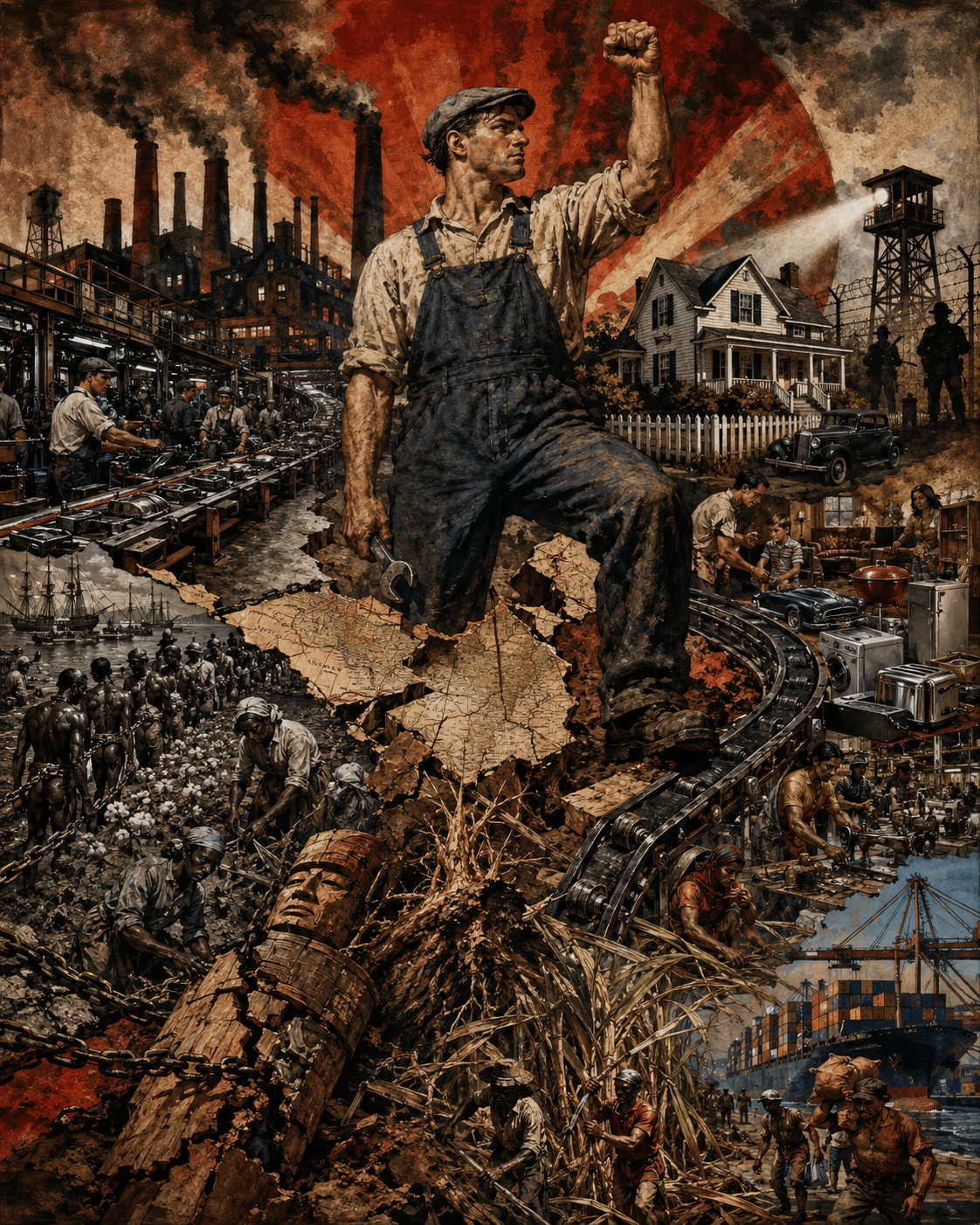
J. Sakai drags the white proletariat down from the altar and reconstructs the settler people that came before it—a population built through stolen land, genocide, slavery and democratic privileges reserved for the conquerors. He follows white labor into the factory, where genuine exploitation produced militant struggle but never automatically severed workers from the empire offering them citizenship, protected employment and advancement over colonized labor. The CIO, New Deal and imperial war transformed that contradiction into a durable settler bargain, while neocolonial democracy governed the oppressed through repression, displacement, managed leadership and reform without sovereignty. From the global plantation to the garrison community at home, Settlers delivers its unforgiving lesson: suffering does not manufacture class consciousness, unity that preserves settler power is not liberation, and revolutionary defection must be consciously organized.
By Prince Kapone | Weaponized Information | Weaponized Intellect Book Review | July 29, 2026
The Proletariat Comes Down from the Altar
Every political tradition has its sacred objects. Liberals kneel before “democracy,” nationalists burn incense to “the people,” and the Euro-Amerikan left has spent generations polishing the halo around “the proletariat.” Once a social category becomes holy, investigation becomes heresy. The label begins doing the work that history was supposed to do. A worker receives wages, therefore revolution must be hiding somewhere inside him—even when his unions exclude the oppressed, his politics defend empire and his idea of liberation amounts to a larger share of somebody else’s plunder.
J. Sakai opens Settlers by placing Marx against this catechism:
“Just as the word ‘people’ has been made holy by the democrats, so the word ‘proletariat’ has been made holy by you.”
This is not an ornamental quotation hung over the doorway to certify the book’s Marxist credentials. It gives Sakai his method. Marx was attacking revolutionaries who flattered the national feeling and status prejudice of German workers instead of investigating their actual conditions and political development. Sakai carries the accusation into the United States, where the white worker has often been awarded a revolutionary character in advance. When history refuses the script, the left rarely questions the casting. It announces that the worker has been deceived, divided or distracted—as though loyalty to the oppressor nation could never possess a material foundation of its own.
Sakai began elsewhere. In his Author’s Note, he describes the project as “a historical investigation into the puzzling class politics of euro-amerikan workers.” The word puzzling matters. He did not begin by declaring a permanent racial nature and then marching backward through history in search of confirmation. He began from a strategic contradiction encountered through movement work: workers could struggle fiercely against individual capitalists while defending the larger social order that subordinated whole peoples. They could curse the boss at the factory gate and salute the empire when the colonized rose against it.
These were not seminar questions. Sakai expected to produce a short paper for internal revolutionary education. The investigation consumed eight years because the mythology was woven through the entire national history: settlement, slavery, territorial expansion, immigration, trade unionism, industrialization, reform and war. The book’s movement origin gives it a different purpose from academic “whiteness studies.” Sakai does not examine white society to improve its manners, diversify its institutions or persuade its beneficiaries to become more enlightened custodians of conquest. He studies it because revolutionaries who misunderstand the social base of the enemy will build strategy on imaginary allies and call each defeat a surprise.
This is why Sakai rejects the soothing liberal claim that conventional U.S. history is merely incomplete. “Theirstory,” he writes, “is not incomplete; it isn’t true at all.” The usual remedy is addition. Add the enslaved to the story of freedom. Add Native peoples to the story of expansion. Add a chapter on racial exclusion to the story of opportunity. The oppressed are admitted into the national narrative, but only after the narrative has already decided what the nation is. The house remains standing. Those who supplied the land and labor are invited to decorate rooms built through their dispossession.
Sakai attacks the foundation. Settler history presents the development of the oppressor nation as the development of everyone living beneath its rule. Its wars become universal struggles for liberty. Its conquest becomes westward movement. Its institutions become neutral arenas slowly corrected through reform. The oppressed appear as delayed Americans waiting to enter a society whose material prosperity and political authority were built through their subjugation.
The Euro-Amerikan left reproduces this fraud whenever it treats the official nation as the natural container of class struggle. Black, Indigenous, Puerto Rican, Mexican and Asian movements may be acknowledged, but they are assigned supporting roles inside a drama whose protagonist has already been selected. Colonial domination becomes prejudice among workers. National liberation becomes an unfortunate complication. Independent organization becomes “division.” The abstract declaration of one common working class ends with the oppressed ordered to subordinate their actual struggle to the presumed historical destiny of settler labor.
Sakai’s reply is brutally direct: “This is a reconnaissance into enemy territory.” For centuries, imperial institutions studied the oppressed as populations to be classified, civilized, managed and pacified. Their families became data, their resistance became pathology and their histories became specialist departments inside universities loyal to the same state that conquered them. Sakai reverses the telescope. White society becomes the object of investigation—its class structure, institutions, political loyalties and relationship to colonized labor.
Reconnaissance is not moral judgment dressed up as theory. It does not assume that every inhabitant of enemy territory occupies the same position, nor does it grant political innocence to anyone wearing work boots. It asks material questions. How was a population formed? What reproduces its standard of life? Which institutions organize it? What advantages connect its exploited layers to the ruling order? What does it defend when class grievances collide with the liberation struggles of oppressed peoples?
That method is also the strongest defense against the crude fatalism later committed in Sakai’s name. If political character must be investigated, it cannot be established by wages alone—but neither can it be settled through biology, ancestry or a frozen racial category. Historical relations can be reproduced, weakened, reorganized or broken. The evidence must show which process is taking place. Sakai’s own method demands more than declaring white workers revolutionary by nature or reactionary for eternity.
This is the revolutionary force of the book’s opening move. Sakai drags the proletariat down from the altar and returns it to the world of land, labor, nations and struggle. No population receives a historical crown before the investigation begins. Before the political character of white labor can be judged, the society that produced it must be reconstructed from the ground up. And Sakai begins where the national mythology is most vulnerable: before there was a white working class, a Euro-American settler colony had to be build.
The Settler People Was Built, Not Born
Before Amerika produced a white worker, it produced a white settler. That sequence anchors Sakai’s history. The United States did not begin as an ordinary capitalist country whose rulers later invented racism to divide an otherwise unified working class. It began through conquest, and conquest distributed land, labor, property and political standing before an industrial proletariat had taken recognizable form. Sakai therefore starts with a proposition that reorganizes the entire national story: Amerika was “a chain of European settler colonies that expanded into a settler empire.” Independence did not abolish the colony. It transferred command over expansion to the settlers themselves.
Land was the great inducement. Sakai cuts through the fireside legend of impoverished Europeans crossing the Atlantic with nothing but courage and a hunger for freedom. Many came from propertied or aspiring middle strata. Others came because capitalism in Europe threatened to drive them downward into permanent wage labor. North Amerika offered an escape, but the exit opened onto somebody else’s country. A European denied land at home could join an invasion abroad and reappear as an independent proprietor. One contradiction in Europe was relieved by exporting it as colonial war.
The social composition matters. Sakai is not describing a European proletariat transported intact across the ocean. He emphasizes farmers, artisans, tradesmen and younger sons seeking property unavailable to them at home. Even indentured servitude usually functioned as a temporary passage toward freedom, land and membership in the dominant population. The captive Afrikan faced hereditary bondage; the European servant could imagine promotion into ownership and, eventually, authority over colonized labor. Harsh conditions could resemble one another without producing the same historical position or future.
Here Sakai locates the poisoned root of settler democracy. Equality among whites did not arise from a universal struggle against domination. It developed through a wider distribution of domination’s rewards. The planter and the small farmer remained unequal in wealth, but both occupied a political order that transformed Native territory into settler property. The merchant, artisan, squatter and hired laborer stood on different rungs, yet the ladder itself rested on conquest. Liberty meant the liberty to possess what had been seized. Independence meant freedom from London to continue the seizure without London’s restraint.
Sakai compresses this structure into one of the book’s hardest formulations: “It is the absolute characteristic of settler society to be parasitic, dependent upon the super-exploitation of oppressed peoples for its style of life.” Detached from the relations he documents, parasitic could become little more than an insult. Sakai gives it material content. Settlers occupied land they had not produced, destroyed societies already reproducing life upon it, trafficked Native and Afrikan captives, and constructed Atlantic commerce around unpaid labor. The farmer who owned no slave could sell into the plantation economy. Sailors, shipbuilders, merchants, distillers and artisans lived from commercial circuits driven by slavery. The largest profits rose to the ruling classes, but the settler economy as a whole stood upon conquered land and colonized labor.
Genocide was therefore not an unfortunate collision at the frontier. The land had to be made available for private settlement, and the peoples living upon it had to be removed, enslaved or destroyed. The polite language of pioneers “moving west” turns armed dispossession into a change of address. Slavery supplied the second indispensable foundation. It produced food, commodities, transportation and commercial surpluses that allowed the settler economy to survive and expand. Conquest supplied the territory; coerced labor made it yield wealth for the conquerors.
This did not erase class inequality among Europeans. Sakai’s argument is more exacting. Settler society contained exploitation within its ranks while elevating those ranks collectively above colonized peoples. Even poor whites could be repositioned as overseers, foremen, patrolmen or prospective landholders. Their deprivation was real, but it did not place them in the same relation as those whose land, bodies and labor were expropriated. The ruling class learned early that limited privilege attached to membership in the dominant nation could turn a potential rebel into a guard.
Beneath settler democracy stood the productive foundation Sakai believes conventional class analysis hides. “The Afrikan nation as a whole served as a proletariat for the Euro-Amerikan oppressor nation.” He is not merely substituting the word worker for slave. He is describing a national relation in which one people’s labor reproduced another people’s property, security and political development. Afrikan labor farmed, built, transported, repaired and manufactured. Native land and labor made the colonial beachhead possible. The settlers appeared self-reliant only because the labor supporting them had been pushed outside the frame of national history.
Once that structure becomes visible, the sacred episodes of early Amerikan democracy lose their innocence. Bacon’s Rebellion is commonly presented as an uprising of ordinary people, with Afrikan participation offered as proof that interracial class unity existed before the ruling class invented division. Sakai asks a harder question: what political project did the rebellion advance? The answer lies not in the temporary composition of its forces but in its struggle over settler power, territorial expansion and war against Native peoples. The oppressed may fight beside a faction of their oppressors without sharing its destination.
Sakai writes that “the inner content of these reforms was the consolidation of a new settler nation.” The phrase cuts through the habit of judging a movement solely by the rights it distributes within its own camp. Wider political participation among settlers can democratize conquest without weakening it. Representative government for invaders may reduce aristocratic control while enlarging the social base of invasion. A republic of conquerors remains a machinery of conquest even after it broadens the franchise.
The War of Independence intensified the same contradiction. For Euro-Amerikans, separation from Britain removed obstacles to continental expansion. For many enslaved Afrikans, British lines offered a possible escape from bondage. For Native nations, settler independence strengthened an enemy less restrained by imperial treaties and metropolitan calculation. The war therefore carried opposed political meanings. One nation’s liberation consolidated its power to dominate others.
Chapter III then overturns the morality play through which the eventual destruction of slavery becomes evidence of settler capitalism’s democratic maturation. Sakai writes that “the slave system had served Amerika well, but…increasingly became a drag on the growth of the new Euro-Amerikan Empire.” Slavery remained profitable. Its contradiction lay in the wider requirements of expansion. A continental industrial power needed European immigration, territorial settlement, mobile labor, new markets and the political consolidation of a broad settler population. The plantation bloc’s labor regime increasingly obstructed the development of the larger system it had helped create.
Capital therefore moved against slavery without moving against colonial domination. One form of expropriated labor became an obstacle to a more expansive settler capitalism. Legal emancipation could destroy chattel slavery while leaving the land order, national hierarchy and bourgeois state substantially intact. History did not simply advance from bondage into freedom. Capital reorganized the bondage.
This is the ground upon which the later white working class enters Sakai’s account. It does not arrive in an innocent republic awaiting corruption by racist propaganda. It enters a social order whose territory has been conquered, whose citizenship has been colonially distributed and whose democratic institutions already know how to unite settlers across class lines against the oppressed. The coming industrial worker will face exploitation by capital. He will face it inside an empire that has already prepared a place for him.
The White Worker Enters the Factory—and the Empire
Industrial capitalism changed the position of the Euro-Amerikan masses without washing away the order that produced them. The workshop gave way to the factory. Independent artisans sank beneath merchant and industrial capital. Immigrants entered mills, mines, rail yards and slaughterhouses where the employer measured human life by the minute and replaced damaged bodies as casually as worn machinery. A permanent white wage-working population finally emerged. But the factory did not rise on neutral ground. It stood inside a settler empire whose land, citizenship and labor hierarchy had already been violently arranged.
Sakai approaches this new formation with a methodological warning: “The key is to see what was dominant in the material life and political consciousness of this new labor stratum, then and now.” The sentence blocks two opposite evasions. Political character cannot be deduced from whiteness as though ancestry were destiny. Neither can revolutionary consciousness be deduced from wage labor as though the payroll were issuing class struggle along with the check. The workers’ suffering was real. The investigation begins by asking what their struggles sought, which social order offered them advancement and where they stood when their interests collided with the liberation of oppressed peoples.
The European immigrants feeding U.S. industry were not one uniform mass. Irish, German, Italian, Jewish, Slavic and other populations entered at different moments and occupied different positions. Many carried memories of peasant revolt, socialist organization, anarchism and militant trade unionism. They encountered poverty, blacklists, dangerous machinery, crowded housing and employers who governed industrial towns like private kingdoms. The republic of opportunity greeted them with a time clock, a company guard and the reassuring advice that their children might someday become supervisors.
That possibility distinguished their historical trajectory from that of colonized labor. European workers were not instantly admitted into equal settler citizenship, but the road toward incorporation remained open. They could fight for recognition as legitimate members of the dominant nation—for protected occupations, land, voting rights, citizenship and a place above workers marked as permanently foreign, colonial or disposable. Capital did not have to abolish exploitation to secure their loyalty. It could preserve exploitation while arranging the ladder so that somebody else remained beneath them.
Sakai therefore reconstructs white trade unionism not merely as a victim of racial division imposed from above, but as an institution frequently built through exclusion. White workers and union organizations fought to reserve jobs and territories for themselves. Chinese workers became targets both because employers exploited them and because settler labor demanded their removal from the national workforce. Afrikan workers confronted unions capable of speaking magnificently about the dignity of labor while defending a labor market organized through their subordination. The brotherhood of man had apparently formed a local and appointed somebody to guard the door.
Black Reconstruction supplied the decisive test. The destruction of slavery created the possibility of a revolutionary transformation driven by the formerly enslaved: land redistribution, political power for Afrikan laborers, the defeat of the planter class and the construction of new institutions under Black leadership. White workers could have joined that transformation by accepting that the most revolutionary force would not necessarily emerge from their own ranks. Instead, decisive sections of settler labor reconciled themselves to the restoration of white power. Their grievances against employers continued, but they refused to place those grievances inside the larger struggle against the colonial order.
Sakai names the contradiction with precision: “The U.S. Empire was founded as a European settler society of privileged conquerors, and the new white masses could not be both savagely exploited proletarians and also loyal, privileged settlers.” Both sides were materially present. Workers faced lockouts, private armies, unemployment, industrial injury and state violence. They also possessed a route toward incorporation unavailable to the peoples whose labor and land sustained the nation. Their exploitation generated rebellion against individual capitalists; their settler position set limits upon where that rebellion would go.
This is Sakai’s decisive advance beyond the nursery version of ruling-class deception. Racism did not simply trick white workers into forgetting their interests. The settler order organized interests unequally. A worker could lose a strike and still defend a labor hierarchy that protected his national status. He could hate the corporation while supporting the exclusion of Chinese labor, the subordination of Afrikan workers or the territorial expansion from which white settlement benefited. The contradiction was not false consciousness floating above material life. It ran through material life itself.
Sakai consequently relocates class consciousness from occupational status to political conduct: “Class consciousness lives in the revolutionary struggles of the oppressed—or dies in the poisonous little privileges…sought by the settler servants of the bourgeoisie.” This does not mean that only the oppressed can understand capitalism or that every struggle they wage is automatically revolutionary. It means that a class proves its historical character through its relationship to the forces attacking the whole structure of domination. Militancy over wages cannot substitute for a political line on conquest, empire and national oppression.
There were workers who crossed that line. The Irish and other European soldiers of the San Patricio Battalion deserted the U.S. Army during the invasion of Mexico and fought beside the people their government had ordered them to conquer. Their choice exposes the difference between advancement and defection. Irish-American incorporation meant winning a place within the settler nation. The San Patricios turned their weapons against its expansion. They did not demand a fairer position in the invading army. They changed sides and accepted the consequences.
Sakai’s method therefore cannot support the fatalism sometimes constructed from his conclusions. He writes that “the political consciousness and material class role of the masses of any given nation cannot be assumed from historic generalizations, but must be discovered by social investigation and scientific analysis.” Anyone who decides in advance that all white workers are revolutionary because they receive wages violates this instruction. So does anyone who decides that no division, defection or political transformation can ever occur because the population was formed through settlerism. Material relations must be investigated precisely because they develop through contradiction.
Chapter V places the white labor question within the Marxist theory of labor aristocracy. Colonial and imperial accumulation gave the bourgeoisie room to stabilize sections of the metropolitan workforce through comparatively higher wages, protected employment, citizenship, property and institutional recognition. Sakai expands the category beyond a narrow layer of bribed labor officials. He treats labor aristocracy as a broader social relationship joining sectors of the working population to the unequal distribution of imperial wealth. Such workers could battle employers ferociously over their portion without opposing the system that made the portion available.
The comparison with South African settlerism sharpens the point. Settler workers could struggle against their own capitalists while defending privileged access to land, jobs and political power over the colonized majority. The existence of class conflict inside the oppressor population did not dissolve the national structure. It often determined the terms on which competing settler classes fought. White labor wanted protection from capital without surrendering the colonial foundation that elevated it.
Sakai finds the same limit inside settler anti-imperialism. The American Anti-Imperialist League opposed annexation in the Philippines, militarism and the growing power of monopoly capital. Yet much of its opposition defended an idealized republic of European settlers against a world empire containing colonized populations. The continental conquest already completed was treated as legitimate national territory; only the newest expansion appeared imperial. The League opposed empire when empire threatened to corrupt the settler republic, not necessarily because Filipinos possessed the right to defeat U.S. rule.
That distinction remains strategically lethal. A movement may condemn monopoly corporations, foreign wars, financial elites and the export of jobs while demanding restoration of prosperity for the dominant nation. It may oppose the management of empire while defending its accumulated benefits. Such politics does not break with imperialism. It accuses the ruling class of distributing imperial advantage poorly. Patriotic socialism is merely settler anti-imperialism wearing a red tie.
Monopoly industry nevertheless created a workforce more permanently proletarian than the earlier settler labor strata. Southern and Eastern European immigrants entered the hardest industries before their full Americanization had been completed. They built industrial unions, organized mass strikes and carried socialist and anarchist traditions into the factories. The Industrial Workers of the World represented the highest point of this offensive. Its militants rejected narrow craft privilege, organized workers capital had divided and endured imprisonment, deportation and armed repression. Their courage was not imaginary, and Sakai’s argument becomes useless if every act of resistance is dismissed as settler theater.
But revolutionary character cannot be measured by courage alone. Sakai asks whether this movement developed the political line and organizational power required to confront the empire as a totality. His verdict is severe: “They flirted with socialism—but in the end preferred settlerism.” The phrase identifies the historical outcome, not a leisurely consumer choice. Repression weakened the radical movement. Established unions defended exclusion. Citizenship and imperial expansion offered advancement. European workers were gradually differentiated from the colonized labor beneath them. These pressures explain the road toward incorporation without making the destination inevitable or absolving those who chose it.
Sakai now introduces a “new industrial proletariat” after earlier describing Amerika as a society without one of its own. The tension should remain open. Industrial development had clearly produced a permanent wage-working mass, but its political formation did not follow automatically from its place in production. The factory concentrated workers against capital while the empire pulled them toward settler citizenship. Economic position and national allegiance moved together, collided and demanded resolution.
The ruling order could not indefinitely treat European industrial workers as disposable labor while expecting them to defend the nation as their own. Either their struggles would deepen into an alliance with the oppressed against the empire, or the empire would reorganize their exploitation into a more secure form of citizenship. Sakai’s next movement follows the institutions that learned how to turn revolt from below into a renovated settler bargain.
The Settler Bargain Is Rebuilt
The industrial revolt forced the ruling order to change methods. By the 1930s, workers had crossed craft lines, occupied factories, halted production and built organization inside industries where the corporation had ruled as private government. The old answer—company spies, injunctions, hired gunmen and state troops—could still break bodies. It could no longer reliably restore production. Capital faced a labor offensive it had failed to prevent and could not simply shoot out of existence.
Sakai captures the historical divergence with one brutal comparison: “In Germany the workers were hit with the Gestapo, while in Amerika they got the CIO industrial unions.” He is not equating a union contract with Nazi terror. He is comparing two methods of capitalist stabilization under different conditions. Nazi Germany smashed independent labor through fascist dictatorship. The United States possessed the accumulated room to concede organization, regulate class conflict and bind industrial workers more tightly to the state. The policeman did not disappear. He acquired a labor-relations department.
The comparison becomes useless, however, if the CIO is treated as a gift handed down by farsighted rulers. The workers moved first. Mass strikes, factory occupations, rank-and-file committees and industrial organizing created the crisis to which Roosevelt, the courts, union officials and sections of capital responded. The new labor order did not invent struggle from above. It captured a force already advancing from below and built channels through which that force could be recognized, negotiated and restrained.
The crisis reached beyond wages. Millions of European industrial workers had been invited into American citizenship while remaining trapped beneath company dictatorship. Their formal place inside the nation exceeded their actual security within it. They worked in the empire’s central industries without yet receiving the stable employment, institutional recognition and material standing that settler citizenship appeared to promise. That fracture made their militancy dangerous. A population expected to identify with the nation could not be indefinitely governed like disposable labor.
Sakai writes that the New Deal “promoted economic struggle and class organization…but only in the settler way.” Every word in that formulation matters. The struggle was real. The organization was real. So were the limits. Collective bargaining recognized workers as an organized social force while enclosing their power within supervised negotiation over the terms of capitalist production. Contracts, grievance systems, dues structures and official bargaining machinery converted disruptive shop-floor power into permanent institutions. Capital surrendered the fantasy of ruling labor without mediation and gained mediators capable of restoring order from within the workforce itself.
Sakai supports this argument through the labor regime’s own testimony. Communist organizer Bob Travis boasted of the UAW’s campaign against unauthorized stoppages. Capitalist observers praised the union steward because he could smooth production more effectively than the old company union. Recognition gave labor institutional strength, but it also gave recognized leaders authority to declare which actions belonged to the union and which had become illegal, irresponsible or premature. The worker won a representative. The corporation gained someone who could deliver the worker back to the line.
This did not abolish class struggle. Employers continued their drive for profit, speed and control. Workers retained organization through which they could defend wages and conditions. The settlement changed the political boundaries of the conflict. Legitimate struggle increasingly meant struggle conducted through institutions integrated into the existing state, over demands compatible with continued accumulation and imperial power. Economic militancy could survive. The independent political horizon narrowed.
“It was the brilliant accomplishment of the New Deal to mend this break,” Sakai concludes. The break ran between industrial labor and the settler nation. The New Deal joined union recognition, state mediation, social provision and national incorporation into one political reconstruction. European immigrant workers gained a firmer position inside the dominant population. Their class organizations became recognized institutions of the republic. Equality widened within the settler camp, and the widened camp strengthened the state that continued to rule over colonized peoples.
The bargain revealed its national boundaries through those it could discard. Mexican laborers were recruited when their work was required and expelled when crisis made them inconvenient. Strikes involving Mexican workers could be answered with violence, deportation and removal from the labor market altogether. The same state that legalized industrial bargaining for white workers treated colonized and migrant labor as machinery that could be imported, disciplined and thrown out. Recognition and expulsion were not inconsistent policies. They were two methods for sorting labor according to accumulation and national status.
Afrikan workers entered CIO unions through a different door. Union membership could bring real protection, organizational experience and access to collective struggle. Yet institutional integration did not dissolve the surrounding colonial relation. A union could oppose discrimination in seniority while leaving untouched the housing, policing and political structures shaping Afrikan life beyond the plant. It could admit Black workers while preserving white control over the union’s strategy. Inclusion into a bargaining unit was not independent power, and it certainly was not national liberation.
The settlement required more than law and labor boards. War supplied its material engine. Sakai writes that “World War II was the answer to every settler’s prayer—renewed conquest and renewed prosperity.” The sentence is designed to offend the patriotic memory of the “good war,” but its purpose is political-economic. War production reopened and expanded factories, absorbed unemployment and accelerated the industrial power of the United States. The nation emerged from the conflict with its productive apparatus enlarged and its position within the imperial system transformed.
The war did not have one universal character. The Soviet people fought for survival against fascist extermination. Colonized nations used the crisis to challenge weakened European empires. Rival capitalist states fought over territory, markets and world command. Sakai attacks the story that dissolves these different struggles into a single American crusade for democracy. For the U.S. settler population, mobilization joined employment, consumption, military service and national identity to imperial ascent. Workers who had seized factories now produced for an arsenal presented as the material proof of their citizenship.
The home front exposed the order this unity defended. Afrikan workers entered war industries and Afrikan soldiers entered uniform while facing exclusion, segregation, police violence and organized settler attack. Sakai writes that “The ‘race riots’ were the war, just on the ‘home front.’” The line does not reduce every wartime conflict to one cause. It identifies the national contradiction war prosperity could not conceal. Official antifascism abroad coexisted with white mob violence at home because the war mobilized the settler nation without abolishing the colonial hierarchy within its borders.
War prosperity completed what labor regulation had begun. Organized white industrial workers gained a more secure place within the nation, while oppressed workers entered the new order on unequal terms or remained subject to removal and coercion. The bargain did not reconcile labor and capital. It gave their conflict an institutional home, a regulated procedure and an imperial foundation from which concessions could be financed.
This history also clarifies the later decline of the Euro-Amerikan communist movement. State repression mattered: prosecutions, surveillance, firings and blacklists weakened organizations and narrowed the political field. But coercion struck a movement whose social base was also being transformed by incorporation. Postwar security, union citizenship and access to the benefits of imperial expansion reduced the appeal of revolutionary rupture among workers who had secured a recognized position inside the system. The state attacked the communists while the settlement drained the contradiction from which they had drawn strength.
The New Deal order was therefore neither a revolution betrayed at the final hour nor a conspiracy imposed upon an inert workforce. It emerged from struggle below, calculation above and wealth accumulated through imperial expansion. Its political genius lay in granting enough worker power to stabilize capitalist rule and enough settler standing to restore national loyalty. The durable lesson is not that every capitalist crisis will produce another New Deal. It is that ruling orders survive by reorganizing contradictions they can no longer suppress in their old form.
White industrial labor could be admitted more fully because its incorporation strengthened the oppressor nation. The peoples whose independent organization contested that nation’s authority required another method. Against them, reform would arrive joined to displacement, selective recognition, leadership management and force. Democracy would become one of the languages through which counterinsurgency governed.
Democracy as Counterinsurgency
The settler state did not govern every population through the same bargain. European industrial workers could be organized more securely into the nation because their incorporation strengthened the nation that ruled. The oppressed raised a different question. Their independent movements did not merely demand better treatment inside existing institutions. They challenged who owned the land, which people possessed sovereignty and whether the empire had any legitimate right to rule them at all.
Sakai names the political answer neocolonialism. Colonial power does not disappear when the administrator replaces the cavalry uniform with the language of reform. It changes form. Open coercion is joined to managed representation, supervised institutions and limited concessions designed to reorganize the oppressed without transferring decisive power to them. The government discovers pluralism when pluralism becomes cheaper than liberation.
Native nations expose this contradiction with particular clarity because their existence places the republic itself on stolen ground. Sakai calls the New Deal’s reservation reforms “a classic case of neocolonial strategy.” The federal state could recognize selected forms of Native administration while retaining command over territory, law, resources and the boundaries of legitimate political life. The colonized might administer portions of their captivity, but the conqueror still determined the meaning and limits of self-government. Even the prison yard may elect a committee; the warden keeps the keys.
The issue is not whether reforms improve conditions. People can use restricted openings, defend institutions and win material relief. Sakai asks what relationship the reform reproduces. Does it restore land, strengthen autonomous organization and transfer power toward the oppressed? Or does it grant administrative responsibility while leaving colonial sovereignty untouched? Liberalism judges the appearance of participation. Revolutionary analysis follows the location of power.
Sakai does not present counterinsurgency as a magical invention of an all-seeing state. He first establishes the insurgency. Garveyism, communist organizing, Southern labor struggles, migration, urban concentration and the growth of Afrikan national consciousness created forces that could no longer be governed through the old plantation order alone. The rulers changed methods because the oppressed had changed the balance of struggle. Counterinsurgency was not the cause of movement. It was the response to movement.
This sequence demolishes the fairy tale in which the state gradually educates itself out of injustice. Concessions arrive because existing arrangements become unstable. The empire may abandon yesterday’s racial etiquette in order to preserve tomorrow’s political command. It may recognize leaders, fund institutions and celebrate cultures once marked for extinction, provided that recognition separates identity from sovereignty and protest from independent revolutionary power.
Sakai compresses the machinery into a general formulation: “Usually counterinsurgency involves three principal components.” Revolutionary cadre are destroyed, isolated or forced underground. The movement’s social base is dispersed, regrouped or institutionally disorganized. A substitute leadership is promoted—one capable of speaking in the language of the oppressed while translating their demands into forms the state can safely absorb.
The components work together. Repression removes organizers least willing to surrender the movement’s strategic aims. Population disruption weakens the social networks through which revolutionary politics reproduces itself. Official recognition then flows toward figures prepared to negotiate within the boundaries already established by the empire. First the state narrows the field. Then it congratulates the survivors for choosing moderation.
Sakai’s discussion of population regroupment gives this process a material body. Migration can break one form of domination while creating exposure to another. Leaving the plantation may weaken direct planter control, yet relocation into segregated cities can place people beneath new regimes of employment, housing, policing and political brokerage. Concentration may produce new forms of collective power even as displacement severs older territorial and social bonds. Sakai’s argument is strongest when read dialectically: the movement of populations creates openings, dangers and new terrain for both revolution and control.
The promotion of acceptable leadership is the sharpest edge of his analysis. Sakai describes “a neocolonial Afrikan leadership that in outward form was integrationist, protest-oriented, radical, and even ‘socialist.’” Militant language, by itself, settles nothing. A leader may condemn injustice, organize demonstrations and win concessions while binding the movement more tightly to institutions whose authority remains colonial.
Neocolonialism works because it can deliver victories. It separates those victories from the construction of independent power. Representation replaces sovereignty. Access replaces control. Advancement for a selected layer is presented as liberation for a people. The acceptable leader enters the community with legitimacy borrowed from struggle and returns to the state with demands already reduced to what the existing machinery can administer.
This is the political meaning of Sakai’s distinction between two forms of Americanization. European immigrants were incorporated upward into the oppressor nation. Colonized peoples were enclosed downward as domestic minorities. One process expanded membership in the ruling people; the other denied that oppressed peoples possessed any political existence beyond U.S. citizenship. Integration offered equal standing inside institutions whose territorial authority remained nonnegotiable.
Chapter X carries the argument into the anticommunist repression of the 1950s. Sakai warns that “the false view that the CPUSA…were crushed by ‘McCarthyite repression’…serves to conceal the mass shift away from class consciousness.” His essential correction is necessary. State attack alone cannot explain why a movement’s social base withdraws, accommodates or discovers a more rewarding place inside the prevailing order.
But the correction cannot become denial. Firings, deportations, prosecutions, imprisonment, surveillance and blacklisting destroyed organizations and narrowed the field of political possibility. The Euro-Amerikan communist movement faced repression while much of its former base was being incorporated into postwar security and national privilege. The fist and the reward were not rival explanations. They were complementary methods. One removed militants from institutions; the other reduced the number of workers willing to follow them outside.
Puerto Rico reveals the colonial distinction more sharply. Repression against the independence movement was not simply an attack on dissent inside an accepted national community. It defended U.S. sovereignty against a people contesting the empire’s right to rule. Neocolonial administration could therefore appear electoral and modern only after revolutionary alternatives had been criminalized, hunted and driven from legitimate political life. The ballot box looks remarkably peaceful once the colonial state has decided who may safely appear on it.
Cash & Genocide extends the same analysis into official apology and monetary compensation. Sakai warns: “Don’t forget: reparations are part of the preparations.” He is not dismissing the legitimate claims of peoples whose land, labor and freedom were stolen. He is asking what settlement the payment secures. Compensation can acknowledge injury while preserving the jurisdiction of the power that inflicted it. An apology may confess yesterday’s crime while converting today’s possession of the stolen property into lawful ownership.
The contemporary force of Sakai’s method lies here. Recognition, representation and reform cannot be judged by their moral language alone. The decisive questions remain material: What power has changed hands? Which institutions have grown stronger? Has the movement increased its capacity to act independently, or has the state acquired more reliable intermediaries through whom to manage it? Democratic form may conceal colonial continuity as effectively as open repression once did.
Sakai’s model must still be kept from hardening into a theory of imperial omnipotence. Native reorganization, Afrikan population movement, Civil Rights leadership, communist repression, Puerto Rican counterinsurgency and reparations do not constitute one identical operation. They unfold through different institutions, mass pressures, ruling-class conflicts and unintended consequences. Sakai identifies a common logic; historical materialism must preserve the specific contradictions through which that logic operates.
The achievement of these chapters is to destroy the false opposition between democracy and coercion. Empire can imprison one organizer, recognize another, disperse a community, finance its representatives, integrate its professionals and call the entire sequence progress. The old colony does not vanish. It learns administration. And the resources sustaining that administration do not originate within the borders alone. Behind the renovated settler bargain and the machinery of neocolonial control stands a global division of labor whose plantations have been stretched across the world.
The Global Plantation and the Garrison at Home
The settler order did not become self-sufficient when it industrialized. It enlarged the territory from which it drew life. Conquered Native land and enslaved Afrikan labor formed the original foundation; imperialism extended the relation until mines, plantations, ports and factories across the oppressed world entered the daily reproduction of the metropolis. The plantation moved beyond the settler’s horizon, but its products continued arriving at his door—processed, priced and stripped of the violence that made them cheap.
Sakai opens Chapter XI with the claim that “Parasitism is still the principal characteristic of Euro-Amerikan society. Only now the crude parasitism of the early settler conquest society has grown into and merged its blood with the greater parasitism of world imperialism.” This is the bridge joining the book’s early history to its late political economy. The settler relation did not vanish when the United States became an industrial power. Continental conquest developed into metropolitan command over a far wider division of labor.
The imperial center presents its abundance as the natural reward of national productivity. Technology produces prosperity. Markets reward efficiency. The supermarket appears fully stocked because capitalism, unlike lesser systems, has mastered abundance. Sakai forces the missing questions back into view. Who cultivated the food, extracted the minerals, assembled the goods and absorbed the poisons? Which governments, armies and police forces enforced the conditions under which labor and resources could be purchased so cheaply? The commodity is capitalism’s ideal witness because it arrives without memory. It records a price and conceals a history.
Metropolitan peace therefore cannot be separated from coercion elsewhere. Sakai’s declaration that a “Third World War” was already underway names the permanent violence hidden beneath the stable surface of imperial life: invasions, counterinsurgencies, military dictatorships and colonial wars securing relations that oppressed peoples continually resisted. The battlefield may remain invisible to the consumer, but the resulting flows of resources and commodities enter the household. War is not an interruption of the imperial economy. It is one of the conditions under which that economy presents itself as peaceful exchange.
Chapter XII carries this argument into the transformation of white labor. Sakai describes “the final promotion of the white proletariat” as so extensive that it “eliminated not only consciousness, but the class itself.” This is among the most provocative passages in Settlers, and it cannot be accepted without determining what Sakai believes has disappeared. Wage labor plainly remains. Workers continue selling their labor power, producing surplus value and submitting to capitalist command. The alleged disappearance must therefore concern something more specific than employment status.
Sakai’s evidence points toward a political and structural transformation. Larger sections of the Euro-Amerikan workforce moved away from the most punishing forms of essential production and into supervision, administration, sales, professional employment and expanding service sectors. Meanwhile, oppressed workers abroad and colonized labor within the United States carried a greater portion of the work sustaining metropolitan consumption. The white wage earner remained exploited by capital while occupying a changing position inside the imperial division of labor.
This resolves—but does not erase—the tension running through Sakai’s use of proletariat. Early in the book, Amerika appears as a settler society without a permanent European proletariat because colonized labor carries the productive foundation. Industrial development later creates a genuinely exploited immigrant workforce. Postwar imperial promotion then weakens that workforce as an independent political formation. Sakai moves among economic location, national position and revolutionary consciousness, sometimes too quickly. These dimensions shape one another, but they are not identical. A class can be incorporated, fragmented and politically defeated without ceasing to exist as a class of wage laborers.
The stronger formulation is that imperialism reorganized the white proletariat rather than abolishing it. It altered where sections of white labor stood within production, expanded their access to consumption and property, and weakened the institutions through which an antagonistic class culture might develop. Exploitation continued, but it no longer pointed automatically toward an independent political identity. The wage relation remained inside a larger national relation that taught many workers to experience the empire’s prosperity as partly their own.
Sakai captures that larger structure through the Black Liberation Movement’s image of U.S. imperialism making “the entire Third World its plantation and Amerika itself its ‘Big House.’” The metaphor does not mean that every oppressed nation occupies an identical position or that modern wage labor is simply chattel slavery under another name. It identifies a governing relation: productive burdens, ecological destruction and low-paid labor are concentrated among oppressed peoples, while ownership, military command, finance and disproportionate consumption accumulate in the metropolitan center.
This structure cannot be reduced to the crude argument that white workers were individually bribed. Sakai describes a social arrangement joining cheap commodities, restored corporate profitability and comparatively protected employment for portions of the settler workforce. Capital did not divide imperial profits equally among whites. It built a society in which unequal access to property, consumption, state protection and occupational mobility connected broad layers of the dominant population to a world order whose largest costs were imposed elsewhere.
The plantation also remained inside the Big House. Agriculture, domestic service and degraded forms of industrial and service labor did not disappear from the United States. They were disproportionately assigned to populations denied the security attached to full membership in the dominant nation. Immigration status, national oppression and the border produced workers who could be recruited, disciplined and discarded under conditions unavailable for the workforce more securely incorporated above them. The mansion had not overcome servitude. It had learned to hide the servants behind the kitchen door.
Chapter XIII brings the world system back into the neighborhood. Sakai writes that the Euro-Amerikan community “is a physical structure for settler life, in which the common culture of the Empire garrison still lives on.” The garrison is not merely a bundle of prejudices lodged inside individual minds. It has property lines, schools, police departments, zoning rules, churches, unions, local governments and civic associations. It reproduces belonging through material access and exclusion. Imperial relations become ordinary attachments to the home, the job category, the neighborhood and the institutions understood as ours.
This explains why white workers are not unorganized human material awaiting the arrival of the correct socialist pamphlet. They enter political struggle through institutions that have already taught them what must be defended, which populations appear threatening and which privileges are misrecognized as universal rights. The corporate enclave, declining industrial town and segregated suburb contain sharp class differences, but all may remain organized around a boundary separating the legitimate community from those treated as outsiders, competitors or subjects of police administration.
Sakai’s Appalachian discussion subjects the faith in spontaneous radicalization to its hardest test. After reviewing poverty, corporate extraction, ecological destruction, violent labor conflict and repeated organizing campaigns, he concludes that “We can see a derailment of the connection between simple exploitation and class consciousness.” The coal company could be hated without the empire being rejected. Economic suffering produced anger, but anger did not arrive carrying an anti-imperialist program.
This does not prove that Appalachian workers—or any other population—are permanently reactionary. It proves that misery does not perform revolutionary education by itself. Political consciousness depends upon organization, interpretation and struggle over the meaning of suffering. Decline can produce solidarity with the oppressed, but it can also produce nostalgia for an earlier position inside the dominant order. Capitalism may issue the eviction notice. It does not include a revolutionary analysis in the envelope.
That warning determines how Settlers can be carried beyond the world Sakai examined. His 1983 map cannot simply be preserved while production, technology and international power continue changing around it. “Global plantation” remains useful only if it guides investigation rather than replacing it. A materialist application must distinguish imperial extraction from sovereign development, dependency from socialist planning, and colonial subordination from transformations that weaken monopoly command. Otherwise a historical relation hardens into a geography in which the same nations must occupy the same positions forever.
The same discipline applies to the garrison. Sakai’s physical community provides a basis for investigating newer systems of classification, surveillance and administrative control, but the book itself cannot supply evidence about technologies developed after its publication. Its contribution is the question those systems must answer: do they merely monitor individuals, or do they reorganize labor, borders, policing and social access along the old lines of national and class power?
Sakai therefore leaves the review at a strategic threshold. The settler bargain may weaken without producing anti-imperialist consciousness. The global division of labor may change without abolishing hierarchy. A garrison may become poorer while remaining committed to the fort. Once deterioration is stripped of revolutionary magic, the decisive problem becomes political: what organization can divide an oppressor nation, defend the independent power of the oppressed and transform material contradiction into conscious defection?
 Weaponized Information
Leave a comment