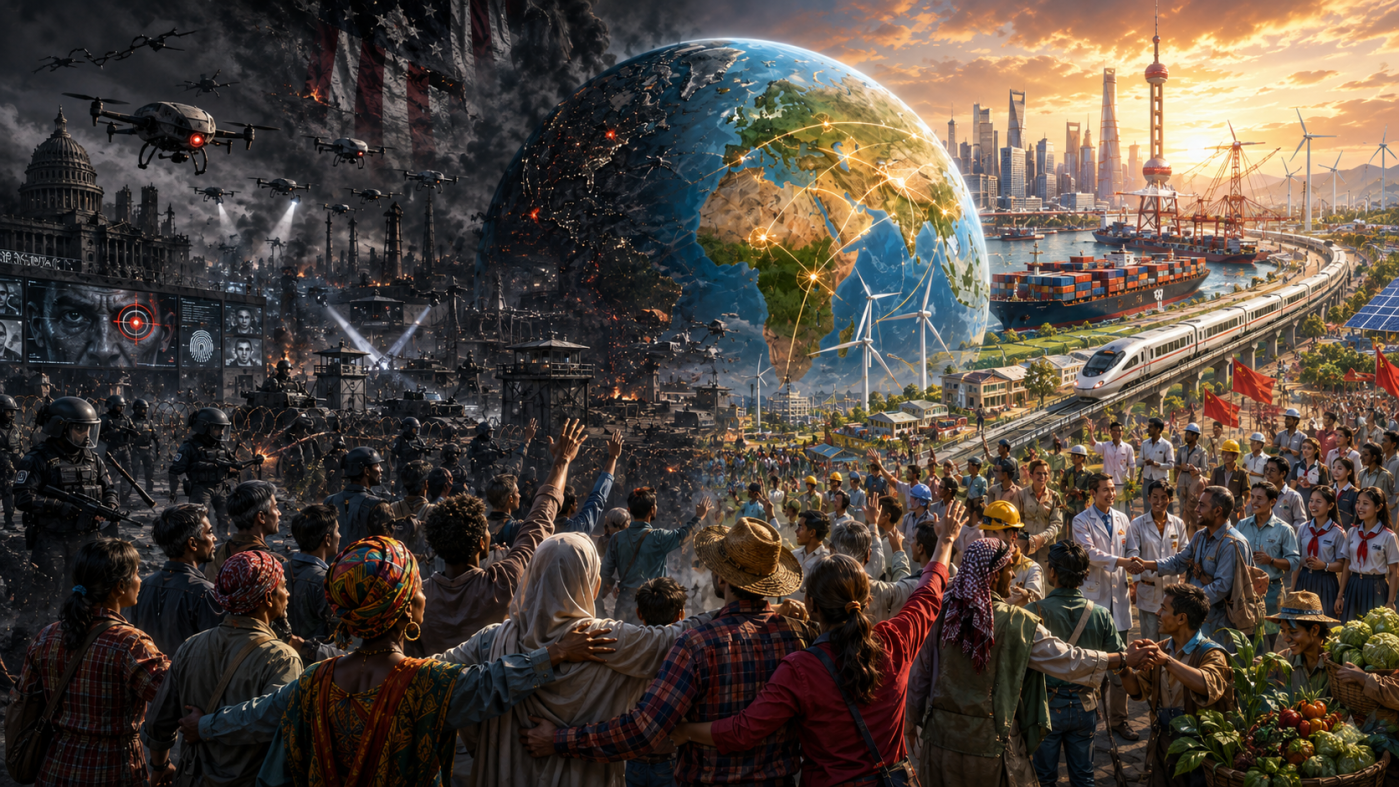
The BBC reports a historic turn toward China, then works to contain its meaning by reducing China’s appeal to image management and Washington’s collapse to Donald Trump’s volatility. Beneath the poll lies a harder material record: wars, coups, foreign military bases and sovereign interference on one side, expanding trade, infrastructure and development partnerships on the other. The world is not comparing reputations but relationships, and China’s rise is weakening the imperial monopoly without automatically transforming multipolarity into socialism. The task now is to turn that fracture in U.S. legitimacy into organized antiwar refusal through political education, labor action, diaspora resistance and a mass movement against military confrontation with China.
Prince Kapone | Weaponized Information | July 15, 2026
I. When the Numbers Refuse to Behave
Something unusual has happened inside the machinery of Western opinion-making: the numbers have escaped their assigned role. In Tessa Wong’s July 15, 2026 BBC report, “More people around the world now favour China over the US, Pew study suggests,” the Pew Research Center finds China viewed more favorably than the United States in twenty-five of the thirty-six countries surveyed. It is the first time Pew has recorded such a result on this scale. Confidence in Xi Jinping remains limited, but it exceeds confidence in Donald Trump across much of the sample. Respondents also describe China as less likely to interfere in other countries and more reliable in world affairs. The empire has received its report card, and even the teacher appears reluctant to read it aloud.
The BBC occupies a central position within Britain’s public-service broadcasting system and, more broadly, within the Atlantic media order. Its authority rests on a cultivated voice of institutional restraint: the measured sentence, the credentialed expert, the appearance of moderation. That style rarely announces ideology directly. It allows ideology to enter as explanation, clarification and common sense.
The article cannot bury the central finding because the finding is the story. It therefore performs a subtler operation: it reports the verdict while disciplining its meaning. China’s improved standing is presented less as the outcome of material relationships than as a triumph of image management. Beijing has been “working hard to burnish its image.” Its growing attraction becomes “soft power.” Its perceived predictability is separated from the actual conduct that might make a country appear predictable. China, in this framing, does not earn confidence through its international behavior. It acquires confidence through presentation, as though millions of people across Asia, Africa, Latin America and Europe had confused a publicity campaign with their own political experience.
The deterioration of the United States receives an equally convenient treatment. The article attributes much of the shift to the “volatility” of American policy under Trump: annexation threats, military force and economic disruption. The word performs heavy ideological labor. Volatility suggests instability of temperament rather than continuity of power. It turns domination into unpredictability and reduces a widening crisis of legitimacy to the behavior of one unusually reckless president. The implication is reassuring: the United States has not been rejected for what it does, only temporarily penalized for doing it without sufficient elegance.
Having allowed the survey to speak, the article summons an authorized interpreter to prevent the reader from wandering toward unauthorized conclusions. Carnegie-affiliated scholar Chong Ja Ian concedes that China may appear more predictable, then restores the approved vocabulary: Xi is a “major authoritarian figure”; China has become more “assertive”; its policies can be “coercive”; questions remain about minorities. These claims do not explain why respondents regard China as less interventionist than the United States. Their purpose is inoculation. The reader is permitted to recognize American decline only after being reminded that China remains morally suspect.
This is the article’s central balancing act. It reports that many people now consider China more favorable, more reliable and less intrusive, but it refuses to let those judgments stand as political intelligence. Western respondents may express opinions. Respondents from the Global South must have their opinions explained back to them. Their conclusions become products of Chinese image-making, American volatility or insufficient attention to the proper liberal anxieties.
The ideological function is therefore containment. The BBC acknowledges that the United States is losing the consent through which power presents itself as leadership, then narrows that reversal into a competition between national reputations. America has damaged its brand; China has polished its own. The historical and material meaning of the shift is postponed, softened and placed under expert supervision before the reader can ask the forbidden question: what has the world actually been comparing?
II. The Material Record Beneath the Poll
The reversal identified by Pew rests on interviews with 42,151 adults in thirty-six countries conducted between February 8 and May 13, 2026. The survey was not a population-weighted referendum of the entire world, and China itself was not included, but its geographic range captured a substantial cross-section of opinion across Europe, Asia, Africa, the Middle East and the Americas. China received higher favorable ratings than the United States in twenty-five countries. Washington led in only six: India, Japan, the Philippines, South Korea, Poland and Israel.
The movement was produced by both rising assessments of China and deteriorating assessments of the United States. Canada registered one of the clearest reversals. In 2023, 57 percent of Canadians held a favorable view of the United States and only 14 percent viewed China favorably. By 2026, China stood at 44 percent and the United States at 33 percent. China also reached record favorable ratings in Italy, Spain, Colombia, Mexico, Indonesia, Malaysia, Nigeria and Turkey.
The trend extends beyond Pew’s survey. Gallup’s polling in more than 130 countries found that approval of Chinese leadership reached 36 percent in 2025 while approval of U.S. leadership fell to 31 percent. Disapproval of American leadership rose to 48 percent, its highest level in Gallup’s global tracking. Neither country received majority approval, but China held its widest advantage over the United States in nearly two decades.
The survey’s questions on foreign policy revealed an even larger difference. Across seventeen middle-income countries, a median of 75 percent said the United States interferes a great deal or a fair amount in the affairs of other countries, compared with a median of 45 percent who said the same of China. Respondents also tended to rate China as the more reliable partner and the stronger contributor to international peace and stability.
In South Africa, 72 percent described China as reliable, compared with 46 percent for the United States. Sixty-four percent said China considers the interests of countries like theirs when making international decisions, while 42 percent said the same of Washington. In Pakistan, 84 percent considered China reliable, compared with 36 percent for the United States.
Across the thirty-six surveyed countries, a median of 35 percent said the United States contributes to international peace and stability, and a median of 32 percent said Washington considers the interests of other countries. A median of 39 percent said the U.S. government respects the personal freedoms of its own people. The last measure declined by double digits in nearly every country where Pew had comparable data from 2021.
The polling period coincided with major uses of American military and economic power. In January, U.S. forces carried out what the White House described as the capture and extradition of Venezuelan President Nicolás Maduro. A subsequent executive order placed revenue derived from Venezuelan natural resources into designated U.S. Treasury accounts intended to advance American foreign-policy objectives.
On February 28, while Pew’s interviews were underway, the United States and Israel opened war against Iran. The Pentagon recorded that Operation Epic Fury began striking Iranian territory under presidential direction. During the same survey period, a thirty-six-country median of 74 percent disapproved of Trump’s handling of Iran. Pew’s analysis found that attitudes toward the United States worsened as the war and the fieldwork continued.
These actions followed a longer documented history of political intervention. The U.S. State Department’s historical archive identifies PBSUCCESS as the Central Intelligence Agency operation that led to the 1954 overthrow of Guatemala’s elected government. Declassified instructions concerning Chile established that it was the “firm and continuing policy” of the United States that President Salvador Allende be overthrown through a coup while American involvement remained concealed. U.S. programs subsequently financed political pressure, propaganda operations and efforts to divide and weaken his government.
The two countries also maintain military presences abroad on sharply different scales. A U.S. Government Accountability Office assessment counted almost six hundred American military sites overseas in 2018. China’s Ministry of National Defense identifies its installation in Djibouti as the People’s Liberation Army’s first overseas support base, established to support escort, peacekeeping and humanitarian operations in and around the Horn of Africa. The figures come from different years and use different institutional classifications, but they establish the relative scale of the two overseas military footprints.
China’s international expansion has developed primarily through trade, infrastructure and state-to-state economic cooperation. By 2025, China had become a major trading partner of more than 160 countries and regions. Its trade with Latin America reached $518.47 billion in 2024, and China had become the leading trading partner of Brazil, Chile and Peru.
Transport infrastructure constructed through Belt and Road cooperation has also altered regional trade conditions. World Bank modeling estimated that completed transport corridors could reduce travel times along participating routes by as much as 12 percent, lowering transport costs and improving access to ports and regional markets where complementary regulatory reforms are implemented.
China’s declared framework for cooperation with Africa states that Beijing will respect African countries’ development choices, refrain from interfering in their internal affairs, avoid imposing its will, attach no political conditions to assistance and seek no unilateral political gain from investment and financing. These commitments coexist with negotiations, disputes and differences in bargaining power across individual projects, but they define the formal diplomatic basis on which China presents its development partnerships.
The poll therefore emerged from a measurable international setting: declining confidence in U.S. leadership, widespread perceptions of American interference, active wars and sovereign interventions during the survey period, a long declassified record of covert political operations, major differences in overseas military reach, and China’s expanding role in trade, infrastructure and development cooperation.
III. The World Is Comparing Relationships, Not Reputations
The BBC presents the Pew findings as a disturbance in the international marketplace of national images. America has damaged its brand; China has improved its presentation. One government has become volatile, the other predictable. But nations are not consumer products, and the people surveyed are not choosing between advertising campaigns. They are comparing two different ways that great power enters their lives.
The survey’s most important finding is therefore not that China has become more popular. It is that the United States is increasingly recognized as an interfering power. That judgment rests upon a material history. Across administrations and decades, Washington has treated the sovereignty of weaker nations as conditional: valid when their governments comply, disposable when they do not. Covert destabilization, coups, military assault and foreign control over national resources are not failures of American leadership. They are among the instruments through which that leadership has been exercised.
Trump did not invent this relationship. He has made it more naked. Previous governments wrapped coercion in the language of democratic responsibility, international order and humanitarian concern. Trump speaks with fewer courtesies. The BBC mistakes this loss of etiquette for a change in essence. What it calls volatility is the imperial structure operating with less diplomatic camouflage.
This explains why the crisis cannot be repaired by changing presidents or hiring better public-relations specialists. When large majorities across middle-income countries identify the United States as an interfering force, they are not reacting only to an unpleasant personality in the White House. They are passing judgment on an accumulated relationship between the imperial center and societies whose political possibilities have repeatedly been narrowed by external power.
The scale of the overseas military presence gives that relationship a permanent physical form. Hundreds of military sites do more than protect isolated national interests. They establish a world in which one state claims an exceptional right to project armed power across continents. At that scale, quantity becomes quality. A global network of bases is not simply foreign policy conducted in many places. It is an architecture through which hierarchy is enforced.
China’s international expansion has developed along another principal route. Its growing influence rests largely on trade, infrastructure, finance and state-to-state cooperation. Countries engage China because they require markets, transport links, industrial goods, investment and alternatives to dependence upon institutions dominated by the old imperial powers. These relationships involve bargaining, disputes and unequal capacities, but they do not reproduce the same historical combination of worldwide military deployment, coups and political supervision.
This distinction is precisely what the BBC cannot permit to become too visible. Once the survey reveals that respondents consider China less intrusive and more reliable, the article redirects attention toward Xi Jinping’s personality and the familiar vocabulary of authoritarianism. Chinese policy is personalized. American power is depersonalized. China becomes the expression of one leader’s character, while the United States becomes an essentially legitimate system temporarily disfigured by Trump.
A materialist analysis reverses the method. It begins not with the moral personalities of presidents but with the institutions, economic relationships and forms of power through which states act. The central issue is not whether Xi is personally admired. Confidence in both leaders remains limited. The central issue is why people who express little confidence in either man nevertheless judge China more favorably, more reliably and less interventionist than the United States.
The answer is present in the contrast established by the factual record. One power has accumulated influence through an enormous military footprint and a documented practice of determining political outcomes beyond its borders. The other has expanded chiefly by becoming a major trading partner, financing and constructing infrastructure, and declaring that cooperation should not require political submission. The world is not confusing these relationships. The BBC is working to blur them.
This does not require pretending that every Chinese project produces equal benefits or that development agreements abolish conflict between states with different levels of economic power. China’s formal commitments to non-interference are tested in actual relationships, where interests are negotiated and contradictions persist. But contradiction does not erase distinction. A disputed railway project and a foreign-sponsored coup do not become the same merely because both involve powerful states.
For oppressed nations, the rise of another major economic partner changes the field of struggle. A government with access to multiple markets, sources of finance and infrastructure partnerships possesses greater room to negotiate than one confined to a single imperial system. That room does not guarantee liberation. National elites may use it for their own accumulation, and sovereign governments may remain separated from the needs of workers and peasants. Multipolarity is not socialism. It is a weakening of monopoly—the opening of political space in which deeper struggles over development, class power and national direction become more possible.
This is why China’s rise creates such anxiety in the Atlantic establishment. The challenge is not merely that another state has accumulated wealth. China reduces the ability of the United States to make isolation economically fatal. It gives countries options where imperial discipline once depended upon the absence of alternatives. The old powers may still possess superior military reach, but they can no longer assume that every road, port, loan, market and diplomatic relationship must pass through their gate.
The Pew survey records the ideological consequence of this material transformation. The United States retains immense power, but it is losing the consent that allowed domination to appear as leadership. More people are beginning to separate the language of freedom from the practice of interference, and the language of order from the machinery of war. The empire has not lost its weapons. It is losing its authority to explain what those weapons mean.
IV. Turn the Breach into Organized Refusal
The collapse of imperial credibility abroad does not automatically weaken the war machinery at home. The United States can lose the argument across much of the world while continuing to teach its own workers that China is their enemy. The immediate task is to carry the contradiction exposed by the Pew survey into workplaces, campuses, churches, veterans’ halls and neighborhood organizations: the country Americans are being prepared to confront is viewed by much of the world as less intrusive and more reliable than the power demanding the confrontation.
The Veterans For Peace China Working Group offers a concrete organizational base for this work. It challenges official disinformation, studies U.S.–China relations and advances the organization’s Pivot to Peace with China and the World resolution against military confrontation and anti-Chinese hostility. Veterans can bring that campaign into union meetings, schools and community forums with the authority of people who know what happens after politicians finish polishing the language of war. Veterans For Peace also makes its annual reports and recent IRS filings publicly available, providing a stronger basis for organizational accountability than political branding alone.
The CODEPINK “China Is Not Our Enemy” campaign supplies educational materials and public actions directed against sanctions, military escalation and the manufacture of a new Cold War. Its recurring China book club provides a model that local organizers can reproduce: sustained collective study followed by public forums, media interventions, petitions and pressure on elected officials. CODEPINK operates as a registered nonprofit charity, although ordinary public tax records do not reveal every contributor. Its campaigns should therefore be judged through their politics, public record and concrete usefulness rather than treated as self-validating because they carry an organizational logo.
The Qiao Collective identifies itself as an all-volunteer formation of diaspora Chinese writers, artists and researchers. Its essays, translations and historical resources can support study circles examining how selective history, racial fear and loaded vocabulary turn China from a contradictory society into a cardboard enemy. Because Qiao does not publish the financial documentation available for established nonprofits, its strongest role here is as an educational resource—not as a substitute for accountable local organization.
The organizing instrument can be simple. Produce a one-page sheet placing Pew’s findings on interference, reliability and peace beside the documented record of military bases, coups, sanctions and war. Move resolutions through unions, student governments, churches and civic groups opposing military encirclement and anti-China propaganda. Demand public hearings on war spending. Ask every elected official why weapons systems remain affordable while housing, healthcare, schools and public infrastructure are declared too expensive.
The world has begun withdrawing its consent from U.S. domination. Those living inside the imperial center must convert that loss of legitimacy into refusal: no war with China, no blank check for military encirclement and no working-class blood for a declining empire. Multipolarity has opened the breach. Organization must keep it open.


Leave a Reply