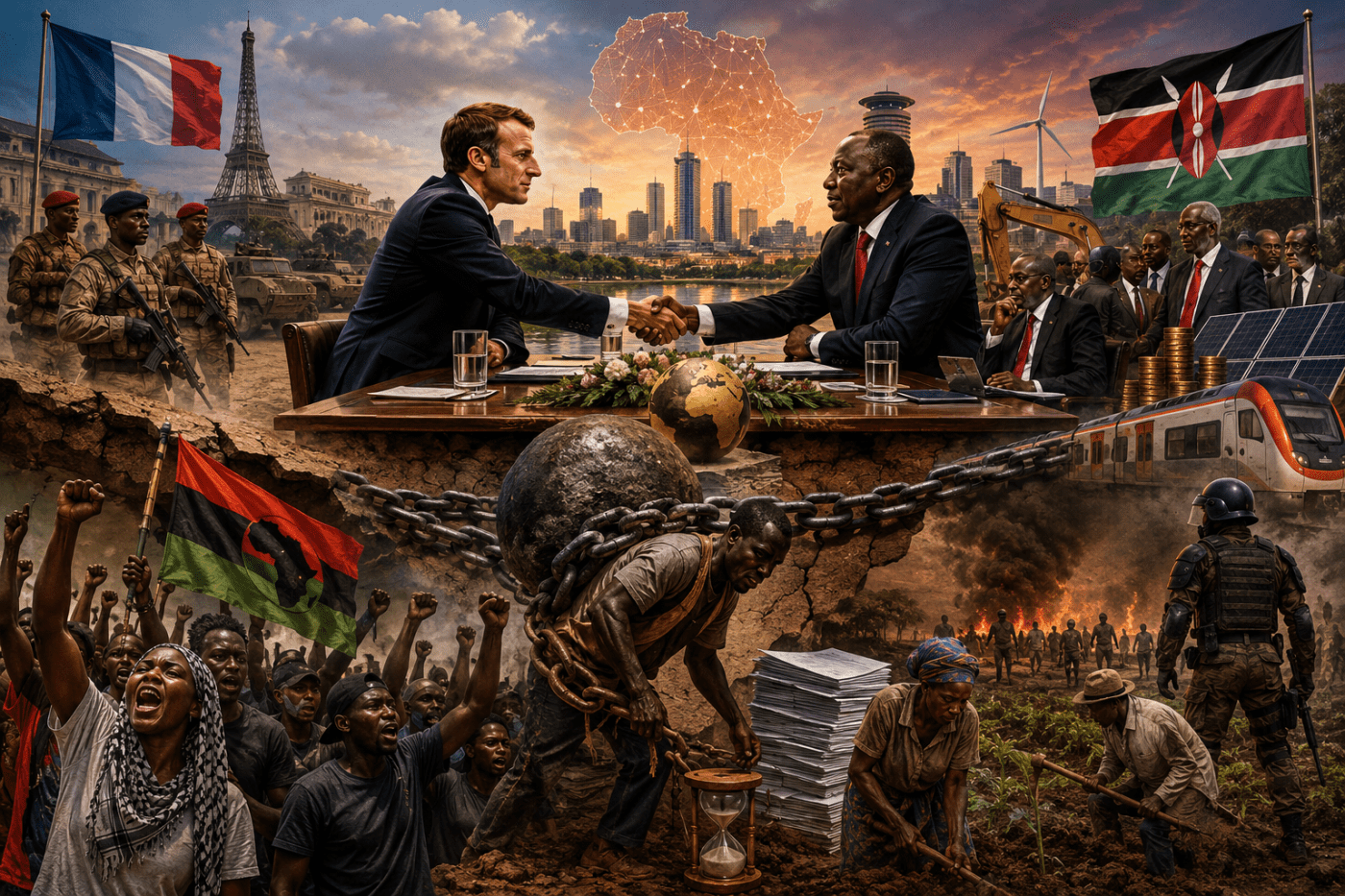
Business Insider Africa sells the Africa Forward Summit as a clean diplomatic reset, but its language of innovation and investment hides the old machinery of empire in new clothes. Behind the summit branding sits France’s retreat from the Sahel, Kenya’s debt and austerity crisis, French military repositioning, and Nairobi’s role as a hinge between Western power and multipolar infrastructure. The real story is not partnership, but imperialism moving sideways after being blocked elsewhere. Across Kenya, Africa, and the diaspora, revolutionary and Pan-African forces are already building the counter-summit against Françafrique’s latest disguise.
By Prince Kapone | Weaponized Information | May 8, 2026
The Empire Calls Its Retreat a Reset
In “Ruto and Macron redefine Africa-France ties as 53-year summit tradition moves outside Francophone Africa for the first time,” published by Business Insider Africa on May 8, 2026, Adekunle Agbetiloye presents the upcoming Africa Forward Summit in Nairobi as a historic diplomatic turn. Kenya, we are told, will become the first non-Francophone African country to host the old Africa-France Summit tradition, now dressed in new clothes, given a fresh name, and marched onto the stage under the banner of innovation, investment, climate finance, and global financial reform. Presidents William Ruto and Emmanuel Macron appear in the article as the co-managers of this symbolic renovation, as though the problem with France’s African policy was never domination, extraction, military occupation, or neocolonial management, but merely poor branding.
The outlet itself matters. Business Insider Africa is not a workers’ paper, not a peasant organ, not a revolutionary Pan-African bulletin written from the dust of the street or the hunger of the village. It is a corporate market-news platform, part of the digital business press ecosystem, where Africa appears most comfortably as a field of investment opportunity, elite leadership, market reform, and entrepreneurial promise. In that world, imperialism rarely walks through the front door wearing its own name. It arrives as “partnership.” It carries a briefcase. It speaks the language of innovation panels, infrastructure corridors, green finance, and reform of the international financial architecture. The thief has learned to say “stakeholder.”
Agbetiloye’s professional location also helps explain the article’s texture. As a reporter focused on African economies, technology, energy transition, and climate change, he writes from the very policy terrain where empire now prefers to conduct its softer operations. The article is not crude colonial nostalgia. It is smoother than that. It does not shout for France’s return to Africa. It whispers that France is adapting. It does not announce imperial retreat. It calls the repositioning a reset. It does not ask why France is being driven out of its old spheres of influence. It asks how France might find new partners beyond them.
The first major device at work is glittering generality. “Redefine,” “reset,” “innovation,” “growth,” “investment,” and “long-term economic partner” float through the piece like incense in a boardroom chapel. These words are clean because they have been emptied. They do not tell us who owns, who pays, who commands, who borrows, who polices, who profits, or who bleeds. They create a pleasant fog around power. By the time the reader reaches the summit’s Business Forum, the political economy of domination has been washed into the respectable language of cooperation.
The second device is omission, the oldest servant in the propaganda household. The article mentions France’s troubles in West Africa, but only as background scenery for a new French opportunity in Kenya. It does not seriously excavate Françafrique, the French military footprint, CFA-zone dependency, African resistance to French domination, Kenya’s austerity crisis, or the organized counter-summit being built against this gathering. The Sahel appears, but only as the place France is leaving, not as the place where African sovereignty movements have forced a rupture in the old imperial arrangement. That is a useful little trick: show the wound, hide the weapon, then compliment the doctor for changing hospitals.
The third device is narrative framing. France is presented as a power trying to modernize its relationship with Africa. Kenya is presented as the symbol of a new diplomatic horizon. Macron becomes the reformer of a tired tradition, and Ruto becomes the host of Africa’s forward march. But the article’s frame never asks whether this forward motion is being directed by African workers, peasants, youth, and popular forces, or by presidents, financiers, corporations, and military planners. The people are not subjects here. They are scenery behind the summit banner.
The fourth device is card stacking. The article gives the reader enough facts to appear informed: Sahel states expelled French troops; France wants new partners; Kenya is hosting the summit; investment talks will take center stage. But the deck is arranged so that these facts point toward one conclusion: France is adjusting to a changing Africa. What disappears is the sharper conclusion: France is searching for new footholds after political defeat and delegitimation in old ones.
Finally, there is vagueness, the polished cousin of evasion. “Economic cooperation” is left undefined. “Innovation” is left unexplained. “Climate finance” is treated as benevolent aspiration rather than a terrain of debt, dependency, and control. The article gives us the vocabulary of development without the anatomy of power. That is why this piece must be excavated. Beneath its summit language lies the more serious question: is Africa moving forward, or is French imperialism merely learning to retreat sideways?
Where the Summit Lights Cannot Hide the Debt
Kenya will host the Africa Forward Summit in Nairobi on May 11–12, 2026, marking the first time the old Africa-France summit framework has been moved outside France or Francophone Africa since the format began in 1973. The language surrounding the gathering is polished carefully for investors, diplomats, and development technocrats: trade, infrastructure, innovation, clean energy, AI, education, and reform of global finance. Paris presents the summit as proof that France is modernizing its relationship with Africa. Nairobi presents it as evidence that Kenya has become a rising diplomatic and economic center inside the changing world order. But beneath the summit branding and polished rhetoric sits a much harsher reality. France is not arriving in Nairobi from a position of continental strength. It is arriving after being pushed backward across major parts of West Africa.
The Nairobi summit cannot be separated from the fact that Mali, Burkina Faso, and Niger formally exited ECOWAS and consolidated the Alliance of Sahel States, while French troops were expelled or forced into withdrawal across broad sections of the Sahel and wider West Africa. Senegal also moved toward ending permanent foreign military presence on its territory. The old Françafrique system — built through military dependency, comprador elites, debt arrangements, intelligence penetration, currency domination, and corporate extraction — has entered open crisis. The summit in Nairobi emerges directly from that rupture even if the summit language carefully avoids admitting it. Empire rarely announces retreat honestly. It prefers softer language. Defeat becomes “strategic adaptation.” Retreat becomes “repositioning.” Colonial contraction suddenly develops a vocabulary filled with innovation hubs, sustainability forums, and investment partnerships.
Across Kenya, opposition to the summit has already crystallized around the understanding that France is attempting to establish new strategic footholds in East Africa after its setbacks in the Sahel. The Pan-Africanism Summit Against Imperialism (PASAI) was organized as a direct counter-summit against the Nairobi gathering, bringing together Communist Party Marxist–Kenya and allied Pan-African forces around an explicitly anti-imperialist position. Yet this entire political terrain disappears from the corporate summit narrative. The masses resisting the summit are erased so thoroughly that one could almost believe the gathering descended peacefully from heaven untouched by politics, class contradiction, or history itself. Apparently the role of ordinary Africans in these conversations is to stand quietly in the background while presidents, investors, financiers, and development consultants redesign the continent between catered lunches and infrastructure panels.
The counter-summit forces have framed the Nairobi gathering as Françafrique in updated form. Military domination is increasingly paired with climate finance, infrastructure diplomacy, AI cooperation, educational exchange, and technocratic reform language. The colonial administrator barking orders from the governor’s palace has largely been replaced by consultants carrying PowerPoint presentations about sustainability and growth corridors. The extraction remains. The vocabulary changed. Empire hired a branding agency and discovered green fonts.
The military dimension of the summit becomes impossible to ignore once one steps outside the narrow confines of summit public relations. The gathering follows the signing of a France-Kenya defense cooperation agreement and the arrival of roughly 800 French soldiers in Mombasa for joint military exercises. France quietly secured deeper military positioning in East Africa while publicly speaking the language of innovation and economic partnership. That contradiction is not accidental. Empire has always preferred entering through two doors at once: one hand carrying investment brochures while the other secures troop access, intelligence cooperation, logistics corridors, and regional strategic positioning. One speech talks about sustainability while another meeting quietly discusses force projection.
At the same time, Kenya’s infrastructure decisions expose the deeper contradiction hidden beneath the summit spectacle. Kenya recently abandoned a major French-led Vinci highway project and shifted toward Chinese firms instead. That decision matters because Kenya is not simply locked into one geopolitical bloc. The Kenyan state is maneuvering between competing centers of global capital and geopolitical influence. On one side stand France, the IMF, Western finance institutions, and U.S.-aligned security structures. On the other stand Chinese infrastructure financing, Belt and Road integration, BRICS+ expansion, and wider multipolar openings. Ruto’s government attempts to balance between these forces while extracting leverage wherever possible. The Kenyan masses, meanwhile, are left balancing the actual bill.
That contradiction sharpened further when China and Kenya elevated bilateral relations in 2025 around what Beijing described as an “all-weather China-Africa community with a shared future”. Cooperation agreements expanded across railways, transport, e-commerce, technology, water resources, vocational education, and trade. Kenya simultaneously pursued negotiations with both China and the United States. This is what multipolar contradiction actually looks like on the ground: not a neat transition from one bloc to another, but unstable maneuvering inside a capitalist-imperialist world system undergoing transformation.
Yet while summit officials speak constantly about “growth,” “innovation,” and “partnership,” Kenya’s domestic terrain remains defined by debt, austerity, and social unrest. Kenya’s debt crisis is deeply tied to IMF restructuring, fiscal consolidation, and austerity discipline. The 2024 Finance Bill revolt did not emerge from nowhere. Workers and youth did not suddenly become irrationally angry about taxation. The uprising developed from a deeper crisis involving unemployment, inflation, privatization, declining living standards, debt servicing, and fiscal extraction imposed on an already exhausted population. Tax increases fell heavily on food, transport, wages, mobile money, sanitary products, and basic working-class survival. The same government now hosting investment summits spent the previous year attempting to squeeze more revenue from a population already struggling to survive.
This is precisely why the #OccupyParliament movement framed the crisis as systemic rather than merely legislative. The issue was never just one finance bill. The issue was a neocolonial political economy in which debt servicing, austerity, elite accumulation, foreign dependency, and police repression increasingly shape ordinary life. Corporate reporting prefers speaking about “growth” because growth sounds neutral and scientific. But capitalism loves infrastructure projects far more than it loves discussing evictions, wage suppression, privatization, police violence, or debt repayment schedules. Investors celebrate development corridors. The people living beside those corridors are usually introduced later by riot police.
The summit narrative also completely erases Kenya’s role in the U.S.-backed intervention in Haiti. Kenyan police deployments to Haiti became the Black face of a Western-backed intervention apparatus, revealing the broader geopolitical role Kenya’s ruling bloc is attempting to play inside the imperial system. Kenya is not functioning merely as a development partner. It is increasingly operating as a regional security subcontractor aligned with wider Western strategic interests.
The Haiti question loops directly back to France itself. France’s role in Haiti stretches from colonial slavery and independence extortion to modern interventionist arrangements that helped destabilize Haitian sovereignty after 2004. The Nairobi summit therefore cannot be understood in isolation. Kenya’s ruling bloc now stands at the crossroads of multiple imperial relationships simultaneously: French military recalibration in Africa, IMF debt discipline, Western-backed security outsourcing in Haiti, and expanding Chinese economic integration through multipolar infrastructure development.
The Africa Forward Summit sits precisely at that intersection. It is not merely a diplomatic gathering. It is a snapshot of a world system in transition: old imperial powers retreating and reorganizing, rising multipolar forces expanding influence, comprador states maneuvering between competing blocs, and popular movements struggling to force sovereignty into a conversation dominated by presidents, investors, military planners, finance ministers, and development technocrats. That is the terrain hidden beneath the summit logo.
The Empire Moves Sideways
The real story unfolding in Nairobi is not that France suddenly discovered respect for African sovereignty after half a millennium of slavery, conquest, extraction, assassination, debt domination, military occupation, and neocolonial manipulation. Empires do not wake up one morning with moral clarity. They wake up when the balance of forces changes against them. What is happening in Kenya is not the birth of a kinder relationship between France and Africa. It is the political expression of an old imperial power attempting to reorganize itself after suffering strategic defeat across parts of the continent.
For decades, France maintained influence in Africa through the architecture commonly known as Françafrique: military bases, intelligence penetration, comprador political classes, debt dependency, currency control, elite patronage networks, and corporate extraction protected under the language of “partnership” and “stability.” That architecture did not collapse because Paris suddenly became enlightened enough to dismantle it voluntarily. It entered crisis because contradictions accumulated. The masses grew restless. Soldiers refused humiliation. Youth grew up under permanent austerity while hearing endless lectures about democracy from governments that backed dictators, plundered resources, and stationed troops indefinitely across African soil.
The Sahel rupture changed the atmosphere completely. Mali, Burkina Faso, and Niger did not merely expel French troops. They shattered the aura of inevitability surrounding French imperial power in Africa. They demonstrated that the old security arrangement could be openly challenged. That is why Nairobi matters so much. France is now searching for new corridors into the continent, especially in regions where the political terrain appears more stable, more diplomatically flexible, and more integrated into Western financial structures.
Kenya under Ruto occupies a contradictory and unstable place inside this wider transition. The Kenyan state is not simply a puppet tied mechanically to one foreign bloc. It is maneuvering between competing centers of global power while attempting to preserve elite accumulation and internal stability. On one side stand the IMF, Western finance institutions, France, and U.S.-aligned security structures. On the other side stand China, BRICS+, Belt and Road integration, expanding South-South cooperation, and the wider openings emerging from multipolarity. The Kenyan ruling bloc attempts to balance between these forces while extracting maximum leverage from all sides at once.
But this balancing act is not being performed from a position of genuine sovereignty. A state buried under debt, dependent on foreign financing, disciplined through IMF restructuring, and pressured constantly by external capital cannot simply maneuver freely like some neutral chess player floating above the world system. Dependency narrows the horizon of choice. That is why the same government hosting summits about innovation and African partnership spent the previous year imposing tax hikes, austerity measures, and fiscal extraction on an already exhausted population. Debt is not merely an economic relation. It is political command disguised as accounting.
This is also why the Nairobi summit cannot be understood separately from Kenya’s role in Haiti. The same state presenting itself as a diplomatic bridge between Africa and the world simultaneously functions as a subcontractor inside the wider imperial security system. Kenyan police deployed to Haiti under the banner of international stabilization became the Black face of an intervention structure shaped largely by Washington, Paris, Ottawa, and the wider imperial order. That contradiction matters deeply because it reveals the difference between African sovereignty and comprador administration. One advances the self-determination of oppressed peoples. The other helps manage instability on behalf of stronger powers.
At the same time, the rise of multipolarity has undeniably altered the terrain beneath imperialism itself. China’s expanding economic role in Africa, the growth of BRICS+, widening South-South trade, infrastructure financing outside traditional Western channels, and new forms of technological cooperation have weakened the absolute monopoly the old Atlantic powers once exercised over development pathways. This matters enormously. The emergence of alternative centers of power creates room for maneuver that did not previously exist. It opens cracks in the architecture of unipolar domination.
But cracks alone do not liberate anybody. Multipolarity is not magic. A Chinese-financed railway can still pass through land where peasants remain dispossessed. Infrastructure corridors can still enrich elites while ordinary workers struggle to afford transport, food, or housing. New trade partners do not automatically dissolve class contradiction, compradorism, or neocolonial dependency. The central question remains the same: who controls development, who benefits from it, and whose interests ultimately shape the direction of society?
That is precisely what the summit language attempts to bury beneath endless talk of innovation, sustainability, entrepreneurship, and partnership. The issue is not whether Africa should engage the world. Africa has always engaged the world — often at gunpoint, under chains, through debt contracts, or beneath military occupation. The issue is whether Africa’s labor, minerals, infrastructure, agriculture, ports, logistics corridors, and technological future will continue to be organized around external accumulation or around the needs of its own people.
This is why the counter-summit forces emerging in Nairobi matter historically. They represent the return of a political memory that imperialism desperately wants erased: the memory that African sovereignty is not a branding exercise managed through summits and investment forums, but a struggle rooted in anti-colonial resistance, working-class organization, peasant survival, Pan-African solidarity, and revolutionary rupture with systems of dependency.
The Africa Forward Summit therefore reveals far more than its organizers intend. It exposes an old empire attempting to move sideways after being blocked elsewhere. It exposes a comprador political class trying to navigate between imperial decline and multipolar transition while preserving its own position. It exposes the growing fragmentation of unipolar power. And it exposes a deeper truth haunting the entire twenty-first century world order: the masses of the Global South are no longer willing to carry empire quietly on their backs while being told to celebrate “development” that never truly belongs to them.
The Counter-Summit Already Began
The most important thing happening around the Africa Forward Summit is not taking place inside luxury conference halls, investment panels, or carefully staged photo opportunities between presidents and CEOs. It is taking place outside them. While diplomats and financiers gather beneath the language of innovation and partnership, forces inside Kenya and across the African world are already organizing against the deeper realities hidden beneath the summit spectacle: debt dependency, military collaboration, comprador governance, neocolonial extraction, and the repackaging of imperialism through development rhetoric.
The Pan-Africanism Summit Against Imperialism (PASAI) represents the clearest immediate expression of that resistance. Organized as a direct counter-summit to the France-Africa gathering, PASAI brings together anti-imperialist, Pan-African, socialist, and revolutionary forces confronting the attempt to rebrand Françafrique for a new generation. The significance of this development should not be underestimated. The struggle is no longer confined to isolated criticism or scattered protest. A political pole is emerging that openly identifies the summit as part of a wider imperial recalibration taking place across the continent.
At the center of this organizing terrain stands Communist Party Marxist–Kenya, which has consistently framed Kenya’s crisis not as a matter of corruption alone, nor simply poor governance, but as the product of neocolonial dependency tied to foreign capital, debt discipline, comprador rule, and imperial military alignment. This matters because imperialism survives partly by reducing every crisis to technical failure. Inflation becomes mismanagement. Austerity becomes necessary reform. Debt becomes unfortunate arithmetic. CPM-K and allied formations instead insist on locating Kenya’s crisis inside the larger structures of imperialism itself.
That political clarity becomes especially important around the Haiti question. Kenyan revolutionary forces openly condemned the Kenyan police deployment to Haiti as a betrayal of Pan-African principles and a collaboration with imperial intervention. That line of struggle must be strengthened internationally because Haiti and Kenya are not separate issues. The same global order imposing austerity in Nairobi also imposes occupation, destabilization, and external management in Port-au-Prince. The same imperial centers repositioning militarily across Africa are attempting to maintain control across the Caribbean. The same ruling classes collaborating with foreign power in one region often collaborate with it in another.
This is why Black Alliance for Peace has connected the Kenyan deployment in Haiti directly to wider structures of neocolonial militarism and imperial policing. Their intervention matters because it restores an internationalist political understanding that corporate media and liberal NGOs work constantly to erase. The issue is not merely whether Kenya should “help stabilize” Haiti. The issue is who defines stability, who benefits from intervention, and why Black nations are repeatedly asked to police one another on behalf of a world order dominated elsewhere.
The agrarian struggle also remains central. The Kenyan Peasants League continues organizing around food sovereignty, seed sovereignty, anti-GMO struggle, and peasant autonomy at a moment when debt dependency, climate vulnerability, foreign agribusiness penetration, and land pressure increasingly threaten rural survival across the continent. This terrain cannot be separated from the summit’s language of infrastructure and development. Imperialism does not only enter through military agreements and debt contracts. It also enters through seed patents, agricultural dependency, land consolidation, logistics corridors, and the restructuring of food systems around external accumulation.
At the continental and diasporic level, the All-African People’s Revolutionary Party continues advancing a Pan-African socialist orientation rooted in anti-imperialism and African self-determination. The relevance of that tradition becomes sharper as old imperial powers attempt to reposition themselves across Africa under the softer language of partnership and innovation. Pan-Africanism, in its revolutionary form, has always insisted that sovereignty cannot be reduced to flags, elections, or summit diplomacy while the economic structure of dependency remains intact.
The struggle also increasingly intersects with the growing global confrontation around China and multipolarity. No Cold War and related international formations opposing the escalating confrontation against China have correctly identified that a new Cold War would deepen militarization, dependency, sanctions pressure, and geopolitical destabilization across the Global South. Africa is already becoming one of the major terrains where this competition unfolds: through infrastructure battles, debt narratives, military agreements, technology corridors, logistics networks, and ideological warfare over development itself.
This is why the task ahead cannot simply be protest in the narrow sense. The task is political clarification. Every infrastructure deal must be examined materially: who owns it, who finances it, who controls it, who benefits from it, who absorbs the debt burden, and whether it expands genuine sovereignty or simply reorganizes dependency under new management. Every military agreement must be exposed publicly. Every “development partnership” must be stripped of its public-relations language and examined through the lens of class power and imperial strategy.
The slogan “Africa Forward” therefore raises the decisive question: forward toward what? Forward into deeper debt dependency managed through climate finance and military cooperation? Forward into a rearranged Françafrique operating through investment forums instead of colonial governors? Or forward toward sovereignty rooted in workers, peasants, youth, Pan-African solidarity, and socialist development independent of imperial command?
That struggle is already underway. The counter-summit already began long before Macron’s plane landed in Nairobi.
 Weaponized Information
Leave a comment