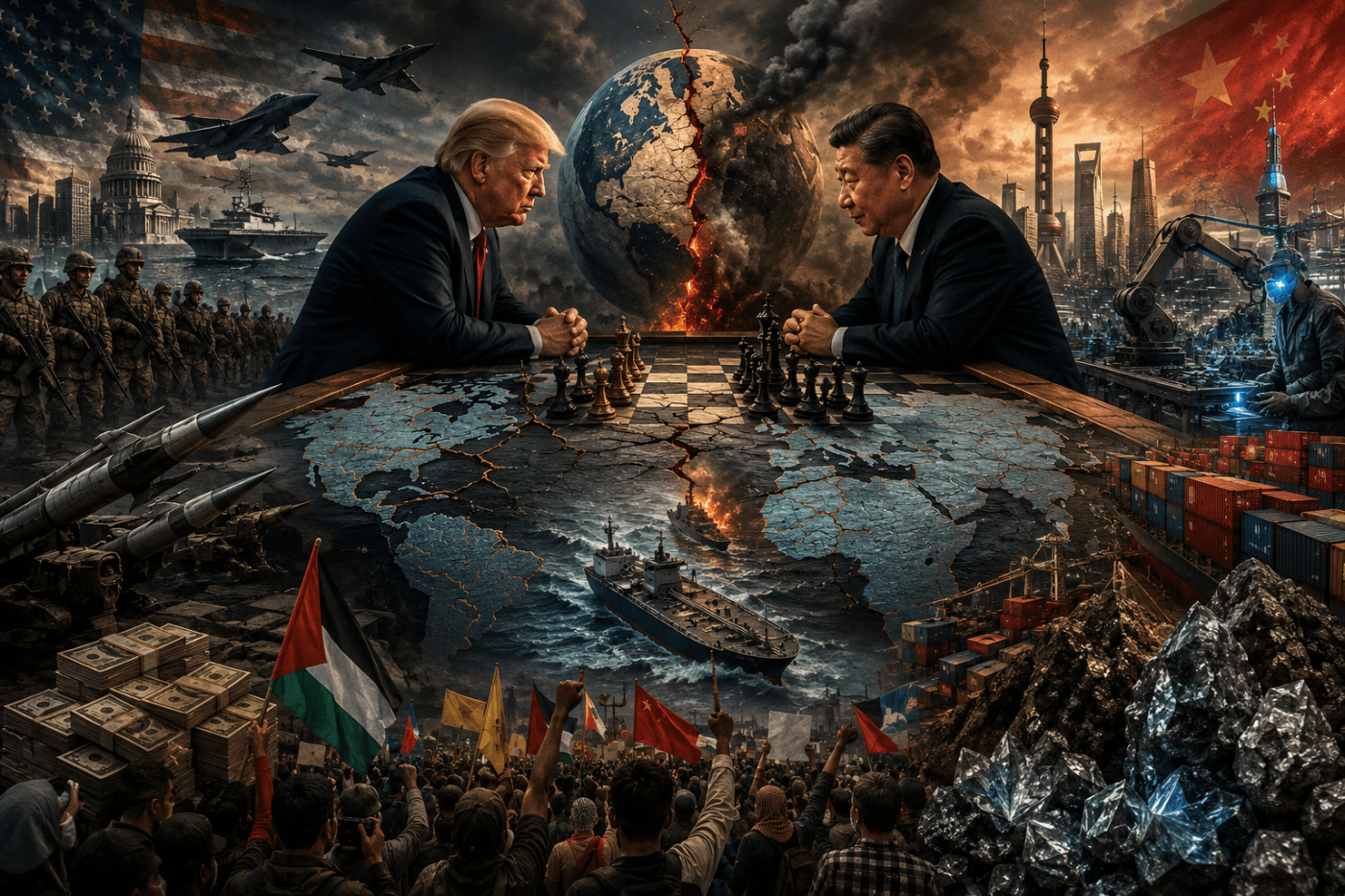
France 24 frames the Beijing summit as a poker match between rival strongmen, masking the deeper structures of imperial crisis, technological warfare, and geopolitical coercion beneath the spectacle. Beneath the summit theater lies a dense architecture of sanctions, military encirclement, semiconductor conflict, rare earth dependency, and unresolved sovereignty struggles stretching from Taiwan to the Strait of Hormuz. The real story is not simply China’s growing leverage, but the unraveling stability of a unipolar system increasingly unable to reproduce its dominance over global production, energy circulation, and technological infrastructure. Across the world, emerging anti-imperialist movements and multipolar solidarity networks are beginning to resist the New Cold War and challenge the casino logic of empire itself.
By Prince Kapone | Weaponized Information | May 13, 2026
The Poker Table Where Empire Hides Its Receipts
France 24’s article, “Who holds the cards at the Trump-Xi summit in Beijing?”, written by Sébastian Seibt and published on May 13, 2026, presents Donald Trump’s visit to Beijing as a high-stakes contest between two giants of world politics. The article tells us that Trump has arrived in China for a two-day summit with Xi Jinping, with tariffs, rare earths, Iran, Taiwan, oil prices, artificial intelligence, and technological rivalry all on the table. Its central argument is clear enough: Xi Jinping appears to be holding more cards than Trump. China has rare earth leverage, Washington has been weakened by war in Iran and global energy instability, and Trump needs a diplomatic victory before the midterm elections come knocking like a bill collector at the mansion door.
But the first thing to notice is the card table itself. The article repeatedly frames the summit through the language of poker: “cards,” “aces,” “trump cards,” and “winning the pot.” This is not accidental decoration. It turns world politics into a gambling scene, as if the fate of workers, peasants, nations under sanctions, and peoples living under the shadow of military escalation were merely chips stacked before two powerful men. The world is burning, the oil routes are shaking, the chip supply chains are militarized, and somehow we are invited to admire the hand management of the gentlemen at the table. One can almost hear the casino music playing while the house counts its profits.
This narrative framing reduces structural crisis to personal maneuver. The article does not begin from the decay of U.S. unipolar power, the militarization of trade, or the long war over technological sovereignty. It begins with Trump and Xi as players in a diplomatic game. The result is a familiar imperial media trick: convert historical forces into personality drama. Tariffs become Trump’s failed gamble. Rare earths become Xi’s ace. Taiwan becomes a bargaining chip. Iran becomes a pressure point. The whole machinery of imperial coercion is packed into the language of competition, as if empire were not a system but a mood swing.
The source hierarchy tells the same story. The article depends heavily on Western academic and security specialists to explain the balance of power. These experts are not irrelevant, but their placement matters. They are made to speak as the sober interpreters of reality, while Chinese, Iranian, Taiwanese, and working-class voices appear mostly as objects of policy. China is analyzed. Iran is discussed. Taiwan is positioned. Workers are affected but absent. The global proletariat and the oppressed nations are nowhere given the dignity of historical agency. Once again, the people who live beneath the weight of these policies are treated like scenery around the decisions of statesmen and CEOs.
The omission is even more revealing. The article names Iran, Taiwan, tariffs, rare earths, and AI, but it does not excavate the coercive architecture beneath them. It does not seriously reconstruct U.S. sanctions, export controls, arms sales, military encirclement, semiconductor restrictions, or the long effort to contain China’s technological rise. It mentions the shadow but not the body that casts it. It tells us the table is tense, but not who built the table, who owns the casino, who controls the door, and who gets beaten in the alley when they refuse to play by house rules.
This is where the appeal to authority performs its quiet labor. The article’s named specialists give the argument a technocratic polish. Their assessments make the conclusion seem like neutral geopolitical accounting: China has leverage, Trump is weakened, Xi may press his advantage. But beneath this supposedly clean analysis lies a political frame. The question is not merely who “holds the cards.” The deeper question is why the world economy has been organized so that minerals, oil routes, islands, chips, and whole nations can be converted into instruments of pressure by ruling classes.
In this sense, the article is not crude propaganda. It is more sophisticated than that. It tells partial truths in a form that protects the larger system from indictment. It can admit U.S. weakness, acknowledge Chinese leverage, and even mock Trump’s bad hand, while still leaving untouched the imperial order that made the game possible. That is the elegance of bourgeois analysis: it may criticize the player, but it rarely burns down the casino.
The Machinery Beneath the Summit
The France 24 article presents the Beijing summit as though it emerged suddenly from diplomatic tension and strategic maneuvering between two rival leaders. But the summit is not floating above history. It sits atop decades of unresolved sovereignty disputes, military positioning, sanctions architecture, technological containment, and struggles over industrial power. Once we move beneath the casino metaphors of “cards” and “aces,” the deeper structure becomes visible.
The 1972 Shanghai Communiqué established the diplomatic basis for normalization between the United States and the People’s Republic of China. In that document, Washington acknowledged that Chinese on both sides of the Taiwan Strait maintain there is one China and that Taiwan is part of China. This matters because the France 24 article treats Taiwan as though it were merely one bargaining chip among many on the summit table. In reality, Taiwan remains one of the central unresolved sovereignty contradictions inherited from the Cold War order.
At the same time, the American Institute in Taiwan openly states that U.S. policy toward Taiwan continues to operate through the Taiwan Relations Act, the Three Joint Communiqués, and the Six Assurances. Washington therefore simultaneously recognizes the One China framework while continuing military and political support for Taiwan. This contradiction is not accidental confusion. It is institutionalized strategic ambiguity built directly into U.S. regional policy.
China’s Foreign Ministry reiterated immediately before the summit that opposition to U.S. arms sales to Taiwan remains “consistent and clear,” emphasizing that Taiwan lies at the core of Chinese sovereignty and territorial integrity. Meanwhile, Taiwanese President Lai Ching-te publicly framed Taiwan’s future through expanded defense spending, strengthened U.S. relations, semiconductor development, and strategic resistance to Beijing. The article references Taiwan primarily as leverage within summit diplomacy, but omits the underlying military architecture: weapons transfers, naval positioning, semiconductor dependency, and the broader U.S. forward-containment system in East Asia.
The same pattern appears around rare earths. France 24 describes China’s export controls mainly as geopolitical leverage over Washington. Yet China’s Ministry of Commerce frames these measures as legal export-control regulations over dual-use materials tied to national security and military applications. Beijing explicitly rejects the characterization of these policies as arbitrary retaliation.
At the same time, Chinese customs data show that the United States remains one of China’s largest trade counterparts even amid tariff escalation and technological confrontation. Chinese commentary surrounding the summit emphasized diversification, industrial adjustment, and market rebalancing rather than simple dependence on the American market. This context is absent from the France 24 narrative, which largely reduces the relationship to tactical pressure and diplomatic advantage.
The Hormuz and Iran question reveals even deeper omissions. China’s Foreign Ministry directly identified the root cause of Hormuz instability as U.S.-Israeli military operations against Iran, a causal chain largely absent from the France 24 framing. The article discusses energy instability and regional crisis, but avoids tracing the military escalation and coercive policies that produced those conditions.
Meanwhile, Iran’s Comprehensive Strategic Partnership agreement with China, established in 2016, spans political, economic, cultural, judicial, security, defense, regional, and international cooperation. Tehran later emphasized implementation of its twenty-five-year cooperation framework with Beijing through infrastructure, energy, finance, and trade integration. This reveals that China-Iran relations are not reducible to sanctions evasion or temporary geopolitical convenience. They are part of a broader long-term restructuring of economic and strategic alignment across Eurasia.
The summit must also be situated within the larger architecture of technological and industrial competition. U.S. Commerce Department budget documents explicitly define policy priorities around strengthening supply chains, advancing “America First Trade Policy,” countering China, and expanding export-control regimes. This places the summit firmly within a wider technological-containment strategy centered on semiconductors, AI systems, strategic minerals, and industrial infrastructure.
Rare earths themselves matter precisely because they are tied to military-industrial production. China’s export-control measures target materials essential to defense-linked supply chains, advanced electronics, EV production, semiconductor systems, aerospace infrastructure, and military technologies. Even Western reporting has acknowledged that Chinese restrictions continue to affect defense manufacturing and strategic technology sectors across the global economy.
China’s Foreign Ministry also emphasized that the Strait of Hormuz carries roughly one-fifth of global oil and LNG flows, including a major portion of China’s energy imports. In other words, the Iran war is not merely a regional security concern. It directly intersects with global energy circulation and the stability of industrial capitalism itself.
Beijing has consistently called for ceasefire, de-escalation, respect for sovereignty, and secure maritime passage through Hormuz while opposing unilateral military escalation disguised as “security enforcement.” At the same time, Iranian officials continue to frame cooperation with China through energy integration, trade coordination, financial cooperation, and regional organizations such as the Shanghai Cooperation Organisation. These relationships reveal the broader geopolitical movement beneath the summit spectacle: the emergence of increasingly interconnected economic and strategic networks outside direct Western control.
Finally, Xinhua framed the summit as taking place amid mounting global uncertainty requiring management between the world’s two largest economies. This is perhaps the clearest contrast with France 24’s framing. The summit is not fundamentally about who “holds the cards.” It is about the instability of a world order where sanctions, military containment, technological restrictions, supply-chain warfare, energy chokepoints, and industrial dependency are converging into one integrated crisis of global power.
When the Empire Discovers It Cannot Eat Its Own Currency
The France 24 article asks who “holds the cards” at the Beijing summit. But that question already accepts the worldview of empire. It assumes the world is still governed primarily through maneuver, prestige, negotiation, and strategic cleverness among powerful statesmen. The deeper reality is harsher and more material than that. The summit is taking place because the old mechanisms through which the United States organized global power are becoming unstable. The problem confronting Washington is not merely that China has leverage. The problem is that the imperial system increasingly depends upon productive capacities, industrial networks, mineral chains, shipping corridors, and technological infrastructures that it no longer fully controls.
For decades the United States presided over a world economy in which it exported finance, imported cheap labor value from the Global South, militarized trade routes, and maintained technological supremacy through sanctions, war, debt institutions, and corporate monopolization. This arrangement appeared eternal to the imperial centers. History had supposedly ended. The bankers toasted globalization while the factories disappeared into Asia. Wall Street inflated itself like a carnival balloon while supply chains stretched across oceans built upon the labor of Chinese workers, African miners, Gulf energy routes, and the disciplined industrial planning of states Washington still imagined it could permanently subordinate.
Now the contradiction has matured. The same imperial system that outsourced production in search of maximum accumulation has discovered that military power alone cannot manufacture semiconductors, refine rare earths, stabilize energy corridors, or magically reconstruct industrial sovereignty once it has been hollowed out by decades of financialization. Empire can print dollars, but dollars cannot be eaten, refined into chips, or welded into missile guidance systems. Even the Pentagon eventually requires actual material production — and material production obeys political economy more than patriotic speeches.
This is why rare earths matter so deeply. The Western media frame them as “leverage,” as though Beijing simply stumbled upon a lucky poker hand. But rare earth dominance emerged from long-term industrial planning, state coordination, infrastructure development, environmental sacrifice, labor organization, and integration into global manufacturing. While American capital chased speculative finance and monopoly rents, China built industrial depth. The contradiction is almost poetic in its cruelty: the empire that preached neoliberal globalization now fears the productive consequences of globalization itself.
The Taiwan question exposes another layer of the crisis. Western media frequently treats Taiwan as an unfortunate “flashpoint,” but in reality it functions as a strategic node within the larger forward-containment architecture surrounding China. Diplomatic ambiguity, arms sales, naval patrols, military integration, and semiconductor concentration transform Taiwan into both a military outpost and an industrial chokepoint. This is not simply about democracy or sovereignty in the abstract. It is about controlling technological infrastructure, sea lanes, and regional power balances in the Pacific.
Yet even here the contradiction deepens. Washington formally acknowledges the One China framework while simultaneously arming Taiwan and embedding it deeper into U.S. strategic doctrine. The result is a permanent state of managed instability — a geopolitical wound deliberately kept from healing because the wound itself serves imperial strategy. The tragedy is that ordinary Taiwanese and Chinese people live beneath the shadow of a contradiction engineered not for peace, but for leverage.
The same logic operates through sanctions and technological containment. Export controls, semiconductor restrictions, AI limitations, and supply-chain interventions are not neutral economic policies. They are instruments of class power deployed internationally. They determine who may industrialize, who may innovate, who may control advanced technology, and who must remain dependent upon imperial centers. Under the language of “national security” lies a deeper struggle over technological sovereignty itself.
Iran enters this terrain through energy circulation and imperial coercion. The Strait of Hormuz is not merely a narrow body of water on a map. It is one of the arteries through which industrial civilization breathes. Oil, LNG, shipping insurance, naval power, sanctions enforcement, and military escalation all converge there. The article presents Iran largely as a destabilizing factor affecting Trump’s diplomatic position. But the larger reality is that the United States and Israel intensified military pressure upon Iran while simultaneously demanding global energy stability. Empire wants domination without consequences, war without disruption, coercion without resistance. It wishes to set fires and then complain about the smoke.
China’s relationship with Iran therefore matters not simply because of oil purchases, but because it reflects the gradual construction of alternative circuits of economic and geopolitical coordination beyond direct Western command. Energy agreements, infrastructure cooperation, regional organizations, and financial coordination all point toward an emerging multipolar landscape. This does not mean a utopia has arrived. China remains integrated into global capitalism and carries its own contradictions, inequalities, and class tensions. But the unipolar era in which Washington could unilaterally dictate the political-economic architecture of entire regions is visibly eroding.
And this is what the summit truly represents. Not a duel between two personalities, but a transition within the world system itself. The United States remains militarily immense, financially powerful, and globally dangerous. Yet it increasingly confronts the limits of militarized imperialism in a world where industrial capacity, technological sovereignty, supply-chain resilience, and strategic resources cannot simply be bombed into obedience.
The France 24 article notices that Washington appears weakened. But it stops short of naming the deeper contradiction. The crisis is not that China has become “too aggressive” or “too powerful.” The crisis is that imperialism can no longer smoothly reproduce the conditions of unchallenged unipolar domination. The summit in Beijing is therefore not merely diplomacy. It is the visible management of imperial decline under conditions where the productive center of gravity of the world economy is shifting while the military-financial architecture of empire struggles desperately to preserve supremacy.
In that sense, the question is not who holds the cards. The real question is whether the old casino of empire can survive a world where the workers, industries, infrastructures, and nations it once treated as subordinate are increasingly capable of reshaping the table itself.
Building Beyond the Casino of Empire
The contradictions exposed by the Beijing summit are no longer confined to diplomatic halls, trade ministries, or military command centers. Across the world, people are beginning to recognize that the same forces driving sanctions, technological containment, militarized trade policy, and war escalation abroad are also deepening austerity, surveillance, precarity, censorship, and social fragmentation at home. The empire’s crisis is not merely geopolitical. It is social, economic, ideological, and civilizational.
What is emerging in response is not yet a unified international movement, but fragments of a new anti-imperialist alignment stretching across continents. These formations vary in size, structure, and political orientation, but many are converging around a shared recognition: the New Cold War against China, the permanent sanctions regime against nations like Iran, and the militarization of the global economy are all components of a larger project to preserve unipolar domination in an era where that domination is increasingly unstable.
No Cold War has become one of the clearest international campaigns opposing the U.S.-led escalation against China. Drawing together organizers, scholars, labor activists, antiwar forces, and anti-imperialist intellectuals across multiple countries, the campaign directly challenges NATO expansion into Asia, anti-China propaganda operations, and the growing normalization of economic and military confrontation. Its significance lies not merely in slogans, but in helping rebuild an internationalist political language capable of resisting the attempt to manufacture consent for a long-term Pacific conflict.
Friends of Socialist China has similarly emerged as an important political education and solidarity platform confronting the propaganda war surrounding China’s development. At a time when Western media institutions increasingly frame Chinese industrial growth and technological sovereignty as existential threats, these networks work to recover historical memory, anti-colonial context, and material analysis. Their work matters because one of the empire’s primary weapons is isolation — separating peoples from one another through fear, caricature, and ideological warfare.
The International Manifesto Group, alongside formations connected to Tricontinental: Institute for Social Research and People’s Dispatch, has helped revive a broader anti-imperialist and multipolar discourse rooted in the traditions of Bandung, national liberation, and Global South sovereignty struggles. Their interventions are important precisely because they reject the old imperial assumption that history belongs exclusively to Washington, Brussels, London, and the financial centers of monopoly capital.
What links these movements is not blind allegiance to any state. It is recognition of a material reality: the struggle over semiconductors, sanctions, rare earths, shipping corridors, AI infrastructure, and military encirclement is simultaneously a struggle over who has the right to develop, industrialize, trade, and determine their own political future outside imperial supervision.
The tasks before anti-imperialist movements therefore extend beyond protest ritual. Political education must become central. Workers in the imperial core must be taught that the same system outsourcing their jobs, privatizing their futures, and drowning them in debt is also constructing military alliances, sanctions regimes, and technological containment systems abroad. The worker whose wages stagnate in Seattle, Liverpool, Johannesburg, São Paulo, or Manila is tied materially to the miner in Congo, the factory worker in Shenzhen, the oil laborer in Iran, and the port worker along the Indian Ocean shipping lanes.
Independent media and revolutionary educational infrastructure are equally critical. The information war surrounding China, Iran, Taiwan, and multipolarity is not secondary theater — it is central terrain. The empire cannot sustain permanent confrontation abroad without manufacturing ideological obedience at home. Every independent study group, labor bulletin, antiwar publication, podcast, reading collective, worker school, and guerrilla intellectual formation becomes part of the struggle against cognitive warfare and imperial mythmaking.
International solidarity must also move from abstraction into concrete practice. Campaigns opposing sanctions, opposing military escalation in Asia-Pacific, defending maritime stability, resisting anti-China racism, supporting Palestinian liberation, and exposing the political economy of the arms industry are all interconnected fronts of the same wider struggle. Multipolarity alone will not automatically liberate humanity, but cracks within the unipolar order create openings through which oppressed nations and working peoples may fight for greater sovereignty, development, and historical agency.
The old imperial order wants the world organized like a casino: a handful of financial elites own the building, the military guards the exits, and the rest of humanity is forced to gamble for survival under rules they never wrote. The task before anti-imperialist movements is therefore not simply to criticize the players at the table. It is to help build the political consciousness, solidarity, and organizational infrastructure necessary to dismantle the casino itself.


Leave a comment