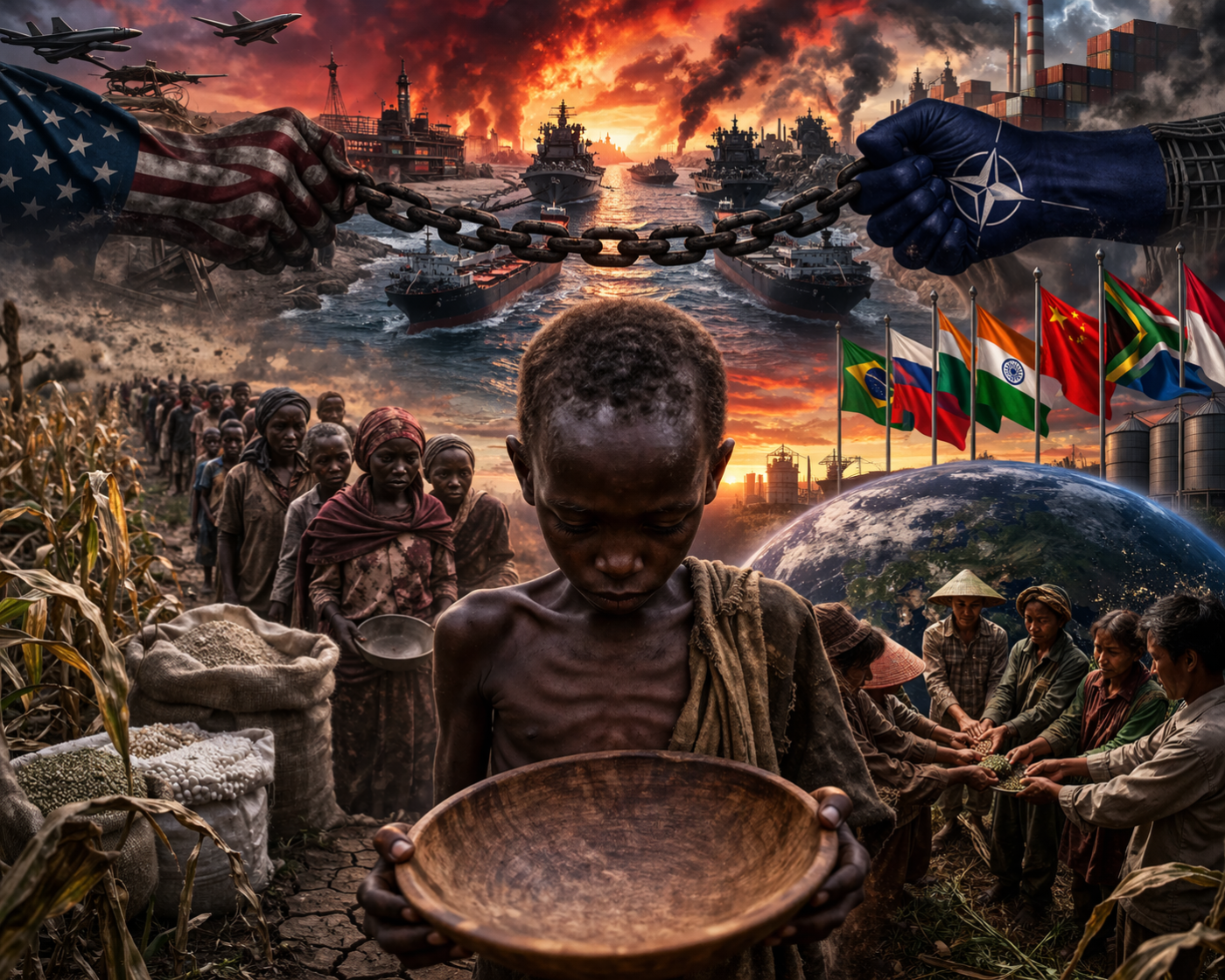
Reuters reports a BRICS food reserve proposal as risk management, but strips away the imperial structure shaping the crisis. The material record shows a world where war, sanctions, and supply chains converge to produce food insecurity at a global scale. Beneath the headlines lies a system that has transformed food, fertilizer, and shipping into weapons of control under hyper-imperialism. The response emerging from the Global South signals not stability, but a growing struggle for sovereignty over the most basic condition of life—bread.
By Prince Kapone | Weaponized Information | April 15, 2026
The Neutral Voice of Empire Speaks in a Calm Tone
“Russia calls for joint food reserves with BRICS to counter Middle East crisis risks”, written by Gleb Bryanski for Reuters on April 13, 2026, arrives dressed in the clean shirt and sober necktie of responsible journalism. Its basic report is simple enough: a senior Russian Security Council official says Moscow wants joint food reserves with BRICS partners and former Soviet neighbors in response to threats to global food security arising from the war against Iran, especially through fertilizer disruption and the risk of rising hunger and crop losses. On the surface, the piece reads like a competent market bulletin from a world in distress. But that is precisely how Reuters works when it is doing its most ideological labor. It does not need to shout. It does not need to foam at the mouth. It speaks softly, with a clipboard in hand, while smuggling in a whole political worldview under the name of balance.
That worldview is inseparable from Reuters itself. Reuters is not some barefoot witness standing in the wheat field alongside peasants wondering whether the next harvest will come in. It is the news arm of Thomson Reuters, a global data and media corporation whose business is to furnish political and financial elites with information packaged as credibility, speed, and objectivity. It publicly roots itself in the Thomson Reuters Trust Principles of integrity, independence, and freedom from bias, but this language of neutrality functions less like a mirror and more like a silk curtain. It does not remove ideology; it perfumes it. Reuters occupies the polished center of the imperial information market, and that institutional location shapes how it narrates crisis. A story about food, war, and international realignment thus appears not as a struggle over power, coercion, and survival, but as a tidy question of “risk management,” as if the world were a spreadsheet and hunger just another troublesome column.
Bryanski’s own professional position reinforces this framing. Reuters identifies him as a correspondent whose recent reporting concentrates on Russian macroeconomics, energy, fertilizer, exports, and state policy. That is to say, he writes from within the specialist lane of market-facing geopolitical journalism, where states appear as strategic actors, commodities appear as flows, and populations appear mostly when their suffering can be quantified into respectable alarm. There is no peasant standpoint here, no food-importing nation speaking in its own historical voice, no worker explaining what it means when the price of bread rises because war and finance have clasped hands at a chokepoint. Instead, the story moves through the usual ladder of sanctioned authority: one Russian security official is quoted, then his claims are stabilized by reference to institutions like the World Bank, IMF, and WFP. This is classic source hierarchy. Reuters does not test the official narrative from below; it launders it upward through institutions whose prestige reassures the managerial classes that the facts are being handled by adults.
The propaganda devices in the piece are subtle but unmistakable. The first is narrative framing: a strategic BRICS and Eurasian food-buffer proposal is reduced to an administrative response to turbulence, stripped of the broader struggle over sanctions, trade weaponization, and the decay of Western-managed globalization. The second is omission. Reuters mentions BRICS, the Eurasian Economic Union, Egypt, China, India, and Indonesia, yet withholds the political and institutional history that would explain why such reserve mechanisms are being discussed now and why they are being sought outside old Western channels. The third is vagueness. The “Middle East crisis” is narrated almost like a storm system, rolling in from nowhere, with passive language that blurs agency and pushes the coercive architecture of war into the fog. The fourth is card stacking. The piece highlights Russia’s potential export opportunity and the specter of global hunger, while sidestepping the harder contradiction that Russia itself faces fertilizer-capacity limits and has already moved to protect domestic supply. Thus Moscow is allowed to appear at once as alarm bell and rescuer, while the more uncomfortable material tensions are escorted quietly offstage.
What Reuters finally offers, then, is not falsehood in the crude sense. It offers something more disciplined and therefore more dangerous: a partial truth arranged in such a way that structure disappears. The symptom is visible, the quote is recorded, the market is informed, and empire’s readers can nod gravely over coffee. But the real story—the one about food security, bloc realignment, coercive disruption, and the fraying legitimacy of the old order—has been trimmed down until it can fit inside the respectable grammar of global risk. That is how the neutral voice of empire speaks. It does not tell you there is no fire. It merely describes the smoke so politely that you forget to ask who lit the match.
When Bread Enters the War Room
The Reuters report gives us the visible surface of the event, and that surface matters. Reuters reports, that Alexander Maslennikov, deputy secretary of Russia’s Security Council, called for joint food reserves with BRICS states and former Soviet neighbors while Russian state reporting echoed the same warning: external shocks tied to the war in West Asia could undermine Russia’s own food security and reverberate outward through the wider agricultural system. Reuters further notes that roughly half of world food production depends on fertilizer, and that a major share of fertilizer trade moving through the Strait of Hormuz has been disrupted by the war-related shipping crisis. That is not a small technical detail buried in the fine print of commodity exchange. That is the kind of fact that tells you modern agriculture is held together by fragile logistical arteries, and when those arteries are squeezed, hunger begins sharpening its knife. Reuters also relays Maslennikov’s warning that if fertilizer shortages persist into early summer, yields of major crops could fall by half and the number of hungry people worldwide could rise to 673 million. The article adds that Russia is a major fertilizer producer but cannot significantly increase output this year, even as it sees room to expand food exports to West Asia, Southeast Asia, Africa, and Latin America. It also notes that Russia aims to raise agricultural exports by 50 percent by 2030 and reminds readers that Egypt is the largest importer of Russian wheat, while China and India are major BRICS food destinations. So yes, the article gives the immediate picture. But like much Reuters prose, it gives you the bones without the blood, the wires without the current, the symptom without the disease.
Because once we move beyond Reuters’ clipped dispatch style, the omitted terrain comes rushing in. On April 8, the IMF, World Bank, and World Food Programme had already warned that war-driven spikes in oil, gas, fertilizer prices, and transport bottlenecks would “inevitably” raise food prices and food insecurity. So this was never just one Russian official ringing an alarm bell in the fog. The alarm was already sounding across the multilateral machinery itself. Even more concrete were the warnings from the U.N. system. UNCTAD warned in March that Hormuz disruptions threatened vulnerable economies through energy, fertilizer, and shipping channels, while the FAO warneda the same crisis could metastasize into something far worse than a temporary price spike: a global agrifood catastrophe. Reuters also lets Russia appear a little too comfortably as the man with grain at the village gate, when the reality is more contradictory. Russian fertilizer producers cannot compensate for a global shortfall because they are constrained by limited spare capacity, domestic supply obligations, and major logistical disruptions tied to the closure of key trade routes. And Moscow has not merely been observing the crisis from a distance. In late March, Russia’s Agriculture Ministry announced restrictions on ammonium nitrate exports from March 21 to April 21, 2026, to ensure the spring planting campaign. The move was explicitly aimed at prioritizing domestic agricultural supply during a critical phase of the farming season. In other words, even one of the world’s major fertilizer powers has already had to tighten its grip on supply in the face of system-wide strain.
Nor did this reserve proposal spring out of thin air like a bright idea delivered by divine revelation to a bureaucrat’s forehead. In April 2025, BRICS agriculture ministers approved a joint declaration centered on food security, agricultural trade, family farming, and cooperative mechanisms. So what Reuters presents as a reaction to immediate turbulence is also part of a longer institutional search for mechanisms of collective protection outside the old Western script. The Indonesia angle matters here too, though Reuters barely sketches it. Ahead of Prabowo’s visit, food and energy self-sufficiency were defined as foundational pillars of Indonesia’s national strategy, while Jakarta advanced concrete energy cooperation with Russia to secure domestic supply amid global instability, treating food sovereignty not as some sentimental slogan but as a core national-security question. The point is not just that Indonesia is talking to Russia. The point is that states across the Global South are increasingly behaving as though the old guarantees of the liberal order are no longer worth the paper they were printed on.
And then there is the sanctions question, that clean-handed form of siege warfare loved by the respectable classes because it kills through paperwork and bank compliance rather than bayonets. Reuters’ piece treats the food crisis primarily through the lens of war and shipping disruption, but a growing body of recent research shows that unilateral coercive measures are themselves a major driver of food insecurity. A 2025 peer-reviewed study in The World Economy found that sanctions raise real food prices by roughly 1.24 percentage points and worsen undernourishment indicators, which is about as clear an empirical verdict as one could ask for. Another 2025 study in The Lancet Global Health found that unilateral sanctions are associated with roughly 564,258 deaths annually, a death toll on the scale of war itself, which is what sanctions often are once one scrapes off the moral deodorant. A wider review in the same journal confirmed that four decades of scholarship consistently find negative humanitarian outcomes under sanctions regimes. So the issue is not anecdotal, not episodic, not some unfortunate side effect to be buried in footnotes. It is structural.
The mechanisms are equally concrete. In 2026, the OHCHR’s call for input on unilateral coercive measures and the right to food explicitly stated that sanctions and over-compliance disrupt access to seeds, fertilizers, agricultural machinery, irrigation systems, veterinary products, agricultural technologies, finance, and insurance. That is the agricultural chain itself being choked, link by link. More important still, the OHCHR made clear that these harms are not limited to the formally targeted states, but produce third-country effects through market disruption, financial blockages, and global food-price volatility. In other words, the sanctions architecture behaves like poison poured upstream: the intended victim is not the only one who drinks it. A recent U.N. General Assembly document sharpened the point further, stating that unilateral economic measures “directly threaten the food security of developing and least developed countries”. That matters because it moves the argument beyond the sanctioned state alone and into the wider terrain of Global South vulnerability, where import-dependent economies get hammered not only by direct coercion but by the spillover effects of coercion elsewhere.
That wider terrain is the larger context Reuters only glances at. Hormuz carries around a quarter of global seaborne oil trade along with major LNG and fertilizer flows, which means this is not simply an oil story with agriculture stapled awkwardly to the bottom. Fertilizer is not an accessory to food production in the modern system. It is one of its load-bearing walls. That is why disruptions in the Gulf reverberate across import-dependent countries in Africa and Asia. The food question is also inseparable from bloc realignment. Indonesia’s 2025 entry into BRICS and the surrounding official language about energy, agriculture, and trade corridors beyond the Atlantic sphere show that this is not merely about emergency reserves; it is about where states believe future security will be organized. As already noted, Russia is among the world’s major wheat and fertilizer powers, which is why any shock in Russian export policy or production constraints rattles markets from Egypt to India to Brazil to China. The Eurasian lane matters too. The Eurasian Economic Union (EEU) has been discussing deeper industrial and agricultural cooperation in 2026, giving this reserve proposal a regional institutional frame rather than the look of a one-off improvisation. All of this is unfolding in a world where developing countries already burdened by debt are being hit with higher energy, freight, and food costs simultaneously. That is not just volatility. That is the bill for empire arriving at the kitchen table.
The present West Asia crisis therefore sits inside a broader coercive architecture in which sanctions, over-compliance, and transport disruption reinforce one another. Shocks to energy markets, fertilizer access, freight rates, bunker fuel, insurance, and maritime supply chains do not stay local; they cascade outward into food production costs and import bills across vulnerable economies. Developing economies, particularly across Africa, are especially exposed, with shipping disruption, rising insurance costs, tighter energy and fertilizer supply, and exchange-rate pressure threatening to deepen a continent-wide cost-of-living crisis. These shocks are transmitted through rising import costs, weakening currencies, and heightened food security risks. Taken together, the sanctions literature and the current West Asia shock reporting tell a story far larger than Reuters’ calm dispatch allows. Food insecurity is not merely the product of drought, local mismanagement, or unfortunate market weather. It is increasingly being produced by a wider architecture of imperial domination—sanctions, finance, shipping, fertilizer dependency, over-compliance, chokepoint pressure—that extends well beyond the formally targeted states. What we are witnessing is not simply a food problem. It is a world order problem, measured in bread.
Bread, Blackmail, and the Cracking of the Imperial Order
This was never just a story about a Russian official making a proposal. That is the cover story, the polite wrapper, the newspaper version fit for people who want to believe that food crises begin in nature and end in policy. The real story is uglier. It is the story of a world capitalist order so concentrated, so militarized, and so violently organized around imperial chokepoints that a war in one corridor can tighten the stomach of a worker thousands of miles away. It is the story of a system that has turned grain, fertilizer, shipping, insurance, and finance into weapons, then acts surprised-offended even-when hunger follows. Reuters gives us the memo. What the material record shows is the battlefield.
The old liberal fantasy said globalization would bind humanity together through efficient exchange. What it actually built was an architecture of exploitation and oppression in which the many eat at the pleasure of the few. Food does not move through the world on some neutral conveyor belt powered by the spirit of comparative advantage. It moves through straits, ports, insurers, banks, freight markets, commodity exchanges, and state systems saturated with class power. When those systems are dominated by imperial states and monopoly capital, “interdependence” becomes a pretty word for organized vulnerability. One war, one sanctions escalation, one shipping crisis, one insurance spike, one export restriction, and suddenly whole societies are told that scarcity has arrived like an act of God. But scarcity here is not a divine mandate. It is administered. It is political. It is class rule wearing the mask of logistics.
That is why the reserve proposal matters. Not because it is noble in itself, and not because BRICS is some immaculate ark sailing above the contradictions of the capitalist world. It matters because it reveals that more and more states in the Global South and adjacent formations no longer trust the old system to keep them fed. They have watched too many sermons about free markets collapse into sanctions. They have watched too many supply chains buckle under war. They have watched too many multilateral institutions issue grave warnings after the damage was already done. And now, under the pressure of repeated shocks, they are groping toward buffers, stockpiles, alternative corridors, regional trade, and reserve mechanisms that might reduce their exposure to imperial blackmail. That is not yet liberation. But it is a sign that faith in the imperial pantry is dying.
Reuters could not tell that story honestly because doing so would require admitting that what is breaking down is not merely confidence, but legitimacy. The so-called rules-based order has spent decades presenting itself as the rational steward of global provision. Yet every serious crisis reveals the same thing: when imperial interests are threatened, the rules become instruments, and the market becomes a whip. The same system that lectures poor nations about efficiency has no trouble strangling shipping lanes, freezing finance, distorting fertilizer access, and tolerating hunger as collateral damage so long as the pain lands mostly on darker nations and poorer classes. That is not governance. That is hyper-imperialism with a polished accent.
And let us be clear: sanctions belong inside this story not as a side note, but as one of its central mechanisms. Sanctions are adored by the respectable classes because they allow empire to kill with paperwork. No bomb crater, no blood on the evening cufflinks, just a swarm of restrictions, compliance rules, banking barriers, shipping fears, and “unintended consequences” that somehow always fall on ordinary people. The peasant cannot get fertilizer. The hospital cannot secure supplies. The importer cannot move payments. The state cannot access machinery. The child eats less. Then the same imperial voices step forward with concern, as though they have stumbled upon a tragedy rather than engineered one. This is one of the dirtiest tricks of the imperialist media apparatus: it reports the hunger while fogging the hand that helped produce it.
The deeper contradiction, then, is not simply between supply and demand. It is between the needs of humanity and a world order governed by accumulation, exploitation, and Western imperial domination. Fertilizer is needed for crops, but fertilizer also moves through routes shaped by war and finance. Grain is needed for life, but grain markets are organized through speculation and state leverage. Shipping is needed for exchange, but shipping lanes are subordinated to military power and insurance regimes tied to capital. Every basic input for social reproduction is embedded in a larger structure of imperial command. That is why food insecurity now appears less and less as a local misfortune and more and more as a systemic output of imperialist decay. The empire is weakening, yes, but it is weakening in the most dangerous way possible: not by retreating cleanly, but by turning its infrastructures into weapons as its grip slips.
This is where the talk of multipolarity must be stripped of its romance and brought down to earth. Multipolarity is not a sunrise painted in soft colors for academic panel discussions. It is a hard, conflict-ridden process in which states long subordinated to unipolar hegemony try to carve out room to breathe, trade, and feed themselves under conditions of intensifying pressure. Some do so out of national survival, some out of strategic opportunism, some out of genuine anti-imperialist impulse, and many through a contradictory mixture of all three. There is no purity here. Russia is not a socialist beacon distributing bread by revolutionary principle. It is a capitalist state pursuing leverage, markets, and geopolitical advantage while also defending its own domestic position. But that very contradiction is instructive. Even a capitalist power outside the old Atlantic core is being pushed toward measures that implicitly acknowledge a truth liberal ideology cannot digest: the world market is no longer trusted to secure life.
And what of BRICS? The imperial press likes two poses here. Either BRICS is dismissed as a loose talk shop of opportunists, or it is treated as a kind of exotic managerial bloc trying to stabilize markets more efficiently than the West. Both readings miss the central point. BRICS matters because it is one expression of a broader international realignment driven by the crisis of imperialism itself. As the old order produces more war, more sanctions, more financial piracy, and more weaponized infrastructure, states seek shelter in new arrangements. Reserve systems, regional payment mechanisms, alternative shipping routes, and food cooperation emerge not because history has become charitable, but because imperial overreach has made dependency intolerable. The empire, in trying to discipline the world, is teaching the world to defect from it.
Still, no illusions. A food reserve does not abolish class rule. A new corridor does not end exploitation. A buffer stock does not dissolve the agrarian question or free the peasantry from the long violence of capitalist agriculture. Sovereignty under capitalism remains sovereignty under pressure, always vulnerable to reversal, sabotage, comprador collaboration, and internal class compromise. But history does not move by waiting for perfect instruments. It moves through ruptures in the old order, through improvised defenses, through struggles over survival that open onto larger questions of power. And that is what lies beneath this episode. Not just a proposal for reserves, but the widening recognition that survival itself now requires insulation from the imperial system.
The imperialist media apparatus cannot say this plainly because the conclusion is devastating. If food reserves, alternative corridors, and South-South hedging are increasingly necessary, then the old order stands exposed as an order of organized insecurity. If the Global South must build protections against the very market system it was told to trust, then the doctrine of liberal integration is bankrupt. If war in one zone, sanctions in another, and insurance shocks in a third can produce hunger across continents, then the issue is not mismanagement but structure. The problem is not that the machine malfunctioned. The problem is that the machine was built to subordinate life to power.
So let us drop the polite fiction. This is what multipolar struggle looks like at the level of bread. It is not decorative diplomacy. It is not a conference photo. It is a contest over whether humanity will remain hostage to imperial chokepoints, sanctions architecture, and the necropolitics of the market. It is a contest over whether the peoples of Africa, Asia, Latin America, and the wider South will eat according to social need or according to the strategic calculations of decaying empire. Reuters gave us a risk story. The truth is harsher: bread has entered the war room, and the world is beginning, unevenly and under duress, to organize against famine by empire.
Organize the Stomach Against Empire
The lesson is not subtle, and it should not be softened. Hunger is being produced through war, sanctions, and the weaponization of infrastructure. That means resistance must be organized with the same clarity. The price of food is not some natural mystery of the market; it is shaped by decisions made by states, militaries, financial institutions, shipping systems, and the imperial order that stands behind them. If war at the chokepoints can tighten supply and raise the cost of living across continents, then opposition to that war has to be built not as a vague moral posture but as a material defense of life itself. The task is to make it impossible to talk about foreign policy without talking about food, and impossible to talk about food without talking about imperialism.
This is where antiwar organizing has to be sharpened and brought down from abstraction to the level of bread, rent, and survival. CODEPINK organizes against U.S. war policy and military escalation, and its public nonprofit records show it operates as a registered 501(c)(3) with publicly available tax filings. That existing infrastructure should be used to hammer home a simple truth: war in strategic corridors does not stay in the diplomatic sphere. It reappears in fertilizer shortages, shipping disruptions, food inflation, and empty stomachs. Teach-ins, coordinated actions, local forums, and public campaigns should draw a straight line from military escalation in the Middle East to the rising cost of food in working-class communities. The message must be plain enough for anybody to grasp: when chokepoints are militarized, ordinary people pay for it in the most intimate way possible—through hunger, debt, and sacrifice.
At the same time, solidarity with the nations and peoples under siege has to be tied directly to a mass struggle against sanctions. Sanctions are too often dressed up as diplomacy, but in practice they operate as slow warfare against civilian life. The Black Alliance for Peace explicitly organizes around anti-imperialism and peace, and it has publicly stated that it is fiscally sponsored by Community Movement Builders. That makes it a real political lane for connecting antiwar struggle, sanctions opposition, and working-class political education. The task here is not merely to denounce sanctions in the abstract, but to expose their material effects with ruthless clarity: sanctions tighten access to finance, distort trade, restrict agricultural inputs, and intensify the same food crises that imperial media later describe as unfortunate global turbulence. Campaigns should show, concretely, how pressure on countries like Iran feeds wider disruptions in fertilizer, shipping, and food markets that strike Africa, Asia, Latin America, and poor and working people everywhere. The goal is to rip away the mask. Sanctions are not clean policy tools. They are economic siege warfare executed with spreadsheets and signatures.
But resistance cannot live by opposition alone. It also has to root itself in forces struggling to build another basis for life. That is where food sovereignty becomes a political weapon rather than a slogan. La Via Campesina is a transnational peasant movement centered on food sovereignty, and its public materials and annual reporting emphasize financial autonomy and supporter-based funding. Its framework matters because it insists that food should not be subordinated to imperial logistics, commodity speculation, and the manic moods of global markets. It insists that peoples have the right to define their own food systems, protect their own production, and organize agriculture around life rather than profit. That perspective must be pulled into broader political struggle. Urban workers fighting grocery inflation, tenants fighting rent hikes, and rural producers fighting for land and inputs are not trapped in separate stories. They are all caught in the same imperial machinery that turns food into leverage and dependence into discipline.
So the practical line should be sharp. Organize public education that traces the path from war to the grocery store, from sanctions to fertilizer shortages, from shipping disruption to household misery. Build local and regional forums that explain how the global food crisis is being manufactured through chokepoints, over-compliance, financial coercion, and military escalation. Develop links between antiwar groups, labor organizations, tenant formations, and food justice struggles so that inflation is not treated as a technical policy issue but as a class issue shaped by empire. Support campaigns demanding an end to sanctions and maritime coercion. Amplify Global South calls for reserve systems, sovereign trade channels, and protection against food-market blackmail. The basis for doing so is already visible in the very institutions the ruling order cites when it wants to sound concerned: the IMF, World Bank, and WFP themselves warned that war-driven spikes in oil, gas, fertilizer prices, and transport bottlenecks would “inevitably” raise food prices and food insecurity. Even the system’s own managers are admitting that war and hunger are now bound together. The revolutionary task is to make that admission politically explosive.
Above all, refuse fragmentation. The system survives by teaching people to experience war as a foreign issue, inflation as an economic issue, and hunger as a private issue. That division has to be smashed. The same imperial machinery that militarizes the Middle East also raises the cost of living for workers at home. The same structures that obstruct fertilizer and food flows abroad also deepen austerity, debt, and insecurity in everyday life. The same empire that demands obedience from the Global South demands sacrifice from its own working class. Once those connections are made clear, bread stops being just another commodity on the shelf. It becomes a political question. It becomes an indictment. It becomes a line of struggle.
This is the horizon that has to be fought for. Not passive endurance. Not technocratic adjustment. Not liberal pity. Organized resistance that links bread, war, and sovereignty into one hard political line. Because the real question posed by this crisis is not simply whether people will eat. The real question is who will control the conditions under which they eat—and whether those conditions remain dictated by a decaying imperial order that weaponizes life itself, or are seized back by those who labor, produce, distribute, and depend on that life.


Leave a Reply