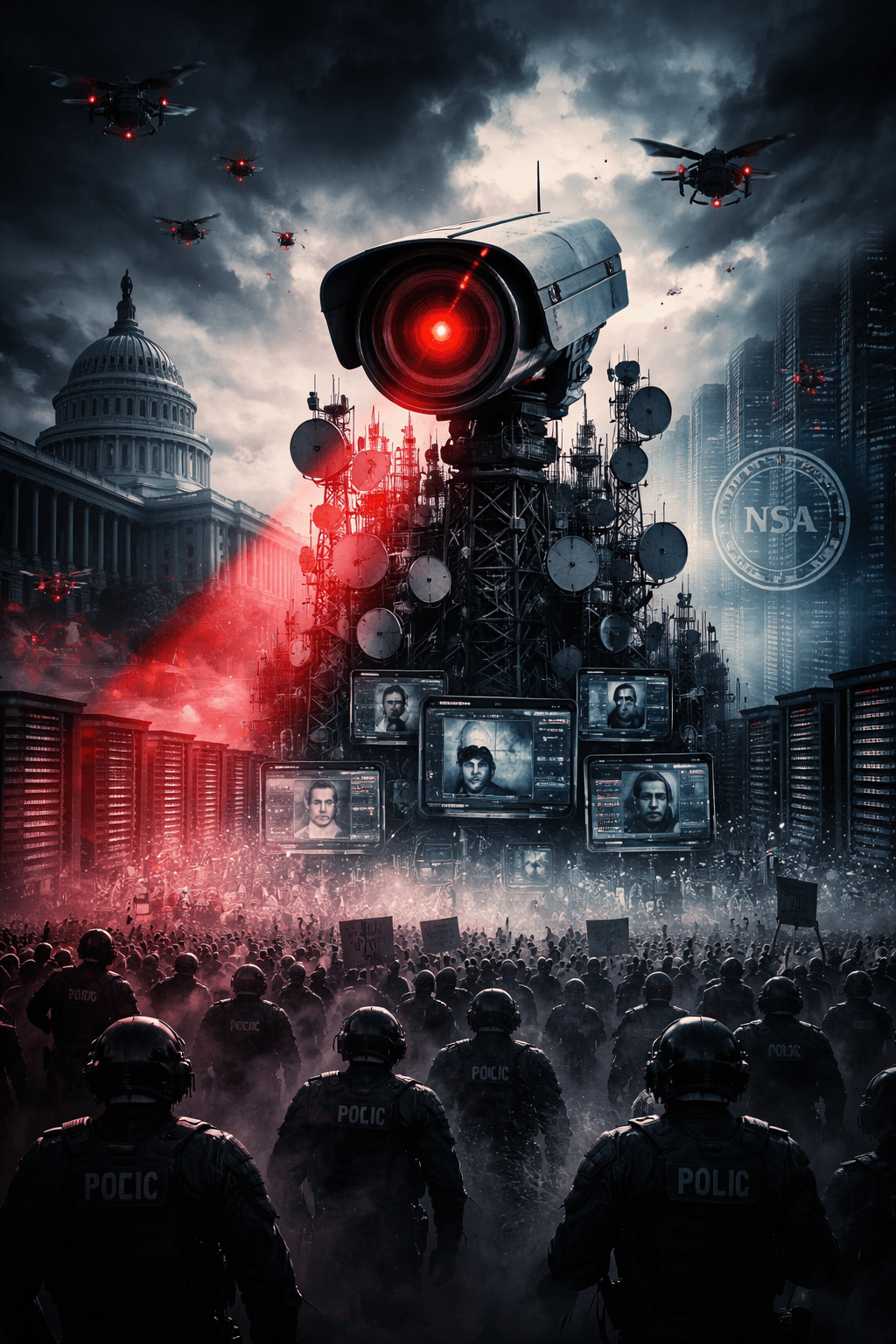
They tell you this is about Democrats failing to stand up to Trump, but that’s a lie—both parties built the spy machine together. The receipts show a straight line from the Patriot Act to Section 702, signed, funded, and protected by the same politicians now playing concerned. What we’re dealing with isn’t a policy debate—it’s a full-blown system of technofascist control rooted in empire, data, and repression. The only real question left is whether we keep arguing over reforms or start organizing to break the damn thing.
By Prince Kapone | Weaponized Information | April 15, 2026
The Whisper of Procedure Over the Machinery of Power
“Dem Leaders Aren’t Even Bothering to Rally Caucus Against Trump Domestic Spying Powers”, written by Matt Sledge and published by The Intercept on April 14, 2026, presents itself as a report on Democratic hesitation ahead of a House vote on Section 702 of FISA. On its face, the article is straightforward enough: party leadership is divided, the whip is not issuing a clear directive, some Democrats want reforms, others want a clean reauthorization, and grassroots opposition is trying to stiffen the spine of a caucus that seems content to bend. That is the article’s formal subject. But the deeper operation of the piece lies not only in what it says, but in how it arranges the reader’s attention. It narrows the political horizon until the surveillance question appears less like a settled structure of power and more like a temporary disagreement among anxious managers. The drama, in other words, is not the spying system itself, but whether Democratic leadership will find its voice.
That narrowing is not accidental. The Intercept, for all its reputation as an adversarial investigative outlet, still occupies a recognizable niche inside the liberal media ecosystem: oppositional enough to register elite hypocrisy, but often still framed by the assumptions of institutional politics. Its political-economic location matters. This is not Fox News waving the flag for the FBI, nor is it a Pentagon newsletter in journalistic costume. It is a progressive publication, one with a history of publishing material embarrassing to the national security state. But even here, the issue is staged largely inside the language of caucus behavior, committee conflict, and leadership ambiguity. That frame gives the article an air of seriousness while quietly accepting the basic terms of debate handed down by official Washington. The question becomes whether the Democrats can get organized, not whether the architecture they are debating has any democratic legitimacy in the first place.
Matt Sledge’s own professional positioning helps explain the shape of the piece. As a Washington politics reporter, he writes fluently in the dialect of Capitol Hill: ranking members, caucus chairs, congressional notices, committee splits, and advocacy pressure campaigns. This gives the article immediacy and procedural credibility, but it also builds a source hierarchy that keeps the reader trapped inside the chambers of respectable power. Lawmakers speak. Staff guidance matters. Policy advocates warn. Progressive groups pressure. The whole thing moves with the quiet choreography of officialdom. Surveillance, that monstrous and ever-hungry apparatus, is thus made to appear as a matter of legislative mood management. It is the old bourgeois trick: reduce structures to episodes, and reduce episodes to personalities. A machine built to peer into the private life of millions is translated into a story about whether Hakeem Jeffries and Katherine Clark are showing enough backbone. Thus the tiger is hidden behind the zookeeper.
The article relies heavily on narrative framing of this kind. Its central device is proceduralism: the suggestion that the real political struggle turns on safeguards, reforms, oversight mechanisms, and vote guidance. Even when the article acknowledges prior abuses, those abuses enter the piece as cautionary material inside a reform conversation, not as evidence of a fundamentally coercive apparatus. This is how liberal political writing often disinfects power. A structure of domination is presented as a policy instrument in need of calibration. A spy system becomes a governance problem. A constitutional outrage becomes a matter of compliance. The article also leans on balance framing, placing advocates of a clean reauthorization and advocates of reform on the same plane of legitimate dispute, as though the contest were between two equally reasonable approaches to administration rather than between the custodians of state surveillance and those, however inconsistently, objecting to some of its excesses. It is the politics of the well-set dinner table: one guest wants poison served warm, another prefers it chilled, and the article calls this debate.
There is omission here too, and not the innocent kind. The piece notes AI concerns and mentions past abuses, but it leaves the broader lineage of surveillance underdeveloped, which has the effect of severing the present fight from the long continuity that produced it. It also softens indictment through concision. Leadership silence is reported, caucus division is noted, activist pressure is acknowledged, but the article stops just short of saying plainly what hovers over every paragraph: that the Democratic leadership’s ambiguity is not mysterious at all once one understands that these people have lived comfortably alongside the national security state for years. The article gives us the smoke, but not quite the fire. That is why its most important ideological function is not to lie outright, but to contain the truth within the language of institutional suspense. It tells us that the house is wobbling. It does not quite tell us that the house was built this way on purpose.
What They Call Oversight Is the Refinement of a Weapon
The fight over Section 702 is being presented, in the manner of all respectable imperial debates, as though the country has stumbled into a difficult legal gray zone and must now decide how best to balance liberty with security. But the immediate facts already tell a more revealing story. Section 702 is scheduled to expire on April 20, 2026, and Trump has publicly pushed Congress to extend it, claiming it is necessary for current military and intelligence operations. On the Democratic side, there is indeed a split, but not one that flatters anyone involved. Jim Himes backed a clean reauthorization, while a bloc led by the Congressional Asian Pacific American Caucus, Congressional Hispanic Caucus, and Congressional Progressive Caucus demanded a warrant requirement and closure of the data-broker loophole. That conflict is real enough. So too is the record of abuse. Section 702 has enabled “backdoor searches” involving Americans, including searches tied to protest activity, journalists, lawmakers, and other domestic political targets. And while the usual courtiers of empire now speak solemnly about AI, the issue is not invented hysteria. Critics have warned that AI and advanced data-analysis tools increase the leverage of analysts over huge pools of intercepted or purchased information, making an already invasive system even more efficient in the hands of a state that has never exactly been shy about abusing power. This entire dispute is unfolding after the 2024 RISAA reauthorization preserved the core warrantless-access structure of Section 702 for another two years. So before anyone starts singing hymns about reform, let us be clear: the system under debate is not one that nearly became dangerous. It is one that has already been preserved, refined, and defended again and again.
Even the day-to-day legislative picture reveals how flimsy the official story is. The article’s sense of urgency was overtaken almost immediately when the House vote was delayed after a conservative revolt, a reminder that the security state is often clothed in the theater of last-minute procedural chaos, as though confusion were democracy and delay were deliberation. But the more important omissions lie behind the week’s headlines. The post-9/11 surveillance buildout did not begin with Trump, and it certainly did not advance through Republican will alone. The USA PATRIOT Act passed the House by 357 to 66, while the Senate passed it 98 to 1. That is not partisan extremism. That is bipartisan consensus in the language of panic. And what that consensus produced was not abstract authority but concrete instruments of intrusion: Section 215’s bulk collection powers, which converted “relevance” into a legal fiction for mass data seizure; roving wiretaps that untethered surveillance from specific devices and allowed continuous monitoring without renewed judicial scrutiny; and the explosive expansion of National Security Letters, which enabled the FBI to obtain financial and communication records without a warrant, often under gag orders that rendered the entire process invisible. This was not merely an expansion of intelligence capacity. It was the normalization of suspicionless surveillance as a governing principle.
What came to be known as “Patriot Act II” did not become law, but the Justice Department’s 2003 draft Domestic Security Enhancement Act revealed the trajectory plainly enough—and more importantly, it revealed a playbook that would not be abandoned, only dispersed. Many of its core ambitions—expanded administrative surveillance, diminished judicial oversight, broader definitions of security threat, and the fusion of intelligence and law enforcement—were not defeated but quietly redistributed across subsequent legislation and executive practice. The FISA Amendments Act of 2008 institutionalized large-scale warrantless surveillance; the ongoing expansion of National Security Letters deepened the use of administrative subpoenas beyond meaningful review; and post-9/11 intelligence integration dissolved the remaining barriers between domestic policing and foreign intelligence gathering. In this sense, “Patriot Act II” did pass—not as a single bill, but as a slow accretion of authorities smuggled through the legislative bloodstream, normalized through repetition, and buried beneath the procedural noise of governance. Empire, when frightened, does not merely grab power. It drafts memoranda for the next grab—and then implements them piece by piece until the extraordinary becomes routine.
The same continuity ran through the Obama years, when liberal constitutional piety was asked to perform the old trick of making repression sound measured. The FY2012 NDAA codified indefinite military detention authority, and civil-liberties defenders warned at the time that it normalized detention without charge or trial under the AUMF framework. This did not literally abolish habeas corpus, but it did something more historically useful for the ruling class: it made emergency-war logic into standing law. That distinction matters. The imperial state does not always need to smash legal language with a hammer. Often it simply hollows it out, leaves the shell standing, and then invites the public to admire the architecture. Then came the Snowden revelations, which tore a hole in the veil and showed that Section 702 sat inside a much wider infrastructure of capture and search. The covert, draconian programs exposed by Snowden included the NSA’s PRISM and Upstream collection systems, demonstrating that “foreign intelligence” surveillance generated a vast pool of communications in which Americans’ messages were regularly swept up and later made searchable. The point was never simply to watch foreigners. The point was to build a net so large that domestic life itself would eventually move through it.
The WikiLeaks disclosures widened that picture further. The file known as Vault 7 revealed extensive CIA hacking and digital intrusion capabilities. That matters because it shattered the comforting fantasy that the surveillance state could be cleanly boxed into one agency, one statute, or one legal controversy. The apparatus is sprawling. The NSA intercepts. The CIA hacks. The FBI queries. Contractors build the pipes. And politicians, with rare exceptions, arrive afterward to legalize, normalize, or politely wring their hands. Trump did not invent this machinery; he inherited and extended it during his first term. Trump signed the FISA Amendments Reauthorization Act of 2017 in January 2018, preserving Section 702 with bipartisan support. Biden, in turn, did not dismantle the regime. Executive Order 14086 added privacy and civil-liberties safeguard language to U.S. signals intelligence, but this was management, not rupture; the order re-legitimated the surveillance structure through promises of better process rather than its abolition. The same polite laundering appeared again when analysts pointed out that the FBI failed to track all U.S.-person queries in 2024 and 2025 as required, meaning the true scale of searches involving Americans remains unknown. Yet the guardians of the system still cite reduced numbers and improved compliance as though a spy bureaucracy that cannot fully account for its own searches should be rewarded with renewed trust.
It gets uglier the closer one looks. A secret FISA Court opinion reportedly found major compliance problems in how the government tracked searches involving Americans, undercutting the tidy claim that modest reforms had solved the problem. At the same time, the commercial data-broker loophole has emerged as a major front in the surveillance fight, because agencies maintain that they can purchase Americans’ sensitive data without a warrant, even where direct compelled access would trigger constitutional objections. This is the modern genius of the system: if the Constitution blocks the front door, capital opens a side entrance and sells the state a key. What appears as a privacy issue is also a political economy issue. Surveillance is no longer merely a set of police powers. It is a market, a contract stream, a data industry, and a public-private labor of repression. The state does not just spy. It shops.
Once this wider terrain is restored, the larger context becomes impossible to ignore. Section 702, first enacted in 2008 and repeatedly renewed, formalized a system in which targeting foreigners abroad creates a reservoir of communications later searchable for information about Americans without a traditional warrant. But that legal structure is only one station in a longer sequence: the Patriot Act’s expansion of state power, the proposed deepening represented by the 2003 Patriot II draft, indefinite-detention codification through the NDAA, “>Snowden’s exposure of NSA mass collection, Vault 7’s exposure of CIA cyber-capabilities, Trump’s 2018 extension, Biden’s safeguard management, RISAA’s 2024 preservation of the core architecture, and now Trump 2.0’s push for a cleaner and more openly unapologetic renewal. This is not merely a national-security story. It is a domestic political story about how imperial tools built in the name of foreign threats are repeatedly normalized for use against protest, dissent, racialized populations, and political opposition. The documented history of Section 702 abuse makes that plain enough.
And here the Democratic contradiction ceases to be an embarrassment and becomes a fact of structure. Democrats helped pass the Patriot Act in overwhelming numbers. Obama signed the NDAA detention framework. Congress, with Democratic participation, preserved Section 702 under Trump 1. Many of the same forces helped maintain the architecture again through RISAA in 2024. So when Democratic leaders now hesitate, equivocate, or mutter anxiously about Trump’s access to these powers, they are not warning the public about a machine they opposed from the outside. They are standing beside a machine they helped build, polish, and feed. The proper question, then, is not whether the state has suddenly overreached. It is how long this overreach has been the design, and how many times the public has been asked to mistake bipartisan authorship for democratic restraint.
The Machine Was Not Hijacked — It Was Handed Over Fully Built
What stands exposed in this moment is not a failure of courage, nor a sudden draconian deviation, nor even a particularly novel abuse of power. What stands exposed is continuity. The entire spectacle surrounding Section 702—the whispering leadership, the cautious reformers, the open totalitarianism—is only intelligible once we abandon the comforting fiction that the United States stumbled into a surveillance state and must now decide whether to keep it. There was no stumble. There was construction. Careful, deliberate, bipartisan construction. And like all serious architecture, it was built to last.
The liberal imagination still clings to the idea that the problem is Trump. That if only a more responsible steward held the reins, these powers would be exercised with restraint, professionalism, and constitutional reverence. But this belief collapses under the slightest historical pressure. The post-9/11 trajectory reveals something far less comforting: every administration did not merely inherit these powers—it expanded, refined, and normalized them. The Republicans shouted “security” and passed the Patriot Act. The Democrats nodded, voted, and called it necessary. Obama did not dismantle the emergency; he legalized it, disciplined it, and wrapped it in the language of reason. Snowden tore open the curtain, and instead of dismantling the stage, the political class repaired the lighting and resumed the performance. Trump did not invent the machinery; he proved how it could be used more openly. Biden did not reverse course; he stabilized the system and restored its legitimacy. And now Trump returns, not as an anomaly, but as a beneficiary of a system already perfected.
This is why the current debate feels so hollow. The arguments over safeguards, warrants, audits, and compliance read like instructions for polishing a weapon rather than dismantling it. The state is not asking whether it should possess these powers. It is asking how best to administer them without provoking too much resistance. Even the language of reform operates within this narrow horizon. One faction demands a warrant before searching Americans’ data. Another insists existing procedures are sufficient. But both accept the premise that the data will be collected, stored, and made searchable in the first place. The argument is not over whether the net should exist. It is over how politely it should be cast.
To understand this properly, we have to name the system for what it has become. This is not simply a surveillance state in the old sense of police files and wiretaps. It is a fusion. A fusion of executive authority, permanent war doctrine, digital infrastructure, and monopoly capital. The intelligence agencies no longer operate as isolated arms of the state; they are embedded within a broader ecosystem of data extraction and technological power. Private corporations collect, store, and analyze information on a scale that previous empires could only dream of. The state, in turn, accesses, purchases, or compels that data, integrating it into its own apparatus of monitoring and control. The result is not merely more surveillance. It is a qualitatively different form of governance—one that operates through continuous observation, predictive analysis, and preemptive intervention.
This is the terrain that must be understood as technofascism—not as a rhetorical flourish, but as a material description. Fascism, historically, has been understood as the fusion of state and capital under conditions of crisis, combined with the suppression of dissent and the mobilization of coercive power. What we are witnessing now is that fusion updated for the digital age. The coercion is not only physical; it is informational. The control is not only exercised through force; it is exercised through visibility, through the constant possibility of being watched, tracked, and analyzed. And the crisis that drives it is not merely political instability, but the deeper contradictions of an imperial system under strain—economic, geopolitical, and social.
Section 702 sits inside this broader formation as one instrument among many. It is not the origin of the system, nor is it its limit. It is a node—a point of access through which the state can reach into the flows of global communication and, inevitably, into domestic life. The distinction between foreign and domestic surveillance, so often invoked in legal debates, collapses under the weight of modern communications networks. Messages do not respect borders. Data does not carry passports. Once the infrastructure is in place, the line between “over there” and “at home” becomes a technicality, and a flexible one at that.
This is why the Democratic posture described in the article cannot be taken at face value. Their hesitation is not evidence of principled opposition. It is evidence of contradiction. They are caught between two imperatives: maintaining the surveillance architecture they helped build, and distancing themselves from its most openly authoritarian deployment under a figure like Trump. The result is a politics of selective outrage. They object not to the existence of the machine, but to the manner in which it is being used—or, more precisely, to the political risks associated with its use by a rival faction of the ruling class.
The deeper truth is harsher and more clarifying. Trump is not seizing a neutral constitutional order and bending it toward tyranny. He is inheriting a system already designed to operate beyond meaningful democratic constraint. The legal frameworks, the intelligence capabilities, the data pipelines, the institutional habits—all of these were constructed over decades with bipartisan support. What changes from administration to administration is not the existence of the system, but the style of its management and the degree of its visibility.
And so we arrive at the real contradiction of the present moment. The same political class that insists on the necessity of these powers now expresses alarm at who holds them. The same institutions that expanded surveillance in the name of security now warn of its dangers under the wrong leadership. But the danger was never contingent on the personality at the top. It was built into the structure itself. A system designed for permanent exception will always exceed its stated limits. A state accustomed to watching will always find new reasons to look. And a ruling class that governs through crisis will always reach for the tools that allow it to anticipate, monitor, and suppress dissent.
To treat Section 702 as a discrete policy issue is therefore to miss the point. It is one visible panel in a much larger machine—a machine that runs on data, secrecy, and power. The real question is not whether this particular provision should be reformed or renewed. It is whether a society can call itself democratic while maintaining an apparatus that systematically erodes the very conditions of democratic life. The answer, once stripped of rhetoric and examined in practice, is already before us.
From Exposure to Organization — Turning the Lens Back on Power
The first mistake people make when confronting a system like this is to believe that exposure alone is enough. That if the facts are sharp enough, the contradictions clear enough, the hypocrisy undeniable enough, then the machinery will begin to crack under the weight of its own illegitimacy. History teaches the opposite. Power does not collapse because it is exposed. It adapts. It absorbs criticism. It rebrands. It drafts new language, creates new oversight bodies, publishes new transparency reports, and continues its work with greater efficiency. The surveillance state has already survived revelations that would have toppled weaker regimes. It survived the Patriot Act backlash. It survived Snowden. It survived Vault 7. It survived the public admission that Americans’ communications are swept up, stored, and searched. It survives because it is not a mistake. It is a function.
That is why the present moment must be treated not as a crisis of knowledge, but as a crisis of organization. The facts are already on the table. What is missing is the capacity to act on them in a sustained, coordinated, and politically grounded way. The fight over Section 702 is not just a legislative skirmish; it is an entry point into a broader struggle over the structure of power in the United States. To engage it seriously requires moving beyond episodic outrage and toward durable forms of collective pressure that can disrupt the quiet consensus sustaining the surveillance apparatus.
There are already points of entry. The Project for Privacy and Surveillance Accountability has positioned itself as a coalition advocating for privacy protections, transparency, and surveillance reform. It operates publicly, outlines its goals, and identifies its work as grounded in civil-liberties advocacy supported by donations and philanthropic funding. This is not a revolutionary organization, but it is a node—a place where agitation can concentrate and from which pressure can be amplified. Similarly, Defending Rights & Dissent organizes explicitly around political surveillance, FBI abuse, protest rights, and press freedom, publishing reports and maintaining a level of financial transparency that allows its institutional position to be scrutinized. These organizations do not represent the horizon of struggle, but they provide infrastructure that can be engaged, pressured, and, where necessary, pushed beyond their own limits.
But organization cannot stop at institutional advocacy. The lesson of the current moment is that pressure must be made visible and local. The protests confronting members of Congress over surveillance policy are not symbolic gestures; they are glimpses of what it means to drag this issue out of classified briefings and into public political conflict. Representatives who quietly support surveillance powers must be forced to answer for them in their districts, in front of constituents who are no longer willing to accept the language of necessity without interrogation. This means coordinated campaigns: town hall disruptions, public forums, teach-ins, and sustained district-level organizing that ties abstract surveillance powers to concrete lived experience.
That connection is essential. Surveillance does not fall evenly across the population. It concentrates. It has always concentrated. On Black organizers, on migrant communities, on antiwar activists, on journalists, on those who challenge the existing order. The documented use of Section 702 in searches involving protest movements and political activity is not an aberration; it is a window into the system’s social function. To organize against surveillance is therefore not simply to defend abstract privacy rights. It is to stand in solidarity with those who are most directly targeted by the state’s gaze. Any serious movement must be built on that foundation, or it will drift back into the safe language of reform without confrontation.
At the same time, the demands being advanced in the immediate fight must be clear, concrete, and tied to the broader architecture. A warrant requirement for U.S.-person queries is not a radical demand, but it is a necessary one. Closing the commercial data-broker loophole—through which the state purchases information it would otherwise need a warrant to obtain—is equally essential. Full declassification of the recent FISA Court opinion is not a procedural nicety; it is a precondition for any meaningful public debate. These demands should not be treated as endpoints, but as pressure points—ways of forcing the system to reveal its logic, its limits, and its resistance to even minimal constraint.
Crucially, the bipartisan history of this apparatus must be weaponized politically. The tendency to frame surveillance as a problem of Republican overreach or Trumpist excess must be rejected outright. The record is clear. Democrats overwhelmingly backed the Patriot Act. The Obama administration codified detention powers under the NDAA. Congress, with Democratic participation, extended Section 702 under Trump. The architecture was preserved again through RISAA in 2024. This is not a partisan aberration. It is a ruling-class consensus. Any movement that fails to name that consensus will find itself trapped in the same cycle of selective outrage and managed disappointment.
The task, then, is not simply to oppose a bill or pressure a vote. It is to build a political understanding that links surveillance to the broader structure of imperial power—war abroad, repression at home, and the fusion of state and corporate control over information. This requires independent media, political education, and disciplined organizing that refuses to separate the technical question of surveillance from the material realities of class, race, and empire. It requires rejecting the illusion that better management of the system will make it just. And it requires a willingness to confront not only the most visible agents of power, but the quieter consensus that sustains them.
Exposure has done its work. The contours of the machine are visible. The question now is whether that visibility can be transformed into force—organized, sustained, and directed. Because if it cannot, the surveillance state will do what it has always done: adjust, endure, and deepen, while the public is invited, once again, to debate the fine print of its own observation.


Leave a Reply