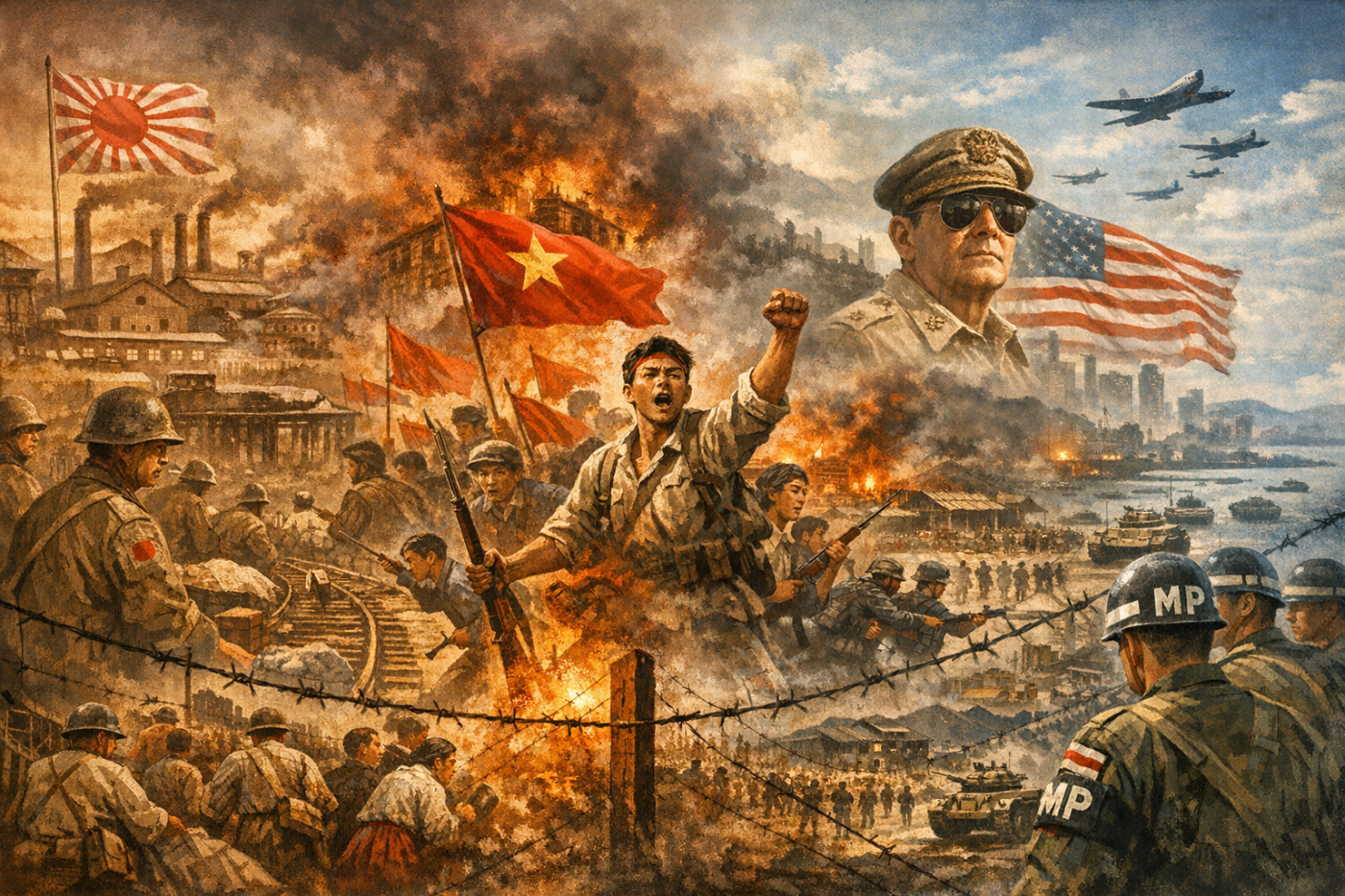
This review reconstructs the Korean War not as a sudden conflict in 1950, but as the culmination of colonial transformation, revolutionary struggle, and imperial intervention between 1945 and 1947. Drawing on Bruce Cumings, it reveals how liberation opened a radical possibility that was contained, divided, and ultimately reshaped into two opposing systems—making war not accidental, but structurally inevitable.
By Prince Kapone | Weaponized Information | Weaponized Intellects Book Review | April 12, 2026
History Is Not Neutral—It Is Written to Defend Power
There are no innocent histories of empire. Every narrative about Korea—especially the Korean War—arrives already armed. It tells you where to begin, what to ignore, and who is allowed to act. It trains you, quietly, to see the world from above: states instead of people, decisions instead of struggles, stability instead of transformation. By the time the story reaches war, the outcome already feels inevitable. That is not an accident. It is political work.
The Origins of the Korean War, Vol. 1 disrupts that training, even when it does not fully escape it. Cumings does something dangerous for imperial history—he reconstructs events from the ground where they were lived. Workers, peasants, committees, police, local authorities, returning migrants, and collapsing colonial institutions come into view not as background noise, but as the substance of history itself. The result is a shift in terrain. Korea is no longer a problem to be managed. It becomes a society in motion.
That motion is the key. Liberation in 1945 did not produce stillness. It produced activity—organization, demands, conflict, and competing visions of what independence would mean. The central question was not whether Korea would be governed, but how. Would authority emerge from below, through the structures people built in the wake of colonial collapse? Or would it be reassembled from above, through institutions aligned with existing property relations and external power? Everything that follows in this history turns on that question.
Cumings shows, often more clearly than he intends, that this question was not resolved internally. It was interrupted. The division of Korea was not the outcome of failed self-government. It was an intervention into an ongoing process. In one half of the peninsula, that process was allowed to develop into structural transformation. In the other, it was contained, dismantled, and reorganized into a different kind of order. The result was not balance. It was divergence produced under pressure.
This review takes that divergence as its starting point—not as abstract theory, but as historical fact grounded in the material record Cumings provides. Where his analysis identifies contradictions, we follow them to their conclusion. Where his language softens the implications, we sharpen them. The aim is not to interpret Korea from a distance, but to understand how liberation struggles are shaped, redirected, and, when necessary, suppressed within a global system that does not tolerate outcomes it cannot control.
Korea is not an isolated case. It is a clear one. It shows what happens when a colonized society attempts to move beyond formal independence toward structural transformation—and encounters forces determined to limit that movement. The forms change across time and place. The pattern does not. That is why this history matters, and why it must be read not as a closed episode, but as part of an ongoing struggle over what liberation is allowed to become.
When Empire Laid Track Through the Village and Called It Progress
Cumings begins where a serious history has to begin: not with generals, not with diplomatic theater, not with the usual courtroom fiction where the Korean people enter only after the verdict has already been written, but with the colonial remaking of Korean society itself. That is the first great strength of these opening chapters. He refuses the childish story that Korea simply drifted from old tradition into modern confusion and then into war. He starts instead with the hard material facts: land, labor, transport, administration, class power, tenancy, migration, and the colonial state. In plain language, he begins with how empire got under the skin of Korean society and started rearranging the bones.
His opening contrast is elegant because it is so devastating. A Korean from the fifteenth century, he suggests, might have found Seoul in 1875 enlarged but still recognizable. Bring that same figure into Seoul in 1945 and the whole social landscape has been violently rewritten: colonial buildings, widened streets, factories, trolleys, bureaucratic routines, new densities of commerce and labor. That is not literary ornament. It is a material point. Korea did not “develop” under Japanese rule the way schoolbook historians talk about development, as though progress were some cheerful machine that arrives without a class signature. Korea was wrenched into a new historical tempo under foreign domination. Time was compressed. Space was reorganized. Production was redirected. Daily life was disciplined. The old order was not simply replaced by the new. It was broken open and forced to serve the needs of empire.
Cumings is especially sharp when he strips away the old colonial fairy tale that Japan “modernized” Korea. That argument has always been a favorite of imperial apologists, which is fitting, because only a parasite mistakes the fattening of the host for benevolence. Yes, Japan built roads, railways, ports, factories, and bureaucratic machinery. So does every empire with a ledger book and a rifle. The real question is never whether colonialism changes a society. It always changes it. A knife changes a body too. The question is who controls that change, who profits from it, what class structure it produces, and how much blood and hunger are buried under the engineer’s blueprint. Cumings does not romanticize precolonial Korea, but he makes the central point clearly: Japanese development in Korea was not development for Korea. It was development for Japanese accumulation, Japanese administration, and Japanese strategic power.
That is why his treatment of the colonial state matters so much. Traditional Korea, he argues, had not possessed a strong centralized state in the modern sense so much as a strong landed class structure that bent state power to its needs. Japanese colonialism changed that balance dramatically. It installed a far more penetrating, centralized, militarized, and autonomous state apparatus than anything Korea had previously known. Police power expanded. Administration thickened. Bureaucratic control reached deeper into local life. Segments of the old elite were pensioned off, others were absorbed, and the whole society was made more legible to authority. This is one of Cumings’ most important insights. Colonialism did not merely seize Korean surplus. It rebuilt the machinery through which that surplus could be extracted more thoroughly and more systematically. The Japanese did not just rob the house. They rewired it, numbered the rooms, taxed the furniture, and posted guards at the door.
The railways reveal the same logic in steel form. Cumings treats them not as neutral symbols of progress but as the physical sinews of imperial integration. Rail lines shortened exchange time, accelerated troop movement, linked ports to mines and cities to export corridors, and tied Korea ever more tightly to Japan and the wider world market. Before the twentieth century, Korea had been among the most roadless countries on earth. By 1945 it possessed a transportation network far denser than China’s, with roads, rails, and ports woven into an entirely new geography. But there is nothing emancipatory in this by itself. Villages that had once been relatively isolated were now made into inputs and outlets for imperial circulation. Rice moved faster. Minerals moved faster. Labor moved faster. Troops moved faster. Capital moved faster. Exploitation, one might say, became punctual. That is the thing about empire: it loves efficiency so long as the people doing the sweating are not the ones writing the timetable.
Cumings also places Japanese expansion within a larger world structure, and this helps clarify why Korea mattered. Japan was not simply acting out some timeless civilizational ambition. It was an emergent imperial power occupying an unstable position in the world economy, pressed by the Western core and seeking its own subordinated zone of accumulation. Korea became one of the answers to that problem. It was not merely occupied territory. It was integrated into an imperial economic system whose railways, tax structures, ports, land surveys, industrial nodes, and administrative organs all served a common purpose. This wider framing is essential because it prevents the colonial period from being reduced to cultural humiliation alone. The humiliation was real enough, but it sat inside a harder structure: Korea was being reorganized as a working part of Japanese imperial capitalism.
Yet the most decisive transformation took place not only in offices and on rail lines, but in the countryside. Chapter 2 is so strong because it shows that beneath all the machinery of colonial modernity, the agrarian question remained central. Cumings refuses two lazy stories at once. He rejects the colonial lie that Japan brought order to a stagnant feudal wilderness, and he rejects any flat nationalist version that treats 1910 as though every evil fell from the sky in a single moment. His argument is more material and more dialectical. The Korean countryside already contained deep historical continuities of landlord domination and tenancy. Japanese annexation did not invent this order from nothing. It preserved its core, rationalized it, made it more legible to state power, and folded it into a more ruthless extractive regime. In that sense, colonialism did not abolish the old agrarian structure. It sharpened it like a knife.
This is why the cadastral survey was so important. On paper it might look like the kind of tidy reform liberals are forever applauding from a safe distance, a modern survey, a legal clarification, a rational ordering of property. In practice it meant the colonial state entering the village with measuring tools in one hand and class power in the other. Land became more fully legible to taxation, ownership claims, debt enforcement, mortgage discipline, and administrative punishment. Old customary relations, however exploitative and unequal, were pulled into a colder legal shell. Contracts hardened. rents became more exacting. values became more convertible into debt and dispossession. The survey was not just a technical exercise. It was a class project. It strengthened landlord control, increased revenue extraction, and gave the colonial regime a firmer grip over the countryside.
The results were savage. By 1930, Cumings notes, roughly four out of five Korean farmers were tenants if one includes part-owner part-tenant households. Rents commonly took half the harvest and in some rich paddy regions climbed toward robbery in its purest form. Debt was widespread and crushing. Extra labor obligations persisted. Gifts to landlords remained common. Sometimes even the land tax itself came out of the peasant’s misery. Meanwhile the colonial state improved irrigation and technique enough to raise output, which is precisely what makes the whole thing so obscene. The peasant got better tools and a worse life. Productivity rose, but so did extraction. Modernity arrived in the village wearing polished boots and carrying an empty rice bowl. Cumings cites evidence of spring starvation, peasants eating bark and roots, devastated villages, and an agrarian economy that even the Government-General could describe as “without hope.” When the colonial bureaucracy begins confessing like that, the case is already closed.
Cumings is also right to refuse the sanitizing of the Korean landlord class. Some conservative historiography likes to soften its role, as though Korean landlords were somehow less parasitic because they were Korean rather than Japanese. That is sentimental nonsense. Korean landlords remained powerful throughout the colonial period, especially in the southern rice regions, and there is no reason to treat exploitation as morally elevated just because the hand collecting the rent speaks your language. Some landlords became more commercially active, moving into storage, shipping, milling, and finance, but most remained tied to an order protected by colonial administration and built on peasant insecurity. This is what made the countryside so combustible. The old ruling layers had not been swept away. They had been preserved inside a new imperial framework that made their domination more market-driven, more legally fortified, and more useful to extraction.
What emerged, then, was not a healthy agrarian capitalism rising from below, but a rigid and ugly hybrid: old landlord power wrapped in modern law, colonial bureaucracy, and export discipline. Rice production expanded, but Korean consumption suffered as grain flowed outward according to imperial need. The market did not liberate the peasantry. It widened differentiation, deepened dependency, and subordinated subsistence to profit. Cumings is very good on this point. He shows that Korea did not pass through some slow, organic capitalist transition of the sort that bourgeois historians like to universalize from England and call history itself. Its agrarian change was compressed, externally driven, and violent. People were pushed off the land faster than society could recompose them into stable new classes. That is why the colonial countryside did not merely become more modern. It became more unstable.
The demographic consequences were immense. Millions of Koreans left their home regions. Many went to Japan, Manchuria, or industrial centers in northern Korea. By 1944, more than a tenth of all Koreans lived outside the peninsula. Most of those displaced were peasants, or the children of peasants, or worker-peasants hovering uneasily between field and factory. Some became miners, laborers, soldiers, conscripts, factory hands. Some were driven out by hunger and debt, others by the labor demands of wartime empire. This mattered because colonial transformation did not neatly turn peasants into a settled industrial proletariat. It uprooted them, scattered them, disciplined them, and then left them suspended between old and new social forms. Korea’s people were being moved around like raw material inside an imperial workshop.
That is the deepest achievement of these opening chapters. Cumings shows that colonialism transformed Korea profoundly without resolving the contradictions it produced. Peasants were pushed from the land but not securely reconstituted into stable new classes. Landlords were drawn toward capitalist forms but remained deeply parasitic. Korean intermediaries entered bureaucracy and commerce, but as subordinate actors within a foreign order. Infrastructure expanded, industry grew, markets widened, and police power deepened, yet all of it remained externally organized and imperially directed. The result was a society shaken loose from older forms but not coherently settled into new ones. Colonialism modernized Korea the way a prison modernizes a captive population: by counting bodies more efficiently, moving them faster, disciplining them harder, and making their labor easier to steal.
So Chapters 1 and 2 do not merely provide background. They give us the social anatomy of colonial Korea. They show a nation ancient in continuity but violently reordered from above, a countryside burdened by landlordism and tenancy, a state transformed into a sharper instrument of extraction, a transport grid built to serve empire, and a people uprooted in their millions by the very process hailed as progress. That is the real foundation laid in these first two chapters. Not the tidy modernization fable of empire, but a colonial social formation swollen with unresolved antagonisms. Cumings’ great merit is that he starts there, where the tracks meet the village, where the survey meets the rent, where the bureaucrat meets the peasant, and where “development” reveals its true face as organized theft with a timetable.
When Liberation Became a Wind and Power Moved from Below
August 1945 did not arrive in Korea as a date. It broke open like pressure finally released. Cumings captures this through the word sinparam—that wind of inner joy that moves people once fear loosens its grip. Liberation was not first experienced as administration or transition. It was felt in bodies, in streets, in sudden movement. Songs erupted. Crowds gathered. Authority dissolved. A people long disciplined into obedience rediscovered their own capacity to act. Liberation Day was not simply remembered—it initiated “an era of mass participation virtually unprecedented in Korean history.” That is the starting point: not vacuum, but surge.
This immediately shatters the standard narrative. The usual story begins from above—Japanese surrender, Allied planning, troop deployment—while Koreans enter late, as spectators to their own fate. Cumings reverses this completely. The first decisive fact of liberated Korea was not administrative transition but popular initiative. The morning after August 15, people were not waiting. They were opening prisons, securing grain, organizing labor, directing traffic, forming committees, and reconstructing order from below. Liberation did not produce passivity. It produced political motion. What followed was not a contest between stability and chaos, but between revolution and counterrevolution inside a newly unbound society. Cumings defines revolution here with precision: a rapid transformation of class relations, institutions, elites, and political myths. The terrain was already set.
The final days of Japanese rule expose the lie at the heart of colonial ideology. For decades, Koreans had been treated as incapable of self-rule, as subjects requiring discipline. Yet at the moment of collapse, Japanese authorities feared not disorder in the abstract, but Koreans themselves. They scrambled to secure a controlled withdrawal by recruiting Korean intermediaries to maintain order and protect Japanese lives and property. This reversal is instructive. The colonial master never truly believes his own narrative of passive subjects. Beneath it lies the constant recognition that repression contains force, not consent. When that force breaks, the colonizer looks for an exit.
The approach to Yö Un-hyöng crystallizes the contradiction. After Song Chin-u refused cooperation, Japanese officials turned to Yö—not from strength, but from urgency. Yö accepted, but on terms that opened space rather than closed it. Political prisoners would be released. Food would be secured. Korean organizing would not be obstructed. This was not collaboration in the vulgar sense. It was a tactical maneuver: extracting concessions from a collapsing regime to accelerate political mobilization. From this came the Committee for the Preparation of Korean Independence (CPKI), which quickly outgrew its initial function. It did not remain a stabilizing mechanism for Japanese withdrawal. It became an instrument for transforming liberation into Korean authority.
What followed spread with astonishing speed. CPKI branches appeared across the peninsula. Prisoners were freed. Workers organized in factories. Peasant unions formed in the countryside. Youth groups and local committees assumed responsibility for order and coordination. Cumings emphasizes the decentralized character of this process. Seoul did not manufacture the movement—it ignited it. The country was already saturated with accumulated grievance and political memory. This is essential. Korea in late 1945 was not governed from a center outward. Power emerged locally, then connected horizontally. Workers asserted control over production. Peasants moved against landlords or renegotiated rents. Committees handled distribution, security, and governance. The people did not wait for a state. They began constructing one.
The prominence of left forces in this moment follows directly from this history. Later narratives would attribute their position to external manipulation. Cumings dismantles that claim. There was no unified communist apparatus directing events. What existed were fragmented networks of organizers, former prisoners, militants, and anti-Japanese activists. Their advantage was legitimacy. They had resisted when others accommodated. In a newly liberated society, that mattered. Political authority did not flow from abstract moderation but from demonstrated struggle. Korean communism at this stage was not an imported doctrine imposed from outside. It was fused with anti-colonial demands: land redistribution, punishment of collaborators, mass participation, and the dismantling of entrenched inequality. It was not foreign because it spoke directly to conditions produced under colonial rule.
The proclamation of the Korean People’s Republic (KPR) on September 6 emerged from this same terrain. Cumings treats it without romanticism but also without dismissal. It was improvised, uneven, and internally divided, but it represented a serious attempt to consolidate sovereignty before foreign powers could define it from above. Its composition was deliberately broad, including leftists, moderates, nationalists, and symbolic figures like Syngman Rhee. Its platform extended beyond formal independence toward social transformation: land redistribution, nationalization of major industry, labor rights, women’s emancipation, universal education, and opposition to foreign domination. This was not disorder. It was a coherent political program arising from the experience of colonial transformation and mass mobilization.
The limitations of the CPKI and KPR are real. Leadership in Seoul often lagged behind provincial initiative. Factionalism persisted. Organizational coherence remained fragile. But these weaknesses do not cancel their significance. Even in imperfect form, these structures performed governing functions—maintaining order, organizing production, distributing food, and coordinating local committees. Cumings makes the point directly: without external intervention, these forces likely would have consolidated power across the peninsula. That claim alone clarifies the stakes. The question was not whether Korea would organize itself, but how—and under whose direction.
Chapter 4 shifts the terrain upward, and the contrast is stark. While Korean society surged from below, American policy formed from above with calculated distance. Cumings captures this through the distinction between two tendencies within U.S. strategy: internationalism and nationalism. The former favored multilateral trusteeship, embedding U.S. influence within global institutions. The latter preferred direct control, military presence, and territorial division. Korea became one of the first sites where this internal debate resolved under pressure toward the latter. The language of cooperation gave way to the logic of containment.
The trusteeship proposal reveals the deeper structure of American thinking. Even its most “liberal” form assumed Korean incapacity for immediate self-rule. Independence would come gradually, under supervision. Authority would be mediated by great powers. Cumings situates this not as hypocrisy but as imperial design. Trusteeship did not reject colonialism—it reorganized it. It replaced exclusive European control with a system open to American influence, commerce, and strategic positioning. Anti-colonial rhetoric masked a new architecture of dominance. Korea, in this vision, would not be sovereign. It would be managed.
The decisive shift came with the drawing of the 38th parallel. Cumings is unequivocal: this was not administrative convenience but political intervention—the first postwar act of containment. Faced with rapid Soviet movement and an unfolding Korean political surge, U.S. planners moved to secure half the peninsula rather than risk losing it entirely. The line was drawn quickly, but its implications were profound. Partition was not the outcome of later conflict. It was embedded at the beginning, imposed before Korean political forces could resolve their own trajectory.
This division cut through more than territory. It severed a social formation in motion. Transport systems, administrative networks, economic linkages, and political organizations developed under colonial rule—and now being repurposed by Koreans—were split apart. The possibility of unified national development through internal struggle was interrupted. Partition was not neutral. It was an intervention into a revolutionary process. Cumings’ evidence makes this unavoidable. The conflict was already civil and social in character. The line imposed from outside did not stabilize that conflict. It restructured it.
When American forces arrived in the south, they did not enter emptiness. They entered a landscape where Japanese authority had collapsed and Korean authority had begun to emerge. Yet occupation policy took its cues not from Korean organizations but from Japanese administrative remnants and American fears of communism. Popular committees were treated as threats. Colonial bureaucrats became guides. The logic was consistent with imperial practice: distrust the population, rely on the apparatus that previously controlled it, and suppress independent political development. Liberation from one empire became subordination to another, now justified in the language of order and democracy.
Taken together, these chapters establish the real opening of the Korean conflict. First, a mass democratic and revolutionary surge emerges from the collapse of colonial rule. Then, external power intervenes to divide the field and constrain its outcome. The sequence is clear: liberation, organization, interruption. Not chaos followed by order, but popular initiative followed by imposed division. The Korean question did not begin with war. It began with a people attempting to determine their own future—and with empire deciding that such determination would proceed only within limits it could control.
Neutrality with Bayonets: Building the Southern State Against the Revolution
Empires do not announce themselves as engineers of counterrevolution. They speak instead of order, stability, and administration, as though history were a messy room and they had arrived with a broom. Cumings strips that language down to its function. The American occupation in southern Korea did not drift into political alignment through confusion or ignorance. It made decisions—rapid, consistent, and decisive—and those decisions “substantially determined the fundamental political structure of postwar south Korea.” The southern state did not emerge organically from Korean political life. It was assembled, piece by piece, in the first months of occupation, when the United States confronted a revolutionary situation and chose control over consent. The priority was clear: not democracy, not sovereignty, but a Korea that would be “orderly, efficiently operated, and politically friendly.” That last word does the real work.
The condition shaping every decision was the strength of popular forces. People’s committees, labor unions, peasant organizations, and the Korean People’s Republic were not marginal phenomena—they were the dominant political reality on the ground. Cumings refuses the language of “instability” that so often disguises this fact. The situation was not chaotic. It was revolutionary. And that meant every policy decision was judged according to a single question: does this strengthen or weaken the Left? The occupation was political from the beginning because Korea was already political. The Americans did not enter a vacuum. They entered a landscape where authority had begun reorganizing itself from below—and where too much of that authority rested on anti-colonial legitimacy and mass participation. Faced with this, the occupation did what imperial power always does when confronted with popular transformation: it searched for a barrier.
Cumings calls that barrier a “bulwark,” and the term is exact. A bulwark is not a democratic arrangement. It is a structure built to hold something back. In southern Korea, what had to be contained was not disorder but the organized movement of workers, peasants, and left nationalists attempting to reshape society. Official policy still spoke the language of trusteeship and unity, but practice moved in another direction. On paper, Korea remained a single problem. On the ground, the occupation acted as though division was already settled. Institutions were built, personnel selected, and alliances formed with the assumption that the South would stand as a separate zone of control. This was not accidental drift. It was containment in action.
The occupation’s first steps revealed its orientation. American forces entered Seoul with Japanese administrators and police still functioning. Hodge’s initial decision to retain the colonial apparatus was so blatant it had to be publicly reversed, but the pattern endured. Japanese officials remained sources of intelligence and administrative guidance. Korean personnel who had served under colonial rule were promoted through existing structures. The logic was straightforward: the colonial state had already demonstrated its capacity to govern from above. Rather than dismantle it, the occupation repurposed it. The result was continuity masked as transition. The state was not rebuilt from below. It was inherited, adjusted, and handed to new clients.
Korean intermediaries played a decisive role in directing this process. The Korean Democratic Party (KDP), lacking broad popular support, possessed something more valuable to the occupation: class alignment, linguistic access, and political reliability. Its members supplied American officials with a steady narrative—left forces were dangerous, the People’s Republic illegitimate, and conservative elites representative of the nation. Cumings shows that this was not simply misinformation. It was information the occupation was prepared to accept. The Americans did not misunderstand Korea so much as choose which Korea to recognize. In doing so, they elevated a narrow stratum of conservative elites into central political actors while sidelining organizations rooted in mass participation. Yesterday’s collaborators became today’s democrats with remarkable efficiency.
From there, state-building proceeded through personnel rather than principle. Advisory bodies were structured to marginalize the Left. Key administrative positions flowed to conservatives and former colonial officials. The police, judiciary, provincial administration, and economic organs were staffed not through popular mandate but through selection. This was the real constitution of the southern state—not a document, but a pattern of appointments. In choosing men, the occupation chose a political order. That order rested on continuity with colonial administration, alignment with conservative interests, and hostility toward mass organization.
The bureaucracy was central to this process. Colonial Korea had developed a highly centralized and efficient administrative system—what Cumings describes as a “giant bureaucratic octopus.” The occupation could have dismantled it. Instead, it preserved and reactivated it. Korean officials were elevated within its hierarchy, but the structure itself remained intact. This decision carried enormous consequences. A system designed for colonial extraction and control became the administrative foundation of the postwar South. National form replaced colonial nationality, but the underlying logic of governance—centralized authority, bureaucratic penetration, and distance from popular accountability—remained largely unchanged.
The police made this continuity unmistakable. The Korean National Police, described even by American observers as an instrument of colonial tyranny, was revived rather than replaced. Despite directives to purge collaborationist elements, many former colonial officers were retained or reinstated. The rationale was explicit: the police were the only reliable instrument of power. They could act quickly, operate independently of local communities, and suppress political threats. These were precisely the qualities that made them effective against popular movements. Police power was not subordinated to democratic control. It was positioned above society, ready to act against it when necessary.
This logic extended into the legal system. While some colonial laws were formally repealed, much of the structure remained intact. Courts and legal offices were staffed by figures acceptable to conservative interests, often with colonial experience. The law was not reconstructed to reflect the democratic surge of liberation. It was stabilized as a mechanism for regulating and containing political opposition. Like the police and bureaucracy, it was national in appearance but continuous in function.
The formation of a southern military followed the same pattern. Even without clear initial authorization, occupation authorities moved to establish armed Korean forces. The officer corps drew heavily from Koreans who had served in Japanese military structures. Anti-Japanese fighters often refused to participate, unwilling to serve alongside former collaborators. The result was predictable. The emerging military reflected the same social composition as the police and administration: conservative, anti-communist, and shaped by prior service under empire. Cumings notes the contrast with Japan, where militarists were purged. In Korea, similar figures were elevated. The difference was not incidental. It reflected different strategic purposes—democratization in one case, containment in the other.
Yet repression alone could not secure legitimacy. The occupation needed figures who could cloak its structure in nationalist credibility. This led to efforts to incorporate exiled leaders and symbolic patriots into the emerging order. Syngman Rhee became the central figure in this search. His credentials—anti-communist, American-connected, and associated with the independence movement—made him useful. He could present the appearance of continuity with Korean nationalism while aligning with the political direction of the occupation. His return was not incidental. It was facilitated because he served a specific function: to fuse nationalist symbolism with a state apparatus already being constructed against the Left.
This arrangement, however, was unstable. Other nationalist figures were less willing to associate themselves with a system heavily staffed by collaborators and aligned against popular organizations. The occupation sought patriotic legitimacy without dismantling the structures that undermined it. This contradiction could not be resolved cleanly. It exposed the limits of the entire project: a state built from above, dependent on coercion, and only partially able to claim national representation.
The suppression of left organizations made the direction unmistakable. The People’s Republic was delegitimized. Labor and peasant organizations faced increasing restriction. Press outlets were closed. Strikes were constrained. Policies consistently favored property holders over workers. These actions were not deviations. They were the operational logic of the state being constructed. Popular power was not to be incorporated. It was to be neutralized.
Economic policy reflected the same contradictions. Attempts at reform—such as rent controls—coexisted with market policies that intensified instability. Inflation, hoarding, and shortages followed. When these measures failed, the occupation reverted to coercive extraction mechanisms resembling those of the colonial period. Reformist language remained, but administrative practice fell back on familiar instruments of control. Once again, continuity prevailed over transformation.
By the end of 1945, the structure of the southern state was already clear. A centralized bureaucracy inherited from colonial rule. A police force staffed by former collaborators. A developing military drawn from the same strata. Political alliances with conservative elites lacking broad popular support. Efforts to secure legitimacy through selected nationalist figures. And a systematic campaign to weaken or eliminate left organizations. Cumings captures the result precisely: a former colonial appendage assuming national form. The state became Korean in name, but its institutional character was shaped by its origins in occupation and containment.
Neutrality was never possible under these conditions. The occupation did not stand above Korean political struggle. It entered that struggle and aligned itself decisively. What emerged in the South was not simply administration, but a state formed in opposition to the revolutionary possibilities opened by liberation. It was national in appearance, continuous in structure, and defined by its role in containing popular transformation. By the time formal institutions would later be declared, the essential character of that state had already been set. Its foundations were laid not in consent, but in selection, continuity, and force.
Where Internationalism Broke and the Provinces Took Power Seriously
By early 1946, the contradiction inside American policy could no longer hide behind diplomatic language. Cumings names it clearly: two lines operating at once—formal commitment to trusteeship and unity, and practical commitment to “de facto containment.” One spoke in the language of international cooperation. The other built a southern state in real time. One addressed Moscow. The other addressed the Korean masses. The first promised process. The second imposed structure. By the opening of 1946, the essential fact was already settled: the southern state existed in embryo. The remaining task was to justify it.
The Moscow Conference exposed the contradiction rather than creating it. The agreement called for a provisional Korean government formed through joint consultation before any trusteeship arrangement. On paper, this aligned with earlier American positions. In practice, it threatened everything the occupation had already constructed in the South. A genuine joint process would raise a dangerous question: who actually represented Korea? The answer would not favor the Right. The Left, rooted in people’s committees, labor unions, and peasant organizations, held real social weight. The Right held offices, not constituencies. Trusteeship became intolerable not as principle, but as threat—to the class content of the southern regime.
Opposition to trusteeship initially cut across political lines. After decades of colonial rule, few Koreans welcomed foreign supervision in any form. But this broad sentiment did not remain neutral. It was seized, redirected, and weaponized. The Right, alongside the occupation, transformed opposition to trusteeship into opposition to the Moscow agreement, then into anti-Soviet agitation, and finally into anti-communist mobilization against domestic forces. What began as national resistance to foreign control was recoded into a campaign against internal enemies. Dependency was repackaged as patriotism. Mass politics was recast as subversion.
Hodge’s role in this transformation was decisive. Rather than clarify that trusteeship had been a longstanding American proposal, he reinforced confusion and encouraged opposition to the Moscow line. The effect was not accidental. By this point, the occupation had already shifted in practice toward separation. Cooperation with the Soviets was treated as unworkable. The priority was securing the South. The Moscow agreement exposed this shift, and Hodge responded by undermining the very policy his government had endorsed. The contradiction between official internationalism and operational containment resolved itself in action: containment prevailed.
But this conflict cannot be understood from Seoul alone. The decisive terrain lay in the provinces. Across Korea, people’s committees had formed at every level—village, county, city, province. In the North, they became the foundation of state power. In the South, they governed large portions of the countryside, in some cases more than half of all counties. These were not symbolic bodies. They administered local affairs, maintained order, organized food distribution, and mediated disputes. For many Koreans, they represented the first experience of government rooted in their own communities. They were not abstractions of sovereignty. They were sovereignty in motion.
Cumings’ strength lies in treating these committees as central rather than peripheral. Their emergence cannot be understood apart from the disruptions of colonial rule. Japanese administration had displaced populations, concentrated land, mobilized labor, and fractured rural life. Liberation did not reset these conditions. It exposed them. Returnees, workers, peasants, students, and former prisoners reentered local spaces carrying new experiences and grievances. The countryside was no longer stable. It was primed. When colonial authority collapsed, these tensions surfaced rapidly, and the committees became the organizational form through which they were expressed.
The speed of this transformation is crucial. Political organization spread through informal networks—word of mouth, local initiative, small groups acting quickly. Structures appeared before centralized authority could reassert itself. These committees were not uniform. Some were radical, others moderate, some contested, others stable. But they shared a common feature: local rootedness. They addressed concrete issues—land, rent, food, labor, security—and drew legitimacy from participation. This made them difficult to displace. They were not external impositions. They were embedded in the social fabric.
Geography shaped their strength. Regions with significant population movement and weaker landlord control often saw stronger committee activity. Peripheral and less accessible areas provided space for organization to consolidate. In contrast, areas where traditional authority remained strong limited access to mass participation. Cumings avoids reducing political development to poverty alone. Instead, he shows how organization emerges from the interaction of grievance, opportunity, and the structure of control. Where authority weakened, participation expanded. Where it held firm, organization faced constraint.
Infrastructure added another layer of contradiction. Colonial railways and communication networks, once tools of imperial integration, facilitated both mobilization and repression. They allowed movements to spread quickly, but also enabled the occupation and its allies to reassert control once they regained access. The same systems that accelerated political awakening later accelerated pacification. Modernization, in this sense, served both sides of the struggle.
“De facto containment” took concrete form in this terrain. It meant dismantling committees, replacing local authority with centralized administration, and reintroducing police power into communities that had briefly governed themselves. The committees were not defeated because they lacked legitimacy. They were dismantled through superior coordination, access to coercive force, and sustained intervention from above. Their strength lay in being first. Their weakness lay in lacking the centralized resources needed to defend themselves against an organized counterforce.
This explains the constant improvisation at the top. Advisory councils, interim legislatures, and various administrative bodies were attempts to stabilize a structure that lacked organic legitimacy. The problem was not institutional design. It was social foundation. The Right did not command mass support. The Left did, but was excluded. The result was a persistent imbalance: a state apparatus without a corresponding social base. Every attempt to resolve this from above failed because the contradiction remained unresolved below.
The provinces ultimately clarified what the center obscured. Two processes unfolded simultaneously. In one, local committees and popular organizations sought to extend liberation into social transformation. In the other, the occupation and its allies reconstructed centralized authority, aligned with conservative forces, and moved to suppress independent organization. These were not parallel developments. They were opposing trajectories. The division of Korea came to reflect not only geopolitical strategy, but competing social outcomes. In the North, committees were incorporated into state formation. In the South, they were dismantled.
By 1946, the implications were already visible. The conditions for conflict were not emerging—they were consolidating. The southern state, built against popular forces, could not accommodate them. The popular forces, once suppressed, could not disappear. The contradiction between liberation from below and reconstruction from above had hardened into opposing systems. The war that would later appear as sudden had, in reality, been developing through these processes. The provinces revealed it first. They showed that the struggle was never simply about administration or diplomacy. It was about who would control the outcome of liberation—and whether that control would rest with the people who had seized it or the structures determined to take it back.
When the Committees Fell and the South Was Forged in Fire
By Chapters 9 and 10, the argument has shed all diplomatic illusion. What remains is the concrete structure of power—how it moved, where it struck, and who it eliminated. Cumings is explicit: the destruction of the people’s committees in the South was not the result of weakness, confusion, or internal collapse. It was the result of force—American power, and Korean power organized, armed, and directed through it. Everything else shaped timing. Nothing altered the outcome. The committees were not outgrown. They were crushed.
This clarifies the real question of 1946. The issue was never administrative competence or political moderation. It was whether the popular structures born from liberation would survive long enough to become a new social order. The committees represented a different principle of authority: local participation, peasant organization, and legitimacy rooted in lived experience rather than imposed structure. That alone made them intolerable. A state being built from above cannot coexist with power growing from below. One of them has to disappear.
The destruction of the committees did not produce a thriving conservative political culture. It produced a vacuum filled by administrative force. The Right did not defeat the committees through organization. It replaced them through control of the state apparatus—police, courts, bureaucracy, and communication networks. Where committees had governed through participation, the new order governed through appointment. The difference is decisive. One draws authority from people. The other imposes it on them.
The provincial record makes this process unmistakable. In South Chölla, committees had spread widely during the delayed American arrival. They administered local government, organized food distribution, and maintained order. Their composition varied, but their authority was real. The response followed a consistent pattern: restore the administrative hierarchy, rebuild the police, remove local leadership, and reassert centralized control. County by county, committee authority was dismantled and replaced with officials backed by force. The transition was not organic. It was enforced.
North Chölla reveals a different configuration. Here, stronger landlord structures and more developed commercial networks limited the depth of committee consolidation. The occupation moved more efficiently, restoring authority with less resistance. Cumings’ analysis avoids simplification. Political outcomes were shaped not only by grievance, but by the capacity of local structures to translate grievance into sustained organization. Where control remained concentrated, resistance was easier to contain. Where it fractured, resistance expanded.
The Kyöngsang provinces present the opposite case. Here, colonial disruption had been more severe—mass displacement, labor migration, and return flows created volatile social conditions. Committees were stronger, more embedded, and more difficult to remove. Suppression required repeated intervention. Authority had to be reimposed, not simply restored. In many areas, official control remained partial, contested, and unstable. These regions would later become centers of sustained unrest for precisely this reason. The contradiction had not been resolved. It had been forced underground.
North Kyöngsang illustrates this instability sharply. Rather than complete suppression, it produced dual conditions—formal authority backed by police alongside persistent local organization. This coexistence was not equilibrium. It was tension. The state existed, but it did not fully penetrate society. The committees survived in altered form, embedded in social networks that continued to resist central control. These were not remnants. They were unresolved political structures waiting for conditions to shift.
Cheju represents the extreme case. Isolation and delayed intervention allowed committees to persist longer and deepen their authority. Cumings’ implication is clear: where suppression was absent or delayed, alternative structures consolidated. This is critical. It demonstrates that the fate of the committees was not predetermined by internal limitations. It depended on external intervention. Where that intervention was weak, the committees endured. Where it was strong, they were dismantled.
By late 1946, the accumulated contradictions erupted. Cumings describes the autumn uprisings as a “last, massive attempt” by popular forces to reclaim or retain power. This was not spontaneous chaos. It was the outcome of sustained pressure—economic crisis, labor repression, police violence, and the systematic removal of local authority. The uprisings followed the geography of prior organization. Where committees had been strong, resistance was strongest. Where they had been destroyed early, resistance was limited. The pattern confirms the argument: revolt did not create political organization. It emerged from it.
The strike wave that preceded the uprisings reveals the same structure. Railroad workers, followed by other sectors, disrupted the logistical core of the state. Their demands combined immediate needs—wages, food, employment—with political ones—release of prisoners, end of repression, restoration of popular authority. This combination matters. It shows that economic struggle and political struggle were not separate processes. They were expressions of the same underlying conflict over power.
Taegu marked the turning point. The killing of a demonstrator triggered an escalation that exposed the depth of accumulated anger. Targets were not random. Police stations, officials, and administrative centers became focal points of attack. This was not disorder. It was directed violence against institutions of control. The response was equally direct: coordinated suppression by police and military forces, backed by American support. The balance of force reasserted itself.
The causes of the uprisings were multiple but interconnected: economic instability, labor dislocation, inflation, food shortages, coercive grain collection, and political repression. These were not separate issues. They formed a unified structure of pressure. Cumings’ analysis resists reduction to a single factor because the situation itself was overdetermined. The uprisings were not caused by one condition, but by the convergence of many within a system already defined by exclusion and control.
The role of the police confirms the character of the emerging state. They were not neutral enforcers. They were the central instrument of political order. Their methods—violence, intimidation, coordinated repression—were consistent with their origins and function. The uprisings strengthened them precisely because their suppression demonstrated their necessity to the regime. A state built against popular forces requires an apparatus capable of acting against them. The police fulfilled that role.
Despite their scale, the uprisings did not achieve consolidation. Cumings is clear about why. The forces involved possessed local strength but lacked centralized coordination. Their organization was extensive but fragmented. They could disrupt and challenge, but not replace the existing structure at a national level. Against a centralized apparatus supported by external power, this limitation proved decisive. The result was not equilibrium but defeat at the level of open political contestation.
By the end of 1946, the divergence between North and South had solidified into distinct social systems. In the North, committees were integrated into state formation and aligned with broader transformation. In the South, they were dismantled, and the state consolidated through administrative continuity and coercive enforcement. The difference was not ideological alone. It was structural. One system incorporated mass participation into its development. The other excluded it.
The uprisings mark the final moment when this trajectory might have been reversed in the South. Their failure did not validate the emerging order. It confirmed its foundation in force. The committees fell, not because they lacked legitimacy, but because they faced a more organized and better-resourced opposition. The southern state emerged not as the natural outcome of liberation, but as its containment.
At this point, the division of Korea was no longer provisional. It was embedded in the lived realities of governance, power, and social organization. Two systems had formed, each representing a different resolution of liberation. Their coexistence was unstable. The conflict between them had already taken shape. What followed would not introduce that conflict. It would extend it.
When Liberation Split and War Was Already Underway
By Chapters 11 and 12, the question is no longer whether Korea was divided, but what kind of historical process took root on each side of that division. Cumings answers without ambiguity: in the North, liberation moved rapidly into structural transformation—a “thoroughgoing revolution.” Land was redistributed. Industry was nationalized. Labor conditions were altered. Women entered legal equality. Political and military institutions took shape. By the end of 1946, the foundations of a new state already existed. This was not administrative drift. It was organized transformation rooted in the collapse of colonial rule.
This outcome did not emerge from foreign design alone. The colonial period had already reshaped the peninsula unevenly. The North, industrialized and less bound by entrenched landlord structures, contained a different social composition than the agrarian South. Workers, guerrilla networks, and anti-colonial militants formed a base capable of moving beyond independence toward systemic change. Liberation did not create these conditions. It activated them. The revolution did not fall from outside. It grew from within a terrain already altered by colonial development.
The Soviet presence influenced this process but did not fully determine it. Cumings shows its uneven character—initial disorder, moments of coercion, and gradual stabilization. What matters is the pattern that followed: local initiative was not immediately suppressed. People’s committees expanded, organized, and gained authority before being consolidated into a central framework. The result was not pure spontaneity or pure imposition, but their fusion. Mass participation generated momentum. Centralization gave it durability. Without both, the process would have stalled or been reversed.
Leadership emerged within this dynamic rather than outside it. Kim Il Sung’s rise reflects this structure. He was neither an empty figure imposed from abroad nor a solitary origin of the revolution. He was a participant who gained advantage—through experience, organization, and alignment with broader political currents. His consolidation of power reflects not a vacuum, but competition within a field shaped by anti-colonial struggle and emerging institutional authority. The state did not appear fully formed. It was built through selection, conflict, and accumulation of control.
Centralization marked the decisive shift. Committees, labor organizations, and local structures were reorganized into a unified system. Administrative hierarchies tightened. Security forces consolidated. A military apparatus began to take shape. This was not the abandonment of popular politics. It was its transformation into state form. Without this step, earlier gains would have remained fragile. With it, they became enforceable. Liberation moved from possibility to structure.
The reforms that followed altered the social foundation itself. Land redistribution removed landlord power as a dominant force. Labor measures changed the conditions of production. Legal changes redefined social relations, including gender. Nationalization placed key industries under state control. These were not symbolic gestures. They reorganized property, authority, and everyday life. Cumings’ claim of “thoroughgoing revolution” rests on these concrete transformations. They define the North’s trajectory more than rhetoric or ideology alone.
These developments did not remain confined to the North. Their effects moved across the parallel. Southern populations observed, reacted, and responded. Demands for land reform and structural change intensified. Migration carried both people and political expectations. Division did not isolate the two zones. It linked them through contrast. Each side became a reference point for the other. Reform in the North sharpened discontent in the South. Repression in the South reinforced consolidation in the North. The line divided territory, not historical process.
By contrast, the South followed a different path. Liberation there narrowed into administrative control. Popular structures were dismantled. Authority concentrated in police, bureaucracy, and aligned political forces. The result was not transformation but containment. Where the North integrated mass participation into state formation, the South excluded it. Where the North altered social relations, the South preserved key elements of the existing order. This divergence was not accidental. It reflected opposing resolutions of the same historical opening.
Cumings’ formulation of a “duopoly” captures the external framework but obscures this internal asymmetry. Both zones were shaped by foreign power, but they were not shaped in the same way. In the North, external influence interacted with a revolutionary process already underway. In the South, it obstructed such a process and redirected development toward stabilization of existing structures. The difference is not one of degree but of direction. One transformed. The other prevented transformation.
The position of nationalist forces reveals this contradiction clearly. Their program centered on independence but did not resolve the social questions that emerged with liberation. Faced with demands for land, labor reform, and structural change, they lacked a coherent response. Some aligned with conservative forces. Others hesitated. None succeeded in commanding the broader process. The nation returned not as unity, but as conflict. Independence without transformation proved insufficient to organize the political field.
In the South, the consolidation of the Right after 1946 confirmed the trajectory. The state remained dependent, its legitimacy limited, its stability enforced. Police and administrative structures became the primary instruments of control. Popular opposition did not disappear; it was suppressed. The result was a system that could maintain order but not resolve its underlying contradictions. Those contradictions did not fade. They persisted beneath the surface, shaping future conflict.
By this stage, the conditions of war were already present. Violence had occurred, systems had formed, and opposing structures had taken shape. The conflict did not wait for formal declaration. It existed in fragmented form—through suppression, uprising, reform, and counter-reform. The year 1950 did not initiate this process. It intensified it. War, in this sense, was not an event but an escalation of an existing condition.
The significance of this conclusion is decisive. Korea was not passively divided and later drawn into conflict. Its division produced two incompatible social systems, each grounded in a different resolution of liberation. Their coexistence was unstable from the beginning. The expansion of conflict was not a deviation from peace. It was the continuation of a struggle already underway.
What emerges, then, is not a story of missed opportunity but of interrupted transformation. Liberation opened a field of possibilities rooted in Korean society itself. In one half of the peninsula, those possibilities were consolidated into a new order. In the other, they were curtailed and replaced. The resulting division was not neutral. It reflected the outcome of this divergence. The war that followed did not create that outcome. It enforced it.
By the end of 1946, the essential structure of the Korean question was complete. Liberation had not failed in the abstract. It had been split, redirected, and unevenly realized. One trajectory moved through revolution. The other through containment. Their collision was not future tense. It was already unfolding. What remained was its expansion into open war.
When Liberation Is Split, War Is the System That Follows
By the end of 1946, the essential structure of the Korean question had already been decided. Not in speeches, not in diplomatic communiqués, and not in the carefully worded ambiguities of trusteeship proposals—but in land seizures and land reform, in the rise and destruction of people’s committees, in strikes and uprisings, in police repression and administrative consolidation. Korea did not stumble into division. It was forced into it through the collision of two incompatible resolutions of liberation. In the North, decolonization fused with social revolution and produced a new order rooted—however unevenly—in mass transformation. In the South, that same possibility was suffocated, and liberation was reorganized into a structure compatible with property, police power, and foreign direction. That is the dividing line. Everything else follows from it.
This is why the Korean War cannot be understood as a sudden eruption in 1950. By the time the guns spoke, the war already existed—in fragmented form, in localized violence, in the suppression of popular power, in the construction of opposing state systems that could not coexist without conflict. What changed in 1950 was not the nature of the struggle, but its scale and visibility. The contradiction that had been developing since 1945 was no longer containable within provinces, committees, or police actions. It expanded. It militarized. It became open war. But the logic was already there, written into the structure of the peninsula itself.
This is the central ideological crime of the dominant narrative. By beginning the story in 1950, it erases the year in which the Korean people attempted to determine their own future and were met with division and suppression. It transforms counterrevolution into defense, and revolution into aggression. It asks us to mourn the outbreak of war while ignoring the systematic destruction of the conditions that might have prevented it. In this way, history is not merely misunderstood—it is weaponized against the very people who lived it.
Cumings gives us the materials to dismantle that lie. He reconstructs the sequence. He maps the forces. He shows, often with more honesty than his discipline permits him to declare outright, that Korea was not a passive object of Cold War rivalry, but an active site of struggle whose outcome was shaped through intervention. Where he stops short is where we must continue. The evidence does not point to tragedy alone. It points to a pattern. When a colonized society moves toward structural transformation, and when that transformation threatens existing relations of power, intervention follows—not to stabilize, but to redirect or destroy.
This is not unique to Korea. It is the general law of imperial management in the twentieth century and beyond. From Southeast Asia to Latin America to Africa, the sequence repeats: liberation opens a political field, popular forces move to reshape it, and external power intervenes to set limits on what that transformation can become. Sometimes it does so through occupation, sometimes through proxy forces, sometimes through economic strangulation, sometimes through ideological warfare. The forms vary. The function does not. The lesson of Korea is not that war is inevitable. It is that when liberation is split—when one path is allowed to develop and another is forcibly contained—the resulting contradiction does not disappear. It accumulates. And eventually, it explodes.
To read The Origins of the Korean War in this way is to move it out of the archive and back into struggle. It ceases to be a corrective footnote to Cold War history and becomes something more dangerous: a demonstration of how imperial narratives are constructed, and how they can be dismantled through material analysis. The book does not need to be accepted in full to be used effectively. Its strength lies precisely in the tension between what it shows and what it hesitates to say. That tension is where its political utility lives.
But this is only the first volume. The story does not end with the formation of two systems. It continues into the period where those systems harden, confront each other more directly, and move toward full-scale war. That is the terrain of The Origins of the Korean War, Vol. 2: The Roaring of the Cataract, 1947–1950. If this first volume reveals how the contradiction was formed, the second will show how it was driven to its breaking point—how repression, consolidation, insurgency, and escalation transformed an already existing conflict into total war. That is where the analysis must go next.
For now, the conclusion stands. Korea was not divided because it failed to govern itself. It was divided because it was not allowed to complete the process it had already begun. The war that followed was not the beginning of that failure. It was its continuation by other means. To understand that is not simply to correct the historical record. It is to recognize a pattern that persists wherever liberation confronts empire—and to understand that the struggle over its outcome is never settled in advance.
 Weaponized Information
Leave a comment