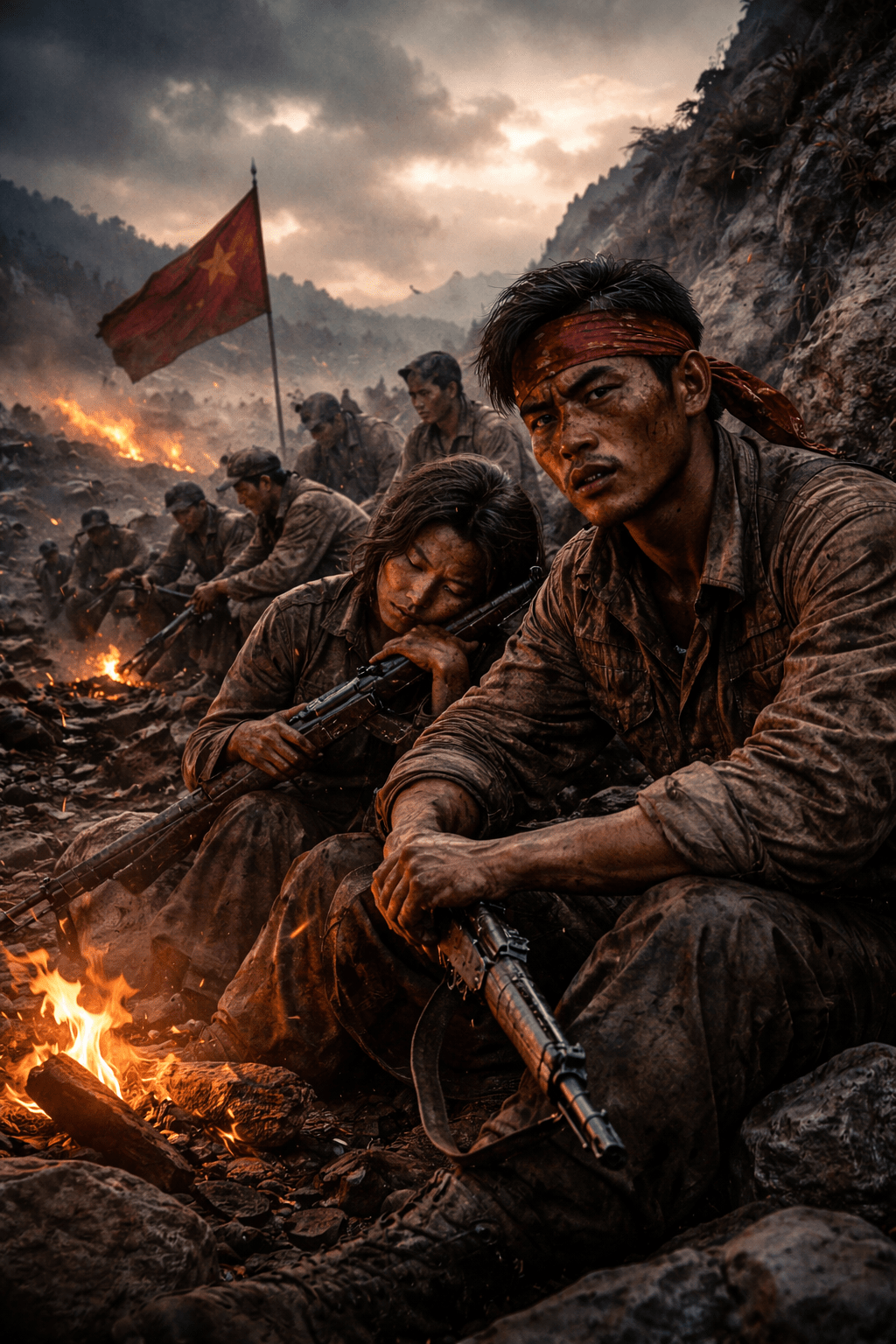
This Weaponized Intellects Book Review treats Kim San’s life not as biography but as a weapon—tracing how colonial violence, exile, repression, and ideological struggle forged a revolutionary consciousness that rejects liberal illusion, exposes the limits of nationalism and adventurism, and affirms that only disciplined, mass-based anti-imperialist struggle can transform defeat into the foundation for victory.
By Prince Kapone | Weaponized Information | Weaponized Intellects Book Review | April 11, 2026
The Undefeated in Defeat
“My whole life has been a series of failures and the history of my country has been a history of failure. I have had only one small victory – over myself. This one small victory, however, is enough to give me confidence to go on. Fortunately, the tragedy and defeat I have experienced have not broken but strengthened me. I have few illusions left, but I have not lost faith in humans and in the ability of people to create history. Who shall know the will of history? Only the oppressed who must overthrow force in order to live. Only the undefeated in defeat who have lost everything to gain a whole new world in the last battle. Oppression is pain, and pain is consciousness. Consciousness means movement. Millions of men must die and tens of millions must suffer before humanity can be born again. I accept this objective fact. The sight of blood and death of stupidity and failure no longer obstructs my vision of the future.” – Kim San
There are books you read, and there are books that read you back. Books that do not merely pass through your hands, but pass judgment on your life, strip your illusions bare, and demand to know what side of history you intend to stand on. Song of Ariran: The Life Story of a Korean Rebel is one of those books. It is not a memoir in the soft bourgeois sense, not a sentimental recollection meant to entertain the idle or flatter the educated. It is a revolutionary document, a testimony written in the language of defeat, sacrifice, exile, prison, and unbroken will. It is the kind of book that leaves a mark on the spirit because it was forged in conditions where spirit itself had to be weaponized in order to survive.
I first read this book when I was twenty-one years old, incarcerated, and trying with all the seriousness I could gather to understand the world that had produced the cage around me. At that time, I had organized a prison study group with two of my closest comrades. We were young, searching, angry, and hungry for clarity. We read because we had to. We read because the official story of the world—the one taught by the state, the schools, the courts, and the news—had already revealed itself to be a lie. We read because if we were going to live as conscious human beings under those conditions, then we needed theory, history, and the testimony of those who had already walked through fire.
Song of Ariran hit all three of us like a hammer.
Not because it gave us comfort. It did not. Not because it offered some cheap little sermon about perseverance. It did not do that either. It hit us because it told the truth. A hard truth. A truth most people spend their whole lives trying to avoid. It told us that oppression is not an unfortunate misunderstanding. It is war. It told us that conscious struggle does not unfold along a smooth upward line, with inspirational speeches and morally satisfying outcomes. It unfolds through pain, confusion, betrayal, sacrifice, fear, and the constant possibility of death. It told us that revolution, if it is real, demands everything.
That book made clear to each of us, in its own stern and unsentimental way, the meaning of Che’s observation that a revolution, if it is truly a revolution, ends in only two ways: victory or death. There is no polite third option. No respectable compromise. No path where the oppressor is gently persuaded to surrender power because the evidence was compelling and the argument was fair. History does not move that way. Power does not yield that way. The old world does not step aside out of decency. It has to be fought, broken, overthrown. And even when victory is won, it comes drenched in mourning. The road to liberation is paved with the blood of those who do not live to see the dawn they helped bring into being.
We felt that when we read Kim San. We felt the loneliness of exile, the ferocity of commitment, the agony of repression, the bitterness of defeat, and still, somehow, the refusal to surrender faith in humanity’s power to make history. That was the part that struck deepest. Not optimism in the childish sense. Not naïve hope. Something harder. Something disciplined. A faith that had passed through fire and come out stripped of illusion but not stripped of conviction. Kim San had seen too much to speak like a liberal. He had suffered too much to romanticize struggle. And precisely for that reason, when he spoke of history, of movement, of the oppressed, his words carried the weight of iron.
Both of those comrades I read this book with are now gone. Dead. And that fact changes the temperature of every page for me now. Time has sharpened the blade. What once struck me as a profound revolutionary text now also returns as something bound up with memory, grief, and love. I cannot revisit this book without thinking of those study sessions, those arguments, those moments of recognition when three imprisoned young men could feel, however briefly, that the walls around us had cracked just enough for history to get in. We were reading about another people, another struggle, another colonial wound. But the pain, the dignity, the sacrifice, the insistence on consciousness and movement—those things crossed every border.
I return to this book now, at forty, because never in my lifetime has revolution stood so clearly as a condition for survival. We are living in an age of imperial barbarism, ecological unraveling, technological domination, social decay, and ruling-class nihilism so advanced it can no longer even pretend to offer humanity a future. The old order has become openly homicidal. It is willing to burn the earth, starve nations, drown populations in war, and grind generations into despair in order to preserve its power a little longer. Under such conditions, revolution ceases to be a noble idea one may choose to admire from afar. It becomes a material necessity if humanity is to live.
That is why this book matters now. Not as an artifact. Not as a relic from some vanished century of heroic struggle. It matters because it tells us what the stakes actually are. It tells us what it means to lose, and keep going. To suffer, and keep fighting. To be surrounded by failure and still refuse despair. To discover, through pain, that pain itself can become consciousness—and that consciousness, if it remains alive, must become movement.
We need that lesson now. We need to understand that if we are serious about a different world, then we must also be serious about the cost of bringing it into being. We must be willing to struggle, to sacrifice, to endure, to suffer, to overcome, and to continue until victory is won. Not because suffering is noble in itself. It is not. But because the enemy will not be defeated by wishful thinking, moral performance, or the narcotic comforts of liberal optimism. The future will belong either to organized struggle or to organized ruin.
So this review begins where Kim San himself begins: with defeat, with pain, with the last scraps of illusion burned away, and with that harder thing that remains when everything else has been taken—faith in the oppressed, faith in history, faith that those who have lost everything may yet gain the world.
And we do not need that faith for ourselves alone. We need it for our children, and for their children. We need it because the old world is dragging all of us toward the abyss, and because the only people who will stop it are those willing to fight for a new one all the way through.
A Song That Remembers What Politics Has Not Yet Learned to Do
The book does not begin with a program. It does not begin with a party, a line, or even a clearly articulated demand. It begins with a song—Ariran—and that choice is not accidental. Before Kim San becomes a revolutionary, before he encounters Marxism, before he even understands the structure of the forces that govern his life, there is already something present that refuses to disappear. Not yet politics. Not yet strategy. But memory—persistent, wounded, and unfinished.
“The path to Ariran has no returning.” That line doesn’t speak like a metaphor invented for literary effect. It speaks like a fact lived too many times to require embellishment. People leave. They do not come back. The road stretches forward, but it does not lead home. And in that simple recognition, something fundamental about colonial Korea is already revealed. A people exists, but not as a unified force. A land exists, but cannot gather its own. The nation survives—but in fragments, in absences, in voices that call out and do not receive an answer.
This is where liberal history usually loses its footing. It prefers to begin with documents—annexations, treaties, official acts—because those can be catalogued neatly, arranged into timelines that give the illusion of order. But Kim San’s life does not begin with a document. It begins with dislocation that has not yet found its language. The song carries grief, but not direction. It remembers loss, but cannot yet organize response. And that is precisely the contradiction that must be faced if we are to understand what follows. Because memory alone does not make a revolution.
Ariran preserves something essential. It refuses erasure. It holds together, however loosely, the sense that something has been taken that ought not to have been taken. But it cannot yet answer the question that history will soon demand: what is to be done about it? The song knows that something is wrong. It does not yet know how that wrong is structured, where its power lies, or how it might be broken. It gathers emotion, but does not yet produce organization. And without that transformation, even the most persistent memory risks becoming a ritual of loss rather than a force of change.
Kim San is born into that gap. He does not enter the world as a revolutionary-in-waiting, armed with clarity and purpose. He enters as a child shaped by conditions he cannot yet name. Poverty is present, but not yet understood as part of a wider system. Authority is encountered, but not yet analyzed. The differences between Korean and Japanese, between those who command and those who obey, are lived long before they are explained. What exists first is not theory, but contradiction—experienced directly, without a framework to contain it.
This is where the song matters again, but now in a more precise way. It does not give Kim San answers. It gives him continuity. It tells him, without fully explaining how, that the world he inhabits is not natural, not permanent, not the only possible arrangement of human life. It keeps alive the memory of something that existed before domination was made to feel inevitable. That is its power. But it is also its limit. Because to remember a different world is not the same as knowing how to bring one into being.
And so the contradiction deepens. A people remembers, but cannot yet act. A nation persists, but cannot yet assemble itself into force. The colonized subject feels the weight of domination, but does not yet possess the tools to analyze or resist it effectively. This is not failure in the moral sense. It is the starting point imposed by history. No one is born with a political line. Consciousness is not inherited fully formed. It is produced—slowly, unevenly, through experience that does not immediately make sense of itself.
What Ariran reveals, then, is not simply the depth of Korea’s wound. It reveals the early stage of a process that has not yet found its direction. The song refuses disappearance, but it cannot yet produce movement. It holds the past, but cannot yet break the present. It keeps something alive, but does not yet know what that something must become.
That is where Kim San’s life begins—not with clarity, but with inheritance. Not with strategy, but with a memory that insists on surviving even when it cannot yet explain itself. And the question that will follow him from this point forward is not whether that memory is real. It is whether it can be transformed into something capable of acting in history.
A Revolutionary Who Must Pass Through Another’s Voice—and Cannot Be Contained There
Kim San does not enter the text on his own terms. He arrives mediated—carried through the pen of Nym Wales, an American journalist in Yenan, writing from within the very imperial world that produced the conditions he is fighting against. This is not a neutral arrangement. It is the first contradiction the reader must confront. A Korean revolutionary, formed through colonial violence, exile, and political struggle, becomes legible to the world through a Western observer. His life is preserved—but only by passing through a structure not his own.
Wales immediately recognizes that Kim San cannot be reduced to a simple type. He is not merely a nationalist, not an abstract “rebel,” not a figure that fits cleanly into the moral categories familiar to liberal readers. He moves across languages—Korean, Japanese, Chinese—not as a sign of cosmopolitan ease, but as a necessity imposed by displacement. He studies, teaches, organizes, and reflects across multiple revolutionary currents. What Wales encounters is not a personality, but a condensation of overlapping struggles: Korean anti-colonial resistance, Chinese revolutionary development, and the wider crisis of imperialism in East Asia. She sees this complexity, but she must also translate it.
That translation is not simply linguistic. It is political. Wales writes for an audience that stands outside the conditions that produced Kim San. To make him intelligible, she must organize his life into a narrative that can be followed—events arranged, contradictions sequenced, development given a sense of direction. His experience becomes structured into a story. His uneven political formation is rendered as progression. What in reality unfolds through confusion, reversal, and partial understanding begins to appear as something closer to coherence.
This is not a personal failure on her part. It is the logic of imperial mediation. The dominant culture does not simply ignore resistance—it records it, translates it, and in doing so, often reshapes it into forms that can be absorbed without requiring transformation. The revolutionary is made visible, but also manageable. His struggle becomes something to be read about, rather than something that reorganizes the reader’s relationship to the world.
And yet, this process does not fully succeed. Kim San does not settle into the form constructed around him. His voice carries too much contradiction, too much unresolved movement, to be smoothed into a stable narrative. There are moments where the structure tightens, where the story seems to move cleanly—and then something breaks through. A hesitation that is not resolved. A judgment that cuts against expectation. A reflection that exposes uncertainty rather than masking it. These are not flaws in the text. They are the points where the revolutionary exceeds the frame.
Because Kim San is not presenting a finished line. He is reconstructing a life lived under conditions where clarity was never given in advance. His account does not move from ignorance to knowledge in clean stages. It moves through error, through misdirection, through forced reorientation under pressure. That unevenness cannot be fully reorganized into narrative stability without distortion. And where it resists that reorganization, something more truthful emerges.
The reader, then, cannot remain passive. To treat Wales as a transparent conduit is to accept the mediation as complete—to read the text as though it were simply the story of an individual life. But this is not an individual story. It is a record of a consciousness formed within struggle, carried through a structure that both preserves and reshapes it. To read seriously is to hold both levels at once: the necessity of the mediation, and its limits.
This has political weight. Imperial culture has long mastered the art of documenting resistance in ways that neutralize its force—turning struggle into narrative, militants into characters, history into something that can be observed without consequence. Wales does not simply reproduce this pattern, but neither can she fully escape it. She stands at its edge, attempting to represent a revolutionary life while writing from within a world structured against it.
Kim San, however, cannot be reduced to that function. His development—as a militant moving across borders, across ideological lines, across successive failures and corrections—cannot be contained without remainder. And it is precisely in that remainder, in what resists narrative smoothing, that the political substance of the text becomes visible. The instability is not a weakness. It is evidence of a life that was not lived according to a script.
So the question is not whether we hear Kim San directly. We do not. The question is whether we are able to recognize where his voice presses against the structure that carries it—where experience refuses to be simplified, where contradiction refuses resolution. Because it is there, in that tension, that his development as a revolutionary can actually be grasped—not as a story completed, but as a process still unfolding.
A Childhood That Feels the Weight of the World Before It Knows Its Name
When Kim San begins to speak in his own memory—“I remember”—the expectation is that the narrative will finally stabilize. That we will be given a clear account of origins, a childhood arranged into causes that explain the revolutionary to come. But that is not what happens. What we encounter instead is unevenness. Fragments. Scenes that appear without full explanation, impressions that carry weight but not yet meaning. The past does not present itself as a finished story. It has to be reconstructed, and even then, not completely. This is not a failure of memory. It is a record of the conditions under which that memory was formed.
To be born in Korea under Japanese rule is to enter a world already structured by force, but not yet explained as such. The child does not begin with an understanding of imperialism. He begins with experience—poverty that feels normal because it is everywhere, authority that appears natural because it is constant, differences that are noticed before they are interpreted. The household struggles, but struggle has no immediate political language. It is simply life as it presents itself. And yet, within that life, something does not sit right.
Kim San recalls moments not as fully understood events, but as impressions that linger. The behavior of officials, the posture of authority, the quiet humiliations that do not announce themselves as political but leave a mark all the same. The child does not yet say, “this is colonial domination.” He feels imbalance. He senses that some stand above while others are forced below. He observes that certain people command without question, while others must adjust themselves to that command. The structure is lived before it is named. This is where consciousness begins—not as clarity, but as disturbance.
Liberal narratives often treat early life as a kind of moral seedbed, as though the future revolutionary can be traced back to moments of early righteousness or innate rebellion. But Kim San’s recollections refuse that simplicity. There is no immediate line from childhood to revolution. There is confusion, partial awareness, misrecognition. There are things he notices but cannot yet explain, things he accepts because there is no framework to question them, and things that trouble him without yet producing resistance.
Even memory itself does not behave obediently. There are gaps. Things he cannot fully recall. Moments that feel important but remain indistinct. This, too, is part of the condition. Colonial life does not unfold in clean narrative sequences. It interrupts, disorients, fractures continuity. To remember under such conditions is already to struggle—to piece together a life that was not experienced as a coherent whole in the first place. And still, patterns begin to emerge.
The differences between Korean and Japanese are not theoretical—they are lived in posture, in speech, in expectation. Authority carries a different weight depending on who exercises it. Respect is not distributed evenly. Dignity is not assumed. The child begins to register that the world is arranged in a way that places him and those around him at a disadvantage that cannot be explained by individual failure alone. But this realization does not arrive fully formed. It accumulates slowly, through repeated encounters that do not quite fit together.
This is the contradiction that defines the early stage of Kim San’s development. He experiences a structured inequality without yet possessing the tools to analyze it. He feels the pressure of domination without yet understanding its mechanism. The world presses on him, but the meaning of that pressure remains unresolved. And this matters, because without that gap—between experience and explanation—there would be no movement at all.
If everything were immediately understood, there would be nothing to struggle through. If everything were accepted without question, there would be nothing to resist. It is precisely the partial nature of early consciousness—the fact that something is felt but not yet known—that creates the conditions for development. The child does not begin as a revolutionary. He begins as someone who cannot quite make sense of the world he inhabits.
What Kim San gives us, then, is not a heroic origin story, but something far more useful: the early formation of a contradiction that has not yet found its resolution. A life that has begun under conditions of domination, where awareness is emerging unevenly, where memory preserves fragments without yet organizing them into a line. The revolutionary is not present here as identity. He is present only as possibility—latent, unformed, waiting for history to force the question that experience alone cannot yet answer.
Where Empire Teaches Submission—and Accidentally Sparks Rebellion
The colonial classroom does not present itself as violence. It presents itself as order. Desks aligned, lessons structured, authority clearly defined. Everything appears calm, rational, even beneficial. The child is told he is there to learn, to improve himself, to become something more than he was. And in a narrow sense, this is true. He does learn. He does change. But what he is being shaped into is not neutral. The classroom is not simply a place of knowledge. It is a place where empire trains the colonized to accept their place within it.
The lessons are precise in their silence as much as in their content. Japanese language is required. Korean history fades into absence or distortion. Authority speaks from one direction and expects no reply from the other. Discipline is enforced not only through punishment, but through repetition—daily practices that make obedience feel natural, even necessary. The student is not only taught what to think. He is taught how to sit, how to respond, how to position himself in relation to power.
At first, Kim San moves within this structure as it is given to him. He studies. He listens. He absorbs what is presented, not because he has accepted it fully, but because there is not yet an alternative framework through which to reject it. The authority of the classroom carries weight. It appears organized, coherent, backed by the force of the state. The lessons may not always align with what he has experienced, but the discrepancy does not immediately produce resistance. It produces uncertainty. And then the cracks begin—not all at once, not dramatically, but in small, accumulating ways.
Something is missing. Korean history does not appear where it should. The world described in the classroom does not fully match the world outside it. The authority that demands obedience offers no explanation that can withstand sustained questioning, only repetition. The more he learns, the more the gaps begin to show themselves—not as explicit contradictions at first, but as absences that refuse to stay quiet.
This is where empire’s educational project begins to falter. Because it cannot teach without opening the door to thought, and it cannot fully control what thought does once it begins to move. Literacy allows access beyond the prescribed lesson. Knowledge creates comparison. The student who is meant to internalize hierarchy begins, however faintly, to observe it instead. And observation, once it takes hold, is difficult to return to obedience from.
Kim San does not immediately become a rebel in the classroom. That would be too simple, and too false. What develops instead is a tension he cannot yet resolve. He continues to participate in the system—he studies, he advances—but the system no longer sits comfortably as it once did. The authority that once appeared solid begins to feel constructed. The lessons that once seemed complete now feel partial. Something has shifted, but not enough yet to produce open refusal.
This is the dangerous stage—the one empire cannot fully eliminate and cannot easily detect. The student has not rejected the system, but he has begun to see it. He has not yet found a line of resistance, but he has begun to suspect that what is presented as natural may in fact be imposed. The contradiction remains internal, unresolved, moving beneath the surface of outward compliance.
And that is precisely what makes it unstable. Because once the world is no longer taken for granted, it cannot return to its previous state. The discipline of the classroom may still hold the body in place, but it no longer holds the mind with the same certainty. The student continues to learn—but now he is also, however quietly, comparing, questioning, noticing what does not align. Empire has taught him how to read. It has not yet learned how to stop him from reading against it.
When Empire Spoke the Language of Freedom and Answered Belief with Bullets
Before the break, there is belief. That is what must be understood if the March First Movement is to be read seriously and not reduced to a morality play with a predetermined ending. When Woodrow Wilson spoke of “self-determination,” the phrase did not arrive in Korea as obvious hypocrisy. It arrived as possibility. Not because the colonized were naïve, but because history itself had opened a moment in which the language of freedom appeared, however briefly, to circulate beyond the boundaries empire usually enforced.
Kim San encounters this not as distant rhetoric, but as something that begins to move through the people around him. Students talk. Networks form. Declarations are drafted. The idea spreads—not as theory, but as expectation. Perhaps the world has shifted. Perhaps the powers that dominate will now recognize what they have long denied. Perhaps justice, spoken clearly enough, might finally be acknowledged.
This belief is not foolish. It is historical. Because the colonized do not invent the language of rights out of thin air. They hear it from the very powers that deny them those rights. Empire speaks in universal terms when it needs legitimacy. It invokes humanity, civilization, progress—words that do not specify their limits until those limits are enforced. The mistake is not that Koreans believed in these words. The mistake belongs to those who spoke them without intending to honor them. And so the movement forms.
On March 1st, 1919, Korea does not act as a scattered memory. It steps forward as something closer to a people. Declarations are read. Crowds gather. The streets fill. For a moment, the nation that had survived as song begins to assert itself as presence. This is not yet revolution in the full sense, but it is no longer passive endurance. It is collective action, organized enough to make itself visible, unified enough to present a demand. And then the answer comes—not in words, but in force.
The Japanese state does not misunderstand the movement. It does not misinterpret the declarations. It recognizes immediately what is at stake: a challenge, however limited, to its authority. And like all ruling powers faced with even the possibility of losing control, it responds in the only language it ultimately trusts. Demonstrations are suppressed. Protesters are beaten, shot, imprisoned. Villages are terrorized. The appeal to principle is met with the administration of violence.
This is the moment where belief breaks. Not gradually. Not through debate. But through confrontation with reality that refuses to accommodate illusion. The idea that justice might be granted from above—that empire might recognize the claims of the colonized if only those claims were made clearly enough—cannot survive this encounter. It is not that the argument failed. It is that the structure itself has no capacity to respond to such arguments except with repression.
For Kim San, this is not an abstract lesson. It is a rupture in understanding. What had appeared possible reveals itself as conditional. What had been spoken as universal shows itself to be selective. The language of freedom does not disappear—but it is exposed. It becomes clear that when empire speaks of self-determination, it does so within limits it does not declare in advance. Those limits are enforced not by discussion, but by force. And once those limits are reached, the mask falls immediately.
This is the real function of liberal imperialism. It does not simply lie. It produces belief under conditions where that belief can be turned against those who hold it. It invites the colonized to speak in its language, and then punishes them when they take that language seriously. It offers recognition in theory, and repression in practice. And in doing so, it attempts to teach a final lesson: that power does not have to honor the principles it proclaims. But the lesson does not land as intended.
The March First Movement does not achieve independence. It is suppressed. But suppression does not erase what has been revealed. It clarifies it. It strips away the possibility that freedom might be negotiated through appeal alone. It forces the question into a new form—not whether the colonized deserve self-determination, but how such determination can be achieved against a system that will not grant it willingly.
Kim San does not yet have the answer. But something has ended. The belief that justice might descend from above, that empire might be persuaded to relinquish control through moral argument, that history might bend without being forced—these begin to collapse under the weight of what he has witnessed. What remains is harder, less comforting, and far more accurate: that the struggle ahead will not be decided by who is right, but by who has the power to make reality conform to that right. And from that point forward, the question is no longer whether the world is unjust. It is how that injustice is organized—and how it can be broken.
In the Empire’s Capital, Knowledge Expands—and So Does the Boundary of Who Is Allowed to Live
Tokyo presents itself not as conquest, but as progress. Its universities, libraries, and disciplined urban order give the appearance of a society organized around knowledge, advancement, and rational development. For a Korean student arriving from a colonized homeland, this access is not abstract. Books that had been scarce become available. Political debates circulate openly among students. The intellectual world appears to widen. At first glance, the imperial center offers something the colony withholds: the tools to understand the modern world.
But those tools are not neutral, and neither is the space in which they are accessed. The universities Kim San enters are not simply institutions of learning. They are products of imperial expansion, financed and stabilized by the extraction of labor and resources from places like Korea. The same system that opens the library door is the one that closed off his country’s autonomy. This contradiction is not theoretical. It is lived. He studies inside structures built on domination while remaining marked by that domination as someone who does not belong fully within them.
This position—admitted but not accepted—sharpens perception in ways that comfort never could. Japanese students move through the university as participants in the system’s reproduction. Kim San moves through it as someone whose presence exposes its limits. He can read the same texts, attend the same lectures, engage the same arguments, but the social ground beneath him is different. He is tolerated, not integrated. His advancement does not translate into equality. The boundary is not always announced, but it is constantly enforced.
Within this environment, political lines compete for authority. Reformists argue that the system can be adjusted, improved, made more just without being overturned. Socialists begin to question the foundations more directly, pointing toward class relations and exploitation. Anarchists reject authority altogether, refusing both state and hierarchy as such. These are not abstract schools of thought for Kim San. They are attempts to answer a concrete problem: why does a system capable of producing knowledge and order simultaneously produce subjugation and exclusion?
At this stage, none of these lines fully resolves the contradiction. Reform promises inclusion, but cannot explain why inclusion is structurally denied. Anarchism rejects domination, but offers little clarity on how to dismantle a system that operates across nations and is backed by organized force. Marxism appears, but not yet as a fully grasped method. Kim San moves through these currents as someone testing them against lived experience, not adopting them as intellectual identities. The question is not which theory is most appealing, but which one can withstand reality. Reality answers with violence.
The Great Kantō Earthquake fractures the appearance of order that Tokyo projects. Infrastructure collapses, communication breaks down, and in that moment of instability, the underlying logic of the system surfaces. Rumors spread rapidly—Koreans are accused of sabotage, of poisoning wells, of plotting insurrection. These accusations do not emerge from evidence. They emerge from a structure that has already marked Koreans as expendable. What follows is not random panic. Police, soldiers, and civilian groups participate in coordinated attacks. Koreans are identified, detained, beaten, and killed. Entire neighborhoods become sites of organized terror.
This is not an interruption of the system. It is the system under stress revealing its core. The same society that organizes knowledge with precision organizes violence with equal efficiency when its authority is threatened. The boundary Kim San has been living with—between access and exclusion—hardens into something final. Education does not protect him. Discipline does not integrate him. No level of adaptation alters the fact that, within this structure, his life can be declared disposable at any moment.
At this point, earlier explanations begin to collapse. Reform cannot account for a system that shifts so quickly from administration to massacre. Moral appeals cannot account for violence that operates with such coordination. What is revealed is not prejudice alone, but a system that produces both knowledge and extermination as part of the same process. Empire educates and destroys without contradiction because both functions serve its continuity.
It is here that Marxism begins to move from possibility to necessity. Not as a finished doctrine, but as a method capable of explaining how such a system operates—how economic extraction, state power, and racial hierarchy combine into a structure that can sustain itself through both development and destruction. The violence of the pogrom is not an anomaly to be explained away. It is evidence of how the system maintains itself when its stability is threatened.
Tokyo, then, does not radicalize Kim San through education alone. It radicalizes him through the collision between what the empire claims—order, knowledge, progress—and what it produces when strained—repression, exclusion, death. The classroom expands the field of understanding. The pogrom redraws its limits in blood. Between those two experiences, the question of belonging is settled. The system cannot be entered as an equal. It can only be understood as a structure to be confronted.
Crossing the Yalu: When the Nation Can No Longer Contain Its Own Struggle
The Yalu River had already appeared once, in song, as a line of loss. A place where people crossed and did not return, where the path forward meant separation rather than arrival. But when Kim San reaches it in life, the crossing no longer belongs to memory alone. It becomes a decision shaped by pressure. Korea, as a terrain for political development, has narrowed to the point of suffocation. Surveillance tightens. Organization becomes dangerous before it can become effective. To remain is not to continue the struggle—it is to be contained by the conditions that prevent it from advancing. Crossing the river does not resolve this contradiction. It displaces it.
On the other side lies Manchuria and China, a space where Korean exiles, independence fighters, and broader revolutionary currents intersect without fully merging. What appears at first as expansion quickly reveals itself as fragmentation on a larger scale. The struggle is no longer confined, but neither is it unified. Different organizations operate with different assumptions, different strategies, and different levels of connection to the people they claim to represent. The question that emerges is not simply how to fight, but how to fight together—if that is even possible.
For Kim San, this shift is not abstract. It is immediate and practical. The national question, which once seemed self-contained, now opens outward. Japanese imperialism does not stop at Korea’s borders. It extends across the region, embedding itself in China, shaping the conditions under which multiple peoples are forced to respond. To treat the Korean struggle as isolated begins to look less like clarity and more like limitation. But to expand the struggle beyond the nation introduces new problems—of coordination, of language, of political line—that cannot be solved by intention alone.
Exile, in this sense, is not liberation. It is reconfiguration under constraint. Networks must be rebuilt. Trust must be established without the grounding of shared locality. Communication becomes uneven, dependent on fragile links that can break under pressure. The revolutionary is no longer operating within a familiar social terrain, but within a shifting field where alliances are provisional and conditions change rapidly. What had once been rooted now becomes mobile, and mobility brings both opportunity and instability.
It is here that the limits of nationalism begin to press more heavily. Not as an abstract critique, but as a practical difficulty. If the struggle is organized solely around Korea, how does it confront an imperial power that operates across borders? If coordination with Chinese movements becomes necessary, what political framework can sustain that coordination without dissolving the specific conditions of Korean oppression? These are not questions that can be answered through slogans. They arise directly from the terrain in which Kim San now finds himself operating.
The crossing of the Yalu does not produce clarity. It produces scale. The field of struggle expands, and with it, the complexity of the problems that must be faced. The revolutionary subject can no longer rely on the assumption that national liberation will unfold within a contained space. The enemy does not operate that way. Neither can the struggle that seeks to defeat it. But recognizing this does not immediately generate a new strategy. It creates a tension between what must be done and what can actually be organized under existing conditions. And still, the crossing cannot be undone.
Whatever continuity once existed between land, people, and struggle has been broken. The revolutionary now moves through a world where those elements must be actively reconnected rather than assumed. This is not a loss that can be reversed by return. It is a transformation that must be worked through. The nation remains the origin of the struggle, but it no longer contains its limits. Something else is required—something that can operate across the very boundaries that imperialism has already rendered porous.
Kim San does not yet possess that framework. But he has crossed into the conditions that demand it. And from this point forward, the question is no longer whether the struggle should expand, but how that expansion can be made into something more than dispersion—something capable of confronting a system that already operates on a wider scale than any single nation can match.
Shanghai: Where Revolution Gathers Without Form—and Breaks Against Its Own Fragmentation
Shanghai concentrates the contradictions of empire into a single, unstable terrain. Foreign concessions divide the city into zones of control governed by competing imperial powers. Banks, shipping houses, and trading firms move capital extracted from across Asia, binding the city to a global system of exploitation. Police forces answer not to a unified authority, but to overlapping jurisdictions that protect imperial interests above all else. In this environment, order exists—but only as a negotiated arrangement between powers that do not trust one another. It is precisely this fractured structure that creates space for revolutionary activity, and at the same time prevents that activity from consolidating easily into power.
For Korean exiles, Shanghai becomes a point of convergence. Independence organizations establish themselves there, drawing in students, militants, and political leaders displaced by repression at home. But convergence does not produce unity. It produces proximity without coherence. Groups operate side by side while advancing different strategies, shaped by the uneven conditions under which they were formed.
An Ch’ang-ho attempts to reconstruct a disciplined national movement, emphasizing organization, education, and continuity. His approach recognizes that without structure, resistance cannot sustain itself. Others reject this slower path, arguing that only immediate armed action can break the paralysis imposed by exile and repression. Still others look outward, seeking diplomatic recognition or support from foreign powers, hoping to leverage international contradictions against Japanese rule. Each of these lines responds to a real constraint. Each isolates one aspect of the problem and elevates it into a strategy.
The difficulty is not the presence of these lines, but their inability to integrate. Organization without force risks stagnation. Force without organization dissipates quickly. External alignment without internal strength produces dependency. What is missing is not commitment, but a framework capable of coordinating these elements into a sustained struggle. Without that framework, each approach operates in partial isolation, advancing where it can and collapsing where it must.
Exile deepens this fragmentation. Leadership in Shanghai is physically separated from the Korean masses it seeks to mobilize. Communication moves slowly, often intercepted or distorted. Conditions inside Korea shift faster than strategies formed abroad can adapt to them. Decisions made in Shanghai arrive disconnected from the realities they are meant to intervene in. The result is not simply error, but misalignment between intention and effect. Plans that appear coherent at the center lose their coherence at the point of application.
At the same time, the pressure to act intensifies. Imperial rule continues uninterrupted. Repression inside Korea limits the development of organized resistance. In Shanghai, where activity is possible but unstable, the desire to move from planning to action grows sharper. But without coordination, action fragments into isolated efforts. What appears as initiative at one level becomes disconnection at another. The contradiction tightens: delay strengthens the enemy, but premature action weakens the movement.
Kim San moves through this terrain not as a spectator, but as someone searching for a line that can hold under these conditions. The appeal of disciplined organization is clear—it promises continuity where everything else is unstable. The appeal of immediate struggle is equally clear—it breaks the inertia that exile produces. But neither, on its own, resolves the deeper problem. The issue is not choosing between them, but constructing a relation between leadership, strategy, and the masses that does not collapse under pressure.
Shanghai exposes what happens when that relation is absent. Organizations compete for legitimacy without a unified process to determine direction. Resources are limited and unevenly distributed. Alliances form around immediate needs and dissolve just as quickly when those needs shift. The movement exists, but not yet as a force capable of directing itself. It advances in fragments, unable to accumulate its efforts into something durable.
This is not reducible to individual failure. It reflects the material conditions of struggle under displacement. Exile disrupts continuity, separating leadership from the social base that gives it strength. It forces reconstruction in an environment shaped by imperial competition, where surveillance, instability, and uneven development are constant. Under these conditions, even correct ideas struggle to take root, while incorrect ones can persist because there is no unified mechanism strong enough to test them against practice and discard them.
For Kim San, Shanghai clarifies a limit that cannot be ignored. Opposition to empire, no matter how widespread or sincere, does not automatically generate effective resistance. Without organization capable of linking strategy to the masses and sustaining action over time, struggle remains dispersed. It appears, advances briefly, and then fragments under pressure. The problem is no longer simply how to fight, but how to build a form of struggle that can survive its own contradictions.
Shanghai does not provide that form. It reveals the necessity of it. What emerges from this period is not a solution, but a sharpened understanding: that without a structure capable of unifying action, every line—no matter how compelling—remains provisional. And in a terrain where the enemy operates with coordination and continuity, provisional struggle cannot hold for long.
When Action Breaks Isolation but Cannot Yet Build Power
From the fragmentation of Shanghai emerges a demand that cannot be postponed: to act. Where organization fails to consolidate, where leadership remains divided, where strategy does not yet hold, the pressure to move shifts from discussion to intervention. Groups like the Yi Nul Dan arise from this condition, not as deviations from the struggle, but as expressions of it. When coordinated resistance is blocked, action detaches from structure and asserts itself directly.
This turn toward militancy is not irrational. It is produced by a situation in which delay carries its own cost. Japanese imperial rule continues uninterrupted. Networks inside Korea are disrupted before they can stabilize. Exile weakens coordination. Under these conditions, waiting begins to resemble surrender. To strike at representatives of empire—officials, collaborators, institutions—appears as a way to reassert initiative, to demonstrate that the system can be reached and challenged despite its apparent dominance.
For Kim San, this is not an abstract debate. He encounters militants who operate with discipline and purpose, who organize under conditions where failure often means imprisonment or death. Figures like Kim Yak-san do not theorize passivity; they reject it outright. Their actions carry immediate effects. An attack disrupts administration, exposes vulnerability, forces the system to respond. In a terrain where paralysis threatens to settle in, this capacity to act registers as strength.
But the conditions that produce militancy also define its limits. Each operation is planned within a narrow scope, executed by small groups, and concluded without the structures necessary to extend its impact. The attack lands, but it does not reorganize the broader field. It proves that the enemy can be struck, but it does not alter the balance of forces in a sustained way. The system absorbs the disruption, reasserts control, and adapts its mechanisms of repression accordingly.
This adaptation is not passive. Repressive measures expand in response to militant activity. Surveillance intensifies. Arrests increase. Collective punishment is used to isolate militants from the population. The state does not treat isolated attacks as contained events—it uses them to justify broader control. What begins as an assertion of initiative can become part of a cycle in which action and repression reinforce one another without breaking through.
The issue here is not the legitimacy of violence. Under colonial rule, the right to resist cannot be reduced to moral debate. The issue is whether a given form of resistance can accumulate into power. And on that terrain, isolated militancy encounters a structural barrier. Without organization capable of linking these actions to a broader social base, each act remains contained within its immediate effect. It ignites, but it does not extend. It disrupts, but it does not consolidate.
Kim San’s understanding develops within this contradiction. The militants’ commitment is not in question. Their willingness to act under conditions where others hesitate reveals a real strength. But that strength cannot substitute for the absence of a framework that connects action to the masses and sustains it over time. Courage can initiate struggle. It cannot, on its own, organize it.
As repression tightens, the attraction of direct action grows. The fewer the spaces for open organization, the more militancy appears as the only remaining path. But the more it becomes dominant, the more the movement risks separating itself from the broader population whose participation is necessary for any sustained transformation. The contradiction sharpens into a pattern: action provokes repression, repression limits organization, and the limitation of organization pushes the movement back toward isolated action.
What emerges is not failure in the sense of collapse, but limitation in the sense of containment. The system is challenged, but not displaced. It is forced to respond, but not forced to retreat. The question shifts accordingly. It is no longer whether resistance can strike, but whether it can build the capacity to outlast and overcome the system it confronts.
Yi Nul Dan exposes this problem in its clearest form. Not because it is misguided, but because it operates at the point where necessity and limitation meet. It answers the demand to act under conditions where waiting is impossible. But it cannot resolve the deeper requirement to construct a form of struggle that accumulates force rather than dispersing it.
For Kim San, this does not produce retreat. It produces a sharper orientation. If action without organization dissipates, then the task is not to abandon action, but to transform its relation to structure and to the masses. Something must be built that can carry struggle beyond isolated operations—something capable of coordinating, sustaining, and expanding resistance across time rather than in bursts.
By the end of this phase, the lesson is no longer partial. Without a form that can unify action and organization, even the most determined militancy remains bounded by the conditions that produced it. It strikes, it disrupts, it sacrifices—and the system endures.
To Refuse Marriage in a World Built on Arrest
By the time Kim San reaches the question of marriage, he is no longer speaking like a young man daydreaming about private happiness. He is speaking like someone who has already had history put its boot on his neck. That difference matters. Bourgeois society teaches people to imagine love as a little fenced garden outside the storm of politics, a private hut where the world is supposed to stop knocking. Kim San knows better. Under colonial occupation, under surveillance, under conditions where prison, torture, disappearance, and flight are not exceptional but routine, there is no private hut. The police kick the door in. The state enters the marriage bed before the wedding night is over.
So when he reflects on why he decided not to marry, the point is not that he had become some ascetic saint of revolution. It is the opposite. He understood too well what marriage demanded—presence, steadiness, protection, time, tenderness, the ability to remain in one place long enough to build something that was not constantly at risk of being shattered by a raid, an arrest, a border crossing, or a bullet. He could not promise those things honestly. To speak of marriage under such conditions was not merely to speak of love. It was to speak of exposure. Every tie became a point through which the enemy could tighten its grip.
And Kim San is not sentimental in the way liberals like their martyrs to be sentimental. He does not turn sacrifice into perfume. He does not write as though renunciation makes a man pure. He writes like someone measuring cost. That is why the section bites. The refusal of marriage is not draped in halo-light. It is a recognition that revolutionary life under repression corrodes the very ground on which ordinary intimacy rests. The state makes itself present not only in the factory and the prison, but in the emotional life of the colonized. It colonizes time. It colonizes movement. It colonizes trust. It turns affection itself into a vulnerability.
But the contradiction is not solved by refusing marriage. It remains alive. Need does not disappear because necessity has spoken. The desire for closeness, for rest, for someone to whom one belongs outside slogans and meetings and false papers and police files—none of that evaporates. Kim San does not become less human by subordinating those needs. He becomes more exposed to the terrible truth of revolutionary life: that history often demands choices it has no right to demand, and yet demands them all the same.
This is also where the review must resist cheap heroics. There is no need to prettify his position. There are gender limits and historical blind spots in how he thinks through women and commitment. The revolutionary movement, like every movement born inside class society, carries old debris into new struggles. It does not step into history pure. But that only deepens the significance of the passage. Because what is at stake here is not whether Kim San solved the contradiction of love and revolution. He did not. What he shows is that for the colonized revolutionary, even the most intimate sphere becomes terrain under enemy occupation. Under those conditions, love does not vanish. It enters the struggle wounded.
How Tolstoy Lost and Marx Entered with a Hammer
Every serious revolutionary has to pass through the graveyard of moralism. Kim San does too. Before Marxism becomes method, before politics becomes a science sharpened in history, there is the earlier stage—the revolt of conscience, the ethical disgust at cruelty, the desire to answer oppression with purity, self-sacrifice, and righteousness. Tolstoy lives in that stage. So does a great deal of colonial idealism. It is not worthless. It is merely unarmed.
Kim San’s movement from Tolstoy to Marx is not the sort of neat intellectual upgrade professors like to diagram on a blackboard, as though a young rebel simply swapped one set of books for another and came away with better vocabulary. The shift is more violent than that. It is the collapse of one way of understanding the world under the pressure of events that refuse to fit it. Moral protest can tell you that empire is evil. It cannot tell you why it persists so efficiently, why it reproduces itself through schools, police, property, armies, newspapers, and collaborators, why it speaks of civilization while running pogroms and prisons like assembly lines.
Tolstoy gives the conscience a mirror. Marx gives the revolutionary a map. That is the difference. Under the sign of moral humanism, injustice appears primarily as a scandal of the heart. Under historical materialism, it appears as a structure—rooted in ownership, class rule, state power, and the organized theft of labor and land. One framework teaches the oppressed to testify against evil. The other teaches them how evil is built, staffed, financed, rationalized, and defended. The first may produce martyrs. The second can produce strategy.
Kim San does not abandon ethical seriousness when he moves toward Marx. He abandons ethical helplessness. That is what matters. He begins to see that imperialism is not just cruelty wearing boots. It is a system of accumulation. National oppression is not just humiliation. It is political economy in armed form. The Japanese empire is not wrong because it lacks compassion. It is wrong because it is an engine of rule and extraction, and engines do not stop because someone writes them a letter about decency.
Once he crosses that threshold, the whole field changes. The question is no longer: how do we remain morally clean in a dirty world? That is a monk’s question, and even monks, as this book shows, sometimes carry more gasoline than incense. The real question becomes: what forces move history, and how can the oppressed intervene in those forces in a disciplined way? Marx enters precisely there—not as a new badge, not as a flattering identity, but as a weapon against confusion.
This is why the section matters so much. Kim San is not merely telling us what he read. He is telling us how a colonized militant learned that sincerity is no substitute for analysis. A good heart without strategy is a candle in a typhoon. It glows beautifully for one second and then the storm laughs and goes on. Marxism, for Kim San, begins when he understands that to fight history, one must first understand its machinery. Anything less is noble defeat, and empire has always had plenty of room in its cemetery for the noble.
Canton Burned Through the Night and Morning Found the Corpses
The Canton Commune enters the book like an argument for immediacy, for the old revolutionary fantasy that courage, timing, and a sufficiently furious leap can break open history before the enemy has time to close his fist. And for a brief moment, under the pressure of insurrection, it can feel that way. Power trembles. Streets shift allegiance. Men and women act not as isolated sufferers, but as a collective force stepping onto the stage. One can understand why such moments intoxicate the revolutionary imagination. They seem to prove that the masses need only rise, and the old order will discover its own hollowness.
But the old order is rarely as hollow as it looks in the first hours of revolt. It has barracks, officers, supply lines, class allies, habits of command, and a deep practical commitment to murder. Canton teaches this in blood. The uprising is not defeated because the rebels lack passion. They have passion to spare. It is defeated because revolutionary energy outruns consolidation. The Commune seizes, but does not hold. It acts, but cannot yet reproduce the structures needed to sustain action under counterattack. What bursts forth politically cannot yet be secured organizationally. The enemy, as enemies do, notices this immediately.
Kim San’s treatment of the episode does not let anyone hide inside romance. He does not give us a poster. He gives us collapse. What follows the uprising is not the triumphant music of destiny but retreat, disarray, executions, and the brute restoration of rule. This is where a lesser revolutionary either turns cynical or becomes dogmatic. Kim San does neither. He treats the defeat as something to be studied. That is precisely where seriousness begins. The point is not to ask whether the revolt was emotionally justified. Of course it was. The point is to ask whether the relation between force, mass support, preparation, and political line was adequate to the conditions. Anything else is funeral oratory.
And that is the lesson Canton hammers into him. Insurrection is not theater. It is not a heroic gesture for history books. It is the concentrated question of whether revolutionary organization has matured enough to survive the answer given by the ruling class. If it has not, then courage becomes raw material for massacre. Not because courage is worthless, but because courage unguided by durable structure can be spent faster than it can be accumulated.
This is where the book’s greatness shows itself. Kim San does not retreat from revolutionary violence after Canton like some chastened liberal who has finally discovered that bullets are unpleasant. He retreats from illusion. He learns that one cannot vault over the difficult labor of constructing organs, cadres, discipline, and a living relation to the masses. History is not insulted into surrender. It must be organized into motion. Canton was real. Its defeat was realer. From that contradiction Kim San draws not passivity, but hardness.
The White Terror Had Clerks, Informers, and Plenty of Rope
After Canton, the counterrevolution shows its true professionalism. The White Terror is not merely revenge, though it has revenge in abundance. It is administration. It is filing systems, interrogators, denunciations, raids at the right hour, names extracted from broken bodies, the patient stitching together of repression into a governing method. This is important to say because liberals often speak of terror as though it were some regrettable excess, a moment when order lapses into brutality. No. Terror is order when the ruling class feels threatened enough. It has managers. It keeps records. It allocates manpower.
Kim San moves through this phase like a man learning how thoroughly modern counterrevolution can be. Comrades vanish. Networks rupture. Places once usable become compromised. Every connection becomes dangerous because every connection can be watched, trailed, bought, or broken. The movement is hunted not only with rifles, but with uncertainty. That uncertainty is one of repression’s great arts. It poisons trust. It stretches nerves. It turns caution into suspicion and suspicion into fragmentation if a movement cannot master itself.
The names and episodes matter here—the arrests, the executions, the hurried escapes, the repeated need to start again from diminished ground. The revolutionary does not move through a dramatic novel of clean loyalties and obvious villains. He moves through a field in which betrayal can arrive in plain clothes, in which rumor can do half the police’s work for them, in which survival itself begins to take on the rhythm of conspiracy. Kim San does not inflate this into melodrama. He shows it as a working environment. That is what makes it frightening.
What the White Terror reveals is that counterrevolution is not simply the other side’s anger. It is the other side’s intelligence. The ruling class studies insurgency. It experiments. It adapts. It knows that shooting militants is only one part of the task. The deeper goal is to break continuity—to make organizing feel impossible, trust feel naive, commitment feel suicidal, and collective action feel permanently one step behind the police file. That is how whole movements are made to stagger even when their cause remains alive.
And still the contradiction remains unresolved, because the Terror cannot abolish the conditions that produced rebellion. It can jail militants, murder cadres, sever communication, scatter organizers, and drench whole districts in fear. But it cannot make imperialism cease to be imperialism. It cannot make exploitation feel just. It cannot make colonized people forget why they rose. Repression can mutilate a movement. It cannot answer it. That is why Kim San’s account never turns into a hymn to endurance for its own sake. Survival matters because the conditions of struggle persist. To live through the Terror is not yet to win. It is merely to remain available for the next round of history.
The Water Cure Teaches the State’s Theology of Pain
When Kim San writes of prison and torture, the prose enters a different register. The revolutionary question narrows from movements and lines and uprisings to the body itself—the lungs, the throat, the nerves, the animal fact of pain. The “water cure” appears in the book not as a metaphor but as a sequence, a method, a lesson administered dose by dose. That detail matters. Torture is never merely sadism, though sadists are often available for the job. It is pedagogy. The state is trying to teach the prisoner what power means when stripped of all ornament.
That is why the “water cure in six doses” bites so hard. It is systematic. It has stages. It is designed to produce not only suffering but collapse—to force speech, to disorder thought, to make the body plead for the very authority that is violating it. This is not the state behaving irrationally. It is the state behaving with grim rationality. Prison takes the wider logic of colonial rule and condenses it into one room: isolate, overwhelm, extract, break, use. The prison cell is empire reduced to essentials.
Kim San does not cheapen the experience by pretending the body is infinitely strong. He does not write like one of those revolutionaries invented after the fact, whose flesh exists only to honor slogans. He understands the terrible truth: under torture, the issue is not abstract moral heroism but the deliberate engineering of conditions meant to destroy resistance from the inside out. Confession, disorientation, partial cooperation, silence, breakdown—these are not tidy ethical categories when the body has been made into a battlefield. They are consequences within a machinery built precisely to produce them.
And yet this section does not end in surrender to that machinery. What survives is not some cartoon invincibility. What survives is the continued struggle to remain politically intact while one is being physically invaded by force. That may mean refusing to speak. It may mean holding to fragments. It may mean surviving with damage rather than emerging with purity. Here again Kim San is superior to the moralists. He understands that repression seeks not merely information, but transformation. The state wants the militant remade—either as collaborator, cautionary tale, or wreck. To resist that remaking, even incompletely, is already to remain in struggle.
This is why prison in Song of Ariran is not a detour in the narrative. It is the concentrated form of everything the book has been teaching. Colonial power is not persuasive at its core. It is coercive. It does not ultimately govern by truth, but by the organized administration of pain and fear. The “water cure” is simply that truth stripped naked. And once Kim San passes through that chamber, neither he nor the reader has any excuse left for speaking about empire as though it were just a bad idea argued too aggressively. It is a machine that floods the lungs and waits for obedience. That is its philosophy. Everything else is stationery.
Inside the Party, the Air Thickens with Suspicion
By the time Kim San reenters sustained party life after prison and repression, the organization is no longer the hopeful instrument imagined in early struggle. It is strained, hardened, and—most dangerously—uncertain of itself. This is not abstract. It shows up in the atmosphere: accusations of “renegades,” whispers of betrayal, the tightening grip of discipline that no longer distinguishes clearly between protection and suffocation. The Party must defend itself, yes. But under the pressure of the White Terror, defense begins to mutate.
Names matter here. The presence of the Blue Shirts, the spread of informers, the constant fear that a comrade might already be compromised—these are not background conditions. They become active forces shaping political life. Meetings are no longer simply about line and strategy. They are about who can be trusted, who has spoken too freely, who might be carrying more than just their own thoughts into the room. Under such conditions, even correct positions can begin to sound suspicious, and suspicion itself starts to masquerade as vigilance.
Kim San does not romanticize this phase. He shows how quickly revolutionary organization can begin to resemble the very pressures it is meant to resist. The Party tightens—and in tightening, risks breaking its own connective tissue. Discipline becomes heavier, but not always sharper. Accusations circulate, but not always with clarity. The line between necessary caution and internal corrosion becomes harder to hold.
This is where lesser narratives would either condemn the Party outright or defend it blindly. Kim San does neither. He remains inside the contradiction. He knows that without organization, there is nothing—only scattered resistance, easily crushed. But he also sees that an organization under siege can begin to devour its own capacity if it loses its grounding in the masses and replaces political clarity with administrative suspicion.
The danger is not simply error. It is misrecognition. To treat every fracture as betrayal, every disagreement as deviation, every uncertainty as evidence of infiltration—this is how a movement begins to suffocate itself while believing it is protecting its core. The Party becomes a space where speech narrows, initiative declines, and comrades begin to measure not only what they say, but whether saying anything at all is worth the risk.
And yet, even here, Kim San does not exit. He does not retreat into individual purity or ideological distance. He stays. That is the hardest position. To remain committed while seeing clearly. To refuse both collapse into cynicism and surrender to unthinking loyalty. It is here, inside the thick air of suspicion, that revolutionary discipline must prove whether it is rooted in living struggle—or merely reacting to fear.
The Party is still necessary. But necessity is not immunity. Under these conditions, the question is not whether the organization exists, but whether it can remain a vehicle of struggle without becoming a mirror of the terror pressing against it. That is not guaranteed. It must be fought for—from within.
Exhaustion Is Not Betrayal, But It Can End a Revolutionary
There is a point in Kim San’s trajectory where the accumulation becomes visible—not as a statistic, but as weight. Prison, flight, factional struggle, ideological reorientation, repeated rebuilding under collapse—these do not simply pass through a person. They settle. They accumulate in the body, in the mind, in the ability to continue at the same intensity. And Kim San does not disguise this. He reaches a point where he is no longer operating at full capacity—not because he has lost conviction, but because he has been stretched beyond what one person can sustain indefinitely.
This is where romantic narratives usually fail. They treat endurance as infinite, as though the revolutionary is a machine that can run on commitment alone. Kim San shows the opposite. What begins to fracture is not belief, but the ability to carry the full burden of struggle under conditions of isolation. The networks are unstable. The Party is strained. The external pressure does not let up. Under these conditions, even the most committed militant begins to thin out—not ideologically, but materially.
He does not present this as confession. He presents it as fact. There are moments where the line cannot be fully held in practice, where clarity becomes harder to maintain, where action becomes uneven. This is not betrayal. It is exposure. The revolutionary subject, when cut off from sustaining structures and mass grounding, begins to erode. Not immediately. Not dramatically. But steadily.
This is where the lesson sharpens beyond comfort. The problem is not that individuals are weak. The problem is that no individual can substitute for a collective base. When struggle becomes concentrated in isolated figures—moving from place to place, carrying networks on their backs, absorbing repression directly—the limits appear sooner or later. The revolutionary becomes a bottleneck, and eventually, a breaking point.
Kim San’s turn here is not framed as discovery. It is forced. The realization that the masses are not simply the objective of struggle but its condition becomes unavoidable. Without them, without rootedness, without structures that distribute the burden, the revolutionary line cannot be sustained at scale. It becomes episodic, fragile, constantly at risk of collapse under pressure.
This is why the return toward mass work matters—not as doctrine, but as survival. It is not cleaner. It is not easier. It is slower, more uneven, less visible. But it is the only terrain where revolutionary energy can accumulate rather than dissipate. Where the burden is shared rather than concentrated. Where the struggle can endure beyond the limits of any one person.
What Kim San shows here is not a fall from revolutionary purity. It is the breaking of an illusion: that commitment alone is sufficient. It is not. Without organization rooted in the masses, commitment burns out. With it, commitment becomes part of something that can last.
War Did Not Unite Them—It Left Them No Choice
By the time Japanese aggression deepens into full-scale war across China, the fragmentation that defined earlier phases of the struggle begins to look less like diversity and more like liability. This is not an intellectual shift. It is imposed by events. The expansion of imperial violence compresses the political field. Forces that once operated in parallel—sometimes in tension, sometimes in open disagreement—are now facing an enemy whose scale does not permit leisurely division.
Kim San moves through this phase with none of the illusions of tidy unity. The anti-Japanese front does not emerge as a harmonious synthesis. It emerges as a necessity. Nationalists, communists, regional forces—all carry their own lines, their own histories, their own suspicions. None of that disappears. It is managed, contained, negotiated under pressure.
Specifics matter. Coordination is uneven. Trust is partial. Agreements are made and tested in practice rather than assumed. The presence of earlier factional wounds does not vanish just because a larger enemy appears. It lingers in how decisions are made, in how authority is distributed, in how quickly cooperation can turn back into friction if conditions shift.
And yet, despite all this, a form of alignment emerges. Not because theory resolved contradiction, but because the cost of disunity becomes immediate. Japanese expansion does not wait for ideological clarity. It destroys, occupies, restructures the terrain. Under those conditions, refusal to coordinate is not principled independence. It is strategic failure.
This is the difference between unity as slogan and unity as condition. The former is declared. The latter is forced. Kim San operates within the latter. He understands that working together does not mean agreement. It means acting in ways that prevent mutual defeat. It means holding contradictions without allowing them to paralyze action at the decisive moment.
It is also in this phase that personal life reenters—not as resolution, but as reconfiguration. The earlier refusal of marriage gives way under altered conditions, not because the contradiction has been solved, but because the terrain has shifted enough to permit a different balance. Even here, nothing is stable. The revolutionary does not step into comfort. He steps into another arrangement of risk and possibility.
War does not purify struggle. It intensifies it. It forces decisions faster than theory can settle them. It exposes which contradictions can be managed and which will explode under pressure. And it leaves no room for indulgence. Under these conditions, unity is not a moral achievement. It is the minimum requirement for survival.
Kim San’s clarity here is hard-earned. He does not celebrate unity. He uses it. Because he knows that history will not wait for perfect alignment. It moves with or without it. And those who cannot act within contradiction will be carried aside by those who can.
No Elegy, No Excuse—Only the Line That Must Be Carried Forward
There is a certain kind of reader who will come to this book looking for a hero and leave satisfied. They will speak of courage, of sacrifice, of a life lived “for others,” and they will close the cover with that familiar, comfortable sigh—the one that says: what a tragedy, what a noble struggle, how unfortunate that history can be so cruel. Then they will return to their lives, having extracted inspiration the way empire extracts resources—quickly, cleanly, without consequence.
This review is not written for them.
Because Song of Ariran is not a story about courage in the abstract. It is a record of what courage looks like when it collides with reality and is forced to either transform or break. Kim San is not useful to us as a symbol. He is useful as a problem. A contradiction that refuses to resolve itself neatly. A revolutionary who learns not in clean stages, but through error, defeat, recalibration, and the long, grinding process of being corrected by history itself.
And what history teaches him—again and again, with very little patience—is that nothing about empire is accidental. It does not misunderstand the colonized. It governs them. It does not fail to deliver justice. It organizes injustice with remarkable efficiency. It does not occasionally become violent. It is violent as a condition of its existence. The pogroms in Tokyo, the bullets in Korea, the prisons, the “water cure,” the White Terror—these are not deviations. They are the system speaking plainly.
Which means that everything built on appealing to its conscience collapses on contact.
This is where the book becomes dangerous. Because it refuses the small comforts that sustain liberal politics. It refuses the idea that if we explain ourselves better, organize more politely, demonstrate more convincingly, power might relent. Kim San learns what millions have learned before and since: power relents only when it is forced to. And force, in this context, does not mean scattered acts of rage or symbolic confrontation. It means organized, sustained, disciplined power rooted in the masses.
Not performance. Not posture. Not identity worn like a badge that substitutes for strategy. Organization. Structure. Line. The slow accumulation of force that can withstand repression, absorb defeat, correct itself, and continue.
This is where most contemporary radicalism reveals itself to be something else entirely. It wants the language of revolution without the burden of building it. It wants visibility without vulnerability, expression without discipline, critique without consequence. It mistakes being seen for being effective. It confuses indignation with transformation. It would not survive the first chapter of Kim San’s life, let alone the prisons that follow.
Kim San has no use for that. Not because he is purer, but because his conditions made illusion impossible. When your comrades are executed, when your organizations fracture under pressure, when you are hunted across borders and broken in cells, you do not have time to confuse aesthetics with politics. Either what you are doing builds power, or it does not. Either it connects to the people whose lives are being organized by exploitation, or it remains a performance staged for itself.
And that is the knife this book holds to the present.
Because the structures Kim San fought did not disappear. They expanded. They refined themselves. They learned. Empire today does not always arrive with a rifle first. Sometimes it arrives with a loan, a development plan, a military base dressed as “security cooperation,” a non-profit that manages dissent instead of sharpening it. But when those softer instruments fail, the old language returns immediately—sanctions, prisons, coups, bombs. The grammar has not changed. Only the vocabulary has diversified.
So the question this text leaves us with is not whether Kim San was right in every decision. He was not. That is precisely why he matters. The question is whether we are capable of the same kind of ruthless learning—of correcting our lines, abandoning what does not work, refusing both despair and delusion, and committing to the long, unglamorous work of building power where it actually lives.
“Only the undefeated in defeat…”—not the ones who never fall, but the ones who refuse to turn defeat into doctrine. The ones who treat failure as material, not identity. The ones who do not build monuments to their mistakes, but extract lessons sharp enough to cut through the next illusion.
There is no redemption offered here. No guarantee. No final assurance that history will reward effort with victory. What is offered is harder and more honest: a line of struggle that must be carried forward without the comfort of certainty.
Study. Organize. Root yourself in the masses. Build structures that can endure pressure. Break with what fails. Refuse what flatters you but does not strengthen you. Understand that revolution is not a moment of expression but a process of construction.
Everything else—every slogan without structure, every posture without risk, every critique without consequence—is exactly what Kim San spent his life learning to leave behind.
And if we cannot do the same, then the problem is not that history has betrayed us.
It is that we have refused to learn from it.


Leave a Reply