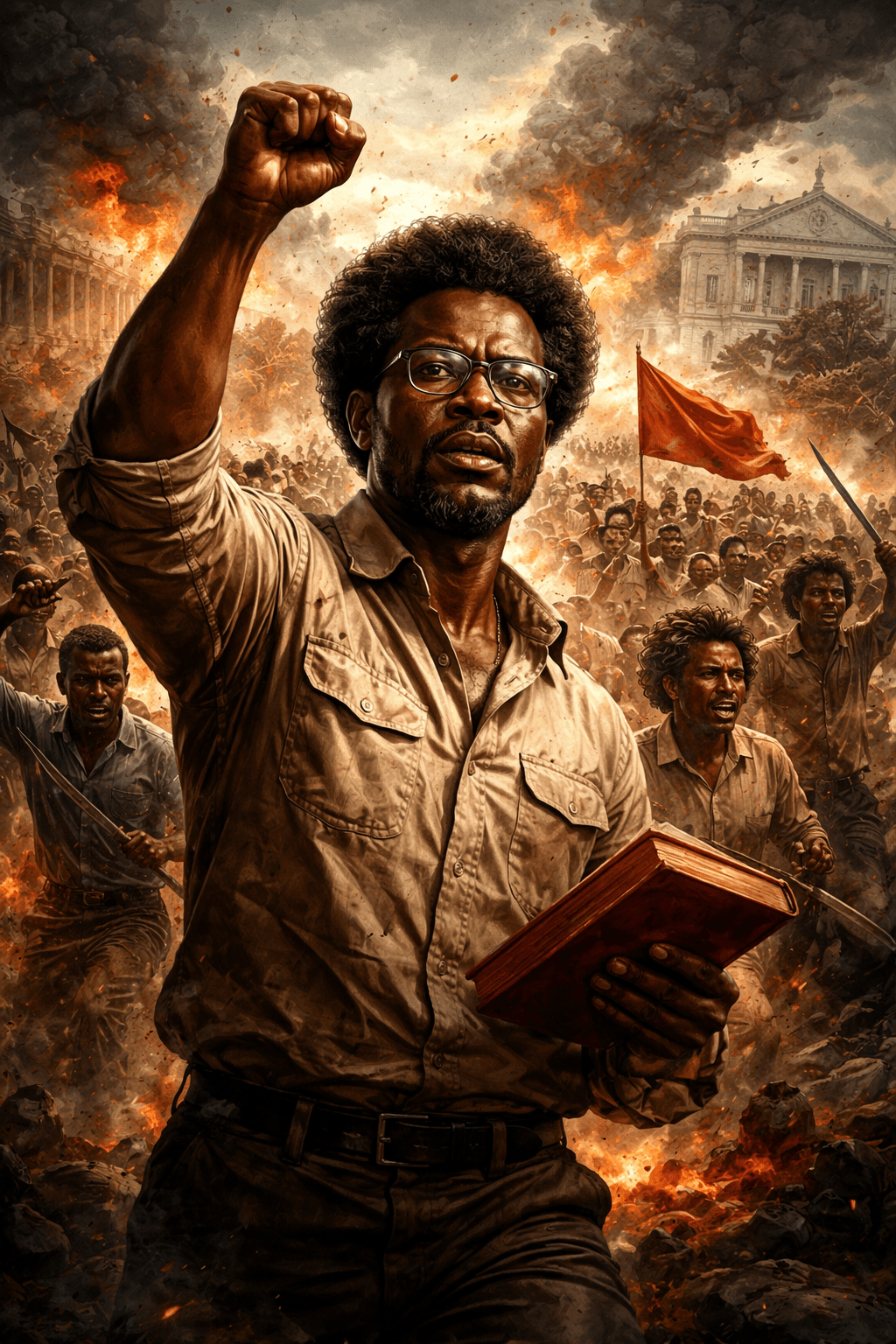
A Weaponized Intellects reconstruction of A History of the Guyanese Working People, 1881–1905 that treats Rodney’s most mature historical materialist work not as scholarship for contemplation, but as theory forged for organization, struggle, and socialist revolution.
A Book Written to Be Used
This review takes up A History of the Guyanese Working People, 1881–1905, written by Walter Rodney and first published in 1981. It is not Rodney’s most cited work, nor his most widely circulated. It is often overshadowed by How Europe Underdeveloped Africa, a text that rightly earned global recognition for naming imperialism as a system rather than a sin. Yet this relative obscurity is precisely what makes A History of the Guyanese Working People so important. Here, Rodney is not only diagnosing imperialism from the outside. He is dissecting it from within, on home ground, at the level of labor, land, law, and everyday survival. This is Rodney at his most disciplined, his most concrete, and his most dangerous.
The book covers a seemingly narrow period—British Guiana between 1881 and 1905—but its scope is anything but provincial. Rodney uses this slice of colonial history to expose the general mechanics of capitalist domination in the colonial world: how exploitation is engineered into geography, how labor regimes are rebuilt after emancipation, how race is manufactured as a tool of division, how reform functions as containment, and how the state ultimately reveals itself as an instrument of class rule. There is nothing ornamental here. Every chapter is driven by material conditions, empirical evidence, and a relentless insistence on tracing social outcomes back to their structural causes.
What distinguishes this work—even within Rodney’s own corpus—is its clarity of method. This is historical materialism without shortcuts. Rodney does not begin with abstract categories and then hunt for examples. He starts with drainage systems, wage contracts, village rates, police records, and labor disturbances, and from there builds a theory of colonial capitalism that never floats above the ground. Class struggle is not assumed; it is demonstrated. Race is not treated as an autonomous force; it is shown to be produced and managed by political economy. Consciousness is not romanticized; it is understood as something forged through struggle, defeat, accommodation, and renewed confrontation.
For that reason, this book stands as a template—a model of Marxist analysis that refuses both academic detachment and activist sloganeering. Rodney writes with the expectation that history should do work. He is not cataloging suffering for moral effect, nor assembling data for career advancement. He is producing knowledge for organization. The working people of Guyana are not presented as objects of sympathy, but as historical actors whose experience contains lessons for revolutionary practice everywhere imperialism operates.
Read in this light, A History of the Guyanese Working People emerges as Rodney’s most mature published work. It synthesizes the global anti-imperialist vision of his earlier writings with a granular analysis of class formation, state power, and resistance under colonial rule. It shows what historical materialism looks like when it is disciplined, rooted, and oriented toward struggle. This review approaches the text in that same spirit—not to admire it, but to extract from it. Because Rodney did not write this book to be remembered. He wrote it to be used.
Land Below Sea-Level: How Nature Became a Class Weapon
Rodney opens the book where every serious Marxist history of Guyana has to begin: not with “ideas,” not with parliamentary chatter, but with the hard, wet, physical world that colonial capitalism tried to turn into a machine for profit. On the coast, the earth itself sits at war with human life. He describes a coastal plain of clays “at sea level or as low as six feet below sea level,” where waterlogged conditions follow logically from “constant flooding from the sea” and heavy rainfall. In other words: the plantation did not arise on a neutral landscape. It arose on a landscape that demanded disciplined, collective labor just to keep the ground from swallowing the whole social order. This is not a scenic detail. It is the first contradiction. The colony’s wealth depended on sugar; sugar depended on coastal agriculture; coastal agriculture depended on drainage, sea defense, canals, kokers, dams—an entire infrastructure of forced labor and coerced maintenance that had to be reproduced day after day, season after season, with no mercy from the Atlantic.
That is why Rodney insists that “physical environment” and “class interests” are not separate topics but fused realities. Whoever controlled the estate controlled the water; whoever controlled the water controlled the life-chances of the working people. The coastal landscape made water management a social power, and the planter class treated it like private property even when the consequences spilled outward onto villages and the poor. The colony’s basic survival required collective engineering, but the social relations governing that engineering were capitalist and colonial: profits privatized, costs socialized, risk dumped onto the masses. So the “environment” becomes a weapon: not because storms have ideology, but because a ruling class can decide whose trench gets cleared, whose dam gets reinforced, whose village floods, whose children drink brackish water, and whose labor gets whipped into motion when the sea rises.
Rodney drives the point home with labor itself—who did the digging, who was assigned to the wettest and most punishing work, and how that work was narrated by the colonial record. He notes that “for a long while, Africans remained the specialist shovelmen,” and even a report on the digging of a canal behind Plantation Annandale in 1885 registers this as a taken-for-granted division of labor. Here Rodney’s method is razor sharp: he does not romanticize “the worker” in the abstract; he shows the concrete labor-process—canal digging, trench clearing, drainage maintenance—as a racialized, class-structured regime of value production and social control. The plantation did not only extract surplus labor in the factory-like field; it extracted surplus labor in the very engineering required to keep the plantation world from dissolving into mud and floodwater. The working people were compelled to build the conditions of their own exploitation.
Then Rodney twists the knife: even where nature seems to “help” by bringing rain, the colony’s dependence on rainfall becomes another vulnerability. He quotes the Argosy’s lament during late 1884, calling a drought of three months “nothing short of a calamity” in “a country with no irrigation save what the rainfall supplies.” That line is revealing precisely because it is not written by a revolutionary—it is written from inside the colonial common sense. It admits, unintentionally, that the entire export economy stood on fragile foundations: water systems built for plantations, not for social need; irrigation treated as incidental; and working people expected to absorb catastrophe as routine. Rodney’s point is not that drought is rare, but that capitalist planning under colonial rule produces permanent crisis-management for the masses and permanent escape routes for the owners.
Having shown how the internal structure of the colony was engineered around plantation profit, Rodney expands the frame outward. The colony is not a self-contained economy—it is a subordinate node in a world capitalist system. This is where Chapter 1 becomes a lesson in imperialism without ever needing to shout the word. Guyana’s ruling class could not simply “solve” its contradictions through policy because its economy was locked into external determinants: metropolitan trade, sugar prices, shipping, capital flows, and competition shaped by the larger capitalist world. Rodney states the colonial bind with brutal clarity: the colony was “unable to enact legislative and fiscal measures to defend its productive forces—as was done by the capitalist states themselves.” That sentence is a whole theory. The imperial core reserves sovereignty for itself—tariffs, subsidies, state protection, strategic investment—while denying those instruments to colonies, then blames the colonized for the resulting underdevelopment and instability. The colony is demanded to compete like a nation but forbidden to act like one.
So the dialectic of Chapter 1 is this: the working people are squeezed from below by the physical environment reorganized into a plantation machine, and squeezed from above by international capitalist forces that dictate the terms of survival. In that vise, “development” cannot be read as a liberal story of gradual progress. It is a struggle over who bears the costs of making society livable—who digs, who drains, who repairs, who starves when the rains fail, who is abandoned when the world market turns, and who still finds ways to carve out life, community, and resistance inside the mud and the ledger book. Rodney begins here because everything that follows—labor formation, peasant creativity, political struggle, race contradictions, and revolt—rests on this foundation of constraint. The working people did not enter history as an “emerging civil society.” They entered as a class forced to wrest existence itself from land stolen, flooded, and commodified under empire.
Emancipation Rewired: How the Plantation Rebuilt Its Grip on Labor
Having established how land, water, and infrastructure were organized as instruments of class rule, Rodney moves to the next unavoidable problem for the colonial ruling class: labor control after emancipation. If Chapter I shows how exploitation is built into the terrain, Chapter II shows how the plantation responds when human beings try to slip the leash. Emancipation did not dissolve the plantation system; it destabilized it. Freed Africans sought land, villages, bargaining power, and time outside the plantation clock. For the planters, this was not a moral crisis—it was a production crisis. Sugar could not flow without disciplined labor, and discipline could no longer rely on outright enslavement. The task of the colonial state became clear: reconstruct coercion under a new legal name.
Rodney is precise about the planter dilemma. African workers did not “withdraw” from labor in the abstract; they withdrew from plantation subordination. They still worked—on their own provision grounds, in villages, in wage labor when it suited survival—but they resisted the total domination that the plantation required. This resistance exposed the contradiction at the heart of post-slavery capitalism in the colony: wage labor without alternatives gives capital power, but wage labor with alternatives gives workers leverage. The planter class responded not by improving conditions or sharing power, but by importing a labor force designed to be cheaper, more controllable, and legally punishable. This was not demographic happenstance. It was strategy.
Indentured immigration enters Rodney’s narrative here as a technology of class rule. Indian labor was recruited under contracts that bound workers to estates, restricted mobility, criminalized breach, and made punishment a routine administrative act. The legal framework surrounding indenture ensured that the colonial state functioned as overseer by other means. Rodney strips away the liberal language of “free migration” and “contract” by showing how the law itself became the whip. Penal sanctions replaced chains; magistrates replaced drivers; prisons replaced barracoons. What mattered was not the form of coercion but its effect: restoring planter command over labor time, wages, and movement.
Crucially, Rodney does not treat Africans and Indians as abstract categories. He shows how the plantation deliberately organized the workforce into differentiated positions, each governed by distinct rules and vulnerabilities. Africans, with access—however limited—to villages and land, were treated as a labor reserve to be pressured back onto estates during downturns. Indians, bound by contract, were treated as a captive labor corps. This segmentation was not an unfortunate side effect of colonialism; it was the core of its labor strategy. Division made discipline cheaper. Racialization became a means of managing surplus value.
Yet Rodney refuses the plantation’s preferred narrative that Africans were “lazy” or that Indians were “naturally suited” to estate labor. He shows instead that both groups responded rationally to the conditions imposed upon them. Africans sought autonomy where it was possible; Indians resisted within the narrow space allowed by coercive contracts. Desertion, slowdowns, disturbances, and informal sabotage appear not as pathologies but as normal reactions to exploitation. The plantation’s racial ideology was retrofitted to justify a system that already depended on division.
The deeper contradiction exposed in this chapter is that the solution to the planter crisis creates new instability. By importing indentured labor, the ruling class temporarily suppresses African bargaining power but introduces a workforce whose conditions generate constant tension, resentment, and resistance. At the same time, the colony’s economy expands beyond the plantation in uneven ways—villages grow, non-estate labor increases, and the social composition of the working people becomes more complex. The plantation attempts to freeze labor into rigid categories, but the society it dominates refuses to remain static.
Rodney’s achievement in this chapter is to show emancipation not as a moral victory followed by social progress, but as a contested restructuring of exploitation. Freedom without power forces the ruling class to innovate its chains, and those chains, once reforged, sharpen the contradictions that will define the struggles ahead. Having reconstructed the labor regime to maintain sugar profits, the colonial system now faces a new problem: how to contain a working population that is increasingly learning to survive, and sometimes resist, outside the plantation’s direct command.
Living Outside the Cane: Survival, Autonomy, and the War on Small Farming
If the plantation rebuilt its grip on labor through contracts and coercion, it still faced a stubborn reality: working people continued to live, eat, reproduce, and imagine survival beyond the estate gates. Rodney turns in this chapter to the zones of partial escape—villages, provision grounds, and small farming—not to celebrate them as liberated spaces, but to expose them as contested terrain in an ongoing class war. These sectors emerge directly from the contradictions of Chapter II. When labor is disciplined on the plantation, it looks for air elsewhere. Small farming is not a refusal of work; it is a refusal of total domination.
Rodney is clear that the village economy develops under pressure, not protection. African villagers and small cultivators carve out land in marginal areas—often flood-prone, poorly drained, and neglected by colonial infrastructure. The same state that invests heavily in estate drainage and sea defense withholds resources from villages, leaving small farmers exposed to environmental catastrophe. Floods destroy crops; droughts ruin yields; disease spreads where sanitation is ignored. Yet these conditions are not accidents of geography. They are outcomes of political choice. The colonial system tolerates village life only insofar as it does not threaten the plantation’s labor needs.
What Rodney documents is a constant push-and-pull between autonomy and dependency. Villagers rely on small farming to reduce their vulnerability to estate wages, but they are still pulled into the market through taxes, rates, credit dependence, and fluctuating prices. Even subsistence is mediated by colonial power. Land access is limited, legal titles insecure, and transport costs high. When villages show signs of stability, the state intervenes—through taxation, infrastructure neglect, or legal pressure—to ensure that small farming never becomes a true alternative to plantation labor. Survival is allowed; independence is not.
Rodney refuses to romanticize these survival strategies. He shows how small farmers are forced into exhausting combinations of wage labor and cultivation, especially during crises. Men migrate for work; women shoulder increased burdens in agriculture and household reproduction; children’s labor becomes essential to family survival. This is not peasant self-sufficiency—it is life lived on the edge of exhaustion. Yet within these conditions, working people develop collective practices, informal cooperation, and political awareness rooted in everyday struggle. Villages become schools of administration and resistance, where people learn about rates, councils, land disputes, and the nature of colonial authority.
The deeper contradiction Rodney exposes is that small farming both stabilizes and threatens the colonial order. On one hand, it absorbs surplus labor, reduces immediate unrest, and provides a buffer against starvation. On the other, it undermines the plantation’s absolute control over labor time and wages. The planter class and the state therefore treat village life as a problem to be managed rather than a sector to be developed. Investment is withheld, autonomy restricted, and crises allowed to do their work. Underdevelopment here is not failure—it is policy.
By the end of this chapter, the social landscape has shifted again. The working people are no longer confined to the estate, but they are not free from exploitation either. Survival outside the plantation produces uneven outcomes: some stabilize precariously, others fall back into wage dependence, and new layers begin to emerge within the working population itself. These differences are not yet class power, but they are the raw material from which new social divisions—and new political tensions—will form. The question now is no longer simply how people survive, but how these uneven survival strategies reshape the working class and its capacity to act together.
Uneven Ground: How Survival Produces Strata, Not Freedom
Once survival outside the plantation becomes possible—however fragile—the working population no longer moves as a single undifferentiated mass. This is the new terrain Rodney maps in this section: a society where exploitation remains universal, but its forms become uneven. The same colonial order that blocks liberation also generates layers within the working people themselves, not through opportunity, but through differentiated exposure to risk, coercion, and proximity to power. What emerges is not upward mobility in the liberal sense, but stratification under constraint.
Rodney traces how economic diversification reshapes the colony without transforming its foundations. Alongside estate labor and village farming, new forms of work appear—dock labor, railway employment, domestic service, artisanal trades, petty retail, clerical positions, and limited civil service roles. These sectors do not exist outside the plantation economy; they orbit it. Sugar still dominates accumulation, but its gravity pulls people into different positions within the same system. Some workers gain more regular wages, others acquire limited skills or administrative roles, while many remain trapped in precarious, seasonal, or migratory labor.
The hinterland deepens this unevenness. As extractive activity expands inland, new labor regimes arise—timber, mining, transport—marked by isolation, harsh discipline, and temporary settlement. These workers are not absorbed into a stable proletariat; they are circulated, discarded, and replaced. Rodney shows that hinterland labor does not soften colonial exploitation; it intensifies it, stripping away even the minimal social protections present on the coast. Yet because this work sits farther from the plantation core, it also produces different political rhythms and weaker institutional visibility.
From these uneven conditions, a thin intermediate layer begins to form—clerks, teachers, professionals, small proprietors, and skilled workers whose livelihoods depend on the colonial economy but are not immediately tied to plantation labor. Rodney treats this layer without sentimentality. Its members often experience relative stability compared to estate and village laborers, but their position is structurally insecure. Their advancement depends on colonial order, not its overthrow. As a result, they tend to seek reform, respectability, and representation rather than confrontation. This is not a moral failing; it is a class position.
The political consequence is decisive. Differentiation weakens spontaneous unity among the working people while creating the social basis for leadership that speaks in the name of the masses but negotiates within the limits of colonial power. Those closest to the state learn its language and procedures; those farthest from it learn the cost of its violence. Rodney shows that this gap is not accidental. Colonial capitalism relies on uneven development precisely because it fragments collective struggle and channels discontent into manageable forms.
By the close of this section, the contradiction has sharpened again. The working people have proven capable of survival beyond the plantation, but that very survival has produced new divisions that complicate resistance. The colony now contains multiple working-class experiences, layered and unequal, all subordinated to the same ruling structure. The question that emerges is no longer only economic—it is political: when pressure builds from below, who will lead, who will speak, and whose interests will ultimately be defended? That question propels the analysis forward, straight into the contested arena of colonial politics and reform.
Reform as Containment: When Representation Becomes a Brake on Struggle
Out of differentiation comes politics—not politics as liberation, but politics as management. Having shown how uneven survival produces layers within the working people, Rodney now turns to the arena where those layers collide: colonial reform and representation. Pressure from below does not vanish; it accumulates. Wages, taxes, land, water, policing, and work conditions continue to generate conflict. But as that pressure grows, it is increasingly intercepted by intermediaries who promise change without rupture. Reform appears not as a gift from above, but as a strategy to stabilize domination when naked coercion alone is no longer sufficient.
Rodney is unsparing in his description of colonial governance during this period. Political power remains firmly in the hands of the planter class and the imperial state. Law, courts, police, and fiscal policy operate as instruments to protect property and discipline labor. The state’s posture toward the working people is not neutral administration but continuous surveillance and containment. Yet the very rigidity of this system forces adjustments. When unrest threatens accumulation, the ruling class experiments with constitutional tinkering and limited concessions—not to empower the masses, but to deflect them.
Villages become a crucial site of this process. Local administration offers a narrow channel for participation, teaching working people the mechanics of governance while keeping real power out of reach. Rates, councils, and petty offices introduce the language of citizenship without its substance. Rodney shows how this creates a double effect: political education on the one hand, and political frustration on the other. People learn how decisions are made precisely by discovering how little influence they have over them. Reform becomes a classroom where the limits of colonial democracy are taught through experience.
Into this space steps the emerging middle stratum—professionals, clerks, small proprietors—who position themselves as leaders of a “popular” movement. Rodney does not deny their opposition to planter dominance, but he dissects its boundaries. Their politics seek inclusion within colonial structures, not their overthrow. They bargain for representation, legality, and respectability, framing mass discontent in terms acceptable to imperial authority. The popular front they assemble is real, but it is carefully disciplined. Energy from below is translated into petitions, speeches, and reforms that leave the underlying relations of production intact.
The working people, however, are not passive spectators in this drama. Rodney emphasizes their participation, their pressure, and their expectations. They enter political processes with demands rooted in material life—jobs, land, wages, relief, dignity. The contradiction emerges when these demands exceed what reformist leadership is willing or able to deliver. At that point, representation becomes a barrier. The very leaders who claim to speak for the masses begin to fear the consequences of mass action itself. Reform reveals its class limit: it can negotiate with power, but it cannot confront it.
This section sharpens the central political lesson of the book. Colonial reform does not fail because it is poorly executed; it fails because it is structurally designed to preserve domination. By channeling struggle into institutional forms controlled by the ruling order, reform transforms pressure into patience. Yet the contradictions it seeks to manage do not disappear. They accumulate beneath the surface, waiting for moments when mediation breaks down and the working people are forced to act outside the bounds of respectability. That moment, Rodney shows, is not an aberration—it is the inevitable outcome of a system that offers voice without power.
Learning Under the Lash: Resistance, Retreat, and the Accumulation of Experience
When reform reveals its limits, struggle does not disappear—it changes shape. Rodney moves here from mediated politics to lived confrontation, from speeches and councils to the daily grammar of resistance under colonial rule. This is not a story of uninterrupted revolt, nor of heroic purity. It is a history of working people learning, through trial and punishment, what power looks like when it sheds its polite clothing. Resistance and accommodation are not opposites in this world; they are intertwined responses to domination enforced by law, police, and hunger.
Rodney begins with the Indian immigrant workforce, whose lives were compressed by the rigid machinery of indenture. Contracts fixed wages, immobilized labor, criminalized breach, and turned everyday disobedience into an offense against the state. Within this narrow space, resistance emerges in forms that colonial records often minimize or misread: work stoppages, collective disturbances, desertion, refusal, and the slow corrosion of discipline. Rodney is attentive to what the archive tries to hide, especially the role of women. He notes growing awareness in the 1890s of brutal labor demands placed on pregnant women and documents disturbances originating in women’s gangs, including the 1903 unrest at Plantation Friends where an indentured woman, Salamea, appears as a central figure. The colonial record treats this as anomaly; Rodney treats it as evidence of a suppressed pattern.
Creole working people confront exploitation across a widening field—on estates, in villages, on docks, railways, and urban workplaces. Their struggles are less bound by contract but no less constrained by force. Police intervention, legal repression, and economic retaliation define the limits of permissible action. Strikes and protests arise, subside, and reappear, shaped by seasonal work, market conditions, and repression. Rodney refuses to reduce these movements to failure. He insists instead that each encounter leaves residue: knowledge of the enemy, recognition of allies, and a clearer understanding of what legality protects and what it punishes.
What unites these experiences is not constant militancy but cumulative learning. Workers test the boundaries of power and are beaten back; they retreat, adapt, and return in new forms. Accommodation appears not as betrayal but as survival under siege. People work when they must, comply when resistance would mean starvation, and resist again when conditions allow. Rodney’s refusal of moralism here is decisive. He shows that revolutionary consciousness does not descend from theory; it is forged in the rhythm of advance and setback, in the recognition that the state is not an arbiter but an enforcer.
Out of this process, new political weapons begin to take shape—not fully formed organizations, but habits of solidarity, shared memory, and tactical awareness. The working people learn which leaders retreat under pressure, which institutions close ranks, and which actions provoke immediate repression. These lessons do not yet resolve the colony’s contradictions, but they sharpen them. Resistance exposes the true character of colonial authority, while accommodation reveals the cost of living without power. Together, they prepare the ground for the next confrontation—one that will not be confined to estates or council chambers, but will spill into the streets and force the state to respond openly as what it has always been: the armed guardian of colonial order.
Race as Discipline: How Division Is Manufactured Inside Class Rule
By this point in the analysis, the question can no longer be avoided. If Africans and Indians labored under the same colonial order, endured overlapping forms of coercion, and accumulated parallel traditions of resistance, why did unity not emerge as a decisive weapon? Rodney takes up this problem not to rehearse cultural stereotypes or moralize distrust, but to dismantle the very framework through which “race conflict” is usually explained. His intervention here is surgical: race is not the starting point of Guyanese history—it is one of its products.
Rodney insists that racial antagonism must be traced back to the organization of labor itself. Africans and Indians were inserted into the economy under different legal regimes, wage structures, housing arrangements, and disciplinary systems. These differences were not incidental; they were engineered to solve the planter’s labor problem. Africans, with partial access to land and villages, were treated as a labor reserve to be pressured during downturns. Indians, immobilized by contract and penal law, were treated as a captive workforce. The resulting inequalities in vulnerability and bargaining power generated resentment that appeared cultural but was rooted in political economy.
Colonial ideology then stepped in to naturalize what capital had produced. Planters, officials, and commentators explained division as the outcome of “racial temperament,” “custom,” or “tradition,” conveniently erasing the legal and economic structures that made division profitable. Rodney warns that historians who begin with race as explanation inevitably reproduce this mystification. If one looks only for racial hostility, one will always find it. What disappears in that method is the colonial system that depends on such hostility to survive.
Yet Rodney does not deny the reality of racial tension among the working people. He explains it. Competition for jobs, differential punishment, and unequal access to land and mobility all sharpened mistrust. When wages fell or repression intensified, workers were pushed into rivalry rather than solidarity. The colony’s structure ensured that conflict flowed laterally instead of upward. Race functioned here as a form of counterinsurgency—an everyday mechanism that redirected anger away from the ruling class and toward fellow workers.
The political consequence is decisive. Racial division weakens collective resistance while allowing the colonial state to present itself as neutral arbiter between “communities” rather than as architect of exploitation. Reformist leaders often reinforce this framing, appealing to harmony without challenging the conditions that make division rational. Rodney exposes the trap: unity cannot be willed into existence through moral appeals. It can only be forged by confronting the material arrangements that produce division in the first place.
This chapter sharpens the stakes of everything that follows. If race is understood as a product of class rule, then moments of mass action cannot be read simply as racial eruptions or criminal disorder. They must be read as explosions of a system that has exhausted its capacity to contain contradiction. When mediation fails and survival is threatened, the working people do not act as sociological categories—they act as forces colliding with power. That collision is no longer theoretical. It is about to become visible in the streets.
When the Streets Spoke: 1905 and the Unmasking of Colonial Power
Everything Rodney has built toward converges here. The 1905 disturbances do not appear as a sudden breakdown of order, but as the moment when a system designed to absorb pressure finally fails to contain it. By this point, the working people have learned enough—about reform’s limits, about the state’s loyalties, about race as a tool of division—to recognize that legality offers no remedy for worsening conditions. What erupts in 1905 is not chaos but clarity: a collective refusal to keep absorbing crisis in silence.
Rodney insists on reading the riots politically, not morally. He reconstructs their movement through the city and its workplaces with care, showing how crowds targeted sites of exploitation and control rather than engaging in indiscriminate destruction. Workers were threatened off job sites; domestics were pulled from employers’ houses; pawnbrokers and jewelers were looted as repositories of wealth extracted from labor. At the same time, Rodney notes what did not happen. There was no generalized arson, no attempt to annihilate the city itself. The action was disruptive, collective, and intelligible. Even the police recognized this, reporting that the crowds sought to stop work rather than simply steal.
Participation cuts across the social layers Rodney has been tracing all along. Estate workers, urban laborers, the unemployed, and women—especially domestics—appear not as background figures but as active agents. This matters. Domestics occupy a unique position in colonial society, laboring inside the homes of the ruling class while remaining among the most precarious and surveilled workers. Their visibility in the disturbances exposes the intimate reach of exploitation and the breaking point of enforced deference. The streets become a political arena precisely because institutional channels have closed.
The state’s response strips away any remaining illusion about neutrality. Police repression is swift and decisive, aimed not at restoring dialogue but at reasserting authority. Rodney treats this response as the logical endpoint of colonial governance, not an excess. When reform, mediation, and division fail, force remains. The riots force the colonial state to act openly as what it has always been: the armed defender of property and order against the working people.
Yet Rodney does not frame 1905 as defeat. He frames it as revelation. The working people do not overthrow the system, but they expose it. In the clash between crowds and police, the structure of colonial power becomes visible in a way that no pamphlet or petition could achieve. The riots mark the end of a political illusion—that representation, reform, or accommodation alone could resolve the colony’s contradictions. What remains unresolved is organization, strategy, and unity across the divisions the system has so carefully cultivated.
This is where Rodney leaves the reader—not with closure, but with responsibility. The history of the Guyanese working people is not a story of inevitable progress or tragic failure. It is a record of struggle under conditions designed to prevent victory. By tracing how domination was built, how resistance adapted, and how power finally revealed itself in 1905, Rodney arms future generations with something more valuable than nostalgia: a method. To understand colonial capitalism is to understand why revolt erupts, why it is crushed, and why it returns—until the structures that produce it are dismantled at their root.
Theory with Consequences: Why Rodney Wrote This Book and Why Empire Killed Him
This history was never meant to sit quietly on a shelf. Rodney did not write A History of the Guyanese Working People as an academic exercise, nor as a neutral contribution to “labor studies.” He wrote it as a weapon. Every page is aimed at stripping away illusion—about development, about reform, about race, about the neutrality of the state—so that the working people could see the system confronting them with clarity. This book is theory forged for practice, analysis sharpened for organization, history written with the expectation that it would be used.
That is why the argument never drifts into abstraction. Rodney anchors power in trenches and contracts, in villages and courts, in police batons and market prices. He traces domination not to bad leaders or cultural failure, but to structures deliberately built to extract labor and fracture resistance. And he does so with a purpose: to make clear that emancipation without power reproduces subordination, that reform without rupture becomes containment, and that unity cannot be achieved by moral appeal when division is materially enforced. These are not interpretive preferences. They are lessons drawn from struggle.
Rodney carried these lessons out of the archive and into the streets of Guyana. He returned not to teach from a safe distance, but to organize—to build a revolutionary movement capable of confronting the postcolonial continuation of colonial power. He understood that the end of formal colonial rule did not dissolve the plantation logic, the class hierarchy, or the imperial grip on the economy. And for attempting to translate this understanding into socialist practice, he was assassinated. That fact is not incidental to this book; it is its final chapter, written in blood rather than ink.
Empire tolerates scholarship that explains oppression as tragedy, inevitability, or cultural misfortune. It does not tolerate scholarship that names mechanisms, identifies enemies, and points toward organization. Rodney crossed that line deliberately. He refused the safety of detached critique and chose the danger of revolutionary clarity. His death stands as confirmation of what this book already proves: ideas that remain academic are harmless; ideas that move people toward power are treated as threats.
For Weaponized Intellects, this is the book’s enduring meaning. Rodney does not offer comfort or nostalgia. He offers discipline. He shows how to read society from the standpoint of those forced to keep it alive, how to expose the techniques used to divide them, and how to recognize moments when containment breaks and the state reveals its true face. To take this history seriously is to accept that theory carries responsibility—that understanding exploitation obligates action.
Rodney wrote this work expecting that others would continue what he began. Not by repeating his conclusions, but by applying his method to new conditions, new terrains, and new struggles. The question his book leaves us with is not whether the working people have suffered enough, but whether we are prepared to turn knowledge into organization, memory into strategy, and history into a weapon capable of finishing the fight he was killed for starting.
 Weaponized Information
Leave a comment