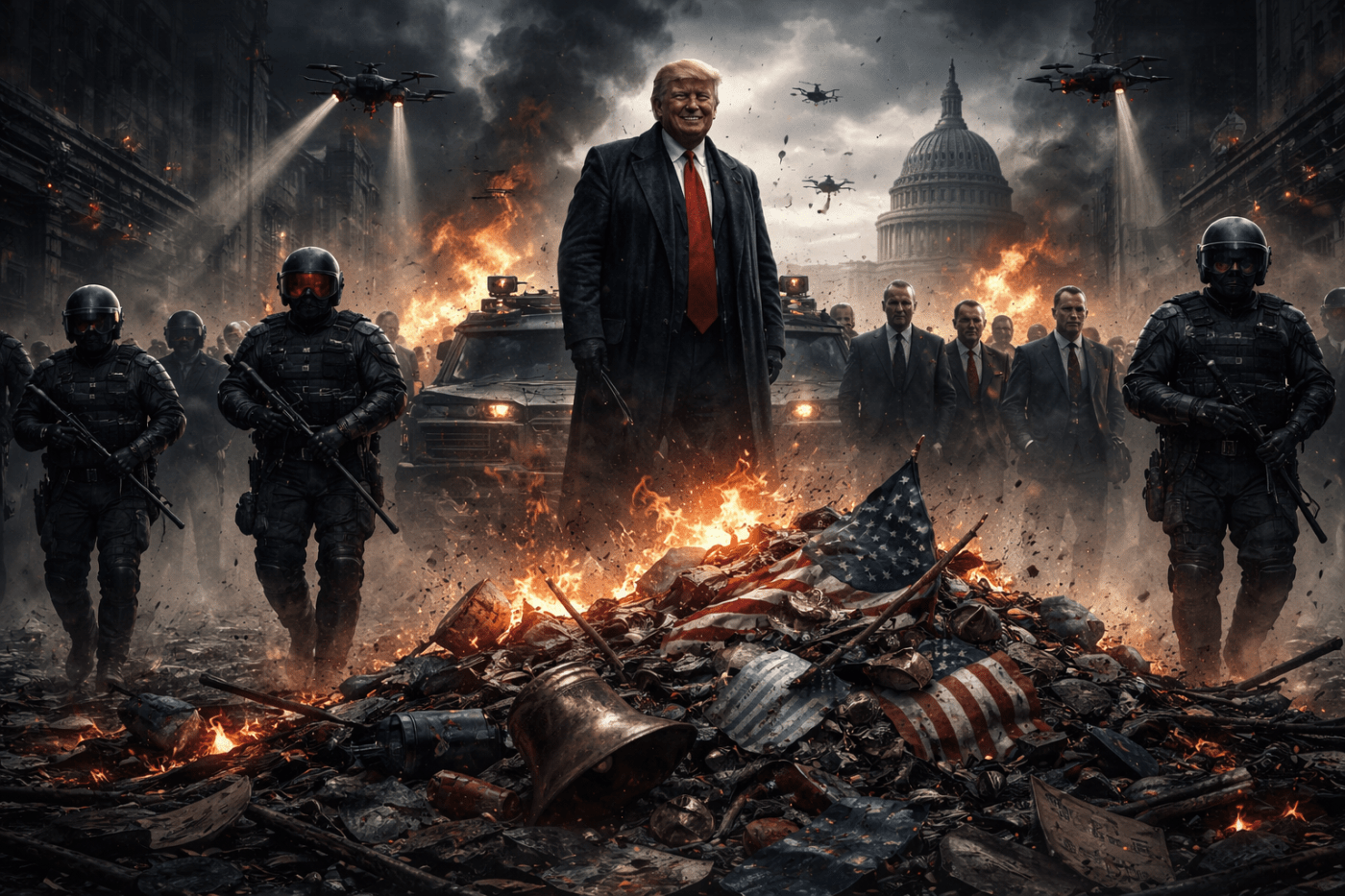
This essay shows how liberal media turns raw power into a moral drama and calls it analysis. It lays out the hard record beneath the story—colonial foundations, security buildup, and institutional force. It names Trump 2.0 for what it is: a technofascist turn driven by imperial decline and class retreat. It argues that when consent is abandoned, the only answer left is organized defection from below.
By Prince Kapone | Weaponized Information | January 22, 2026
Democracy as a Mood: How the Guardian Turns Power Into a Morality Play
The article under excavation—“American democracy on the brink a year after Trump’s inauguration, experts say” by Lauren Gambino in The Guardian—does not begin by explaining a system. It begins by staging a feeling. From the first lines, the reader is placed inside a one-year countdown: “three hundred and sixty-five days” after the oath, democracy is said to be “on the brink – or beyond it.” This is the opening move: a stopwatch narrative, built to produce urgency, to narrow the horizon of thought, and to compress political life into a single dramatic interval. The effect is not simply to inform but to position the audience emotionally—toward alarm, toward dread, toward a sense that the ground has suddenly shifted under their feet, that history has been hijacked by one man moving “with startling speed.”
Notice what follows: the article stacks a long, breathless inventory of presidential actions in one continuous surge—“dismantling,” “purging,” “firing,” “sidelining,” “challenging,” “deploying,” “stifling,” “persecuting,” “targeting,” “scapegoating,” “ordering,” “leveraging,” “trampling,” “escalating.” This is not a neutral list. It is a rhetorical device designed to overwhelm. The verbs are arranged like blows in a flurry, less an argument than an onrush, a rapid montage that makes the reader feel the speed of the state. That velocity is the point. It creates the sensation that resistance must be immediate, but also that resistance must be routed through the narrow channels the article later presents as legitimate: courts, elections, and “experts.” The reader is shaken first, then guided to the proper exits.
The article’s authority is manufactured through an orderly parade of credentialed voices and institutional scorekeepers. It leans hard on prominent academic authors—Steven Levitsky, Daniel Ziblatt, Lucan Way—and installs their language as the central diagnosis. It pulls in Bright Line Watch to translate politics into a numerical temperature check, then brings in the Century Foundation’s democracy indexing project to dramatize a “collapse” with a single percentage. It quotes a former Freedom House research director as a kind of interpreter of authoritarian symptoms, and it adds an “intelligence-style report” written by ex-national security officials to wrap the story in the aura of classified seriousness—“moderate to high confidence,” as if democracy were a foreign country being assessed from a distance. This is the technocratic chorus: the story does not ask working people what they see or feel; it asks institutions to rate the situation, then invites the public to accept the rating as reality.
The ideological trick here is subtle but decisive: democracy is framed not as a struggle over power but as an institutional condition that can be measured, certified, and restored by the right set of guardians. The article even pauses to acknowledge definitional dispute—“There is no universally accepted definition of democracy”—but this concession functions like a small vent in a sealed room: it releases pressure without changing the structure. The narrative quickly returns to a managed range of permissible interpretations, where the dispute is about labels (“flawed,” “illiberal,” “autocratization”) rather than about who holds power and how. In this way, the article establishes a baseline assumption without arguing it: that democracy lives in procedures and norms, and that the crisis is primarily a crisis of those procedures and norms, violated by a president who is described as more “methodical,” more vengeful, and less constrained by “internal” checks.
A further device is moral personalization. Trump is presented through the language of temperament and inner restraint—his “approach,” his “desire for vengeance,” his remark that the only constraint is “my own morality.” This turns politics into character study: the machinery of the state becomes a stage for a single moral drama, and the stakes become whether the ruler’s conscience will hold. Even when the piece gestures toward structure—such as the role of tech billionaires—it frames this as an innovation in the “autocratic playbook,” a shocking breach of proper boundaries, rather than as the predictable intimacy between wealth and state power. The rhetorical gain is clear: by moralizing the crisis, the article invites outrage at a figure while leaving the deeper architecture unexamined. The villain is legible; the system remains mist.
Finally, the article contains its own dissent. It names alarm—“No Kings rallies,” protest, fear of political violence—yet it constantly re-centers legitimacy in institutional response. The ACLU’s litigation record is offered as reassurance, court resistance is foregrounded, and the horizon of hope is placed in electoral timing: off-year wins, midterm prospects, polling vulnerabilities, the possibility of “a check.” Even when the article warns against fatalism, it does so by returning the reader to sanctioned forms of engagement—voting, staying “engaged,” supporting dissenting Republicans. In short: the piece manufactures fear of authoritarian power, but then disciplines the reader into a politics of managed opposition. Panic is produced, then channeled; the moral universe is clarified, then the permissible actions are circumscribed.
The overall narrative is not merely that democracy is threatened, but that democracy is a delicate institutional garden that must be protected by experts, indices, courts, and elections—while the people appear mainly as spectators who must be persuaded to keep believing. That is the deeper propaganda function: to treat legitimacy as a matter of public faith and elite certification, and to present the crisis as a deviation from institutional normalcy rather than as something rooted in the material organization of power itself. The reader is asked to mourn democracy like a lost etiquette—while the hands that write the eulogy quietly reserve for themselves the authority to define what democracy was in the first place.
The Facts the Article Admits—and the History It Leaves Outside the Frame
Once the rhetoric is stripped away, the Guardian article does offer a narrow set of concrete claims about what has happened since Trump’s return to office. It reports a rapid tightening of executive power: agencies reshaped or dismantled, civil servants and watchdogs pushed out, Congress bypassed on budgets, trade, and war, and courts openly defied when they stand in the way. It notes the expanded use of federal force in Democratic-run cities, the hardening of repression against protest, and the intensified targeting of immigrants through enforcement and spectacle. It points to aggressive gerrymandering, loose talk about canceling elections, mass departures from the federal workforce, the insertion of private capital into executive administration, and a sustained assault on the press. These are the observable moves the article treats as proof that something fundamental has gone wrong.
To make sense of these moves, the article leans on a familiar institutional chorus. Democracy scores drop, indices flash red, experts diagnose a slide into “competitive authoritarianism.” Civil-liberties lawsuits and upcoming elections are presented as the main lines of defense. This is as far as the article goes: a crisis measured by charts, interpreted by specialists, and held together by the hope that the system can repair itself if the right levers are pulled. What it does not ask is whether the system being defended was ever what it claims to be.
The first missing fact is also the oldest one. The United States did not begin as a universal democracy that later lost its way. It began as a settler project built on stolen land and forced labor, where political rights were reserved for a narrow population and coercion was the daily reality for everyone else. Indigenous nations were conquered, enslaved Africans were treated as property, and racialized exclusion was written into the very architecture of citizenship. From the start, ballots and bayonets existed side by side. Any discussion of democracy that ignores this foundation is already standing on sand.
On top of that foundation grew a long tradition of domestic counterinsurgency. Throughout the twentieth century, the federal state learned to police politics itself. Labor organizers, antiwar movements, and Black liberation struggles were watched, infiltrated, and broken up in the name of security and order. Political dissent was treated not as a democratic right but as a problem to be managed. Programs like COINTELPRO were not accidents or excesses; they were expressions of how power actually works when it feels threatened. When today’s commentators talk about the “weaponization” of agencies, they quietly skip over this history, as if repression were a recent invention.
That machinery expanded dramatically after September 11. The legal walls that once constrained state power were pushed outward, then torn down. Surveillance authorities multiplied, information-sharing became routine, and emergency powers stopped being exceptional. The creation of a sprawling security bureaucracy brought intelligence, immigration enforcement, and counterterrorism under one roof, turning migration and dissent into standing security concerns. By the time Trump returned to office, the rules had already been rewritten. The tools he now wields were forged long before his hand reached for them.
Beneath these laws sits a dense, everyday infrastructure of internal security. Fusion centers knit together federal agencies, local police, private contractors, and corporate data systems, circulating information about “suspicious” people and activities. Federal grants and task forces have steadily militarized policing, equipping departments with hardware, software, and training borrowed from the battlefield. None of this appeared overnight. It was assembled piece by piece, budget line by budget line. When federal force shows up in a city today, it is not improvising; it is switching on a machine that has been humming for years.
Corporate power has been part of this machine from the beginning. Long before tech executives stepped into cabinet rooms, their companies were already running the digital backbone of the state. Data storage, analytics, surveillance platforms, and predictive systems were handed over to monopoly firms whose profits depend on permanent insecurity. The marriage of government authority and corporate infrastructure is not a scandalous breach of tradition; it is the tradition. What has changed is only how visible the relationship has become.
To understand why all of this is now being used so openly, we have to look beyond U.S. borders. The American state is operating in a moment of imperial stress: shrinking industrial power, growing resistance to financial domination, and the steady rise of alternative centers of gravity in the world system. Sanctions, trade wars, and military pressure have produced backlash abroad, while austerity and precarity deepen at home. When the old methods of persuasion stop working, command steps forward. The iron fist does not appear because leaders lose their morals; it appears because power is losing its grip.
The techniques that now alarm liberal commentators were tested and refined far from Washington. Economic strangulation, mass surveillance, political destabilization, and the criminalization of resistance were normalized through decades of imperial management in the Global South. What we are witnessing is not a change in logic, but a change in direction. The methods once used to discipline others are coming home.
Seen this way, the present crisis looks very different. It is not the story of a healthy democracy suddenly falling ill, but of a political system built on exclusion and coercion reaching a point where its foundations can no longer be hidden. What is breaking down is not democracy in the abstract, but the comforting story empire told about itself. This is the ground on which any serious analysis—and any real resistance—has to begin.
From Settler Democracy to Technofascist Rule: When the Empire Abandons Its Own
What we are witnessing under Trump 2.0 is not simply a harsher version of the old order. It is a break in how the ruling class intends to govern. Liberal commentary treats this moment as democratic erosion, as if the system were slowly drifting off course. But drift is the wrong word. This is a turn. Trump is not mismanaging American democracy; he is presiding over its liquidation. What is being dismantled is not an accidental arrangement, but a political settlement that the ruling class no longer finds useful.
For most of U.S. history, the empire ruled through a divided structure. The colonized—Indigenous peoples, enslaved Africans and their descendants, migrants, and much of the Global South—were governed through force, surveillance, and deprivation. The settler mass, by contrast, was incorporated through relative privilege: wages tied to imperial extraction, access to social goods, and the rituals of political participation. This was the material basis of “democracy” in the United States. It was never universal, but it was functional for empire.
That arrangement is now collapsing. The global conditions that sustained settler incorporation—cheap resources, uncontested markets, financial dominance—are breaking down. The ruling class no longer sees the settler population as a base to be maintained, but as a cost to be cut, a risk to be managed, a population to be disciplined. This is the shift unfolding before our eyes: the colonial methods once reserved for the periphery are being generalized inward. The line separating citizen from subject is thinning, not because empire has become fairer, but because it has become more desperate.
Trump’s project reflects this reality with brutal honesty. The slogan of restoration—“make America great again”—is theater. The actual program is extraction and control. Strip away social infrastructure. Hollow out civilian institutions. Reduce governance to policing, surveillance, and military power. Plunder what remains of the economy through monopoly capital and financial predation. Rule not through consent, but through data, force, and fear. This is not a deviation from capitalism in crisis; it is capitalism in crisis shedding its last democratic illusions.
This is what gives Trump 2.0 its distinct character. The older authoritarian moments of U.S. history still operated within a framework that assumed the eventual restoration of liberal norms. What is emerging now is different. It is a mode of rule that fuses state power, monopoly capital, digital infrastructure, and permanent security governance into a single apparatus. Surveillance is not a tool but an environment. Policing is not a response but a condition of everyday life. The state no longer pretends to represent society; it moves to manage and contain it.
In this sense, technofascism is not simply repression plus technology. It is a reorganization of power around the assumption that large sections of the population—settler and colonized alike—are surplus to the needs of accumulation. The promise of upward mobility is replaced by the threat of downward force. Politics becomes administration, administration becomes enforcement, and enforcement becomes automated. What was once justified as emergency now becomes normal. What was once hidden now becomes policy.
The colonial contradiction does not disappear in this process; it mutates. The colonized remain the first targets, the most intensely policed, the most disposable. But the settler mass is no longer exempt. It is being repositioned from junior partner to managed population. The privileges that once bound large sections of white labor to the imperial order are eroding, replaced by precarity, debt, surveillance, and repression. This does not produce automatic solidarity. It produces confusion, fear, and reaction—conditions that technofascist rule is designed to exploit.
Liberal institutions sense the danger but misname it. They warn of authoritarianism while clinging to procedures that the ruling class itself is abandoning. Courts, elections, and indices remain, but they are being hollowed out, subordinated to security imperatives and executive command. Democracy survives as a shell, useful for managing legitimacy abroad and channeling dissent at home, but no longer central to how power actually operates.
From the standpoint of the global working class and peasantry, this moment reveals a grim symmetry. The United States is beginning to govern itself the way it has long governed others. The techniques refined in sanctions regimes, counterinsurgency campaigns, and economic blockades are being redeployed domestically. Empire is not ending; it is retooling. And in the process, it is discarding even the settler protections that once distinguished the core from the periphery.
This is the fundamental shift Trump 2.0 represents. Not restoration, but reduction. Not greatness, but fortification. A state pared down to its coercive essentials, overseen by plutocrats, enforced by police and military power, and mediated by digital control. Understanding this is not an academic exercise. It clarifies what kind of struggle we are in. The question is no longer how to save a broken democracy, but how to confront a ruling class that has decided it no longer needs one.
From Diagnosis to Defection: Organizing Against a State That Has Chosen Coercion
If Trump 2.0 represents a ruling class that has decided it no longer needs democratic mediation, then resistance cannot be framed as a plea for a return to normal. Normal is gone because it is no longer useful to those who rule. The task before the global working classes, the colonized nations, and revolutionary forces inside the imperial core is therefore not restoration, but realignment. This means organizing from the recognition that power has shifted openly toward policing, surveillance, and militarized control—and that only counter-power rooted in material struggle can meet it.
Across the world, this recognition is already taking form. In the Global South, states and popular movements confronting sanctions, blockades, and financial warfare have learned—often at immense cost—that legality and moral appeal do not stop imperial enforcement. Their response has been practical: building alternative trade routes, developing independent financial mechanisms, asserting control over resources, and strengthening regional solidarity. These struggles matter not as distant examples, but as living proof that empire can be resisted when people organize around sovereignty, production, and collective survival rather than abstract norms.
Inside the imperial core, resistance must grow from similarly concrete ground. Workers facing layoffs, automation, and austerity are already encountering the sharp edge of technofascist restructuring. Communities subjected to constant surveillance and aggressive policing understand that “public safety” has become a cover for permanent occupation. Migrant communities know that the security state treats human movement as a crime. These are not separate issues; they are expressions of the same system reducing society to a field of management and control. Organizing begins by naming this shared condition and refusing the narratives that isolate each struggle.
Popular organizations and grassroots campaigns already exist at these fault lines. Labor formations resisting privatization and union-busting, tenant unions fighting mass eviction, abolitionist groups confronting the police and prison apparatus, migrant justice networks opposing detention and deportation, and independent media projects breaking through information control are all engaged in fragments of the same fight. The task is not to invent struggle from scratch, but to connect these fronts into a shared understanding of what the state is becoming and why it is moving this way.
In practical terms, this means shifting priorities. Electoral engagement may still have tactical value, but it cannot be treated as the horizon of politics. Building durable organizations capable of defending people materially—through mutual aid, strike funds, legal defense, and collective self-protection—becomes essential as the state withdraws social provision and expands coercion. Political education must move beyond civics and into history: teaching how empire has always ruled, how those methods are now being generalized, and how past movements confronted similar conditions.
It also means developing forms of resistance appropriate to a digital-security state. Surveillance thrives on isolation and fear; it weakens when communities act collectively and transparently in defense of shared interests. Independent communication infrastructure, disciplined organizing practices, and a refusal to let algorithms define political horizons are no longer optional. They are conditions of survival. The struggle against technofascism is as much about reclaiming social space as it is about contesting formal power.
Above all, this moment demands clarity. The ruling class is not confused about what it is doing. It is preparing to rule through force, technology, and extraction in a world it can no longer dominate through consent. The question is whether those below will continue to argue over the ruins of a democracy that empire itself has abandoned, or whether they will organize for something fundamentally different. History offers no guarantees—but it does offer lessons. Empires fall not when they become cruel, but when their methods of rule provoke organized defection.
To organize now is to accept that defection is no longer theoretical. It is practical, necessary, and already underway. The choice facing working people everywhere is stark: remain fragmented subjects of a technofascist order, or become conscious agents in the struggle to build power beyond it. There is no neutral ground left. The state has chosen its direction. The only remaining question is whether those it seeks to manage and discipline will choose theirs.
 Weaponized Information
Leave a comment