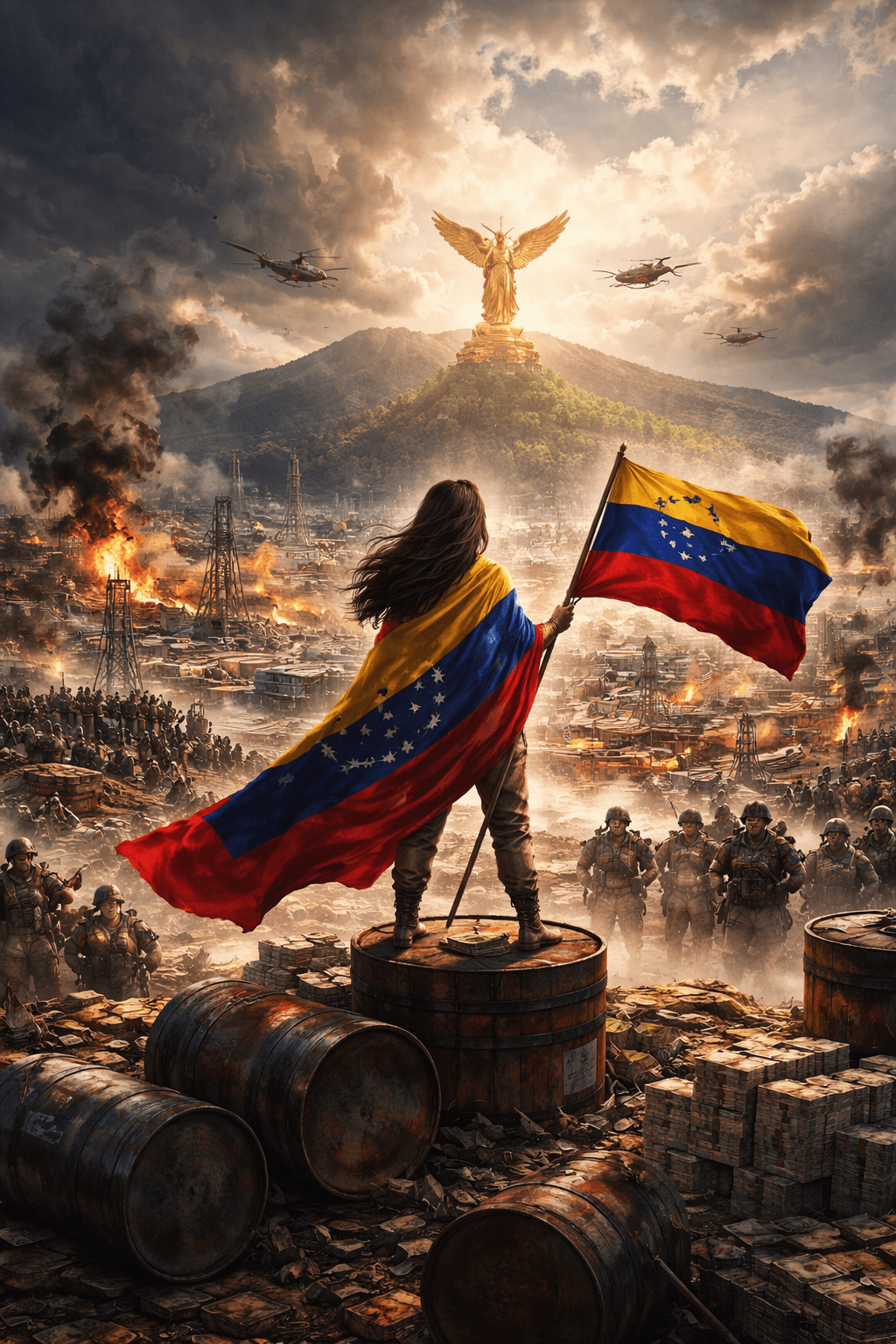
Trump’s claim that Venezuela “stole” U.S. oil is not a gaffe or exaggeration—it is an imperial verdict. This essay dismantles that claim by tracing the conflict over Venezuela’s resources through international law, the neoliberal wreckage of the pre-Chávez era, the Bolivarian rupture, Maduro’s Plan de la Patria, and María Corina Machado’s restoration blueprint. What emerges is not a story of theft, but of a nation punished for asserting sovereignty in a world order that no longer tolerates it.
When Empire Calls Sovereignty Theft
When Donald Trump declares that Venezuela “stole” oil, land, or wealth from the United States, he is not making a factual claim. He is issuing a verdict. It is the verdict empire always delivers when a people refuse to behave as property. The language is blunt because the purpose is blunt: to erase sovereignty itself and replace it with an assumed right of ownership by foreign capital. In this framing, a nation does not possess its land or its oil by virtue of history, labor, or law. It possesses them only on loan, contingent upon obedience.
This is why the accusation sounds absurd even before it is examined. Venezuela did not cross an ocean to seize American territory. It did not occupy U.S. oil fields or nationalize refineries in Texas. What it did was assert control over resources located within its own borders—resources that had been extracted for generations under colonial and neocolonial arrangements that treated Venezuelan soil as a warehouse and Venezuelan labor as a cost to be minimized. When that arrangement was challenged, the challenge itself was recoded as criminality.
Empire has always relied on this inversion. Colonization is renamed “investment.” Extraction becomes “development.” Resistance is rebranded as theft. The slave who runs away is said to have stolen himself. The colony that nationalizes its resources is said to have stolen what was never owned by the colonizer in the first place. The language performs ideological work: it transforms domination into entitlement and liberation into crime.
What Trump’s claim really asserts is not that Venezuela broke the law, but that international law itself should not apply when it interferes with imperial prerogative. The United Nations Charter, the principle of sovereign equality, and the doctrine of permanent sovereignty over natural resources are all implicitly rejected in a single sentence. In their place stands a simpler rule: whoever has power decides what belongs to whom. Oil belongs to those who can seize it. Assets belong to those who can freeze them. Legitimacy belongs to those who can enforce their narrative.
This is why the accusation must be taken seriously—not because it is true, but because it reveals the real terrain of struggle. The issue is not a dispute over contracts or compensation, which can be argued in courts and arbitration panels. The issue is whether a formerly colonized nation is permitted to exist as a sovereign political subject at all. Venezuela’s real offense is not mismanagement or corruption, but disobedience: the refusal to accept that its future must be dictated by foreign capital, foreign courts, and foreign states.
To understand what is happening, we must therefore strip away the moral theater and ask a more precise question. If Venezuela did not steal anything, what exactly is being reclaimed? And if sovereignty is being treated as a crime, what kind of order requires that crime in order to survive? Only by answering those questions can we begin to see that what is called “asset recovery” is in fact a restoration project—an attempt to roll history backward and make colonial relations normal again.
The Law Empire Tries to Forget
The easiest way to sustain a lie is to pretend the rules were never written. That is precisely what the rhetoric of “stolen oil” attempts to do: it speaks as if the twentieth century never happened, as if decolonization never tore through the old imperial order, as if the legal architecture built in the wake of colonial plunder does not exist. But the rules do exist, and they were written because the world had already seen what happens when resource ownership is left to gunboats and corporations.
Modern international law did not emerge from philosophical debates in quiet rooms. It emerged from the wreckage of empire. After centuries in which European and later U.S. power treated the Global South as a reservoir of land, labor, and minerals, newly independent states forced the question onto the world stage: who owns what lies beneath our feet? The answer they fought for was unambiguous. Nations are sovereign. Their land is theirs. Their oil, minerals, and natural wealth are not concessions granted to foreign capital but components of national existence.
This principle was not framed as charity. It was framed as necessity. Without sovereignty over resources, political independence is an illusion. A flag without control over land and oil is just fabric. International law recognized this reality by affirming permanent sovereignty over natural resources and by insisting that states have the sovereign and inalienable right to choose their economic system. Capitalism, socialism, mixed economies—all are permitted. What is not permitted is the claim that foreign investors acquire ownership over a nation itself.
Nationalization, within this framework, is not an act of aggression. It is a lawful expression of sovereignty. States may restructure industries, reclaim strategic sectors, and alter property relations in accordance with national development goals. Compensation disputes may arise, and international mechanisms exist to address them. But these disputes concern value, not ownership. They presuppose sovereignty; they do not negate it. To argue otherwise is to smuggle colonial privilege back into law through the side door.
This distinction matters because it exposes the bad faith at the core of imperial outrage. When Venezuela asserts control over its oil, it is not violating international norms; it is acting within them—because Venezuela’s Constitution explicitly affirms that mineral and hydrocarbon deposits belong to the Republic as public property and because international law affirms that peoples and nations have permanent sovereignty over their natural wealth and resources. When foreign corporations protest that compensation is insufficient, they are not defending legality; they are defending profit expectations shaped by decades of unequal power. And when the U.S. state converts those protests into sanctions targeting Venezuela’s financial and oil sectors, alongside seizures and interception practices that even Venezuelan law now frames as piracy and blockade, it is no longer arbitrating a dispute—it is overriding the very legal order it claims to defend, as reflected in the UN Special Rapporteur’s conclusion that unilateral sanctions imposed on Venezuela have violated international law and harmed human rights.
The accusation of theft, then, is not merely incorrect. It is a declaration of exemption. It announces that certain states reserve the right to ignore international law when that law interferes with their access to resources. Sovereignty is respected in the abstract, but suspended in practice whenever it threatens imperial accumulation. This is not a contradiction; it is the system working as designed.
Once this is understood, the debate shifts. The question is no longer whether Venezuela violated the rules, but why the rules are being treated as optional. And the answer leads away from legal technicalities toward political economy: toward a world order in crisis, clinging to old privileges, and increasingly unwilling to tolerate even the most modest assertions of independence from the periphery.
From Contracts to Chains: How Sovereignty Became a Debt
Once sovereignty is acknowledged in principle, empire shifts the terrain. It stops arguing about ownership and starts arguing about obligation. The language changes from “you stole” to “you owe.” Contracts, awards, and debts are piled one atop another until sovereignty itself is reframed as a balance-sheet problem. What began as a political right becomes a financial liability. A nation is told it may govern itself—so long as it pays for the privilege.
This is where investment disputes enter the story, not as neutral mechanisms of resolution but as instruments that convert historical extraction into enforceable claims. The past is quietly erased. Centuries of unequal exchange, tax evasion, capital flight, and environmental destruction are excluded from the ledger. Only the moment of nationalization is frozen in time and treated as the original sin. From that moment forward, every assertion of independence is measured against the expectations of investors who assumed permanence in a world built on impermanence.
Arbitration, in this context, functions less like a court and more like a filter. It strips disputes of their social and historical content and presents them as technical disagreements over value. Who benefited from the original arrangement is irrelevant. How much wealth was extracted before nationalization does not enter the calculation. The only question that matters is how much hypothetical future profits were interrupted. This narrowing of vision is not accidental; it is what allows a political conflict over sovereignty to masquerade as a neutral disagreement over numbers.
Once converted into numbers, these claims acquire a dangerous afterlife. Awards become leverage. Leverage becomes sanctions. Sanctions become seizures. What begins as a disagreement over compensation is transformed into a justification for freezing assets, intercepting payments and trade-linked revenue streams, and dismantling a nation’s economic arteries. The legal fiction of enforcement replaces the political reality of coercion. Power hides behind procedure, and domination is recast as compliance.
The irony is that this entire architecture depends on the very sovereignty it seeks to undermine. Contracts only exist because states recognize them. Arbitration only functions because states consent to it. Enforcement only succeeds when backed by state power. Yet the moment a state attempts to renegotiate the terms under which it participates, its sovereignty is treated as an inconvenience—something to be disciplined rather than respected.
This is how sovereignty becomes conditional. Not abolished outright, but hedged with clauses, deadlines, and penalties. You may control your resources, the logic goes, but only if you accept the rules written when you were weak. You may pursue development, but only if it does not disturb established profit streams. You may be independent, but only in ways that do not matter.
Venezuela’s experience makes this logic visible. The country is not being punished for breaking the law; it is being punished for refusing to internalize a subordinate role within a system that treats resource-rich nations as permanent debtors. The dispute is not about contracts. It is about whether a people can decide that the old terms no longer apply—and live to tell the story.
The World Venezuela Inherited and the One It Rejected
To understand why sovereignty became intolerable to empire, it is necessary to recall the world Venezuela was expected to accept before Chávez. This was not a golden age of stability interrupted by radical excess. It was a disciplined order, tightly integrated into global finance, praised by international institutions, and deeply hostile to the poor. Its legitimacy rested on elections that changed faces but never structures, and on an oil economy that generated immense wealth while distributing insecurity as policy.
The Punto Fijo system functioned as a gatekeeping arrangement. Political parties rotated power while maintaining a consensus around foreign investment, elite control of oil rents, and alignment with U.S. geopolitical priorities. The state mediated between capital and society, but always downward. When oil prices fell and debt mounted in the 1980s, this arrangement revealed its true character. The social contract was rewritten by technocrats and enforced through austerity.
Structural adjustment did not arrive in Venezuela as an abstract doctrine. It arrived as currency devaluation, subsidy removal, wage compression, and sudden price hikes that turned everyday survival into a crisis. Public goods were treated as inefficiencies. Consumption by the poor was framed as distortion. The promise was that pain would be temporary, discipline would restore growth, and prosperity would eventually trickle down. What actually trickled down was desperation.
The Caracazo was the moment this order lost its moral cover. When transportation costs doubled overnight and food prices followed, the population responded not with theory but with revolt. The state responded not with dialogue but with force. Soldiers were deployed against neighborhoods, and hundreds—likely thousands—were killed. The message was unmistakable: economic policy was not negotiable, and democracy would be suspended if necessary to protect it.
Oil, in this period, was not a national instrument but a bargaining chip. Through the apertura petrolera of the 1990s, foreign companies were invited back into strategic roles under terms designed to attract capital, not to build sovereignty. The state retained formal ownership, but practical control over rents and production decisions was diluted. Venezuela was rich in resources and poor in leverage—a classic profile of neocolonial dependence.
This was the inheritance Chávez confronted. Not chaos, but order; not isolation, but integration; not mismanagement, but management for someone else’s benefit. The Bolivarian rupture was therefore not an irrational departure from a functioning system. It was a refusal to continue absorbing the costs of a model that required periodic repression to survive. Sovereignty did not appear as an ideological abstraction. It appeared as a response to a lived experience of exclusion, discipline, and enforced inequality.
Empire remembers this world fondly. It was predictable. It was profitable. It produced stability for investors and volatility for everyone else. When contemporary opposition figures promise to “restore” Venezuela, this is the baseline they invoke—often without naming it. The restoration project is not aimed at correcting failures, but at reviving a political economy that functioned exactly as intended, so long as the majority remained silent.
The Bolivarian Break: When the Poor Entered History
The rise of Chávez did not interrupt a stable order; it shattered a brittle one. What the Bolivarian process represented was not simply a change in leadership, but a reorientation of political gravity. For the first time in modern Venezuelan history, the poor were no longer treated as a demographic problem to be managed, but as political subjects whose needs, memory, and anger mattered. This was the true rupture, and it is why it provoked such ferocity.
Chávez did not invent Venezuela’s contradictions. He named them. He spoke openly about oil as stolen wealth, not because it had been carried away in ships, but because it had been converted into private privilege while the majority lived in precarity. By reclaiming control over oil rents and redirecting them toward housing, health care, education, and food security, the Bolivarian state altered the flow of power as much as the flow of money, as reflected in the expansion and design of the Misiones (health, education, food, housing, and work programs). Redistribution became a political act, not a charitable one.
This shift immediately collided with entrenched interests. For domestic elites and foreign capital alike, the problem was not inefficiency but loss of command. Decisions that had once been made quietly in boardrooms and ministries were now contested in public. Oil ceased to be a neutral commodity and became a site of struggle over national purpose. That struggle was framed by its opponents as authoritarianism, but its substance was participation.
The Bolivarian project also disrupted the ritual of obedience to international financial institutions. Venezuela rejected IMF tutelage not as a symbolic gesture but as a practical necessity, a break underscored when it announced its withdrawal from the IMF and World Bank after paying off remaining obligations. The memory of the Caracazo was still raw, and the lesson was clear: adjustment programs demanded social sacrifice without democratic consent. By asserting policy autonomy, the state reclaimed the right to plan, to spend, and to prioritize according to domestic needs rather than external benchmarks.
Popular power was not an ornament added to this process; it was its justification. Communal councils, missions, and participatory mechanisms were imperfect and uneven, but they marked a decisive departure from elite mediation, institutionalized through laws such as the Ley Orgánica de los Consejos Comunales. Politics was pulled downward, into neighborhoods long excluded from decision-making. This expansion of participation is often dismissed as clientelism, yet it is difficult to imagine how any serious redistribution could occur without building new channels of mass involvement.
None of this resolved Venezuela’s structural vulnerabilities. Dependence on oil persisted. Bureaucratic distortions multiplied. Corruption did not vanish by decree. But the direction of travel mattered. The state was no longer organized primarily to reassure investors; it was organized, however inconsistently, to absorb social demands. That reorientation is what made the Bolivarian experiment intolerable to empire. It suggested that sovereignty could be exercised not only in law, but in practice.
The ferocity of the response—coups, lockouts, sanctions, and isolation—should be read as confirmation of what was at stake. Systems do not mobilize such force against trivial threats. They mobilize it when a precedent appears, when the possibility emerges that other nations might follow the same path. The Bolivarian break was dangerous not because it failed, but because it dared to show that another alignment of power was possible.
The Plan for the Homeland: Sovereignty as a Development Strategy
When Maduro speaks of the Plan de la Patria, he is not improvising under pressure nor clinging to a slogan inherited from Chávez. He is articulating a conception of development that treats sovereignty not as a rhetorical flourish, but as an organizing principle. The plan is often caricatured as ideological excess, yet it is far more prosaic and therefore more dangerous to empire: it insists that national planning, public ownership of strategic resources, and popular participation are legitimate tools of governance in a world that would prefer discipline without consent.
The Plan de la Patria situates Venezuela’s crisis within a long historical arc of dependency and extraction. It does not deny economic hardship, nor does it pretend that sanctions alone explain every contradiction. Instead, it frames recovery as inseparable from control over oil, land, and finance. In this vision, development cannot be outsourced to markets that have already demonstrated their indifference to social life. It must be planned, contested, and anchored in collective priorities—as reflected in the official constitutional national development framework that aligns with long-term goals and social transformation.
Central to the plan is the idea that strategic resources are not merely revenue streams but levers of national survival. Oil is not treated as an asset to be liquidated for short-term relief, but as a foundation upon which social rights, infrastructure, and food security are built. This is why privatization appears in the document not as reform, but as surrender. Once control is ceded, planning collapses into hope, and hope becomes policy.
The plan also reflects an explicit rejection of the old technocratic bargain: austerity now for growth later. Instead of deferring social needs to satisfy external creditors, it asserts that education, health, housing, and employment are productive forces in their own right. Popular participation is not an add-on but a mechanism through which legitimacy is maintained under siege. Communes, councils, and participatory mechanisms were legally established to empower neighborhood decision-making and local development, buffering against the total marketization of life.
Internationally, the Plan de la Patria assumes a multipolar world. It does not imagine Venezuela as a junior partner awaiting reintegration into Western financial circuits, but as a state seeking diversified alliances, regional cooperation, and strategic autonomy—echoing broader Bolivarian goals of a multipolar geopolitical order that contributes to balance and peace.
What makes the plan intolerable to imperial power is not that it is perfect, but that it is coherent. It offers an answer to crisis that does not begin with privatization or external tutelage. It insists that a people under siege still retain the right to plan their future. In a system that treats sovereignty as an obstacle, this insistence becomes an act of defiance. The Plan de la Patria is therefore not simply a policy document; it is a declaration that Venezuela refuses to negotiate its existence.
Maduro’s “7 Transformations” do not replace this logic; they operationalize it. They are the plan’s way of refusing the imperial trick that says sovereignty is a flag-waving abstraction while the real decisions are “technical,” “market-driven,” and therefore safely removed from the people. The 7T framework is an attempt to pin sovereignty to concrete terrain: production, territory, security, rights, democracy, ecology, and geopolitics—so that it cannot be reduced to a speech and then confiscated by creditors. These priorities are spelled out officially in the Plan de la Patria de las 7T, which lists the seven transformational pillars.
The first transformation—economic—starts from a confession the old oil-rent model never had the courage to make: dependence is not merely a revenue problem, it is a political vulnerability. The “new national economic model” is not a slogan for growth at any cost; it is an argument that production must be re-rooted, diversified, and made governable by the nation itself. In plain terms: the economy must be restructured so that external shocks, sanctions, and financial sieges cannot decide whether children eat, whether hospitals function, whether a country exists. This is why the plan insists on planning capacity, national value chains, and strategic sectors under public direction. It is not anti-market; it is anti-subordination.
The second transformation—“human city for good living,” services, and infrastructure—forces a question neoliberalism tries to bury: who is the city built for? In the old order, infrastructure was a showcase for investors and a shortage for everyone else. Under siege, services become a battlefield: electricity, water, transportation, housing, and maintenance are not neutral utilities but the physical conditions of social life. The 2T logic treats territory as political economy made visible. If sovereignty is real, it must show up in the pipes, the roads, the homes, and the daily time of the working class. A country that cannot keep its people housed and moving is a country whose future will be auctioned.
The third transformation—security and defense, unity and territorial integrity—names what the West calls paranoia and what the Global South calls experience. Venezuela’s recent history has not been one of peaceful “institution-building” with polite disagreements; it has been a laboratory of destabilization, paramilitary pressure, sabotage, and the normalization of coercion as diplomacy. In that environment, security is not reducible to policing; it is the defense of the state’s capacity to govern at all. The 3T approach treats sovereignty as something that must be protected materially—against conventional threats and against the nonconventional wars of sanctions, financial strangulation, cyber operations, and information warfare that aim to hollow out a society until collapse looks “inevitable.”
The fourth transformation—social protection and social development—takes direct aim at the imperial fairy tale that austerity is “responsibility.” The plan refuses to treat rights as luxuries to be postponed until investors feel confident. Instead, it treats social guarantees as productive forces: health, education, nutrition, and housing are not costs to be cut, but capacities that make a society resilient under siege. This is where the Plan for the Homeland becomes a development strategy rather than a moral declaration. It insists that a country does not develop by shrinking its people until only statistics remain; it develops by expanding the material ground beneath the majority so that politics does not collapse into survival.
The fifth transformation—political transformation and popular power, “new methods of revolutionary government”—is the plan’s clearest refusal of the old Punto Fijo logic in updated clothing. It argues that democracy must be territorialized and socialized—pulled into the grassroots, into communes, councils, and mechanisms of direct participation—so that legitimacy is not a television performance but a lived relationship between state and people. This is precisely what empire finds most intolerable, because it undermines the old method: capture the elite, and you capture the country. Communal councils and popular structures are empowered as part of this decentralized governance logic.
The sixth transformation—ecosocialism, science, and technology—treats the climate crisis and the knowledge question as matters of sovereignty, not branding. Under imperial conditions, dependency is reproduced not only through finance but through patents, supply chains, and technological lock-in. The 6T emphasis on science and technology is therefore an attempt to build productive and ecological capacity that is not hostage to foreign denial, foreign sanctions, or foreign price-setting.
The seventh transformation—geopolitics of peace and integration—states explicitly what Washington tries to keep implicit: there is no such thing as apolitical development. A country’s economic options are shaped by the world system it is allowed to access. The 7T horizon treats multipolarity not as romance but as strategic oxygen: diversify alliances, deepen South-South cooperation, support regional blocs, and refuse the trap of a single pole that uses access to trade and finance as a weapon. This vision is affirmed in official commentary emphasizing external alignment with emerging powers and deepening ties in a pluripolar world.
Read together, the 7 Transformations clarify what the Plan de la Patria is actually saying: sovereignty is not a courtroom argument and it is not a ceremonial anthem. It is a set of institutions, capacities, and mass relationships strong enough to withstand siege. Empire hates this not because it is irrational, but because it is legible—because it names the battlefield and builds defenses where neoliberal restoration demands open doors. The plan’s wager is simple and dangerous: that even under blockade conditions, a people can still choose to govern, still choose to plan, and still choose not to sell their future back to the very forces that spent decades ensuring they never had one.
Sanctions as Siege: How Restoration Is Enforced
No restoration project of this magnitude can rely on persuasion alone. When a population has already experienced what market discipline looks like in practice, consent becomes unreliable. This is where sanctions enter—not as diplomatic tools, but as instruments of siege, according to the UN Special Rapporteur’s comprehensive assessment of unilateral coercive measures against Venezuela. They function to exhaust alternatives, to narrow political imagination, and to make surrender appear as the only rational option. In this sense, sanctions are not a response to Venezuela’s policies; they are the environment in which the restoration project is meant to succeed.
The architecture of coercion is extensive and deliberate. Financial and sectoral sanctions block access to international credit and immobilize state assets, including through broad asset freezes and transaction prohibitions. Sanctions have kept Venezuela’s government from accessing financing and dealing with its debt, while over-compliance by banks, insurers, and shipping companies expands their impact beyond formal restrictions, effectively restricting legitimate trade and financial activity. What is described as pressure on a government is experienced by society as economic suffocation.
This is not accidental collateral damage. It is strategy. UN analyses of unilateral sanctions show they degrade a state’s capacity to import food, medicine, and industrial inputs by limiting hard currency and complicating legitimate transactions. Sanctions can reduce government revenue by blocking the core source of export income, which has declined dramatically during sanctions years. Every failure of public provision is then cited as proof that the state cannot function, reinforcing the argument for privatization and external management. The logic is circular and ruthless: first disable, then accuse, then replace.
The seizure of Venezuelan assets abroad makes this logic explicit. Gold and sovereign assets have been frozen or litigated abroad under unilateral measures that restrict Venezuela’s control over its reserves. Overseas subsidiaries and revenue streams are subject to legal proceedings under U.S. sanctions enforcement. Oil tankers carrying Venezuelan crude have been seized and intercepted under U.S. pressure and blockade tactics. Each act is justified as enforcement or compliance, yet taken together they constitute a transfer of sovereign wealth away from the nation and into the hands of creditors and foreign authorities. What cannot be won politically is taken administratively.
International law does not recognize siege as a legitimate form of governance, but sanctions are often framed as benign, even humanitarian, when described as targeted and reversible. The reality documented by independent observers is otherwise: sanctions have been linked to dramatic declines in government revenue and public services, exacerbation of food and medicine shortages, and steep drops in imports that underpin social welfare. In this sense, sanctions are less an alternative to intervention than a slower, more deniable form of it.
The enforcement of restoration through sanctions reveals the hollowness of the democracy narrative. If the goal were genuinely free choice, the conditions of choice would not be manipulated. A population denied access to its own wealth, trade, and assets is not being offered a referendum on its future; it is being coerced into accepting one. Sanctions ensure that any path other than privatization and alignment with imperial capital is rendered unbearably costly.
What emerges, then, is a clear picture: the conflict is not between democracy and authoritarianism but between sovereignty and tutelage. Sanctions are the means by which that tutelage is imposed, and restoration is the reward promised for compliance. Venezuela’s resistance to this arrangement is treated as irrational precisely because it threatens to expose the system’s core truth: that empire no longer governs by consent, but by exhaustion.
Two Futures, One Country
Stripped of slogans and moral theater, Venezuela stands before a choice that empire insists on presenting as inevitable. Yet inevitability is itself a political weapon. The future is framed as a narrow corridor: privatize or collapse, submit or starve, surrender sovereignty or be crushed beneath its weight. This framing is not an analysis of reality but an attempt to manufacture it. It seeks to close history by declaring that only one path remains open.
On one side stands the vision articulated through the Plan de la Patria, flawed, embattled, and uneven, yet anchored in a simple premise: that the country’s land, oil, and labor exist for the collective survival of its people. It is a future that assumes planning is possible, that social rights are productive forces, and that sovereignty is not a luxury to be postponed until markets are satisfied. It is a wager that dignity can be defended even under siege, and that development without submission is not an illusion.
On the other side stands the restoration blueprint, promising relief through liquidation. In this future, Venezuela’s crisis is solved by converting national wealth into tradable assets, by reassuring creditors that politics will no longer interfere with profit, and by redefining democracy as the smooth functioning of markets. Social peace is expected to emerge not from participation, but from growth managed elsewhere. The people are invited to trust a system that has already demonstrated its willingness to discard them when discipline is required.
These are not abstract alternatives. Venezuela has already lived both trajectories. One produced mass exclusion, austerity, and repression in the name of stability; decades of neoliberal adjustment programs in Latin America widened inequality and marginalized working classes long before the Bolivarian era. Venezuela’s own lost decades in the 1980s and 1990s illustrate that previous model’s consequences. The other trajectory emerged as a response to that experience, carrying both the hopes and contradictions of a society determined not to return quietly to the margins of its own history.
The ferocity with which the second path has been attacked is itself evidence of what it threatens. Measures such as the broad array of Venezuela-related sanctions imposed by the U.S. Department of Treasury, and repeated interception and seizure of oil tankers carrying Venezuelan crude reported by international agencies, demonstrate how economic policy can be leveraged against a country’s sovereign economy. These actions occur in a context where oil — the overwhelming source of export earnings and fiscal revenue — is structurally central to Venezuela’s economy as one of the world’s largest oil producers and a key OPEC member.
Empire insists that the question is economic efficiency. In truth, it is political power. Who decides how oil is used? Who bears the costs of crisis? Who is allowed to plan, and who is expected to endure? These questions cannot be answered by markets, nor should they be outsourced to foreign courts or financial institutions. They are questions of collective life, and they demand collective authority.
The struggle over Venezuela is therefore not about rescuing a failed state or reclaiming stolen assets; it is about whether a nation that dared to interrupt the flow of wealth outward can be forced back into line. The restoration project offers peace on one condition: that Venezuela forget what it learned when the poor entered history. The Bolivarian wager, for all its contradictions, refuses that amnesia. It insists that another future remains possible, even when every lever of pressure is pulled to prove otherwise.
In the end, this is what makes Venezuela intolerable to empire. Not that it is perfect, but that it remembers. And in a world where power depends on forgetting who owns what, memory itself becomes an act of resistance.
Sovereignty Is the Crime Empire Cannot Forgive
When the dust settles and the slogans fall away, the charge against Venezuela is not mismanagement, corruption, or even authoritarianism. Those accusations are interchangeable tools, deployed or withdrawn as needed. The real crime is sovereignty exercised in defiance of hierarchy. Venezuela did not merely claim the right to govern itself; it attempted to use that right to reorganize the flow of wealth, power, and decision-making. That is the offense for which no amnesty is ever granted.
Empire tolerates independence only when it is hollow. Flags may fly, elections may be held, constitutions may be written, so long as the fundamental questions—who owns the land, who controls the oil, who decides economic priorities—remain insulated from popular interference. The moment those questions are reopened, legality is reinterpreted, markets are weaponized, and coercion is dressed up as concern. What follows is not a debate, but a campaign of attrition designed to make resistance appear futile.
Venezuela’s experience exposes the structure of this order with unusual clarity. International law recognizes the right of nations to control their resources, yet that right is treated as conditional in practice. Arbitration is elevated over sovereignty. Sanctions are imposed in the name of democracy while systematically undermining the material basis of democratic choice. Asset seizures are justified as enforcement, even as they strip a population of the very wealth needed to determine its future. The contradiction is not accidental; it is the operating principle.
The restoration project depends on this contradiction. It promises normalization, stability, and prosperity, but only after sovereignty is neutralized and politics reduced to administration. It asks the population to forget the past, to forget the Caracazo, to forget the decades when oil wealth flowed upward while repression flowed downward. Memory is dangerous because it reveals that the proposed cure is indistinguishable from the original disease.
The Bolivarian process, for all its flaws and unfinished struggles, broke that spell. It demonstrated that oil could be used differently, that planning could be political, that the poor could be more than objects of policy. It also revealed how violently the system reacts when such possibilities are made visible. Coups, lockouts, sanctions, and sieges are not overreactions; they are signals. They mark the boundaries of what is permitted.
This is why Venezuela matters beyond itself. The conflict is not local, and it is not exceptional. It is a rehearsal for how power responds when nations attempt to reclaim control over the material foundations of life in an era of imperial decline. The message is intended to travel: sovereignty will be punished, memory will be erased, and alternatives will be starved until they collapse or submit.
Yet history rarely ends on schedule. The insistence that Venezuela must be broken in order to be saved reveals the fragility of the order issuing the command. Systems confident in their legitimacy do not require sieges to enforce compliance. They do not fear planning, redistribution, or popular participation. The fury directed at Venezuela is therefore less a sign of its failure than of empire’s narrowing tolerance for disobedience.
What remains, then, is a simple truth obscured by endless noise: Venezuela did not steal anything. It claimed what international law already recognizes as its own. The punishment that followed was not the result of illegality, but of audacity. In a world organized around the quiet transfer of wealth from many to few, the decision to interrupt that flow is treated as an unforgivable act. Sovereignty, exercised seriously, becomes the ultimate heresy.
 Weaponized Information
Leave a comment