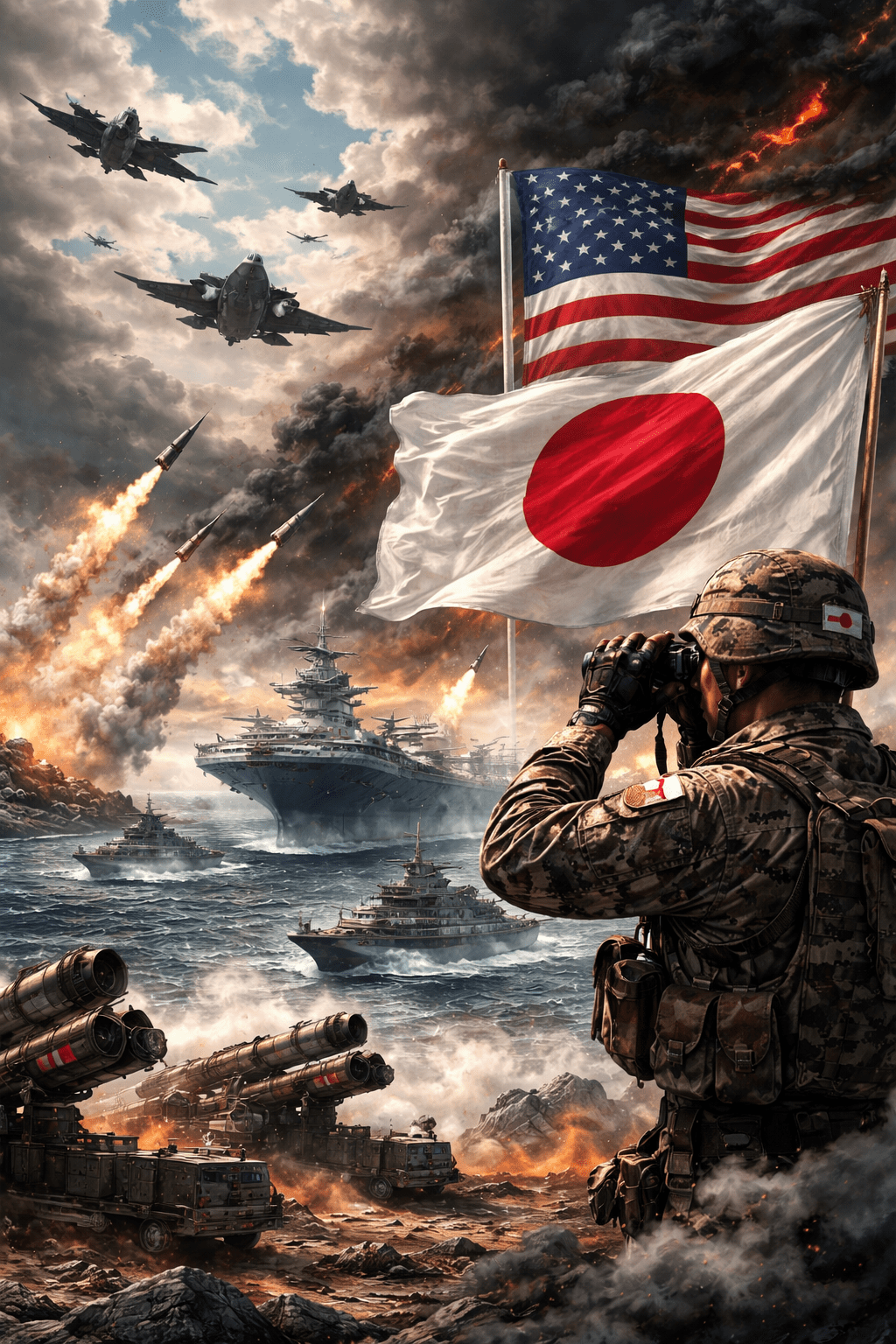
An Associated Press report presents Japan’s remilitarization as reluctant self-defense rather than a political choice shaped by power. Beneath the calm language, constitutional erosion and alliance discipline are reframed as common sense. Placed in historical and geopolitical context, Japan’s military buildup appears as a reassignment of roles within a U.S.-led imperial order in crisis. Against this normalization, working people and anti-militarist movements are called to organize across borders to refuse a future built on permanent war.
The Quiet Voice of a Returning Gun
The Associated Press piece, “Pacifist Japan has slowly transformed from exclusively self-defense to a military buildup,” by Mari Yamaguchi, published by the AP on December 31, 2025, reads like a lullaby for a nervous age. It does not bark orders or wave flags. It speaks softly, calmly, almost sympathetically, as if to reassure the reader that nothing truly dangerous is happening—only a sensible nation adjusting its posture in a dangerous world. The story it tells is simple and repeated with patient insistence: Japan was pacifist, Japan is still peaceful at heart, and Japan’s growing arsenal is not a choice but a burden forced upon it by history, geography, and a threatening neighbor.
The first trick of the text is grammatical, and therefore political. Militarization is narrated without decision-makers. Japan “has stretched,” “has evolved,” “has allowed,” “has come to reinterpret.” No hands pull the lever. No class interests push the wheel. History, in this telling, ambles forward on its own. This passive voice is not innocent style; it is ideology with good manners. By dissolving agency, the article converts deliberate state strategy into something like weather—unfortunate perhaps, but no one’s fault. Guns do not return because someone wants them to; they return because the times demand it.
Intent is distributed with similar care. Japanese leaders are portrayed as cautious adults in a rough neighborhood, always responding, never initiating. Even the most dramatic shifts—the reinterpretation of Article 9, the embrace of long-range strike capability, the normalization of arms exports—are framed as reluctant steps taken with a heavy heart. China, meanwhile, enters the narrative as a shadow rather than a subject. Its actions are mentioned, not explained; its motives assumed, not examined. Radar locks and carrier movements float through the text like omens. One side reacts defensively; the other simply threatens. This asymmetry is presented as common sense rather than as a choice made by the author.
Time itself is bent to serve the story. The word “slowly” does more ideological work here than any overt argument. Decades of political struggle, legal reinterpretation, and strategic planning are compressed into a gentle drift. Change appears incremental, almost accidental. By stretching the timeline, the article blunts the sharpness of each break, each decision taken against opposition. What disappears is the reality that every “stretch” of the constitution was contested, resisted, and imposed. The reader is guided to see inevitability where there was struggle, and maturation where there was coercion.
Article 9, the symbolic heart of Japan’s postwar settlement, is treated not as a political line drawn in blood and rubble, but as a clever legal puzzle. The constitution becomes elastic, endlessly interpretable, its meaning expanded without consequence. This framing turns violation into ingenuity. The question is never whether the spirit of pacifism has been abandoned, only whether the text can be bent far enough to justify new weapons. By the time the reader reaches the present, the constitution has already been hollowed out rhetorically. Its erosion feels technical, not tragic.
Memory is handled with the same careful containment. Japan’s wartime aggression appears briefly, like a ritual apology offered before moving on. Yasukuni is mentioned, regional anger acknowledged, and then the past is sealed off. It is not allowed to intrude on the present as a living continuity. Today’s militarization is treated as something entirely different from yesterday’s conquest. Remorse is noted, therefore history is closed. Closed history, in turn, cannot indict present policy. This is how empires launder memory: by acknowledging it just enough to neutralize it.
Most revealing, however, is what fades into the background. The United States is everywhere and nowhere at once. Tens of thousands of troops are mentioned as fact, not as force. Pressure is implied, never interrogated. The alliance is treated like gravity—always present, never political. By naturalizing this presence, the article presents Japan’s trajectory as nationally generated, a story of internal adjustment rather than external discipline. The reader is encouraged to see a reluctant nation arming itself, not a regional order being reorganized under imperial supervision.
Taken together, these choices form a propaganda far more sophisticated than crude lies. This is not the propaganda of shouting generals, but of reasonable sentences and balanced tones. It teaches the reader to grieve pacifism without defending it, to accept militarization without alarm, and to see preparation for war as the sober responsibility of adulthood. In this quiet voice, the gun returns—not with a bang, but with a reassuring explanation that makes alternatives vanish.
What Is Said, What Is Withheld, and the Material Record Beneath the Story
Stripped of tone and narrative cushioning, the Associated Press article presents a clear set of verifiable claims about Japan’s present military trajectory. Japan has approved a record defense budget exceeding nine trillion yen, placing it among the world’s top military spenders. The government has accelerated its target of reaching two percent of GDP in defense spending, a benchmark long associated with U.S.-led alliance expectations. Japan is acquiring long-range cruise missiles, unmanned combat systems, and so-called “strike-back” capabilities that exceed the boundaries of its former self-defense doctrine. Official strategy documents now identify China as Japan’s primary strategic challenge, and recent cabinet decisions have expanded arms exports, joint weapons development, and operational integration with allied militaries.
The article also establishes that Japan’s constitutional constraints have not been formally abolished but reinterpreted. Article 9, which renounces war and the maintenance of military forces for settling international disputes, has been progressively redefined to permit collective self-defense, overseas deployments, and the use of force in support of allied states. This legal evolution culminated in security legislation passed under the government of Shinzo Abe and later consolidated through updated national security strategies under subsequent administrations. The current leadership presents these moves as continuity rather than rupture, insisting that Japan remains a peaceful nation even as its military roles, missions, and capabilities expand dramatically.
These are the facts the article places on the table. What it does not place there is equally important. Missing is any sustained accounting of the external pressures shaping Japan’s decisions, particularly the role of the United States in actively encouraging and structuring Japanese remilitarization since the early Cold War. Japan’s military trajectory did not emerge organically from regional anxiety alone. It developed within an alliance framework in which Washington has consistently pushed Tokyo to assume greater military burdens, expand its operational reach, and integrate more fully into U.S.-led command structures across the Asia-Pacific.
Absent as well is a material discussion of the U.S. military presence itself. The United States maintains a substantial military presence in Japan, with approximately 55,000 U.S. military personnel stationed there under the U.S.–Japan security alliance, spread across numerous air, naval, and ground facilities. Japan hosts more U.S. bases than any other country, with roughly 70 percent of those installations concentrated on Okinawa, underscoring the scale and geographic reach of the U.S. presence. These installations are not benign markers of cooperation; they serve as forward-deployed nodes of U.S. military power projection, integral to joint strategic planning, training, and operational coordination, and extended deterrence efforts with Japan’s Self-Defense Forces. Their existence profoundly shapes Japan’s security environment, its threat perceptions, and its policy options, yet in the article, this presence is treated as background scenery rather than as a driving force in the remilitarization process.
The article also omits the broader historical arc of Japan’s postwar military reconstruction. The creation of the Self-Defense Forces in the 1950s, justified at the time by the Korean War, already represented a decisive departure from the spirit of the postwar constitution. Subsequent decades saw steady normalization of military institutions, intelligence cooperation, and overseas deployments under the banner of peacekeeping. By presenting militarization as a recent response to Chinese actions, the article erases this longer continuity and obscures the fact that today’s buildup is the culmination of a project decades in the making.
Economically, the article avoids confronting the domestic drivers of military expansion. Japan’s prolonged economic stagnation, demographic pressures, and industrial restructuring have made defense production an increasingly attractive sector for state investment. Arms exports, joint weapons programs, and advanced military technologies are not merely security measures; they are also industrial policies aimed at revitalizing capital accumulation and technological competitiveness. This political-economic dimension is essential to understanding why military spending is rising even as social needs deepen, yet it is left unexplored.
Finally, the regional context is narrowed to a single antagonistic axis. China appears as the primary and almost exclusive source of instability, while the broader militarization of the Indo-Pacific region is left largely unexamined. Japan’s buildup unfolds alongside parallel expansions by allied states, increased joint exercises, and intensified surveillance and force deployments across East Asia. By isolating Japan’s actions from this wider pattern, the article presents militarization as a bilateral problem rather than as part of a systemic reconfiguration of regional power.
What emerges from a full accounting of the facts, both stated and omitted, is a picture far more concrete than the narrative of reluctant adjustment suggests. Japan’s military expansion is legally engineered, economically incentivized, and strategically embedded within a long-standing alliance structure. The transformation described in the article is not an accidental drift away from pacifism but a material process shaped by history, power, and political choice—conditions that must be confronted directly before any serious understanding of the present can begin.
From Pacifism to Platform: How Empire Reassigns a Nation’s Role
Once the facts are placed back in their historical sequence, the story changes its posture. What appears in the article as a reluctant drift away from pacifism reveals itself, on closer inspection, as a managed transition within a wider imperial system under strain. Japan’s postwar pacifism was never an abstract moral awakening; it was a political settlement imposed after catastrophic defeat, designed to neutralize a former rival while folding it into a U.S.-led order. Pacifism functioned less as an absolute principle than as a conditional arrangement, tolerated so long as it did not interfere with the strategic needs of the dominant power in the Pacific.
The steady reinterpretation of Article 9 must be understood in this light. What is described as legal creativity or constitutional flexibility is, in material terms, the gradual removal of restraints that no longer serve the prevailing balance of forces. Each reinterpretation corresponded not to an abstract legal debate, but to concrete shifts in the regional and global order: the Cold War, the consolidation of U.S. bases, the expansion of overseas operations, and now the sharpening confrontation with a rising China. The constitution did not fail on its own; it was methodically reshaped to meet new strategic requirements.
Seen from the standpoint of the global working class and peasantry, this process has a familiar rhythm. When an imperial order begins to lose uncontested dominance, it does not retreat quietly. It redistributes burdens. Responsibilities once carried by the core are pushed outward to allies and subordinate partners. Japan’s transformation from a protected rear area into an active military platform reflects this redistribution. The language of “self-reliance” masks a deeper reality: Japan is being repositioned to absorb greater military risk in defense of an order whose benefits are increasingly concentrated elsewhere.
The fixation on China as an existential threat plays a central role in this reorganization. China’s rise is not dangerous because it is uniquely aggressive, but because it disrupts a hierarchy that long operated without serious challenge in East Asia. By framing China as the singular source of instability, the narrative converts a structural shift in the world economy into a moral drama. Militarization becomes common sense, and alternatives—regional cooperation, demilitarization, independent security arrangements—are pushed outside the realm of the thinkable.
For colonized and formerly colonized nations in Asia, this normalization carries a heavier weight. Japan’s remilitarization cannot be detached from its unresolved imperial past. The issue is not symbolic remembrance but material continuity. A state that once organized conquest across the region now reenters the military field under new banners, backed by a powerful patron, without any regional process of reckoning or consent. The reassurance that today’s weapons are purely defensive offers little comfort to societies that have already lived through what “necessary security” looked like when defined from Tokyo.
At home, the costs fall along familiar class lines. Rising military expenditure competes directly with social spending in a society facing stagnating wages, demographic pressure, and deepening precarity. Defense expansion is sold as national protection, but its material benefits flow upward—into arms manufacturers, technology firms, and alliance-linked industries—while its risks are socialized. Young workers are asked to accept fewer guarantees at home in exchange for greater exposure abroad. Pacifism, once a shield for the population, is reframed as an indulgence the nation can no longer afford.
From the vantage point of revolutionary and multipolar forces, the meaning of this transformation is clear. Japan’s militarization is not an isolated national choice but a node in a broader reconfiguration of power aimed at preserving dominance in a changing world. The article’s narrative of reluctant adjustment obscures this reality by focusing attention on surface anxieties rather than underlying structures. What is being reorganized is not simply Japan’s military, but the regional division of labor within an imperial system struggling to reproduce itself.
Reframed this way, the question is no longer whether Japan has abandoned pacifism, but why pacifism has become intolerable to the existing order. The answer lies not in cultural shifts or legal interpretations, but in the material pressures of an imperial system confronting limits. To accept the article’s framing is to accept those limits as destiny. To reject it is to recognize that militarization is a political choice—one that serves specific interests, carries specific costs, and can be resisted by those who bear its consequences.
Turning the Refusal of War into a Common Struggle
If militarization is a political choice, then resistance must also become one. The quiet normalization of war preparations in Japan is not an isolated national affair; it is part of a broader attempt to reorganize global power at the expense of working people, peasants, and colonized societies. The task before us is not to mourn the passing of pacifism as a moral ideal, but to turn its erosion into a rallying point for collective action across borders. War is being prepared in polite language; opposition must be organized in plain speech.
This struggle does not begin from zero. Within Japan itself, popular forces have long resisted remilitarization. Constitutional pacifist movements, labor unions, student organizations, and grassroots networks—particularly in Okinawa—have consistently opposed base expansion, military exercises, and the erosion of Article 9. These movements are not abstract or nostalgic; they are rooted in lived experience, from land seizures to environmental destruction to the daily presence of foreign troops. Their resistance exposes the lie that militarization reflects popular will.
Across East Asia, similar currents are already in motion. Peace and demilitarization networks link activists in Japan, Korea, the Philippines, and beyond, challenging the steady conversion of the region into a forward military zone. These movements understand that war preparation does not stop at national borders. Surveillance systems, missile deployments, and joint exercises bind the region together in a shared vulnerability. Their insistence on regional dialogue and de-escalation stands in direct opposition to narratives that frame confrontation as inevitable.
For the global working class, especially in the imperial core, the contradiction is immediate and material. Rising military budgets are funded by social austerity, wage restraint, and the erosion of public goods. Workers are told that there is no money for healthcare, education, or pensions, yet limitless resources appear when weapons are on the agenda. The same states that discipline labor at home ask that labor accept war abroad as a necessary sacrifice. This contradiction is not accidental; it is structural, and it must be confronted as such.
The call, then, is not for symbolic protest alone, but for connection. Workers’ organizations in the Global North must build living ties with anti-militarist movements in Japan and across Asia, recognizing that they face a common enemy in an order that profits from insecurity. Independent media projects, popular education initiatives, and rank-and-file labor formations all have a role to play in breaking the manufactured consensus that equates militarization with safety. Silence, in this context, is collaboration.
For colonized and formerly colonized nations, solidarity means refusing to allow historical memory to be erased. Japan’s return to an armed role in the region must be interrogated not through diplomatic euphemisms but through the lived history of imperial violence. Grassroots exchanges, people-to-people diplomacy, and regional forums outside military frameworks offer concrete ways to challenge the story that security can only be achieved through force. Peace, like war, is something that must be organized.
The purpose of mobilization is not simply to oppose one country’s military buildup, but to disrupt the broader logic that makes such buildups appear unavoidable. As long as war is presented as maturity and restraint as weakness, the cycle will continue. The task of revolutionary forces—whether in the Global South or the imperial centers—is to expose this logic, refuse its premises, and organize power from below. The future will not be secured by quieter guns, but by collective refusal to accept a world permanently prepared for war.
 Weaponized Information
Leave a comment