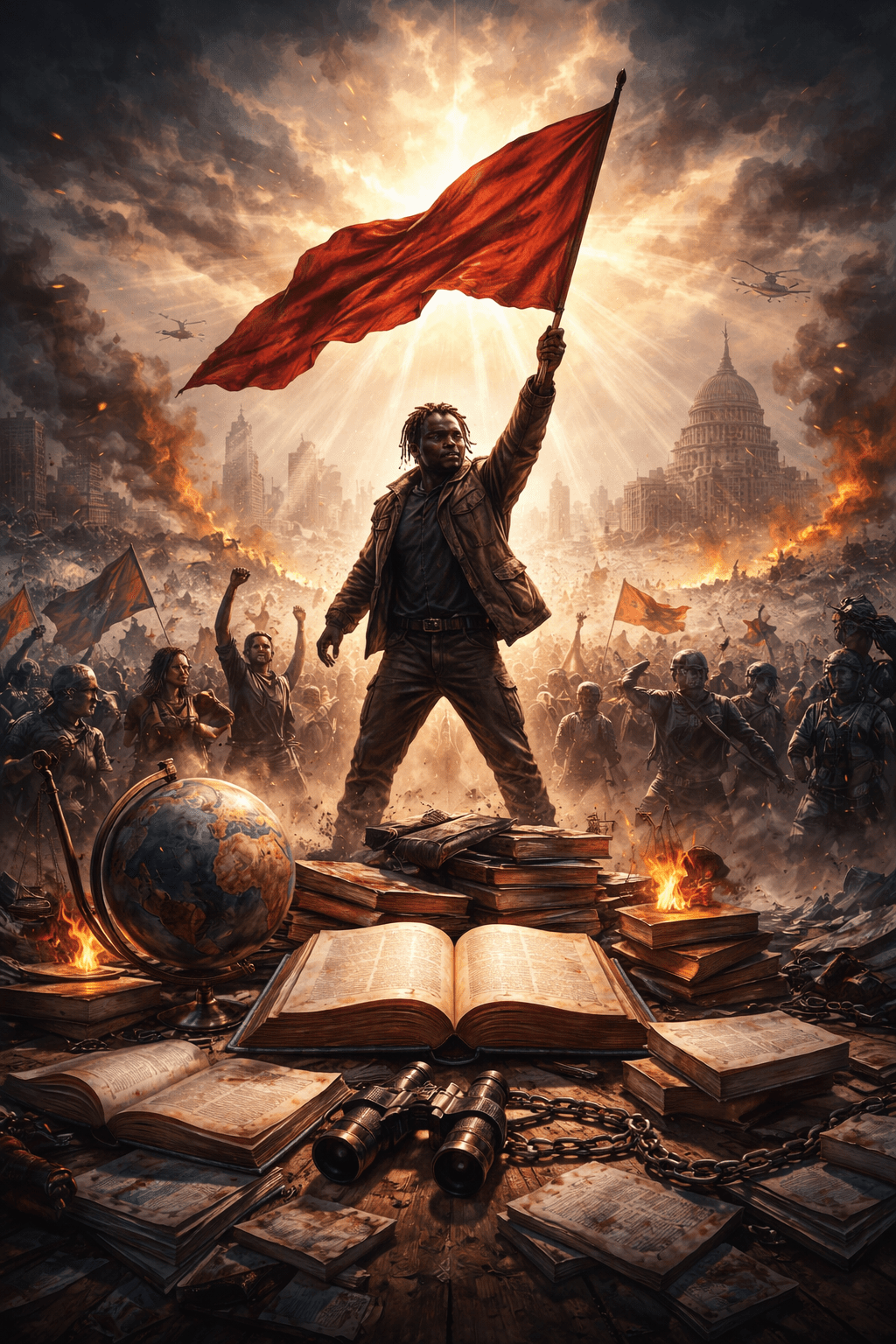
A rupture with procedural political science and canonical abstraction, this essay reconstructs politics as the scientific study of power—how it is accumulated, organized, enforced, and resisted—drawing on revolutionary praxis, settler colonial history, and imperial crisis to redefine what political theory is, who produces it, and what it is for.
The False Object: How Political Science Lost Power as Its Subject
I came into political science expecting to study power the way a mechanic studies an engine: not by admiring the hood ornament, but by opening the hood. I expected a discipline that could explain who rules, how they rule, what keeps them in place, and what makes them fall. Instead I walked into a museum of respectable illusions—an academic showroom where “politics” is presented as a polite debate between ideas, a competition between parties, a negotiation among interests, a dance of institutions and norms. It is a world where the state appears as an impartial referee, where law floats above society like a halo, where elections are treated as the final court of history. And if you bring up empire, coercion, counterinsurgency, or the organized violence that actually keeps property and hierarchy standing, you can feel the room tighten. The discipline does not say “that’s false.” It says, more politely, “that’s not political science.”
Political science presents itself as the study of politics, but it has quietly substituted a different object in politics’ place. Instead of studying power—how it is seized, organized, enforced, defended, and resisted—the discipline studies its surface effects. Institutions replace domination. Procedures replace coercion. Norms replace force. What remains is a field that describes how decisions appear to be made while refusing to analyze what makes those decisions binding in the first place.
This substitution is not a misunderstanding. It is a disciplinary choice. Modern political science, particularly in the imperial core, was consolidated around the assumption that politics could be rendered legible without confronting violence, class power, or empire as structuring realities. The state is treated as a neutral arena rather than as an apparatus built to secure specific property relations. Law is approached as a system of rules rather than as force given regular form. Order is explained through legitimacy rather than through the organized capacity to compel obedience.
As a result, political science studies politics as it is meant to be perceived, not as it actually operates. Elections are analyzed without asking what they cannot change. Constitutions are interpreted without examining the conditions they were designed to contain. Public opinion is measured without tracing how it is manufactured, disciplined, or ignored. Violence enters the analysis only as deviation—terrorism, instability, breakdown—never as a constitutive feature of political order itself.
This is why entire domains of real political life appear in the discipline as secondary or external. Colonialism becomes historical background rather than foundational structure. Empire is treated as foreign policy rather than as the material basis of domestic stability. Policing and incarceration are framed as social problems, not as political technologies. Economic coercion—debt, sanctions, austerity—is displaced into economics or international relations, severed from the study of power proper.
The effect is a science of politics that cannot explain how power actually holds. It can describe institutions that persist, but not why they survive repeated crises. It can catalog rights, but not why they expand for some and contract for others. It can model participation, but not why participation so often fails to translate into control. When politics turns openly coercive—during uprisings, repression, coups, or war—the discipline reaches for the language of exception, as if power had suddenly departed from its normal course rather than revealed it.
The problem, then, is not that political science lacks sophistication or data. It is that it has misidentified its object. By treating power as an effect rather than as the core phenomenon, the discipline explains outcomes while leaving domination intact and unanalyzed. It produces knowledge that can manage political systems, but not knowledge that can account for their violence, their durability, or their collapse.
Any attempt to build a new political science must begin by correcting this error. Before we can ask how politics works, we have to ask what politics is actually made of. If power is not placed at the center of analysis—if coercion, hierarchy, and empire remain peripheral—then political science will continue to function as a language for administering order rather than a science capable of explaining it. The task ahead is to rebuild the discipline around the thing it has systematically refused to study.
Procedure as Technology: How Power Was Rewritten as Form
Once political science displaced power as its object, it required a substitute that could be studied without reopening the questions power raises. That substitute was procedure. Politics was reconceived as a system of forms—elections, constitutions, courts, bureaucracies—whose operation could be observed, measured, and compared without interrogating the coercive capacities that make those forms effective. This was not a move away from politics, but a reconfiguration of how politics would be seen.
Procedure performs a specific analytical function: it renders domination legible without rendering it unstable. By focusing on how rules operate rather than on how they are enforced, political science converts force into form. The ability of the state to compel obedience is translated into legitimacy. The threat of violence recedes behind process. What matters is no longer who holds power, but whether the correct steps have been followed. In this way, procedure does not eliminate coercion; it masks it.
Elections are the clearest example. They are treated as the central mechanism of political life, the moment when popular will is said to enter the system. Yet elections are analyzed almost entirely at the level of participation, preference, and outcome, not at the level of constraint. Rarely does political science ask what electoral systems are structurally incapable of changing: ownership of productive assets, control over credit and investment, the security apparatus, or the imperial commitments that set the outer limits of policy. Procedure becomes a ritual that affirms order precisely by channeling conflict into forms that cannot threaten it.
Constitutions operate in a similar fashion. They are approached as neutral frameworks rather than as historical settlements forged under conditions of fear, inequality, and force. The emphasis falls on interpretation and balance, not on why certain questions were removed from popular control in the first place. The insulation of property, the indirect filtering of popular will, and the elevation of unelected authorities appear as technical design choices rather than as deliberate strategies to contain mass politics. Procedure transforms these strategies into architecture.
The concept of legitimacy completes the translation. Power that flows through recognized procedures is treated as qualitatively different from power that does not, regardless of material effect. A policy that immiserates millions is rendered legitimate if enacted through proper channels; resistance to that policy is rendered illegitimate if it disrupts them. In this way, procedure becomes a moral filter. It separates acceptable from unacceptable forms of political action while leaving the distribution of power itself untouched.
This procedural lens also disciplines analysis. By defining politics as the operation of formal mechanisms, political science narrows the range of phenomena it can recognize as political. Strikes, uprisings, occupations, and insurgencies appear as disruptions rather than as political acts with their own rationality. Policing and incarceration are relegated to criminal justice. Economic coercion is handed off to economics. Empire is segmented into foreign policy. Procedure draws boundaries around the political that exclude precisely those moments when power is most visible.
The result is a discipline fluent in governance and impoverished in explanation. It can describe how decisions move through institutions, but not why institutions are structured to absorb some demands and crush others. It can model stability, but not account for the force required to maintain it. Procedure offers political science a way to speak endlessly about politics while rarely confronting the mechanisms that make political outcomes stick.
Understanding procedure as a technology rather than a neutral feature of political life clarifies what comes next. If power is not eliminated but reformatted as form, then the question is no longer whether political theory avoids power, but how theory trains us to see form as sufficient. That training does not occur accidentally. It is organized, reproduced, and enforced through the canon itself.
The Canon as Training Regime: How Political Theory Teaches Elites to See
If procedure is the technology that neutralizes power, the canon is the pedagogy that makes this neutralization feel natural. Political theory is not merely a record of past ideas; it is a training regime that disciplines perception. It teaches students what counts as a political question, what counts as a legitimate answer, and—just as importantly—what should not be seen at all. The canon does not explain power; it conditions how power is perceived.
Canon formation is often presented as an inheritance story: the best ideas survive, the weak are forgotten. In reality, it functions more like selection pressure. Theories that abstract from struggle, violence, and empire travel easily across time and institutions. They can be taught without implicating the present order. Theories that arise from direct confrontation with power—those that name domination plainly and draw strategic conclusions—do not travel as easily. They carry instructions, not just interpretations, and are therefore treated as dangerous or partisan.
This is why figures such as Thomas Hobbes and David Locke occupy a central place. Their work exemplifies the traits the canon rewards: hypothetical reasoning, elite standpoint, and distance from organized struggle. Hobbes constructs authority through an imagined fear of disorder rather than through a historical account of conquest. Locke grounds political obligation in consent and property without tracing the colonial violence that made those categories operative. These are not accidental omissions. They are what make the theories portable.
Portability is key. A canon that must be taught across empires and generations cannot require students to grapple with the material origins of their own advantage. Abstraction allows political theory to speak in universal terms while remaining anchored to a specific social position. European experience is elevated into human nature; elite anxieties are recoded as timeless problems of order. In this way, the canon trains its audience to experience domination as a philosophical puzzle rather than as a historical relationship.
The training effect is cumulative. Students learn to admire balance, moderation, and restraint while treating mass politics as excess. They learn to distrust movements that threaten stability and to sympathize with institutions that promise order. They learn to frame political conflict as disagreement among interests rather than as struggle between classes and empires. By the time they encounter overt violence—policing, war, repression—they have already been taught to see it as an unfortunate necessity rather than as the core mechanism of rule.
What appears as theoretical rigor is therefore a form of socialization. The canon teaches future administrators, analysts, and scholars how to think like rulers without ever naming rule as such. It filters out perspectives that would force a reckoning with power as domination and selects for those that render domination abstract, procedural, or invisible. This is why proximity to praxis disqualifies theory in academic settings: not because praxis lacks insight, but because it disrupts the training.
Weaponized Information approaches the canon without reverence or dismissal. It treats canonical texts as evidence of how ruling classes understand themselves and wish to be understood. The question is not whether these theories are true in the abstract, but what kind of political subject they produce. A canon that teaches abstraction, distance, and proceduralism produces analysts capable of managing power, not of challenging it.
Once the canon is understood as a training regime, its authority dissolves. It becomes clear that political theory has been curated to sustain a particular way of seeing—one compatible with existing hierarchies. The task is not to expand this canon at the margins, but to break its monopoly over what counts as political knowledge. That requires turning from selection to method: from who is included to how political knowledge should be produced at all.
Why Imagined Origins Cannot Explain Real Domination
The canon’s reliance on hypothetical origins is not a stylistic quirk; it is a methodological failure. Political theory built on imagined beginnings—states of nature, original contracts, abstract individuals—cannot explain political power as it actually exists. These models ask how authority might arise among equals, but political history is the story of how authority emerges among unequals. When theory begins by erasing inequality, it guarantees that domination will reappear later as mystery, deviation, or moral failure rather than as structure.
Hypothetical politics treats violence as a problem to be solved rather than as a condition to be explained. By positing a pre-political world of fear or cooperation, it displaces the historical realities that produce order: conquest, enslavement, enclosure, and the organized capacity to enforce hierarchy. Authority is derived from consent because consent is easier to moralize than force. Yet consent narratives cannot account for why political orders repeatedly rely on coercion to survive, nor why those subjected to authority so often experience it as imposition rather than agreement.
This method also collapses time. By anchoring political legitimacy in an imagined moment of origin, it treats present domination as the settled outcome of a rational choice made long ago. Ongoing struggles—between classes, nations, and racialized populations—are rendered secondary, as if the foundational question has already been resolved. Politics becomes a matter of maintenance rather than conflict, administration rather than struggle. What cannot be traced back to the original fiction appears as disorder.
The scientific problem is clear. A method that begins outside history cannot explain historical change. It cannot account for revolutions, counterrevolutions, colonial expansion, or imperial decline. It has no tools to analyze why states suspend their own rules in moments of crisis, why repression intensifies when legitimacy erodes, or why legal equality coexists with material domination. These phenomena appear anomalous only because the method has excluded power as a causal variable from the start.
Real political orders do not originate in agreement; they originate in victory. Victories are then stabilized through law, ideology, and institutional design. Property relations hardened by force are later described as natural rights. Borders drawn through war are later presented as legal facts. Political theory that refuses to follow this sequence—from violence to form—cannot explain why power looks stable until it suddenly breaks.
Weaponized Information rejects hypothetical origins in favor of historical induction. Political knowledge must be drawn from concrete processes: how land was taken, how labor was disciplined, how resistance was crushed or absorbed, and how ruling classes learned to govern more efficiently. This does not mean abandoning theory; it means grounding it. Abstraction is not eliminated, but it is subordinated to evidence produced by struggle.
The implication is decisive. If imagined origins cannot explain real domination, then political science must look elsewhere for its foundations. It must turn toward those sites where power is encountered directly and where political actors are forced to theorize in order to survive. The next task, then, is not to refine abstraction, but to examine how knowledge emerges from practice itself.
Praxis as Epistemology: How Power Produces Knowledge
If imagined origins cannot explain real domination, then political knowledge must be sought where domination is encountered directly. This requires a break with the academic reflex that treats involvement as bias and distance as rigor. In politics, distance obscures. Power does not reveal itself fully to observers who encounter it only through texts, models, or secondhand accounts. It reveals itself under pressure—when decisions must be made with incomplete information, when institutions harden against challenge, and when failure carries material consequences. Praxis is not a moral posture; it is an epistemic condition.
Governing, organizing, and resisting produce knowledge because they force political actors to confront constraints that abstraction cannot anticipate. When a strike collapses, when an uprising is repressed, when a reform is neutralized by capital flight or legal obstruction, something precise is learned about how power is organized and where its limits lie. These lessons are not anecdotes. They are data generated by struggle. A method that dismisses them as subjective while privileging surveys or procedural metrics confuses cleanliness with accuracy.
This is the methodological insight articulated most clearly by Lenin and Mao, not as philosophical speculation but as operational necessity. Lenin’s analysis of the state as an instrument of class rule was not derived from constitutional diagrams; it emerged from clandestine organization, mass strikes, failed revolutions, civil war, and the problem of holding power against coordinated counterrevolution. Mao’s insistence that knowledge comes from practice was not a slogan. It was a response to the lethal consequences of applying abstract formulas to uneven, hostile conditions.
What distinguishes praxis-based knowledge is its capacity for correction. Ideas forged in struggle are continuously tested against outcomes. Strategies that fail are revised or abandoned. Concepts that do not correspond to material conditions are discarded because they endanger lives and movements. This iterative process—action, reflection, adjustment—is the closest politics comes to experimentation. It produces theory that is provisional, situational, and sharpened by consequence rather than by consensus.
Academic political science inverts this process. It treats practice as contamination and theory as something to be protected from contact with power. The result is a body of knowledge insulated from falsification by events. When predictions fail, the model is refined; when realities contradict assumptions, the anomaly is explained away. Praxis-based theory cannot afford this luxury. Its failures are immediate and often irreversible, which is precisely why it generates sharper insight into how power actually behaves.
Recognizing praxis as epistemology does not mean romanticizing every action taken in the name of change. It means acknowledging where political knowledge is produced under conditions of necessity. Those forced to confront power learn things that those tasked with managing it prefer not to know: how legality bends under pressure, how institutions coordinate repression, how consent is withdrawn and reimposed. These insights do not emerge from neutrality. They emerge from engagement.
Once this epistemic rule is established, the category of political theorist must be redefined. Theory is no longer validated by distance, elegance, or peer recognition, but by explanatory power under real conditions. The next step is to apply this rule consistently and examine who, historically, has produced the most rigorous knowledge of power—and why they have been excluded from the discipline that claims to study it.
Revolutionaries as Scientists of Power
Once praxis is recognized as a source of political knowledge, the hierarchy of political theory collapses. Those who have been treated as mere activists, militants, or leaders suddenly appear as the most rigorous analysts of power available. This is not because they possessed superior moral clarity, but because their survival depended on understanding how power actually operates under hostile conditions. Revolutionaries theorized not in seminar rooms, but in prisons, guerrilla camps, ministries under siege, and societies subjected to sabotage, embargo, and war.
What unites these figures is not ideology but method. They confronted concrete problems—how to mobilize a population fractured by colonial rule, how to sustain legitimacy under material scarcity, how to govern without reproducing the structures being overthrown. Their theories emerged as answers to these problems, revised through failure and sharpened through confrontation. This is political science stripped of pretense: hypotheses tested against repression, strategy evaluated by survival, and concepts discarded when they no longer corresponded to reality.
Consider Amilcar Cabral. His insistence that culture is not an ornament of politics but a terrain of struggle emerged from the practical problem of sustaining a liberation movement among a peasantry targeted by Portuguese counterinsurgency. Culture, for Cabral, was not identity rhetoric; it was a material force that could either anchor resistance or be weaponized by the colonizer. This insight was not deduced from theory. It was learned in the process of organizing villages under aerial bombardment and political infiltration.
Ho Chi Minh developed a theory of political endurance that liberal political science cannot comprehend. Governing was inseparable from resisting, and legitimacy was not a legal status but a relationship continuously reproduced through sacrifice and material redistribution. His synthesis of nationalism and socialism was not an ideological compromise but a strategic necessity forged in a century-long struggle against successive empires. Political authority was measured not by constitutional form, but by the capacity to sustain mass commitment under extreme violence.
Thomas Sankara confronted a different problem: how to exercise state power without reproducing dependency. His theory of sovereignty emerged from governing a poor country locked into unequal trade, debt, and aid regimes. Sankara’s insistence on self-reliance, mass participation, and austerity for officials was not moral posturing; it was a diagnosis of how external economic power corrodes political autonomy. His assassination is itself data, confirming the limits imposed on any state that threatens imperial arrangements.
More recently, Hugo Chavez generated a body of political theory through the problem of transforming a petro-state from within. Concepts such as participatory democracy, communal power, and dual authority were not rhetorical flourishes. They emerged from concrete confrontations with capital flight, media warfare, coups, and bureaucratic inertia. Chávez’s theoretical innovations cannot be separated from the attempt to govern against entrenched class power while maintaining electoral legitimacy under constant destabilization.
What distinguishes these figures from canonical theorists is not that they rejected abstraction, but that abstraction was always subordinated to lived contradiction. Their theories do not begin from imagined individuals but from historically produced populations. They do not assume stable institutions; they analyze how institutions fracture under pressure. They do not treat power as a problem of coordination; they treat it as a relation of force that must be reorganized or dismantled.
The exclusion of these theorists from political science is therefore not an oversight but a boundary maintenance strategy. To take them seriously would require redefining what counts as theory, what counts as evidence, and who is qualified to produce knowledge. It would collapse the distinction between scholar and militant, between analysis and organization. Yet if political science is to become a science of power rather than a language of administration, this collapse is not a threat. It is a requirement.
Having established revolutionaries as producers of rigorous political knowledge, the analysis must now turn inward—to those figures within the imperial core who did govern, did theorize, and did exercise power. The question is not whether they qualify as political theorists, but what kind of theory their practice produced.
The Founding Fathers as Settler Political Theorists
If praxis is the criterion for political theory, then the leaders of the early United States cannot be dismissed as mere ideologues. They governed, they commanded armies, they wrote constitutions, and they designed institutions that still structure political life. In the Weaponized Information sense, they qualify as political theorists precisely because their ideas were forged through practice. The decisive question is therefore not whether they theorized, but what kind of power their theory was designed to secure.
The political problem confronting the revolutionary elite in North America was not how to achieve universal freedom, but how to consolidate settler rule over stolen land while preventing rebellion from below. Independence from Britain did not abolish hierarchy; it transferred authority from an imperial metropole to a local ruling class embedded in slavery, land speculation, and commercial expansion. The task of political theory in this context was to stabilize elite control without provoking the very masses whose labor and obedience were required to sustain the new state.
Figures such as Thomas Jefferson, James Madison, and George Washington produced a body of political thought inseparable from this project. Their writings and institutional designs reveal a consistent preoccupation with containment: of enslaved populations, of Indigenous resistance, and of poor settlers whose grievances could easily turn against elite property relations. Republicanism, in their hands, was not a doctrine of popular rule but a strategy for filtering and disciplining it.
This is why their political theory emphasizes restraint, balance, and indirectness. Popular participation is permitted, but only through layers of mediation that protect property and insulate decision-making from sudden shifts in mass sentiment. Power is fragmented not to empower the many, but to prevent any single force—especially the people themselves—from exercising decisive control. What later generations would celebrate as constitutional wisdom was, in its original context, a counterrevolutionary solution to the problem of governing a volatile settler society.
The founders’ suspicion of democracy was not philosophical abstraction; it was grounded in experience. They had witnessed slave revolts, frontier wars, debtor uprisings, and the radical egalitarianism unleashed by revolutionary mobilization. Their political theory reflects an acute awareness that unchecked popular power threatened the social order from which they benefited. The solution was not repression alone, but institutional design capable of normalizing inequality while presenting it as self-government.
Seen in this light, the early American state appears less as a democratic breakthrough than as a successful experiment in settler governance. It combined electoral forms with racial exclusion, legal equality for some with permanent unfreedom for others, and representative institutions with a security apparatus ready to deploy force when containment failed. The theory that justified this arrangement cannot be separated from the material realities it was built to manage.
Treating the Founding Fathers as settler political theorists does not require moral condemnation or nationalist reverence. It requires analytical precision. Their ideas were effective because they aligned with the requirements of a colonial ruling class operating in a hostile environment. That effectiveness is precisely why their theories endure. But recognizing this also exposes their limits. A political theory designed to secure settler domination cannot serve as a universal guide to emancipation.
To understand those limits fully, the analysis must move from political form to political substance. The next task is to examine the central institutions that made settler rule possible—slavery and Indigenous dispossession—not as moral contradictions within the founding project, but as theoretical pillars without which it could not have survived.
Slavery and Genocide as Theory: The Material Grammar of Settler Power
Liberal political science prefers to treat slavery and Indigenous genocide as moral failures that interrupted an otherwise emancipatory project. This framing preserves the legitimacy of the founding theory by isolating violence as deviation. A science of power cannot afford this comfort. Slavery and genocide were not aberrations that contradicted early American political theory; they were the material conditions that made it coherent. Remove them, and the theory collapses.
The early American state confronted a structural problem: how to construct political order on conquered land while extracting labor from a population denied political existence. Slavery solved the labor problem; genocide and removal solved the land problem. Political theory emerged to stabilize these solutions. Concepts such as property, citizenship, and representation were not neutral abstractions but instruments calibrated to protect racialized accumulation. Theories of liberty were crafted alongside legal architectures that defined who could be owned, who could own, and who could be excluded altogether.
Property occupies the central place in this theoretical grammar. It is treated as a natural right rather than as a historical relation produced through violence. Enslaved people appear not as political subjects but as assets; Indigenous land appears not as sovereign territory but as empty space awaiting improvement. Political theory does not ask how these transformations occurred. It presupposes them. By doing so, it converts conquest into background condition and exploitation into common sense.
Citizenship performs the complementary function. It marks the boundary of political humanity. Those inside the boundary are granted limited participation; those outside are governed without consent. This division is not accidental. A settler state that extended political equality to enslaved people or Indigenous nations would have dissolved itself. Political theory therefore works to naturalize exclusion, presenting it as prudence, gradualism, or constitutional necessity rather than as domination.
Representation completes the structure. Political power is distributed in ways that amplify settler interests and mute the voices of those most affected by state violence. Electoral mechanisms are designed to aggregate settler consent while rendering enslaved and colonized populations politically invisible. This is not a flaw in representation; it is its function. Representation becomes a way to govern in the name of “the people” while defining the people narrowly enough to secure elite control.
Seen together, slavery and genocide are not external to political theory; they are its organizing principles. They determine what can be said, who can be heard, and which conflicts are rendered illegitimate from the outset. Theories of order that do not account for these relations are not incomplete—they are ideological. They explain the stability of the settler state only by refusing to name the violence that sustains it.
This reframing has analytical consequences. Appeals to founding ideals cannot ground emancipatory politics because those ideals were formulated to manage a racialized hierarchy, not to dismantle it. Constitutional reverence becomes a barrier to understanding rather than a source of guidance. A science of power must therefore treat slavery and genocide as theoretical data—evidence of how political concepts function when designed to secure domination across generations.
Once this is acknowledged, the task shifts from moral evaluation to classification. Political theories must be sorted not by their stated values but by the power projects they serve. The next section undertakes that task, replacing ideological taxonomy with a material one.
Political Theory Classified by Power Project, Not Profession of Values
Once slavery and genocide are recognized as constitutive rather than accidental, the inherited way of organizing political theory becomes unusable. Sorting theories by values—liberal, conservative, radical—or by chronology obscures the only classification that matters for a science of power: what kind of rule a theory is designed to stabilize, manage, or overthrow. Political theory must be regrouped according to the power projects it serves, not the moral language it employs.
The first category is settler-colonial political theory. This is theory produced by ruling classes governing conquered land and dependent on coerced labor. Its central problem is containment: how to secure elite control while preventing rebellion from enslaved, dispossessed, or impoverished populations. Its characteristic features include restricted citizenship, racialized property regimes, indirect representation, and permanent territorial expansion. Order is maintained through a combination of legal form and organized violence, with democracy carefully rationed to those whose participation will not threaten accumulation.
The second category is imperial managerial theory. This emerges when conquest has matured into administration and domination must be sustained across vast distances. Here political theory becomes technical. Empire is redescribed as governance; coercion as security; extraction as development. The central task is not to justify violence openly but to normalize it through institutions, expertise, and policy language. Modern political science overwhelmingly inhabits this category. Its concern is stability, predictability, and risk management, not emancipation.
The third category is revolutionary anti-colonial political theory. This body of work is generated under conditions of asymmetry, repression, and material scarcity. Its central problem is not how to manage power but how to break it and reorganize social relations in the process. Theory here is inseparable from strategy. The state is analyzed as an apparatus of class and colonial domination; ideology as a battlefield; the masses as historical agents rather than variables. Success and failure alike generate knowledge because both reveal the real structure of power.
What distinguishes these categories is not intention but alignment. Settler-colonial and imperial theories align with the reproduction of hierarchy, even when they speak in universal terms. Revolutionary theory aligns with its disruption, even when it must operate within inherited forms. This alignment determines what each theory can see. Theories that serve domination are structurally blind to its violence; theories forged in struggle are forced to confront it directly.
This classification clarifies why academic political science appears pluralistic while remaining functionally narrow. Multiple perspectives coexist, but almost all operate within the bounds of imperial management. Dissent is tolerated so long as it does not threaten foundational arrangements of property, sovereignty, and global hierarchy. The exclusion of revolutionary anti-colonial theory is not an oversight; it is a condition of the discipline’s coherence.
Reorganizing political theory along these lines dissolves false equivalences. A constitutional treatise and a counterinsurgency manual can be analyzed together if they serve the same power project. A guerrilla strategy document and a labor organizing text can be read side by side if they illuminate similar dynamics of resistance. What matters is not genre, but function.
With this framework in place, the limits of mainstream political science become fully visible. By confining itself to imperial managerial theory, it cannot explain why domination persists, mutates, or turns inward under crisis. To answer those questions, the analysis must expand its scale and reintroduce the variable the discipline has most carefully avoided: empire itself.
Empire as the Missing Variable: Why Political Science Cannot Explain the World It Inhabits
With political theory reorganized by power project, the central failure of mainstream political science comes into sharp focus. The discipline attempts to explain political order without accounting for the global system that makes that order possible. Empire is treated as an external concern—an episode in history, a subset of foreign policy, or a moral controversy—rather than as the material architecture through which wealth, coercion, and stability are distributed across the world. Without empire, political science is left analyzing shadows.
The separation between “domestic” politics and “international” relations is the discipline’s most consequential fiction. Wages, welfare states, infrastructure, and political stability in the imperial core are examined as internal achievements, while the extraction of resources, labor, and surplus from the periphery is relegated elsewhere. This division allows political science to explain prosperity without explaining where it comes from, and to analyze crisis in the Global South without tracing its origins to imperial intervention, debt regimes, and structural dependency.
Empire does not merely project power outward; it organizes political life inward. Racial hierarchy, border regimes, labor stratification, and policing practices in the core are not accidental domestic features. They are adaptations of imperial governance, refined through centuries of colonial rule. The discipline’s refusal to treat these as connected phenomena produces analytical absurdities: migration without displacement, poverty without plunder, authoritarianism without empire.
The historical roots of this blindness are not mysterious. Modern political science and international relations emerged during the high period of European and U.S. imperial dominance. Early theorists openly debated how to manage colonies, races, and subject populations. As formal decolonization made such language untenable, the discipline sanitized itself. Empire did not disappear; it was recoded. Hierarchy became development. Control became stability. Intervention became responsibility. Political science followed empire’s lead, adopting a vocabulary that preserved function while erasing origin.
Anti-colonial political theory never accepted this erasure. Thinkers such as Kwame Nkrumah insisted that political independence without economic sovereignty was meaningless, because imperial power had simply shifted form. His concept of neocolonialism named what political science refused to see: a system in which domination persists through finance, trade, military alliances, and political interference rather than direct rule. This was not ideology but diagnosis, grounded in the lived experience of newly independent states immediately constrained by imperial structures.
When empire is excluded, political science is forced to explain systemic outcomes as local failures. States subjected to sanctions, coups, or capital flight are diagnosed as corrupt or poorly governed. Popular resistance to imperial arrangements is framed as instability or extremism. Meanwhile, the imperial core appears as a zone of normal politics, temporarily disrupted by polarization or populism. The discipline cannot see that what it treats as domestic crisis is often the internalization of contradictions long managed abroad.
Restoring empire as a central variable resolves these distortions. It becomes possible to trace how global extraction subsidizes domestic order, how coercive techniques migrate from colony to metropole, and why political forms celebrated as democratic coexist with permanent states of exception. Empire explains continuity where political science sees anomaly and reveals structure where the discipline sees chaos.
A science of power that refuses to theorize empire will always misdiagnose the present. It will treat imperial decline as moral failure, geopolitical competition as misunderstanding, and resistance as irrational disruption. To understand contemporary politics—its violence, its authoritarian turns, its intensifying repression—empire must be analyzed not as background, but as system. Only then can the discipline begin to explain the world it claims to study.
Technofascism as Imperial Reorganization: When Empire Turns Inward
Once empire is restored as a structuring variable, the present no longer appears as a break from liberal order but as its reorganization under stress. The tightening of surveillance, the fusion of corporate and state power, the erosion of civil liberties, and the normalization of emergency governance are not deviations from political science’s models; they are what those models could never explain. What is unfolding is not the collapse of democracy into authoritarianism, but the recalibration of imperial rule when external extraction no longer suffices to stabilize the core.
Liberal governance relied on a geographic division of coercion. Violence, deprivation, and counterinsurgency were concentrated in the periphery, while consent, rights, and welfare were selectively expanded at the center. As profitability declines, rival powers rise, and imperial reach encounters limits, that division erodes. Techniques refined abroad—population surveillance, economic coercion, psychological operations, legal exceptionalism—are generalized inward. Political science names this “backsliding” because it lacks a framework for continuity.
Technofascism names this continuity. It is not a revival of twentieth-century fascism with mass parties and explicit racial mythologies, but a managerial form of domination suited to a digital, financialized empire in crisis. Control is exercised less through spectacle than through infrastructure. Platforms mediate speech. Algorithms sort populations. Credit, employment, and visibility become levers of discipline. Participation persists as form while decision-making migrates upward and outward—to executive authority, security agencies, and monopolized technological systems.
This shift exposes the limits of procedural politics. Elections continue, courts issue rulings, legislatures debate—but increasingly within boundaries set by security imperatives and capital mobility. When procedures obstruct accumulation or control, they are bypassed, suspended, or reinterpreted. What political science treats as constitutional strain is better understood as the system revealing its priorities. Order is preserved not because procedures are respected, but because coercive capacity remains intact.
The domestic targets of this reorganization are not chosen randomly. Surplus populations, migrants, racialized communities, and politically organized workers experience the sharpest edge of technofascist governance first. This mirrors imperial practice abroad, where rule was always differentiated by usefulness and threat. The novelty is not repression itself, but its expansion to groups previously buffered by imperial privilege. What was once exceptional becomes routine as the costs of empire are redistributed inward.
Political science struggles here because it continues to treat authoritarian measures as temporary responses to crisis rather than as structural adaptations. It asks when normality will return instead of asking why normality depended on external domination in the first place. Without empire, technofascism appears as pathology. With empire, it appears as strategy.
Understanding technofascism as imperial reorganization clarifies the stakes of the present moment. The question is not whether liberal democracy can be restored through procedural repair, but whether a system built on global hierarchy can be reformed without relinquishing domination. A science of power does not offer reassurance on this point. It offers diagnosis. And the diagnosis suggests that as long as imperial relations persist, governance will continue to harden, adapt, and concentrate—no matter the language used to justify it.
If this is the trajectory, then the task of political science cannot be to rescue a collapsing form. It must be to equip those subject to this reorganization with the analytical tools to understand it and resist it. That task requires a discipline oriented not toward management, but toward demystification and struggle.
Weaponized Information as a New Political Science
At this point the break is complete. The problem is no longer diagnosing what political science has failed to explain, but articulating what a science of power must actually do. Weaponized Information does not propose an alternative canon or a new subfield. It proposes a different discipline altogether, defined by a different object, a different method, and a different purpose. Politics, here, is not the study of governance, representation, or legitimacy in the abstract. It is the study of how power is accumulated, organized, enforced, contested, and transformed under concrete historical conditions.
The object of this political science is power itself. Not power as influence or persuasion, but power as the structured capacity to shape outcomes, compel behavior, and reproduce social relations across time. This includes the state, but is not limited to it. Capital, empire, race, technology, ideology, and violence are treated not as external variables but as constitutive elements of political life. Institutions matter, but only insofar as they condense these relations into durable form. When institutions fail, fracture, or turn openly coercive, that failure is treated as data rather than anomaly.
Methodologically, Weaponized Information is historical, materialist, and praxis-driven. It begins from real processes—conquest, enslavement, enclosure, industrialization, decolonization, counterinsurgency, financialization—and traces how political forms emerge from them. Theory is not derived from hypothetical models but induced from struggle, governance, repression, and resistance. Concepts are provisional and revisable, judged by their capacity to explain outcomes under pressure rather than by their elegance or acceptance within academic markets.
This method requires an expanded archive. Revolutionary writings, organizing documents, speeches delivered under siege, internal debates within movements, declassified intelligence files, military manuals, economic data, and lived experience all count as political evidence. Academic scholarship is neither privileged nor excluded; it is evaluated by what it clarifies about power relations. Authority does not flow from institutional affiliation, but from explanatory force. A peer-reviewed article and a prison letter can sit side by side if both illuminate how domination operates.
The purpose of this discipline is not prediction for policymakers or optimization for administrators. It is orientation. Weaponized Information aims to make power legible to those subjected to it, not to those tasked with managing it. Knowledge is treated as a weapon in the precise sense that clarity alters the terrain of struggle. To understand how power works is already to weaken its mystifications, its moral alibis, and its claims to inevitability.
This orientation dissolves the false separation between analysis and organization. Political theory is not an end in itself, but a moment within broader processes of collective learning and action. The value of an analysis lies in whether it sharpens strategy, clarifies contradictions, and helps movements avoid repeating failures disguised as tradition. A political science that cannot be translated into practice is not incomplete; it is misdirected.
Weaponized Information therefore understands itself as both analytical framework and political intervention. It does not seek to professionalize dissent or to offer a more inclusive version of existing disciplines. It seeks to expose how those disciplines function as part of the machinery of rule and to replace them with a science adequate to the realities of imperial crisis, technological domination, and mass dispossession. In doing so, it restores politics to its proper scale and seriousness: not as a game of procedure, but as a struggle over power with material consequences.
What remains is not to defend this approach in the abstract, but to draw its implications to their conclusion. If politics is the science of power, then neutrality is impossible, management is complicity, and knowledge carries responsibility. The final question is not whether this discipline is legitimate, but whether those who grasp its insights are willing to act on them.
From Knowledge to Defection: Politics as a Science with Consequences
A political science that takes power as its object cannot end in description. To understand how domination is organized is already to confront a choice. Knowledge of power is not neutral information; it is orientation. It clarifies who benefits, who bears the costs, and which arrangements are maintained by force rather than consent. Once these relations are made visible, the posture of detached analysis collapses. One either assists in the management of domination or contributes to its undoing.
This is why the prevailing discipline insists on neutrality even as it quietly aligns with existing power. Neutrality functions as a moral alibi for administration. It allows scholars to analyze repression without opposing it, empire without naming it, and inequality without tracing its sources. Weaponized Information rejects this stance not because it is unethical, but because it is analytically false. Power does not observe neutrality, and a science that pretends otherwise will always misrecognize its own function.
Politics, understood as the science of power, demands a different responsibility. It requires following domination wherever it leads—across borders, through institutions, into markets, prisons, and data centers. It requires recognizing that the most consequential political knowledge has often been produced by those forced to theorize under threat: the colonized, the enslaved, the insurgent, the besieged. To treat this knowledge as secondary is to side with the conditions that made it necessary.
The aim of Weaponized Information is not to replace one academic orthodoxy with another. It is to rupture the false division between understanding and action that protects existing hierarchies. A science of power that cannot inform strategy, sharpen organization, or clarify lines of struggle is not incomplete; it is decorative. In an era of imperial reorganization and technofascist governance, decoration is a luxury afforded only by those insulated from consequence.
To grasp power clearly is to recognize that reform, restoration, and procedural repair cannot resolve contradictions rooted in conquest, exploitation, and hierarchy. The question facing those who come to this understanding is therefore not theoretical but practical. Will political knowledge be used to stabilize a collapsing order, or to help those subjected to it find leverage, coordination, and clarity?
Weaponized Information names this choice directly. Politics as the science of power leaves no room for innocence. It asks not only how the world is governed, but for whom—and at whose expense. To study politics under these terms is already to defect from the discipline as it exists and to enter a different terrain, where knowledge is inseparable from responsibility and understanding carries obligations.
The wager of this project is simple and uncompromising: that clarity is a material force, that demystification weakens domination, and that a political science grounded in power rather than procedure can contribute to emancipation rather than administration. In a world organized by coercion and managed by illusion, that wager is not radical. It is necessary.
 Weaponized Information
Leave a comment