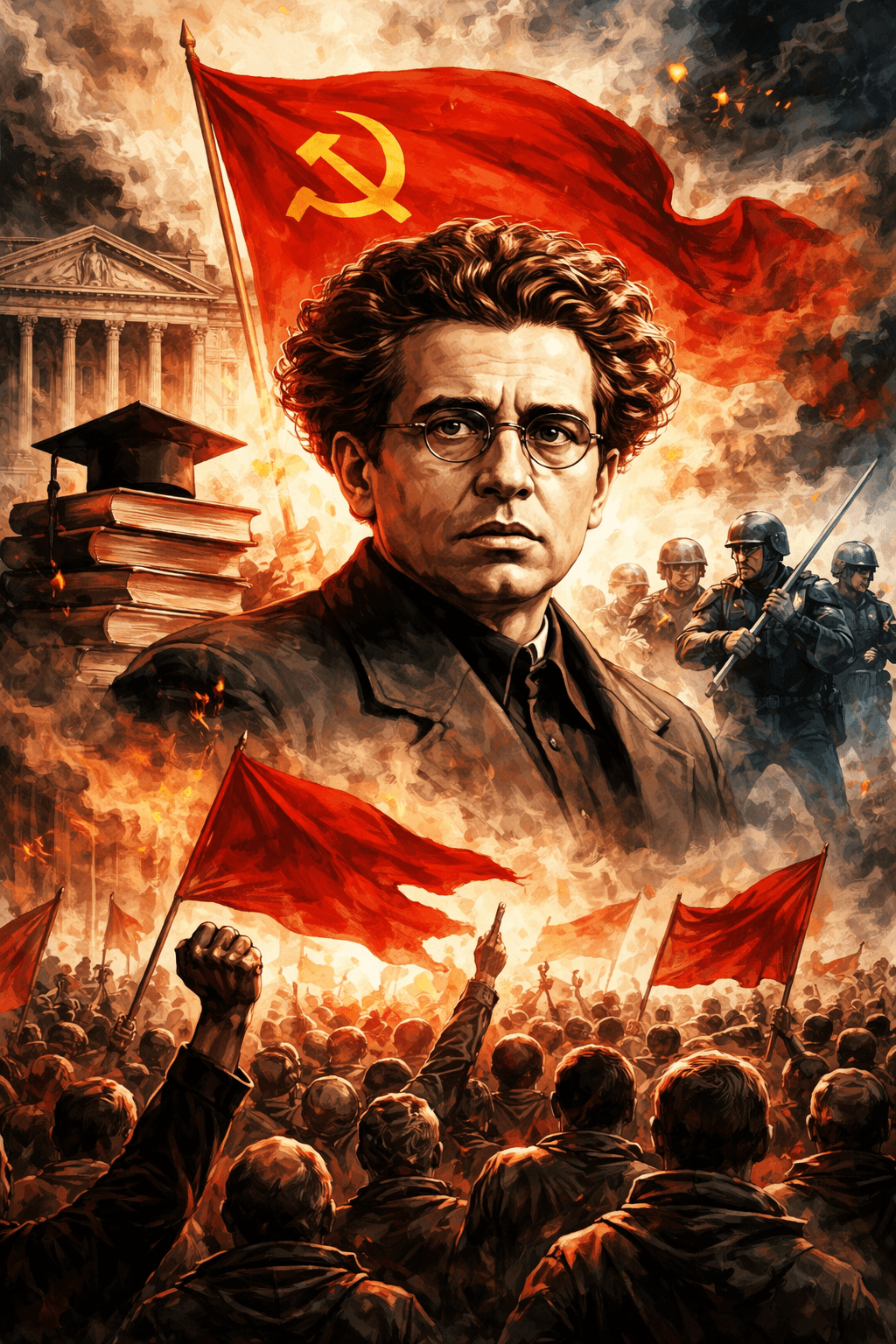
A polemical reconstruction of Antonio Gramsci as a Leninist revolutionary whose theory of hegemony was forged to solve the problem of power under advanced capitalism—and how imperial academia captured, fragmented, and neutralized that theory to manage dissent rather than overthrow domination.
By Prince Kapone | Weaponized Information | December 22, 2025
Gramsci in the Imperial Seminar Room
In the imperial academy, Antonio Gramsci is everywhere and nowhere at the same time. He’s everywhere in citations, everywhere in syllabi, everywhere in conference titles and cultural theory footnotes. But he is nowhere in the places where power is actually contested—where organizations are built, where cadres are trained, where strategy is hammered out under pressure, where the question is not “how do we interpret the world?” but “how do we take it from those who own it?” That contradiction is not a minor academic curiosity. It is the opening wound. It tells you, before you even turn to the Prison Notebooks, that something has been done to Gramsci.
The ruling class does not finance institutions to distribute weapons to its enemies. It finances institutions to manage them. Empire does not only conquer territory; it manufactures the mental furniture people live inside. It teaches you what is thinkable, what is respectable, what is “complex,” and what is “too extreme.” So when a revolutionary communist becomes a canonical darling of the very institutions tasked with reproducing imperial legitimacy, the correct question is not “Why do they admire him?” The correct question is: what version of him have they allowed to circulate?
In most academic settings, Gramsci arrives already defanged. He is presented as the theorist of “civil society,” the analyst of “hegemony,” the patron saint of cultural critique. He becomes a kind of Marxism without rupture: a language for talking about domination that does not require confronting the state, building disciplined organization, or taking power. The seminar room loves this Gramsci because this Gramsci does not threaten the foundations of the seminar room. He is Gramsci as a safe specialist for the professional-managerial left: useful for diagnosing vibes, useless for winning battles.
This is why Gramsci is not simply “misunderstood.” He is positioned. He is used. His thought is processed through the machinery of imperial knowledge in the same way so many revolutionary traditions are processed: extracted for concepts, stripped of commitments, and redeployed as a respectable critique that can circulate freely precisely because it has been separated from its revolutionary purpose. The empire does not need to ban the thinker when it can launder him. Better to let Gramsci be famous—so long as he is famous in a way that keeps people disarmed.
The scientific question, then, is not a matter of taste or interpretation. It is a question of political economy and ideological function. How does a communist organizer—imprisoned by fascism, removed from political work by force—get repackaged as a theorist of culture for liberal institutions? How does a Leninist concerned with the problem of power become a mascot for a left that is terrified of power? How does a theory forged in struggle become a toolkit for managing dissent?
This essay takes that question seriously because it is not just about Gramsci. It is about the broader intellectual world war—what Weaponized Information was built to fight from inside the imperial core. We are not dealing with neutral “readings” that float above history. We are dealing with a battlefield where ideas are either sharpened into weapons or softened into therapy. Gramsci is one of the greatest prizes on this terrain precisely because his concepts, when restored to their revolutionary purpose, help explain how capitalist rule stabilizes itself and how it can be dismantled. The academy prefers him as a cultural theorist because that version cannot win. The task here is to reclaim the Gramsci who can.
Thinking in Chains: Theory Produced Under Repression
Antonio Gramsci did not write from a café, a fellowship, or a quiet university office insulated from consequence. He wrote under surveillance, censorship, physical decay, and deliberate isolation. That fact is not biographical color—it is the material condition of his theory. To understand Gramsci scientifically, we have to begin where the fascist state wanted him to end: in prison, cut off from political work, deprived of books, correspondence, and even basic health, with every word subject to inspection by his jailers.
The Italian fascists did not imprison Gramsci because they feared cultural critique. They imprisoned him because he was a communist leader capable of organizing workers, articulating strategy, and translating Marxism into a living political force under Italian conditions. The famous injunction to “stop this brain from functioning” was not metaphorical. It was counterinsurgency logic applied to a revolutionary mind. The prison was not a retreat from struggle; it was the continuation of struggle by other means.
This matters because the fragmented, notebook-based form of Gramsci’s most famous writings is routinely mistaken for philosophical preference. In reality, it is the mark of repression. Gramsci could not write openly about revolution, the party, or the state without risking further punishment or confiscation. He coded, circled, returned, revised. What appears to later readers as ambiguity is often the trace of constraint. To read the Prison Notebooks as if they were freely composed essays is to erase the violence that shaped them.
Revolutionary theory has always been forged under pressure. Lenin wrote in exile, under police harassment and constant displacement. Mao theorized protracted struggle while surrounded, hunted, and materially deprived. Cabral developed his analysis of culture and liberation while leading an armed struggle against colonial power. In none of these cases did repression produce retreat. It produced strategic reflection sharpened by necessity. Gramsci belongs to this lineage. His prison writings are not a turn away from revolutionary politics; they are an attempt to understand why revolution stalled in the imperial core and how it might yet be made possible.
Gramsci’s letters make this material reality unmistakable. He writes about failing health, about the monotony and cruelty of confinement, about the difficulty of concentrating, about the limits imposed on what he can read and write. There is nothing romantic here. This is the slow violence of the state against a political enemy. Any interpretation of Gramsci that treats the Prison Notebooks as abstract meditations divorced from these conditions is not neutral—it is ideological. It reproduces the fascist state’s final victory by turning forced silence into philosophical choice.
The first methodological correction, then, is simple but decisive: fragmentation is not theory. It is the scar left by repression. Gramsci’s thought must be reconstructed with constant attention to the conditions under which it was produced, just as we do with every revolutionary thinker who wrote under fire. To ignore this is to misread him from the start—and to make it easier for imperial institutions to present his work as indeterminate, flexible, and endlessly adaptable to projects he never would have recognized as his own.
With this material grounding established, the question shifts. Once we stop treating Gramsci as a free-floating cultural theorist and recognize him as a communist thinking in chains, we can finally ask what he was actually trying to solve. That problem was not culture in the abstract. It was power—specifically, why power proved so difficult to seize in the advanced capitalist societies of Western Europe. That is where his theory properly begins.
Power Delayed, Not Abandoned: Gramsci as a Leninist Strategist
Once Gramsci is returned to his material position—as a communist organizer silenced by force rather than a cultural critic speaking freely—the real content of his theoretical project comes into focus. Gramsci was not asking whether revolution was desirable, nor whether Marxism needed to be softened for modern sensibilities. He was confronting a harder, more dangerous question: why had revolution succeeded in the periphery of capitalism but stalled in its core?
Gramsci never broke with October. He took it seriously. The Bolshevik Revolution was not, for him, an anomaly to be explained away or a tragedy to be lamented. It was proof that Marxism could become power. But Gramsci also understood that Italy was not Russia. Western Europe was marked by a dense web of institutions—parliaments, unions, churches, schools, newspapers—that bound the working class to the existing order in ways brute repression alone could not explain. The ruling class ruled not only through force, but through leadership.
This is where Gramsci extends Lenin rather than departing from him. Lenin had already insisted that revolutionary consciousness does not emerge spontaneously from economic struggle. It must be organized, educated, and led. Gramsci takes this insight and applies it to societies where capitalism had succeeded in stabilizing itself through consent as well as coercion. The problem was not the absence of crisis, but the absence of a revolutionary force capable of converting crisis into power.
The party, in Gramsci’s framework, remains central. His concept of the “Modern Prince” is not literary flourish or metaphorical play. It is a restatement, under new historical conditions, of the Leninist party as the organizer of collective will. Without disciplined organization, there is no strategy. Without strategy, there is no seizure of power. Gramsci’s entire project presupposes this. He is not theorizing alternatives to the party; he is theorizing how the party must operate when domination is diffused across society rather than concentrated solely in the state.
This is why it is a fundamental distortion to read Gramsci as retreating from the question of power. He does the opposite. He insists that power in advanced capitalist societies is harder to take precisely because it is better concealed. The ruling class does not simply command; it leads. It shapes common sense. It organizes alliances. It presents its interests as universal. To overthrow such a system requires more than courage or spontaneity. It requires an organized counter-force capable of contesting leadership across the whole of social life.
Gramsci’s analysis is therefore born not of pessimism, but of strategic seriousness. He refuses the comforting fantasy that capitalism will collapse under its own contradictions, and he rejects the equally comforting fantasy that sheer will can overcome entrenched power. His Marxism is sober, disciplined, and unsentimental. Revolution is delayed, not impossible. The task of theory is to explain that delay so it can be overcome.
This distinction matters because it marks the line separating Gramsci from what later becomes Western Marxism. Where Western Marxism often treats defeat as final and power as inherently corrupting, Gramsci treats defeat as a problem to be studied and power as a necessity to be conquered. His work is not an apology for permanent opposition. It is a manual for building the conditions under which opposition can become rule.
With this Leninist orientation restored, Gramsci’s most famous concepts can finally be approached on their own terms. They are not tools for cultural critique detached from politics, but instruments for understanding how bourgeois power maintains itself and how a revolutionary force might dismantle it. Hegemony is the name Gramsci gives to that problem—and it is to hegemony, properly understood, that we now turn.
Hegemony Is About Rule, Not Rhetoric
Hegemony, in Gramsci’s hands, is not a theory of messaging, discourse, or cultural vibes. It is a theory of rule. It names the specific way a ruling class secures and stabilizes its power in societies where domination cannot rely on naked force alone. To treat hegemony as a cultural phenomenon divorced from the state is not a creative interpretation; it is a political disarmament.
Gramsci is explicit: hegemony is the combination of consent and coercion. It is exercised through institutions, law, education, religion, and everyday practices that make bourgeois domination appear natural, inevitable, and even beneficial. Consent does not float freely in civil society; it is organized, enforced, and backed by the coercive apparatus of the state. Remove the state from the concept of hegemony and you remove the concept’s teeth.
Civil society, for Gramsci, is not a refuge from power. It is one of its primary terrains. Schools, unions, newspapers, cultural organizations, and churches are not neutral spaces where ideas simply compete. They are battlegrounds where ruling-class leadership is reproduced and where it must be challenged if revolutionary forces are to succeed. To operate in civil society without an orientation toward state power is to fight endlessly without aiming to win.
This is where the academic misuse of Gramsci becomes most dangerous. When hegemony is reduced to narrative control or cultural representation, it becomes compatible with liberal pluralism. Politics is flattened into discourse, struggle into symbolic contestation, and revolution into permanent critique. This version of Gramsci is celebrated precisely because it demands nothing that threatens existing power relations.
Gramsci’s own framework allows no such escape. Consent is never self-sustaining. It is continually reinforced by law, police, courts, and prisons. The ruling class leads because it can punish those who refuse to be led. Hegemony collapses without coercion, just as coercion becomes unstable without consent. This unity is what makes bourgeois rule resilient—and what makes revolutionary struggle so demanding.
Revolutionary forces, in Gramsci’s analysis, must therefore construct a counter-hegemony that is equally serious about power. This does not mean winning arguments in isolation. It means building organizational capacity, ideological coherence, and mass leadership capable of contesting bourgeois rule across society and ultimately replacing it. Culture matters because it prepares people to accept or resist authority. It does not matter because it substitutes for authority.
This understanding places Gramsci in direct continuity with other revolutionary thinkers who grasped the centrality of ideology without mistaking it for autonomy. Mao’s insistence that political power grows out of struggle, Cabral’s emphasis on culture as a weapon within liberation movements, and Lenin’s focus on leadership all converge here. None of them imagined that culture could liberate people on its own. All of them understood that ideas become material force only when organized and wielded.
To read Gramsci otherwise is not simply to misunderstand him; it is to convert his theory into an alibi for impotence. A hegemony that never confronts the state is not counter-hegemonic at all. It is an intellectual adaptation to defeat. Gramsci’s concept was forged to explain why bourgeois power holds and how it can be broken—not to provide a language for endless opposition without consequence.
With hegemony restored to its proper terrain, the strategic question sharpens. If bourgeois rule is entrenched through institutions and consent, then revolutionary struggle cannot always advance through direct assault alone. It must adapt its tactics to historical conditions. Gramsci names this problem through the distinction between war of position and war of manoeuvre, a distinction that has been endlessly abused and rarely understood. That is the next step in the argument.
Strategy Under Fortified Capitalism: War of Position Is Not Surrender
Gramsci’s distinction between a war of manoeuvre and a war of position is one of the most cited and least understood elements of his work. In the hands of the academic left, it becomes a justification for endless cultural labor without rupture, a polite way of saying that revolution must always wait. In Gramsci’s own framework, it means something far more precise—and far more dangerous.
A war of manoeuvre describes moments when state power is exposed, brittle, and vulnerable to direct assault. Russia in 1917 was such a moment. The Tsarist state collapsed under the weight of war, economic crisis, and popular rebellion. In those conditions, rapid movement, decisive action, and centralized leadership could shatter the old order. Gramsci never rejected this model. He understood why it worked where it did.
Western capitalist societies, however, were not built the same way. They were protected by layers of institutions that absorbed shocks and neutralized crises before they could become revolutionary openings. Parliamentary systems, trade unions integrated into the state, mass media, educational systems, and religious institutions all functioned as trenches protecting bourgeois power. To attempt a frontal assault under these conditions was not revolutionary courage; it was strategic blindness.
The war of position emerges here as a response to fortified capitalism, not as an alternative to revolution. It names the long, patient struggle to erode bourgeois leadership within civil society, to build working-class capacity, and to develop an alternative moral and political authority. This is not passive waiting. It is active preparation under conditions where power cannot yet be seized.
Gramsci is explicit that strategy is historically specific. There is no eternal method, no universal formula that applies regardless of conditions. What matters is whether revolutionary forces are capable of reading the terrain and adapting without losing sight of the objective. The objective never changes. Power must be taken. What changes is how that objective can be reached.
The academic distortion begins when war of position is severed from this strategic horizon. It is transformed into a permanent ethic of gradualism, a lifestyle politics of discourse, representation, and reform. In this version, manoeuvre becomes synonymous with authoritarianism, and rupture is treated as moral failure. The result is a politics that prides itself on patience while quietly renouncing victory.
Gramsci never makes this move. War of position is preparation for manoeuvre, not its replacement. It is the work of constructing a revolutionary force capable of acting decisively when conditions shift. Without this preparation, moments of crisis pass unused or are captured by reaction. With it, rupture becomes possible rather than catastrophic.
This understanding aligns Gramsci with other revolutionary strategists who faced prolonged struggle under adverse conditions. Mao’s protracted people’s war was not an alternative to seizure of power but the method through which it became possible. Cabral’s emphasis on political education alongside armed struggle served the same purpose. In each case, patience was tactical, not philosophical.
To treat war of position as an excuse for endless cultural work without organizational consolidation is to reverse Gramsci’s intent. It converts strategy into resignation. Gramsci’s framework does the opposite. It demands discipline, clarity, and constant assessment of conditions. It insists that revolution is neither imminent nor impossible—but contingent on the ability of revolutionary forces to build strength where bourgeois power appears most secure.
With this strategic clarification in place, another problem comes into view. If Gramsci’s concepts are so tightly bound to organization and power, how did they come to be read as indeterminate, ambiguous, and endlessly flexible? The answer lies not in Gramsci’s theory, but in how his writings were produced, edited, and circulated. The politics of fragmentation is the next terrain we must confront.
Fragments Under Guard: How Indeterminacy Was Manufactured
The widespread claim that Gramsci is “open,” “ambiguous,” or endlessly adaptable is not an innocent observation about his style. It is the political afterlife of repression. Gramsci did not choose fragmentation as a method; it was imposed on him by a carceral regime designed to interrupt revolutionary thought. To treat the Prison Notebooks as if they were a set of free-standing essays is to misrecognize the violence that shaped every page.
Writing in prison meant writing under censorship, surveillance, and the constant threat of confiscation. Gramsci could not name enemies directly, could not speak plainly about the party or the state, and could not access the sources required to develop arguments fully. He wrote in notes, returned to concepts repeatedly, and encoded his language to survive the censor’s eye. What appears to later readers as philosophical tentativeness is often the trace of constraint—a theory forced to move sideways to remain alive.
After Gramsci’s death, this enforced fragmentation became the raw material for a second operation: editorial mediation. The Prison Notebooks were assembled, translated, and reorganized long after the conditions of their production had been stripped away. Themes were grouped, sequences imposed, and political edges softened. The result was a Gramsci who appeared less like a communist strategist thinking under duress and more like a contemplative theorist offering reflections on culture.
This editorial process was not neutral. Decisions about ordering, emphasis, and translation shape meaning. When references to Leninism, party leadership, or revolutionary rupture are de-emphasized, Gramsci’s work begins to look indeterminate by design rather than constrained by circumstance. Indeterminacy becomes a feature, not a wound. The prison disappears, and with it the state power that produced the fragments in the first place.
Concordance scholarship makes this process visible. When the notebooks are read chronologically, in relation to letters and to the conditions of imprisonment, a coherent political orientation emerges. Gramsci’s concerns recur with striking consistency: leadership, organization, the formation of collective will, and the problem of power in advanced capitalist societies. What changes is not his line, but the language available to him at any given moment.
The myth of Gramsci’s indeterminacy serves a clear ideological function. A thinker who appears unfinished and endlessly flexible can be adapted to almost any project. Once the conditions of repression and mediation are forgotten, Gramsci becomes a quarry from which concepts can be extracted without obligation to his politics. This is how a revolutionary communist is transformed into a general theorist of culture.
Restoring the material conditions of the Prison Notebooks does not close interpretation; it disciplines it. It forces readers to confront the fact that what appears ambiguous may be the residue of censorship, and what appears abstract may be the product of enforced silence. Gramsci’s thought becomes sharper, not softer, when the prison is put back into the text.
Once this manufactured indeterminacy is exposed, the path toward Gramsci’s capture becomes clearer. A fragmented thinker is easier to appropriate. Concepts detached from strategy are easier to circulate. The next step, therefore, is to trace how Gramsci’s ideas were extracted from their revolutionary context and integrated into the broader tradition of Western Marxism as a safe, professionalized critique. That process is neither accidental nor mysterious. It follows the logic of imperial knowledge production.
From Revolutionary Arsenal to Academic Quarry
Once Gramsci’s thought was rendered fragmentary, indeterminate, and safely detached from the conditions of its production, it became ripe for capture. This is where Western Marxism enters the picture—not as a tradition Gramsci belonged to, but as the intellectual formation that absorbed and neutralized him. The process follows a familiar imperial pattern: extract what is useful, discard what is dangerous, and redeploy the remainder in a form compatible with existing power.
Western Marxism did not discover Gramsci as a comrade in struggle. It discovered him as a resource. His concepts could be lifted from the terrain of organization and state power and repurposed for a politics that rejected both. Hegemony could be discussed without coercion. Civil society could be analyzed without revolution. Intellectuals could be theorized without discipline. What remained was a vocabulary of critique severed from the strategy that gave it force.
This capture mirrors what happened to Marx himself, whose revolutionary critique of political economy was transformed into a philosophical system, and to Fanon, whose theory of liberation was stripped of armed struggle and recast as identity discourse. In each case, imperial institutions did not ban the thinker; they canonized a version of them that could circulate safely. The thinker survives, but the threat is neutralized.
The key to this operation is subtraction. The party disappears. The state disappears. Revolution disappears. What remains is a language that can diagnose domination endlessly without posing the question of how to overthrow it. Gramsci’s concern with leadership becomes a discussion of “organic intellectuals” detached from organization. His theory of consent becomes an account of cultural influence divorced from force. His strategic analysis becomes an ethic of patience.
Rockhill’s framework makes this intelligible. Imperial knowledge production does not require censorship when it can rely on incentives. Scholars are rewarded for readings that align with institutional norms and marginalized when they insist on revolutionary continuity. Over time, the captured version of Gramsci becomes common sense. To read him otherwise begins to look eccentric, ideological, or naïve.
This is why it is misleading to describe Gramsci as a “Western Marxist.” The label suggests continuity where there is rupture and lineage where there is appropriation. Gramsci did not arrive at Western Marxism; Western Marxism arrived at Gramsci, long after fascism had removed him from the field of struggle. He is not one of its founders. He is one of its most valuable spoils.
Understanding this capture is not an exercise in academic score-settling. It clarifies how revolutionary theory is defanged in the imperial core. When concepts are detached from organization and power, they do not become more sophisticated; they become more useful to the system they claim to oppose. Gramsci’s fate illustrates this process with unusual clarity precisely because his original intent was so explicitly revolutionary.
Having traced how Gramsci was absorbed into Western Marxism, the remaining question is why imperial institutions were so willing—indeed eager—to embrace him. That question cannot be answered at the level of ideas alone. It requires examining the political economy of the academy itself, where some theories are celebrated not despite their limits, but because of them.
Why Empire Tolerates Gramsci
Gramsci’s prominence in the imperial academy is often treated as evidence of his relevance or intellectual sophistication. In reality, it is evidence of successful neutralization. Empire does not fear theory that circulates freely inside its own institutions; it fears theory that organizes against them. Gramsci, once stripped of party, state, and revolutionary rupture, becomes not only tolerable but useful.
The modern university is not a neutral space for the pursuit of truth. It is an ideological factory embedded in the political economy of empire, financed by foundations, state funding, and corporate capital whose interests are bound to the reproduction of the existing order. Within this environment, theory is rewarded when it explains domination without threatening to end it. Gramsci’s captured vocabulary fits this requirement perfectly.
Foundations and NGOs eagerly deploy a domesticated Gramsci to train activists in “civil society engagement,” “narrative strategy,” and “counter-hegemony” that never reaches the question of power. His concepts are repackaged as tools for reform, inclusion, and management of dissent. The revolutionary core—dictatorship of the proletariat, disciplined organization, seizure of state power—must disappear for this usage to be possible.
This explains why Gramsci is omnipresent in cultural studies, political theory, and liberal democratic thought, yet largely absent from serious discussions of revolutionary strategy. A Gramsci who openly affirms revolutionary violence, socialist states, and the necessity of coercion alongside consent would immediately become institutionally radioactive. He would violate the unspoken condition of academic legitimacy: anti-communism.
Rockhill’s analysis of imperial knowledge production clarifies this dynamic. Intellectuals are not ordered to betray revolution; they are incentivized to forget it. Career advancement, publication, and prestige flow toward readings that align with imperial norms. Over time, the captured Gramsci becomes the only Gramsci most people ever encounter. Alternative readings are marginalized not through censorship, but through neglect.
Popularity, under these conditions, is not a neutral metric. It is diagnostic. A revolutionary thinker embraced by imperial institutions is almost always embraced in a mutilated form. What survives is what does not threaten. Gramsci’s acceptance therefore tells us less about his ideas than about the limits of acceptable critique in the imperial core.
This is not unique to Gramsci. It is a general mechanism of ideological control. Empire does not merely suppress its enemies; it repackages them. By allowing certain concepts to circulate while banning their strategic implications, it creates the illusion of pluralism while maintaining firm control over the horizon of possibility.
Recognizing this dynamic is essential if Gramsci is to be reclaimed as anything other than an academic ornament. The question is not whether his ideas are interesting, but whether they are dangerous. As long as Gramsci remains safe for empire, he will remain useless for liberation. To recover his revolutionary force, we must look beyond the academy—to the struggles that his theory was meant to serve.
That recovery begins not in lecture halls, but in the terrain of anti-imperialist struggle, where questions of consent, leadership, and power are not theoretical puzzles but matters of survival. It is there that Gramsci’s thought regains its original sharpness, and it is to that terrain that we must now turn.
Gramsci Beyond the Core: Hegemony, Anti-Imperialism, and the Multipolar Fight
When Gramsci is read outside the imperial academy—outside its career incentives, its NGO pipelines, its professionalized radicalism—his work looks very different. In the Global South and in socialist and anti-imperialist movements, Gramsci is not primarily a theorist of culture. He is a strategist of power. His concepts resonate not because they soften struggle, but because they clarify it under conditions of siege.
Anti-colonial and socialist movements have long understood what the academy prefers to forget: domination is not sustained by force alone, and liberation cannot rely on force alone either. The struggle is always simultaneously material and ideological. Gramsci’s insistence that ruling classes organize consent as a condition of rule speaks directly to societies targeted by imperial propaganda, NGO penetration, and “civil society” manipulation. Here, hegemony is not a metaphor. It is a weapon wielded daily by empire.
In these contexts, Gramsci’s analysis converges naturally with figures like Cabral, Mao, and Ho Chi Minh, who treated political education, culture, and ideology as integral to revolutionary struggle rather than as substitutes for it. For them, building consent was never about inclusion within an existing order; it was about forging the collective will necessary to destroy it. Gramsci’s framework helps explain why revolutions that ignore this terrain often collapse or are captured from within.
This is particularly relevant in the current multipolar moment, where imperial power increasingly relies on soft-power operations to undermine states it can no longer dominate outright. Sanctions, information warfare, NGO networks, and elite co-optation function as tools of counter-hegemony deployed from above. Gramsci’s theory exposes these operations as strategies of rule, not humanitarian deviations or unfortunate side effects.
Read this way, Gramsci becomes indispensable for understanding why revolutionary projects must secure mass consent for the exercise of power, especially under prolonged external pressure. Socialism cannot survive as a purely coercive apparatus in a hostile world system. It must lead, educate, and organize, or it will be eroded from within. This was Gramsci’s concern long before it became the lived reality of twenty-first-century anti-imperialist states.
Crucially, this reading reverses the academic inversion. Instead of treating civil society as a space for endless critique without consequence, it treats it as a contested terrain where imperial ideology must be defeated in order for revolutionary power to endure. Gramsci’s relevance here is not abstract. It is practical. He helps explain why NGO-ized opposition movements fail, why color-revolution tactics succeed where force does not, and why ideological clarity is a matter of survival.
In the hands of movements fighting imperial domination, Gramsci is not a cultural Marxist. He is a guide for revolutionary leadership under modern conditions. His thought regains its original function once it is removed from the safety of the imperial core and returned to the struggles it was meant to serve.
With this reclamation complete, the task that remains is one of line-drawing. Gramsci cannot be both a revolutionary communist and a mascot for liberal civil society theory. He cannot serve both empire and its enemies. The final step is therefore to make the break explicit—to say clearly what Gramsci was not, and what it means to reclaim him today.
Gramsci Was Not a Cultural Marxist
Antonio Gramsci did not write to help empire manage dissent. He wrote to understand how it rules, and how it can be overthrown. The fact that his name now circulates most comfortably in institutions dedicated to reproducing bourgeois order is not a testament to the flexibility of his thought, but to the effectiveness of imperial capture. Gramsci was not softened by history; he was disarmed by interpretation.
Western Marxism did not inherit Gramsci as a living tradition of struggle. It encountered him after defeat, after imprisonment, after death, and reassembled him in a form compatible with its own retreat from power. What was lost in this process was not nuance, but direction. The party vanished. The state vanished. Revolution vanished. What remained was a language of critique that could circulate indefinitely without ever threatening to become a force.
Reclaiming Gramsci therefore requires more than correcting misreadings. It requires choosing sides. Either Gramsci is read as a Leninist communist grappling with the concrete problem of revolutionary defeat under advanced capitalism, or he is reduced to a theorist of civil society whose work justifies endless preparation without rupture. Both readings cannot coexist. One leads toward liberation. The other leads back into the managed pluralism of empire.
The stakes of this choice extend far beyond Gramsci himself. They cut to the heart of what Marxism is allowed to be in the imperial core. A Marxism stripped of organization, anti-imperialism, and power is not a safer Marxism. It is a captured one. It explains the world in order to preserve it. Gramsci’s fate shows how easily revolutionary theory can be transformed into an intellectual ornament when its political core is removed.
Weaponized Information exists precisely to refuse this fate. From inside the imperial core, we do not pretend to occupy neutral ground. We write from within the intellectual world war Gramsci helps us understand. Our task is not to curate theory, but to sharpen it. Not to admire revolutionary thinkers, but to put them back into the struggle they were taken from.
Gramsci does not belong to the seminar room. He belongs to the long fight against empire, where questions of consent, leadership, and power are matters of life and death. To reclaim him is not to reinterpret the past, but to rearm the present. The question is no longer how Gramsci should be read. The question is whether Marxism will remain a weapon for liberation—or continue to be neutralized into a language of permanent opposition without victory.
 Weaponized Information
Thanks for this! Nice to know that it’s referenced here: https://www.laprogressive.com/economic-equality/antonio-gramsci-turned-into-a-hallmark-card?utm_source=LA+Progressive+NEW&utm_campaign=4ce906767d-LAP+News+–+%288%29+18+NOVEMBER+2022_COPY_01&utm_medium=email&utm_term=0_61288e16ef-4ce906767d-287058603&ct=t(EMAIL_CAMPAIGN_11_17_2022_10_46_COPY_01)&mc_cid=4ce906767d&mc_eid=80395995cc
LikeLike