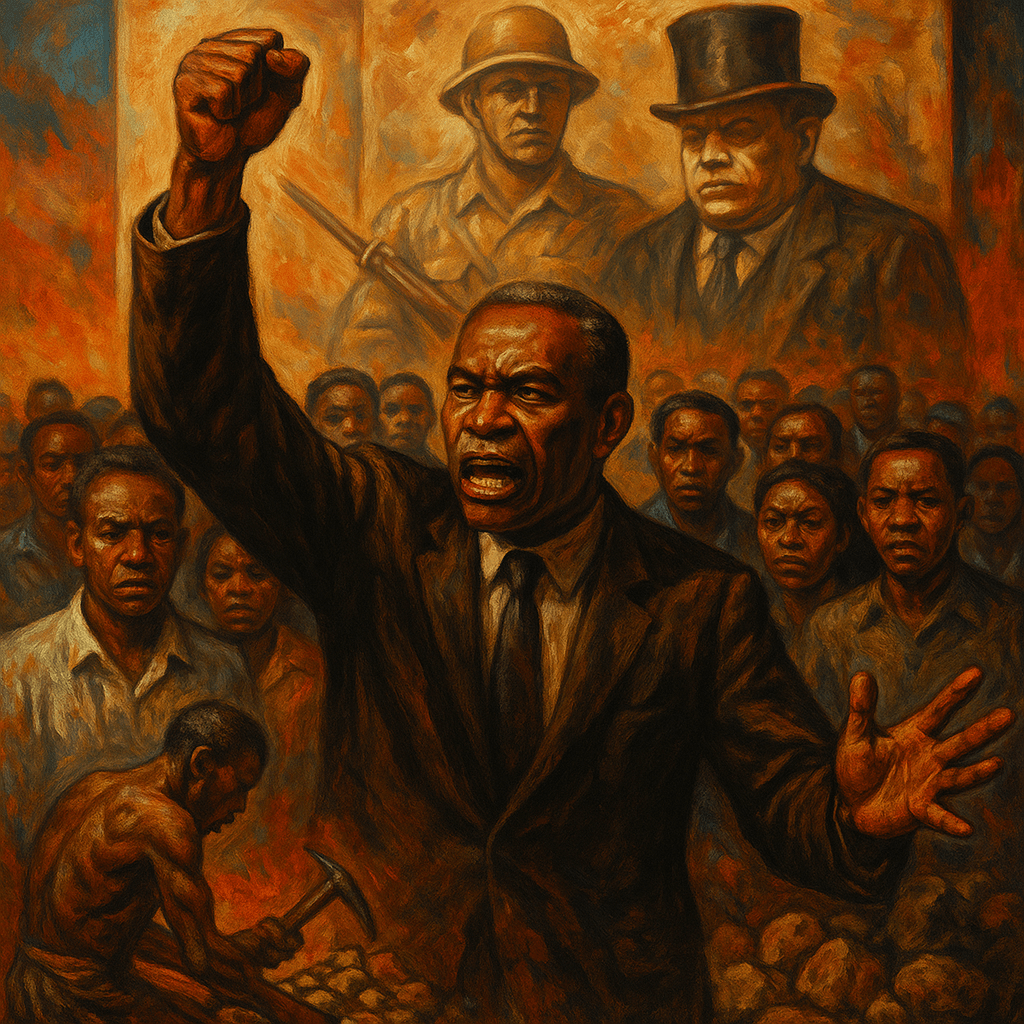
A Weaponized Propaganda Excavation of How Corporate Media Sanitizes Colonial Crimes, Buries Trillions in Stolen Wealth, and Obscures Africa’s Renewed Fight for Justice and Sovereignty
By Prince Kapone | Weaponized Information |
December 1, 2025
How the Guardian Turns Colonial Crimes into a “Debate” About Recognition
The piece we’re excavating, “African leaders push for recognition of colonial crimes and reparations”, appears in the Guardian under the neutral, almost technocratic banner of world news. The story is filed through the Associated Press, with the Guardian as host and amplifier. On the surface, it reports that African leaders gathered in Algiers to push for colonial-era crimes to be recognised, criminalised, and addressed through reparations. Algerian foreign minister Ahmed Attaf is quoted calling for explicit recognition of colonial crimes, a legal framework for restitution, and justice for the “heavy price” Africa continues to pay. The article nods toward Algeria’s brutal history under French rule, mentions looted artefacts like the Baba Merzoug cannon, touches Western Sahara as “unfinished decolonisation,” and closes by linking these African demands to parallel calls in the Caribbean.
On a first read, the piece looks sympathetic: Africa is framed as a continent that has suffered, that is now speaking up, that wants justice. But once you slow the narrative down, sentence by sentence, the machinery underneath starts to show. The opening line—“African leaders are pushing to have colonial-era crimes recognised, criminalised and addressed through reparations”—immediately narrows the struggle to official leadership within inter-state arenas. The driving force is not workers, peasants, prisoners, or communities; it is “leaders,” “diplomats,” and “summits.” The people who actually bled are present only as an abstract plural noun: “victims of colonialism.” The struggle enters the scene already domesticated as a matter for conference halls and resolutions.
The voice hierarchy is also telling. The primary speaking subject is Ahmed Attaf, a foreign minister. His statements are framed as the central content: Africa “is entitled to demand” recognition; restitution should be “neither a gift nor a favour”; colonial crimes created “exclusion, marginalisation and backwardness.” These lines are strong, but they are quarantined inside quotation marks. Outside those quotes, the narrator’s voice stays cool and distant: “African leaders are pushing… diplomats and leaders convened… African states have in recent years intensified demands…” The article never allows that narrator to speak in a voice of conviction about colonial crimes; conviction is outsourced to the Africans, while the text itself hovers above as a neutral referee.
The way violence is described is another quiet device. Algeria is said to have suffered “some of the most brutal forms of French colonial rule,” and we are told that “hundreds of thousands of people died,” that French forces “tortured detainees, disappeared suspects and devastated villages.” On paper that is strong language, but look at the grammar: the perpetrators are named once, then fade; the violence is packaged as “ordeal” and “bitter experience,” an episode to be remembered rather than a relationship to be broken. Colonialism appears as a completed horror film whose credits have already rolled, not as an ongoing arrangement that structures the present.
Time itself is used as a framing weapon. The article constantly speaks of “the colonial period,” “that era,” “the legacy,” language that fences colonialism off as a closed chapter. Even when Attaf is quoted saying Africa still pays a “heavy price,” the narrator’s prose keeps colonialism behind glass, as a historical exhibit. The reader is invited to see reparations as a way of “addressing the consequences of that era,” not confronting a system that may still be in motion. Past and present are stitched together just enough to justify moral concern, but not enough to raise the question of ongoing liability.
Law is the second big framing device. The piece spends valuable space noting that international conventions outlaw slavery, torture, apartheid, and the seizure of territory by force, while colonialism itself is not explicitly named in the UN charter. This is presented as the key problem to be solved: the absence of the right words in the right documents. The African Union, we are told, wants a “unified position on reparations” and a formal definition of colonisation as a crime against humanity. The horizon, in other words, is to get the existing legal order to acknowledge something it previously refused to name. The article does not ask whether that legal order is part of the problem; it assumes that if colonialism can just be properly inscribed in law, justice is on the way. Law is treated like neutral ground, not a terrain shaped by the same powers that carried out the crimes.
Notice also who is missing. We hear about “African states,” “Algeria’s parliament,” “Caribbean governments,” but not about the movements, organisations, or communities that have been raising these demands for generations. The Sahrawi people are referenced only through Attaf’s voice, with the Sahrawis collectively described as “indigenous” and fighting for their “legitimate and legal right to self-determination.” No Sahrawi is quoted. The Caribbean appears as “governments” and a “delegation” visiting the UK. This isn’t an accident: by restricting agency to states and diplomats, the article erases mass struggle while pretending to report on justice.
The emotional temperature is carefully managed. The language never rises above a controlled indignation. Words like “staggering,” “brutal,” and “bitter ordeal” are there, but they are cushioned by formulations such as “believed to be” and “some estimates.” Colonial plunder is “estimated in the trillions,” but the sentence stops there. No one is named on the other side of that ledger; no one is held up as the beneficiary. Anger is acknowledged, then folded back into polite, diplomatic vocabulary. The reader is encouraged to feel that something terrible did happen, but also that the proper place to sort it out is in quietly worded resolutions and carefully managed conferences.
Finally, look at how the article closes. It brings in the Caribbean reparations push and reminds us that colonialism’s “legacies” are being debated elsewhere, too. We are told Caribbean governments are calling for “recognition,” “formal apology,” and “forms of financial reparations.” The choice of words—“forms of,” “recognition,” “legacy”—keeps everything floating in a fog of generality. The last note is not confrontation but dialogue: delegations visiting London, appeals being made, sensitivity needing to be navigated. By the time the reader reaches the end, the possibility that colonialism might demand anything more than managed negotiations and partial gestures has been quietly evacuated.
That is what this article does, beneath the sympathetic surface. It presents a continent demanding justice, but only within the boundaries of a script where colonialism is a closed chapter, reparations are a technical question for states and lawyers, and Europe’s role is to “reckon” with its past rather than stand accused in the present. The names change—Algeria, Western Sahara, the Caribbean—but the narrative frame stays the same. That frame is the propaganda.
0
Colonial Loot in the Trillions: Putting Names, Numbers, and Terrain to the “Legacy”
Having stripped the Guardian’s story down to its narrative bones, we now have a simpler job: lay out the record. What exactly is being talked around when we hear about a “bitter ordeal,” a “heavy price,” and an economic cost “in the trillions”? Who did what, to whom, where, and with what material consequences? Before we argue, we have to put the facts on the table.
First, the basic scene. The article reports that African leaders and diplomats gathered in Algiers to push for colonial-era crimes to be recognised, criminalised, and addressed through reparations, advancing an African Union resolution adopted earlier this year that calls for a unified position on reparations and for colonisation to be formally defined as a crime against humanity. Algerian foreign minister Ahmed Attaf is quoted insisting that restitution should be “neither a gift nor a favour,” and that Africa is entitled to official and explicit recognition of crimes committed during colonial rule, as a first step toward addressing the ongoing exclusion and marginalisation the continent faces. The article notes that international conventions now outlaw slavery, torture, and apartheid, and that the UN Charter prohibits the seizure of territory by force, but colonialism itself is not explicitly named as a crime.
The piece also states that the economic cost of colonialism in Africa is believed to be staggering, with some estimates putting the value of plunder in the trillions, as European powers extracted resources such as gold, rubber, diamonds, and other minerals, leaving African populations impoverished. It mentions that African states have intensified demands for the return of looted artefacts held in European museums, and gives the example of Baba Merzoug, a 16th-century Algerian cannon seized during the French invasion of Algiers in 1830 and still displayed in Brest, France, under the name “La Consulaire.” The article highlights Algeria’s experience under French rule and the 1954–1962 war of independence, during which hundreds of thousands of Algerians were killed and French forces systematically used torture, disappearances, and village destruction to maintain control. It notes that nearly a million European settlers—known as pieds-noirs—enjoyed superior political, economic, and social rights in a territory that France legally treated as part of itself.
The article then connects Algeria’s colonial history to its position on Western Sahara, describing the territory as a former Spanish colony claimed by Morocco and the pro-independence Polisario Front, and quoting Attaf’s description of it as “Africa’s last colony.” It notes that Sahrawis are fighting to assert their right to self-determination, and that this right is repeatedly affirmed in UN decolonisation doctrine. UN bodies continue to list Western Sahara as a Non-Self-Governing Territory, and UN resolutions in 1979 and 1980 explicitly deplored Morocco’s 1975 military occupation, reinforcing that the Sahrawi people are entitled to a process of decolonisation and a referendum on self-determination. Regional sources and solidarity networks routinely refer to Western Sahara as “Africa’s last colony.”
Finally, the article gestures beyond Africa to parallel demands in the Caribbean, pointing to visits to the UK by a delegation connected to the region’s slavery reparations movement. That movement is anchored institutionally in the CARICOM Reparations Commission (CRC), which has developed a 10-point plan demanding, among other things, a full formal apology from former colonisers, debt cancellation, investment in health and education, technology transfer, and programs for cultural and psychological rehabilitation. European governments have so far refused to accept legal responsibility, even when acknowledging slavery as a crime against humanity. At a CARICOM summit in Barbados in early 2025, leaders again pressed European officials—including the president of the European Commission—for both acknowledgement and material reparations, underscoring that the legacy of slavery and colonialism remains an active political question, not a museum piece.
Once we step outside the tight frame of the article, the scale of what is being discussed becomes more concrete. Studies of colonial and post-colonial economic flows show that wealth has not simply “failed to trickle down” to Africa; it has been systematically drained out. Research on unequal exchange in the post-1960 period finds that the global North, as a group, appropriates resources and labour from the global South on the order of more than $2 trillion per year, measured in Northern prices—a transfer that depends on systematically lower wages and prices in Southern economies. One estimate based on updated work by Utsa and Prabhat Patnaik suggests that British rule alone drained the equivalent of $64.8 trillion from India between 1765 and 1900, illustrating what such plunder looks like when someone actually runs the numbers. An Oxfam report on modern-day colonial economic structures estimates that the current global system still extracts wealth from the global South to the richest 1% in the North at a rate of roughly $30 million an hour.
Africa’s specific trajectory matches this pattern. Colonial rule refashioned African economies around the export of primary commodities—fossil fuels, metals, cash crops—to serve industrialisation in Europe and North America, leaving many countries structurally dependent on volatile commodity markets and external finance well into the so-called “independence” era. Even today, analyses of Africa’s development path describe the continent as caught in an extractive model that has depressed growth and made states vulnerable to external shocks, while multinational companies and foreign investors control much of the mining and oil sectors. Critical voices within African economics and tax justice circles explicitly link this ongoing extraction to the unfinished business of colonialism and call for policy shifts aimed at building energy, food, and industrial sovereignty on the continent itself.
Algeria’s role in this discussion is not just symbolic. Under French rule, Algeria was legally treated as part of France, but the vast majority of indigenous Algerians were denied full citizenship, faced land expropriation, and were subjected to a battery of repressive measures while European settlers consolidated control over the best land and key sectors of the economy. During the war of independence, French forces ran widespread torture centers, deployed forced relocations that affected more than 2 million Algerians, and carried out massacres, leaving deep demographic and psychological scars that Algerian society still lives with today. The seizure of Baba Merzoug and its re-erection in Brest—topped with a Gallic cockerel, literally mounting a French national symbol on a captured Algerian weapon—was understood even at the time as a deliberate act of domination over Algerian memory and pride, which is why its return has taken on such importance in Algerian debates over restitution.
On the legal side, the article is right that the current international framework is contradictory. Treaties like the Convention on the Prevention and Punishment of the Crime of Genocide and later human rights instruments have codified certain atrocities as crimes, and apartheid has been explicitly condemned. But colonialism as such has never been comprehensively defined as a crime against humanity in the core instruments of international law, despite repeated calls from newly independent states and legal scholars from the global South. UN decolonisation bodies continue to list territories like Western Sahara as unfinished business, even as powerful states selectively recognise or ignore these classifications depending on their alliances and interests. That is the legal terrain African leaders are trying to push on in Algiers.
When you put all of this together—the AU’s push to name colonialism as a crime, Algeria’s history of settler rule and counterinsurgency, the unresolved status of Western Sahara, the trillions siphoned out of the global South, the demands coming out of the Caribbean for reparatory justice, and the continued presence of stolen cultural objects in European museums—you get a picture very different from a vague “legacy” that needs to be remembered. You get a ledger with entries that can be counted, institutions that can be named, and an unfinished argument over who owes what to whom.
Reparations as Class Warfare: Reframing the Ledger of Empire
By the time we arrive at this point in the excavation, the pattern becomes unmistakable: what the Guardian presents as a diplomatic conversation about “recognition” is, at its root, a battle over the architecture of the modern world. The facts laid out in the previous section do not describe a “legacy.” They describe a system. They describe a world economy built on forced extraction, a legal order designed to sanctify conquest, and a political geography where entire nations are still fighting to complete the very decolonisation that Europe claims happened generations ago. The polite language of summits and communiqués can cover all of this over—but it cannot erase the structure.
Once you follow the facts to their logical conclusion, a different picture emerges. Reparations are not a request. They are a confrontation with the world imperialist system itself. They are a demand that the North admit, even for a moment, that its wealth did not fall from the sky. That it was dug out of the earth by African miners who never held the diamonds they pulled from the soil. That it was grown on plantations by enslaved Caribbean peasants whose descendants still navigate economies designed to keep them exporting sugar instead of building sovereignty. That it was enforced by the legal machinery of an international order drafted by the very powers that built their fortunes on massacres and extraction.
This is why the issue becomes radioactive the moment anyone tries to count the actual cost. The moment you put numbers to it, the mask slips: you are no longer talking about “historical wounds,” but about an ongoing system of transfer. You are talking about European and North American living standards that sit on top of centuries of drained value. You are talking about continents made deliberately dependent. You are talking about a South that produces the wealth and a North that consumes it like an inheritance it never earned. That is not “legacy.” That is economics.
When African leaders gather to define colonialism as a crime against humanity, they are not simply asking for symbolic recognition. They are stepping into the center of a contradiction that has structured the entire modern era. The international legal order was never written to criminalise colonialism; it was written to stabilise it. It was written to hand new flags to old systems, to turn colonies into “partners,” to convert extraction into “development aid,” and to rename exploitation as “investment.” The refusal to name colonialism as a crime is not an oversight. It is an admission of guilt hidden in plain sight.
And so the struggle becomes clear. Algeria’s own history—settler rule, mass torture, entire villages wiped from the earth—shows that colonialism was not simply domination. It was an attempt to reorder a society from the soil upward, to remake the land, the people, the economy, and the culture in service of an external power. The war for independence was not a fight against memories. It was a fight against a machinery that had reshaped every institution in the country. When Algerian officials speak today about unfinished decolonisation, they are not being rhetorical. They are naming the structure that still exists.
Western Sahara exposes this structure with surgical precision. Here is a territory recognised by the United Nations as still awaiting decolonisation. Here is a people whose right to self-determination has been affirmed again and again in formal doctrine. And yet the process remains frozen—not because the law is unclear, but because the political balance of power still tilts toward the occupying state and its international supporters. If colonialism were truly “over,” Western Sahara would not still exist as a political category. Its unfinished status is the system confessing its own survival.
The same is true of the Caribbean. Their reparations movement does not emerge from nostalgia or moral sentiment, but from living material conditions: economic dependence, debt regimes, export monocultures, and health crises born from centuries of engineered poverty. When the CRC demands apology and material compensation, it is articulating a truth that the Guardian cannot write: the past is not past. The architecture of domination was updated, not dismantled.
When we look at the whole terrain together—the trillions drained, the unfinished decolonisation, the legal evasions, the looted cultural objects still behind European glass—the reframing becomes unavoidable. This is not a debate over history. This is a confrontation with a global class structure built through conquest. The demands for reparations, recognition, restitution, and self-determination are not separate issues. They are fronts in a single worldwide struggle between those who live off the accumulated plunder of empire and those who have been forced to pay its costs.
And here is the final truth that the Guardian cannot afford to articulate: the forces demanding reparations today are not simply governments. They are part of a rising, global bloc—African workers fighting for sovereignty, Sahrawi fighters struggling for their land, Caribbean organisers insisting that the chains did not disappear when the plantations did, and millions across the South who see the world shifting and are no longer willing to be polite about it. They do not ask Europe to “reckon” with the past. They confront Europe with the present.
In that sense, the fight for reparations is not peripheral to world politics. It is world politics. It is the frontline where the old imperial order is being forced to answer for the world it made—and the frontline where a new one struggles to be born.
From Ledger to Liberation: Building the Front Against the Masters of Plunder
Once the structure is exposed—once the numbers are named, once the unfinished colonies are seen, once the wealth transfers are revealed for what they are—the question becomes painfully simple: what do we do with this knowledge? You cannot look at a world built on the enforced poverty of billions and the obscene enrichment of a handful of states and corporations and walk away with a shrug. A system built on theft demands a response built on struggle. And that struggle is not theoretical. It is already happening. The task is to join it, strengthen it, and weaponize it.
Across Africa, the push for reparations is not a conference-room novelty—it is the political expression of a deeper movement for sovereignty. When the African Union advances a unified reparations agenda, they are building on the work of activists, workers, historians, youth formations, and grassroots networks that have been documenting plunder, exposing corporate looting, defending land, and fighting for economic independence. Every demand issued in Algiers is anchored in real organizing: cultural workers fighting for the return of stolen heritage; miners and oil workers demanding control over natural resources; communities resisting foreign military bases; land movements confronting agribusiness and extraction.
Algeria’s own memory institutions, veterans’ organizations, and popular associations have spent decades preserving the truth of the independence war and pushing the state to stand firmly against French revisionism. Their insistence that colonialism’s wounds remain open is not nostalgia—it is political clarity. And their clarity radiates outward. It shapes the continental mood.
In Western Sahara, the Sahrawi liberation struggle continues despite blackout, blockade, and abandonment by Western powers. Their political structures, their refugee communities, their cultural networks, their student and youth organizations—they all represent a living movement that has refused, for half a century, to let the colonial map become permanent. They are not symbols. They are a frontline. And their fight is tied to Africa’s broader demand to finish what decolonisation began.
In the Caribbean, the CARICOM Reparations Commission is one of the most advanced formations in the world. They have built a coherent program, mobilized civil society, confronted European governments face to face, and placed reparations at the center of regional politics. Their work is supported by teachers’ unions, farmers’ associations, Rastafari organizations, cultural institutions, and descendants’ groups who refuse to let slavery be shrink-wrapped as “heritage.” These are not petitions—they are political instruments.
For those of us in the imperial core—whether in the belly of the beast or on its margins—the call is straightforward: choose a side. And choosing a side means joining the movements that already exist rather than inventing new ones in our imaginations. It means linking our own fights against austerity, low wages, police violence, surveillance, and ecological destruction to the global struggle against the imperial system that produces all of them.
In material terms, that looks like strengthening ties with reparations movements in the Caribbean and Africa; supporting Sahrawi solidarity networks; organizing pressure campaigns against museums and universities holding stolen African and Indigenous artifacts; building research collectives that map corporate extraction; and amplifying the voices of African, Caribbean, and Indigenous organizers who are building the front lines of this battle. It means treating reparations not as a niche issue but as a central battlefield in the fight against capitalism itself.
It also means building political education where we live—study circles, reading groups, community teach-ins—so that people can see the connection between the low wages of workers here and the looted wealth of workers and peasants abroad. Every victory for the global South weakens the imperial architecture that disciplines workers in the North. Every fracture in the old order strengthens the possibility of a new one.
And finally, it means refusing the sentimental, depoliticized language of “reckoning” and “reflection.” The movements leading this struggle are not asking the West to feel bad. They are demanding the return of what was stolen and the power to shape their own futures. They are not closing a chapter—they are opening one.
That is the task before us: to turn the ledger of empire into a map of liberation. To move from understanding the system to dismantling it. And to stand in disciplined, uncompromising solidarity with the people and nations who have decided that the age of plunder must end—not with apology, but with power.
 Weaponized Information
Leave a comment