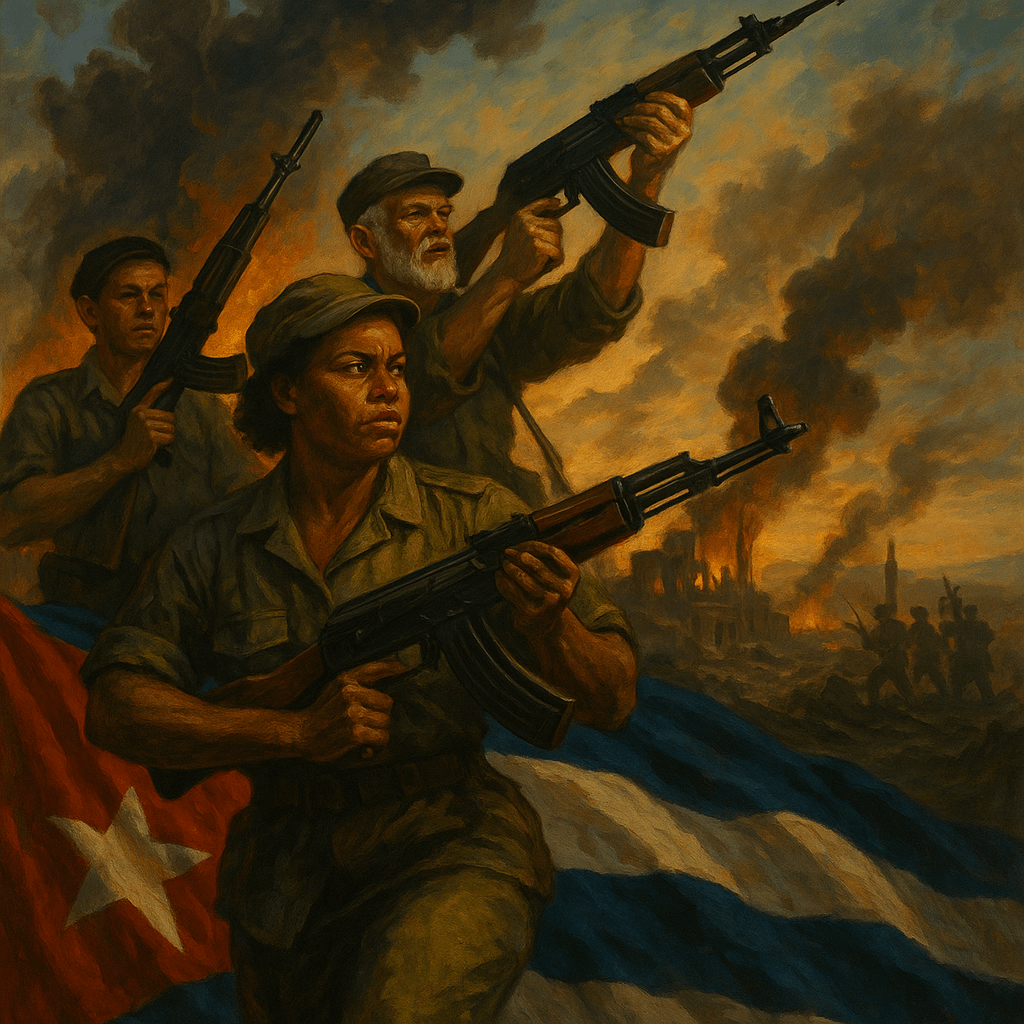
From Libya’s Ruins to Venezuela’s Resolve — How the Global South Is Relearning the Art of Sovereignty
By Prince Kapone | Weaponized Information | October 2025
The Return of Armed Sovereignty
The myth of a “rules-based international order” has finally collapsed under the weight of its own hypocrisy. For three decades, Washington and its junior partners cloaked naked imperial aggression in the language of democracy, human rights, and humanitarian concern. They called invasions “interventions,” coups “transitions,” and economic blockades “sanctions.” Yet behind every euphemism was the same old colonial logic: the right of empire to dictate the destiny of other nations. That logic—born in the slave ships and perfected in the boardrooms of Wall Street—has not vanished. It has simply digitized, financialized, and rearmed itself for the 21st century.
National self-defense has thus returned to the center of world politics, not as a slogan but as a condition for survival. When the U.S. can assassinate leaders by drone, freeze central bank reserves by keystroke, and call starvation “economic pressure,” sovereignty becomes a matter of both rifles and routers, of territory and technology. The so-called unipolar peace was never peace—it was pacification. And in every corner of the world where people have refused to kneel, from Palestine to Donetsk to Caracas, the empire has answered with bombs, sanctions, and lies.
But history has a rhythm, and even empires can lose the beat. The very arrogance that drove NATO across continents has generated the backlash that now defines our age: the rise of multipolarity. This is not merely a shift in the balance of power between states; it is a rebellion of civilizations against the presumption that one nation’s interests equal humanity’s fate. Multipolarity is the political expression of a deeper truth—that the world will no longer live on its knees to capital.
In this emerging epoch, self-defense is no longer an individual act of survival; it is a collective declaration of existence. The Bolivarian Republic of Venezuela, targeted for its defiance, stands as the present testing ground. If Libya was the graveyard of neutrality, Venezuela is the battlefield where the meaning of sovereignty will be redefined. The United States has already made its position clear: Latin America is not a continent of nations but a backyard to be managed. The drone strikes off Venezuela’s coast, the designation of its government as a “narco-terrorist regime,” and the open talk of regime change by figures like Secretary of State Marco Rubio—these are not isolated provocations. They are the early volleys of a war to preserve a dying world order.
The question that now confronts humanity is simple yet profound: will the nations of the Global South, and the powers that claim to champion multipolarity, allow another Libya? Or will they recognize that defending Venezuela is not only a matter of solidarity but of strategic necessity? Because if sovereignty can be extinguished in Caracas, it can be extinguished anywhere. The age of unipolar impunity has taught us that those who wait to defend themselves until they are attacked have already surrendered. The age of multipolarity demands something different: proactive sovereignty, armed with both principle and power.
This essay explores that demand. It traces the evolution of national self-defense from the ruins of Libya to the resistance of Venezuela, and through it, the moral and strategic challenge now facing Russia, China, and the entire Global South. It argues that peace without sovereignty is the peace of the graveyard, and that the only true guarantee of peace is the credible capacity to make aggression too costly to attempt. In short: the world is discovering again what the oppressed have always known—freedom is not granted, it is defended.
The Lessons Written in the Ruins of Libya
History is not a museum; it is a battlefield of memory. In 2011, the world watched the dismemberment of Libya, one of Africa’s most prosperous nations, under the cynical banner of “humanitarian intervention.” The United States and NATO sold the lie that their bombs would protect civilians, while Russia and China—then still hesitant powers in a U.S.-dominated world—chose to abstain at the United Nations. That abstention was not neutrality; it was an act of appeasement. The result was the annihilation of a sovereign state. Muammar Gaddafi, who had poured Libya’s oil wealth into free healthcare, housing, and education, was lynched in the desert as Hillary Clinton cackled, “We came, we saw, he died.” Beneath that laughter echoed the sound of a continent’s hope being buried alive.
The destruction of Libya was not a tragedy of fate but a lesson in political physics: unipolar power expands until it meets resistance. NATO’s real target was not Gaddafi himself, but the example he represented—the possibility of African independence financed by African resources. Libya’s state-run oil model, its investment in a pan-African monetary fund, and its refusal to privatize under Western pressure were mortal sins in the eyes of empire. The so-called no-fly zone became an air campaign for recolonization. The end result was not democracy but a slave market, a shattered state, and a warning to every nation that mistook Western legality for justice.
For Moscow and Beijing, the Libyan war was the shattering of an illusion. Russia had believed that partnership with the West might bring stability; China had believed that neutrality could protect its economic interests. Both discovered that abstention is indistinguishable from surrender when facing an empire that recognizes only obedience. The abstention on Resolution 1973 stands as a monument to the cost of political timidity. As NATO planes turned Tripoli into rubble, 30,000 Chinese workers were evacuated from a country that had been one of Beijing’s flagship partners. Russia lost billions in energy and arms contracts and watched a friendly government replaced by a NATO client. The lesson was seared into the strategic consciousness of both powers: never again permit Western “humanitarianism” to become a cover for conquest.
Libya’s destruction changed the course of global politics more than any Western strategist cares to admit. It created what might be called the “Libya Syndrome” in Moscow and Beijing—a permanent distrust of Western resolutions, treaties, and moral crusades. When Russia intervened in Syria in 2015, it did so explicitly to prevent another Libya. When China built the Belt and Road Initiative, it designed it as an economic shield against the financial warfare that followed the Libyan catastrophe. The age of appeasement was over. Multipolarity was born not in conference rooms, but in the ruins of Sirte and Tripoli.
The lesson of Libya is as stark as it is simple: imperialism never retires, it only rebrands. When the bombs fall, the only “human rights” that matter are the right to resist and the right to survive. In the era of multipolarity, those rights must be defended collectively, or they will vanish one by one. Every sovereign nation now understands what Gaddafi understood too late—that peace bought with silence is just another word for occupation deferred. The task of our century is to ensure that no nation fights alone again. For if Libya was the graveyard of neutrality, then the defense of Venezuela must become the resurrection of solidarity.
Venezuela: The Frontline of a New World
If Libya was the graveyard of neutrality, Venezuela is the frontline of rebirth. The Bolivarian Republic stands at the very intersection where empire and multipolarity collide. Since Hugo Chávez first declared that “the world is not for sale,” Washington has treated Venezuela not as a country but as a rebellion that must be extinguished. It has endured sanctions designed to starve, coups designed to fracture, and propaganda designed to isolate. Yet Venezuela remains, not because of miracle or luck, but because its people decided that dignity is not negotiable. In the eyes of empire, that is the unforgivable sin.
The United States has made no secret of its intent. It claims Latin America as its sphere of influence, a 21st-century version of the Monroe Doctrine rebranded as national security. To justify aggression, it labels sovereign governments “narco-terrorist regimes,” equating self-determination with crime. It has already conducted drone strikes off the Venezuelan coast, killing alleged “narco-traffickers” whose only real offense was operating beyond Washington’s leash. Secretary of State Marco Rubio speaks openly of “liberating” Venezuela, Nicaragua, and Cuba—as if liberation were something to be delivered by cruise missile. The theater is set, the script familiar: criminalize, destabilize, invade, and recolonize.
But the old choreography is stumbling. The multipolar world has rewritten the rhythm. What Washington still calls its “backyard” is fast becoming a sovereign neighborhood. Venezuela’s alliances with Russia, China, and the ALBA bloc have transformed it into both symbol and test case—a living experiment in whether the Global South can defend its revolutions against modern imperial siege. The stakes extend far beyond Caracas. If the United States can destroy a nation that sits atop the world’s largest proven oil reserves, then no country’s sovereignty is safe. If it fails, the spell of inevitability surrounding U.S. power will be broken.
What makes Venezuela dangerous to empire is not merely its resources but its refusal to submit. It continues to trade, to educate, to vaccinate, to govern, under blockade conditions that would have collapsed lesser states. Its endurance has exposed the moral bankruptcy of sanctions as a weapon of war. And its survival has offered proof that the post-American world is not an abstraction; it is already under construction. For Washington, that is intolerable. For the rest of humanity, it is hope made visible.
Venezuela is not waiting for salvation from abroad. Its revolution has matured in the crucible of siege. The Bolivarian project understands that the only peace an empire respects is the peace of exhaustion. So it prepares—not for conquest, but for survival. Its streets are filled with the quiet discipline of a people who know that every loaf of bread baked, every field tilled, every child taught to read is an act of national defense. They have learned what all oppressed peoples eventually learn: that sovereignty is not a status but a struggle, renewed every day against those who would erase it.
As the storm gathers, Venezuela embodies the moral question of our time. Will the nations that speak of multipolarity stand idle while the empire burns another country alive? Or will they understand that the defense of Venezuela is the defense of a principle—the right of peoples to shape their own destiny without asking permission from Washington, Brussels, or Wall Street? The answer will determine whether multipolarity becomes a shield for the weak or just another slogan of the strong. In the veins of the Venezuelan people runs the same truth that guided the Vietnamese, the Algerians, the Cubans, and the Angolans: that freedom, once declared, must be defended by every means necessary. History is watching to see who will stand beside them when the cannons fire.
The Meaning of Self-Defense in a Multipolar World
Every empire in decline claims to be the defender of civilization. Rome called its conquests pacification; Britain called its plunder free trade; Washington calls its wars the preservation of a “rules-based order.” The rule, of course, is that only one power is allowed to act in its own interest. Everyone else must ask permission. In this moral geometry, self-defense becomes heresy. When Iraq armed itself, it was called defiance. When Libya refused privatization, it was called tyranny. When Venezuela nationalized its oil, it was called socialism and therefore evil. The empire grants itself the monopoly on force, while branding every act of sovereignty as aggression.
To resist that order requires not only weapons, but an entirely different conception of peace and security—one rooted in equality, not hierarchy. The multipolar world that is now struggling to be born has revived a long-buried idea: that the right of self-defense belongs to nations, not blocs; to peoples, not patrons. Article 51 of the United Nations Charter states plainly that nothing shall impair the “inherent right of individual or collective self-defense.” The words are simple, but their meaning is revolutionary. They enshrine a principle the West has spent decades trying to erase: that oppressed nations have the same right to resist as oppressors have to dominate.
In this sense, national self-defense in the 21st century is not the province of generals alone. It is a social project, a moral discipline, and an economic necessity. A country that cannot feed itself, wire itself, or produce its own medicine is a hostage waiting for ransom. Self-defense means building industries immune to sanctions, media immune to propaganda, and populations conscious enough to see through the psychological warfare of the “free world.” The rifle matters, but so does the radio and the router. In a global system where algorithms decide whose suffering counts, the fight for self-defense begins with reclaiming the right to define reality.
That fight is not new. It stretches from the guerrillas of Vietnam who turned a peasant army into a world-historic victory, to the Cubans who repelled an empire at Playa Girón, to the South Africans who broke apartheid under sanctions meant to suffocate them. Each of these struggles taught that defense is not reaction—it is revolution in motion. As Walter Rodney wrote, the colonized have always known that to resist exploitation is to reassert humanity. The same is true today. To defend sovereignty is to affirm life against the machinery of profit.
The contemporary articulation of this idea—the doctrine of multipolar self-defense—emerges from the very nations the U.S. once called its backyard. Latin America’s Proclamation of the Zone of Peace, adopted by the Community of Latin American and Caribbean States in Havana in 2014, declared that the region would resolve its conflicts without outside interference. It was more than a diplomatic gesture; it was a quiet revolution. For the first time since Bolívar’s dream of continental unity, an entire hemisphere asserted that peace cannot be imported by warplanes. The proclamation’s deeper message was that peace must be defended—by solidarity, by preparation, and, if necessary, by arms.
This is the contradiction the old order cannot tolerate: that peace might belong to those who refuse subordination. That a nation’s will to live can outweigh another’s will to dominate. And that self-defense, far from being aggression, is the highest expression of internationalism. The empire speaks of stability while sowing chaos; the multipolar world speaks of sovereignty while building equilibrium. Between these two visions lies the future of humanity. The question is no longer whether nations have the right to defend themselves—it is whether they will find the courage to do so together.
Fortress of the People: Venezuela’s Preparation for Self-Defense
Empires assume that war is won with technology. Venezuela knows that war is won with people. Beneath the headlines of sanctions and propaganda lies a quieter revolution—the construction of a state and society built for resistance. Years of siege have forged not paralysis but preparation. While Washington rehearses its invasion scenarios, Venezuela has been rehearsing survival. It has built a system designed not around one man or one government, but around a population ready to fight for its sovereignty block by block, barrio by barrio, hill by hill.
The cornerstone of this defense is the Milicia Bolivariana—millions of working people, farmers, students, and retirees trained as the living backbone of a territorial defense doctrine. The militias are not a separate force from the nation; they are the nation in arms. Alongside the regular army, air force, and navy, they form the Fuerza Armada Nacional Bolivariana (FANB), an integrated structure capable of both conventional and guerrilla warfare. Every region of the country, from the Orinoco basin to the urban sprawl of Caracas, has been mapped not merely for geography but for defense. Bridges, highways, and river crossings are treated as arteries of sovereignty, to be guarded and, if necessary, sacrificed.
Years of hybrid war have taught the Bolivarian Republic that sovereignty in the 21st century must be multi-dimensional. Defense is no longer just a matter of rifles and rockets—it is about infrastructure, communications, food, and morale. Venezuela has hardened its critical networks against cyber sabotage, decentralized its energy grid, diversified its oil exports, and built local production systems for food and medicine. The blockade that sought to starve it into surrender forced it to relearn the most revolutionary lesson of all: self-reliance. The empire’s chokehold became the anvil on which a new economic and military independence was hammered out.
Under the Bolivarian concept of “comprehensive defense,” the entire society is considered part of the battlefront. Neighborhood councils coordinate with local defense units. Workers in factories practice evacuation drills alongside maintenance of machinery critical to national production. Farmers form rural defense brigades to secure the food supply against sabotage. Universities double as training grounds for engineers and cyber-defense specialists. This is what Chávez once called the “fusion of the civilian and the soldier,” where the defense of the nation becomes indistinguishable from the daily life of its people. It is the moral opposite of imperial militarism: the gun is not aimed outward to conquer, but inward to preserve what has been built collectively.
Militarily, Venezuela has invested heavily in asymmetric warfare—what imperial strategists derisively call “denial strategies.” The FANB’s air defense network, equipped with Russian systems and domestic innovations, is dispersed rather than centralized, making decapitation strikes ineffective. Mobile radar units, MANPADS, and coastal defense missiles form a layered shield against aerial and naval intrusion. Venezuela’s geography itself is an ally: dense jungles, sprawling urban terrain, and a coastline rich with hiding places turn invasion into attrition. The goal is not to match U.S. firepower, but to make victory impossible—to turn occupation into quicksand.
But the heart of Venezuela’s self-defense is not hardware; it is political consciousness. The Bolivarian Revolution has survived because it forged a bond between the armed forces and the masses, between the state and the street. Unlike the comprador armies of past regimes that collapsed at the first whiff of U.S. dollars, the FANB draws its legitimacy from the people themselves. Soldiers are sons of workers, daughters of campesinos. Their defense of the nation is inseparable from defense of their own homes, their own families, their own revolution. This is why every color revolution and coup attempt has failed: because beneath the uniforms and flags lies a human wall the empire cannot buy or break.
Venezuela’s preparation is not merely military—it is psychological, spiritual, and cultural. Its music, murals, and education all repeat the same lesson: that a people who know their history cannot be colonized again. In schools, children learn about Bolívar and Chávez not as saints, but as proof that empires can bleed. In the streets, murals of Afro-Venezuelan fighters stand alongside the faces of Palestinian martyrs and Sandinista heroes, connecting struggles across continents. Every barrio becomes both a classroom and a fortress. This is not paranoia; it is memory—memory of coups, invasions, and betrayals. In a hemisphere soaked in intervention, vigilance is the price of existence.
By transforming siege into discipline, Venezuela has already achieved what the empire fears most: a nation capable of defending itself without foreign masters. That is the true meaning of sovereignty in the age of multipolarity. Russia and China may supply radar and credit, but the will to fight can only be manufactured at home. The empire will find no easy prey in Caracas, only a people who have decided that to surrender would be to cease to exist. The Bolivarian model shows that the future of multipolarity depends not on the promises of great powers, but on the preparedness of the oppressed. Every grain silo, every satellite link, every armed worker is a declaration to the world: we will not be Libya. We will be Venezuela.
The Shield of the South: CELAC, ALBA, and the Zone of Peace
When Latin America declared itself a Zone of Peace in 2014, it was not a utopian gesture; it was a geopolitical warning. It told Washington that the continent of Bolívar would no longer tolerate being treated as a military laboratory or a colonial estate. The Community of Latin American and Caribbean States—CELAC—was born from centuries of resistance: from the Indigenous uprisings of Túpac Amaru to the anti-imperialist campaigns of Sandino and Fidel. The proclamation of peace was not a renunciation of struggle—it was an assertion that true peace is possible only through sovereignty. In that single document, the nations of the South collectively reclaimed the right to say no.
Today, that declaration is being tested in Venezuela. An assault on the Bolivarian Republic is not merely an attack on one government; it is a strike against the principle of continental independence itself. Washington’s strategists understand this. Their dream is to shatter the political unity that has emerged among Latin America’s progressive and multipolar currents—to separate Caracas from Managua, Havana from La Paz, and turn each into an isolated target. The region’s task, then, is not simply to defend Venezuela, but to defend the very concept of a post-Monroe world.
CELAC and ALBA form the institutional spine of that defense. CELAC provides the diplomatic shield: thirty-plus nations speaking with one voice, demanding respect for international law, and refusing to allow foreign military bases on their soil. ALBA—the Bolivarian Alliance for the Peoples of Our America—provides the revolutionary heart: a network of nations bound not by capital but by solidarity, trade in kind, and political conviction. When Washington withdrew its ambassadors, ALBA sent doctors. When the U.S. froze Venezuela’s accounts, ALBA members built barter systems and supply chains. This is what collective self-defense looks like when rooted in people’s power rather than military alliances.
If U.S. aggression escalates into open war, CELAC’s moral authority will be crucial. Latin American governments—left, center, and even those under U.S. pressure—would be forced to declare where they stand: with the right of nations to self-determination, or with the right of empire to destroy. The continent’s history of U.S. coups—from Guatemala 1954 to Chile 1973 to Honduras 2009—has burned into memory the consequences of submission. No leader can pretend ignorance now. To betray Venezuela would be to betray their own sovereignty.
ALBA’s response, meanwhile, would not be symbolic. Cuba, Nicaragua, and Bolivia have already made clear that any attack on Venezuela is an attack on all. Cuba, with its unmatched experience in medical and civil-defense mobilization, would become the logistical rear of a humanitarian counteroffensive. Nicaragua would open its ports and infrastructure to sustain Venezuelan supply lines and refugees. Bolivia and other progressive governments would lead the international campaign to isolate the aggressor diplomatically and morally. The phrase “an injury to one is an injury to all” would no longer be metaphor—it would be policy.
The Zone of Peace does not mean the absence of war; it means the rejection of submission. It means that the peoples of the South will decide for themselves whether their future is written in Spanish, English, or Quechua—not dictated by the Pentagon. The world is watching to see whether Latin America’s leaders will live up to their own declarations. If they fail, history will remember them as the generation that let the empire return through the back door. But if they stand firm—if CELAC and ALBA unite as one political fist—then Venezuela’s defense will become the defense of an entire hemisphere’s dignity.
The day Latin America refuses to let Washington bomb one of its own, the era of U.S. dominance will end—not with an explosion, but with a simple collective refusal. No drones, no bases, no proxies, no submission. That is what peace looks like when the oppressed define it for themselves.
The Twin Pillars of Multipolar Deterrence: Russia and China
If Venezuela represents the moral front of the struggle for sovereignty, then Russia and China represent its strategic backbone. Together they form what Washington fears most: a counter-system capable of denying empire the privilege of unilateral violence. Each has its own motives, history, and calculus, but both have drawn the same lesson from Libya—that silence is complicity and that non-intervention, in a world ruled by drones and sanctions, is not neutrality but surrender.
For Russia, the defense of Venezuela is more than solidarity; it is a question of strategic parity. When NATO marched to Russia’s borders through the ruins of Yugoslavia, Iraq, and Libya, Moscow realized that empire respects no promises, only power. In Venezuela, it sees a mirror image of its own encirclement: a sovereign state under siege for asserting independence in Washington’s declared sphere of influence. By supporting Caracas, Moscow is not seeking confrontation—it is seeking equilibrium. Its shipments of radar systems, armored vehicles, and advisers are acts of balance, not aggression. They signal that if the United States insists on turning the world into a chessboard, then Russia will ensure that no square belongs exclusively to the empire.
China, for its part, has long understood that development without sovereignty is an illusion. Beijing’s relationship with Caracas is not built on ideology but on the pragmatic recognition that an independent Venezuela strengthens the world’s capacity to resist U.S. financial hegemony. Through oil-for-loan agreements, infrastructure projects, and digital trade networks, China has offered a lifeline that no Western institution would dare provide. For China, defending Venezuela is also defending the Belt and Road—the vision of a world connected through cooperation rather than coercion. If every partner that dares to trade with China can be bombed or sanctioned into submission, then multipolarity itself is dead on arrival. Beijing cannot—and will not—allow that precedent to stand.
Yet the strength of the Russia–China partnership lies precisely in their complementarity. Russia brings the guns, China brings the gold. One supplies deterrence through hard power; the other through economic gravity. Together they provide what no single nation can: a shield made of both missiles and markets. If Washington’s empire is built on the twin pillars of force and finance, the multipolar counterweight must rest on the twin pillars of defense and development. That is the architecture now quietly under construction across Eurasia and the Global South.
Both Moscow and Beijing understand that credibility is the currency of deterrence. To fail Venezuela now would be to repeat the cowardice of 2011. The ghosts of Tripoli still haunt the halls of the United Nations, whispering what happens when good intentions bow to imperial deceit. That is why, behind the careful diplomacy, there is a growing steel in both capitals. Russia has learned to veto not with hesitation but with principle; China has learned that peace must be defended, not simply declared. The world’s oppressed watch closely to see if “Never again Libya” is a slogan or a strategy.
A coordinated defense of Venezuela need not mean a direct clash with U.S. troops. It can mean something more sophisticated—and more effective. It can mean the visible presence of Russian and Chinese “technicians,” the docking of humanitarian ships under foreign flags, the creation of financial corridors immune to sanctions, and the constant threat that any strike might hit a foreign adviser and ignite an uncontrollable crisis. In a world where perception shapes policy, deterrence is not only about capability but about conviction. The empire must be made to believe, beyond doubt, that another invasion will cost it far more than it can bear.
In the great ledger of history, Russia and China have reached the point where restraint without resistance equals defeat. They no longer have the luxury of hesitation. The defense of Venezuela is, in essence, the defense of the world they are trying to build—a world where no nation is bombed for choosing its own destiny. The choice before them is stark: stand up and make multipolarity real, or stand aside and watch the old order devour it before it is born. The future will remember what they chose.
Building the Deterrent Wall: Collective Defense in Practice
The old world believes in domination through monopoly—of weapons, of finance, of narrative. The new world being born understands power as collective strength: a shield woven from many threads. In the era of multipolarity, deterrence is not the private property of superpowers but the shared architecture of sovereign nations refusing to be recolonized. The lesson of the past twenty years is that no state can survive imperial siege alone; the lesson of the next twenty is that none will have to.
Collective defense begins not with formal treaties but with shared will. It starts when nations agree that the independence of one is the independence of all. A U.S. drone over Caracas is a message to Moscow and Beijing, to Tehran and Havana, to Pretoria and Brasília. It says: your sovereignty is conditional. The multipolar world must answer with a single phrase—not anymore. That answer does not have to come in the form of a declaration of war; it can arrive through coordination, through logistics, through visibility. The empire must come to understand that aggression anywhere triggers resistance everywhere.
A credible multipolar deterrent therefore operates across layers. The first layer is diplomatic unity: coordinated vetoes, synchronized condemnations, and the rapid mobilization of the Global South’s institutional voice. When the empire moves to justify its aggression through the United Nations or regional organizations, a wall of refusal must rise. The second layer is economic defense: shared payment systems, barter networks, and supply corridors that make blockades ineffective. The third is military-technical solidarity: intelligence-sharing, defensive equipment transfers, and the quiet deployment of advisers who transform isolated nations into fortified nodes of resistance. Finally, there is the layer of information warfare: the struggle for truth in a world where lies travel faster than missiles.
If the empire relies on fear, the antidote is certainty. Washington must believe that attacking Venezuela means confronting a hemisphere and a world unwilling to stand aside. A joint Russian–Chinese–Latin American statement pledging “collective self-defense against aggression” would be worth more than a fleet of warships. Add to that the unmistakable presence of foreign advisers, the docking of humanitarian vessels in Venezuelan ports, and the launch of joint naval patrols in international waters, and suddenly the calculus changes. Every additional variable multiplies the risk for the aggressor. The goal is not to provoke conflict but to make it politically, economically, and militarily irrational for the United States to start one.
This is the art of modern deterrence—what might be called revolutionary defense by multiplication. Each layer amplifies the others. Economic cooperation strengthens political unity; political unity justifies military coordination; military coordination safeguards economic independence. The architecture becomes self-reinforcing, a global firewall against recolonization. In this system, no single country must bear the burden of confrontation alone. Instead, the empire faces a world where every act of aggression threatens to detonate an international crisis of its own making.
For centuries, the oppressed have been told that peace requires submission. The collective defense doctrine of the multipolar age turns that logic inside out. It declares that peace is preserved not by surrendering sovereignty but by sharing it—by recognizing that the safety of one revolution is bound to the survival of all. The days when imperialists could bomb one nation to frighten the others are ending. A new deterrent wall is rising, built not of concrete or steel but of solidarity, courage, and consequence. When that wall stands firm, the empire will finally encounter something it cannot sanction, sabotage, or intimidate: a humanity united in self-defense.
The Edge of the Abyss: Limits and Dangers of Great-Power Confrontation
There is a solemn truth that sits between the slogans: deterrence can prevent war, but deterrence can also mislead. The same instruments that protect a nation can, in the wrong hands or the wrong moment, become engines of catastrophe. To say that Russia and China should make Venezuela a red line is to acknowledge a moral and strategic fact—but it is also to accept a terrible responsibility. The line that deters must not be a hair-trigger that detonates the world.
Nuclear weapons cast a long shadow over everything that follows. They make direct superpower clashes unthinkable, and in that sense they stabilize. But they also lock adversaries into rigid mental maps in which misperception, accident, or local escalation can escalate in ways no one planned. A single misidentified aircraft, a misrouted missile, or an advisor killed under ambiguous circumstances can unlock chains of response that spin out of control. That is the paradox of our age: weapons that make war less likely make mistakes far more lethal.
Geography and logistics impose more mundane, but no less relevant, limits. Russia and China can supply advisers, ship parts, and dispatch technical teams—but projecting sustained expeditionary combat power across the Atlantic is neither cheap nor instantaneous. Bases, overflight permissions, resupply corridors, and legal cover all matter. The multipolar shield is powerful precisely because it is distributed; but that distribution is also a source of fragility. If a single choke point is closed or a staging port denied, the ability to deliver aid and deterrence rapidly can be degraded.
There is also the political limit: the global economy. The world is deeply interdependent. Sanctions, trade embargoes, and financial decoupling wound not only the targeted states but the institutions and populations of those who wield them. A direct and brazen confrontation over Venezuela could trigger a cascade of economic pain—shipments halted, credit lines frozen, markets convulsing. For countries like China, which depend on stable global trade networks, this risk is existential in a different register. The calculus of solidarity, therefore, must always be weighed against the real human cost that broad, poorly targeted economic reprisals would inflict on ordinary people.
Another danger is the corruption of revolutionary movements by the necessities of war. When survival becomes a permanent state, grievances that once welded peoples together can be manipulated by entrenching military casts, shadow economies, and unchecked power. Mobilization must be accompanied by institutions of accountability; otherwise, the defense of the nation can become the license for predation. History provides many warnings: states erected to fend off empire sometimes morph into new forms of internal domination if civic controls are not maintained. The revolution that survives an imperial blow must also survive its own temptations.
Finally, there is the moral hazard of overreach. Deterrence that rests on the threat of force can become a substitute for building popular institutions. If Moscow and Beijing are seen as the primary guarantors of a region’s security, local governments may be tempted to underinvest in their own capacities, to defer hard choices to external patrons. That reproduces a dependence the multipolar project intends to eliminate. The strategy must therefore be clear: external aid is a multiplier, not a replacement. Sovereignty regained through foreign guns is a fragile sovereignty; sovereignty built with popular arms, resilient industries, and political legitimacy is durable.
The path forward requires discipline. It requires publicly stated escalation ladders, secure communication channels among capitals, deconfliction mechanisms at sea and in the air, and shared rules of engagement that prioritize preventing accidental escalation. It requires investment in non-kinetic tools—sanctions relief corridors, humanitarian insurance schemes, and rapid legal recourse in international courts—that allow diplomatic pressure to have effect without immediate recourse to arms. Above all, it requires humility: a willingness to accept that even the best-intended deterrent posture can create unintended harm, and therefore a commitment to constant reassessment and restraint.
The multipolar world can create a shield for the oppressed without igniting the world. But that shield must be forged with care. It must balance the imperative to make aggression unaffordable against the imperative to avoid making the world unlivable. On the knife-edge between peace and apocalypse, wisdom—not bravado—must be the guiding principle. If the defenders of sovereignty are to succeed, they must practice a discipline that values human life over geopolitical vanity and builds institutions that survive both bullets and bargains.
The Political Economy of Sovereignty
Empires fall not only when their armies are defeated, but when their money ceases to command obedience. Every bomb the United States drops is backed by a dollar, and every dollar by the implicit threat of force. This is why national defense cannot be separated from economic independence: one cannot defend the flag if the economy beneath it is owned by foreign capital. In the old world, sovereignty ended at the balance sheet. In the new, it begins there.
For Venezuela, Cuba, Nicaragua, and much of the Global South, the blockade has been a crash course in political economy. The sanctions meant to break them have instead revealed the anatomy of imperial control: currency monopoly, financial blackmail, and technological dependency. When a nation’s oil cannot be sold, its software cannot be updated, and its banks are cut from global payment systems, it learns the true meaning of “war by other means.” The lesson is clear—economic sovereignty is not a luxury of peace; it is a weapon of survival.
The multipolar world is attempting to turn that lesson into infrastructure. The BRICS bank, the Shanghai Cooperation Organization, and emerging settlement systems in rubles and yuan are not mere trade conveniences—they are the scaffolding of independence. Each transaction outside the dollar weakens the empire’s invisible chain. When Venezuelan oil is traded in yuan, when Russian grain moves through ruble accounts, when African nations use Chinese credit lines rather than IMF debt, the battlefield shifts. Every act of de-dollarization is an act of defense.
Sovereignty also has a social dimension. A nation cannot be independent if its elites are tied to the imperial core by profit. True self-defense requires a new class architecture: one where production serves need rather than accumulation, where surplus is reinvested in collective capacity rather than siphoned abroad. The struggle for multipolarity therefore demands not only geopolitical realignment but class realignment. The barricade must rise not just between nations, but between the people and their own comprador bourgeoisie.
Economic warfare, like military warfare, is fought through logistics. To survive under siege, a nation must build redundancy: domestic agriculture, parallel internet infrastructure, regional supply chains, and industrial alliances that cannot be switched off by foreign decree. Cuba’s medical diplomacy, Iran’s scientific self-reliance, and Venezuela’s network of communal production are prototypes of this new defensive economy. They embody the simple revolutionary insight that dependence is defeat in slow motion.
At its core, the political economy of sovereignty is about returning power to the laboring majority—the very people who, under capitalism, produce the wealth that fuels their own subjugation. A sovereign economy is not one that isolates itself from the world, but one that participates in it on its own terms. It trades with dignity, plans with foresight, and resists with organization. It refuses to die quietly beneath the weight of sanctions and speculation.
In the age of multipolarity, the factory, the farm, and the fiber optic cable are as critical as any tank or missile. The empire of capital will not be dismantled solely by speeches or alliances, but by the material construction of an alternative world system—one whose arteries flow through Caracas and Havana, through Johannesburg and Moscow, through Tehran and Beijing. In that system, sovereignty is not an aspiration; it is an economy in motion, defended by the organized intelligence of those who make and sustain life itself.
Toward a Global Doctrine of Collective Self-Defense
The world stands at a crossroads between two irreconcilable visions. One is the imperial order, where power flows upward and sovereignty is a privilege licensed by empire. The other is the multipolar horizon—an order of equals bound not by coercion but by shared resistance. The hinge between these two futures is collective self-defense: the recognition that peace can only exist when the oppressed refuse to face the empire alone. If the twentieth century was the age of national liberation, the twenty-first must be the age of collective sovereignty.
A new doctrine of global defense is already taking shape, though it has yet to be formalized. Its first principle is sovereign equality: every nation, regardless of size or wealth, has the absolute right to chart its own path without foreign interference. This is not an abstract moral claim but a material one. It means that economic systems, currencies, technologies, and defense structures must be diversified so that no state can be held hostage by the monopolies of another. To protect sovereignty in the age of drones and sanctions is to make independence structural—wired into ports, payment systems, and production lines.
Its second principle is collective deterrence. The empire’s greatest weapon has never been its missiles, but its ability to isolate its victims one by one. Iraq yesterday, Libya today, Venezuela tomorrow. Collective deterrence breaks this sequence. It transforms isolated nations into interlocking shields—political, economic, and military—that make imperial aggression a problem too big to solve. Under this doctrine, an attack on one multipolar state triggers the coordinated response of all: not a declaration of war, but a declaration of consequences. Diplomatic isolation of the aggressor, coordinated economic retaliation, military-technical aid, and the opening of alternative trade corridors become the vocabulary of collective survival.
The third principle is integrated defense. The line between military and civilian, between war and peace, has evaporated in the digital age. An empire that wages war through sanctions, sabotage, and psychological warfare must be confronted by a resistance that unites production, media, and defense. Integrated defense means that a nation’s sovereignty is not confined to its borders—it exists in its data, its satellites, its crops, its software, its consciousness. The farmers who grow food under blockade, the engineers who build indigenous tech, the journalists who expose imperial lies—these are all soldiers in the same war for human emancipation.
Institutionally, this doctrine demands new formations: a defensive alliance of the Global South that fuses the capacities of CELAC, ALBA, BRICS+, and the Shanghai Cooperation Organization into an anti-NATO for the oppressed. Not a pact of aggression, but a network of survival. A multipolar rapid-response mechanism could coordinate humanitarian aid, cyber defense, and counter-propaganda in the event of hybrid attack. A shared intelligence and logistics platform could serve as the backbone of the South’s strategic autonomy. Such an architecture would finally give weight to the words “international law,” rescuing them from the hypocrisy of Western usage and returning them to their original purpose: the protection of nations against imperial predation.
But this new order will not be born through treaties alone. It will emerge through the convergence of movements—from peasant unions to worker federations, from anti-war coalitions to climate justice struggles—that see in the defense of sovereignty the defense of their own survival. For the empire wages war not only on states, but on the planet itself. To defend national sovereignty is also to defend ecological sovereignty—the right of a people to decide how their land, air, and water are used. The multipolar doctrine of defense, if it is to mean anything, must therefore be grounded in the defense of life.
This is the unfinished project of decolonization. It is the realization that political independence without collective protection is a flag without a fortress. The world’s revolutions have proven that liberation is possible; what remains is to prove that it can endure. Collective self-defense is how history ensures that no more Haitis are isolated, no more Vietnams are starved, no more Libyas are destroyed while the world debates legality. It is how humanity, scarred by centuries of conquest, learns to say—not just in words but in power—never again.
The Price of Neutrality: Peace Through Resistance
History does not forgive neutrality in the face of oppression. Those who claim to stand above the struggle always end up standing on the side of power. Libya proved it. Iraq proved it. Every crushed revolution, every bombed village, every sanctioned child has proved it again and again. In our time, neutrality is not peace—it is collaboration dressed in cowardice. The new world will be built not by those who watch, but by those who act. The defense of Venezuela, of Palestine, of any nation under siege, is not charity—it is the frontline of humanity’s defense against annihilation.
Venezuela now occupies the same position once held by Vietnam, Cuba, and Algeria: a small nation carrying the weight of a principle far larger than itself. Its struggle will determine whether the multipolar order is merely a slogan or a living fact. Should the empire succeed, it will be a signal to every other independent nation that resistance is futile and sovereignty a myth. But if Venezuela stands—if it repels invasion, survives blockade, and refuses surrender—it will confirm to billions that the tide has turned. The death mask of the unipolar world will crack, and the living face of a new humanity will emerge beneath it.
This is the true meaning of national self-defense in the age of multipolarity: not the defense of territory alone, but of possibility itself. When a people defend their sovereignty, they defend the right of all peoples to imagine a world not governed by fear. Their trenches become our classrooms, their barricades our blueprints. Every factory that refuses to close, every farmer who continues to sow, every soldier who defends without hatred—each becomes a node in the global anatomy of liberation. The Bolivarian Revolution’s endurance under siege is already a victory; its survival will be the foundation upon which the next century is built.
The empire believes it can bomb history into obedience. It cannot. The people of the world have seen too much, suffered too long, and learned too well. They know that peace without justice is only silence before the storm. The real peace, the peace of multipolarity, will not be negotiated in boardrooms but forged in the unity of nations and peoples who refuse to kneel. It will be built by the hands that harvest, the minds that teach, and the arms that defend. It will be born from the realization that to live free is already to fight, and that every act of resistance—economic, cultural, or armed—is a contribution to the global chorus declaring that humanity will no longer bow to empire.
So let the world’s rulers brand this defiance as extremism; let them call sovereignty subversion. History will call it what it truly is: the rebirth of internationalism. The flags that fly over Caracas, Havana, Managua, and every village that refuses to die will one day mark not the outposts of resistance, but the coordinates of a new civilization. And when the dust of this long struggle finally settles, the epitaph of empire will read simply what the oppressed have always known—that the path to peace runs not through submission, but through solidarity. In the end, those who dared to fight were the only ones who truly loved peace.
 Weaponized Information
“The path forward requires . . . “
Or maybe Vlad could call The Donald on the Bat phone and explain.
“Don, it’s Vlad. Listen, Venezuela is a client of ours. Like Ukraine is for you.”
“So there were these Russian theoretical scientists who discovered new principles that were developed by Russian materials scientists into something Russian engineers could design a weapon around. Russian workmen then built the weapon and Russian solders transported and made the weapon ready in Venezuela. It is connected to the Russian Command and Control system using Russian satellites and other technologies for targeting data. When Russian civilian leadership decides to strike they will inform Russian military leaders of their decision. This will be transmitted to the bare general who will inform the Major who will inform the Captain who will instruct the Lieutenant to order the Russian technician to launch the middle.”
“But remember, this is a Venezuelan attack! Not a Russian attack!”
“Thank you, I just love these games you Americans teach us.”
LikeLike
You have a tremendous imagination comrade!
LikeLike