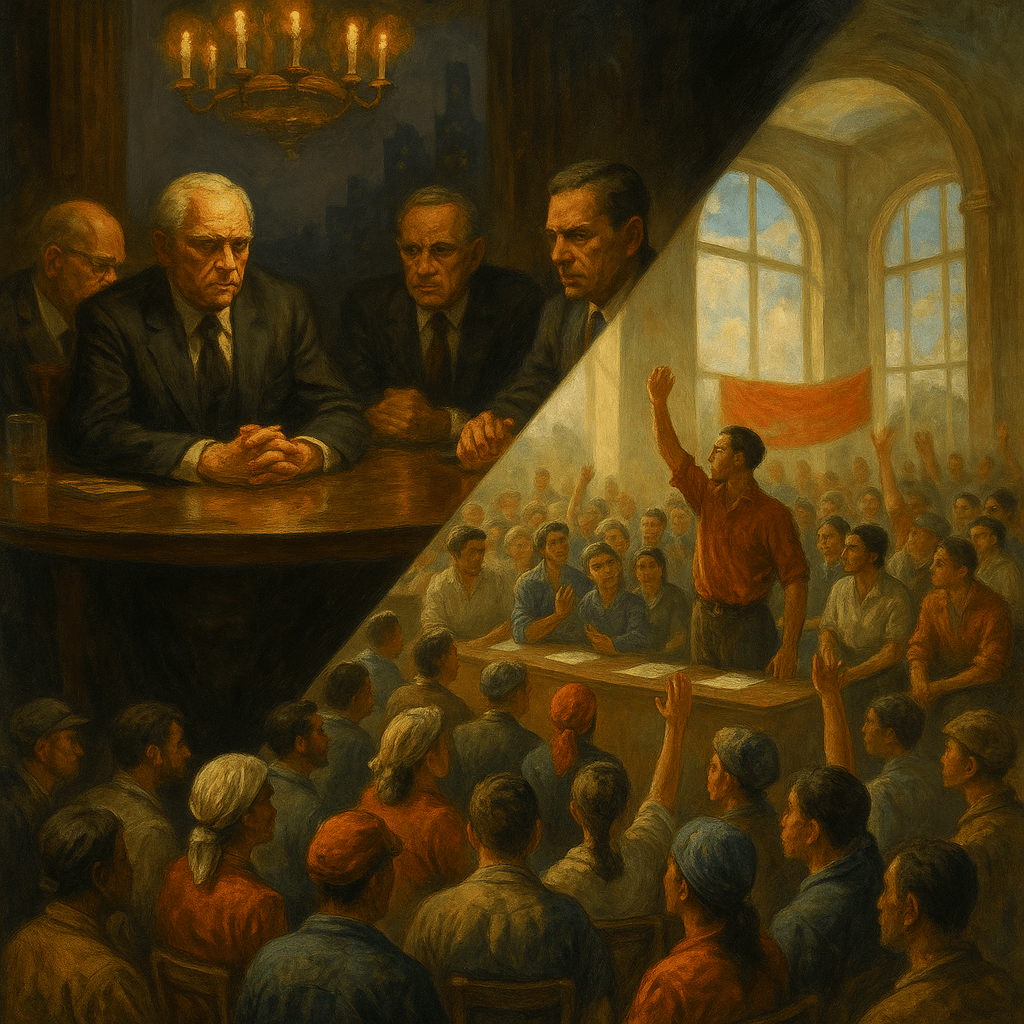
Why democracy cannot coexist with capitalism, and why socialism alone makes it possible
By Prince Kapone | Weaponized Information | September 23, 2025
The Mirage of Democracy Under Capitalism
They tell us we live in a democracy. They wave ballots in our faces, hold up constitutions like sacred scripture, and remind us of the “freedom” to choose between two parties bought by the same banks. But if democracy means the people rule, then capitalism is its executioner. Capitalism is a system where the land, the water, the machines, the wires, the satellites, even the airwaves are locked in private vaults and turned into commodities. In such a system, power follows wealth, not people. The great riddle of bourgeois democracy is no riddle at all: the minority who own command the majority who labor, and the parliament becomes the stage where their managers squabble over how best to govern the property of the rich.
What we really live under is plutocracy, the government of the wealthy. “Money is power,” they say, and in the capitalist world this is no metaphor—it is law. You cannot speak if you do not own a press, you cannot run if you cannot pay, you cannot live if you cannot buy. The poor are free in the same way a starving man is “free” to purchase bread he cannot afford. The working class is granted the right to vote once every few years, but denied the right to shape the economy that feeds, houses, and employs them every day of their lives. We are permitted to choose our overseers, not to rule ourselves.
Capitalist democracy, so-called, is a democracy of masks. Behind the mask sits the dictatorship of capital, the iron law of profit. It tolerates dissent so long as dissent does not threaten property, and when it does, the mask slips. Ask the striking worker clubbed by police, the tenant evicted by a court, the colonized nation bombed into submission. For them, democracy is a word used to justify the violence that robs them of dignity. Marx said the executive of the modern state is but a committee for managing the affairs of the bourgeoisie; we might update that to say Congress is but a boardroom for the investors of Wall Street, and every law passed is a line item in their quarterly report.
This is why capitalism and democracy are not uneasy companions but mortal enemies. Democracy means the people rule. Capitalism means property rules. The two cannot live under the same roof without one strangling the other. In our time, it is clear which has prevailed: democracy is the mask, plutocracy is the reality. To imagine otherwise is to mistake the shadow for the body. But to understand this contradiction clearly is to also see the path forward: only by uprooting the dictatorship of wealth can the rule of the people ever be real. And that path is called socialism.
From the Ballot Box to the Bank Vault
The story of bourgeois democracy is always told like a fairy tale: noble revolutionaries overthrow kings, declarations of rights unfurl in the breeze, the people rise as sovereign citizens. But look closer at who counted as “the people” in those early democracies—landlords, merchants, slaveowners. Property, not humanity, was the ticket to power. The vote was chained to wealth, and democracy was born already shackled. When the poor demanded inclusion, the ruling class relented only under duress—when barricades went up in Paris, when abolitionists lit the fuse under slavery, when striking workers threatened to shut down industry. Every expansion of suffrage was wrestled from the jaws of plutocracy, not granted out of its generosity.
Even when the franchise widened, the logic of plutocracy remained intact. A worker may cast a ballot, but the capitalist casts a fortune. Campaigns cost millions; media empires cost billions. The vote is one dollar per person; the lobbyist counts by millions of dollars per vote. In this arithmetic, the worker is always outnumbered. What they call “free speech” is in practice the freedom of the wealthy to purchase louder megaphones. What they call “representation” is in fact the auction of political office to the highest bidder. The White House may change its tenants, but Wall Street never loses the lease.
Capitalist democracy functions as a pressure valve: it lets the people blow off steam, but it does not let them seize the engine. The real levers—banks, corporations, media conglomerates, the military-industrial complex—remain firmly in the grip of the ruling class. Marx and Engels were blunt: the state is a machine for class domination, no matter how many flags it drapes itself in. In our time, this truth is visible in every bailout, every tax cut for billionaires, every law criminalizing poverty while legalizing exploitation. The United States prides itself on being the oldest democracy in the world, but what it has truly perfected is the most sophisticated plutocracy in history, complete with patriotic jingles to disguise the racket.
This is the natural form of democracy under capitalism: not rule of the people but rule over the people, managed through the illusion of choice. It is government as theater, plutocracy in costume. To call this system democracy is to abuse the word. The only accurate name is what it has always been: the dictatorship of the bourgeoisie, an oligarchy maintained by ballots in the day and batons at night. That is the heritage of the ballot box when its contents are owned by the bank vault.
The State as the Machinery of Class Rule
If democracy is to mean anything more than a slogan, then we must be honest about the state. It is not a referee standing above society, nor a neutral ground where all interests compete on equal footing. The state is a weapon—an organized machinery of coercion that enforces the rule of one class over another. Marx and Engels said it plainly: every state is a dictatorship. The question is never “dictatorship or democracy,” as liberals would have us believe, but which class holds dictatorship, and over whom?
Under capitalism, the dictatorship belongs to the bourgeoisie. The courts, the police, the military, the prisons—all the heavy institutions of order—are built to protect property and discipline labor. They may allow elections and constitutions, but the substance remains unchanged: the capitalist class rules, the working class obeys. Even the celebrated freedoms of speech and press are conditional, for speech without resources is a whisper, and press without capital is silence. It is democracy in form, plutocracy in content, the dictatorship of the few wearing the mask of the many.
Socialism turns this relationship on its head. When the working class and peasantry take power, the state ceases to serve the exploiters and begins to serve the exploited. This is the dictatorship of the proletariat—a phrase that sends shivers down liberal spines, but which simply names democracy for the vast majority and suppression of the parasitic minority. For once, it is the worker who commands and the capitalist who must submit. The rights that matter—the right to work, to live, to learn, to heal—are secured, not as privileges of wealth but as guarantees of citizenship.
This is not to romanticize the process. The old ruling classes do not go quietly. They conspire, sabotage, flee abroad and beckon imperialist armies to their rescue. To imagine that the working class could rule without restraining its former masters is to live in fantasy. Every socialist revolution has had to defend itself, not only against internal exploiters but also against the siege of imperialism. To hold the line in such conditions is not a betrayal of democracy but its very preservation, for democracy cannot survive if those who would strangle it are left free to act.
Here lies the distinction that liberals cannot admit: democracy under socialism is deeper and broader precisely because it is partisan. It does not pretend to serve all classes equally. It serves the overwhelming majority by denying power to the handful who once monopolized it. The state, stripped of its mask, finally declares its allegiance: to labor, to the poor, to the colonized, to the builders of a new world. And in this declaration, the meaning of democracy becomes clear for the first time.
When the People Take the Stage
Theory alone cannot carry the weight of this argument. We must look to history, to those moments when the working classes and colonized peoples seized the machinery of power and attempted to remake it in their own image. The record is not of perfection but of struggle—living, contradictory, improvisational struggle. And yet from these struggles, one truth shines: where socialism was built, democracy was no longer a word confined to paper but a practice inscribed into daily life.
In the Soviet Union, born from the fire of 1917, democracy meant soviets—councils of workers, peasants, and soldiers who deliberated, argued, and voted on the fate of factories, villages, and the revolution itself. For the first time, those who produced the wealth of society debated its distribution. Literacy campaigns swept across the land, not as charity but as necessity, because democracy requires that all can read, write, and think politically. The soviet form was battered by civil war, famine, and invasion, but it gave flesh to the slogan “All power to the Soviets.”
In China, democracy was not modeled after parliaments but forged through the mass line. Leaders were instructed to “from the masses, to the masses”—to gather ideas from below, refine them, and return them as policy. During the liberation war and after 1949, village assemblies and peasant associations became schools of governance, where the poor learned not only to farm collectively but to administer their own affairs. This was no seminar in civics; it was the practice of power in the hands of those long denied it.
Vietnam carried the same flame through its people’s committees. In the midst of anti-colonial war, peasants convened to decide on land reform, distribution of harvests, and the mobilization of defense. Democracy was not postponed until victory; it was the very instrument of victory. Guinea-Bissau and Mozambique followed a similar path, where village assemblies created during the people’s wars became nuclei of a new social order—participatory structures rooted in struggle rather than imported constitutions.
Cuba, after 1959, brought democracy down to the block. The Committees for the Defense of the Revolution formed networks of neighbors who watched out for one another, debated policy, and mobilized for literacy, healthcare, and defense. When the United States tried to starve Cuba into submission, these committees ensured survival through collective decision-making. Half a century later, Venezuela revived this tradition with its communal councils, giving barrios direct control over budgets, projects, and local governance under the banner of the Bolivarian Revolution.
And in Libya, before NATO bombs turned the country into rubble, the Jamahiriya experimented with “direct people’s authority” through Basic People’s Congresses and Committees. Whatever its contradictions, it posed a radical question: what if governance did not pass through parties and parliaments at all, but through assemblies where citizens spoke for themselves?
These examples do not describe utopias. They describe attempts—messy, incomplete, besieged—to translate the principle of popular sovereignty into institutions. They show us that socialism, even under conditions of war and blockade, generates participatory forms of democracy that capitalism never could. For in capitalism, democracy is tolerated only until it threatens profit; in socialism, democracy is the very condition for survival.
Whose Rights, and for Whom?
When the West lectures the world about “human rights,” it speaks with forked tongue. By rights, it means only civil and political rights: freedom of speech, freedom of assembly, the right to vote every few years for one of two millionaires. These rights are paraded as the highest expression of liberty, but under capitalism they are fragile ornaments, shattered the moment they collide with wealth. You are free to speak, yes—but your speech drowns beneath the roar of corporate media. You are free to assemble—but only until the police arrive in riot gear. You are free to vote—but never on whether factories should serve profit or people. These rights are paper-thin, and for the poor they often exist only on paper.
Socialism broadens the horizon. It declares that rights are not only political but also economic, social, and cultural. The right to work, to education, to healthcare, to housing, to culture—these are not luxuries to be bartered but guarantees to be lived. A Cuban farmer who learns to read under the literacy campaign exercises a right more profound than any ballot cast in Miami. A Soviet worker with rent capped at a fraction of their wage enjoyed a security unknown to tenants in capitalist metropolises. A Chinese peasant with land redistributed after centuries of feudal domination tasted a freedom deeper than a line in a constitution. Socialism takes rights off parchment and places them in kitchens, schools, and hospitals.
Critics complain that socialist states did not always grant full weight to political and civil liberties. This is true, but the truth has a context. Every socialist experiment has faced encirclement: blockades, sabotage, coups, invasions, civil wars funded and armed by imperialist powers. In such conditions, the priority was survival—feeding people, housing them, teaching them to read, defending them from bombs. To withhold this context is not analysis; it is propaganda. Socialism did not deny civil rights out of contempt, but out of necessity, because the very existence of socialist democracy was under siege.
Imagine, then, what democracy could be once the imperialist boot is lifted from the necks of socialist societies. Freed from siege, socialism could harmonize the full spectrum of rights: civil, political, economic, social, cultural. Only then would “human rights” mean the totality of human life, not the privileges of property owners. In that future, freedom of speech and assembly will walk hand in hand with freedom from hunger and homelessness. And in that day, the West’s hollow sermons on rights will be remembered for what they always were: cover stories for the dictatorship of capital.
On Contradictions and the Lessons They Teach
No socialist state has ever walked a path free of contradictions. Bureaucracies hardened, leaders erred, participation at times withered under the weight of emergency. It would be dishonest to pretend otherwise. But here is the critical point: these contradictions are not evidence against socialism, they are evidence of the conditions under which socialism has been forced to survive. Every socialist experiment has been born under fire—civil wars, blockades, sabotage, invasions. Where capitalism expands by plunder, socialism is compelled to defend itself against plunderers. A system besieged does not flower easily, yet even under siege it delivered more substantive democracy to the majority than capitalism ever did at its most tranquil.
The accusation is always “authoritarianism.” But what does that mean when spoken by the ruling classes of the West? Authoritarian for whom? To the landlords who lost their estates, yes. To the factory owners expropriated, yes. But to the millions who gained land, housing, schools, and clinics, socialism was not authoritarian but emancipatory. The dictatorship of the proletariat is experienced as repression by the exploiters, and as liberation by the exploited. This is the contradiction liberal critics cannot resolve because they refuse to admit the obvious: democracy is always class democracy.
The lesson is not that socialism failed, but that socialism must be clear-eyed about its enemies. Where it defended itself boldly, it survived and built. Where it hesitated or conceded, it was rolled back into capitalist restoration, and with it the return of plutocracy. Our conclusion should not be to abandon the project of socialist democracy, but to deepen it—to fuse participatory governance with vigilance against the return of exploitation. That is not a flaw in socialism; it is the logic of class struggle itself.
Democracy in the Age of Crisis
Look around at the capitalist world today and tell me where democracy lives. The ballots are still cast, the parliaments still convene, but the substance has evaporated. Neoliberal capitalism has stripped even its own illusions bare. Campaigns are bought by billionaires and hedge funds. Lobbyists draft the very laws they bribe legislators to pass. Surveillance corporations track every click and whisper, building dossiers thicker than police files. This is not democracy—it is technofascism, plutocracy upgraded with algorithms and drones.
The gap between rich and poor yawns wider by the day, whole cities sink under the waters of climate collapse, and war is endless because war is profitable. These are not accidents; they are the predictable outcomes of a system where wealth rules and life is expendable. When the poorest demand bread, the rulers answer with riot police. When the planet demands survival, the rulers answer with oil rigs. In such a world, democracy is not simply absent—it is impossible.
And yet, under siege and blockade, flashes of another world persist. Venezuela’s communal councils, where barrios decide budgets and priorities, are democracy more real than any congressional hearing televised in Washington. Cuba’s neighborhood committees, even after six decades of embargo, mobilize communities to protect health, education, and solidarity. These are imperfect, embattled, under constant attack, but they embody something capitalism never will: people governing themselves, not as consumers of empty promises but as producers of their own future.
The crisis of capitalism makes the stakes clear. Either democracy is torn apart, hollowed out into corporate spectacle and police repression, or it is rebuilt on socialist foundations—participatory, collective, rooted in the needs of the many. There is no middle ground left. To speak of democracy today is to speak of socialism, or not at all.
Socialism or Barbarism
The verdict is plain. Capitalism and democracy cannot live under the same roof. One demands that wealth rules, the other that people rule. History shows us which side has triumphed in the capitalist order: plutocracy, masked by ballots and guarded by police. The so-called “democratic West” has given us billionaires as kings, corporations as governments, and war as permanent policy. That is not democracy. That is barbarism dressed in a suit and tie.
Socialism, despite all its trials and contradictions, remains the only road where democracy can breathe. It is the dictatorship of the proletariat, yes—democracy for the vast majority, dictatorship over the exploiters. It is councils of workers and peasants, neighborhood assemblies, communal budgets, the right to work, to learn, to heal, to live with dignity. It is not a utopia but a struggle, a struggle in which the people themselves take the stage as subjects of history, not spectators.
The choice before us is stark and unavoidable. Either we accept plutocracy, with its collapsing climate, endless wars, and hollow parliaments—or we fight for socialism, where democracy is not a mask but a way of life. Rosa Luxemburg named it clearly more than a century ago: socialism or barbarism. Today the truth rings louder than ever. If humanity wants democracy, it must tear wealth from the throne and build socialism with its own hands. Nothing less will do.
 Weaponized Information