By Prince Kapone, Weaponized Information
Agriculture as Metabolism, Not Machine
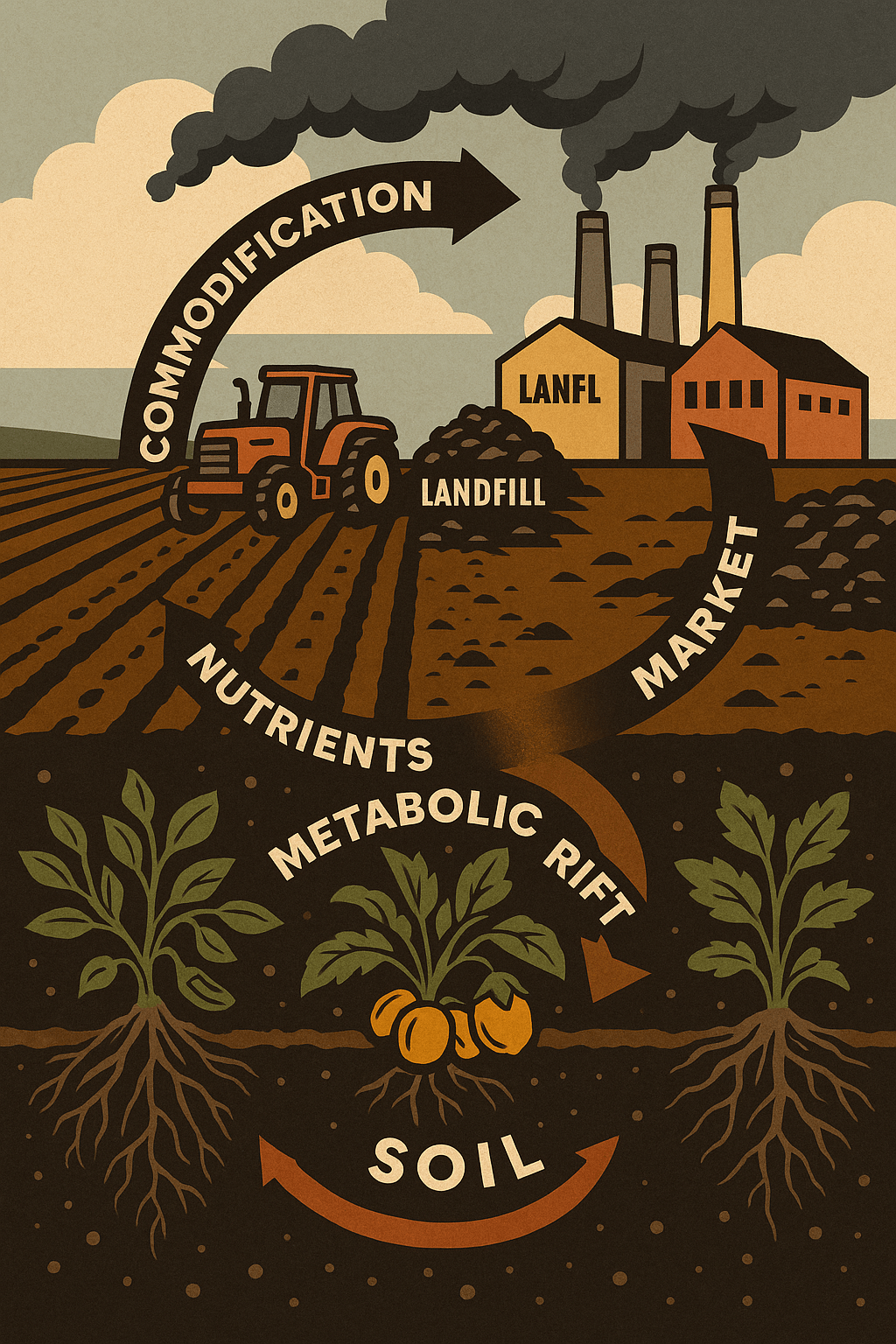
Before agriculture was commodified, it was life: a complex, cyclical exchange between humans and nature. Seeds fell, soils breathed, animals fertilized, microbes decomposed. Water flowed, sun shone, people harvested, ate, and returned to the land what they took. This was not Eden—it was labor, struggle, and adaptation—but it was a system grounded in metabolism: the continual, dynamic interchange between human society and the natural world.
Capitalism does not tolerate this kind of reciprocity. It seizes, encloses, and reroutes nature’s processes into supply chains, profit flows, and accumulation circuits. Where once there were regenerative cycles, now there are externalities. What was once soil becomes substrate. What was once compost becomes waste. This is the essence of the metabolic rift: capitalism’s rupture of the cycles that sustain life itself.
Marx and the Metabolic Contradiction
Karl Marx foresaw this rift clearly. In Capital, Volume III, he wrote that capitalist agriculture “undermines the original sources of all wealth—the soil and the worker.” He was writing in the context of 19th-century English agriculture, where urbanization, industrialization, and export-oriented farming were stripping nutrients from rural land and dumping waste into the cities, without return.
This process has only intensified. Under monopoly capital and technofascism, the metabolic rift has become systemic. Every part of the agricultural process is now fractured, monetized, and subordinated to profit. The logic of life is displaced by the logic of capital.
Capitalism Dismantles the Cycle
1. Soil is no longer alive—it is a chemical medium
Industrial agriculture treats soil as an inert base onto which synthetic inputs are dumped. Fertility is outsourced to fossil-derived fertilizers. Pesticides destroy microbial life. Erosion accelerates. One-third of all soil globally is now degraded, and according to the FAO, we may have fewer than 60 harvests left at current rates.
2. Waste becomes pollution, not renewal
In pre-capitalist systems, food scraps, manure, and crop residues returned to the land. Today, industrial systems treat waste as disposable: burned, dumped, or dumped into oceans and landfills. This has created methane emissions, water dead zones, and public health crises.
3. Animals are severed from the land
Capitalism creates CAFOs (Concentrated Animal Feeding Operations), where animals are raised in confinement, fed grain they did not evolve to eat, and produce toxic quantities of waste with no place to go. The ancient symbiosis between animal and soil is broken.
4. Labor is deskilled and alienated
Farmers are no longer stewards—they are machine operators, input buyers, and often debtors. Knowledge of ecology and season is replaced by corporate advisories, crop insurance algorithms, and app-based compliance tracking. The worker is alienated not only from the product, but from nature itself.
5. The eater is alienated from the grower
Most food now travels over 1,500 miles before being consumed. The majority of consumers in the imperial core have no idea where their food comes from, what labor produced it, or what ecological cost it carries. Meanwhile, food waste, obesity, and malnutrition all rise together.
The Profit Motive Rations the Metabolism
Under capitalism, nothing flows unless it turns a profit. Nutrients, water, energy, and labor are diverted not according to need, but market price. Vast monocultures are grown not to feed people, but to satisfy export quotas, biofuel contracts, or livestock feed demand in the Global North. Meanwhile, subsistence farmers are displaced, Indigenous territories are colonized, and small-scale producers are strangled by debt and competition.
This isn’t mismanagement. It’s the logic of accumulation: turn every flow—of nitrogen, calories, genes, and water—into an extractable commodity. The rift is the system.
Technofascism and the Digital Management of Life
Under technofascism, the metabolic rift becomes militarized, digitized, and made programmable. Today’s agriculture is managed not just by tractors and silos, but by satellites, drones, proprietary software, and venture capital. AI predicts rainfall and recommends inputs. Blockchain tracks soil and crop histories for compliance. Corporate platforms enforce “precision agriculture” that reduces the farmer to an extension of a logistics algorithm.
Finance capital, Big Ag, and Big Tech now function as a single apparatus, managing the biological reproduction of food systems through surveillance, intellectual property, and cloud-based governance. In this world, even weather becomes an asset class—hedged and securitized for investors while the people suffer famine.
Metabolic Repair: Toward an Ecosocialist Agriculture
The solution is not to romanticize the past, but to rupture the system that made reciprocity impossible. A truly revolutionary agriculture must be metabolic—it must restore the broken cycles of life, labor, and land. This means:
- Restoring the soil through agroecology, compost, and polycultures
- Recycling nutrients through bioregional food systems
- Shortening food chains and relocalizing production
- Returning land to communities and reuniting labor with stewardship
As Marxist ecologists like John Bellamy Foster have argued, this is not just ecological work—it is class struggle on ecological terrain. The metabolic rift can only be repaired by abolishing the system that created it.
The Metabolism Will Not Be Privatized
Life wants to cycle. Capital wants to interrupt. The contradiction is clear. In every pile of compost, every rain barrel, every seed swap and collective harvest, a different system is emerging—not to reform the market, but to render it obsolete.
Metabolic repair is revolutionary. It is the negation of capital at the level of breath, water, and root. And it begins wherever people say: no more extraction—only return.
In Part IV, we will examine the corporate food system: how labor, logistics, packaging, and retail are weaponized to alienate food from people—and how to dismantle the machinery that keeps people hungry while food rots in warehouses.
 Weaponized Information
Leave a comment