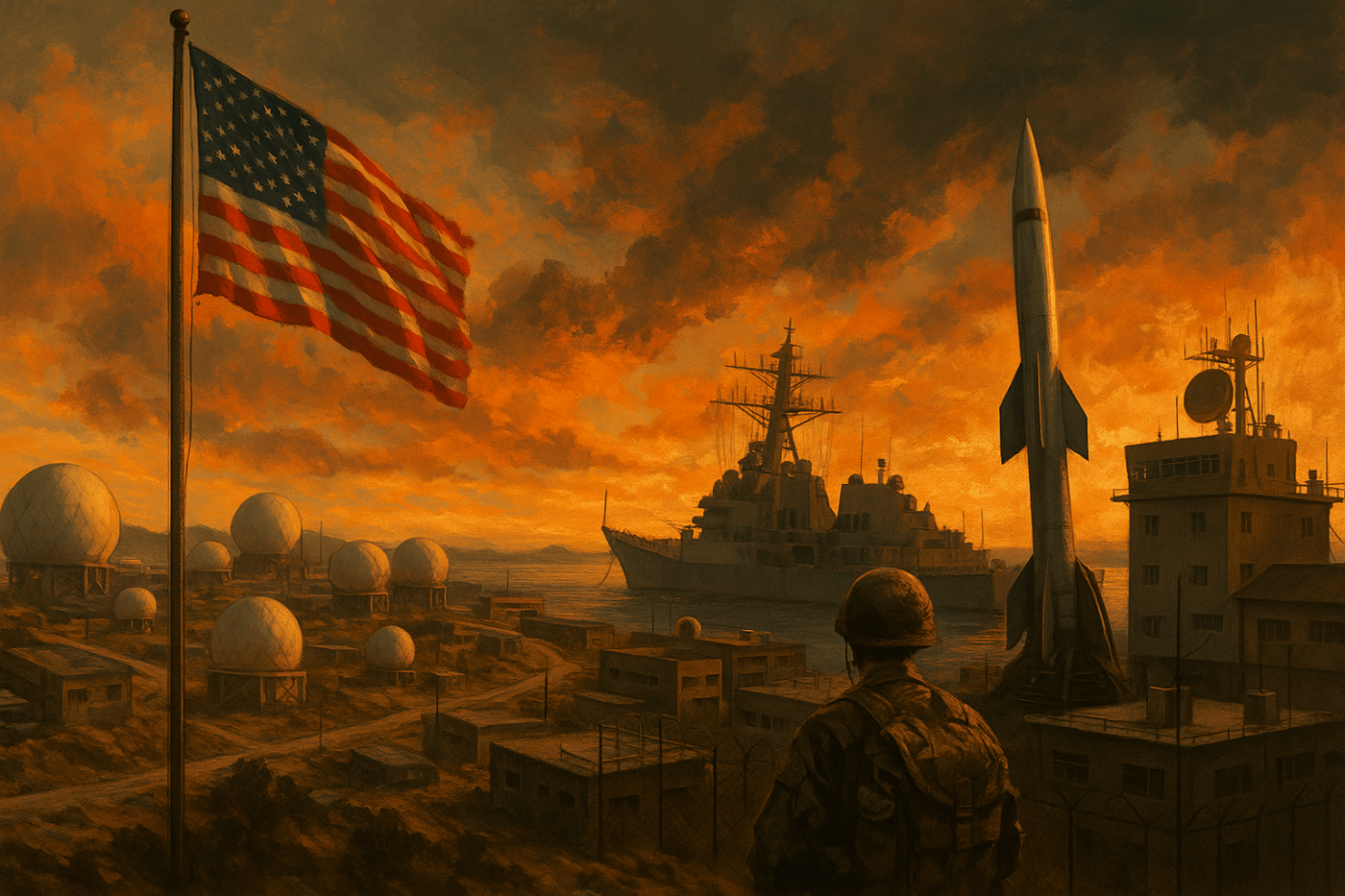
Debt. Doctrine. Domination. How the U.S.–Japan alliance became a logistics chain for empire.
Empire by Spreadsheet: The Paperwork of War
On June 30, 2025, Stars and Stripes published a piece that reads like a memo passed between Pentagon functionaries: “U.S. Restructures Pacific Command—Containment Gets a Bureaucratic Upgrade.” The title sounds harmless enough, as if Washington were merely tidying up some filing cabinets. But tucked beneath the sterile language is something far more aggressive: a restructuring of U.S. Forces Japan (USFJ) dressed up as administrative housekeeping, but in essence, a methodical act of military escalation. In the fog of euphemism, war planning is disguised as modernization, domination as efficiency, and command control as policy refinement.
The article does not bother to question the justification. General Stephen Jost is quoted citing “growing threats from China,” and that’s the end of it. No analysis. No counterpoint. Just the straight line from threat to response, as if geopolitics were a software update. The authors parrot Pentagon talking points as fact, celebrating tighter integration with Japan’s newly minted Joint Operations Command, the creation of liaison teams, and a mushrooming of U.S. military infrastructure in Tokyo. The entire development is reported not as a matter of imperial strategy, but as technocratic process—devoid of memory, detached from power, and insulated from political context.
Seth Robson and Hana Kusumoto, the article’s authors, are not investigative journalists. They are glorified stenographers of empire. Robson has spent his career embedded with U.S. forces from Baghdad to Guam, refining the art of laundering occupation through access journalism. Kusumoto, trained in the soft diplomacy of the Christian Science Monitor and Boston University’s halls of imperial enlightenment, specializes in sanitizing Pentagon policy for Japanese audiences. Together, they do not challenge power. They relay it—fluently, obediently, and without shame.
Their employer, Stars and Stripes, is not an independent newsroom—it’s a branch of the war machine. Bankrolled by the U.S. Department of Defense and tasked with maintaining morale among deployed troops, it serves not to investigate, but to anesthetize. Its function is ideological: to make militarism look like administration, to make domination seem like diplomacy. In this latest installment, the performance is seamless—strategic aggression is rendered as benign policy realignment.
To give the article a veneer of credibility, two predictable “outside experts” are trotted out: Brad Glosserman of Pacific Forum and Ken Jimbo of Keio University. But these are not neutral analysts—they are appendages of the very apparatus they are asked to comment on. Glosserman’s think tank is funded straight from Washington’s coffers, while Jimbo serves as a civilian whisperer to Japan’s Ministry of Defense. Their role is not to interpret events, but to manufacture consent. What they call analysis is closer to chorus work in a state-sponsored opera.
The methods of persuasion deployed in the article are textbook. “Modernization” is invoked to camouflage expansion. There is no mention of Japan’s postwar constitutional limits, no attention to local protest, no historical grounding in the long, contested presence of U.S. military bases. Instead, we are handed a tidy narrative of strategic necessity. The figure of China hovers throughout the piece like an unexamined villain—invoked to stoke fear, never understood. Aid deliveries and missile strikes are lumped together under the bland banner of “joint operations,” while China is caricatured as “coercive” and “unprofessional”—language lifted straight from the Orientalist instruction manual.
But perhaps the most insidious weapon in the arsenal is the language itself. The phraseology—“enhanced deterrence posture,” “spectrum of operations,” “command realignment”—turns violence into spreadsheets. It drains the blood from policy, transforming war planning into what sounds like bureaucratic feng shui. This is cognitive warfare through clerical style. Not a single bullet has been fired, but already the battlefield has been prepped—on paper.
This is the genius of late-stage imperialism: aggression by form-fill. Acronyms replace accountability. Memoranda eclipse morality. There is no need for public approval, because there is no public process—only procedures, only logistics, only the steady hum of background escalation. Beneath the PowerPoints and PDFs, the imperial engine roars on. It doesn’t march. It updates.
Facts on the Ground, Truth in the Shadows
The Stars and Stripes article presents a neat inventory of bureaucratic adjustments—“modernization” in the parlance of empire. But while the facts may be technically accurate, they are stripped of scaffolding. The dots are real. The lines connecting them have been erased. What we are given is a sterile recital of timelines and troop realignments, unanchored from history, strategy, or the structural logic of imperialism. The omissions speak louder than the confirmations.
According to the article, U.S. Defense Secretary Pete Hegseth announced the command restructure during a March 30, 2025 visit to Tokyo. By April, USFJ had opened a new satellite office at the Akasaka Press Center—strategically nestled beside Japan’s Ministry of Defense. That same month, Japan launched its Joint Operations Command, tightening the latticework of U.S.–Japan military fusion. On June 24, Japan test-fired a surface-to-ship missile from Hokkaido, flexing its new hardware as it prepares to receive U.S.-made Tomahawk cruise missiles later this year—a plan reaffirmed in the U.S.–Japan Joint Leaders’ Statement. And all of it sits atop a command structure newly reinforced with liaison integration teams—unquestioned, unopposed, and uncontextualized.
But behind these maneuvers lies an architecture of subordination. None of it is new. None of it is neutral. The foundation was laid in 1960, when the U.S.–Japan Security Treaty was signed—not by mutual agreement among equals, but under U.S. occupation, amid mass Japanese protests, and without a democratic referendum. That treaty, still in force, grants the U.S. sweeping basing rights and permanent military access. It is the skeletal structure on which all this “modernization” rests—codified colonialism wrapped in legalese.
The media would have us believe Japan’s military expansion is a matter of prudent self-defense, a reaction to rising regional tensions. But this is not a renovation—it is a rupture. In 2023, Tokyo passed a record $55 billion defense budget, part of a sweeping plan to double military spending to 2% of GDP by 2027. This surge follows a 2022 reinterpretation of Article 9 of Japan’s pacifist constitution, clearing the way for “counterstrike capabilities,” foreign base deployments, and long-range missiles. The postwar consensus, forged in the rubble of Hiroshima and Nagasaki, is being discarded—one weapons shipment at a time.
Even as Japan carries the highest sovereign debt burden among advanced economies, it continues to underwrite U.S. deficits and absorb the costs of rearmament. But this is not financial autonomy—it is structured dependence. What appears as sovereign decision-making is more often scripted obligation.
Meanwhile, the scale of U.S. military occupation on Japanese soil remains untouched by scrutiny. Japan hosts over 120 U.S. military facilities—an archipelago of airfields, naval outposts, missile silos, and intelligence hubs, spread from Okinawa to Misawa. China, by comparison, maintains precisely one overseas military base, in Djibouti. Yet we are told, with a straight face, that the U.S. is playing defense.
So yes, the facts in the article are technically true. But truth divorced from context is worse than omission—it is misdirection. The command restructure is not an “upgrade.” It is the operationalization of an imperial architecture that was designed decades ago, insulated from democracy, and now updated with digital precision. Japan is not a co-equal partner. It is a garrison state. And the paperwork only makes it easier to pretend otherwise.
Debt, Doctrine, and Domination: How Empire Recalibrates in Asia
This is not modernization. It’s militarized recalibration. The U.S. empire, watching its unipolar grip slip through the cracks of multipolar momentum, is not backing down—it’s digging in. The restructuring of U.S. Forces Japan (USFJ) is no routine reorganization; it is the bureaucratic face of imperial entrenchment, the formalization of a command doctrine built not on partnership, but on programmed subordination. In this doctrine, Japan is not a sovereign nation—it is a subordinate node in a logistical command network. The Pentagon doesn’t just want allies. It wants assets.
Two structural pillars hold up this new architecture of domination: Debt Imperialism and Maritime Encirclement. Neither is accidental. Both are designed with precision.
Let’s start with the math. Japan holds over $1.1 trillion in U.S. Treasury securities, effectively financing Washington’s deficits. At the same time, its own sovereign debt has ballooned past 260% of GDP, the highest among advanced economies. In a twisted financial loop, Japan bankrolls the dollar, which bankrolls the Pentagon, which then sells Japan the very missiles and systems it is politically compelled to buy. That’s not alliance. That’s fiscal captivity. This is how debt becomes doctrine, and how doctrine becomes dependency.
For the Global South, this pattern is familiar. When Sri Lanka defaulted in 2022, the IMF marched in with its structural adjustment checklist: privatize, liquidate, surrender. Japan’s militarization, though more ceremoniously wrapped, is driven by the same logic—only with Tomahawks instead of tariffs. The mechanism may differ, but the outcome is constant: sovereignty mortgaged in exchange for imperial compliance.
Then comes maritime encirclement—the spatial arm of U.S. strategy in the Pacific. As detailed in “World War Sea”, the Indo-Pacific has been transformed from shared commons into a U.S.-engineered launch corridor. From Guam to Palawan, Darwin to Okinawa, Washington is building a floating fence of forward bases, surveillance nodes, and missile platforms—all under the banner of “regional security.” But this isn’t about securing peace. It’s about pinning down China’s sea lanes, encircling its coastlines, and maintaining unbroken strike capacity across the Pacific Rim. Beneath the talk of deterrence lies preparation for war.
And this isn’t theoretical. Filipino fisherfolk have been expelled from ancestral waters, now cordoned off by U.S.-brokered basing pacts. In the Marshall Islands, toxic nuclear waste leaches into fisheries still occupied by U.S. logistics hubs. These are not collateral damages. These are the frontline sacrifices of a maritime siege economy. The costs are borne by islanders and peasants. The profits flow to defense contractors and fuel-hungry fleets.
The empire calls this “integration.” But what’s being integrated is not sovereignty—it’s infrastructure. Japan is being remade as a logistics hub, a missile warehouse, a communications relay. Its debt purchases subsidize its own subjugation. Its territory serves as the staging ground for war against its largest trading partner. The contradiction is not just deep—it is deliberate.
And even this plan is beginning to buckle under its own contradictions. A 2024 Stimson Center report warns that Chinese missile threats to U.S. airbases in Japan and the Indo-Pacific could close runways and disrupt operations—signaling that the bureaucratic armor the U.S. has built to streamline domination may fracture under the stress of its own speed. Efficiency does not neutralize contradiction. It often accelerates collapse.
This is what Antonio Gramsci once called a Passive Revolution: a shift in form to preserve the content of power. The U.S. doesn’t abandon its goals—it simply renames them. Command centers become “coordination hubs.” War plans become “interoperability strategies.” Missile shipments are recast as “defense partnerships.” But the core objective remains untouched: military primacy in Asia, enforced through language, logistics, and debt.
The consequences, however, extend far beyond Tokyo. Japan’s debt-financed militarization isn’t isolating China—it is catalyzing a revolt. BRICS+ states are laying down alternatives: currency swaps, independent payment systems, and de-dollarization protocols. Every Tomahawk exported to Japan is a warning flare to the Global South: the dollar is no longer a neutral instrument of trade. It is a weapon. And the world is beginning to arm itself in response.
This is no longer imperial overreach. It is, as the Tricontinental Institute describes, Hyper-Imperialism: a stage where coercion, debt, surveillance, and narrative warfare fuse into seamless domination without formal governance. Japan is not an ally. It is a prototype. South Korea, the Philippines, Micronesia—all are being absorbed into this bureaucratic empire without borders. What the Pentagon calls “burden sharing” is better named what it is: structural absorption.
And while the oceans rise, the empire digs in. The IPCC and its partners warn of accelerating sea-level rise through the projections tool based on the AR6 report. The GAO-19‑453 report highlights that multiple Department of Defense installations—many coastal—are vulnerable to extreme weather and climate impacts, yet only a fraction have fully assessed those risks. From Guam to Diego Garcia, the bases are sinking. But instead of retreating, the U.S. is reinforcing them. This is Necro-Extractivism—sacrificing land, sea, and life itself for just a few more years of projection, a few more decades of dominance.
Japan is not a sovereign partner. It is a garrisoned asset. And this latest command restructure is not a regional upgrade. It is a dress rehearsal—for total integration, for debt-backed domination, for war executed through spreadsheets and euphemisms. Welcome to the paperwork of empire.
From Yokota to You: Breaking the Chain of Command
If the Indo-Pacific is the laboratory where empire rehearses its next war, then we in the imperial core are the supply chain. The Tomahawk missiles tested off Hokkaido are not the product of abstract policy—they are manufactured in Tucson, subsidized by tax dollars stripped from shuttered public schools in Oakland and gutted hospitals in the Bronx. The liaison units stationed in Tokyo are not magically funded—they are paid for by evictions, by foreclosures, by austerity budgets that trade libraries for laser-guided bombs. What the U.S. government calls a “partnership” with Japan is not just an external alliance—it is an internal theft. We are not observers to this militarization. We are embedded in its circuitry.
This is not a regional pivot. It is a planetary escalation. The United States’ 2024 military budget stands at $883.7 billion—a sum so grotesque it no longer registers as shocking. Meanwhile, the country suffers from a $78 billion affordable housing shortfall. Every Tomahawk launched toward the Pacific is a public housing unit never built in Harlem. Every Pentagon “upgrade” is a student loan never forgiven. Every expanded base abroad is a clinic closed at home, or a police precinct militarized in its place. The empire does not merely export domination—it imports decay.
But empire is not monolithic. It is contested. And from Okinawa to Oakland, people are fighting back.
In Okinawa, resistance is not rhetorical. It is physical, daily, and decades deep. Elders and youth have blocked runways with their bodies, staged sit-ins outside base gates, and faced arrest in defense of their land. These communities have said no with such consistency that Washington has had to build airstrips on coral reefs to circumvent them. Yet their defiance is erased in U.S. media, which treats every act of military expansion as an “upgrade,” every protest as an inconvenience, and every demand for sovereignty as an obstacle to “regional stability.”
Across the region, the pattern repeats. In the Philippines, youth and peasant coalitions mobilize against the reactivation of U.S. bases in Subic and Palawan. In Australia, Indigenous land defenders fight the desecration of sacred ground to make way for Pentagon logistics hubs. These are not isolated protests. They are part of a shared refusal—to be used as springboards for someone else’s war, to be reduced to coordinates on an American command map.
The cracks are widening. In 2023, Niger expelled U.S. AFRICOM forces from its territory, rejecting the imperial farce of “counterterrorism partnerships.” Where Washington’s footprint recedes in West Africa, Tokyo’s grows in East Asia—tethered tighter to the dollar, to debt, to doctrine. One country chooses rupture. Another is being restructured to never choose.
So where does that leave us—those of us inside the belly of the beast, watching the world be swallowed from conference rooms, voting booths, and social media threads? We organize not as spectators, but as saboteurs.
That means targeting the war machine where it sources its strength: logistics, legitimacy, and silence. We join divestment campaigns to force cities, universities, and pension boards to withdraw their capital from the weapons cartels—Raytheon, Lockheed, BlackRock. Campaigns like CodePink’s Divest from the War Machine have already pushed local governments in places like San Luis Obispo and Charlottesville to exit military investment portfolios. We amplify frontline media from Micronesia to the Philippines, where journalists risk retaliation to expose the twin brutality of military buildup and climate collapse. We build open-source cyber platforms to track weapons shipments, contractor profits, and permit filings. We turn logistics into revelation.
We fight on every front. Through local political education, we draw the lines connecting “national security” to evictions, surveillance budgets to school closures, counterinsurgency to curriculum cuts. We build dual power where empire is thickest: tenant unions in weapons industry towns, strike funds for engineers who refuse to code surveillance tools, mutual aid clinics in neighborhoods looted by defense contracts.
This is not about sympathy. It’s about strategy. We do not mourn what empire does—we interrupt it. We do not appeal to generals—we defund them. We do not wait for permission—we act. Because the frontlines are not only in the Pacific. They are here, in our paychecks, our ballot boxes, our newsfeeds, our neighborhoods.
The U.S. command restructure in Japan is not just about “deterring China.” It is about disciplining disobedience—abroad and at home. It is about extending the reach of empire while tightening its grip on the domestic population. This is technofascism: a war machine wrapped in jargon, powered by debt, and protected by silence. And it will not be stopped by policy memos or polite objection. It will be stopped by rupture. Resistance must not wait for the next war. Resistance must begin with refusal now.
 Weaponized Information
Leave a comment