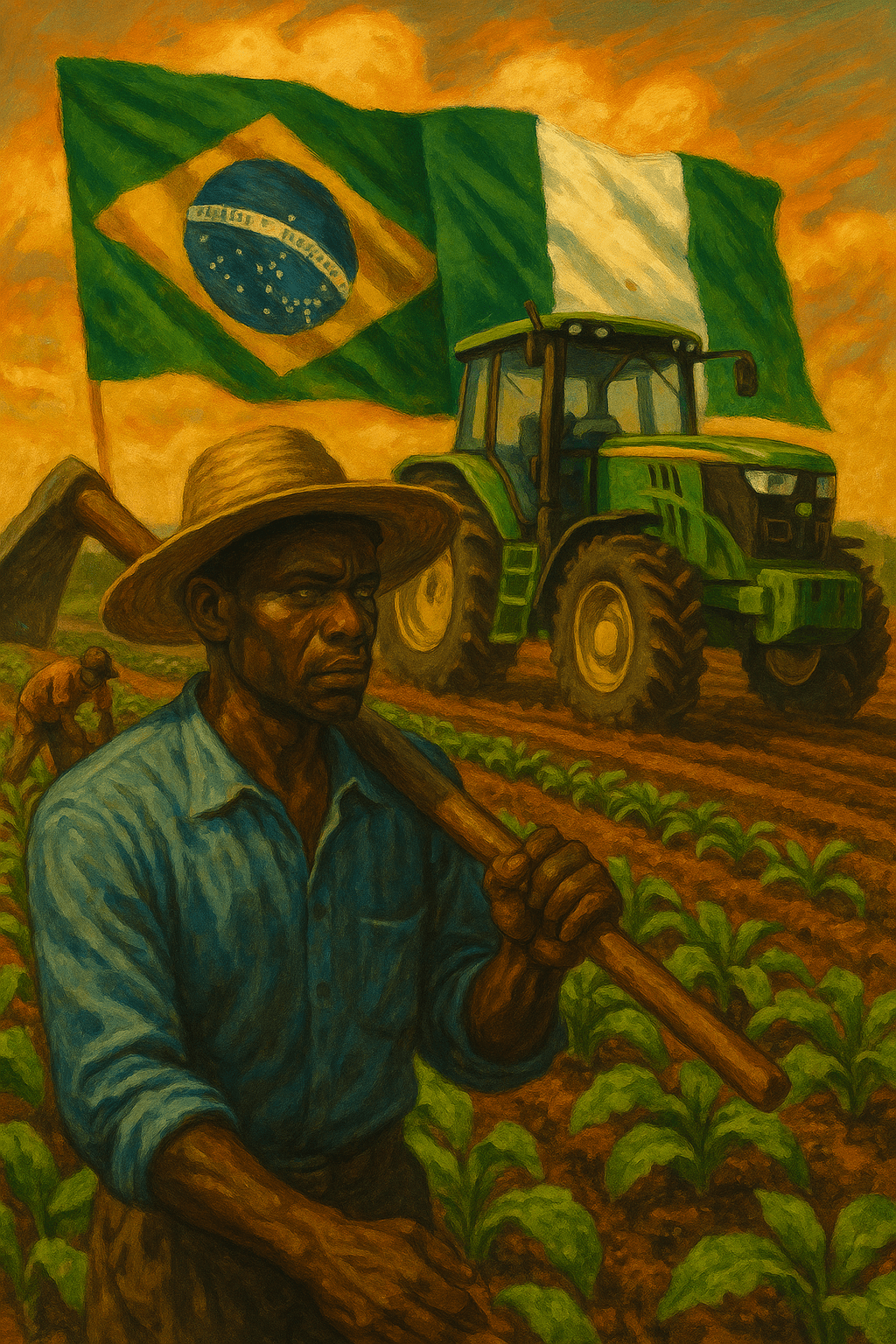
A billion-dollar agreement to mechanize Nigerian agriculture may sidestep Western finance—but not capitalist extraction. The South is moving, negotiating, and resisting. The question is: who holds the tools, and who gets fed?
By Prince Kapone | Weaponized Information | June 29, 2025
Development Without Context, Empire Without Name
The Reuters piece titled “Nigeria and Brazil sign $1 billion agreement to boost agriculture” reads like a benign dispatch from the development beat. Short on adjectives and long on quotes, it follows the standard blueprint of corporate journalism: report what was said, avoid what it means. This is propaganda by omission—whispered in structure, framing, and erasure.
MacDonald Dzirutwe, the Reuters correspondent, is experienced in covering African political economies—but operates within an outlet whose editorial architecture is shaped by Western finance, legalism, and imperial respectability. Reuters is not merely a newswire; it is a central node in the global information infrastructure of capital, furnishing “trusted” narratives to corporations, hedge funds, and institutions. Its neutrality is the neutrality of capitalist stability.
The framing of this agreement as a bilateral partnership between Brazil and Nigeria strips out critical context. No mention of BRICS, South–South cooperation, historical struggles against Western dependency, agribusiness monopolies, or unequal land relations. Brazil is reduced to machinery‑provider and Nigeria to recipient—sans any social or class dynamics. Absent is discussion of Lula’s tension with Brazil’s agribusiness bloc, or Nigeria’s fraught struggle for food sovereignty under austerity and structural adjustment.
Language carries ideological weight. The article’s uncritical reference to Nigeria’s pivot “from subsistence to scale” treats scale as inherently progressive and subsistence as primitive. We are not asked: Who controls that scale? Whose land is mechanized? Who is displaced? Mechanization is framed as development, modernization, investment, progress—ideological reflexes embedded in capitalist discourse.
Most glaring are the absent details. What are the terms of the finance—grant, concessional loan, or commercial credit? What interest rate? What collateral? Who underwrites the risk, and who captures the surplus? These are material linchpins of the deal. By omitting them, Reuters preserves the illusion of benign South–South solidarity and neutral partnership.
Equally revealing is how the piece frames Nigeria’s political economy. Tinubu’s currency devaluation, subsidy removals, and IMF‑adjacent austerity measures are portrayed as economic “reform” that has “helped reshape Nigeria’s economy”—ignoring the inflation, hunger, and unrest that have followed. That framing aligns perfectly with creditor and investor interests, manufacturing legitimacy for neoliberal discipline.
This is propaganda not as caricature, but as technocratic sleight‑of‑hand. Cloaked as neutral reporting, it erases history and class, omits power, and smooths the terrain for capitalist expansion. In this case, the $1 billion deal is not reported objectively—it is rendered palatable, even welcome, by structuring the discourse to serve South‑facing capital. Multipolarity may appear, but the underlying extraction remains the same.
Between Green Machines and Broken Chains
To understand what this Brazil–Nigeria agro‑financing deal represents, we must look beyond the press‑release gloss and ask: what material contradictions made it possible? What global shifts shaped its form? And most importantly, what class forces stand to gain—or lose—from its implementation?
First, this is not a World Bank loan. It is Brazil—under Lula—extending $1 billion in credit and machinery to Nigeria. That difference isn’t just geographical—it’s geopolitical. Lula has publicly emphasized multipolarity and South–South cooperation, but his administration operates under intense pressure from the ruralista agribusiness bloc, which has aggressively lobbied to weaken Indigenous and environmental protections.
The machinery involved—tractors, harvesters, irrigation systems—is the same industrial hardware driving Brazilian agribusiness expansion. Companies like AGCO Brasil, Stara, and Jacto are deeply embedded in soy and cattle supply chains that continue to devastate the Amazon and Cerrado. As Reuters has reported, even longstanding conservation pacts are eroding under the weight of agro-export profits.
Meanwhile, Nigeria’s agricultural crisis is deepening. Over 60% of its workforce is rural, yet domestic food production is insufficient to feed its 200 million citizens. As noted in the Reuters report on the Brazil–Nigeria deal, the government plans to “move from subsistence to scale”—but without addressing who owns the land or who benefits from scale. Structural adjustment, currency devaluation, and subsidy cuts have already ravaged Nigeria’s agricultural base. Worsening insecurity has led thousands of farmers to abandon their land, as documented in field reports.
Mechanization without land reform accelerates dispossession. Whether through formal state-led consolidation or subtle market pressures, smallholder farmers are forced off their land. The Bakolori irrigation project in Sokoto stands as a historical warning: large-scale agrarian modernization displaced tens of thousands, sparking unrest and long-term social fragmentation.
Resistance persists. The All Farmers Association of Nigeria (AFAN), along with regional peasant movements and affiliates of La Via Campesina, have long opposed land grabs and anti-peasant policies. But without democratic control over deal implementation, their leverage remains limited.
On the global stage, this deal signals a crack in the West’s development stranglehold. Where once African states could only negotiate with the IMF, World Bank, or commodity traders, they now encounter China, Brazil, Turkey, and India. But while multipolarity breaks Western monopoly, it doesn’t break capitalism. Different creditors—same logic.
Lula’s Brazil sits at the crossroads of these contradictions: rhetorically aligned with sovereignty and solidarity, materially anchored to agribusiness and export elites. The Nigerian deal could reproduce extractivism—or, if seized from below, become a lever for building South–South alternatives. But without peasant power, mechanization remains enclosure by another name.
The Deal Is Not the Revolution—But It Opens a Door
What does it mean when one Global South nation extends a billion‑dollar line of credit to another? It is not imperialism—but it is not socialism either. It is a contradiction, and in a world long dominated by dollar diplomacy, IMF blackmail, and Western structural adjustment, even a contradiction can become a crack in the wall.
As reported by Reuters, the deal comes amid Nigeria’s attempt to “move from subsistence to scale” in agriculture while pursuing a $1 trillion economy under Tinubu—including reforms in finance, energy, and public finance aimed at attracting foreign investors.
Lula’s Brazil is not offering reparations—it’s offering tractors, credit, training, and market connections. This is not anti‑capitalism—it’s a different modality of capitalism, one rhetorically rooted in mutual development and South–South coordination. That matters. For decades, African states were told the only path to modernization passed through Washington or Brussels. Now the script is being rewritten—if not in dramatic revolutionary fashion, then in a way that opens space for negotiation.
But these state-led gestures are not driven by peasants or Brazilian workers—they are the strategies of bourgeois governments perched between class tensions. Lula’s government still needs agribusiness support and Tinubu’s government remains tied to elite networks aligned with global capital. This deal is a gamble: mechanize agriculture, broaden the energy mix, and attract investment—but it is bourgeois nationalism, not revolution.
History shows bourgeois nationalist projects can crack colonial order and create openings for deeper organizing—even while preserving elites. We must understand these contradictions as terrain—not solutions.
We cannot cheerlead bourgeois diplomacy, but we cannot overlook the tractor-laden forest. Multipolarity is not revolution—but if movements assert land redistribution and democratic oversight, the soil may be ripe for the next step. Lula and Tinubu have opened a door. What walks through depends on us.
The Machinery of Empire Must Be Broken from Below
The future of agriculture in Nigeria—or anywhere in the Global South—will not be determined by vice presidents, summit photos, or financing announcements. It will be determined in the fields, on the streets, and inside the movements of those who refuse to starve in silence. South–South agreements like this one may reflect the weakening grip of Western capital, but unless that weakening opens space for mass struggle, the chains will only be re‑forged in different hands.
Mechanization without land reform is enclosure. Credit without sovereignty is dependency. Investment without accountability is merely recolonization through paperwork. Replacing old empires with new partners is not enough—what matters is whether the people gain power over the land, the tools, and the food that sustains them.
That terrain of struggle lies not in the text of the agreement, but in the balance of forces below it. If organized peasants, workers, and grassroots cooperatives can assert real control over how deals are executed, then even deals rooted in capitalist logic can be repurposed as weapons of liberation. If left to comprador elites, foreign firms, and export cartels, it will be just another enclosure—in new colors.
It means solidarity must move beyond commentary. Those of us in the imperial core—whose banks, agribusiness corporations, and governments built and sustain the system these deals claim to bypass—must expose, disrupt, and help dismantle the global architecture that makes imperial dependency possible.
The South is not waiting. It is negotiating, experimenting—and above all, resisting. These deals may not yet be revolutionary, but they carry within them contradictions that can be opened into horizons of food sovereignty, land democracy, and popular power. The machinery’s potential is not in its steel, but in whose hands hold its gears. That decision will not be made in the North.
 Weaponized Information
Leave a comment