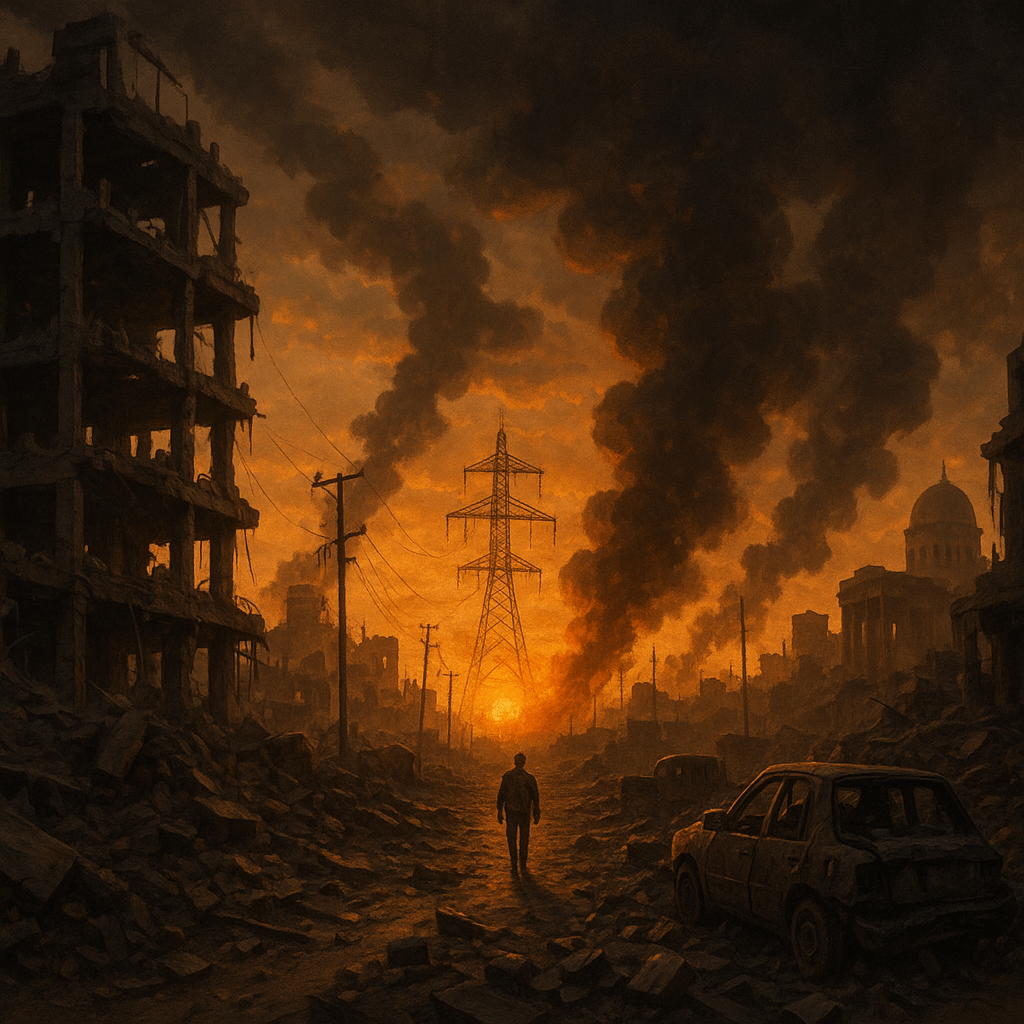
What the West couldn’t destroy with war, it now seeks to own through debt
By Prince Kapone | Weaponized Information | June 25, 2025
They Bombed It, Now They Want to Bill It
On June 25, Euronews ran a headline that would’ve made Joseph Schumpeter blush. The World Bank, we’re told, is returning to Syria with a $146 million electricity project—its first major “investment” since the war began. On the surface, it sounds like progress: power lines being restored, substations rebuilt, maybe even a few light bulbs flickering on in Aleppo. But beneath the polished script of “development,” there’s a much uglier story. Because what this article doesn’t say—what it actively conceals—is that the war wasn’t an accident. It was a strategy. And now the people who lit the match are walking in with fire insurance contracts, asking Syria to pay up.
The byline belongs to Gavin Blackburn, a media functionary whose job is not to investigate power, but to echo it. He’s not a reporter—he’s a translator of empire, channeling the voice of the World Bank in a tone calm enough to make theft sound like charity. And Euronews? That’s not a news outlet. It’s a PR firm in state-media drag, financed through EU partnerships and venture capital from Lisbon to Luxembourg. Its role isn’t to challenge imperialism—it’s to launder it. To wrap IMF austerity in a European accent and call it human rights. To narrate recolonization as if it were recovery. By 2023, 97.6% of Euronews was owned by Alpac Capital, a private equity firm tied to European state-affiliated interests and venture financiers.
The script, of course, has its chorus. The World Bank. USAID. The Gulf Cooperation Council. The Turkish Ministry of Energy. Global contractors sniffing around for fresh markets. They don’t need to be named as beneficiaries—their fingerprints are already on every dollar, every turbine, every bullet that tore through Syria’s grid in the first place.
The propaganda trick here is subtle but deadly. First, they roll out the humanitarian euphemisms: “electricity emergency project,” “affordable energy access,” “resilient infrastructure.” Nowhere does it say this grid was bombed into rubble—bombed by the very alliance now parading in with wires and contracts. Euphemisms like these are not just dishonest. They’re ideological weapons. They erase agency, strip causality, and make colonial violence seem like bad weather.
Second, the article wipes the slate clean. There is no mention of the CIA’s death squads, no word about the armed jihadist proxies, no memory of the chemical lies, the fuel sanctions, the humanitarian embargoes. Syria’s history is treated like a blank chalkboard, so the World Bank can draw its logo on top. The timeline begins not with the war, but with the grant application.
Third, Syria is painted as a patient on the operating table, helpless without Western intervention. There’s no reference to the January 2025 coup. No note that Syria’s new ruler, the man now presiding over this reconstruction package, is a rebranded al-Qaeda commander who used to run with Jabhat al-Nusra. That detail might raise eyebrows—so the article quietly sidesteps it. No questions asked. No power interrogated.
Fourth, the language is abstract by design. We hear about “critical public infrastructure” and “lifeline services,” but we’re never told who owns what. Will these rebuilt grids belong to Syria, or to foreign consortia? Will electricity be a public right, or a metered commodity sold back to the people through IMF pricing models? No one says. And that silence speaks louder than any fact-sheet ever could.
And finally, we get the classic imperial moral framing: the West appears as savior, sweeping in to fix the very country it spent a decade dismembering. It’s the same formula every time. First they break your legs. Then they sell you the crutches. Then they lease you the sidewalk. Syria isn’t being rescued—it’s being repossessed. The war didn’t fail. It succeeded. Because now, the bombs are gone—but the bankers have moved in.
Reconstruction Wrapped in Razor Wire
Strip away the soft development-speak, and the facts are brutally clear. The World Bank has approved $146 million for what it calls the “Syria Electricity Emergency Project.” The project promises to rebuild damaged 400 kV transmission lines, restore transformer substations, and reconnect the grid with Jordan and Türkiye. But this is not a neutral act. These cables aren’t just for electricity—they’re shackles. This isn’t power delivery. It’s power consolidation.
What the article refuses to say is that Syria’s grid didn’t fail on its own. It was dismantled through war—through deliberate bombardment, foreign occupation, and the long siege of sanctions. This was a war waged by NATO states, Gulf monarchies, and Israeli warplanes, with the CIA arming factions that tore apart the Syrian state and splintered its territory. As detailed in WI’s investigation into Trump’s recolonization campaign, the battlefield was never just military—it was financial. The end goal wasn’t victory, but vacuum: to hollow out Syria’s sovereignty and sell off the pieces.
That plan came to a head in early 2025. Assad was forced out—not by revolution, but by a foreign-backed front that installed a repackaged strongman who once led the armed opposition. A regime now dressed in civilian clothing but backed by the same foreign states that tried to destroy the country outright. This is the setting in which the World Bank returns—not as a builder, but as a broker. It arrives not with aid, but with contracts, policy strings, and a business model built on dependency.
The World Bank’s project is not about recovery—it’s about recolonization by wire. These grids are being rebuilt not for Syrian autonomy, but for imperial oversight. Once restored, the infrastructure will be governed, financed, and monitored by a patchwork of foreign holding companies, Gulf-backed financiers, and technocrats trained in the logic of conditionality. This is how chokepoints are built: not just with soldiers, but with circuits and clauses. This is the quiet logic of financial piracy—wreck the house, then lend money for repairs with a deed to the property attached.
Türkiye, for its part, has moved from sponsor to suzerain. Its banks print the money — in northern Syria the Turkish lira has largely replaced the Syrian pound, amounting to a transfer of seigniorage and economic control. Its ministries administer the north — Turkey exercises military and administrative authority via Turkish appointees in local governance structures. Its construction firms are already laying claim to the spoils — Turkish contractors are lining up for a share of Syria’s rebuilding pie since sanctions were eased. Gulf capital is pouring in through public–private partnerships — Qatar and Saudi energy firms are behind major infrastructure investments in post‑Assad Syria. These aren’t recovery deals—they’re asset seizures. One transformer at a time.
And it’s not just Syria. The same playbook is being run across the region. Lebanon, crippled by Israeli aggression and IMF austerity, has been handed $250 million for “lifeline infrastructure.” Iraq, already gutted and sectioned off by decades of U.S. occupation and reconstruction grift, is set to receive $930 million to overhaul its railways. But this isn’t about transport. It’s about control. From Umm Qasr to Mosul, the West is drawing new lines of extraction—steel arteries not for sovereignty, but for logistics domination.
What ties it all together is the myth that this is “development.” It isn’t. It’s discipline. It’s restructuring. It’s imperialism in a hardhat. The World Bank isn’t giving Syria anything—it’s buying it back, with money that never left its vaults. And the price is everything that made the Syrian state sovereign in the first place.
From Dirty War to Debt War: Syria’s Final Subjugation
What’s unfolding in Syria today isn’t reconstruction—it’s recolonization. And the architects of that recolonization aren’t hiding in the shadows. They’re seated at the head tables of Bretton Woods institutions, shaking hands with Gulf sheikhs, Turkish financiers, and American generals. This was never about rebuilding what was lost—it’s about finishing what the bombs began. The proxy war that started in 2011 didn’t end when the guns fell quiet. It metastasized. It put on a suit, picked up a loan agreement, and called itself a “partner in development.”
The January 2025 coup marked a turning point. After years of economic siege, military pressure, and narrative warfare, the U.S. and its allies got what they wanted: regime change on their terms. Bashar al-Assad was ousted, not by a popular uprising, but by a Western-approved proxy front. At its helm is Abu Mohammad al-Jolani, former emir of al-Nusra Front and one-time al-Qaeda commander. His rebranding was no accident. He went from most-wanted terrorist to “security-conscious administrator,” complete with glowing profiles in Western outlets. The same empire that once used him as a tool to destabilize Syria now props him up as a technocrat in training. It’s not a contradiction. It’s continuity.
Jolani’s rule is secured not by popular mandate but by imperial patronage. Türkiye has de facto annexed the north, issuing currency and running schools. The Gulf states bankroll his administration, funneling capital through U.S.-approved NGOs and private equity firms. And the World Bank is back, clutching a $146 million “aid” package that doubles as an economic leash. Infrastructure is the new battlefield. Control the power lines, and you control the people. Control the contracts, and you dictate the policies. This is not postwar recovery—it’s technofascist reconstruction, where every kilowatt comes with a conditionality clause.
Meanwhile, the social foundations of the Syrian state—those hard-won institutions of health, education, and subsidized life—are being dismantled in real time. Reconstruction contracts are going not to Syrian labor collectives or local councils, but to the usual suspects: foreign contractors, Gulf investors, Turkish monopolies, and U.S.-aligned NGOs. The IMF and World Bank aren’t there to help—they’re there to enshrine austerity. Their mission is clear: to render Syria safe for markets and hostile to socialism. The hospitals that survived the airstrikes won’t survive the loan repayment schedules.
Even after rebranding itself as a force for stability, the al-Sharaa/Jolani regime has spiraled into sectarian violence. In March 2025, Alawite-majority coastal areas in Latakia and Tartus witnessed brutal reprisals—over 600 civilians killed, including whole families at checkpoints—documented by independent monitors as part of communal violence by forces aligned with the government. In late April, rare clashes erupted in Jaramana near Damascus, where Druze and Christian neighborhoods experienced armed attacks by regime-affiliated militias, prompting Israel to conduct “warning” airstrikes in defense of the Druze. Reports also warn that minority Christians in Homs, Hama, and the northwest have faced kidnappings and sectarian threats—even as the regime publicly pledges inclusivity— revealing the hollow nature of its “new Syria” claims. This isn’t instability—it’s sectarian terror unleashed by the very mercenary forces the regime backs, exposing the lie of the “new Syria” under construction.
But to grasp the full weight of what’s happening, we must zoom out. Syria was never just a target in isolation—it was a strategic keystone in a much larger imperial gambit. The ultimate goal was, and remains, Iran. Topple Assad, and you break the resistance corridor from Tehran to Beirut. Isolate Iran, and you pave the way for a new regime-change campaign. Cripple Iran, and you undercut the Eurasian integration projects led by Russia and China. This is the logic of imperial recalibration: a multi-front assault, where economic warfare, information control, and strategic fragmentation replace the old boots-on-the-ground model.
The West calls this stability. We call it a financial coup. Where once they sent in drones, now they send consultants. Where once they carpet-bombed cities, now they audit ministries. But the outcome is the same: sovereignty reduced to a spreadsheet. And as imperial decay deepens, the tools of domination only grow more desperate—hybrid warfare, sanctions-as-siege, and the soft dictatorship of technocrats who wear no uniforms but enforce the same orders.
Syria today is not a country recovering—it’s a country under occupation by other means. The war never ended. It just changed form.
Against the Recolonizers: Revolution Is the Only Recovery
No amount of grants, no number of power stations, no chorus of World Bank consultants can disguise what’s really happening in Syria. This isn’t recovery—it’s recolonization by other means. The bombs may have stopped falling, but the war continues through contracts, checkpoints, and conditionalities. The battlefield is no longer Aleppo or Deir ez-Zor—it’s the debt ledger, the procurement office, the energy grid. The enemy wears suits now, speaks in development jargon, and flies in on Gulfstream jets with PowerPoints about “resilience.” But make no mistake: it is the same imperial war. Only the weapons have changed.
And so must the resistance. To fight this phase of recolonization requires a new strategy—one that understands the nature of the enemy and refuses to play by its rules. That means rejecting the legitimacy of the World Bank and IMF altogether. It means exposing the al-Jolani regime as the imperial proxy it is—not the voice of the Syrian people, but the ventriloquist dummy of Washington, Doha, and Ankara. It means calling out so-called “recovery” for what it is: the final act in a counterinsurgency campaign that spans from drone strikes to debt traps.
But it also means more than critique. It means building dual and contending power: grassroots energy collectives that bypass privatized grids, popular councils that reject foreign-managed reconstruction, cross-border solidarity networks that refuse to let Syria be carved up by finance capital. It means defending what remains of Syria’s social infrastructure and working to rebuild it from the bottom up—under the control of the people, not technocrats. And it means mobilizing internationally: demanding cancellation of Syria’s illegitimate debt, exposing the farce of the “post-war” narrative, and standing in active, material solidarity with all anti-imperialist forces resisting recolonization in West Asia and beyond.
The outlines of this resistance already exist. From Iranian supply corridors keeping Syrian hospitals open, to Hezbollah’s defiance of Israeli aggression, to defectors from HTS refusing to serve as imperial puppets—there is a struggle alive in Syria that no World Bank grant can extinguish. The question is whether we in the imperial core will meet that struggle with words, or with action. Whether we will watch as Syria is sold off piece by piece—or whether we will choke off the pipelines of profit that make it possible. Whether we will build with the people, or write eulogies after the fact.
This is not about nostalgia for the past. It’s about fighting for a future that belongs to the people of Syria—not the investors circling like vultures. We do not want a reconstructed Syria under occupation. We want a liberated Syria, rebuilt by its own people, under its own terms. Until then, our task is clear: expose the enemy, stand with the resistance, and prepare for revolutionary rupture.
 Weaponized Information
Leave a comment