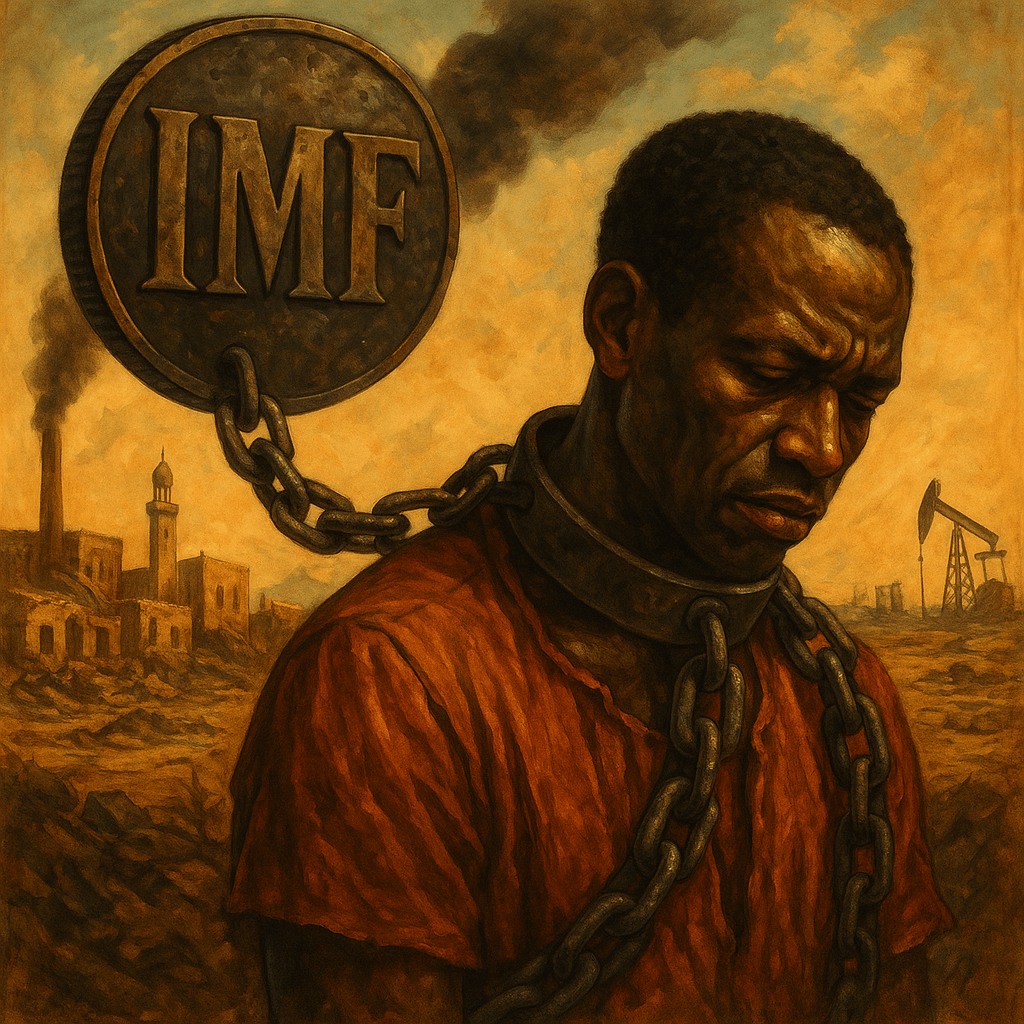
What they call “debt sustainability” is imperial sabotage by spreadsheet—colonial extraction repackaged as fiscal responsibility, and enforced through technofascist obedience.
By Prince Kapone | Weaponized Information | June 25, 2025
Polite Chains and Quiet Crimes: How Financial Journalism Launders Empire
“Senegal’s Debt Burden Reaches Critical Threshold” isn’t just a report—it’s a weapon. Dressed up as economic commentary, this article from MENAFN functions like a press release from the International Monetary Fund itself. No byline, no voice from the streets, no dissenting economists—just technocratic ventriloquism repeating debt-to-GDP ratios like they were the laws of physics. It reads like science, but it smells like empire.
This is the house style of financial propaganda: numb the reader with data, strip the violence of all feeling, and frame imperial domination as a mild fiscal problem. “Debt servicing rose 24%.” “Confidence wavered.” “Grants dwindled.” Not a single actor is named. Who issued these loans? Who’s raking in the interest? Who made the rules that let this happen? The answer is hidden behind a fog of passive voice and sanitized phrases. This is the propaganda of silence—structural theft disguised as spreadsheet turbulence.
The IMF’s fingerprints are everywhere. Edward Gemayel, the Fund’s mission chief to Senegal, is quoted like a neutral doctor offering diagnosis—never as the political enforcer of a global racket. The article never explains why the IMF suspended funding: not because Senegal suddenly forgot how to do math, but because it got caught underreporting debt levels—numbers that were already cooked to satisfy IMF benchmarks in the first place. It’s a manufactured scandal built atop an already manufactured system.
The piece cries crocodile tears about “budget flexibility” and “market confidence,” but it never asks about the cost to actual people. What does this crisis mean for the teacher in Kaolack whose salary was frozen? The hospital in Saint-Louis without enough medicine? The student in Dakar whose scholarship disappeared when subsidy “reforms” kicked in? You won’t find them here. The only protagonists in this story are bondholders, credit agencies, and technocrats trying to salvage their reputations.
Even the hope dangled is a lie. Oil and gas reserves—like the Sangomar field—are presented as a fiscal life raft, never mind that they’re mostly foreign-owned, tax-sheltered, and structurally divorced from the needs of Senegal’s people. It’s the same myth every colonized people has been sold for decades: extract more, export more, borrow more—and someday, maybe, you’ll be free. But that “someday” never comes. Not when the banks write the rules. Not when your currency is pegged to your colonizer’s. Not when sovereignty is a checkbox on a donor compliance form.
This isn’t journalism. It’s camouflage. It’s the kind of article that gets taught in World Bank media trainings as a model of “balanced reporting.” But balance between what? Between the hammer and the nail? Between the IMF and the street vendor crushed under fuel price hikes? No. This is not balance. This is bourgeois consensus masquerading as analysis. It’s the ideological infrastructure of financial warfare—warfare waged not with tanks but with targets, forecasts, and penalties for poor compliance.
In the eyes of MENAFN, Senegal’s crisis is a mistake. A hiccup. A technical error on the road to progress. But for those of us watching from below, it’s the latest chapter in a much longer story: the story of how empire hides its crimes in columns of numbers, and how journalists become clerks for colonial plunder. This is not a debt crisis. It is a sovereignty crisis. And the headlines are part of the heist.
What the Numbers Don’t Say: Colonial Currency, Hidden Rebellions, and IMF Blackmail
Behind every sterile statistic in the MENAFN article lies a truth too dangerous to publish: Senegal is not simply in debt—it is in chains. The real crisis is not fiscal mismanagement or “underreporting.” It’s the neocolonial scaffolding that ensures the nation’s economy can never serve its people. What’s missing from the story is not a decimal point or a growth forecast—it’s the entire structure of imperial rule dressed up in the jargon of economic reform.
The first omission is the CFA franc itself—a colonial currency pegged to the euro, controlled in Paris, and protected by French military treaties. Senegal’s monetary sovereignty is a myth. Every fiscal “target” and debt “threshold” is measured in a currency it does not issue, cannot control, and must earn through exports of raw materials to Europe. This is not integration. It is domination.
Second, the supposed savior—the country’s newly operational oil and gas fields like Sangomar—doesn’t belong to Senegal in any meaningful sense. Woodside Energy, an Australian multinational, has already filed arbitration claims against the Senegalese government to dodge taxes. Profits from extraction will be expatriated through legal loopholes and offshore accounts. And when the wells dry up? Debt will remain.
Third, the IMF’s so-called “suspension” of its financing program is less a penalty for misreporting than it is a strategic act of blackmail. The Fund is not a neutral lender—it is an enforcer. Withholding funds at the precise moment Senegal’s fiscal crisis deepens forces the government to greenlight austerity reforms it cannot otherwise justify. These include slashing fuel subsidies, expanding regressive taxes, and delaying wages—measures the article whitewashes as routine “adjustments.”
None of this is explained. There is no mention of how popular movements across Senegal, especially among youth and street traders, helped propel Ousmane Sonko’s opposition to power with demands for a break from IMF dictates and French financial hegemony. The uprising wasn’t about accounting. It was about liberation. But that struggle is completely erased.
And while MENAFN positions Senegal as a fragile but loyal partner, it refuses to compare the country to its revolutionary neighbors—Mali, Niger, Burkina Faso—who are ejecting French troops, exiting the CFA zone, and building development outside the Western orbit. This contrast matters because it reveals the stakes: Senegal is being held up as a showcase for capitalist “stability” precisely because others chose rupture.
What we are witnessing is not a national financial failure—it is the maintenance of a global system of control. Opaque, technocratic, and enforced through debt, courts, and metrics. The omissions in the article are not oversights. They are cover stories—for empire.
Debt Is a Weapon, Not a Mistake: Reframing Financial Crisis as Class War
The MENAFN article wants you to believe that Senegal’s crisis is a matter of budgetary error—a problem to be solved with better discipline and honest reporting. But the problem is not honesty. It’s power. This crisis was designed. It is the deliberate result of a system that disciplines nations through debt, strips sovereignty with contracts, and uses economics as a weapon of class war.
What is framed as “external assistance” is in truth a coercive tool of imperial control. Senegal’s debt— over 105% of GDP—is not the result of reckless spending, but of foreign lending designed to deepen dependency. These are dollarized loans, governed by creditor courts, and enforced by ratings agencies. The terms are asymmetrical by design: short windows, volatile rates, and extractive repayment conditions that choke any autonomous development before it can start.
The IMF doesn’t offer support—it issues mandates. Fuel subsidies must go. Wages must freeze. Informal workers must be brought into a tax net designed not for redistribution but for repayment. These austerity programs are not “reforms”—they are acts of economic violence, imposed through the illusion of technical expertise. And they are never neutral. They protect creditors, not communities.
Even Senegal’s official development blueprint—SND 2025–2029—is a surrender document in disguise. Built on public-private partnerships, it invites foreign capital in while leaving the working class out. It does not promise sovereignty. It promises “resilience” under conditions of subordination.
And at the core of this system is the CFA franc—not just as colonial legacy, but as modern technofascist infrastructure. It isn’t simply that the currency is printed in France. It’s that it links monetary policy to the dictates of algorithms, capital flows, and remote decision-makers in Brussels and Paris. The CFA doesn’t just preserve dependency. It automates it.
Meanwhile, the rupture emerging in the Sahel is not just a geographic rebellion—it is a class one. When Niger, Mali, and Burkina Faso reject the CFA and IMF mandates, they are rejecting the premise that development must come through obedience. That is what scares the empire most. Not failure, but the threat of success without permission.
In contrast, Senegal is being wired into a financial grid of obedience—algorithmic governance, digitally administered austerity, and foreign-controlled energy infrastructure. This is not development. This is what technofascism looks like in economic form. A future where sovereignty is managed by spreadsheet, and political choices are preemptively foreclosed by debt service schedules.
But resistance is growing. From the lumpen in the markets to the youth on the streets, the people understand: this is not about fiscal discipline—it is about class war. Until Senegal breaks with the IMF, the CFA, and the comprador class that holds the leash, there will be no future worth fighting for. Only managed decline dressed up as reform.
Rupture Is a Two-Way Street: What the Global North Must Learn—and Do
The crisis in Senegal is not a local tragedy—it is a global warning. A template. A mirror. What is being tested in Dakar is the same system used to discipline Argentina, silence Sri Lanka, kneecap Greece, and extract from Detroit. It’s the same machine—just different fronts. The weapons vary: IMF debt in Senegal, municipal bond ratings in Chicago, austerity mandates in London. But the logic is identical. Starve the people. Feed the creditors. Blame the victims. Sell the future.
For revolutionaries, workers, and multipolar forces in the heart of empire, this isn’t charity work. This is counterinsurgency turned inward. The same algorithms that bankrupt Senegal are coming for you—through credit scores, eviction courts, privatized health care, and climate catastrophe priced in futures contracts. This is not about watching the Global South resist. It’s about learning how to fight the same enemy under different masks.
The IMF, the World Bank, and the network of arbitration courts like ICSID are not foreign policy tools—they are class war infrastructures. They don’t just dominate poor countries. They discipline global labor. They maintain Western living standards on stolen wealth, and punish any rupture that threatens that flow. The job of revolutionaries in the imperial core is not just to “stand in solidarity.” It is to sabotage the machine.
That means organizing to dismantle the financial chokeholds within the core: expose the banks that underwrite extraction, resist the tech firms and consultancies engineering debt colonialism, and discredit the media that paints looting as reform. That means calling the IMF what it is: a criminal syndicate with diplomatic immunity. It means rejecting the illusion of “neutral institutions” and seeing them as the enforcers of imperial hierarchy. And it means learning from the periphery—because the Global South has always been the university of resistance.
When Mali, Niger, and Burkina Faso kick out France and tear up IMF contracts, they’re not “radical.” They’re building the world the West only claims to want. A world beyond dollar domination, beyond settler hypocrisy, beyond debt peonage dressed in philanthropic language. It’s up to us, in the belly of the beast, to ensure that multipolarity isn’t just geopolitical—but proletarian. That means confronting our own states, our own banks, our own corporations. If we don’t, we’re not just bystanders. We’re collaborators.
The path forward is not reform. It is rupture. It is building revolutionary internationalism grounded in material solidarity—not NGO hashtags, but sabotage, strikes, expropriation, and ideological war. It means rejecting the liberal lie that “development” must come through exploitation, and instead building systems that prioritize sovereignty, dignity, and survival. If Senegal is being forced to choose between submission and rebellion, so is every worker, every tenant, and every student under this decaying empire.
The only question is which side we’re on. The front is global. The enemy is coordinated. And history is offering a chance to join the break. The time for passive observation is over. From Paris to New York, from London to Dakar, rupture is not only possible—it’s already underway.
 Weaponized Information
Leave a comment