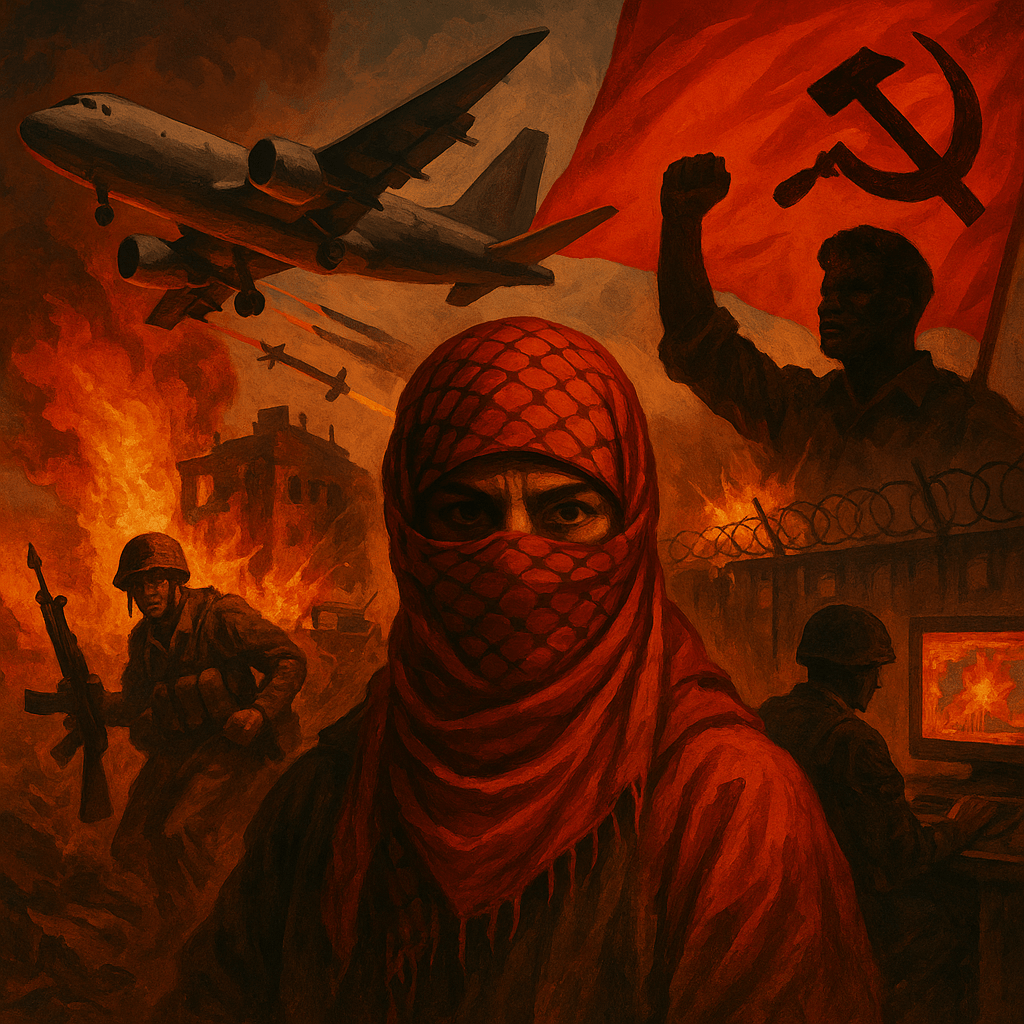
Behind the headlines about Tehran’s “shadow war” lies the real story: a nation surrounded, a region scorched by U.S. bases, and a resistance that won’t kneel. This is not about theology—it’s about sovereignty, imperialism, and the right to exist.
By Prince Kapone | Weaponized Information | June 20, 2025
Empire’s Ink: The Jerusalem Post and the Propaganda of Projection
On October 18, 2024, The Jerusalem Post ran an op-ed by Catherine Perez-Shakdam, a columnist with a checkered past that includes affiliation with neoconservative and Zionist think tanks now repositioned for the Trump 2.0 war doctrine. One of those think tanks—the Foundation for Defense of Democracies (FDD)—is a U.S.-sanctioned war lobby with financial ties to Raytheon and Lockheed Martin. The piece, cloaked in concern about regional instability, paints Iran as a menacing “web-weaver” of militias stretching across the Middle East. But Perez-Shakdam’s prose does more than editorialize—it prepares public consent for escalation. Each sentence serves as ideological air support for imperial maneuver, rebranding U.S.-Israeli militarism as defense and Iranian deterrence as aggression.
The Post, a mouthpiece long intertwined with Israeli state interests, is no stranger to this role. Owned by Eli Azur’s Mirkaei Tikshoret Group—a holding company controlled by investor Eli Azur, with significant stakes across Israeli media, including The Jerusalem Post and Maariv— and backed by lucrative defense contracts tied to the Iron Dome and Arrow 3 missile systems, notably a multi‑billion‑shekel deal between the Israel Ministry of Defense and Israel Aerospace Industries to boost Arrow 3 production— it functions not as a press institution but as a fully integrated node of the Imperialist Media Apparatus. This is journalism as logistics—a factory for manufacturing consent.
The core propaganda technique is misdirection by omission. Perez-Shakdam opens by lamenting “Iranian hegemony” without disclosing a single U.S. or Israeli base in the region. She names militias but not the foreign invasions that spawned them. She mentions missile ranges but not occupation footprints. What she offers is not analysis but theater: a villain without a map, a threat without context, a spiderweb without a jar.
Second, the piece deploys moral equivalency to obscure causality. By flattening all armed actors into “terror proxies,” it erases the historical distinction between invading armies and resistance forces. Hezbollah’s birth in 1982, Iraq’s PMF rise in 2014, and the Houthi mobilization after 2015 aren’t accidents—they’re responses to occupation, bombardment, and siege. But none of that fits Perez-Shakdam’s frame. Her canvas can’t contain imperial footprints, only Iranian shadows.
Third, the Post article normalizes nuclear apartheid. It invokes Iran’s uranium stockpile—verified by the IAEA as non-weaponized—but ignores Israel’s uninspected arsenal of an estimated 90 nuclear warheads. As documented in the 2023 SIPRI Yearbook, chapter 7 (World Nuclear Forces), these weapons are mounted on Jericho III missiles capable of striking Tehran in minutes. But in the Post’s rendering, Israel’s bombs are invisible and Iran’s centrifuges apocalyptic.
Fourth, the column invokes regional “destabilization” without identifying the destabilizer. From Syria to Yemen, it is U.S. and Israeli airpower, not Iranian militias, that has turned cities to rubble. The United Nations, Amnesty International, and Human Rights Watch have all documented U.S.-backed Saudi bombings of hospitals, schools, and homes in Yemen. Yet these atrocities never penetrate the Post’s editorial filter. In the imperial playbook, only the colonized can commit violence.
Fifth, the op-ed reproduces the Orientalist tropes that Edward Said warned of decades ago—casting Iran as a monolithic, irrational “Persian menace” animated by mystical zealotry. This move is not simply rhetorical. It dehumanizes an entire population, setting the stage for war crimes by legitimizing them as civilizational self-defense. It is Cognitive Warfare at its most insidious: soft power preparing the terrain for hard war.
Finally, the article erases geography itself. It speaks of “encirclement” by Iran while ignoring the 19 U.S. military sites currently active in the region. Not one Iranian soldier sits in a foreign capital. But this isn’t about facts. It’s about narrative management—one that renders empire invisible and every act of resistance as unprovoked aggression.
Those who benefit from this framing need not be named in the text. The gears of the imperial machine are already turning. Carrier groups move toward the Red Sea. Congress whispers of authorization. Contracts are inked for more interceptors. And the American public, softened by stories of menace, is nudged one headline closer to war. All of this aligns with CENTCOM’s 2025 strategic posture update and AIPAC’s lobbying agenda for an expanded $14 billion weapons package.
What looks like journalism is really the first salvo in a war of perception. Catherine Perez-Shakdam isn’t just writing an op-ed—she’s setting the coordinates. And if we fail to expose this script for what it is, the next missile won’t just be metaphorical.
The Real Encirclement: A Pentagon Ring, Not a Persian Web
Flip the map, comrades, and the picture snaps into focus. Iran is not the spider; it is the fly inside a Pentagon jar. The United States operates an archipelago of at least nineteen active military sites across the Middle East and Central Asia—eight of them acknowledged as permanent bases by the Council on Foreign Relations. Reuters tallies roughly 40,000 forward-deployed U.S. troops policing these installations. Al Udeid in Qatar is the largest U.S. air base on Earth outside the homeland; Al Dhafra in the UAE hosts F-35s and drone fleets; Bahrain’s 5th Fleet HQ commands every destroyer that stalks the Persian Gulf. Shift west and you meet Union III in Baghdad’s Green Zone and Erbil Air Base in Iraqi Kurdistan—visible reminders that the 2003 invasion never really ended. Tehran, by contrast, hosts exactly zero foreign garrisons.
These military installations don’t exist in a vacuum. They represent a hardened form of Militarized Imperialism—an imperial model not of territorial conquest, but of permanent siege and saturation. U.S. base infrastructure frequently maps over former British colonial garrisons, updating 19th-century gunboat diplomacy with drone surveillance and stealth bombers. What was once carried by redcoats is now flown in by Lockheed.
Layer on top of that the region’s only undeclared nuclear power. Israel—subsidized by $3.8 billion in annual U.S. aid—maintains an estimated 90 operational nuclear warheads, with capacity for many more, according to the 2025 SIPRI Yearbook. Those warheads sit on Jericho-III missiles capable of reaching Tehran in minutes, yet they never appear in Perez-Shakdam’s ledger of “regional threats.” The Jerusalem Post’s sleight of hand is complete: the finger on the trigger is invisible; the target is framed as the gunman.
What the column dismisses as Iran’s “peripheral militias” are, in material fact, fire brigades raised in the ruins of U.S. and Israeli interventions. Hezbollah emerged to resist Israel’s 1982 invasion of Lebanon. Iraq’s Popular Mobilization Forces coalesced in 2014 when ISIS—spawned in the vacuum left by the U.S. occupation—blitzed Mosul. Yemen’s Houthis armed in earnest only after a U.S.-backed Saudi-UAE coalition began carpet-bombing Sana’a in 2015. These movements did not rise from some Persian master plan; they rose from the craters imperial airstrikes left behind.
Meanwhile, Washington’s own “proxy archipelago” enjoys a press pass. Saudi F-15s refueled by the U.S. Air Force drop JDAMs on weddings; Emirati commandos trained by ex-Navy SEALs seize ports along the Red Sea; Kurdish SDF units serve as rent-a-grunts whenever CENTCOM wants a raid without body bags. Influence by way of arms, cash, and ISR feeds—by the Post’s own metric—renders the Gulf monarchies de facto divisions of U.S. Central Command.
On June 13, 2025, Israel launched Operation Rising Lion—a coordinated assault on over 100 Iranian targets across Isfahan, Tehran, and Natanz. According to Reuters, the Tehran Forensic Medicine Organization reports 217 civilians were killed. Iranian engineering brigades assessed over $380 million in damaged infrastructure. This assault exposes the Chokepoint logic of imperial encirclement: U.S. bases in Qatar and Bahrain enabled real-time targeting data flow to Israeli jets via CENTCOM’s Falcon Horizon system, turning occupied territory into a kill switch.
All of this is best understood not as a normal military presence, but as a hallmark of Hyper-Imperialism—a decadent stage of U.S. domination characterized by forward-deployed chaos, military overstretch, and spasmodic counterforce to shrinking legitimacy—exemplified by Israel’s June 13 assault on Iran, which killed 217 civilians per Tehran’s forensic report while destroying $380 million in infrastructure according to independent assessments.
Encirclement by Siege: Sanctions, Sabotage, and the Stranglehold on Sovereignty
If the tanks mark the perimeter, the banks tighten the noose. Beyond the Pentagon’s hardware lies a quieter but equally devastating campaign: economic siege. Iran remains trapped in one of the most suffocating sanctions regimes on earth—a textbook case of sanctions architecture as imperial warfare. Since the 1979 revolution, but especially since 2006, Washington has constructed a financial blockade targeting Iran’s oil exports, banks, shipping sector, and foreign reserves. Under Trump 2.0, this siege has intensified into hybrid strangulation—denying food, medicine, and trade even when not explicitly sanctioned. It is not just policy—it is warfare through paperwork.
The human cost is staggering. As reported by Human Rights Watch and a BMJ Global Health study, Iran’s healthcare sector has been hollowed out—its hospitals unable to import cancer drugs, dialysis kits, or even PPE during the early COVID-19 wave. According to the International Monetary Fund, Iran has lost well over $100 billion in oil revenue since 2018. These are not collateral effects. They are intentional outcomes of what scholars now call financial piracy—imperial looting administered through legalese, SWIFT locks, and Treasury decrees.
But those lemons didn’t fall far enough. When sanctions break down as tools of control, empire reaches for the bomb. This dynamic is laid bare in recent kinetic escalation—precisely the pattern expected when sanctions fail and U.S.-backed strikes pick up the baton.
Iran has attempted to break free. Its accession to BRICS+ in August 2024 secured yuan-denominated oil sales and barter channels with Russia and China—small cracks in the dollar’s chokehold. Yet those cracks remain boxed in by physical and financial chokepoints: the U.S. 5th Fleet stalks the Strait of Hormuz, and SWIFT-clearing remains U.S.-controlled. Those are choke points where capital becomes leverage.
Meanwhile, the ongoing blockade of Yemen has created a humanitarian abyss—23,811 cholera deaths according to the World Health Organization and 85,000 child starvation fatalities as estimated by Save the Children—underlining what critics call necro-extractivism, where Arab bodies lubricate petrodollar flows and imperial logistics.
The Jerusalem Post op-ed makes no mention of this siege. It speaks of Iran “destabilizing the region,” while ignoring how many children die for lack of medicine. It decries “Iranian expansionism,” while praising Israeli drone assassinations and Mossad sabotage teams inside Tehran. It frames Hezbollah, the PMF, and the Houthis as “proxies,” never acknowledging that each arose from the very chaos unleashed by imperial war. These forces are not Iranian puppets—they are formations of local resistance engaged in asymmetric survival.
Hezbollah, for example, isn’t simply a militia. It operates a nationwide network of schools, clinics, and charities that reaches hundreds of thousands of Lebanese people—services the U.S.-backed Lebanese state has failed to provide (Brookings, 2006). This is not just counter-force; it is counter-power. In the language of revolutionary praxis, these are embryonic expressions of dual and contending power—institutions that grow in the shell of the old and defy the logic of dependency.
To reduce them to sectarian pawns is both Orientalist and ahistorical. It assumes that colonized people cannot act independently, cannot build, cannot lead. But history shows otherwise. From the Viet Minh to the Sandinistas to the ANC, the oppressed have always found ways to organize—even under blockades and bombs.
The tragedy is that much of the Western left continues to look for purity instead of principle. They ask whether the resistance is secular enough, democratic enough, Western enough. They critique the theocracy in Tehran but remain silent about Riyadh’s beheadings, Tel Aviv’s apartheid, or Washington’s drone wars. This isn’t internationalism—it’s ideological cowardice.
Real solidarity begins with naming the contradiction. Iran is not a socialist state. But it is a nation asserting its right to survive in a world built to destroy it. And the resistance movements it supports—however uneven, contradictory, or flawed—are fighting battles that we in the imperial core will soon have to fight ourselves. If we don’t learn from them, we will perish in isolation.
With the Encircled, Not the Empire: Organizing from the Heart of the Beast
We stand with the resistance. Without hesitation, without apology, and without illusions. In a world where the U.S. empire and its Zionist junior partner bomb hospitals, sanction food and medicine, arm apartheid, and wage proxy wars across the Global South, our allegiance lies not with “strategic interests” or bipartisan consensus—it lies with those struggling to breathe under siege. The so-called “Axis of Resistance”—from Hezbollah’s defiant stand in southern Lebanon, to the Popular Mobilization Forces resisting U.S. occupation in Iraq, to the Houthis confronting Saudi, Emirati, and Israeli aggression from Sanaa—does not need our permission to exist. It needs our solidarity.
That solidarity is not symbolic. It is material. It begins by rejecting the language of empire—refusing to call liberation movements “terrorists,” refusing to parrot propaganda that paints Iran as an aggressor while ignoring the dozens of U.S. military bases ringing its borders. It continues by naming imperialism as the principal global threat—not theological militias but high-tech militaries; not religious fanaticism but Financial Piracy enforced by drones, banks, and embargoes. And it culminates in direct acts of defiance—organizing, educating, disrupting, and building alliances that weaken the empire from within.
Historically, the U.S. antiwar movement has failed to consistently align with the resistance forces fighting back. During the Iraq invasion, there was outrage—but not enough action. During Israel’s repeated assaults on Gaza, there were demonstrations—but little follow-through. Today, with Trump 2.0 escalating confrontation with Iran, and Zionist atrocities normalized across media and policy, we must do better. Our line must be clear: every base is a battlefield, every sanction a weapon, and every resistance force a front in our global struggle.
There are practical things we can do now, starting with our own terrain:
- Expose the Imperialist Media Apparatus by launching propaganda campaigns that target key outlets like the New York Times, Reuters, and Jerusalem Post for their role in cognitive warfare.
- Organize radical education—teach-ins, study circles, and reading groups that connect the siege of Gaza to the siege of Tehran, and both to the occupation of Turtle Island. These are different fronts of the same global war.
- Support Médecins Sans Frontières clinics in Yemen, or solidarity fundraisers for Iranian families impacted by sanctions. Material aid is resistance, not charity.
- Launch divestment campaigns targeting weapons manufacturers like Lockheed, Raytheon, and Boeing. Leverage local pension boards, campus endowments, and union funds to cut off the war economy at the root. Apply Financial Piracy logic in reverse—drain capital from the machine.
- Coordinate disruption campaigns against U.S. military logistics. Dockworkers in Yemen have already shown the way by refusing to load arms shipments. We must bring that same clarity to ports in Oakland, New Jersey, Savannah, and beyond.
- Center diasporic leadership from Arab, Iranian, and Muslim working-class organizers already embedded in these struggles. Build alliances rooted in trust, not saviorism.
We must also invest in revolutionary infrastructure. That means building media, networks, and cadre that can agitate, educate, and organize beyond spontaneous outrage. As Guerrilla Intellectuals, we must weaponize study as preparation, not retreat—arming the movement with clarity and coherence when confusion is mass-produced.
It also means naming the full scope of imperial violence. Saudi airstrikes have left entire regions of Yemen in ruin, where cholera and famine thrive not by accident, but by design. This is Necro-Extractivism—where death itself becomes a condition of profit and imperial control.
We affirm: to stand with Iran is not to endorse its internal policies. It is to stand against encirclement, blockade, and war. It is to defend the right of a nation under siege to breathe, trade, and live. It is to affirm the principle of Anti-Imperialist Sovereignty—even when its bearers are contradictory, imperfect, or unfamiliar to Western paradigms.
Comrades: this war is not looming. It is here. It is waged through finance, famine, narrative, and noise. The frontlines are not just in the Gulf—they are in our ports, our universities, our budgets, and our ideologies. Let the empire have its lobbyists. We’ll take the partisans. Let them celebrate domination—we will organize liberation. And when the smoke clears, it will be the resistance that remains.
 Weaponized Information
Leave a comment